Automatic Irrigation System using IoT
R. Pushpa Jothi ,C. Saravanakumar , M. ArunMSc, Electronics and Communication Systems ABSTRACT
Climate change and rainfall has been erratic over the past few decades. Due to this in recent era, climatesmart methods called as smart agriculture is adopted by many Indian farmers. Smart agriculture is an automated and directed information technology implemented with IOT (Internet of Things). IOT is developing rapidly and widely applied in all wireless environments. For this, it is done using remote sensing, microprocessors, IoT, DBMS is proposed. The major objective is to get the real-time data and reduce the water that is lost in the irrigation process and reduce the time spent on the field.
Keywords : Internet of Things, Android Development Tools, integrated development environment, TYPO3, MODx, Joomla, WordPress, phpBB, MyBB, Drupal
I.
INTRODUCTIONAs the world is trending into modern technologies and implementations it is a necessary goal to trend up in agriculture also. Many researches are working in the field of agriculture. Most projects signify the use of wireless sensor network collect data from different sensors deployed at various nodes and send it through the wireless protocol. The collected data provide the information about the various environmental factors. Monitoring the environmental factors is not the complete solution to increase the yield of crops. There are number of other factors that decrease the productivity to a greater extent. Hence automation must be implemented in irrigating fields to overcome these problems. So, to provide solution to all such problems, it is necessary to develop an integrated system which will take care of watering the crops. But complete automation in irrigation is not achieved due to various issues. Though it is implemented in the research level it is not given to the farmers as a product to get benefitted from the resources. Hence this paper deals about Automatic Irrigation System using IoT.
II.
LITERATURE SURVEYtemperature from various location of farm and as per the need of crop controller to take the decision whether the irrigation is enabled or not.[6]It proposes an idea about how automated irrigation system was developed to optimize water use for agricultural crops. In addition, a gateway unit handles sensor information.[7]The atmospheric conditions are monitored and controlled online by using Ethernet IEEE 802.3.The partial root zone drying process can be implemented to a maximum extent.[8]It is designed for IoT based monitoring system to analyze crop environment and the method to improve the efficiency of decision making by analyzing harvest statistics.[9]In this paper image processing is used as a tool to monitor the diseases on fruits during farming, right from plantation to harvesting. The variations are seen in color, texture and morphology. [10]In this paper, greenhouse is a building in which plants are grown in closed environment. It is used to maintain the optimal conditions of the environment, greenhouse management and data acquisition.
III.
PROPOSED WORKIn the field section, sensors are deployed in the field like soil moisture. The data collected from these sensors are sent to the Database via the android application.
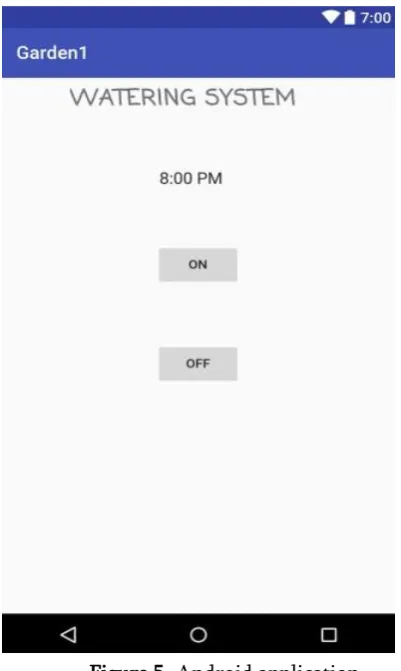
In control section, the system is turned on using the application, this is done using the on\off buttons in the application. Also, this system is turned on automatically when the moisture of the soil is low, the pump is turned on and depending on the moisture content. The application has a future feature of taking the time from the user and irrigate the field when the time comes.
In manual mode, there is a manual switch in the field to make sure that if the system fails, one can turn off the water supply manually.
Other parameters like the moisture sensor shows the threshold value and the water level in the soil.
IV.
HARDWARE USEDArduino Uno-MICROCONTROLLER:
The Arduino Uno is one of the most popular microcontrollers in the industry. It is user convenient and easier to handle. The coding or programming of this controller is also easy. The program is deemed volatile due to the flash memory technology. The microcontroller has wide range of applications used in many huge industries. It is used in security, remote sensors, home appliances and industrial automations. The device has capabilities to be connected the internet and act as a server too, this way the handling of information and data.
Figure 1. Arduino Uno
V.
ARCHITECTURESOIL MOISTURE SENSOR
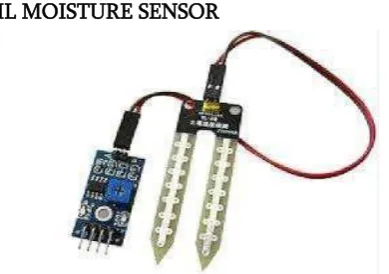
Figure 3. Soil Moisture Sensor
Soil moisture sensor is a sensor which senses the moisture content of the soil. The sensor has both the analogue and the digital output. The digital output is fixed and the analogue output threshold can be varied. It works on the principle of open and short circuit. The output is high or low indicated by the LED. When the soil is dry, the current will not pass through it and so it will act as open circuit. Hence the output is said to be maximum. When the soil is wet, the current will pass from one terminal to the other and the circuit is said to be short and the output will be zero.
The sensor is platinum coated to make the efficiency high. The range of sensing is also high. It is anti-rust and so the sensor has long life which will afford the farmer at a minimum cost.
ESP8266
Figure 4. ESP8266(Wi-fi Module)
The ESP 8266 is a low cost wi-fi module which is used for interne interfacing for microprocessors. The ESP 8266 has a 64 KiB of instruction RAM and 96 KiB of data RAM.
SOFTWARE USED
• Arduino CC(IDE): -The Arduino IDE is a software which is used for coding for all Arduino boards. This application compiles your code before uploading to the Arduino board to find errors. In this IDE, we use basic embedded C. Also, one may need to create their own header files to carry out certain operations. This helps to increase the functionality.
• Android Studio: - Android Studio is the official integrated development environment (IDE) for Google's Android operating system, built on JetBrains' IntelliJ IDEA software and designed specifically for Android development. It is available for download on Windows, macOS and Linux based operating systems. It is a replacement for the Eclipse Android Development Tools (ADT) as primary IDE for native Android application development. • MySQL: - MySQL is a central component of the
LAMP open-source web application software stack (and other "AMP" stacks). LAMP is an acronym for "Linux, Apache, MySQL, Perl/PHP/Python". Applications that use the MySQL database include: TYPO3, MODx, Joomla, WordPress, phpBB, MyBB, and Drupal. MySQL is also used in many high-profile, large-scale websites, including Google (though not for searches), Facebook, Twitter, Flickr, and YouTube.
EXPERIMENTATION & RESULTS
Figure 5. Android application
VI.
FUTURE WORK & CONCLUSION
For future developments, it can be enhanced by developing this system for large acres of land. Also, the system can be integrated to check the quality of the soil and the growth of crop in each soil. The sensors and microcontroller are successfully interfaced and wireless communication is achieved between various nodes. Also, the system can be further improved by adding machine learning algorithms, which are able to learn and understand the requirements of the crop, this would help the field be an automatic system. The observations and results tell us that this solution can be implemented for reduction of water loss and reduce the man power required for a field.
VII.
REFERENCES
[1]. K. Lakshmisudha, Swathi Hegde, Neha Kale, Shruti Iyer, "Smart Precision Based Agriculture
[2]. International Journal of Computer Applications (0975-8887), Volume 146-No.11, July 2011 [3]. Nikesh Gondchawar, Dr. R.S. Kawitkar, "IoT
Based Smart Agriculture", International Journal of Advanced Research in Computer and Communication Engineering (IJARCCE), Vol.5, Issue 6, June 2016.
[4]. M.K. Gayatri, J. Jayasakthi, Dr.G.S. Anandhamala,
[5]. "Providing Smart Agriculture Solutions to Farmers for Better Yielding Using IoT", IEEE International Conference on Technological Innovations in ICT for Agriculture and Rural Development (TIAR 2015).
[6]. Chetan Dwarkani M, Ganesh Ram R, Jagannathan S, R. Priyatharshini, "Smart Farming System Using Sensors for Agricultural Task Automation", IEEE International Conference on Technological Innovations in ICT for Agriculture and Rural Development (TIAR 2015).
[7]. S. R. Nandurkar, V. R. Thool, R. C. Thool, "Design and Development of Precision Agriculture System Using Wireless Sensor Network", IEEE International Conference on Automation, Control, Energy and Systems (ACES), 2014.
[8]. Joaquin Gutiérrez, Juan Francisco Villa-Medina,
[9]. Alejandra Nieto-Garibay, and Miguel angel Porta-Gandara, "Automated Irrigation System Using a Wireless Sensor Network and GPRS Module", IEEE Transactions on Instrumentation and Measurements, 0018-9456,2013
[10]. 13Dr. V. Vidya Devi, G. Meena Kumari, "Real- Time Automation and Monitoring System for Modernized Agriculture", International Journal of Review and Research in Applied Sciences and Engineering (IJRRASE) Vol3 No.1. PP 7-12, 2013.
IEEE 16th International Conference on Computational Science and Engineering, 2013. [12]. Monika Jhuria, Ashwani Kumar, Rushikesh
Borse, "Image Processing for Smart Farming: Detection of Disease and Fruit Grading", IEEE Second International Conference on Image Information Processing (ICIIP), 2013.
[13]. Orazio Mirabella and Michele Brischetto, "A Hybrid Wired/Wireless Networking Infrastructure for a.Greenhouse Management", IEEE Transactions on Instrumentation and Measurement, vol. 60, no. 2, pp 398407, 2011. [14]. C. Liu, W. Ren, B. Zhang, and C. Lv, "The
application of soil temperature measurement by lm35 temperature sensors," International Conference on Electronic and Mechanical Engineering and Information Technology, vol. 88, no. 1, pp. 1825– 1828, 2011
[15]. D.D. Chaudhary1, S.P. Nayse2, L.M. Waghmare,"Application of wireless sensor networks for greenhouse parameter control in precision agriculture", International Journal of Wireless & Mobile Networks (IJWMN) Vol. 3, No. 1, February 2011.
[16]. Q. Wang, A. Terzis and A. Szalay, "A Novel Soil a.Measuring Wireless Sensor Network", IEEE Transactions on Instrumentation and Measurement, pp. 412–415, 2010
[17]. Ji-woong Lee, Changsun Shin, Hyun Yoe," An Implementation of Paprika Greenhouse System Using Wireless Sensor Networks", International Journal of Smart Home Vol.4, No.3, July 2010. [18]. Mahesh M. Galgalikar, "Real-Time
Automization Of Agricultural Environment for Social Modernization of Indian Agricultural System", 978- 1-424455867/10/$26.00 C 2010 IEEE.
[19]. Y. Song, J. Wang, X. Qiao, W. Zheng, and X. Zhang, "Development of multi-functional soil temperature measuring instrument," Journal of Agricul- tural Mechanization Research, vol. 9, no. 1, pp. 80–84, 2010
[20]. A.R. Sepaskhah, S.H. Ahmadi, "A review on partial rootzone drying irrigation. International Journal of Plant Production", October 2010. [21]. Terry Howell, Steve Evett, Susan