Original Research Article
Traditional beliefs and practices in newborn care among mothers in a
tertiary care centre in Dehradun, Uttarakhand, India
Akhil Bangari
1, Sunil Kumar Thapliyal
1*, Ruchi
2, Bindu Aggarwal
1, Utkarsh Sharma
1INTRODUCTION
India is one of the vast countries with extraordinary characteristics and diversity in terms of its geographical, linguistic, religious, social-cultural features. Different culture has different beliefs, values and practices. They play an important role in medical attention - seeking behavior among mother and family members when it comes to taking care of newborn. Some of the practices are harmful to the health of newborns and mother. Though all over the world emphasis is being laid out to bring down the neonatal mortality but it has not come
down to desired levels, especially in developing countries. The average neonatal mortality rate in developing countries is much higher than that prevalent in developed countries.1 Approximately two thirds of the children less than 1 year of age die during neonatal period, thus reflecting vulnerability of neonates.2,3 Most of the deaths occur outside the health care facility or within 24 hours of admission (because of delay in seeking proper health care). In appropriate neonatal care practices has been cited as an important contributor to high mortality levels and drew attention towards improving newborn care globally.4-6 When any
ABSTRACT
Background: Neonatal care practices are different in different communities. Before any intervention planned to reduce mortality and mortality in community, understanding of local belief and practices is necessary. Some of the harmful practices need to be abandoned and good or harmless practices need to be appreciated. This study was conducted to understand the cultural beliefs and practices in newborn care among residents of Uttarakhand.
Methods: This was descriptive, cross-sectional study carried out among 300 postnatal mothers admitted to the hospital. The data was collected using self-administered questionnaires. Statistical analyses of the data was done using SSPS version 22.0.
Results: 4% of the mothers believed colostrum to be unsuitable for the newborn. 71% mothers were practicing daily baby massage. 71.3% believed that hot and cold foods can harm their baby‟s health. 57.3% practiced application of Kajal on baby‟s face. 74.7% of mothers would keep Knife under pillow and 16.7% match box under baby‟s cloth. 5.3% mother believed in practice of branding. 81% of mothers accept to practice of pouring oil in baby‟s ear. 22.3% mothers believed in isolating mother baby together for 30-40 days.
Conclusions: Certain practices are still prevalent like Branding, discarding colostrum, Kajal application, pouring oil in baby‟s ear and very restricted dietary regime of mothers. These practices need to be stopped by educating mothers and relatives in postnatal wards.
Keywords: Belief, Culture, Colostrum, Branding, New born care
1
Department of Pediatrics, Shri Guru Ram Rai Institute of Medical and Health Sciences, Patel Nagar, Dehradun, Uttarakhand, India
2Department of Community Medicine, Government Doon Medical College, Patel Nagar, Dehradun, Uttarakhand, India
Received: 28 March 2019
Accepted: 09 May 2019
*Correspondence:
Dr. Sunil Kumar Thapliyal, E-mail: [email protected]
Copyright: © the author(s), publisher and licensee Medip Academy. This is an open-access article distributed under the terms of the Creative Commons Attribution Non-Commercial License, which permits unrestricted non-commercial use, distribution, and reproduction in any medium, provided the original work is properly cited.
intervention is planned towards a community it is very important to understand the prevalent belief and practices otherwise the intervention may not get accepted by the community. This type of study has never been conducted in Uttarakhand. And understanding of community practices is important before planning any effective behavioral change strategies.
Aims and objectives
To find out the cultural beliefs and practices in newborn care among residents of Uttarakhand.
METHODS
This was a cross-sectional study conducted using self-administered semi-structured questionnaire. The study was conducted in Postnatal wards of Shri Mahant Indresh Hospital, Patel Nagar, Dehradun, Uttarakhand. 300 postpartum mothers were recruited for the purpose of this study between January 2017 to August 2017.
Inclusion criteria
Inclusion criteria were postpartum mothers delivered in SMIH (Shri Mahant Indresh Hospital) or mothers delivered outside but admitted in SMIH during study period; post-partum mothers who gave consent to voluntarily participate in our study.
Exclusion criteria
Exclusion criteria were post-partum mothers who declined to give consent to participate in the study.
Data collection
The participants were briefed about the study purpose, objectives, benefits and informed consent was obtained from each participant. The data was collected by interview method from all the eligible subjects willing to participate in the study by one time contact, within first three days of post-partum period by using semi-structured questionnaire.
Confidentiality was maintained at all levels of study.
Data analysis
All the data collected by questionnaire were entered in SPSS version 22 software (Statistical Package of social Sciences). Statistical analysis of the data was done using SPSS version 22. Categorical data was expressed in frequency and percentage. The graphs were formed using Microsoft Excel version 16.
RESULTS
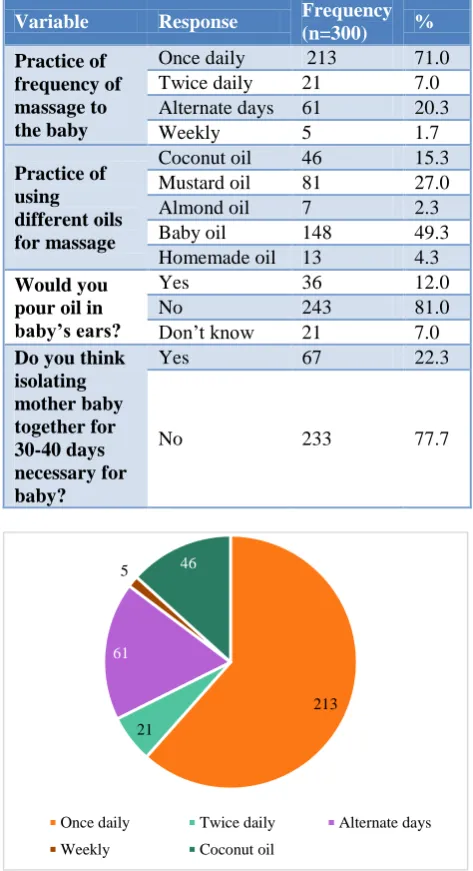
Out of 300 mothers, 71% mothers responded that massage should be done daily once followed by 20% who
believed that it should be done on alternate days. 49% mothers said baby oil is best for massaging (advertisement) followed by 27% who said mustard oil is best as advised by grandparents. 12% mothers believed in pouring oil in their baby‟s ears. Moreover, 22.3% mothers thought that mother and baby together should be isolated for 30-40 days (Table 1).
Table 1: Distribution of mothers as per their cultural beliefs and practices regarding baby massage and
mother-baby isolation.
Variable Response Frequency
(n=300) %
Practice of frequency of massage to the baby
Once daily 213 71.0 Twice daily 21 7.0 Alternate days 61 20.3
Weekly 5 1.7
Practice of using different oils for massage
Coconut oil 46 15.3 Mustard oil 81 27.0
Almond oil 7 2.3
Baby oil 148 49.3
Homemade oil 13 4.3
Would you pour oil in baby’s ears?
Yes 36 12.0
No 243 81.0
Don‟t know 21 7.0
Do you think isolating mother baby together for 30-40 days necessary for baby?
Yes 67 22.3
No 233 77.7
Figure 1: Distribution of practice of frequency of baby massage.
More than 2/3rd of the mothers practiced daily massage to their baby, 20% alternate day massage, 7% twice daily and 1.7% weekly massage (Figure 1).
About half of the mothers applied baby oil to their baby, while rest half used to apply either coconut or mustard
213
21 61
5 46
Once daily Twice daily Alternate days
oil. 2.3% used almond oil for baby massage while 4.3% used home made oil (Figure 2).
Figure 2: Distribution of practice of using different oils for massage.
Table 2: Distribution of mothers as per their cultural beliefs and practices regarding kajal application, baby
clothes and others.
Variable Response Frequency
(n=300) %
Is there any need of applying kajal?
Yes 172 57.3
No 128 42.7
Do you think applying kajal over forehead/behind ears will help baby?
Yes 210 70.0
No 90 30.0
Would you keep a knife under baby’s pillow?
Yes 224 74.7
No 76 25.3
Would you keep matchbox under baby’s cloth?
Yes 50 16.7
No 250 83.3
Would you rub dough on to your baby’s skin?
Yes 61 20.3
No 239 79.7
Would you ever put hot iron needles/rods over baby’s
abdomen?
Yes 16 5.3
No 284 94.7
Do you think certain hot and cold foods in your diet could harm your baby?
Yes 214 71.3
No 20 6.7
Don't
know 66 22.0
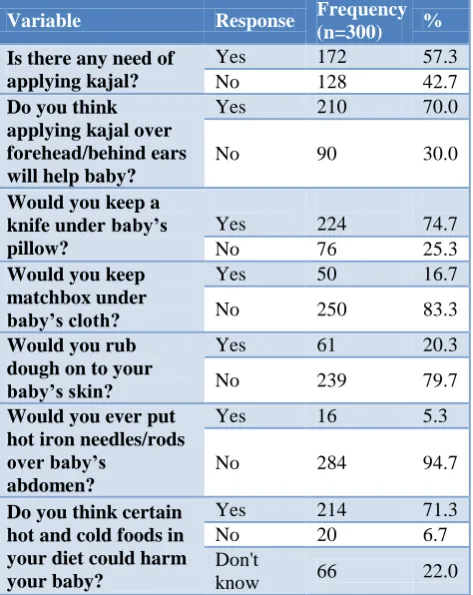
57.3% mothers believe in applying kajal to the eyes of baby.70% mothers believed in applying kajal over forehead/behind ears will help baby. 74.7% mothers said that they practice keeping a knife under the baby‟s pillow. 16.7% mothers believed in keeping matchbox under their baby‟s cloth. 20.3% of the mothers used to rub dough on their baby‟s skin. 5.3% mothers believed in putting hot iron needles/rods over baby‟s abdomen for
treatment. 71.3% mothers believed that certain hot and cold foods in your diet could harm their baby (Table 2).
DISCUSSION
India is one of the vast countries with extraordinary characteristics and diversity in terms of its geographical, linguistic, religious, social-cultural features and practices. Some of the practices are harmful to the health of newborns and mother. When any intervention is planned towards a community it is very important to understand the prevalent belief and practices otherwise the intervention may not get accepted by the community.
The study investigated traditional baby care practices of mother in Uttarakhand (India).
Altung et al reported that 84.5% of the participant stated that they valued traditional practice to varying degrees; another study reported that 70% women consider traditional practices to varying degrees.7,8 When these practices are followed, it relives their mental stress and makes them more socially acceptable.
Our study revealed that out of 300 postnatal mothers interviewed, 96% of the mother were giving initial milk (colostrums), this is a new development against old practice of discarding the milk produced in early days after delivery. This finding is contradictory to previous Indian study where strong cultural belief hampered the use of colostrums.9 Nethra et al reported in north Karnataka, 15.5% percent of mothers were discarding the colostrums this finding was similar to one reported by Reshma et al.10,11 Khan et al reported 41% of mother giving colostrum to their newborn.12 Ganjoo et al reported that 57% of mothers believed that colostrum to be unhygienic and did not give it to their baby.13
Practice of massage to the baby daily was reported by 71% of the mother. And majority (40.3%) were using the commercial (as per advertisement) baby oil, while 27.3% were using mustard oil. Only 15.3% mother were using coconut oil. Sashikala et al reported 79.4% used oil message before bath.14 Nethra et al revealed that 87% of them massaged their newborn with oil.10 Reshma et al reported 92% mother massage baby with oil before bath.11 According to Shankarnarayanan et al, coconut oil massage resulted in significantly greater weight velocity.15
71.3% of mothers believe that hot and cold foods could harm their baby and their health. This concept of hot and cold food is not related to the temperature of food when served or eaten but to the food itself. A particular food is considered hot in one culture and cold in other culture. Benakappa et al reported "Hot" and "Cold" food concept.16 Hot foods mean those that produce heat in the body and cold foods are those that cause colds (running nose, cough, etc.). Chicken (36%), brinjal (20%), mutton and jaggery (14%) were considered "hot" by the majority. 46
81
7 148
13
Coconut oil Mustard oil Almond oil
Fish, papaya and beet root too were also considered to be "hot". Curds (92.65%), butter milk (91%), bananas, lemon juice and other citrus fruits were considered to be "cold ". Study by Cacodcar et al revealed that 62.54% of the mothers had strong beliefs in “hot” and “cold” foods such as mangoes, meat, eggs as they were believed to generate excessive body heat.17 Altung et al reported 97.9% of women had dietary restriction in puerperium period.7 Catherin et alreported that few mothers opined that warm water consumed by the mother caused the baby to have more prominent veins, which was unattractive and hence they preferred to consume cool water.18 These beliefs put unnecessary restriction in diet of mother.
57.3% of women believed that applying kajal to newborn baby on eyes or behind the ear, is essential. And 70% of the women believed it helps newborn baby to remain healthy. Sasikala et al reported that 84% of the participant applied kajal on face of newborn to prevent from evils eye,14 which was similar to one reported by Reshma et al (82%).11 Cacodcar et al reported that 39.08% of the mothers applied kajal to the baby's eye to ward off evil.17 However, its application to the eyes can cause conjunctivitis and dacrocystitis, and finger nail trauma to the eye can also occur.19 Other child rearing practices observed by Cacodcar et al were tying black thread around the neck and waist of the baby and amulets to ward off evil (97.72%).17 Khan et al in his study at Aligarh reported that kajal was applied by 97% of mother on baby‟s.12
Akkamamba reported 93.9% of mothers are practising kajal application to eyes.20
In our study 74.7% would keep knife under newborns pillow and 16.7% of mother would match box under babys cloth. It keeps them healthy and prevents the baby away from ill effects of djinn, Ghosts. Sunanda and Paul in their study in Mangalore reported that 65% of the women keep a stick, a broomstick, or metal rod under their bed.21 Shakya reported that to save the mother and baby from evil eyes, tools like bamboo or a sickle are placed near the pillow.22 Premji et al reported that A knife (or some form of iron) is kept near the baby at all times to Protects the young baby from ghosts.23
Branding is a traditional practice of making „therapeutic‟ burns with hot iron rods over the skin for treatment of various diseases. It is a harmful practice for the health which causes serious morbidity and is also leads to delay seeking proper medical care. It is being used for various illnesses including physiologic jaundice in newborns, pneumonia, and convulsions. 5.3% of the mothers reported believed in this practice. Branding has been reported by Bastug et al.24 A law has been enacted by the Indian government for this issue and it has been criminalized because this practice is common in rural areas of India.25
81% of the women believed in pouring oil in baby‟s ear. Nethra et al reported that 75% of the mother practices
pouring oil into the ears of the newborn because they believe ears will get closed otherwise.10
22.3% mother believed that isolating mother and baby for 30 to 40 days is necessary for the baby. The importance of puerperium is significant in all cultures.
CONCLUSION
Cultural practices are passed on from generation to generation. They are a part of our society, hence more respectable and deeply rooted. This study showed that in spite of governments effort to educate mothers and community regarding newborn care, traditional beliefs and practices are still prevalent. Certain practices are harmful which need to be stopped. Certain other practices are harmless, by acknowledging and agreeing to these practices, Medical professionals can build a good rapport with mothers and family, so that necessary desired behavior changes in family can be brought out.
The medical professionals should be aware of the cultural practices followed in the community to provide culturally appropriate integrated care as it is more acceptable by the society.
ACKNOWLEDGEMENTS
The authors are indebted to the mothers who participated in the study.
Funding: No funding sources Conflict of interest: None declared
Ethical approval: The study was approved by the Institutional Ethics Committee
REFERENCES
1. Bhutta ZA, Darmstadt GL, Hasan BS, Haws RA. Community based intervention for imp;roving perinatal and neonatal health outcomes in developing countries; a review of evidence. Pediatrics. 2005;115( Suppl 2):519-617.
2. Lawn JE, Cousens S, Zupan J. Lancet Neonatal survival steering Team. $ million neonatal deaths; when ? where? Why? Lancet. 2008;365;891-900. 3. Lawn JE, Kinney MV, Black RE; et al; newborn
survival; a multi – country analysis of a decade of change. Health Policy Plan. 2010;27;1116-28. 4. Bhutta ZA. Bridging the equity gap in maternal and
child health. BMJ. 2005;331;585-6.
5. Darmstadt GL, Bhutta ZA, Cousens S, Adam T, Walker N, de Bernis L, et al. Evidence – based, cost effective interventions; how many newborn babys we can save? Lancet. 2005;365;977-88.
7. Altuntuğ K, Anık Y, Ege E. Traditional Practices of Mothers in the Postpartum Period:Evidence from Turkey. African J Reprod Health. 2018;22(1):94-102.
8. Karabulutlu O. Determining of the traditional practices at postpartum period which is applied to maintenance of infant in Kars. DEUHYO ED. 2014;7(4):295-302.
9. Ekambaram M, Bhat VB, Ahamed MAP. Knowledge, attitude and practice of breasting among postnatal mothers. Current Pediatr Res. 2010;14 (2):119-24.
10. Nethra N, Udgiri R. A study on traditional beliefs and practices in newborn care among mothers in a tertiary health care centre in Vijayapura, North Karnataka: Int J Community Med Public Health. 2018;5(3):1035-40.
11. Reshma, Sujatha R. Cultural practices and beliefs on newborn care among mothers in a selected hospital of Mangalore taluk. Nitte University J Health Sci. 2014;4(2):21-6.
12. Khan MH, Khalique N, Khan R, Ahmad A. Good and harmful neonatal practices among pregnant women in periurban area of Aligarh. Int J Med Sci Public Health. 2013;2(3):553-7.
13. Ganjoo C, Rowlands R. Breastfeeding and weaning practices of urban housewives in Srinagar. Indian J Nutr Diet. 1988;25(11):354-8.
14. Sasikala P, Jyothi C, Chandershekhar V, Kumar C, Bhashkar S. A study on traditional beliefs and practices in newborn care among Women attending UHTC, NMC, Nellore A.P. National J Res Community Med. 2017;6(2):120-4.
15. Shankaranarayanan K, Mondkar JA, Chauhan MM, Mascarenhas BM, Mainkar AR, Salvi RY. Oil massage in neonates: an open randomized controlled study of coconut versus mineral oil. Indian Pediatr. 2005;42:877-84.
16. Benakappa AD, Shivamurthy P. Beliefs regarding diet during childhood illness. Indian J Community Med. 2012;37(1):20-4.
17. Cacodcar J. A Cross-Sectional Study on Child Rearing Practices in Rural Goa. JKIMSU. 2015;4(4):192.
18. Catherin N, Rock B, Roger V, Ankita C, Ashish G, Delwin P, et al. Beliefs and practices regarding nutrition during pregnancy and lactation in a rural area in Karnataka, India: a qualitative study. Int J Community Med Public Health. 2015;2(2):116-20. 19. Vaishnav R. An example of the toxic potential of
traditional eye cosmetics. Indian J Pharmacol. 2001;33:46-8.
20. Akkamamba B, Padmanalini P, Sunil S. Impact of health education on the knowledge of mothers on newborn care practices- A study done in a tertiary care centre. J Evolution Med Dent Sci. 2017;6(82):5778-82.
21. Sunanda B, Paul S. a study on cultural practices of postnatal mothers in selected hospitals at mangalore. Nitte University J Health Sci. 2103;3(3):43-8. 22. Shakya BK. Cultural practices during postnatal
period in Tamang community in Bhaktapur district of Nepal. J Nepal Health Res Council. 2006;4(2):1-6.
23. Premji S, Khowaja S, Mehrali S, Forgeron R. Sociocultural influences on newborn health in the first 6 weeks of life: qualitative study in a fishing village in Karachi, Pakistan. BMC Pregnancy Childbirth. 2014;14:232.
24. Baştuğ O, Korkmaz L, Korkut S, Halis H, Güneş T, Kurtoğlu S. A harmful traditional practice in newborns with adrenocorticotropic hormone resistance syndrome: branding. Turk Pediatri Ars. 2016;51(4):224–7.
25. Mehta MH, Anand JS, Mehta L, Modha HC, Patel RV. Neonatal branding-towards branding eradication. Indian Pediatr. 1992;29:788–9.