Original Research Article
Study of knowledge, attitude and practice among nurses regarding
needle stick and sharp item injuries
Sonia
1, Sukhbir Singh
2*, Brijender Singh
2, Satpal Singh
3, Anil Khurana
3, Ramesh Verma
4INTRODUCTION
A needle stick injury (NSI) is defined as an accidental skin-penetrating stab wound from a hollow-bore needle (or any sharp) containing another person’s blood or body fluid. Sharp injury (SI) is defined as a skin-penetrating stab wound caused by sharp instruments & accidents in a medical setting.1
Needle stick injuries are an important occupational hazard for nursing personnel as they form an important mechanism for transmission of blood borne pathogens. Health care professionals are exposed to variety of dangers like infections, cuts and needle stick injuries,
exposure to anaesthetic gases, radiations, dermatitis causing substances, vaccines serum etc. This study focuses on issues related to some of these risks & possible ways and means on how to overcome these risks. Hence the knowledge of nurses about the prevention & management of needle stick injuries and practicing standard precautions is critical.2
According to World Health Report (WHR) 2002, out of 35 million healthcare workers (HCWs), 2 million experience percutaneous exposure to infectious diseases each year. It further notes that 37.6% of hepatitis B, 39% of hepatitis C and 4.4% human immunodeficiency virus (HIV)/AIDS among HCWs around the world are due to NSIs globally. NSIs are the most common source of
ABSTRACT
Background: Needle stick injuries are an important occupational hazard for nursing personnel as they form an important mechanism for transmission of blood borne pathogens. A needle stick injury (NSI) is defined as an accidental skin-penetrating stab wound from a hollow-bore needle (or any sharp) containing another person’s blood or body fluid. Sharp injury (SI) is defined as a skin-penetrating stab wound caused by sharp instruments & accidents in a medical setting.
Methods: The study is hospital based cross-sectional descriptive in PGIMS Rohtak. The study was designed towards achievement of all objectives.The study was carried out from 14 June 2016 to 13 August 2016.
Results: Majority (6%) of sample were in the age group of 20-25 years and (31%) in age group of 26-30 years. Majority of sample (98.5%) were female. Majority of sample (90%) were GNM, (6.5%) were B.Sc Nursing, (1.5%) was M.sc Nursing. Majority of sample (91.5%) were married.
Conclusions: The study identified the presence of suboptimal practices that put both staff nurses and patients at significant risk of contracting occupational infections.
Keywords: Knowledge, Attitude, Practice, Needle stick injury
1
DCRUST, Murthal, Sonepat, Haryana, India
2Department of Hospital Administration, 4Department of Community Medicine, PGIMS, Rohtak, Haryana, India 3Department of Management Studies, DCRUST, Murthal, Haryana, India
Received: 08 February 2019 Revised: 16 March 2019 Accepted: 18 March 2019
*Correspondence: Dr. Sukhbir Singh,
E-mail: [email protected]
Copyright: © the author(s), publisher and licensee Medip Academy. This is an open-access article distributed under the terms of the Creative Commons Attribution Non-Commercial License, which permits unrestricted non-commercial use, distribution, and reproduction in any medium, provided the original work is properly cited.
occupational exposure to blood and the primary cause of blood-borne infections of HCWs in India, around 3-6 billion infections are given per year, of which two-third infections are unsafe (62.9%) and the use of glass syringe is constantly associated with a higher degree of unsafeness.3
Nurses are persons working in health care setting & they are potentially exposed to infectious material such as blood, tissue, specific body fluids, medical supplies, equipment or environmental surfaces contaminated with these substances. They are frequently exposed to occupational hazards through percutaneous injury such as needle stick or cut with sharps, contact with the mucous membrane of eyes or mouth of an infected person, contact with non-intact skin exposed with blood or other potentially infectious body fluids. That’s why this study was planned in a tertiary care institute of Haryana with the aim to assessment of knowledge, attitude and practice among nurses regarding needle stick & sharp item injuries in a tertiary care institute Pt. B D Sharma PGIMS, Rohtak.
Objectives
To assess the level of knowledge, attitude and practice among nurses regarding needle stick and sharp injuries in Pt. B. D. S. PGIMS, Rohtak.
METHODS
Study design
The study was hospital based cross-sectional descriptive in PGIMS Rohtak. The study was designed towards achievement of all objectives.
Study area
The study was carried out in PT. BD Sharma, PGIMS, and Rohtak from 14 June 2016 to 13 August 2016.
Study population
The study population consisted of Staff Nurses who came into contact with patients, or were potentially exposed to body fluids from patients while attending to or handling samples from patients.
Study tool
Questionnaire was adopted and developed with modification from related study– occupational needle stick and sharps injuries among hospital healthcare workers in Bale Zone, Southeast Ethiopia.
RESULTS
Table 1 showed that a total of 200 nurses were included in the main study. The description of demographic
characteristics was included in term of age, sex, qualification, marital status, place of posting, experience.
Table 1: Detail of nursing staff.
Total staff nurses posted
Subjects taken
Hospital area
Medicine ward 50 24 Surgery ward 54 27 Obst and gynae ward 56 26 SOT complex ward 23 11 Paediatrics ward 35 17 A & E ward 59 29 Orthopaedics ward 18 9 Chest and TB ward 13 7
ENT ward 7 3
Eye ward 9 4
Super speciality block
Cardiology ward 6 2
CTVS ward 7 5
Urology ward 7 4 Nephrology ward 14 7
BPS ward 14 7
Intensive care unit
CTVS ward 12 5
Cardio ward 6 2
A+E ward 16 8
Ward 25 ICCU 8 4
Total 414 200
Table 2 showed that majority (6%) of sample were in the age group of 20-25 years, (31%) in age group of 26-30 years, (19%) in age group of 31-35 years, (8.5%) in age group of 36-40 years, (5.5%) in age group of 41-45 years, (7.5%) in age group of 46-50 years, (7.5%) in age group of 51-55 years, (15%) in age group of 56-61 years. Majority of sample (98.5%) were female and (1.5%) were male. Majority of sample (90%) were GNM, (6.5%) were B.Sc Nursing, (1.5%) was M.sc Nursing. Majority of sample (91.5%) were married & (8.5%) were unmarried. Majority of sample (31%) have 1-5 years of experience, (31%) have 6-10 years of experience, (1.5%) have 11-15 years of experience, (5%) have 16-20 years of experience, (4.5%) have 21-25 years of experience, (13%) have 26-30 years of experience, (7.5%) have 31-35 years of experience, (10%) have 36-40 years of experience.
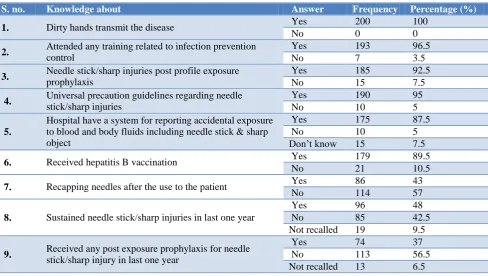
received Hepatitis B vaccination. Majority (48%) of sample have sustained needle stick/sharp injuries in last one year, minority (42.5) of sample have not that & not recalled (9.5%) of sample also have not that. Majority (56.5%) of sample have not received any post exposure prophylaxis for needle stick/sharp injury in last one year
and majority (99%) of sample were discarding the needle/sharp immediately after using on the patient, minority (1%) of sample didn’t that. Majority (58%) of sample have not any accidental spillage blood/body fluid on the body.
Table 2: Demographic characteristics of study subjects (n=200).
S. no. Characteristics Demographic variables Frequency Percentage (%)
1. Age (in years)
20-25 12 6
26-30 62 31
31-35 38 19
36-40 17 8.5
41-45 11 5.5
46-50 15 7.5
51-55 15 7.5
56-61 30 15
2. Sex Male 3 1.5
Female 197 98.5
3. Qualification
GNM 180 90
B. Sc nursing 13 6.5
M. Sc nursing 3 1.5
4. Marital status Married 183 91.5
Unmarried 17 8.5
5. Experience (years)
1-5 62 31
6-10 62 31
11-15 3 1.5
16-20 10 5
21-25 9 4.5
26-30 26 13
31-35 15 7.5
36-40 13 6.5
Table 3: Assessment of level of knowledge, attitude, and practice among staff nurses (n=200).
S. no. Knowledge about Answer Frequency Percentage (%)
1. Dirty hands transmit the disease Yes 200 100
No 0 0
2. Attended any training related to infection prevention control
Yes 193 96.5
No 7 3.5
3. Needle stick/sharp injuries post profile exposure prophylaxis
Yes 185 92.5 No 15 7.5
4. Universal precaution guidelines regarding needle stick/sharp injuries
Yes 190 95
No 10 5
5.
Hospital have a system for reporting accidental exposure to blood and body fluids including needle stick & sharp object
Yes 175 87.5
No 10 5
Don’t know 15 7.5
6. Received hepatitis B vaccination Yes 179 89.5 No 21 10.5
7. Recapping needles after the use to the patient Yes 86 43 No 114 57
8. Sustained needle stick/sharp injuries in last one year
Yes 96 48 No 85 42.5 Not recalled 19 9.5
9. Received any post exposure prophylaxis for needle stick/sharp injury in last one year
Sr. No. Knowledge about Answer Frequency Percentage (%)
10. Discarding needles/ sharp immediately after using on patient in your hospital
Yes 198 99
No 2 1
11. Any medicine for post exposure prophylaxis of needle stick/sharp injury available in your hospital or ward
Yes 166 83 No 23 11.5 Not known 11 5.5
12. Any accidental spillage blood/body fluid on your body Yes 84 42 No 116 58
DISCUSSION
Majority (6%) of sample were in the age group of 20-25 years, (31%) in age group of 26-30 years, (19%) in age group of 31-35 years, (8.5%) in age group of 36-40 years, (5.5%) in age group of 41-45 years, (7.5%) in age group of 46-50 years, (7.5%) in age group of 51-55 years, (15%) in age group of 56-61 years. In the study subject maximum (90%) subjects were GNM, (6.5%) were B. Sc Nursing, (1.5%) was M.sc Nursing. Majority of subjects (31%) had 1-5 years of experience, 31% subjects had 6-10 years of experience, 1.5% had 11-15 years of experience, 13% had 26-30 years of experience and 10% had 36-40 years of experience. All subjects said that dirty hands transmitted the disease. Majority (96.5%) of sample had attained training related to infection prevention and control. Majority (92.5%) of sample knew about needle stick/sharp injuries post exposure prophylaxis treatment but 7.5% of samples were not aware. Jaber et aland Salekar et al reported the similar observations.4,5
Majority (95%) of subjects knew about universal precaution guidelines regarding needle stick/sharp injuries while 5% of subjects were not aware. Majority (87.5%) of sample knew about hospital have a system for reporting accidental exposure to blood & body fluids including needle stick & sharp object. Parbhu quoted the similar results.6 Majority (89.5%) of sample had received Hepatitis B vaccination, few (10.5%) of sample had not received the vaccine. Nearly half (57%) of subjects were not recapping the needle after the using to patient and 43% of subjects had knowledge. Majority (48%) of sample had sustained needle stick/sharp injuries in last one year. 56.5% of sample had not received any post exposure prophylaxis for needle stick/sharp injury in last one year. Maximum (99%) of sample were discarding the needle/sharp immediately after using on the patient in hospital. 83% subjects knew the medicines for post exposure prophylaxis of needle stick/sharp injury available in hospital or ward. 58% of sample had not any accidental spillage blood/body fluid on the body. Parbhu et al and Guruprasad et al revealed the similar observations.6,7
CONCLUSION
The needle recapping was key modifiable risk behavior. The study identified the presence of suboptimal practices
that put both staff nurses and patients at significant risk of contracting occupational infections.
Recommendations
The healthcare authorities should arrange training for staff nurses. Health policy makers and hospital administrators should formulate strategies to improve the working condition for staff nurses and increase their adherence to universal precautions. Furthermore, regular reporting, follow up and evaluation of occupational injury exposures need to be introduced. Follow up study is needed to determine the actual incidence of NSSI exposure and to which type disease staff nurses are exposed.
Limitations
The study was limited to staff nurses at single hospital.
The study was limited to 200 staff nurses only.
ACKNOWLEDGEMENTS
The Questionnaire was adopted and developed with modification from related study– occupational needle stick and sharps injuries among hospital healthcare workers in Bale Zone, Southeast Ethiopia.
Funding: No funding sources Conflict of interest: None declared
Ethical approval: The study was approved by the Institutional Ethics Committee
REFERENCES
1. Pavithran VK, Murali R, Krishna M, Shamala A, Yalamalli M, Kumar AV. Knowledge, attitude, and practice of needle stick and sharps injuries among dental professionals of Bangalore, India. J Int Soc Prev Community Dent. 2015;5(5):406-12.
2. American Nurses Association – Independent Study Module Needle stick Safety and Prevention Available at: www.who.int/occupational_health/ activities/1anaism.pdf. Accessed on 2 February 2019.
4. Jaber MA. A survey of needle sticks and other sharp injuries among dental undergraduate students. Int J Infect Control. 2011;7:1–10.
5. Salekar S, Motghare DD, Kulkarni MS, Vaz FS. Study of needle stick among health care workers at a tertiary care hospital. Indian J Public Health. 2010;54:18–20.
6. Prabhu A, Rao AP, Reddy R, Sugumaran K, Mohan G, Ahamed S. Needle safety awareness among dental nurses. Workplace Health Saf. 2014;62:243– 8.
7. Guruprasad Y, Chauhan DS. Knowledge, attitude, and practice regarding risk of HIV infection through accidental needlestick injuries among dental students of Raichur, India. Natl J Maxillofac Surg. 2011;2:152–5.