Original Research Article
Causes of head injury in Dr. Hasan Sadikin General Hospital
Bandung in 2015
Tan Rongkai
1, M. Zafrullah Arifin
2*
, Ihrul Prianza Prajitno
3INTRODUCTION
Head injury (HI) is usually defined as injuries affecting the brain, scalp, skull, maxilla and mandible and special senses of smell, vision and hearing. Depending on the extent of the head trauma, head injuries are also commonly referred to as brain injury or traumatic brain injury (TBI).1
Patients with traumatic HI have a 10-fold higher mortality than in those without traumatic HI. Moreover, HI takes up two-thirds of in-hospital trauma deaths.2 According to The Global Burden Disease (GBD) 2004 Summary Tables by Health Statistics and Informatics
Department, World Health Organization, Geneva, Switzerland, the prevalence of HI worldwide is 17670 thousands, for Africa Region is 1647 thousands, for the region of the Americas is 2074 thousands, for Eastern Mediterranean region is 2150 thousands, for Europe region is 2412 thousands, for South East Asia Region is 4459 thousands, and for Western Pacific region is 4486 thousands.3 It shows that prevalence of HI in South East Asia region is one of the highest globally.3
According to the epidemiology of HI by Jennett in the Journal of Neurology, Neurosurgery, and Psychiatry 1996, road traffic accidents (RTAs), falls, and assaults are the primary causes of HI. However, there is a considerable variation on causes of HI from place to
ABSTRACT
Background: The study aimed to describe the causes of head injury (HI) in Rumah Sakit Hasan Sadikin Bandung with the considerations of gender, age and the severity of HI.
Methods: This was a descriptive retrospective study. The study subjects were HI patients in Department of Neurosurgery of Dr. Hasan Sadikin General Hospital Bandung in 2015. Consecutive sampling was used with minimum sample size of 97 patients. The variables of the study were patients’ characteristics, causes of head injury,
and types of road traffic accidents in HI patients.The data were collected from medical records.
Results: Roadtraffic accidents (RTAs) contributed to 70.3% mild HI, 77.2% moderate HI, and 100% severe HI and it was the highest cause of HI (73%). Two-wheelers motor vehicle contributed to 62.5% mild HI, 75% moderate HI, and 66.7 severe HI and it was the highest cause of RTAs (68%). Majority of the HI patients were male (57%). The highest number of HI was 18-45 years old.
Conclusions: RTAs is the main mechanism of HI, while two-wheelers motor vehicle is the main cause of RTAs.
Keywords: Head injury, Patients, Road traffic accidents
1
Faculty of Medicine, Universitas Padjadjaran, Jatinangor, Sumedang, West Java, Indonesia
2
Department of Neurosurgery, Faculty of Medicine, Universitas Padjadjaran/Dr. Hasan Sadikin General Hospital, Bandung, West Java, Indonesia
3Department of Anatomy and Cell Biology, Faculty of Medicine, Universitas Padjadjaran, Jatinangor, Sumedang, West
Java, Indonesia
Received: 31 August 2019
Revised: 05 October 2019
Accepted: 07 October 2019
*Correspondence:
Dr. M. Zafrullah Arifin,
E-mail: [email protected]
Copyright: © the author(s), publisher and licensee Medip Academy. This is an open-access article distributed under the terms of the Creative Commons Attribution Non-Commercial License, which permits unrestricted non-commercial use, distribution, and reproduction in any medium, provided the original work is properly cited.
place.The distribution of causes also changes remarkably according to gender, age, and severity of injury.4
In this study, Glasgow coma scale (GCS) is chose to classify the severity of head injuries in this research study. This is because GCS is used throughout the world to monitor patients’ conscious level, which is the global index of brain function. GCS is used in terms of three easily-measured variables as the eye opening response, the best motor response in the upper limbs, and the verbal response.5
HIs are significant cause of mortality, thus are crucial health problem worldwide that cannot be neglected.6 Therefore, the aim of this study is to describe the causes of HI in Dr. Hasan Sadikin General Hospital Bandung with the considerations of gender, age and the severity of HI. Theoretically, this will provide us with the information and knowledge about the causes of HI. Practically, this can create society’s awareness on the causes of HI, help the future researchers to design preventative interventions based on the causes of HI to reduce the number of HI and contribute in upcoming study.
METHODS
The method used in this study was a descriptive retrospective method. The study subjects were HI patients who were treated in the Department of Neurosurgery of
Dr. Hasan Sadikin General Hospital Bandung with the inclusion criteria of admission period from 1st January 2015 to 31st December 2015. The exclusion criteria including incomplete or lost data of medical record on patient’s age, gender, date of admission, Glasgow coma scale (GCS) score, diagnosis and cause of HI. In this study, causes of HIother than road traffic accidents (RTAs), assault and falls are not included. The types of RTAs other than bicycle, two-wheelers motor vehicle, three-wheelers motor vehicle, four-wheelers motor vehicle (car, jeep, van, bus and truck), and pedestrians are also not included in this study. Data collection began on
September to November 2015 with a consecutive sampling method, where the minimum sample size required in this study were 97 patients. The minimum sample size was calculated based on the formula for descriptive quantitative study. The study was conducted in Department of Neurosurgery of Dr. Hasan Sadikin General Hospital Bandung.
The variables in this study were patients’ characteristics (gender, age, and GCS score), causes of HI, and types of road traffic accidents in HI patients. Causes of HI included road traffic accidents, falls, and assault. The types of road traffic accidents in HI patients included bicycle, two-wheelers motor vehicle, three-wheelers motor vehicle, four-wheelers motor vehicle (car, jeep, van, bus and truck), and pedestrians.
Data were collected retrospectively from the medical record of the patients with HI who were treated in the Department of Neurosurgery of Dr. Hasan Sadikin General Hospital Bandung, in the period of 1st January 2015-31st December 2015 after the letter of ethics and research permit were released. After the data were collected, the data were recorded and tabulated. The data collected are private and confidential. The obtained data were presented in the form of tables with frequencies. Descriptions of the data were carried out by counting the required totals and percentages of data using Microsoft Excel 2007.
RESULTS
159 data was collected but 8 of them did not fulfil the inclusion criteria which leads to 151 data in total. This had fulfilled the minimum sample size criteria for this study.
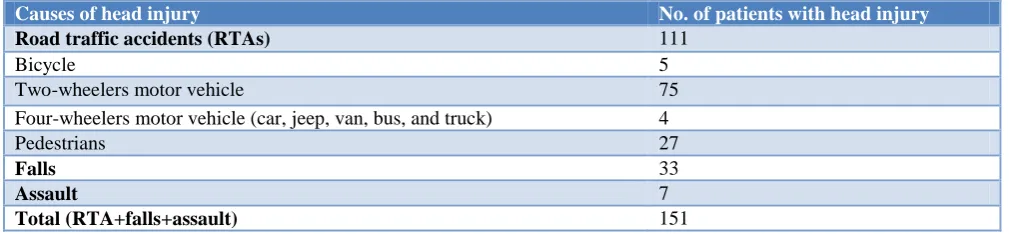
Road traffic accidents (RTAs) was the highest cause of HI (73%), followed by falls (22%). The lowest cause of HI was assault (5%). In this study, two-wheelers motor vehicle was the highest cause of road traffic accidents in HI patients (68%) (Table 1).
Table 1: Number of patients with head injury based on the causes of head injury.
Causes of head injury No. of patients with head injury
Road traffic accidents (RTAs) 111
Bicycle 5
Two-wheelers motor vehicle 75
Four-wheelers motor vehicle (car, jeep, van, bus, and truck) 4
Pedestrians 27
Falls 33
Assault 7
Total (RTA+falls+assault) 151
In this study, majority of the HI patients were male (78%). Female only took up to 22% of all HI patients. In male and female, road traffic accidents was the highest
Table 2: Causes of head injury based on gender.
Gender
Causes of head injury
Road traffic accidents (RTAs) Falls Assault Total
Male 87 24 7 118
Female 24 9 0 33
Table 3: Causes of road traffic accidents based on gender.
Gender
Road traffic accidents (RTAs)
Total
Bicycle Two-wheelers motor vehicle
Four-wheelers motor vehicle (car, jeep, van, bus, and truck)
Pedestrians
Male 2 63 4 18 87
Female 3 12 0 9 24
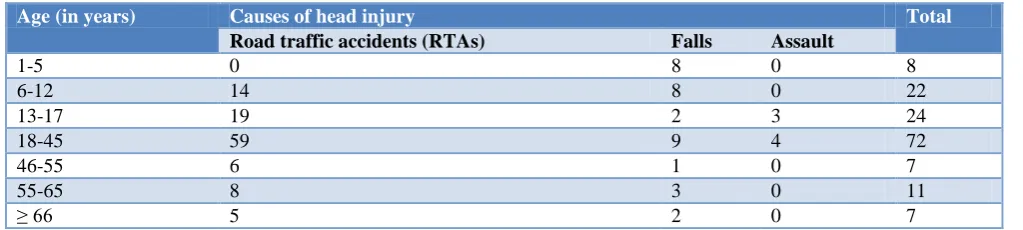
Table 4: Causes of head injury based on age.
Age (in years) Causes of head injury Total
Road traffic accidents (RTAs) Falls Assault
1-5 0 8 0 8
6-12 14 8 0 22
13-17 19 2 3 24
18-45 59 9 4 72
46-55 6 1 0 7
55-65 8 3 0 11
≥ 66 5 2 0 7
In male and female patients, road traffic accidents due to two-wheelers motor vehicle was the highest (72.4% for male, 50% for female) (Table 3).
The age range that had the highest number of HI caused by road traffic accidents, falls and assault was 18-45 years old (53.2% for RTAs, 15% for falls, and 57.1% for assault). Therefore, the age range of 18-45 years old had the highest number of HI patients in this study (Table 4).
The age range that had the highest number of road traffic accidents due to bicycle was 6-12 years old (80%), while the age range that had the highest number of road traffic accidents due to two-wheelers motor vehicle, four-wheelers motor vehicle (car, jeep, van, bus, and truck) and pedestrians was 18-45 years old (64% for two-wheelers motor vehicle, 75% for four-two-wheelers motor vehicle, and 29.6% for pedestrians) (Table 5).
Table 5: Causes of road traffic accidents based on age.
Age (in years)
Road traffic accidents (RTAs)
Total
Bicycle Two-wheelers motor vehicle
Four-wheelers motor vehicle (car, jeep, van, bus and truck)
Pedestrians
6-12 4 3 0 7 14
13-17 1 16 0 2 19
18-45 0 48 3 8 59
46-55 0 4 0 2 6
55-65 0 2 1 5 8
≥ 66 0 2 0 3 5
Table 6: Causes of head injury based on Glasgow coma scale.
Glasgow coma scale (GCS)
Causes of head injury
Total
RTAs Falls Assault
13-15 (Mild head injury) 64 23 4 91
9-12 (Moderate head injury) 44 10 3 57
Table 7: Causes of road traffic accidents based on Glasgow coma scale.
Glasgow coma scale
Road traffic accidents
Total
Bicycle Two-wheelers motor vehicle
Four-wheelers motor vehicle (car, jeep, van, bus, and truck)
Pedestrians
13-15 (Mild head injury) 4 40 3 17 64
9-12 (Moderate head injury) 1 33 1 9 44
3-8 (Severe head injury) 0 2 0 1 3
In mild, moderate and severe HI, the highest cause of HI was road traffic accidents (70.3% for mild HI, 77.2% for moderate injury and 100% for severe HI) (Table 6).
In mild, moderate and severe HI, the highest cause of road traffic accidents was two-wheelers motor vehicle (62.5% for mild HI, 75% for moderate injury, and 66.7% for severe HI) (Table 7).
DISCUSSION
In this study, RTAs is the highest cause of HI (73%). This is similar to a study from Nigeria and United Arab Emirates, where RTAs are the main causes of HI in these countries (69% for Nigeria and 67.1% for United Arab Emirates).2,7 The result of this study might be due to the significant growth of motor vehicles each year in Indonesia.8 In contrary, the incidence of HI caused by RTAs has been replaced by falls as the main cause of HI in Sweden over time due to the success of preventive strategies and public safety measures for RTAs according to a study in Sweden.9 The second highest cause is falls (22%), which is similar to a study in United Arab Emirates, where falls is also the second highest cause of HI.2 The result of this study may be caused by the lack of proper safety measures in the place of work, specifically at construction sites.10 The lowest cause of HI in this study is assault (5%), which is different to a study in Ethiopia (2014), where fights is the highest cause of HI (38.5%).11 The difference of results may be caused by considerable variations due to different study locations.4
Two-wheelers motor vehicle is the highest cause of RTAs in patients with HI in this study (68%). This is supported by a study in Greece, where 60.8% of motor vehicle traumas are motorcyclists.12 This result is also supported by a review of risk factors and patterns of motorcycle injuries which states that motorcycle accidents takes up 80% of injuries due to road traffic accidents in Thailand and more than 50% of road traffic deaths in Malaysia. Two-wheelers accounted for more than 50% of all registered vehicles in these two Asian countries.13 The result in this study is similar to a study in Bandung, where two-wheelers motor vehicle is the highest cause of RTAs in traumatic brain injury patients (74.6%). In Bandung, most people still consider that two-wheeled vehicle is the best transportation option till today. This may be the factor that contributes to the result in this study.6 Besides, the result in this study may be also due to
a high number of two-wheelers motor vehicle in Indonesia because motorized 2- and 3-wheelers take up 82.8% of the total registered vehicles in Indonesia in 2013 according to WHO’s Country Profiles.14
In this study, most of the HI patients are male (78%), while female only takes up 22% of all HI patients. This is the similar to a study in Ethiopia, where there are 47 males out of 52 HI patients (90.4%).11 This result is also similar to the study in United Arab Emirates, where there are 521 males out of 589 HI patients (88.3%).2 The result in this study may be due to the less exposure to risk factors of HI in females as they prefer to stay in the house compared to males.15
RTA was the highest cause of HI for both male and female in this study. This is different compared to a study in Scotland where falls is the highest cause of HI for both male and female. This might be caused by considerable variations due to different study locations.4
Two-wheelers motor vehicle is the highest cause of road traffic accidents in both male and female HI patients in this study which is supported by a study conducted in Greece, where motorcyclists is the highest cause of RTAs in male and female road-users.12 The result in this study might be due to a high number of two-wheelers motor vehicle in Indonesia because motorized 2- and 3-wheelers take up 82.8% of the total registered vehicles in Indonesia in 2013 according to WHO’s Country Profiles.14
In this study, the age range that has the highest number of HI caused by RTAs, falls and assault is 18-45 years old. Therefore, the age range of 18-45 years old has the highest number of HI patients in this study. This is similar to a study in Bandung, where 18-45 years old is the age range that has the most cases of TBI. The result in this study can be due to the high mobility in the age range of 18-45 years old.6
the other hand, the age range that has the highest number of RTAs due to two-wheelers motor vehicle, four-wheelers motor vehicle (car, jeep, van, bus, and truck) and pedestrians in this study is 18-45 years old. This is supported by a study in Kenya, where 75% of road traffic accident victims are in the age range of 20-49 years.20 The result in this study might be due to the high mobility in the age range of 18-45 years old.6
In this study, the highest cause of HI in mild, moderate and severe HI is RTAs. This is different from a study on epidemiology of HI by Jennett where road traffic accidents are the dominant cause only for severe and fatal injuries.4 The result of this study is also different compared to a study in United Arab Emirates, where RTA is the main mechanism for only severe HI, causing more than 80% of deaths.2 The difference of results might be due to RTA as the major cause of HI in this study.
The highest cause of RTAs in mild, moderate, and severe HI in this study is two-wheelers motor vehicle. This is different from a study in Taiwan, where 89.6% of patients that met with motorcycle accidents sustain mild head injury.21 The difference of results might be due to two-wheelers motor vehicle as the major cause of RTAs in HI patients in this study. This is supported by the significant growth of motor vehicle in every year that is dominated by motorcycles in Indonesia.8
Limitation
The limitation of the study is the short data collection period, thus only 151 data were collected. This may affect the interpretation and analysis of the study results. Besides, incomplete or lost data of medical record is also the limitation to this study.
CONCLUSION
RTAs is the main mechanism of HI and two-wheelers motor vehicle is the main cause of RTAs in HI patients in Dr. Hasan Sadikin General Hospital Bandung. This is the same for all genders and severities of HI. In this study, male is more susceptible to head injury compared to female. The age range that has the highest number of HI due to RTAs, falls and assault is 18-45 years old. This is the same to the highest number of RTAs due to motor vehicles and pedestrians, while the age range that has the highest number of RTAs due to bicycle is 6-12 years old. Therefore, to reduce the number of HI effectively, future researchers have to design various preventative methods based on the causes of HI with the considerations of gender, age and the severity of HI.
ACKNOWLEDGEMENTS
Sincere thanks to Dr. M. Zafrullah Arifin, Dr. SpBS (K) and Ihrul Prianza Prajitno, Dr. Sp.S. PAK., M. Kes for their full support, dedicated guidance and helpful advice. I would also like to thank Department of Epidemiology
and Biostatistics for information related to this study and staffs of Department of Neurosurgery for their help in data collection.
Funding: No funding sources Conflict of interest: None declared
Ethical approval: The study was approved by the Institutional Ethics Committee
REFERENCES
1. Whitfield PC, Thomas EO. Head injury: a multidisciplinary approach. 1st ed. Cambridge University Press; 2009: 309.
2. Al-Kuwaiti A, Hefny AF, Bellou A, Eid HO, Abu-Zidan FM. Epidemiology of head injury in the United Arab Emirates. Ulus Travma Acil Cerrahi Derg. 2012;18(3):213-8.
3. Health statistics and informatics Department WHO, Geneva: Global Burden of Disease (GBD); 2004: Summary Tables 2008.
4. Jennett B. Epidemiology of head injury. J Neurol Neurosurg Psychiatr. 1996;60(4):362-9.
5. Gentleman MD. Head Injury. 2008.
6. Zamzami NM, Fuadi I, Nawawi AM. Angka Kejadian dan Outcome Cedera Otak di RS. Hasan
Sadikin Bandung Tahun 2008-2010. JNI.
2013;2(2):89-95.
7. Emejulu JKC. Epidemiological patterns of head injury in a newly established neurosurgical service: one-year prospective study. Afr J Med Med Sci. 2008;37(4):383-8.
8. Soehodho S. Motorization in Indonesia and its impact to traffic accidents. IATSS Res. Elsevier; 2007;31(2):27-33.
9. Kleiven S, Peloso PM, von Holst H. The epidemiology of head injuries in Sweden from 1987 to 2000. Inj Control Saf Promot. 2003;10(3):173-80. 10. Barss P, Addley K, Grivna M, Stanculescu C,
Abu-Zidan F. Occupational injury in the United Arab Emirates: epidemiology and prevention. Occup Med (Lond). 2009;59(7):493-8.
11. Aenderl I, Gashaw T, Siebeck M, Mutschler W. Head injury-a neglected public health problem: a four-month prospective study at Jimma University Specialized Hospital, Ethiopia. Ethiop J Health Sci. Ethiopia; 2014;24(1):27-34.
12. Markogiannakis H, Sanidas E, Messaris E, Koutentakis D, Alpantaki K, Kafetzakis A, et al. Motor vehicle trauma: analysis of injury profiles by road-user category. Emerg Med J. 2006;23(1):27-31.
13. Lin MR, Kraus JF. A review of risk factors and patterns of motorcycle injuries. Accid Anal Prev. 2009;41(4):710-22.
14. World Health Organization (WHO). Global Status Report on Road Safety 2015. 2015.
from a rural set–up of a developing country. Int J Crit Illn Inj Sci. 2011;1(1):13.
16. Eid HO, Bashir MM, Muhammed OQ, Abu-Zidan FM. Bicycle-related injuries: a prospective study of 200 patients. Singapore Med J. 2007;48(10):884. 17. Thompson MJ, Rivara FP. Bicycle-related injuries.
Am Fam Physician. Citeseer. 2001;63(10):2007-13. 18. Hansen KS, Eide GE, Omenaas E, Engesaeter LB, Viste A. Bicycle-related injuries among young children related to age at debut of cycling. Accid Anal Prev. 2005;37(1):71-5.
19. Rosenkranz KM, Sheridan RL. Trauma to adult bicyclists: a growing problem in the urban environment. Injury. 2003;34(11):825-9.
20. Mogaka EO, Ng’ang’a Z, Oundo J, Omolo J, Luman E. Factors associated with severity of road traffic injuries, Thika, Kenya. Pan Afr Med J. 2011;8:20. 21. Liu HT, Rau CS, Liang CC, Wu SC, Hsu SY, Hsieh
HY, et al. Bicycle-related hospitalizations at a Taiwanese level I Trauma Center. BMC Public Health. 2015;15(1):1.