http://www.ijcmph.com pISSN 2394-6032 | eISSN 2394-6040
Review Article
Parents’ perception on factors of early marriage among the Urhobos
in Delta State of Nigeria
Emmanuel A. Agege,
Ezekiel U. Nwose*, Stella Odjimogho
INTRODUCTION
Early marriage is a global issue that affects the educational and social development as well as health, mental and physical well-being of the individuals involved.1,2 The enormity of early marriage is hallmarked by the proportion of girls that are out of school, as well as those married at 18years averaging about 34% in the world, with Asia and Sub-Saharan Africa constituting the top two regions of the world (Figure 1).2-5
Focusing on Nigeria’s, about 700 million early marriages were documented in a 2015 report, of which Africa had a high percentage (Figure 2). In particular, Nigeria was indicated to have the largest number of early marriage in
Africa and it is estimated that more than 60% of Nigerian women aged 20 to 24 years were married before they turned 18 years.6 This percentage is however less than the prevalence reported on some African countries (Figure 3).1
Legalities shroud national and international efforts, thus causes of early marriage are yet to be exhaustively discussed.7 Socioeconomic status (SES), such as educational and financial level of parents, has been indicted as a factor that causes early marriage.8 However, the extent of impact of SES is subject of further articulation. For instance, studies from Africa show that the incidence of early marriage has decreased by 50% among the richest families, but are unchanged among the
ABSTRACT
Early marriage forces girls into adulthood before they are emotionally and physically matured, and it has harmful effects on their health, educational, economic and social development. In many countries, 18 years is the legal age of marriage and Nigeria has made a constitutional effort to establish same as a minimum age for marriage. This narrative review examined the causes and consequences of early marriage with a view to establish framework to assess the perception on factors among Urhobos in Nigeria. Unpublished stories are appraised alongside news media and published literature to illustrate scenarios that exemplify discussed causes. Several causes of early marriage were noted and gender discrimination, ignorance, and unexpected pregnancy appear salient or are under-discussed. There is evidence that men and women prefer husbands to earn higher wages than wives and females are less ambitious. Although there are public health concerns in the literature, data on perception of parents, especially those in low socioeconomic status, regarding public health is lacking. Critical appraisal posits that early marriage is not only shrouded in legalities, but is also caused by multiple factors. The factors that cause or lead to early marriages need to be identified for each society to appropriately address the associated ramifications. The lack of data on perception of parents suggests that educational intervention needs to start with community needs assessment.
Keywords: Early marriage, Gender discrimination, Ignorance, Peer-pressure, Unexpected pregnancy Department of Public and Community Health, Novena University, Ogume, Delta State, Nigeria
Received: 27 November 2017
Accepted: 25 December 2017
*Correspondence:
Dr. Ezekiel U. Nwose, E-mail: [email protected]
Copyright: © the author(s), publisher and licensee Medip Academy. This is an open-access article distributed under the terms of the Creative Commons Attribution Non-Commercial License, which permits unrestricted non-commercial use, distribution, and reproduction in any medium, provided the original work is properly cited.
poor.1,5,6 Other causes of early marriage that have been identified include customs, gender discrimination, ignorance, peer group influence, and unexpected pregnancy, but the extent to which these affect different communities is not clear.2,9-11 It is noted for instance, in Bangladesh that the standard age-disparity between husband and wife is 8–10 years and families purposely seek for a much young woman for the son to marry.10 Thus, where for instance a 25 years old man want to get married, the likelihood is that under-aged girl is the target. Powerlessness is less articulated as a cause and this is exemplified in the story of 15 years old Kenyan girl Naisiae, who together with. her mother were powerless against the power of the community’s chief priest.12 Another factor that is not emphasized in the discourse on ‘causes of early marriage’ is the contribution of sexual narcissism.13 There seems to be marriage child abuse, with clemency for ignorance and probably sexual behaviour of the girl involved in some cases.14,15 It is important for parents' to protect the sexual virtue of their daughters, especially in a culture that forbids premarital sex.10
Figure 1: Proportions of girls in early marriage– comparison of regions of the world.
Figure 2: African proportions in global prevalence of early marriage.6
The Urhobos constitute one of the minority tribes in Nigeria, but a dominant tribe in Delta State. As in some
non-Western cultures, extended families of the spouses are involved in marriage. The families negotiate the marriage and provide support including guide against divorce. Significant in the marriage tradition is that love may be secondary and marriage is guided by the principle of commitment/trust. It is common for an Urhobo man living outside of the Urhobo community, to request his family to ‘help’ find a wife. The practice of a spouse choosing his/her partner is modern and typical Urhobo marriage culture is polygamous, and some Urhobos may see Western marriage culture as infringement and a restriction.16 On the other hand, education with economic independence has empowered the women to reject polygamy.16 What is unknown is the prevalence of early marriage as well as the perceptions of parents regarding early marriage. If more than 60% of Nigerian 22±2 years old women marry early, then Urhobos contribute significantly to that subpopulation; hence it is necessary to investigate.6
Figure 3: Prevalence rates in African countries including Nigeria.1,6
CASE SCENARIOS EXEMPLIFYING SALIENT CAUSES OF EARLY MARRIAGE
Case 1: A man in the city requesting his family to find a wife in rural community
Jay (not real name) was a 17 years old girl in secondary class five when her parents were approached to ‘help find a wife’. The delegates who visited to make the proposal
were elderly family members of a young man: Regret (not real name) living in the city. The parents of Jay gave partial consent with a proviso that their daughter and Regret meet before final approval was given. Interestingly, Regret never visited, but provided funding for Jay to visit him in the city and Jay’s parents granted approval for two weeks’ visit. To the dismay of her parents, Jay spent three months instead of proposed two weeks and returned with pregnancy. Given the pregnancy, Jay’s parents demanded immediate payment of dowry to fulfil traditional marriage rites. Thus, Jay went into early marriage and moved to the city without discussion about her education and a career. Within a year of the marriage, Regret considered Jay as
0 5 10 15 20 25 30 35 40 45 50
Asia (Middle
East)
Asia (Others)
Latin America &
Caribbean
South & East Africa
West Africa
0% 5% 10% 15% 20% 25% 30% 35% 40%
Africa/Global Africa <15/Africans
Global '20-24'/Global
Africans/Global '20-24'
Prevalence rate based on global 700 million
unsociable, unfit for him and regretted getting into the union; and at the same time Jay’s family had counter accusations and regret. The marriage finally broke – divorce without compensation or Western style settlement. Jay and Regret lived with mental trauma of ‘I should have done better’, which they tell their young siblings. Years later, a younger brother of Jay had children with girl-friend but Jay’s parents did not ask their son to make immediate payment of dowry to fulfil traditional marriage rites.
Case 2: adolescent risky sexual behaviour leading to marriage
Grace was a 13 years when her poor and illiterate parents sent her to live with her aunty in the city of Warri and attend secondary. The premise was to protect Grace from the ‘predatory’ boys in the village. In about 2 years while in secondary class 2, Grace started dating a young auto-mechanic boy, Jason, a contract worker with an oil company. Grace’s auntie, a semi-illiterate, was impressed by the boy’s demeanour and extravagant show of love. Grace got pregnant and the aunt pressurized the boy into marrying her. Grace dropped out of school, was chased (albeit subconsciously) out home by her aunty, denied by her parents, and naively was accepted by the young man who was yet to have secure job. In a few years, later, the subsidiary company that Jason was for closed down and terminated his contract, leaving Jason without a job and income. Having earned relatively good wages in his previous job, Jason was now neither willing to work for paltry wages, and jobs were scarce to find. Hence, Grace and Jason spent several years in poverty and stress with all the associated ill-health.
DISCUSSION
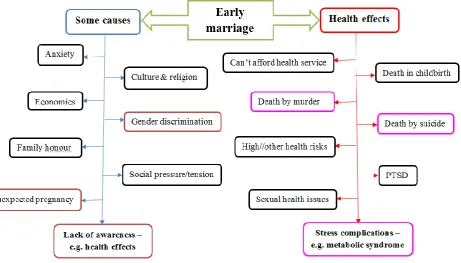
Causes and consequences of early marriage appear to have very well discussed in the scientific literatures and social media. Salient in the two Cases presented are causes and consequences that underlie early marriage that can get lost in presuppositions and unconscious bias, which are hereby highlighted in graphical overview (Figure 4). Even the World Health Organization has acknowledged much of these causes and consequences, thus worthy of reflections.5
Reflections on the case scenarios
In case 1 scenario, it may be arguably misconstrued that culture was the factor. However, salient in the story are the facts that firstly, unexpected pregnancy triggered Jay’s parents to demand immediate payment of dowry to fulfil traditional marriage rites. Secondly, gender discrimination underlies Jay’s parents demanding immediate payment of dowry – i.e. putting it on the man to take responsibility, instead of considering their daughter’s independence. Ironically, the gender discrimination in occasions of unexpected pregnancy is mostly against the man, but the girl that suffers the consequences more. Thirdly, it is perhaps ignorance that Jay and Mr. Regret scheduled their first date for two weeks that turned into three months; and married without making time to know each other. Such ignorance is hallmarked by the ‘had I known’ regrets and divorce. Obviously, the ignorance ‘had I known’ is another way of admitting to have been ignorant.
Similarly, case 2 scenario, it may also be arguably misconstrued that Grace’s parents were poor or illiterate. Peers may admit unprotected sexual intercourse or risky sexual behaviour (RSB) at the core of this early marriage – i.e. ignorance of Grace and Jason. However, salient in the story are the facts that social tension, ignorance, and gender discrimination were mixed causes of the early marriage. On social tension: The friends and social agents around the affected girls are rarely made to take responsibility where the circumstance is obvious. This is more sacrosanct in the world of political correctness, such as where teenage pregnancy is condoned while the affected girls are suffering the same ill-health consequences as those in early marriage.
Relative to Mr Regret in Case 1, there is another perspective to the ignorance; on one hand, Jason was ignorant of his job status and never planned for financial security before embarking on family life. Yet on another hand, Grace’s aunty was carried away by Jason’s demeanour and extravagant spending. These perspectives of ignorance may be viewed from the adage a boy-child gets 9-tubers of yam and decide to get married, ignorant of the fact that the 9-tubers will finish in 9-days. Surely, this adage depicts that cultures have discouraged boys from early marriages, but not girls.
The gender discrimination in this story is that first, Grace’s parents were blaming the boy instead of educating their daughter. The aunty was focused on Jason’s extravagancy without the thought of what Grace takes into the union. Similar to Jay and Regret’s case, the gender discrimination of man is to be provider for the wife, but it is the girl that suffers the consequences when the permutation fails. This gender discrimination is buoyed by the fact that highly educated women are losing the prospect of getting a husband and at the same time wish to marry men who earns more money.17 Indeed, a study found that single women (but not men) who wish to be married hide or subdue their careers ambitions.18
Implications for public health
The health consequences of early marriage include cervical cancer, death during childbirth, and obstetric fistulas as well as risk for sexually transmitted diseases.1 Beyond these risks, there is the risk of death – the girl committing either murder (killing the man) or suicide 7. Given legalities surrounding cultural and religious traditions; and the necessity to work within customary and statutory laws, it is pertinent to recognize the causes and consequences of early marriage.7,20 It is likely that knowledge of these risks in the proponents of early marriage is a deterrent; in other words, ignorance of these risks may be factor to perpetuation of early marriage. It had been suggested that educational programs aimed at early marriage prevention need to be broadened to include parents and also the men who seek under aged
girls for marriage.21-23 Hence, it is pertinent to survey the perspectives of parents and stakeholders on factors of early marriage. This calls for an initial community needs assessment in the context of determining the perceptions of parents regarding early marriage with a view to improve current efforts. The predominant set of combinational factors causing early marriages need to be identified in society to appropriately address the associated public health issue in targeted educational campaigns.
During the 1995 World Conference on Women that held in Beijing, factors inhibiting the realization of women’s potentials including their health were addressed. Child marriage was recognized as one of the social malaise that needed to be eradicated in order improve the quality of life of the girl child in the pursuit of sustainable development.7,24,25 Reflecting on published stories: in the story of child marriage of Wasilla who was given out in marriage at the age of 14 years old, death was involved and murder was suspected. If there is a public or sexual health impact of child marriage, death is the worst culmination of ill-health and here is a case example. In the story of year-10 girl given out to marriage before being informed, suicide was attempted and post-traumatic stress disorder was a complication. In the case of the year-8 girl who voluntarily went into the early marriage, poverty and stress are compounded by inability to afford healthcare for the potentially stress-induced ill-health.
CONCLUSION
This paper highlights causes of early marriage that are perhaps over-looked or under-discussed. The narrative further highlights that the Urhobos in Nigeria have marriage practices, similar to some cultures, which include early marriage. It posits that early marriage is not only shrouded in legalities, but is also caused by multiple factors. In particular, gender discrimination is in the subconscious perhaps of even the highly educated unmarried women, while men are equally inclined to marry a less ambitious woman, which translates to encouragement of parents in low SES to allow their daughters into early marriage. Ignorance and unexpected pregnancies are also exemplified. It is suggested that surveys of the perspectives of parents and stakeholders on these salient factors of early marriage is conducted.
ACKNOWLEDGEMENTS
This paper is a 2nd part of review (the 1st was on legalities) on this work. The stories constituting Cases 1 and 2 are real life, but the names have been changed for ethical reasons. Dr Phillip Bwititi has kindly edit this manuscript and is hereby acknowledged.
REFERENCES
1. Nour NM. Health consequences of child marriage in Africa. Emerging Infect Dis. 2006;12(11):1644-9. 2. Malhotra A. The causes, consequences and solutions
to forced child marriage in the developing world. International Center for Research on Women 2010; Available at: https://www.icrw.org/files/images/ Causes-Consequences-and%20Solutions-to-Forced-Child-Marriage-Anju-Malhotra-7-15-2010.pdf. Accessed on 4 October 2017.
3. Abdulmalik A. Shocking: Nigeria holds world record in number of children out of school. Premium Times. 2013;11th June, 2017.
4. United Nations Children’s Fund. Ending Child Marriage: Progress and prospects, 2014. Available at: https://www.unicef.org/media/files/Child_ Marriage_Report_7_17_LR..pdf. Accessed on 4 October 2017.
5. World Health Organization. Child marriages: 39 000 every day. 2013; Available at: http://www.who. int/mediacentre/news/releases/2013/child_marriage_ 20130307/en/. Accessed on 4 October 2017. 6. United Nations Children’s Fund. A profile of child
marriage in Africa. New York: UNICEF; 2015. 7. Agege EA, Nwose EU, Odjimogho S, Igumbor EO.
Legalities of child marriage in Nigeria: Implications on health and strategies of prevention. Sex Health Issues. 2017;1(1):1-4.
8. Manganara J. President's letter: Child marriage – a practice driven by poverty. International Alliance of Women 2016; http://womenalliance.org/child-marriage-a-practice-driven-by-poverty. Accessed on 12 August, 2017.
9. Bell Bajao. What causes early marriage? 2012;
http://www.bellbajao.org/what-causes-early-marriage/. Accessed 10 August 2017.
10. Henry EG, Lehnertz NB, Alam A, Ali NA, Williams EK, Rahman SM, et al. Sociocultural factors perpetuating the practices of early marriage and childbirth in Sylhet District, Bangladesh. Int Health. 2015;7(3):212-7.
11. Thakur P. The curse of child marriage: Our neglect and ignorance. Breakthrough 2013. Available at: http://www.breakthrough.tv/earlymarriage/2013/10/ curse-child-marriage-neglect-ignorance/. Accessed on 12 August, 2017.
12. Ngware M. Girls should be in school – not forced into marriage by powerful men The Conversation 2016. Available at: http://theconversation.com/girls- should-be-in-school-not-forced-into-marriage-by-powerful-men-61876, 11th July, Accessed on 12 August, 2017.
13. McNulty JK, Widman L. Sexual narcissism and infidelity in early marriage. Archives of sexual behavior. 2014;43(7):1315-25.
14. Veenema TG, Thornton CP, Corley A. The public health crisis of child sexual abuse in low and middle income countries: an integrative review of the literature. Int J Nursing Studies. 2015;52(4):864-81. 15. Wondie Y, Zemene W, Reschke K, Schroder H.
Early marriage, rape, child prostitution, and related factors determining the psychosocial effects severity of child sexual abuse in Ethiopia. J Child Sexual Abuse. 2011;20(3):305-21.
16. Eruvbetere JO. Urhobo traditional marriage and modern influences upon its institution. Urhobo Historical Society, 2003. Available at: http://www.waado.org/urhobo_kinsfolk/archive/con ferences/fourth_annual/cultural_session/marriage-eruvbetere.html, Accessed on 13 October 2017. 17. Sullivan N. Young women who prioritize family
over career deserve respect. Institute for Family Studies, 2017. Available at: https://ifstudies.org/ blog/young-women-who-prioritize-family-over-career-deserve-respect. Accessed on 8th October 2017.
18. Bursztyn L, Fujiwara T, Pallais A. 'Acting wife': Marriage market incentives and labor market investments. National Bureau Economic Res. 2017. 19. Pouwer F, Kupper N, Adriaanse MC. Does
emotional stress cause type 2 diabetes mellitus? A review from the European Depression in Diabetes (EDID) Research Consortium. Discovery Med. 2010;9(45):112-8.
20. Hampton T. Child marriage threatens girls' health. J Am Med Assoc. 2010;304(5):509-10.
21. Braimah TS. Child marriage in Northern Nigeria: Section 61 of Part I of the 1999 Constitution and the protection of children against child marriage. African Human Rights Law J. 2014;14(2):474-88. 22. Duvall EM. How effective are marriage courses?
Journal of Marriage and the Family. 1965;27(2):176-84.
23. Fayokun KO. Legality of child marriage in Nigeria and Inhibitions Against Realisation of Education Rights. US-China Law Rev. 2015;12:812.
24. World Conference on Women (4th: 1995: Beijing), London Roundtable on Women's Health. Statement of the London Roundtable on Women's Health for the Fourth World Conference on Women (FWCW), 7 January 1995. Planned parenthood in Europe = Planning familial en Europe. 1995;24(1):24-6. 25. Friedman S. Girls: a key to the future. People the
Planet. 1998;7(3):6-9.