Original Research Article
Effect of stress on hypertension among professional groups
at Bareilly: a cross sectional study
Shailesh Gupta
1*, Shruti Gupta
2INTRODUCTION
Hypertension also known as high or raised blood pressure is a global public health issue. It is a major risk factor for stroke and coronary heart diseases and is a major contributor to the onset and progression of chronic heart failure and chronic kidney failure. Blood pressure is the force of blood pushing against the walls of arteries as flows through them. Blood pressure is highest when the heart beats to push out blood into the arteries (systolic blood pressure) and when the heart relaxes to fill with blood again the pressure is at its lowest point (diastolic
blood pressure).1 The global prevalence of raised blood pressure defined as systolic and/or diastolic blood pressure ≥140/90 mmHg in adults aged 18 years and over was around 22% in 2014. In India, hypertension is the leading non communicable disease risk and estimated to be attributable for nearly 10 per cent of all deaths. Adult hypertension prevalence has risen dramatically over the past three decades from 5 per cent to between 20-40 per cent in urban areas and 12-17 per cent in rural areas. The number of hypertensive individuals is anticipated to nearly double from 118 million in 2000 to 213 million by 2025.2 High blood pressure is increasing in India due to rapid urbanization and globalization leading to adoption
ABSTRACT
Background: The objective of the present study was to study the effect of stress on hypertension in various professional groups.
Methods: A cross sectional study was done from 1st August 2015 to 30th August 2017 in district Bareilly. A predesigned and pretested questionnaire was used comprising of demographic data and stress. Three types of professionals were included in this study: doctors, managerial staff and school teachers from the teaching institutions.
Results: This study showed association of hypertension with stress level and found that 24.62% doctors, 72.31% school teachers and 27.69% managerial staff were hypertensive with mild stress level. Among all study subjects 41.54% were hypertensive with mild stress level. 15.38% doctors, 10.77% school teachers and 46.92% managerial staff were hypertensive with moderate stress level. Among all study subjects 24.36% were hypertensive with moderate stress level. 46.15% doctors, 0.76% school teachers and 8.46% managerial staff were hypertensive with severe stress level. Among all study subjects 18.46% were hypertensive with severe stress level. Chi-square test for association was applied and p-value was found significant for doctors, managerial staff and insignificant in school teachers. Among all study subjects p value 0.016 was found significant.
Conclusions: The present study showed highly significant association for hypertension with stress level among doctors and managerial staff with p value (0.005) and (0.001).
Keywords: Hypertension, Stress, Doctors, Teachers, Managerial staff
1
Department of Community Medicine, BPS GMC (W), Sonepat, Haryana, India
2
Department of Obstetrics and Gynecology, Sir Gangaram Hospital, Delhi, India
Received: 22 June 2019
Accepted: 30 July 2019
*Correspondence:
Dr. Shailesh Gupta,
E-mail: [email protected]
Copyright: © the author(s), publisher and licensee Medip Academy. This is an open-access article distributed under the terms of the Creative Commons Attribution Non-Commercial License, which permits unrestricted non-commercial use, distribution, and reproduction in any medium, provided the original work is properly cited.
of unhealthy lifestyles. Many people are unaware that they have high blood pressure and remain undiagnosed. Even the majority of those who are diagnosed do not get treated to control the blood pressure. It became evident in early 1970s that only about half of the hypertensive subjects in the general population of most developed countries were aware of the condition only about half of those aware of the problem were being treated and only about half of those treated were considered adequately treated. Stress has become a public health menace of the day. It cannot be eliminated from life and it's absolutely essential that we learn to manage it. Stress management is of special relevance to doctors who encounter extreme challenges in their professional and personal life. It will pave the way for working out appropriate coping
strategies and interventions.3 Decreased physical
activities coupled with increased mental tension are important contributors. Several studies have shown that lifestyle factors have their significant role in causing hypertension in professionals. Keeping this in view the present study was done to study the impact of stress on hypertension among three professional groups, doctors, school teachers and managerial staff of Bareilly, Uttar Pradesh.
METHODS Study design
It is a cross sectional study done in three professional groups; doctors, school teachers and managerial staffs.
Study period
The total study period was two year from 1st August 2015 to 30th August 2017.
Study tool
A predesigned and pretested questionnaire comprising of demographic data and mental stress was prepared in English language after reviewing the available literature; however questions were asked in local language at the time of interview after obtaining verbal consent.
Study area
The present cross sectional study was done in district Bareilly.
Inclusion criteria
All individual willing to participate from each profession, have been included in the study.
Exclusion criteria
Subjects with co-morbid conditions were not included in the study and subjects not willing to participate were also excluded.
Sampling technique
The study subjects were selected randomly from three professional groups.
Sample size estimation
According to a study conducted by Ramachandran et al on young physicians in India, the using prevalence of hypertension 35.6%.4 Absolute errors was taken as 5% and the required sample size was 352.The sample size is rounded to 390. The study includes 3 professional groups i.e., doctors, school teachers and managerial staff. Therefore the total sample size is divided into 3 parts and 130 sampling units are assigned to each professional group.
Table 1: Classification of Blood pressure (BP).
BP classification SBP (mmHg) DBP (mmHg)
Normal <120 and <80
Prehypertension 120-139 80-89
Stage 1
hypertension 140-159 90-99
Stage 2
hypertension ≥160 ≥100
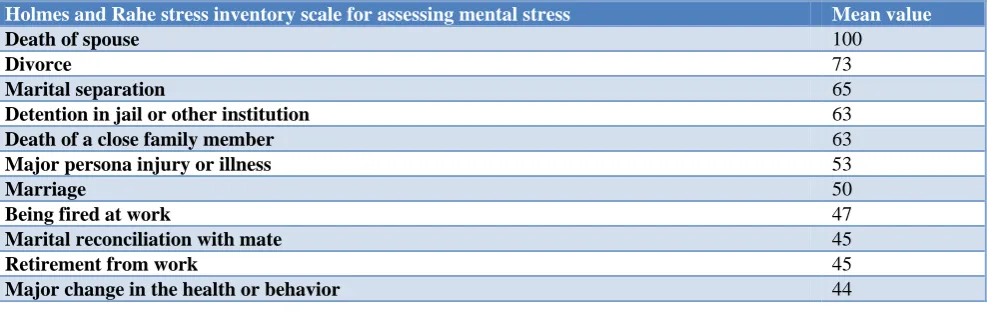
Table 2: Mental stress was assessed by using Holmes and Rahe stress inventory scale.6
Holmes and Rahe stress inventory scale for assessing mental stress Mean value
Death of spouse 100
Divorce 73
Marital separation 65
Detention in jail or other institution 63
Death of a close family member 63
Major persona injury or illness 53
Marriage 50
Being fired at work 47
Marital reconciliation with mate 45
Retirement from work 45
Major change in the health or behavior 44
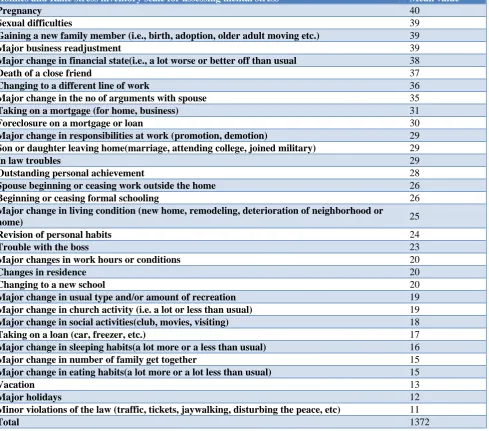
Holmes and Rahe stress inventory scale for assessing mental stress Mean value
Pregnancy 40
Sexual difficulties 39
Gaining a new family member (i.e., birth, adoption, older adult moving etc.) 39
Major business readjustment 39
Major change in financial state(i.e., a lot worse or better off than usual 38
Death of a close friend 37
Changing to a different line of work 36
Major change in the no of arguments with spouse 35
Taking on a mortgage (for home, business) 31
Foreclosure on a mortgage or loan 30
Major change in responsibilities at work (promotion, demotion) 29
Son or daughter leaving home(marriage, attending college, joined military) 29
In law troubles 29
Outstanding personal achievement 28
Spouse beginning or ceasing work outside the home 26
Beginning or ceasing formal schooling 26
Major change in living condition (new home, remodeling, deterioration of neighborhood or
home) 25
Revision of personal habits 24
Trouble with the boss 23
Major changes in work hours or conditions 20
Changes in residence 20
Changing to a new school 20
Major change in usual type and/or amount of recreation 19
Major change in church activity (i.e. a lot or less than usual) 19
Major change in social activities(club, movies, visiting) 18
Taking on a loan (car, freezer, etc.) 17
Major change in sleeping habits(a lot more or a less than usual) 16
Major change in number of family get together 15
Major change in eating habits(a lot more or a lot less than usual) 15
Vacation 13
Major holidays 12
Minor violations of the law (traffic, tickets, jaywalking, disturbing the peace, etc) 11
Total 1372
Blood pressure was measured using standard protocol. The auscultatory method of BP measurement with a calibrated and validated manual mercury sphygmo-manometer was used. An adult sized cuff bladder was used to ensure accuracy. Subjects were asked to be seated quietly for at least 5 minutes in a chair with feet on the floor, and arm supported at heart level. The systolic and diastolic pressures were measured three times over a period of at least 3 minutes and the lowest reading was recorded. Hypertension was diagnosed using JNC 7 criteria.5
Data management and statistical analysis
Data so obtained were compiled and presented in tabular form and statistical analysis was done with the help of appropriate statistical test and software. The data collected were entered in the Excel spread sheet and statistical analysis was done using IBM SPSS v20.0.0.
RESULTS
by 23.34 % in middle class, 11.29% in upper middle, 0.76% in lower middle class.
Table 4 shows stress level among doctors, school teachers and managerial staff (stress level was assessed by a scoring system suggested by Holmes and Rahe stress inventory scale).6 Majority of school teachers (84.62%) were found mildly stressed followed by managerial staff (30.77%) and doctors (24.62%).
Majority of managerial staff (53.08%) was found moderately stressed followed by doctors (20.77%) and school teachers (13.08%). Majority of doctors (54.61%) were found severely stressed followed by managerial staff (16.15%) school teachers (2.30%).On applying χ2 test association between stress level and professional groups was found to be highly significant with p value (<0.001).
Table 3: Distribution of study subjects according to their sociodemographic characteristics (n=390).
Socio-demographic variables Frequency (N) Percentage (%)
Age distribution (in years)
20-30 87 22.30
30-40 185 47.43
40-50 71 18.20
>50 47 12.07
Status of family Nuclear 269 68.97
Joint 121 31.03
Sex Male 306 78.46
Female 84 21.53
Religion
Hindu 363 93.08
Muslim 16 4.11
Sikh 9 2.30
Others 2 0.51
Caste
General 227 58.20
OBC 152 38.97
SC 10 2.57
ST 1 0.26
Educational status Graduate 106 27.18
Postgraduate 284 72.82
Socio-economic class
Upper class 252 64.61
Upper middle class 44 11.29
Middle class 91 23.34
Lower middle class 3 0.76
Lower class 0 0
Table 4: Stress level among doctors, school teachers and managerial staff (n=390).
Stress level (score)
Doctors School teacher Managerial staff Total
N (%) N (%) N (%) N (%)
No significant problem (0-149) 0 (0) 0 (0) 0 (0) 0 (0)
Mild (150-199) 32 (24.62) 110 (84.62) 40 (30.77) 182 (46.67)
Moderate (200-299) 27 (20.77) 17 (13.08) 69 (53.08) 113 (28.98)
Severe (>300) 71 (54.61) 3 (2.30) 21 (16.15) 95 (24.35)
Total 130 130 130 390
χ2 179.528
df 4
P value <0.001
Table 5 shows association among the doctors, school teachers and managerial staff according to their stress level and found that mild stress level among professional groups and found 24.62% doctors, 72.31% school teachers and 27.69% managerial staff were hypertensive with mild stress level. Among all study subjects 41.54%
stress level. Among all study subjects 18.46% were hypertensive with severe stress level. A 𝑥2 test for association was applied and p value was found significant
for doctors, managerial staff and insignificant in school teachers. Among all study subjects p value 0.016 was found significant.
Table 5: Association of hypertension with stress level among various professional groups (n=390).
Stress level
Doctors School teacher Managerial staff Total
HTN Non HTN HTN Non HTN HTN Non HTN HTN Non HTN
N (%) N (%) N (%) N (%) N (%) N (%) N (%) N (%)
Mild 32
(24.62) 0 (0) 94 (72.31) 16 (12.31) 36 (27.69) 4 (3.08) 162 (41.54) 20 (5.13)
Moderate 20
(15.38) 7 (5.39) 14 (10.77) 3 (2.31) 61 (46.92) 8 (6.16) 95 (24.36) 18 (4.62)
Severe 60
(46.15) 11 (8.46) 1 (0.76) 2 (1.54) 11 (8.46) 10 (7.69) 72 (18.46) 23 (5.89)
Total 112
(86.15) 18 (13.85) 109 (83.85) 21 (16.15) 108 (83.08) 22 (16.92) 329 (84.36) 61 (15.64)
χ2 8.607 5.890 16.831 8.280
df 2 2 2 2
P value 0.014 .08 <0.001 0.016
DISCUSSION
In the present study majority of the study population (64.61%) belonged to socioeconomic upper class, followed by 23.34 % in middle class, 11.29% in upper middle class, and 0.76% in lower middle class which is comparable to Mendez et al (2003) reported in a cross sectional study to examine the association between socio-economic status and hypertension (SBP ≥140/ DBP ≥90
mm Hg) in 2082 adults in Jamaica.7 The income
distribution of BP and hypertension were non-linear and moreover, the hypertension was found to be the highest in wealthiest women. In men with same high school education, income was positively associated with BP whereas Ribet et al reported a study analyzed the relationship between major cardiovascular risk factors in French men (aged 40-50 years) and their spouse’s occupational category.8 Spouse’s occupational category was independently associated with men’s hypertension.
The present study showed stress level among doctors, school teachers and managerial staff and found that in mild category, majority (84.62) were school teachers followed by managerial staff (30.77%) and (24.62%) in doctors. In moderate category maximum stress level (53.08%) was found in managerial staff followed by in doctors (20.77%) and 13.08% in school teachers. In severe category majority (54.61%) were doctors followed by 16.15% in managerial staff and 2.30% in school teachers. By applying Chi-square test for association p value <0.001 was found highly significant which is comparable to study of Cesana et al studied the association between job strain and blood pressure in four population samples of age 25 to 54 years from northern Italy.9 Among men there was a 3 mmHg increase of systolic blood pressure (p<0.001) moving from low to high strain job categories. Nakanishi et al showed the
association of long working hours with the risk of hypertension in men (35-54 years) and reported the relative risk of Hypertension above the borderline levels to be 0.63 in subjects working <8.0 hours/day.10
CONCLUSION
The present study showed highly significant association for hypertension with stress level among doctors and managerial staff with p value (0.005) and (0.001). The odds of developing high blood pressure and its adverse consequences in professional groups can be minimized by management of stress by recreational activities, meditation and yoga.
Individuals who already have hypertension can actively participate in managing their condition by, adopting the healthy behaviors such as monitoring blood pressure at regular intervals at home if feasible, checking blood sugar and blood cholesterol and urine albumin twice a
year, following medical advice and prescribed
medications for lowering blood pressure.
Funding: No funding sources Conflict of interest: None declared
Ethical approval: The study was approved by the Institutional Ethics Committee
REFERENCES
1. Hypertension Gale Encyclopedia of Medicine, 2008.
Available at: http://medicaldictionary.thefreediction ary.Com/hypertension. Accessed on 1 August 2017. 2. Non communicable disease situation and response:
3. Dhar N, Datta U, Nandan D. Stress among doctors a review Health and Population: Perspect Issues. 2008;31(4):256-66.
4. Ramachandran A, Chamukuttan A, Yamuna SA,
Murugesan N. High prevalence of cardiometabolic risk factors among young physicians in India. J Assoc Physician India. 2008;56;17-20.
5. Khan NA, Hemmelgarn B, Padwal R, Larochelle P,
Mahon JL, Lewanczuk RZ. The 2007 Canadian Hypertension Education Program recommendations for the management of hypertension: part 2-therapy. Can J Cardiol. 2007;23:539-50.
6. Holmes T, Rahe R. Holmes-Rahe Social
Readjustment Rating Scale. J Psychoso Res. 1967;11(2):213-8.
7. Mendez, Forrester T. Income, education, and blood pressure in adults in Jamaica, a middle-income
developing country. Int J Epidemiol.
2003;32(3):400-8.
8. Ribet C, Lang T, Zins M, Bingham A, Ferrières J, Arveiler D, et al. Do cardiovascular risk factors in men depend on their spouses occupational category. Eur J Epidemiol. 2001;17:347-56.
9. Cesena G, Ferrario M, Sega R. Job strain and
ambulatory blood pressure levels in a population based employed sample of men from northern Italy. Scand J Work Environ Health. 1996;22(4):294-305.
10. Nakanishi N, Yoshida H, Nagano K, Kawashimo H,
Nakamura K, Tatara K. Long working hours and risk for hypertension in Japanese male white collar
workers. J Epidemiol Community Health.
2001;55(5):316-22.