IJSRSET185309 | Published : 28 April 2018 | March-April-2018 [(5) 3 : 61-66]
Themed Section : Engineering and Technology © 2018 IJSRSET | Volume 5 | Issue 3 | Print ISSN: 2395-1990 | Online ISSN : 2394-4099
61
Spectrum Allocation with Full Duplex by Using Effective DF
Cognitive Radio Networks
P.Divya1, Dr.P.Kailasapathi2
1PG Scholar, Annamalai University, Tamil Nadu, India.
2Professor and Head, Annamalai University, Tamil Nadu, India
ABSTRACT
The enormous growth of the radio frequency (RF),wireless powered cooperative cognitive radio network (CCRN) has drawn a rapid increase of interest for improving the spectrum utilization with encourage to motivate joint information and energy cooperation between the primary and secondary systems. Dedicated energy beam forming is have the intension of achieving of wireless power transfer at relieves the low efficiency, which nonetheless evoke out-of-band EH phases and thus low cooperation efficiency. To address this issue, in this paper, we consider a novel CCRN aided by full-duplex (FD)-enabled energy access points (EAPs) that can support to wireless charge the secondary transmitter while simultaneously receiving primary transmitter’s signal in the first transmission phase, and to perform decode-and-forward relaying in the second transmission phase. We examine a weighted sum-rate maximization problem subject to transmitting power constraints as well as a total cost constraint using successive convex approximation techniques. A zero-forcing-based suboptimal scheme that need only local channel state information for the EAPs to acquire their optimum receiving beam forming is also solved. Various tradeoffs between the weighted sum-rate and other system parameters are provided in numerical results to statement the effectiveness of the proposed solutions against the benchmark ones.
Keywords: Cognitive Radio, Cooperative Communication, Full-Duplex, Decode-And-Forward, D.C. Programming, Successive Convex Approximation, Power Splitting, Energy Harvesting.
I.
INTRODUCTIONThe rapid development of wireless services and applications, the demand for frequency resources has dramatically increased. How to accommodate these new wireless services and applications within the limited radio spectrum becomes a big challenge facing the modern society [1].
The compelling need to establish more flexible spectrum regulations motivates the advent of cognitive radio (CR)[2].Cooperative cognitive radio networks (CCRNs) further pave way to improve the spectrum efficiency of a CR system by advocating cooperation between the primary and secondary
systems for mutual benefits. As Compared with classical CR start to deal with [3], CCRN make it possible for cooperative gains on top of CR in the sense that the secondary transmitter (ST) helps to provide the diversity and enhance the performance of primary transmission via relaying the primary user (PU)’s message while being allowed to access the PU’s spectrum. Inspite of the conventional CCRN advantage from information-level cooperation, its implementation in real world might be limited due to STs’ power constraints, especially when the STs are low-power devices.
improve the overall system spectrum efficiency by enabling both information level and energy-level cooperation [4]. Apart from the natural energy sources such as solar and wind that is intermittent due to the environmental change, radio frequency (RF) signal has recently been exploited as a new viable source for wireless power transfer (WPT) (see [5] and references therein). RF-enabled WPT has many preferred advantages. For example, compared with other induction-based WPT technologies, it can power wireless devices to relatively longer distance (e.g., commercial chips available for tens of microwatts (μW) RF power transferred over 12m [6]), while the associated transceiver designs are more flexible with the transmitting power, waveforms, and resource blocks fully controlled to accommodate different physical conditions. Joint information and energy cooperation in CR networks has thus been explored in much wireless energy harvesting (WEH)-enabled scenarios, e.g., [7]–[10]. The benefit of RF-powered CCRN is nevertheless compromised by the low WPT efficiency mainly due to the severe signal attenuation over distance. One way to improve the WPT efficiency is to employ multiple antennas at the ST, which can improve the EH efficiency of the secondary system [8]. The other way to boost the WPT efficiency is to power the ST via the dedicated energy/hybrid access point (EAP/HAP) [9] in addition to the PU. However, previous works all assume that the involved devices operate in half-duplex (HD) mode, which transfers wireless power at the expense of some spectrum efficiency. In continuous effort to address this issue, full duplex (FD)-enabled communications with wireless information and power transfer has sparked an upsurge of interest (see [11]–[15] and references therein).
In this paper, we consider a spectrum sharing decode and- forward (DF) relaying CR network consisting of one pair of primary transmitter (PT) and primary receiver (PR), and one pair of multiple-input multiple-output (MIMO) secondary users (SUs). A number of multi-antenna FD EAPs are coordinated to
simultaneously retrieving information sent from the PT in the first transmission phase, decode and forward the PT’s message to the PR in HD mode in the second transmission phase. The ST is required to assist the primary transmission and earn the rights to access the PU’s spectrum in return; the EAPs are paid by the system as an incentive to support the cooperative WPT and wireless information transfer (WIT). We assume that there is no direct link between the PT and the PR due to severe path loss [14], and the perfect1 global channel state information (CSI) known at a coordination point who is in charge of acquiring global CSI from the dedicated nodes2 and implementing the algorithm accordingly in every transmission block (assumed to be equal to the channel coherence time.
that they fundamentally improve the spectral efficiency of the CCRN system of interest. Second, compared with the non-cooperative EAPs whose power levels are binary (on or off) in [19], we exploit EAP-assisted cooperation in both WPT and WIT phases via continuous power control, which is an extension to the non-cooperative model.
II.
RELATED WORKIn this paper [2], RF band is the set of radio etiquettes in, protocols, air interfaces, spatial and temporal patterns that intense the use of the radio spectrum. Cognitive radio ranges Software radios for multiband multimode personal the software radio with radio-domain model-based reasoning about such etiquettes are emerging as platforms.
In this paper [3], to achieve the ergodic capacity and the outage capacity of the secondary user-fading channel under different types of fading channel models and power constraints, we consider the case known as the optimal power allocation and spectrum sharing strategies.
In this paper [4], to enabled wireless communication by investigating a new joint communication and energy cooperation approach, we pursue a unified study on smart grid and coordinated multipoint (CoMP).
In this paper [5] wireless powered communication, networking (WPCN) is a new networking paradigm by use of microwave wireless power transfer (WPT) technology. So, the battery of wireless communication devices can be remotely replenished.
In this paper [7], from ambient radio frequency (RF) signals by energy harvesting, the Wireless networks can be self-sustaining. Recently, researchers have attention on designing.
In this paper [5], we attentively at wireless powered efficient circuits and devices for Radio
Frequency energy harvesting appropriate for low-power wireless applications.
In this paper [8], Cooperation between the primary and secondary systems can improve the spectrum efficiency in cognitive radio networks. The efficient idea is to boost secondary system that helps the primary system's performance by relaying, and, in return, the primary system provides more opportunities for the secondary system to access the spectrum.
The cognitive WPCN is work under bandwidth sharing in primary wireless communication systems by using technique of cognitive radio which is enabled in secondary WPCN is shown in [9].
In paper [11], it has shown that the WPCN allocate the optimal network resources. Here to set distribution users in the downlink (DL) to operate full duplex in one hybrid access point, simultaneously it receive information from the users through TDMA in the uplink.
III.
PROPOSED SYSTEMThe Main Contribution of this Paper:
The weighted sum-rate of the FD EAPs–aided CCRN system is maximized using successive convex approximation (SCA) techniques subject to per-EAP power constraints for WPT and WIT, respectively, the STs transmitting power constraint, and a practical cost budget that constraints the payment made to the EAPs for their assistance.
The centralized optimization enables cooperation among the EAPs to effectively mitigate the interference with STs Information decoding (ID), and the self-interference (SI) that degrades EAPs, reception of the PTs signal.
simulation to yield performance with little gap to that achieved by the proposed iterative solutions.
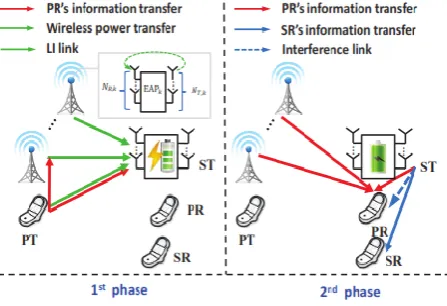
This paper, we consider a WEH-enabled CCRN that consists of one primary transmitter-receiver pair, one secondary transmitter-receiver pair, and a set of FD-enabled EAPs denoted by K = {1,…, K} as shown in Fig. 1. The PT and the PR are equipped with one antenna each, while the ST and the SR are equipped with N and M antennas, respectively. The number of transmitting and receiving antennas at the kth EAP are denoted by NT,k and NR,k , respectively, ∀k ∈K , and Nk = NT,k + NR,k .
Figure.1 System model for the wireless powered CCRN.
Figure 2. Transmission Protocol for the Wireless Powered CCRN
We assume that the ST is battery less, and thus it resorts to WEH as its only source of power for information transmission.3 .As illustrated by Fig. 2, a two-slot (with equal length) transmission protocol is assumed to be adopted. In the first time slot, the PT transfers the energy-bearing primary user’s signal to the ST. Concurrently, the EAPs operating in FD mode
cooperate to transfer wireless power to the ST using NT,k ’s antennas, while jointly receiving information from the PT using NR,k ’s antennas. In the secondary time slot, the ST decodes and forwards PT’s message and superimposes it on its own to broadcast to the PR and the SR. Meanwhile, the decoded PT’s information is also forwarded to the PR by the EAPs that employ
Nk antennas each for information transmission. Let s
denote PT’s transmitting signal that follows the circularly symmetric complex Gaussian (CSCG) distribution, denoted by s ∼CN (0, 1), and x ∼CN (0, X), the energy signals4 coordinately transmitted by K
EAPs, where X is the covariance matrix of x. On the other hand, x can also be alternatively expressed by x
=
xk kk1 , wherexl N k
k , T
C
x
is the energy signal transmitted by each individual EQP and is subject to per-EAP power constraint given by
x
P
k
K
E
k 2
0
.IV.
RESULTS AND DISCUSSIONA. Performance Merits
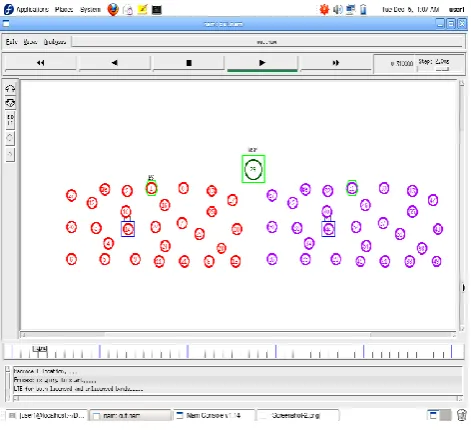
The simulation result shows the comparison between the existing system and proposed system. In existing system, there are two transmitters and receivers are works under the one base station, namely primary and secondary. This primary and secondary users are communicate with each other by using one base station will leads to occur collision and packet loss. To overcome this issue, the proposed system is designed, in this proposed system both the transmitters and receivers are works under two Energy Access Point (EAP1 & EAP2) for communication. Like, primary transmitter and receiver uses the energy access point1 (EAP1) and secondary transmitter and receiver uses energy access point 2 (EAP2) which provides efficient spectrum, traffic less, and efficient packet delivery.
B. Simulation
system shows that one base station for each user, which causes collision. In proposed system, there is two energy access points splited for primary users and secondary users, which provides efficient spectrum.
Figure 3. Packet Drop at Heavy Traffic
Figure 4, shows that, to overcome existing issues, replace the energy access points instead of one base station, to provide efficient spectrum, traffic less and good packet delivery.
Figure 4. Efficient Spectrum for Communication
Figure 5. Packet Delay
Figure 5. Shown that comparison of packet delay, where red sign shows proposed system, which the packet delay is less, whereas the existing system shows the sign of green, which the packet delay is high.
Figure 6. Energy Consumption
Figure 6, shows the comparison of energy consumption, as same as above red sign shows proposed system, and energy is less as compared to existing system as shown in green sign.
Figure 7. GoodPut
Figure 8. Spectral Efficiency
Figure 8. Shown the comparison of spectral efficiency as same as above red sign shows proposed system, and goodput is high as compared to existing system as shown in green sign.
IV. CONCLUSION
This paper investigated two techniques to fundamentally improve the spectrum efficiency of the RF EH-enabled CCRN, namely, dedicated EB and FD relaying both provided by multi antenna EAPs. Specifically, assuming a two-equal-slot DF relaying protocol, the EAPs jointly transfer wireless power to the ST while decoding PT’s message in the first transmission phase, the EAPs cooperate to forward PT’s message and the ST superimposes PT’s message on its own to broadcast in the second transmission phase. The EAPs’ EBs as well as their receiving and transmitting beam forming for PT’s message, and ST’s PS ratio as well as its transmitting beam forming were jointly optimized to maximize the weighted sum-rate taking both energy and cost constraints into account. The proposed algorithms using SCA techniques were proved to converge with the KKT conditions satisfied. The EB design based on ZF was also shown to be promising. Other benchmark schemes were also provided to validate the effectiveness of the proposed ones.
V.
REFERENCES[1] FCC, “Spectrum policy task force,” Federal Communications Commission, ET Docket No. 02-135, Tech. Rep., Nov. 2002.
[2] J. Mitola and G. Q. Maguire, “Cognitive radio: Making software radios more personal,” IEEE Pers. Commun., vol. 6, no. 6, pp. 13–18, Aug.1999.
[3] X. Kang, Y.-C. Liang, A. Nallanathan, H. K. Garg, and R. Zhang, “Optimalpower allocation for fading channels in cognitive radio networks:Ergodic capacity and outage capacity,”
IEEE Trans. Wireless Commun.,vol. 8, no. 2, pp. 940–950, Feb. 2009.
[4] J. Xu and R. Zhang, “Comp meets smart grid: A new communicationand energy cooperation paradigm,” IEEE Transactions on VehicularTechnology, vol. 64, no. 6, pp. 2476– 2488, Jun. 2015.
[5] S. Bi, Y. Zeng, and R. Zhang, “Wireless powered communication networks: an overview,” IEEE Wireless Commun., vol. 23, no. 2, pp.10–18, Apr. 2016.
[6] Wireless Power Solutions-Power cast Corp.
[Online]. Available:
http://www.powercastco.com
[7] S. Lee, R. Zhang, and K. Huang, “Opportunistic wireless energy harvesting in cognitive radio networks,” IEEE Trans. Wireless Commun.,vol. 12, no. 9, pp. 4788–4799, Sept. 2013.
[8] G. Zheng, Z. Ho, E. A. Jorswieck, and B. Ottersten, “Information andenergy cooperation in cognitive radio networks,” IEEE Trans. SignalProcess., vol. 62, no. 9, pp. 2290–2303, May 2014.
[9] S. Lee and R. Zhang, “Cognitive wireless powered network: Spectrum sharing models and throughput maximization,” IEEE Trans. Cogn.Commun. Netw., vol. 1, no. 3, pp. 335– 346, Sept. 2015.
[10] C. Zhai, J. Liu, and L. Zheng, “Cooperative spectrum sharing with wireless energy harvesting in cognitive radio networks,” IEEE Trans.Veh. Technol., vol. 65, no. 7, pp. 5303– 5316, Jul. 2016.
[11] H. Ju and R. Zhang, “Optimal resource allocation in full-duplex wireless powered communication network,” IEEE Trans. Commun., vol. 62,no. 10, pp. 3528–3540, Oct. 2014.