Original Research Article
Breastfeeding and complementary feeding practices and nutritional
status of children under 5 years in a tribal community of
Nandurbar district, Maharashtra
Sanika R. Patil
1, Muralidhar P. Tambe
2, Malangori A. Parande
2*,
Aditi M. Patil
3, Rigved V. Jeurkar
3INTRODUCTION
Breastfeeding is today the single most effective preventive intervention for improving the survival and health of children.1 It is universally acknowledged as providing health benefits for mothers and infants, decreasing infant mortality and morbidity, particularly in developing countries. Ideally, infants should be breastfed within one hour of birth, breastfed exclusively for the
first six months of life and continue to be breastfed up to 2 years of age and beyond. It has been reported that if breastfeeding can be initiated within one hour after birth then 22.3% neonatal deaths can be prevented.2 In India, it will account to saving 2,50,000 new born babies annually. Early initiation of breastfeeding is also a contributing factor towards the achievement of the Millennium Development Goal of increased levels of child survival. World Health Organization (WHO) not ABSTRACT
Background: Breastfeeding is the single most effective preventive intervention for improving the survival of
children. Hence, the purpose of this research study to capture the firsthand breastfeeding perceptions and practices and nutritional status of children in tribal community of Nandurbar district (Maharashtra, India).
Methods: This was community based cross-sectional study carried out on parents of 100 children. A house to house
survey was conducted and either one or both the parents were interviewed regarding ‘Early initiation of breastfeeding, exclusive breastfeeding and complementary feeding’ using a pretested, predesigned questionnaire after obtaining written informed consent. Every child below 5 years went through anthropometric measurements like mid upper arm circumference (MUAC), length/height and weight and was categorized as normal/MAM/SAM. The data was analyzed using Microsoft Excel and ENA (Emergency Nutrition Assessment) for SMART software.
Results: 85% mothers were aware of right breastfeeding practices but only 30% babies received breastfeeding within
first hour of birth and 72% children were exclusively breastfed till 6 months. Practice of healthy breast feeding was significantly associated with education of mother and awareness of breast feeding. It was found that prevalence of malnourishment was more among children not receiving exclusive breast feeding.
Conclusions: The importance of breastfeeding is not well recognized by the people living in tribal area as there was a
gap between knowledge and practice. There were various medical, social and psychological barriers for breastfeeding. Doctors, family members, television and ASHA have majorly contributed in spreading awareness.
Keywords: Early initiation of breastfeeding, Exclusive breastfeeding, Complementary feeding, Tribal community
1
Third year MBBS Student, BJGMC, Pune, Maharashtra, India
2
Department of Community Medicine, BJGMC, Pune, India
3
Intern, BJ Govt. Medical College, Pune, Maharashtra, India
Received: 06 June 2018
Accepted: 10 July 2018
*Correspondence: Dr. Malangori A. Parande,
E-mail: [email protected]
Copyright: © the author(s), publisher and licensee Medip Academy. This is an open-access article distributed under
the terms of the Creative Commons Attribution Non-Commercial License, which permits unrestricted non-commercial use, distribution, and reproduction in any medium, provided the original work is properly cited.
only highlights the importance of increasing early initiation of breastfeeding but also questions why it has not received more attention.3 Despite strong recommendations from WHO, breastfeeding rates, and in particular exclusive breastfeeding rates at six months, remain lower than recommended.4 Currently, only 50% of infants in the world are breastfed during the first hour of life.5 In India, according to statistics from International Baby Food Action Network (IBFAN), 24.5% mothers initiated breastfeeding within one hour.6 Initiation of breastfeeding after birth is considerably delayed in India, and in most cases the valuable colostrum is discarded before putting to breast.7 Undernutrition contributes to nearly half of all deaths in children under 5 and is widespread in Asia and Africa
According to the National Family Health Survey-4 (2015-16) of Nandurbar district, only 68% of children under the age of 6 months were exclusively breastfed.8 The World Health Organization reported that inappropriate feeding in children is responsible for one-third of the cases of malnutrition.9 A study have shown that inappropriate breastfeeding practices are associated with severe malnutrition in the under five children, lack any advantage in terms of weight gain and are associated with growth faltering.10 Malnutrition has significant health and economic consequences, which includes increased risk of death, illness and lower cognitive development. The percentage of underweight children below the age of five years was 57% while 49.7% children under five years were stunted.9 It is important to find the prevalence of stunting and wasting among the children to assess their nutritional status. As per WHO’s definitions, stunting is ‘below minus two standard deviations from median height for age of reference population’ and wasting is ‘below minus two standard deviations from median weight for height of reference population’.12
As early initiation of breastfeeding, exclusive breast-feeding and complementary breast-feeding are vital for the health of the child, understanding barriers and reasons for not implementing proper breastfeeding practices are important to increase our knowledge of these barriers and hence improve conditions and strategies to overcome them. Hence, the purpose of this research project is to capture the firsthand breastfeeding perceptions and practices and its association with the nutritional status in under five children in tribal community of Nandurbar district of Maharashtra, India.
METHODS
This was a community based cross sectional study conducted in a tribal community of Shahada block, Nandurbar district of Maharashtra state among children under 5 years of age by house to house survey. A house in the tribal community of Shahada block was selected by random sampling. The data collection procedure was carried out for a period of 2 months (May-June 2016). A
house to house survey was conducted and either one or both the parents were interviewed regarding ‘Early initiation of breastfeeding, exclusive breastfeeding and complementary feeding’ using a pretested, predesigned questionnaire after obtaining writteninformed consent by principal investigator and co-investigators. Everychild below 5 years went through anthropometric measurements like weight, length/height and mid upper arm circumference (MUAC) and was categorized as healthy/ acutely malnourished/ chronically malnourished as per WHO criteria.9 Total 100 houses were covered.
Inclusion criteria
Inclusion criteria were parents having a child under the age of 5 years, willing to participate in the study, child available for examination at the time of interview.
Exclusion criteria
Exclusion criteria were parents with children more than the age limit of 5 years and not willing to participate in the study.
The study was carried out after obtaining permission from Institutional Ethical Committee.
Statistical analysis
Appropriate statistical tests like percentage, mean, standard deviation, Chi square test and t test were used to analyse the data using statistical software. WHO standards (2006) were used to classify nutritional status. Microsoft Excel and ENA (Emergency Nutrition Assessment) for SMART software were used for data entry, analysis and graphical representation.
RESULTS
Total 100 children were enrolled in the study. Out of these, mothers of 86 (86%) children were below 30 years of age. Majority 82 (82%) were Hindus and 27 (27%) mothers were illiterate or educated upto primary level education and 8 (8%) mothers were graduates. Only 34 (34%) mothers were working and majority 31(31%) were in unorganized sector. More than half family’s income was less than Rs. 5000/- per month.
In this study, 36 (36%) children were less than 6 months of age while 21 (21%) were between 6 months to 1 year and 43 (43%) were above 1 year of age.
(72%) children practiced exclusive breast feeding in this study. Regarding awareness of complementary feeding, 77 (77%) of these mothers were aware of this. Out of 100 study subjects, 72 (72%) had started complementary feeding as per the guidelines at 6 months of age.
It was found that doctors (36% in early initiation and exclusive breast feeding and 32% in complementary feeding) and family members (22% in early initiation and exclusive breast feeding and 26% in complementary feeding) were the major sources of information regarding breastfeeding practices (Figure 1).
Figure 1: Source of information regarding early initiation and exclusive breast feeding and complementary feeding.
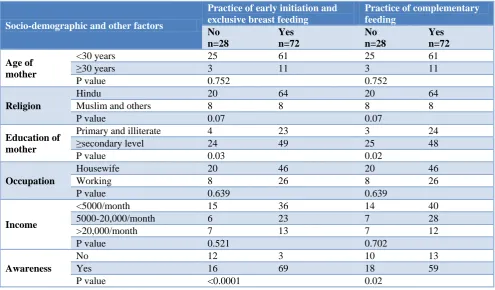
Table 1: Association between socio-demographic and other factors and practice of early initiation and exclusive breast feeding and complementary feeding.
Socio-demographic and other factors
Practice of early initiation and exclusive breast feeding
Practice of complementary feeding
No n=28
Yes n=72
No n=28
Yes n=72
Age of mother
<30 years 25 61 25 61
≥30 years 3 11 3 11
P value 0.752 0.752
Religion
Hindu 20 64 20 64
Muslim and others 8 8 8 8
P value 0.07 0.07
Education of mother
Primary and illiterate 4 23 3 24
≥secondary level 24 49 25 48
P value 0.03 0.02
Occupation
Housewife 20 46 20 46
Working 8 26 8 26
P value 0.639 0.639
Income
<5000/month 15 36 14 40
5000-20,000/month 6 23 7 28
>20,000/month 7 13 7 12
P value 0.521 0.702
Awareness
No 12 3 10 13
Yes 16 69 18 59
P value <0.0001 0.02
Various socio-demographic and other factors affecting the practice of breast feeding and complementary feeding were presented in Table 1. Practice of early initiation and exclusive breast feeding was significantly associated with education of mother (p=0.03) and awareness of breast
feeding (p<0.0001). Practice of complementary feeding was also significantly associated with education of mother (p=0.02) and awareness of breast feeding (p=0.02).
0 10 20 30 40 50 60 70
Pamphlets Poster ANW ASHA Television Family Doctors
2 2 3
9 15
22 36
1 2
6 10
8
26
32
Mothers aware about Early Initiation and Exclusive Breast feeding
Table 2: Association between breast feeding practices and nutritional status of children.
Nutritional status
Children receiving exclusive BF No.(%)
Children receiving BF+BMS No.(%)
Normal 67 (93.0) 19 (67.8)
MAM 4 (5.5) 5 (17.9)
SAM 1 (1.5) 4 (14.3)
Total 72 (100) 28 (100)
P=0.003; (BF= Breastfeeding, BMS= Breast milk substitutes)
When the nutritional status of children were studied with respect to breastfeeding, it was found that prevalence of malnourishment was more among children receiving breast feeding and breast milk substitutes (BMS) as compared to the group which had received exclusive breast feeding (p=0.003) (Table 2).
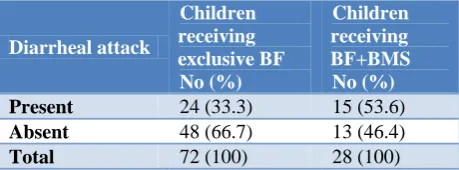
Table 3: Association between breast feeding practices and diarrheal attacks.
Diarrheal attack
Children receiving exclusive BF No (%)
Children receiving BF+BMS No (%)
Present 24 (33.3) 15 (53.6)
Absent 48 (66.7) 13 (46.4)
Total 72 (100) 28 (100)
P=0.03; (BF= Breastfeeding, BMS= Breast milk substitutes).
Similarly, diarrheal attacks were found to be significantly more common among children receiving breast feeding and BMS as compared to the group which had received exclusive breast feeding (p=0.03) (Table 3).
A significant association was found between mother’s education and underweight (p<0.0001) and malnutrition of child (p<0.017). In addition to this, Mother’s BMI is also significantly associated with underweight.
Various misconceptions regarding breastfeeding practices also exist in the community leading to pre-lacteal feeds and late initiation and faulty breastfeeding practices. It was observed that traditional practices (30%), lack of knowledge (27%), lack of social support for breastfeeding (23%) were the major reasons. Other barriers in this tribal community for healthy breast feeding practices were lack of medical facilities, mother’s illiteracy and low socio-economic status etc.
DISCUSSION
This study was focused on study of knowledge and practices of early initiation of breastfeeding, exclusive breastfeeding and complementary feeding in the tribal community. Only 30% started breast feeding within the stipulated time and the median time of initiation of breast
feeding was 5.5 hrs which was quiet more than the stipulated time i.e. within half an hour. The mothers of 72% children practiced exclusive breast feeding in this study and 72% had started complementary feeding as per the guidelines at 6 months of age.
It was found that addressable factors like education level of mother, awareness of mother regarding breast feeding, source of information regarding breastfeeding, family support, nutritional status of mother etc. have an impact on the breastfeeding practices. The study also showed the association between breastfeeding practices and growth of children.
This study established the relation between mother’s education and child’s nutritional status. A study done by Aidam and Perez-Escamilla has also indicated that educational level of the mother has an important influence on breastfeeding.13 Mother’s nutritional status plays an important role in growth of infants. In this research, it was found that Mother’s BMI is also significantly associated with underweight.
Doctors and family had a positive effect on healthy breastfeeding practices. Doctor and family were mentioned as a major source of information by the parents. This demonstrates compliance with the ten steps of successful breastfeeding where it is stated that hospital staff should support mothers to follow standard breastfeeding practices.14 From this research data, it came to notice that apart from the physicians, all other health care staff in India must be instructed to advice their expecting parents on benefits of breastfeeding.
The study focused on higher risk of diarrhea in the infants who were either not breastfed or who received, in addition to breast milk, other energy containing foods before 6 months of age. Contaminated complementary food is primary source of gastro-intestinal pathogen.15
Previous study by Yoon and Black have also reported a protective effect of breastfeeding on diarrhea morbidity and mortality.16 Early breastfeeding initiation reduces the use of pre lacteal feeds that carry a high risk of contamination, while breastfeeding appears to both protect and have positive regulatory effects over the intestinal mucosa.17 Thus, both early initiation and exclusive breastfeeding are important and should be promoted by program and policy makers in the rural India.
CONCLUSION
ACKNOWLEDGEMENTS
We would like to acknowledge the Indian Council of Medical Research (ICMR) for their grant support for this project in the form of Short Term Studentship (STS). The authors would like to thank Department of Community Medicine, BJGMC, Pune and local officials of Shahada tribal block (Nandurbar) for their co-operation.
Funding: No funding sources Conflict of interest: None declared
Ethical approval: The study was approved by the Institutional Ethics Committee
REFERENCES
1. Helsing E, King FS. Breast feeding in practice. Oxford University Press, New Delhi. 1984.
2. Edmond KM, Zandoh C, Quigey MA, Amenga-Etego S. Delayed breastfeeding initiation increases risk of neonatal mortality. Pediatrics. 2006;117:380-6.
3. Jana AK. Interventions for promoting the initiation of breastfeeding: RHL commentary. The WHO Reproductive Health Library. World Health Organization. 2009.
4. Barona-Vilar C, Escriba-Aguir V, Rerrero-Grandia. A qualitative approach to social support and breastfeeding decisions. Midwifery. 2009;25:187-94.
5. Victora CG, Bahl R, Barros AJD. Breastfeeding in the 21st century. Lancet. 2015;387:475-90.
6. Sandor M, Dalal K. Influencing factors on time of breastfeeding initiation among a national representative sample of women in India; IBFAN. 2007.
7. Bandyopadhyay M. Impact of the ritual pollution on lactation and breastfeeding practices in rural West Bengal, India. Int Breastfeeding J. 2009;4:2.
8. Govt. of India. National Family Health Survey NFHS IV (2015-2016). International Institute for Population Studies, Ministry of Health and Family Welfare, Mumbai, 2017.
9. WHO/UNICEF. Global strategy for infant and young child feeding. WHO Geneva. 2003:5-10. 10. Arifeen S, Robert EB. Exclusive breastfeeding
reduces acute respiratory infection and diarrhea deaths among infants in Dhaka slums. Pediatrics. 2001;108:67.
11. Zulfiqar AB, Tahmeed Ahmed, Robert EB. What works? Interventions for maternal and child undernutrition and survival. Lancet. 2008;6736(07):61693-6.
12. Aidam, Perez-Escamilla. Factors associated with exclusive breastfeeding in Accra, Ghana. European J Clin Nutr. 2005;59:789-96.
13. Yotebieng M, Labbok M. Ten steps to successful breastfeeding programme to promote early initiation and exclusive breastfeeding in DR Congo: a cluster-randomized controlled trial. Lancet. 2015;3:546-55. 14. Edmond K. Timing of initiation, patterns of breastfeeding, and infant survival: prospective analysis of pooled data from three randomized trials. Lancet. 2016;4:266-75.
15. Yoon PW, Black RE. Effect of not breastfeeding on the risk of diarrheal and respiratory mortality in children under 2 years of age in Metro Cebu, The Philippines. Am J Epidemiol. 1997;143:1142-8. 16. Brandtzaeg PE. Current understanding of
gastrointestinal immunoregulation and its relation to food allergy. Ann N Y Acad Sci. 2002;964:13-45.
Cite this article as: Patil SR, Tambe MP, Parande