Volume 4 Issue 10 ǁ Dec. 2019
ISSN: 2582-1601
www.ijahss.com
Analysis of accounting application at Micro Small and Medium
Enterprises in Manado City
Treesje Lusje Runtuwene
1, Opa Mustopa
2, Agustinus Lumettu
3*Accounting Department and Tourism Department Manado State Polytechnic
Abstract:
Analysis of accounting application at Micro Small and Medium Enterprises in Manado CityAccounting plays an important role in economic and social systems. Accounting can be defined as financial cycle recording activities. In a broader sense, accounting is a set of recording, measuring, identifying, presenting and reporting financial activities. Micro small and medium enterprises (UMKM)is a very important sector o Indonesian economy viewed from various sectors such as its contribution to the labor absorption as much as 96 % in 2018, unemployment eradication and also economic buffer which contributes 60 % of the Gross Domestic Income. However ,so far there still many Micro Small and Medium Enterprises which have not applied accounting in their businesses due to limited knowledge, skills, time and personnel for this job. This results in bankruptcy of many businesses which fail halfway because of running out of capital, the business costs increase while income is not as expected. The special target to be achieved is that the Micro Small and Medium Enterprises in Manado city can survive or even expand their businesses. The method used in this research is Qualitative method where the data are collected through direct interviews and questionnaire for getting information about the fund and its utilization as well as the hindrances faced by the businesses. The sample was taken randomly using random sampling and the data were analyzed descriptively and quantitatively.
Keywords:
Analysis, accounting application, micro small and medium enterprises.I.
Introduction
Micro Small and Medium Enterprises are a group of businesses with the biggest number and has been proved to be shock resistant to economic crises that happened in Indonesia in 1998 and therefore the development this type of business is interesting attracts attention of many parties, both the government and the business people. In 2004, these businesses had a 95% labor absorption of all the national labor and contributed 57 % the Gross Domestic Product which proves that the Micro Small and Medium Enterprises are able to strengthen the structure of the national economy. However, the business doers have the problems of insufficient capitals for business expansion. Of the 54.4 million of Micro Small and Medium Enterprises in Indonesia, only 30 % could access the funding. Basically, these businesses have big chances to get bank credits for cash injection. There are many funding programs both from the government and the banks one of which is KUR ( People’ ). In 2019 , the funding for these businesses is targeted to be 140 trillion IDR. There is an increase from the previous year which was 123 trillion IDR. This scheme of funding is meant to be a solution as an effective capital financing for UMKM considering that there many hindrances for accessing credits from the banks. Consequently, the credit realization was much lower ( only 14.8 trillion IDR from the initially targeted amount of 20 trillion IDR.. Baas dan Schrooten (2006) in in Rudiantoro and Siregar ( 2011)mentions that one of the most common techniques of granting credit is Financial Statement Lending that bases the credit granting on the financial information of the debtor. When seen from another perspective, it becomes an obstacle because UMKM get difficulties in providing information required by the banks. Good financial management is a key factor in making any business succeed or fail. Undisciplined booking and financial management can also influence business development. A practical method of booking and financial management in UMKM is applying accounting properly. Hence, accounting can provide necessary information for UMKM to run the business.
important thing for UMKM to do if they want to develop their business because it makes it easier for them to know their business path, obstacles experienced and required information. The hindrance of UMKM to have financing/credit is making standardized financial report while financial report is one of the accounting cycle outputs. With adequate accounting, UMKM can qualify the requirements of credit application, that is, Financial Report. Financial report can also be used for evaluating performance, knowing the financial position and calculating the tax ( Warsono, 2010). Financial Report is one of the essential components of UMKM if they want to expand their business. Therefore, it is very important to get MSMEs to write reports on business activities as well as financial reports. Due to the need for the availability of accounting standard which is simple than the general IFRS based, FINANCIAL ACCOUNTING STANDARD (SAK) and ENTITY WITHOUT PUBLIC ACCOUNTABILITY FINANCIAL ACCOUNTING STANDARD (SAK ETAP) due to the lack of human resources in producing financial report using those both pillars, the Indonesian accountants Association, has issued the Financial Accounting Standard for MSMEs (SAK EMKM) that started to be effective on January 1, 2018. It is intended for the entities without significant public accountability. This standard deals with the accounting arrangements which are simple than SAK ETAP because it regulates public transaction done by EMKM its basic measurement only uses historical cost. SAK EMKM is expected to support the development of MSMEs in Indonesia. The advantages of SAK EMKM application is that the financial report produced can be used as the base of the business decision making that will be beneficial for the business continuity. In addition, this standardized report can also be used for credit application for business development.
Definition of accounting: According to Rudianto (2010), accounting is the activities of collecting, analyzing, presenting in the form of figures, clarifying, summarizing and reporting activities/transactions of a business entity in the form of financial information. According to Ismail (2010 : 2), accounting is an art of recording, classifying and summarizing that result in information of all financial activities of the business. The aim of accounting presented in the financial report is to provide information that is useful for the user’s decision-making/while Ika (2016 : 28) defines accounting from 2 points of view :
1. Function and Utility
Accounting is a service whose function is to give quantitative information about economic entities especially in relation financial information that is useful for decision-making.
2. Process of Activities
Accounting is an art of recording, classifying and summarizing of transactions which are at least partially financial in nature by interpreting the results.
Accounting Cycle: According to Kartika Hadi, et,al (2012 : 83), Accounting Cycle is a circle of accounting processes to record transactions and events during a certain accounting period until financial statements are prepared.
Accounting activities include:
1) Identifying and measuring data that are relevant for making decisions. 2) Data processing and then reporting the results.
3) Communicating the information to the report users.
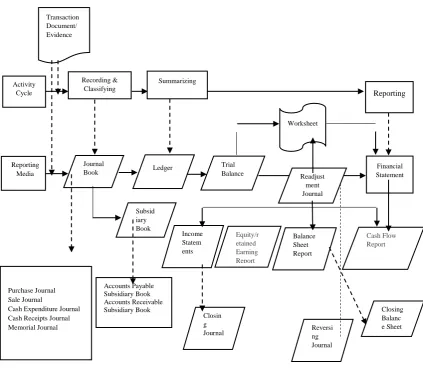
In detail, the activities which form the accounting cycle can be described as follows:
1) Analyzing the business transactions and preparing the bookkeeping evidence (transactions document). 2) Recording accounts to journal books.
3) Posting accounts to the ledger. 4) Compiling a trial balance. 5) Making adjusting entries, if any.
6) Compiling a balance sheet/worksheet if necessary.
7) Preparing financial statements (income statement, statement of changes in equity/capital, retained earnings report and balance-sheet report.
The activities in accounting cycle can be expressed in a diagram form as follows:
Figure 1. Accounting Cycle
Sumber : Pura, 2013
Financial Standards for Micro Small and Medium Entities
Financial accounting standards for micro small and medium entities is the newest accounting standard which is simpler than the IFRS based general accounting standard and SAK ETAP. SAK EMKM was designed to push and facilitate the financial reporting needs of micro small and medium enterprises (UMKM). Many results of research show that there are MSMEs, which have not applied SAK ETAP accurately considering that this standard is still considered to be to complex and incompatible with the MSMEs reporting needs. These results of research give recommendation for the designing of a simpler accounting standard for MSMEs. SAK EMKM was approved by the Financial Accounting Standard Council of Indonesian Accountant Association on October 24, 2016 and started to be effective since January 1, 2018. SAK EMKM contains accounting regulation which is simpler than SAK ETAP since it regulates the common transaction done by MSMEs and its measure went is merely historical cost. This standard is expected to facilitate the entities in going through the transition from the cash-based financial statement to accrual based financial statement.
Financial Statement : Financial statement is a record of information of a company in a period of accounting that depicts the performance of the company. It is useful for the bankers, creditors, owners and stakeholders in analyzing and interpreting the financial performance and the condition of company (Indonesian Accountants Association, 2016). According to Rudianto (2008),the financial statement produced by an organization has a
Transaction Document/ Evidence
Activity Cycle
Recording & Classifying
Summarizing
Reporting
Reporting Media
Journal Book
Trial Balance Ledger
Worksheet
Financial Statement
Subsid iary Book
Readjust ment Journal
Purchase Journal Sale Journal
Cash Expenditure Journal Cash Receipts Journal Memorial Journal
Accounts Payable Subsidiary Book Accounts Receivable Subsidiary Book
Income Statem ents
Equity/r etained Earning Report
Balance Sheet Report
Cash Flow Report
Closin g
Journal Reversing
Journal
certain objective. Although business entities have different lines of business and characteristics, their financial statement have similar objectives as follows:
1. Give dependable financial information regarding economic sources, duties and capital of a company. 2. Give dependable information regarding changes in economic sources, duties and capital of a company. 3. Give information that can help the report users in estimating the potential of a company for making
profit in the future.
4. Give financial information that can help the report users in estimating the potential of company for making profit.
5. Give other important information regarding changes in economic resources, duties such as purchasing activities investment.
6. Reveal other information relating to other relevant financial statement for the report users such as information about accounting policies held by the company.
While IAI and SAK EMKM state that the objective of financial statement is to provide useful information about the financial status and performance of a business entity for a great number of users in economic decision making by anyone who is not in the position of being able to ask for the special financial statement to fulfill the information needs. The users include the resources for the entity such as creditors and investors. In achieving its target, a financial statement also performs managerial accountability on the resources entrusted to them.
Components of Financial Statement
According to SAK EMKM chapter 3, paragraph 39, minimally, a financial statement consists of : 1. Report of the financial status at the end of the period.
This report is a report that provides information about the financial status of the company in a certain period. It can include the following posts (SAK-EMKM, chapter 4, paragraph 2):
a. Cash and the equivalent b. Accounts receivable c. Inventory
d. Fixed asset e. Liability f. Bank loan g. Equity
2. Income statement during the period.
This statement informs about the company’s business results in a certain period. It can include the following posts (SAK-EMKM, chapter 5, paragraph 3):
a. Income
b. Financial burden c. Tax burden
3. Notes to financial statements containing addition and certain relevant details of posts. It includes: a. A statement that financial statement has been written in accordance with SAK EMKM.
b. Summary of accounting policies.
c. Additional information details of certain posts that explain important transactions and materials in order that the users understand the financial statement.
Definitions of Micro, Small and Medium Enterprises (MSMEs)
Central Bureau of Statistics defines MSMEs based on the quantity of labor. Small enterprise is a business entity whose labor is from 5 to 19 people while the medium enterprise has from 20 to 99 personnel. According to Law No. 20 of 2008, MSMEs are business entities with the following criteria:
1. Micro Enterprise
A micro business as intended by Law of the Republic of Indonesia number 20 chapter 5 article 1of 2008 regarding Micro, Small and Medium enterprises is a self - supporting productive economic entity run by individuals or business entities which is not a subsidiary or a branch of a company that is owned, controlled or becomes a part of a medium enterprise or a large company which fulfills the following criteria:
2. Small Enterprise
A small enterprise as intended by Law of the Republic of Indonesia No. 20 chapter 1 article 1 of 2008 regarding Micro, Small and Medium enterprises are self- supporting economic entity run by individuals or business entities which is not a subsidiary of a branch of a company that is owned, controlled or becomes a part of a medium enterprise or a large company which fulfills the following criteria as mentioned in chapter IV article 6 :
a. Having a net asset more than 50.000.000 IDR (fifty million rupiahs) up to maximally 500.000.000 IDR (five hundred million rupiahs) excluding the land and building where the business is run.
b. Having annual sales results more than 300.000.000 IDR (three hundred million rupiahs) up to maximally 2.500.000.000 IDR (two billion and five hundred million rupiahs).
3. Medium Enterprise
Medium enterprise is intended by Law of the Republic of Indonesia No. 20 chapter 1 article 1 of 2008 regarding Micro, Small and Medium enterprises is an a self-supporting economic entity run by individuals or business entities which is not a subsidiary or a branch of a company that is owned, controlled or directly or indirectly becomes a part of a small or a large enterprise with the amount of net asset and annual sales results as mentioned by the Law chapter 4 article 6 (the criteria of a medium enterprise) as follows :
a. Having a net asset more than 500.000.000 IDR (five hundred million rupiahs) up to maximally 10.000.000.000 (ten billion rupiahs) excluding the land and building where the business is run, or
b. Having annual sales results more than 2.500.000.000,00 (two billion and five hundred million rupiahs) up to maximally 50.000.000.000,00 (fifty billion rupiahs).
Table 2. Criteria of business based on Law No. 20 of 2008
No Description Criteria
Asset Turn over 1 Micro enterprise Max. 50 million Max. 300 million 2 Small enterprise ˃50 million-500 million ˃300 million-2.5 billion 3 Medium enterprise ˃500 million-10 billion ˃2.5 billion-50 billion
Source of data : Law No. 20 of 2008
II.
Method
MSMEs.4. Library Studies, the researchers gathered information related to the topic of the problem to be examined through scientific journals about Financial Accounting Standards for MSMEs and research method as well as quoting from the internet. The most important instrument of research is the researchers. The data analysis techniques used was descriptive analysis. Research with qualitative analysis is research that has the characteristics of data stated in the natural condition or as it is which is not modified in the form of symbols or numbers (Nawawi and Martini, 2004 :174). Descriptive research is intended to make an objective representation of the symptoms contained in the research problems. The representation is done by describing symptoms as data or facts as they are (Bungin, 2003). Steps of analysis followed : 1. Classifying the data based on the accounting recording, accounting reporting and the business constraints that hinder the MSMEs in applying the accounting as shown by semi-structured interview and questionnaire. 2. Identifying accounting recording and reporting from each classification. 3. Analyzing the constraints faced by MSMEs in applying accounting. 4. Processing the data and drawing conclusions as a whole based on the data gathered. Steps of Research is
1. The researchers conducted observation in the site of research. 2. The researchers conducted the research in the site planned. 3. The researchers gathered the data from the 50 MSMEs.
4. The researchers analyzed the data gathered from the 50 MSMEs chosen. 5. The researchers wrote the research report.
6. The researchers wrote a journal for publication.
III.
Results and Discussion
Because there are so many businesses in Manado City, the researchers limit this research to only a few businesses related to student activities namely photocopy, food stalls, laundries, motor bike and car repair shops, pulse kiosks, small kiosks and billboards. From the results of research that has been done in 50 MSMEs in some sub districts in Manado City obtained an overview of the application of accounting as follows :
Table 3. Types of business, constraints and financial statements made
Type of Business Capital (000)
Number of
Workers Constraints
Financial Statements Made
Ewa shop 10.000 2 Stock of goods is hampered
in shipping Available “Never”
Workshop 50.000 4 Many competitors Unavailable Bersama
Restaurant 1.000 1 Location is not strategic
Cash receipts and disbursements Fried Food 5.000 3 Many competitors Unavailable
Pulse Counter 5.000 1 Many competitors Purchase/sale/income/cost Nina Stahl 10.000 3 Limited stock Purchase/sale of product Imanuel Kiosk 5-7.000 1 Many competitors Purchase/sale of product Billboard 5.500 1 Many competitors Purchase/cash receipts
Photocopy 300 3 Run out of stock/damaged
machine Unavailable
Grocery Stall 8.000 1 Run out of stock/a lot of
debt Available
Shop 7.000 1 Many competitors Purchase/sale of product Restaurant 700 1 Many people buy on credits Unavailable
Car Repair Shop 5.000 1 Many competitors, lock of
machinery Unavailable Food Stall 5.000 2 Many people buy on credits Unavailable Vegetable Vendor 6/700
IDR 1
Many competitors, lack of
tools Unavailable
Restaurant 20.000 4 Many people buy on credit Purchase, cash receipts, employ salary records ModaClass House
Furniture 150.000 6 Small business place Available Grilled Fish
Gallery 6.000 8
Many competitors, product
does not sell Available
noodles Restaurant
does not sell
Refill water
Depot 100.000 3
Many competitors, products
don’t sell Purchase/sale/income/cost Mobil Ungke
Motors Workshop 25.000 2 Much debt Unavailable Yul Stall 10.000 1 Limited stock of products Purchase/sale Ibu Yanti Cake
Stall 2.000 2
Many competitors, products
don’t sell Unavailable Muna Cake Stall 2.000 1 Many competitors Unavailable
Fitri Shop 10.000 2 Stock of good is hampered
in shipping Purchase/sale Sari Water Depot 100.000 4 Many competitors Unavailable Ibu Ane
Restauraant 2.000 1 Much debt
Cash receipts & disbursements Fried Food 5.000 3 Many competitors, products
don’t sell Available
Pulse Counter 5.000 1 Many competitors Purchase/sale/income/cost Rico Photocopy 25.000 5 Many competitors Purchase/sale/income/cost
Opa Kiosk 5-7.000 1 Many competitors, products don’t sell Purchase/sale of products
Billboard 3.500 1 Many competitors Purchase, cash receipts, record of wages Photocopy 15.000 3 Many Competitors Purchase/sale Stall 8.000 1 Out of stock/much debt Available Shop 7.000 1 Many competitors Purchase/sale
Restaurant 700
IDR 1
Many competitors, products
don’t sell Unavailable
Car Repair 5.000 1 Many competitors, lack of
tools Unavailable
Food Stall 5.000 2 Many competitors, lack of
tools Unavailable Vegetable
Vendors
6/700
IDR 1 Many people buy on credits Unavailable]]
Restaurant 20.000 4 Many competitors, products don’t sell
Purchase/cash receipts, record of wages Furniture Shop 150.000 6 Small business place Available Grilled Fish 6.000 8 Many competitors, products
don’t sell Available Tinutuan &
Noodles Restaurant
10.000 1 Many competitors, products
don’t sell Purchase/sale/income/cost
Refill Water
Depot 100.000 3 Many competitors Purchase/sale/income/cost King & Queen
Laundry 30.000 3 Many competitors Purchase/sale/income/cost Ara Kiosk 5.000 1 Many competitors Unavailable
Andre Motor
Workshop 5.000 -
Many competitors, business
place is not strategic Unavailable
Nona Kiosk 7.000 2 Many competitors, business
place is not strategic Unavailable
can then be concluded that of the 50 business entities being researched, only 8 entities or 16% have made financial reports while 42 other business entities or 84% have not made financial statements due to incomplete records and in compatibility with the recording requirements for the MSMEs. From table 3.1 above we also know that there are 5 categories of constraints experienced by the MSMEs, namely: (1) Hampered by many competitors (31 entities or 62%), (2) Hampered by stock depletion while capital does not return due to uncollectible accounts (10 entities or 20%) and there were 4 business entities (8%) which did not develop because their location are not strategic, and 3 entities (6%) did not develop due to lack of capital causing insufficient stock and 2 entities or 4% were constrained due to late shipping. It can then be concluded that the biggest problem is tight competition in the same type of business, so there is a need for creativity and precise and quick calculation to be able to complete in developing the business and therefore, a good accounting record is needed so that the company is able to calculate the income and costs incurred. In addition, accounting records are needed to record who has owed, what amount and when it will be paid. All must be well documented so that the business owner can demand the payment from the debtor accounting to the agreement and the business can run again. Moreover, promotion efforts are needed to introduce businesses and business locations and order to be better known to the public or consumers, who needs goods and services. There are 6% of businesses that capital. In facts, this can be immediately overcome by applying for loans to banks, and other financial institutions. For this reason, a good accounting record is needed so that financial institutions can provide the needed capital assistance, while the 4% of businesses whose shipments were late could actually be minimized if there had been a better procurement plan for those businesses.
IV.
Conclusions and Suggestions
Conclusions
1. Of the 50 businesses studied, only 8 businesses have made financial reports while the other 42 or 84% have not been able to made financial reports due to lack of knowledge in terms of their records. Some others recorded their activities only partially and did not conform to the requirement of accounting record that apply for MSMEs.
2. The biggest obstacle in these businesses is the number of competitors in the same business so it requires high creativity as well as precise and quick calculation to be able to completed and develop the business. For this reason, a good accounting record is needed so that the entrepreneurs are able to calculate the income and costs incurred in the business. From this record, it can be seen how much profit is obtained in the business. Besides, a good accounting record can produce good financial reports and can be used to obtain loans from banks or other financial institutions for the business development.
Suggestions
1. There should be a socialization about the importance of financial records and financial statements in accordance with the provisions of SAK EMKM.
2. There should be a training for financial records and financial statements in accordance with the provisions of SAK EMKM.
Reference
Journals[1]. Baas and Schrooten.2006. Relationship Banking and SMEs, A Theoretical Analysis.https://www.jstor.org>stable
[2]. Rudiantoro& Siregar. 2011.Kualitas laporan keuangan UMKM Serta Prospek Implementasi SAK Etap.https://media.neliti.com>media
[3]. Jati Hironnymus dkk.2004.Menumbuhkan Kebiasaan Usaha kecil Menyusun Laporan Keuangan. Jurnal Bisnis Usahawan 118. P. 210 – 218
[4]. Ikatan Akuntan Indonesia. Standart Akuntansi Keuangan. www. iaiglobal.or.id.sak-efektif-2sak-ef [5]. Ikatan Akuntan Indonesia. Standart Akuntansi Keuangan Entitas Tanpa Akuntabilitas Publik.
www.iaiglobal.or.id.sak-efektif-2sak-ef
[6]. Sugiyono dan Esterbeg. 2013. Teknik Wawancara.https://osf.io.download [7]. Books
[8]. Rudianto. 2010. Akuntansi Koperasi. Jakarta. Erlangga
[9]. Rudianto. 2012.Pengantar Akuntansi Adaptasi IFRS. Jakarta. Erlangga. [10]. Ismail.2010. Manajemen Perbankan . Jakarta. Kencana
[11]. Ika Farida Ulfah, 2016 Akuntansi Untuk UMKM. Surakarta. CV. Kekata Grup.
[12]. H. Kartika Hadi, 2012. Akuntansi Keuangan Berdasarkan SAK Berbasis IFRS. Jakarta. Salemban Empat.
[14]. Moleong. 2009. Metode Penelitian Kualitatif.Bandung.PT. Remaja Rosdakarya.