46
Effects Of Dietary Supplementation With
Sheep
Fat
On Broilers Performance
And Feed Utilization
Badea Ali Gaafer, Mohamed Tag Eldin Ibrahim, Omer Massaad Elbashier
Abstract: This study was performed to investigate the effect of inclusion of 3% sheep fat on broiler performance including: Feed consumption, live body weight, body weight gain, feed conversion ratio, water consumption, carcass characteristics, mortality, protein efficiency ratio, lysine efficiency ratio, efficiency of energy utilization, , relative water consumption
٫
production efficiency factor. Two hundreds; unsexed broiler chicks, 28 day-old (Ross 308) were used. The Chicks were randomly distributed into 2 treatments experimental groups, designated T1, and T2, each group has 4 replicates of 25 chicks. Birds were fed experimental diets for 3 weeks. They were fed finisher diets from 29 to 49 day old, in which sheep fat was added to the iso-calaric and iso-nitrogenous diet T1 0% (Control group), T2 3% in each experimental. High significant differences (p<0.01) were observed between groups T1 and T2, in live body weight, body weight gain, carcass weight٫
water consumption٫
feed conversion ratio٫
factor. No significant different were found in feed consumption, Therefore٫
it is concluded that adding sheep fat based diets improved broiler performance.Key Words: Broilers, Mortality, Energy utilization, Carcass weight, Lysine efficiency.
————————————————————
Introduction:-
Broiler industry is increasing dramatically throughout the developing countries. There have been a notable increase in growth rate and feed efficiency in commercial broiler chickens in the last 20 years. Current commercial hybrids with high performance require high energy and protein diets which would enable the maximum exploitation of those genetic potential [1]. In Sudan there is a large amount of animal fat produced daily from slaughtering animals and it’s not all used, so it can be used as an alternative energy source in poultry industry. Sudan has 90-95% of the feed materials used in poultry feed available locally٫ but import from abroad about 5-10% of the feed, which it drains great deal of the cost which reach 23.37% of the total cost of the feed. [1] and [4]. There is a problem to meet such a high energy level with conventional feed ingredients such as maize, wheat, barley and soybean. Fats provide a concentrated source of energy to achieve high energy broiler diets. In the developing countries, fat or oils as energy rich feed are available from animal sources and plant sources. Fats also provide varying quantities of the essential nutrient linoleic acid [13]. Another important role of fats in diet is its inhibition from de novo lipogenesis in broiler chickens that could increase energy efficiency in diets [25]. The profile of fatty acids is of importance to the quality of the utilization of lipids and to the absorption of these lipids by the bird, and also because it influences the quality of the fat deposited in broiler carcass. The main factor that affects the metabolizable energy value of oils and fats is their digestibility, which is depends on the following factors: the length of the carbonic chain, the number of double bonds, the presence or absence of ester bonds (triglyceride or free fatty acid), the specific arrangement of the saturated and unsaturated fatty acids on the glycerol backbone, the composition of the free fatty acid, the composition of the diet, the type and quantity of triglycerides supplemented in the diet, the intestinal flora, the sex and age of the birds [14].
Fats and oils are subject to oxidation which is responsible for rancidity. Rancid fat have an objectionable odor and decrease the palatability of a feed. Rancidity can be prevented or slowed by adding antioxidants. Vitamin E is the major natural antioxidant and various synthetic antioxidants are used to prevent rancidity. When commercial feed fats are used to increase energy in feedlot diets they are usually added at the rate of 2 to 5 percent of the diet’s total dry matter. Total fat levels exceeding 6 to 8 percent can cause digestive disturbances. In addition to the energy value of fats, the control of dust arising from finely ground components [13].
Birds are not able to synthesize all fatty acids and thus, some are considered essential fatty acids. Linoleic (18:2, n-6) and linolenic (18:3, n-3) fatty acids are recognized as metabolically essential. However, the linoleic acid is the only essential fatty acid whose diet requirement has been demonstrated [20].
Various researchers have conducted feeding trials using fats and oils in diets. The results indicate that when fat is fed at rates up to 5% of the dry matter; that dry matter intake decreased, with an improvement in average daily gain, and feed efficiency and carcass weight, during the first feeding days on feed, average daily gain increased by 9.8% with the addition of 4% fat. However over the entire feeding period feeding 4% fat improved average daily gain by only 3.8%. The addition of fat had no effect on dry matter intake, feed to gain ratio or carcass traits [5] and [20]. There are theories which are based on both physiological (controlling mechanisms within the bird which limit and encourage consumption of a particular nutrient or energy yielding components) and physical. [8]. The amount of feed consumed is closely associated with growth performance in meat-type poultry. Aside from adequate diet formulation, maintaining maximum feed intake is the single-most important factor that will determine the rate of growth and efficiency of nutrient utilization [11]. [6] Used diets with similar nutritive values added with 4, 7 and 10% of animal fat, and observed that the increasing fat level of the diet increased the quantity of
abdominal fat, corroborating results reported by [27]. [10],
reported that high dietary energy level significantly increased (LBWG) during the finisher period, increasing energy level significantly increased LBW and LBWG [7]. House Temperature: Probably the most important factor influencing feed conversion is the temperature of the broilers environment. Birds are homeotherms (warm-blooded), __________________________
Badea Ali Gaafer, Mohamed Tag Eldin Ibrahim, Omer Massaad Elbashier
Sudan University of and Technology
47 meaning they maintain a relatively constant body temperature
regardrdless of the environmental temperature. Birds perform best when there is minimal variation in house temperatures over a 24 hour period of time [19].
Table (1) Sheep fat fatty acids Sheep fat fatty acids %
Myristic almitic Stearic Arachidic Tetradecenoic Hexadecenoic Octadecenoic Octadecadienoic Octadecatrienoic C2022 unsaturated acids
2-4 23 -28 15-31 --- --- 1-0-2-5
36-46 - 4-6
--- 0.5*
Barker & Hilditch (1950). (Values quoted are % by wt.)
Materials and Methods:-
Experimental location and Site:-
This study was conducted at the Poultry Farm٫ College of Animal Production Science and Technology٫ Sudan University of Science and Technology during the period from 2end of March to 9th of April 2015. This study was performed to investigate the effect of sheep fat on broiler performance including: Feed consumption, live body weight, body weight gain, feed conversion ratio, water consumption, carcass characteristics, mortality, protein efficiency ratio, lysine efficiency ratio, efficiency of energy utilization, , relative water consumption
٫
production efficiency factor.Experimental houses:-
The experiment was conducted in an open side deep litter house 8×5m dimensions
٫
4m central altitude and 2.5m side altitude٫
constructed by corrugated iron sheets roofing٫
wire netting sheets supported by 50cm cement wall at sides and concrete floor. The long axis of the house extended east-west facing the wind direction for efficient ventilation. The house was divided into twelve experimental sections (replicates) of equal area (1.5m2)٫
each and 75cm walls altitude which separate experimental sections. The experimental house and equipments were cleaned٫
burned and disinfected. Then fresh wood shaving litters was spread in the experimental section floor at depth of 5cm٫
Moreover٫
each section was provided with one tubular metal feeder and circular plastic drinker. The house had four lamps at 2m altitude٫
Expressed as high from ground.Experimentalbirds:-
A total of two hundred; one day old unsexed broiler chicks, 28 day-old (Ross 308), were used. The Chicks were randomly distributed into 2 experimental groups, designated T1 and T2, each group has 4 replicates of 25 chicks. Birds were fed finisher diets from 29 to 49 day old, in which sheep 3% fat was added to the iso-calaric and iso-nitrogenous diet T1 0% (Control group), 3% in T2. Water was supplied with multi –
vitamin from 28 -31 days. Antibiotic Doxystin (Doxycycline Hcl 50mg – colistin sulphate 400000 I.U) as prevention dose from 35 – 40 day.
Experimental Diets:-
The experiment consisted of three treatment groups, designated as T1 control group fed 0% fat
٫
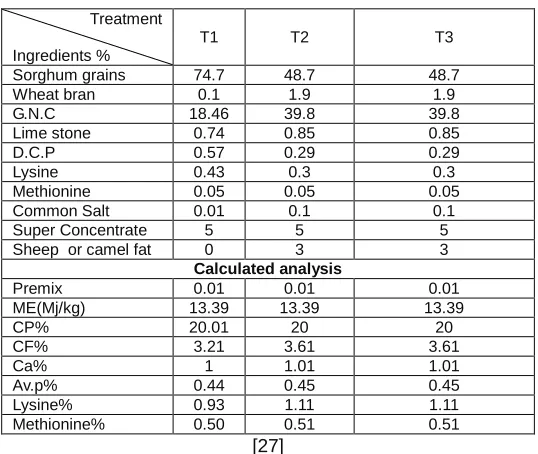
T2 fed 3% sheep fat. Each group consist of one hundred birds and each group was further subdivided into four replicates of twenty five per replicate. All birds were fed on pre starter ration for the 1st week of age then they were fed on starter feed ration from 8 to 27 day. Then birds were allocated in to the experimental finisher diets from 28 to 49 day. All rations were formulated to be approximately iso-caloric and iso-nitrogenous to meet the nutrient requirements for broiler chicks as out lined by the [20]. Feed and water were supplied adlibitum during the experimental periods.Analysis of the finisher experimental ration:
Table (2): composition (%) and calculated analysis of experimental finisher diets:
Treatment
Ingredients %
T1 T2 T3
Sorghum grains 74.7 48.7 48.7 Wheat bran 0.1 1.9 1.9 G.N.C 18.46 39.8 39.8 Lime stone 0.74 0.85 0.85
D.C.P 0.57 0.29 0.29
Lysine 0.43 0.3 0.3
Methionine 0.05 0.05 0.05 Common Salt 0.01 0.1 0.1 Super Concentrate 5 5 5 Sheep or camel fat 0 3 3
Calculated analysis
Premix 0.01 0.01 0.01 ME(Mj/kg) 13.39 13.39 13.39
CP% 20.01 20 20
CF% 3.21 3.61 3.61
Ca% 1 1.01 1.01
Av.p% 0.44 0.45 0.45
Lysine% 0.93 1.11 1.11 Methionine% 0.50 0.51 0.51
[27]
Table (3): Chemical composition of concentrate:
Item Ingredients
ME Mj/kg
CP %
Ca %
AVP %
Lysine %
Methionine %
CF %
Concentrate 10.02 35 10.6 4.9 1.1 4.3 1.5 Source: lab of Hendrix Company٫Netherlands.
Data collection:-
48 Mortality = number of dead birds ×100
Total number of birds
Calculations:-
Production Efficiency Factor (PEF) = (final bird weight, kg x livability %)/( age days x feed conversion ratiox100) [15].
Protein Efficiency Ratio (PER): Weight gain divided by protein intake [12].
Energy Efficiency Ratio (EER): Weight gain x100/total ME intake [12].
Lysine efficiency: Lysine intake (mg)/weight gain (g)
Calculation of European Production Efficiency Factor Liveweight (kg) x Liveability (%) x 100
Age at depletion (days) x Feed conversion efficiency
Production Efficiency Factor Live weight (lb.) x Liveability - (whole bird condemns + 50 percent part condemns x 100 Age at depletion (days) x Calorie conversion (megacalories/lb. live Estimation of water intake rate during the experimental period (standard intake) was carried-out using a regression analysis between water consumption in water- restricted birds and age (variable X). Compensatory consumption in the period from 28 to 49 days of age was calculated as the difference in water intake between the groups previously submitted to water restriction and the control group [20].
Statistical analysis:-
Completely randomized design (CRD) was used in the current study. The data were subjected to analysis of variance (One – way- ANOVA) and the means were suppurate by the least significant difference (LSD) using the statistical package for social science (SPSS) version 16.0 (2007) computer program.
Results:-
Temperatures of experimental period:-
Weekly high and low ambient temperature of experimental period (three weeks) is presented in table (1). It was observed that the lower environmental temperature was٫ 28.3C0 whereas the highest temperature was 40C0.
A` Table(4): Weekly Minimum and maximum Temperatures of experimental Period:
Temperatures Week Minimum 0 C Maximum 0 C
Week one 28.7 40
Week two 28.3 40
Week three 28.3 39.8
Table(5): Dietary(Finisher) effects of sheep fat 3%on weekly broiler Performance
Parameters Weeks Treatment Week one Week two Week three
Live body weight
(LBW):- Control
761.57 ±78.8b 991.19± 131.4b 1257.7 ±151.3 b Ration added 881.36 1293.9± 1667.6
sheep fat ±108.6
a 143.6 a
±119.7 a
Significance ** ** **
Body weight gain
(BWG):- Control T1
46.79± 12.7 45.12±7. 98b 50.28± 11.3b Ration added
sheep fat T2
50.59± 5.9 65.19±8. 6a 59.36± 11.2a
Significance NS ** *
Feed
consumption(FC) by
(grams/bird/day) :
Control 75.06± 9.4b
97.56±0. 2a
88.81± 15.4b
Ration added sheep fat 79.39± 0.5ab 99.58±0. 4a 104.77 ±11.1a
Significance ** * **
Feed conversion
ratio (FCR):- Contorol T1
1.76±0 .6
2.27±0.4
b 1.82±0 .4 Ration added
sheep fatT2
1.59±0 .2
1.56±0.2
a 1.82±0 .4
Significance NS ** NS
Water consumption (WC):-
Control 232.61
±85.3b 358.78±40.0b 450.15±53.8b
Ration added sheep fat 254.70 ±72.9a 473.86± 38.3a 479.63 ±24.7a
Significance * ** ** a٫ ٫ b٫ means within the same column followed by different
superscript are at significantly (P<0.05) different. *: significance different at (p<0.05).
**: Highly significance different at (p<0.01).
Table(7): The overall broiler performance birds fed 3 % sheep fat sources Item Treat ment LBW (gram) WG (gram) FC
(gram) FCR
WC (gram) Dressi ng % Contr ol 1257.7±
151.3b 99.61±29.6b 238.04±44.3 1.50±0.5a 912.93±163.8b 62.15±1.3b
Ration added camel fat 1619.5± 99.2a 154.21± 28.5a 253.71 ±43.2 2.66± 0.1b 1092.40± 157.7a 62.87± 1.8ab Signifi
cant ** ** NS ** ** * ٫ b٫ means within the same column followed by different superscript are at significantly (P<0.05) different.
*: significance different at (p<0.05). **: Highly significance different at (p<0.01). NS: No significant difference.
49
Broilers Feed Utilization:
Table(8): Dietary(Finisher) effects of sheep fat on weekly broiler feed utilization
Parameters
Week Treatment Week
one Week two
Week three Protein efficiency
ratio (PER):- Control
3.21±
1.1 2.27±0.4
b 2.88±0.
7 Ration
added sheep fat
3.19±
0.4 3.27±0.4
a 2.86±0.
6
Significan
ce NS ** NS
Efficiency of energy utilization (EEU):-
Control 4.80±
1.6 3.39±0.6
b 4.30±0.
1 Ration
added sheep fat
4.76±
0.6 4.89±0.6
a 4.27±0.
9 Significan
ce NS ** NS
Production efficiency factor (PEF):-
Control 14.93±4.1b 11.32±2b 15.34±3.51b
Ration added sheep fat
16.99
±1.5a 21.16±4.8a 20.55±5.8a
Significan
ce * ** **
Lysine efficiency
ratio (LER):- Control
19.30
±6.7 25.00±0.4
a 20.00±0
.4 Ration
added sheep fat
17.50
±2.1 17.10±2.6
b 20.00±0
.5
Significan
ce NS ** NS
Relative water consumption (RWC):-
Control 27.46
±9.3 38.84±6.7
35.94±3 .4a Ration
added sheep fat
28.70
±6.1 37.10±4.5
28.97±3 .4b
Significan
ce NS NS **
a٫ b means within the same column followed by different superscript
are at significantly (P<0.05) different. **: Highly significance different at (p<0.01). NS: No significant difference.
Most tested parameters (protein ratio efficiency Factor, efficiency energy utilization, lysine efficiency and production efficiency factor) scored significantly high difference (p< 0.01) for the three weeks of the experimental period compared T1, except relative water consumption, which showed no significant difference in the first and second week but showed significantly high difference (p< 0.01) for the third week. The mortality% was 4% for all treatments of experimental period. Livability was 96% for all treatments through the experimental period
Discussion:
The overall result showed that no significant differences were observed in feed consumption, but highly significant differences (p<0.01) were observed for live body weight, body weight gain, carcass weight٫ water consumption and feed conversion ratio٫ and significant differences (p<0.05) were noticed for dressing% which improved by inclusion of sheep fat. Growth performance of broiler has improved performance,
which could be due to that the dietary fat reduced the passage rate of the digesta through the gastrointestinal trait, allowing for better nutrient absorption and utilization [21], [5] and [13], or might be due to the dietary fat which increases diet digestibility and to stimulate growth and feed efficiency, or as a result of the higher percentage of long chain fatty acids and higher contents of triglyceride. These results are in agreement of that reported by [23]. The result of water consumption highly significant differences (p<0.01) were observed between groups. Birds fed 3% fat sheep recorded the highest water consumption which might be due to the dietary energy content
٫
these results are in agreement of that reported by [17]. The result of Feed consumption showed that no significant differences among different experimental groups. Highly significant differences (p<0.01) were noticed for feed conversion ratio which might be due to the dietary fat which decreased feed intake. Feed efficiency was improved as reported by [11]. The result showed that supplementation of sheep fat 3% to broiler chicks resulted in a highly significant differences (p<0.01.) Live body weight٫ body weight gain was studied by [10], they reported that high dietary energy level significantly increased (LBWG) during the finisher period, increasing energy level significantly increased LBW and LBWG [19] and [8]. In contrast, [23], concluded that LBW and LBWG were not significantly affected by dietary energy levels. The result showed that supplementation of feed by 3% of sheep fat to broiler chick showed a highly significant difference (p<0.01) for carcass weight compared to control diet, Also the present study results are agreement of that reported by [19], who found that carcass weight significantly improved by adding sheep fat which can be substitute for energy source as alternative local feedstuff to decrease the price of broiler feed and to reduce the competition between human and animals.Fat energy values may be influenced by dietary components, and perhaps this explains why the values obtained in the present experiment were higher than those generally found in
literature. Finally addition of fat improved the weekly
performance of broiler chicks, while the overall had significant different except the feed consumption, efficiency of energy utilization and protein efficiency ratio.
Conclusion:
-The results showed that the inclusion of sheep fat in poultry diet by 3% had improved broiler performance (feed conversion ratio, live body weight٫ water consumption٫ body weight gain٫ production efficiency factor(PEF)
٫
lysine efficiency ratio (LER), Dressing% and carcass weight, when compared with the control diet. That is mean that sheep fat can use as broiler feed to reduce the production cost.Recommendations:
-Further Studies can be conducted to investigate the effect of insertion of another percentage of sheep fat as broiler feed to reach a good percentage for broiler feed.
Acknowledgment
50
REFERENCES:-
[1] Akamittath, J. G., Brekke, C. J. and Schanus, E. G. 1990. Lipid oxidation and colour stability in restructured meat systems during frozen storage. Journal of Food Science 55 (10): 1513−1517.
[2] Ali٫ S.A.M.٫ Abdalla H.O.and Abasaid.M.A. (2011).Sunflower meal as an alternative protein source to groundnut meal in laying hens rations. Egypt. poult. Sci.٫31:745-753.
[3] AOAD (1989). Second Arabic Conference to development of meat and poultry industry. Arab Organization for Agricultural Development (AOAD) ٫ khartoum٫sudan.
[4] Babiker٫M.S.٫C. kijora٫S.A. Abbas and J.Danier. (2009). Nutrient composition of main poultry feed ingredient used in sudan and their variations from local standard tables values .Int. J . poult. Sci.٫ 8:355-358.
[5] Baião NC, Lara LJC. Oil and fat in broiler nutrition. Braz J Poult Sci. 2005; 1:129–141. Celebi S, Utlu N. Laying performance, serum lipoproteins, cholesterol and triglyceride of hens as influenced by dietary fat sources. J Appl Anim Res. 2004; 25:121–124.
[6] Deaton JW, Mcnaughton JL, Reece FN, Lott BD.
Abdominal fat of broilers as influenced by dietary level of animal fat. Poultry Science 1981; 60:1250-1253.
[7] Elmansy, M. M. (2006). Assessment of the effect of L-carnitine supplementation to the diet with different dietary energy levels on broiler performance. M. Sc. Thesis, Fac. Agric., Tanta Univ., Tanta, Egypt. Greenwood, M.W; Cramer, K. R.; Clark, P.M.; Behnke, K.C. and Beyer, R.S. (2004). Influence of feed on dietary lysine and energy intake and utilization of broiler from 14 to 30 days of age Inter. J. of Poult. Sci., 3: 189-194.Griffiths L, Lesson S, Summers JD. Influence of energy system and level of various fat sources on performance and carcass composition of broilers. Poultry Science 1977; 56:1018-1026.
[8] HUANG, K.H., KEMP, C. and FISHER, C. (2011). Effects of nutrition on water intake and litter moisture in broiler chickens. In: Proc. of the Australian Poultry Science Symposium, Sydney, Australia, and pp 26-31.In: Abate e processamento de frango Campinas: APINCO; 1994.
[9] Hussein, A. S.; Cantor, A. H.; Pescatore, A. J. and Johnson, T. H. (1996). Effect of dietary protein and energy levels on pullet development. Poult. Sci., 75:973-978.Jeffri D, Firman H, Kamyab A. Comparison of soybean oil with an animal/vegetable blend at four energy levels in broiler rations from hatch to market. Int Poult Sci. 2010 2010;9:1027– 1030
[10]Jeffery, R.W., Rydell, S., Dunn, C.L., Harnack, L.J, Levine, A.S., Pentel, P.R., Walsh, E.M.. Effects of
portion size on chronic energy intake. International Journal of Behavioral Nutrition and Physical Activity, 4, 27-31. doi: 10.1186/1479-5868-4-27
[11]Kamran, Z., M. Sarwar, M. Nisa M. A. Nadeem, S. Ahmad, T. Mushtaq Effect of Lowering Dietary Protein with Constant Energy to Protein Ratio on Growth, Body Composition and Nutrient Utilization of Broiler Chicks Asian-Aust. J. Anim. Sci.Vol. 21, No. 11 : 2008 1629 - 1634November www.ajas.info
[12]Latshaw JD. Daily energy intake of broiler chickens is altered by proximate nutrient content and form of the diet. Poult Sci. 2008; 87:89–95.
[13]Leeson, S. and J.D. Summers, 2001. Scoot's Nutrition of the Chicken. University Book. Guelph, Canada.
[14]Lemme A, Frackenpohl U, Petri A, Meyert H.
Response of male BUT big 6 turkeys to varying amino acid feeding programs. Poult. Sci. 2006, 85: 652-660.
[15]Lien RJ, Hess JB, McKee SR, Bilgili SF and JC Townsend Effect of light intensity and photoperiod on live performance, heterophil-lymphocyte ratio and processing yields of broilers. Poult. Sci. 2007; 86: 1287-1293.
[16]Marks H. L., Pesti G. M.The roles of protein level and diet form in water consumption and abdominal fat pad deposition of broilers. Poult. Sci. 1984;63:1617-1625.
[17]Moore CH The effect of light on growth of broiler chicken. Poult. Sci. 1957; 36:1142 –1143.
[18]Nahashon, S. N.; Adefope, N.; Amenyenu, A. and Wright, D. (2005). Effects of dietary metabolizable energy and crude protein concentrations on growth performance and carcass characteristics of French guinea broilers. Poult. Sci., 84: 337-344.NCR (1994). Nutrient Requirements of Poultry. (9th Ed). Agriculture National Research Council.
[19]Ribeiro, AML. Viola TH and Penz Jr. AM. Compensatory water consumption of broilers submitted to water restriction from 1 to 21 days of age
Revista Brasileira de Ciência
Avícolahttp://dx.doi.org/. 200510.1590/S1516-635X2005000400008
[20]Peebles ED, Zumwalt CD, Doyle SM, Gerard PD, Latour MA, Boyle CR, Smith TW. Effects of breeder age and dietary fat source and level on broiler hatching egg characteristics. Poult Sci. 2000;79:698– 704
51 [22]Thacker PA, Campbell GL, XUY. Composition and
nutritive value of acidulated fatty acids, degummed canola oil and tallow as energy sources for starting broiler chicks. Animal Feed and Technology 1994; 46:251-260.thigh and skin tissues of chicken broilers as influenced by dietary Universidade Federal Fluminense; 1999.
[23]Salah Abou El-wafa Ahmed and Mohamed Shabaan Hassan. Influence of different dietary oil and fat sources on broiler performance. Egyptian Poultry Science, 2000, P741-756
[24]YalÁin S, Ozkan S, AÁikgoz Z. Influence of dietary
energy on bird performance, cacass parts yield and nutrient composition of breast meat of heterozygous naked neck broilers reared at natural optimum and summer temperatures. British Poultry Science 1998; 39(5):633- 638.
[25]Yeh, Y.Y. and G.A. Leveille, 1971. Studies on the relationship between lipogenesis and the level of coenzyme A derivatives, lactate and pyruvate in the liver of the growing chick. J. Nutr., 101: 911-920.
[26]Yusuf, H.B... The effects of dietary energy-protein