934 | P a g e
DOCUMENT IMAGE BINARIZATION BASED ON
ADAPTIVE CONTRAST METHOD FOR
DEGRADED DOCUMENT IMAGES
1
Arathy U.P.,
2Arun P.S.
1,2
Computer Science & Engineering, Kerala University, (India)
ABSTRACT
Segmentation of text from badly degraded document images is a very challenging task due to the high inter/intra
variation between the document background and the foreground text of different document images. Here, we
propose a novel document image binarization technique that addresses these issues by using adaptive image
contrast. The adaptive image contrast is a combination of the local image contrast and the local image gradient
that is tolerant to text and background variation caused by different types of document degradations.In the
proposed technique, an adaptive contrast map is first constructed for an input degraded document image. The contrast map is then binarized and combined with Canny’s edge map to identify the text stroke edge pixels. The
document text is further segmented by a local threshold that is estimated based on the intensities of detected text
stroke edge pixels within a local window. The proposed method is simple, robust, and involves minimum
parameter tuning
Keywords
:
Adaptive image contrast, document analysis, document image processing, degraded documentimage binarization,
I.
INTRODUCTION
In document image processing, the paper documents are initially scanned and stored in the hard disk or any
other required location. It is easy to define document image processing as scanning-storing-retrieving-managing.
The final outcome of document image processing will be in compatible electronic format, which makes
documents easier and quicker to access. Document image processing comprises of a set of simple techniques
and procedures, which are used to work upon the images of documents and convert them from pixel information
into a format that can be read by a computer. Document image binarization is usually performed in the
pre-processing stage of different document image pre-processing related applications such as optical character
recognition (OCR) and document image retrieval. Basically, document image processing using OCR is divided
into two steps. The first step captures the text, based on the information from the document. It identifies the
reorientations, tables, words and their colours, font sizes and other textual matter in the file. The second step
involves graphical processing which works on drawings, dividing lines between paragraphs and sections, logos
and other pictorial representations. As the images are one of the most important components in the documents, it
935 | P a g e
Document image binarization aims to segment the foreground text from the document background. But thesegmentation of text from badly degraded document images is a very challenging task due to the high inter
and intra variation between the document background and the foreground text of different document images.
Document image binarization converts the acquired image to binary format, the objective of binarization is to
automatically choose a threshold that separates the foreground and background information. Document
image binarization has been studied for many years[1]-[3], the thresholding of degraded document images is
still an unsolved problem due to the high inter and intra variation between the text stroke and the document
background across different document images
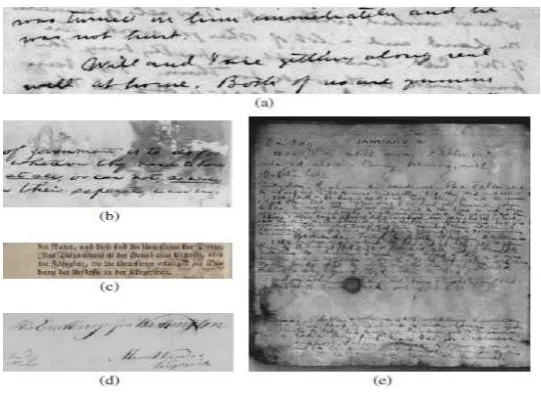
Fig. 1. Five degraded document image examples (a)–(d) are taken from DIBCO series datasets and (e)
is taken from Bickley diary dataset
II. RELATED WORKS
A new document image binarization technique that segments the text from badly degraded historical document
images. Here makes use of the image contrast that is defined by the local image maximum and minimum.
Compared with the image gradient, the image contrast evaluated by the local maximum and minimum has a nice
property that it is more tolerant to the uneven illumination and other types of document degradation such as
smear. Given a historical document image, the technique first constructs a contrast image and then detects the
high contrast image pixels which usually lie around the text stroke boundary. The document text is then
segmented by using local thresholds that are estimated from the detected high contrast pixels within a local
neighbourhood window.They divide this section into three subsections, which deal with the contrast image
construction, the high contrast pixel detection, and the local threshold estimation, respectively
2.1Contrast Image Construction
The image gradient has been widely used in the literature for edge detection. However, the image gradient is
often obtained by the absolute image difference within a local neighbourhood window, which does not
incorporate the image intensity itself and is so sensitive to the image contrast/brightness variation. Take an
936 | P a g e
stroke boundary) within bright document regions may be much higher than that within dark document regions.To detect the high contrast image pixels around the text stroke boundary properly, the image gradient needs to
be normalized to compensate for the effect of the image contrast or brightness variation. At the same time, the
normalization suppresses the variation within the document background as well. In the proposed technique, we
suppress the background variation by using an image contrast that is calculated based on the local image
maximum and minimum as follows:
where fmax(x, y) and fmin(x, y) refer to the maximum and the minimum image intensities within a local neighbourhood
window. In the implemented system, the local neighbourhood window is a 3 × 3 square window. The term e is a
positive but infinitely small number, which is added in case the local maximum is equal to 0.The image contrast
in above equation, lowers the image background and brightness variation properly. In particular, the numerator
(i.e. the difference between the local maximum and the local minimum) captures the local image difference that
is similar to the traditional image gradient. The denominator acts as a normalization factor that lowers the effect
of the image contrast and brightness variation. For image pixels within bright regions around the text stroke
boundary, the denominator is large, which neutralizes the large numerator and accordingly results in a relatively
low image contrast. But for image pixels within dark regions around the text stroke boundary, the denominator
is small, which compensates the small numerator and accordingly results in a relatively high image contrast. As
a result, the contrasts of image pixels (lying around the text stroke boundary) within both bright and dark
document regions converge close to each other and this facilitates the detection of high contrast image pixels
lying around the text stroke boundary(to be described in the next subsection).
2.2 High Contrast Pixel Detection
The purpose of the contrast image construction is to detect the desired high contrast image pixels lying around
the text stroke boundary. As described in the last subsection, the constructed contrast image has a clear bimodal
pattern where the image contrast around the text stroke boundary varies within a small range but is obviously
much larger compared with the image contrast within the document background. We therefore detect the desired
high contrast image pixels (lying around the text stroke boundary) by using Otsu’s global thresholding method.
2.3 Historical Document Thresholding
The text pixels can be classified from the document background pixels once the high contrast image pixels
around the text stroke boundary are detected properly. The document thresholding from the detected high
contrast image pixels is based on two observations. First, the text pixels should be close to the detected high
contrast image pixels because most detected high contrast image pixels lie around the text stroke boundary.
Second, the intensity of most text pixels should be close or lower than the average intensity of the detected high
contrast image pixels within a local neighbourhood window[4]-[6]. This can be similarly explained by the fact
that most detected high contrast image pixels lie around the text stroke boundary.
For each document image pixel, the number of the detected high contrast image pixels is first determined within
937 | P a g e
number of high contrast image pixels within the neighbourhood window is larger than a threshold. Thedocument image pixel can thus be classified based on its intensity relative to that of its neighboring high
contrast image pixels as
where Emean and Estd are the mean and the standard deviation of the image intensity of the detected high
contrast image pixels(within the original document image) within the neighbourhood window that can be
evaluated as
where I refers to the input document image and (x, y) denotes the position of the document image pixel under
study. E refers to the binary high contrast pixel image where E(x, y) is equal to 0 if the document image pixel is
detected as a high contrast pixel. Ne refers to the number of high contrast image pixels that lie within the local
neighbourhood window. So if Ne is larger than Nmin and I(i, j) is smaller than Emean+ Estd/2, R(i, j) is set at 1.
Otherwise(i, j) is set at 0.
Disadvantages:
It can’t handle document images with bright text properly. This is because a weak contrast will be
calculated for stroke edges of the bright text where the denominator in Equation(image contrast, is
calculated based on the local image maximum and minimum)will be large but the numerator will be
small.
Time consuming.
III. PROPOSED METHOD
In the proposed document image binarization techniques, given a degraded document image, an adaptive
contrast map is first constructed and the text stroke edges are then detected through the combination of the
binarized adaptive contrast map and the canny edge map. The text is then segmented based on the local
threshold that is estimated from the detected text stroke edge pixels. Some post-processing is further applied to
938 | P a g e
Fig2:System design of document image binarization technique3.1 Contrast Image Construction
The image gradient has been widely used for edge detection and it can be used to detect the text stroke edges of
the document images effectively that have a uniform document background. On the other hand, it often detects
many non-stroke edges from the background of degraded document that often contains certain image variations
due to noise, uneven lighting, bleed-through, etc. To extract only the stroke edges properly, the image gradient
needs to be normalized to compensate the image variation within the document background.
In earlier method , The local contrast evaluated by the local image maximum and minimum is used to suppress
the background variation as described in Equation (image contrast, is calculated based on the local image
maximum and minimum). In particular, the numerator (i.e. the difference between the local maximum and the
local minimum) captures the local image difference that is similar to the traditional image gradient. The
denominator is a normalization factor that suppresses the image variation within the document background. For
image pixels within bright regions, it will produce a large normalization factor to neutralize the numerator and
accordingly result in a relatively low image contrast. For the image pixels within dark regions, it will produce a
small denominator and accordingly result in a relatively high image contrast.However, the image contrast in the
earlier method has one typical limitation that it may not handle document images with the bright text properly.
This is because a weak contrast will be calculated for stroke edges of the bright text where the denominator in
Equation(image contrast, is calculated based on the local image maximum and minimum)will be large but the
numerator will be small. To overcome this over-normalization problem,we combine the local image contrast
with the local image gradient and derive an adaptive local image contrast as
where C(i, j ) denotes the local contrast in the previous equation and(Imax(i, j ) − Imin(i, j )) refers to the local
image gradient that is normalized to [0, 1]. The local windows size is set to 3 empirically. α is the weight
between local contrast and local gradient that is controlled based on the document image statistical information.
Ideally, the image contrast will be assigned with a high weight (i.e. large α) when the document image has
significant intensity variation. So that the proposed binarization technique depends more on the local image
contrast that can capture the intensity variation well and hence produce good results. Otherwise, the local image
939 | P a g e
and avoid the over normalization problem of our previous method.We model the mapping from document imageintensity variation to α by a power function as
where Std denotes the document image intensity standard deviation, and γ is a pre-defined parameter. The power
function has a nice property in that it monotonically and smoothly increases from 0 to 1 and its shape can be
easily controlled by different γ .γ can be selected from [0,∞], where the power function becomes a linear
function when γ = 1. Therefore, the local image gradient will play the major role in Ca(i, j )when γ is large and
the local image contrast will play the major role when γ is small.
3.2 Text Stroke Edge Pixel Detection
The purpose of the contrast image construction is to detect the stroke edge pixels of the document text properly.
The constructed contrast image has a clear bi-modal pattern [7],where the adaptive image contrast computed at
text stroke edges is obviously larger than that computed within the document background. We therefore detect
the text stroke edge pixel candidate by using Otsu’s global thresholding method.
As the local image contrast and the local image gradient are evaluated by the difference between the maximum
and minimum intensity in a local window, the pixels at both sides of the text stroke will be selected as the high
contrast pixels. The binary map can be further improved through the combination with the edges by Canny’s
edge detector, because Canny’s edge detector [8]-[13] has a good localization property that it can mark the
edges close to real edge locations in the detecting image. In addition, canny edge detector uses two adaptive
thresholds and is more tolerant to different imaging artifacts such as shading.
3.3 Local Threshold Estimation
The text can then be extracted from the document background pixels once the high contrast stroke edge pixels
are detected properly. Two characteristics can be observed from different kinds of document images: First, the
text pixels are close to the detected text stroke edge pixels. Second, there is a distinct intensity difference
between the high contrast stroke edge pixels and the surrounding background pixels. The document image text
can thus be extracted based on the detected text stroke edge pixels as
where Emean and Estd are the mean and standard deviation of the intensity of the detected text stroke edge
pixels within a neighbourhood window W, respectively. The neighbourhood window should be at least larger
than the stroke width in order to contain stroke edge pixels.
3.4 Post-Processing
The binarization result can be further improved by incorporating certain domain knowledge as described in post
processing algorithm. First, the isolated foreground pixels that do not connect with other foreground pixels are
filtered out to make the edge pixel set precisely. Second, the neighbourhood pixel pair that lies on symmetric
940 | P a g e
foreground text). One pixel of the pixel pair is therefore labelled to the other category if both of the two pixelsbelong to the same class. Finally, some single-pixel artifacts along the text stroke boundaries are filtered out by
using several logical operators.
Advantages:
The main advantages of the system are as follows:
It relies more on image gradient and avoid the over normalization problem
The proposed method simple, robust and capable of handling different types of degraded document
images with minimum parameter tuning
IV.
CONCLUSION
Segmentation of text from badly degraded document images is a very challenging task due to the high
inter/intravariation between the document background and the foreground text of different document images.
Here, propose a novel document image binarization technique that addresses these issues by using adaptive
image contrast. The adaptive image contrast is a combination of the local image contrast and the local image
gradient that is tolerant to text and background variation caused by different types of document degradations. In
the proposed technique, an adaptive contrast map is first constructed for an input degraded document image.
The contrast map is then binarized and combined with Canny’s edge map to identify the text stroke edge pixels.
The document text is further segmented by a local threshold that is estimated based on the intensities of detected
text stroke edge pixels within a local window. This is an adaptive image contrast based document image
binarization technique that is tolerant to different types of document degradation such as uneven illumination
and document smear. Moreover, it works for different kinds of degraded document images. The proposed
technique makes use of the local image contrast that is evaluated based on the local maximum and minimum.
The proposed method is simple, robust, and involves minimum parameter tuning
V.
ACKNOWLEDGEMENT
We would like to thank various technological experts who researches about degraded document image and
improve the result by implementing new methods. We would also like to thank Google for providing details on
different issues addressing the challenges of degraded document image binarization technique from twitter and
about other related techniques.
REFERENCES
[1] B. Gatos, K. Ntirogiannis, and I. Pratikakis, “ICDAR 2009 document image binarization contest
(DIBCO 2009),” in Proc. Int. Conf. Document Anal. Recognit., Jul. 2009, pp. 1375–1382.
[2] Pratikakis, B. Gatos, and K. Ntirogiannis, “ICDAR 2011 document image binarization contest (DIBCO
2011),” in Proc. Int. Conf. Document Anal. Recognit., Sep. 2011, pp. 1506–1510
[3] Pratikakis, B. Gatos, and K. Ntirogiannis, “H-DIBCO 2010 handwritten document image binarization
competition,” in Proc. Int. Conf. Frontiers Handwrit. Recognit., Nov. 2010, pp. 727–732.
[4] S. Lu, B. Su, and C. L. Tan, “Document image binarization using background estimation and stroke
941 | P a g e
[5] B. Su, S. Lu, and C. L. Tan, “Binarization of historical handwritten document images using localmaximum and minimum filter,” in Proc.Int. Workshop Document Anal. Syst., Jun. 2010, pp. 159–166.
[6] G. Leedham, C. Yan, K. Takru, J. Hadi, N. Tan, and L. Mian, “Comparison of some thresholding
algorithms for text/background segmentation in difficult document images,” in Proc. Int. Conf.
Document Anal. Recognit., vol. 13. 2003, pp. 859–864.
[7] O. D. Trier and T. Taxt, “Evaluation of binarization methods for document images,” IEEE Trans.
Pattern Anal. Mach. Intell., vol. 17,no. 3, pp. 312–315, Mar. 1995.
[8] J. Sauvola and M. Pietikainen, “Adaptive document image binarization,”Pattern Recognit., vol. 33, no.
2, pp. 225–236, 2000.
[9] J.-D. Yang, Y.-S. Chen, and W.-H. Hsu, “Adaptive thresholding algorithm and its hardware
implementation,” Pattern Recognit. Lett., vol. 15,no. 2, pp. 141–150, 1994.
[10]Blayvas, A. Bruckstein, and R. Kimmel, “Efficient computation of adaptive threshold surface for
image binarization,” Pattern Recognit.,vol. 39, no. 1, pp. 89–101, 2006.
[11]M. Sezgin and B. Sankur, “Survey over image thresholding techniques and quantitative performance
evaluation,” J. Electron. Imag., vol. 13,no. 1, pp. 146–165, Jan. 2004
[12]L. Eikvil, T. Taxt, and K. Moen, “A fast adaptive method for binarization of document images,” in
Proc. Int. Conf. Document Anal. Recognit., Sep. 1991, pp. 435–443.
[13]J. Canny, “A computational approach to edge detection,” IEEE Trans.Pattern Anal. Mach. Intell., vol.