389 | P a g e
ACTIVE BODY CONTROL SUSPENSION
Mahipati Dahiphale
1,Yogesh Chopade
2, ChetnaPatil
3, Prof. F.U. Pathan
41,2,3
Department of Mechanical Engg., BVCOE&RI, Nashik,(India)
4
Asst. Professor, Dept. of Mechanical Engg.(India)
ABSTRACT
Active Body Control or ABC is employed to explain hydraulic absolutely active suspension that enables
management of the vehicle body motions and thus just about eliminates body rolling in several driving things
together with cornering, fast and braking. Solely offered on rear-wheel drive models, all-wheel drive models
square measure offered solely with Air matic semi-active air suspension.In the ABC system, a laptop detects
body movement from sensors settled throughout the vehicle, and controls the action of the active suspension with
the employment of hydraulic servomechanisms. The hydraulic pressure to the servos is provided by a high radial
piston hydraulic ram. A complete of thirteen sensors regularly monitor body movement and vehicle level and
provide the alphabet controller with new knowledge each 10 milliseconds. Four level sensors, one at every
wheel live the ride level of the vehicle, 3 accelerometers live the vertical body acceleration, one acceleration
detector measures the longitudinal and one detector the crosswise body acceleration. At every hydraulic
cylinder, a pressure detector monitors the hydraulic pressure. Because the alphabet controller receives and
processes knowledge, it operates four hydraulic servos, every mounted nonparallel on a spring strut, beside
every wheel. Virtually instantly, the servo regulated suspension generates counter forces to body lean, dive and
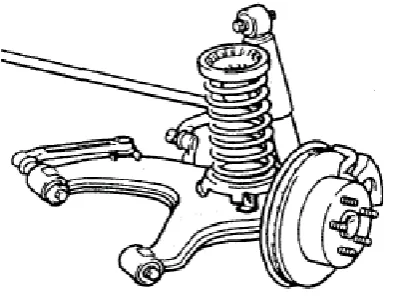
squat throughout numerous driving condition.A suspension strut, consisting of a steel spring and a cushion
square measure connected in parallel, yet as a hydraulically controlled adjusting cylinder, square measure
settled between the vehicle body and wheel. These parts modify the cylinder within the direction of the
suspension strut, and adjusted suspension length. This creates a force that acts on the suspension and wetting of
the vehicle within the frequency vary upto five hertz. The system conjointly incorporates height adjustable
suspension that during this case lowers the vehicle up to 11mm (0.43 in) between the speeds of sixty – a hundred
and sixty km/h for higher mechanics, fuel consumption, and handling.The alphabet system conjointly permits
self-levelling suspension that raises or lowers the vehicle in response to ever-changing load (i.e. the loading or
unloading of passengers or cargo). Every vehicle equipped with alphabet has Associate in nursing alphabet
sport button that enables the driving force to regulate the suspension vary for various driving vogue preferences.
This feature permits the driving force to regulate the suspension to keep up a lot of level ride in additional
stringent driving conditions.
Keywords: Suspension, Hydraulic fully active suspension, Vehicle body motions, Sensors, ABC
controller, ABC sport button, Suspension strut, shock absorber.
I. INTRODUCTION
An active mechanical system possesses the power to scale back acceleration of sprung mass endlessly yet on
390 | P a g e
traction management and vehicle manoeuvrability are often significantly improved. Today, a rebellious race is
happening among the automotive business thus on turn out extremely developed models. One in every of the
performance necessities is advanced suspension systems that forestall the road disturbances to have an effect on
the rider comfort whereas increasing riding capabilities and playacting a sleek drive. whereas the aim of the
mechanical system is to supply a sleek ride within the automobile and to assist maintain management of the
vehicle over rough piece of land or just in case of fulminant stops, increasing ride comfort ends up in larger
suspension stroke and smaller damping within the wheel hop mode. Several management ways are planned to
beat these suspension issues. Several active suspension management approaches like Linear Quadratic Gaussian
(LQG) management, adjective management, and non-linear management square measure developed and planned
thus on manage the occurring issues.
II. LITERATURE REVIEW
The first complete and prepared for production version of alphabet was introduced in 1999 on the top-of-the-line
Mercedes-Benz CL-Class in 2010 across wind stabilization perform was introduced.Magic Body management in
2007, the Mercedes-Benz F700 construct introduced the PRE-SCAN suspension, Associate in Nursing early
paradigm road scanning suspension, mistreatment sensors, supported Active Body management.In 2013 the new
Mercedes-Benz S-Class (W222) introduced the series production version of PRE-SCAN, however with a stereo
camera rather than optical device projectors.In 2014 the new C217S-Class auto introduced Associate in nursing
update to Magic Body management, known as Active Curve Tilting. This new system permits the vehicle to lean
up to two.5 degrees into a flip, almost like the approach a bike leans into a flip.
III. PROPOSED SYSTEM
391 | P a g e
Fig 3.2 Working of ABC suspension
In this study, Associate in Nursing automatic mechanical system for 1 / 4 automobile is taken into account
Associate in Nursing an intelligent controller is meant once the vehicle is experiencing any road disturbance (i.e.
pot holes, cracks, and uneven pavement), the vehicle body mustn't have massive oscillations, and also the
oscillations ought to dissipate quickly. The road disturbance is simulated by a step input as a soft trial and rough
road as a simulated to possible way and also the distance between the body mass and simulation mass is output
of the system.
Fig.3.3Schematic quarter car model.
The objective of the current report is to focus on the various technological processes used for suspension
Systems management as a primary step within the recent paper.
IV. SUSPENSION SYSTEM MODEL
Passive suspensions as shown in Fig.3.3.can solely accomplishes smart ride comfort or good road holding since
these 2 criteria conflict one another and necessitate totally different spring and damper characteristics. Whereas
392 | P a g e
supply a substantial improvement.
A significant improvement are often achieved by mistreatment of an energetic mechanical system, that provided
a better power from Associate in Nursing external supply to get suspension forces to realize the required
performance. The force could also be a perform of many variables which may be measured or remotely detected
by numerous sensors, that the flexibility are often greatly enhanced.With speedy advances in electronic
technologies, the event of style techniques for the synthesis of active vehicle suspension systems has been an
energetic space of analysis over the last 20 years to realize a stronger compromise throughout numerous driving
conditions.Automotive Corporation’s square measure competitive to create a lot of developed cars, whereas
comfort of passengers is a crucial demand and everybody expects from industries to boost it day by day.
Therefore, so as to supply a sleek ride and satisfy passengers comfort, planning a contemporary mechanical
system is necessary. a decent and economical mechanical system should speedily absorb road shocks then come
to its traditional position, slowly. However, in an exceedingly passive mechanical system with a soft spring,
movements are high, whereas mistreatment arduous springs causes arduous moves because of road roughness.
Therefore, it’s troublesome to realize smart performance with a passive mechanical system.In order to meet the
target of planning an energetic mechanical system i.e. to extend the ride comfort and road handling, there square
measure 3 parameters to be determined within the simulations. The 3 parameters square measure the wheel
deflection, dynamic tire load and automobile body acceleration. For definition of the allowable limits of
automobile body acceleration, there's a frequency domain wherever citizenry square measure most sensitive to
vibration (human sensitivity band). Fig. three provides a measured result from a report of ISO/DIS 5349 & ISO
2631 - 1978, that shows the human endurance limit to waveband to vertical acceleration is four ~ 8Hz, which
implies that for the aim of rising the ride comfort the automobile body acceleration gain ought to be during this
vary [38]. so as to boost the ride quality, it's necessary to isolate the body, conjointly known as sprung mass,
from the road disturbances and to decrease the resonance peak of the sprung mass close to one cycle, that is
understood to be a sensitive frequency to the anatomy. so as to boost the ride stability, it's necessary to stay the
tire connected with the paved surface and thus to decrease the resonance peak close to ten cycle, that is that the
resonance frequency of the wheel also known as international organization sprung mass.The mounted setting of
a passive mechanical system is usually a compromise between comfort and safety for any given input set of road
conditions on one hand and payload suspension parameters on the opposite. Semi-active/active suspension
systems try and solve or a minimum of scale back this conflict. during this regard, the mechanism of semi-active
suspension systems is that the adaptation of the damping and/or the stiffness of the spring to the particular
demands. Active suspension systems in distinction offer an additional force input additionally to potential
existing passive systems and thus want far more energy. This conjointly clarifies the dependency of a vehicle
suspension setup on parameter changes as a results of temperature, deflection, and wear and tear. These changes
should be taken under consideration once planning a controller for an energetic or semi-active suspension to
avoid excess performance loss.
V. QUARTER VEHICLE ACTIVE SUSPENSION SYSTEM
In this search, we tend to square measure considering 1 / 4 automobile model with 2 degrees of freedom. This
393 | P a g e
The motion equations of the automobile body and also the wheel square measure as follows:
mbzb= fa- k1 (zb- zw ) -Cs (zb- zw )
mwzw=-fa+k1 (zb- zw ) -k2 (zw- metallic element )
With the subsequent constants and variables that respect the static equilibrium position:
omb= body mass (one quarter of the entire body mass) 250 kilogram
o mw= wheel mass, 35 kg
o k1 = spring constant (stiffness) of the body sixteen 000 N/m
o K2 = spring constant (stiffness) of the wheel a hundred and sixty 000 N/m
osolfa syllable = desired force by the cylinder
o metal = damping quantitative relation of the damper 980 Ns/m
o metallic element = road displacements
ozb= body displacement
ozw= wheel displacements
VI. SYSTEMS AND TECHNOLOGIES FOR SUSPENSIONS SYSTEMS CONTROL
Two criteria of excellent vehicle suspension performance square measure generally their ability to supply good
road handling and enhanced rider comfort. The most disturbance poignant these 2 criteria is piece of land
irregularities. Active suspension management systems scale back these undesirable effects by analytic
automobile body motion from vibrations at the wheels.Vehicle mechanical system performance is often rated by
its ability to supply improved road handling and improved rider comfort. Current automobile suspension
systems mistreatment passive parts will solely supply a compromise between these 2 conflicting criteria by
providing spring and damping coefficients with mounted rates.Sport cars typically have stiff, harsh suspensions
with poor rider comfort whereas luxury sedans supply softer suspensions however poor road handling
capabilities. the standard engineering apply of planning spring and damping functions as 2 separate functions
has been a compromise from its origination within the late 1800s. Poor road handling capability and shrunken
rider comfort square measure because of excess automobile body vibrations leading to artificial vehicle speed
limitations, reduced vehicle-frame life, biological effects on passengers, and prejudicial consequences to
payload. Active suspension management systems aim to ameliorate these undesirable effects by analytic the
automobile body from wheel vibrations induced by uneven piece of land.The main objective of suspension
systems is to scale back motions of the sprung mass. it's documented that motions of the sprung mass at the
wheel frequency modes cannot be reduced if the sole management input could be a force applied between the
sprung and international organization sprung plenty (as is that the case for vehicle suspension systems). Several
management approaches are investigated for the quarter-vehicle case like nonlinear management, best
management and back stepping management. To boot, best management approaches are applied to the
full-vehicle case yet. An energetic mechanical system ought to be ready to offer totally differentBehavioural
characteristics dependent upon numerous road conditions and be ready to do thus while not going on the far side
its travel limits.It is shown therein employing a force management loop to catch up on the hydraulic dynamics
will destabilize the system. This full nonlinear management downside of active suspensions has been
394 | P a g e
VII. CONCLUSION
Active suspension offers several edges over standard and semi-active suspension systems.
A realization of a hybrid mechanical system has been bestowed. The system involves an endlessly variable
semi-active damper and a coffee information measure mechanism that is enforced nonparallel to the first spring
of the suspension. The hybrid suspension are often complete mistreatment stock hardware of production
vehicles. The bestowed models of the actuators mirror their dynamic behaviour well and also the clear
management ideas square measure well applicable in terms of procedure quality for real time application at the
take a look at rig.Future work of the authors can involve a lot of advanced management schemes for the
semi-active damper yet as additional study of high-level vehicle suspension management ideas for the hybrid
mechanical system.Suspensions management is very a troublesome management downside because of the
sophisticated relationship between its parts and parameters. The researches were applied in suspensions
management systems cowl a broad vary of style problems and challenges. Within the gift survey we tend to
explore the techniques of answer procedures of various management policies like classical and intelligent
management ways.
ACKNOWLEDGEMENT
We would like to convey our gratitude and respect to our resourceful guide, mentor, Prof. F.U. Pathan,
Department of Mechanical Engineering, BVCOE&RI, Nashik for his valuable guidance and support which was
instrumental for the successful completion of the seminar.We would like to express our sense of gratitude to
Prof. D.D. Patil, Head of the Department, Mechanical Engineering Department, Prof. C.K. Patil, Principal,
BVCOE&RI, Nashik. It was their constant encouragement and inspiration that enabled us to successfully
complete the seminar work.We would also like to thank the entire teaching faculty, non-teaching staff, our
friends and family who continue to support us in all of ourendeavours.
REFERENCES
[1]. Alleyne, A., and Hedrick, J. K., “Non-linear Adaptive Control of Active Suspensions,” IEEE Trans. Control
Syst. Technol., 3(1), 1995,pp. 94–101.
[2]. Ben Gaid, M., Cela, A.,Kocik, R., “Distributed control of a car suspension system,” COSI - ESIEE - Cit´e
Descartes,
[3]. A.G. Thompson, "Design of active suspensions", Proc. Instn. Mech.Engrs., 185:553–563, 1970–1971.
[4]. D.A. Crolla and A.M.A. AboulNour, "Theoretical comparisons of various active suspension systems in
terms of performance and power requirements", Proceedings of IMecE Conference on Advanced
Suspensions, C420/88:1–9, 24–25 October 1988.
[5]. W. Gao, N. Zhang and H. P. Du, “A half-car model for dynamic analysis of vehicles with random parameters”, 5th Australasian Congress on Applied Mechanics, ACAM , 2007, 10-12 December 2007,
395 | P a g e
[6]. Anil Shirahatt, P.S.S. Prasad, and M.M. Kulkarni, “Optimal Design of Passenger Car Suspension for Ride and Road Holding” J. of the Braz. Soc. of Mech. Sci. & Eng. January-March 2008, Vol. XXX, No. 1
pp.66-77.
[7]. Barron, M. B. and Powers, W. F., 1996, "The Role of Electronic Controls for Future Automotive
Mechatronics Systems ,"IEEE/ASM
[8]. Yue, C., Butsuen T., and Hedrick, J.K.: Alternative control laws for automotive active suspensions, ASME,
Journal of Dynamic Systems, Measurement and Control, 111 (1989), pp 286-291.E Trans. Mechatronics,
Vol. 1, No. 1, pp. 80-88.
[9]. Hac, A., Youn, I., and Chen, H.H.: Control of suspension for vehicles withflexible bodies - Part I: active
suspensions. ASME, Journal of Dynamic Systems, Measurement and Control, 118 (1996), pp 508- 517.
[10]. Wilson D A, Sharp R S, Hassan S A, “Application of linear optimal control theory to the design of automobile suspensions”. Vehicle System Dynamic, 1986, 15: pp.103~118.
[11]. M.M.M. Salam and Ayman A. Aly, "Fuzzy control of a quarter-car suspension system", International