IJEDR1702052
International Journal of Engineering Development and Research (www.ijedr.org)309
EA Based Approach for Resource Allocation in Cloud
Computing
1Robin Khunger, 2Pa wan Luthra, 3Bindu Ba la 1
SBSSTC,Fero zepur, 2SBSSTC,Fero zepur, 3SBSSTC,Ferozepur
Abstract
—
In Cloud Environment, the process of execution requires Resource Management due to the high process to the resource ratio. Resource Scheduling is a complicated task in cloud computing environment because there are many alternative computers with varying capacities. Scheduling is one of the most important tasks in cloud computing environment. In this paper, we have analyzed various scheduling algorithm and tabulated various parameter. We have noticed that disk space management is critical issue in virtual environment. Existing scheduling algorithm gives high throughput and cost effective but they do not con sider reliability and availability. So we need algorithm that improves availability and reliability in cloud computing environment In the proposed approach the Evolutionary Algorithm is applied in this load sharing algorithm. Using the proposed approach a reserved resources are kept in order to tackle any kind of bursty traffic or bursty tasks. To validate the results of proposed approach various metrics are used like delay, delivery time, energy efficiency, throughput, down time etc. From the results section it is clear that the proposed approach is better than that of existing studies.. Keywords: Cloud, VM, Host, VM Placement SchemesI. IN TRO DUC TION
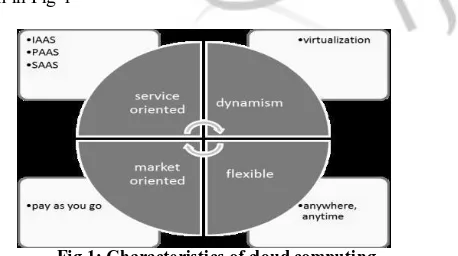
With the event of high speed networks, there's associate dire rise in its usage comprised of internet queries on a daily basis and thousands of e-commerce transactions. an oversized scale knowledge centers handle this ever increasing demand by consolidating tons of and thousands of servers with different infrastructure like cooling, network systems and storage. the event of this comme rcia lisation is called as cloud co mputing. Clouds square measure sky rocket ing virtualized knowledge centers and applications offered as services on a subscription basis. The characteristics exhib ited by Clouds square measure shown in Fig 1
Fig 1: Characteristics of cloud computing
Cloud delivers 3 va riety of services like co mputer code as a Service (SaaS), Platform as a Service (Paa S) and
IJEDR1702052
International Journal of Engineering Development and Research (www.ijedr.org)310
SPA is AN approach that takes under consideration theprovision of the full network resource, whereas guaranteeing load-balancing and SLAs objectives. to realize th is, migrat ing Virtual Data Center Networks (VDNs) ought to clearly specify its elaborate resource necessities (i.e. the resource vector) to the hosting physical network. this may give for best place ments and satisfying services. during this context, necessities might vary fro m a virtual network to a diffe rent, looking on the thought of topologies and also the provided services. However, a mong all the network parts, the challenge for the hosting CDNs (i.e. the physical ones) chiefly lies within the change capabilit ies of its network, additional e xactly, its path process capacities. Indeed, wherever for a packet to urge processed through a change device, sure resources area unit needed. during this context, allow us to outline the physical switch as a collect ion of virtual switches, wherever every virtual switch operates a collection o f v irtual change ways. Mainly, a virtual change path to work needs a collection of: (1) packet process resources (network processor cycles, search caches, me mories); (2) ports; (3) informat ion measure over the ports. Typically, for a packet process task to work, this requires: (1) processors (for parsing and analysis); (2) recollect ions (for the search tables) which will be either internal or e xterna l (e.g. TCAMs, SRAMs); (3) queues (for packets’ programing and storage, and for the method of shaping priorities); (4) in formation measure over the busses that interconnect the aforesaid internal parts. consequently, such physical resources are nearly div ided a mong the various virtual knowledge ways that area unit allotted (reserved) to satisfy the wants of the VDNs topologies. Hence, for economical a llocations and best place ment selections, such resource vectors got to be clear so as to see for resource convenience at the hosting physical network.
III.PROBLEM FO RMULATIO N
Interesting models that tackle the problem of virtual machines place ment are a lready proposed in the lite rature. However, to the best of our knowledge, no work tackles the proble m of placing a full network as one package. In this context, place ment models should provide for performance optima lity for the whole parties involved in the placement process. Indeed, where is not a wise solution to place a virtual mach ine in a way that fulfills its performance require ments but causing problems to others. Considering the p lace ment costs is also a crucial factor in such decision, however, other factors like load-balancing and QoS guarantees are also important. • First, the candidate PMs are chosen in a way that does not consider that fact that reaching those PMs is done through a network that consists of several nodes (i.e . the connecting devices like switches and routers) interconnected via set of lin ks (i.e. bandwidth resources). Checking the resource availability at the servers only is not enough to provide a proper candidate to hold the required applications or the needed services. Typically, this model will result in a non-optima l p lace ment decision. Indeed, where being part o f a network, it is some times mo re crucia l to check the resource
availability over the network co mponents (e.g. switches and lin ks) that interconnects such servers with the end-users. Without these resources, servers capacity is useless!
• Second, the migrat ion-based placement scenario a llo ws migrat ing the already placed VMs fro m one PM to another in a way to ma ke space for a new VM to be place instead. This is not efficent, as those VMs that already been placed and run over a PM may have functional dependencies between each other or with other VMs fro m different PMs5. M igrating (re-placing) such VMs to new PMs may not be a feasible process, as this may cause s everal proble ms (e.g. service fa ilures, interruptions) for many VMs which may violate the Service Level Agree ments (SLAs) and the contracted QoS guarantees. Third, the proposed model does not consider the load -balancing issues. Choosing the candidate PMs according to the total completion time does not necessarily comply with the load-balancing objectives. Administrators of Cloud -service networks always aim to ma ximize their revenue objectives while not violat ing the SLAs and the QoS guarantees provided to their customers. To do so, they tend to keep the loads over their networks balanced in a way to avoid congestions or any other problems that may harm the network performance.
IV. FLOW CHART
Start
Create resource vector of VDN
Check input of VDN resource vector
Prepare CDN according to entries of
VDN
Check requirement of Virtual Nodes
Check Resource of Host M achine
Resource Check another Host
Available
Allocate Virtual node to Host
Compare and validate results
IJEDR1702052
International Journal of Engineering Development and Research (www.ijedr.org)311
Fig 3: Flow Chart
STEP 1: Virtual machines in idle state. It describes about the main screen that is showing the machines that are in the idle state that is no load is assigned to them. In the proposed scheme the load migrated is done on the basis of parameters like utilization, speed, me mory and power where VM is the virtual mach ine.
STEP 2: Load the machines. It describes about the mach ines when load is assigned to all the machines. The assigned values described about the load on various machines. When the load is allocated to the various machines continuously and it reaches the threshold value, the load will be migrated fro m that loaded machine to the other underloaded machine.
STEP 3: Overloaded Machine. It describes about t he overloaded machine that is in the red mark. The assumed threshold for the overload condition to occur is above 80%.When the threshold is crossed, the load in the machine is migrated to the optima l destination having less load on it.
STEP 4: According to the priority with respect to the parameters like utilizat ion, me mory, speed and power of the virtual machines, the optima l destination is chosen. It describes about the selection of the candidate Virtual Mach ine that to which the load is to be transferred according to the priority table. In the research a priority table is developed by the algorithm, for the calcu lation of the destination machine.
STEP 5: Select ion of the Virtual Machine that to which the load is to be transferred according to the priority table. The optima l destination is chosen according to the priority with respect to the parameters like utilizat ion, me mo ry, speed and power of the virtual mach ines. The machine having less load on it and greater speed and better power, the load wi ll be transferred to it. It describes about the selection of the candidate Virtual Machine that to which the load is to be transferred according to the priority table.
STEP 6: Downtime during the load sharing. Downtime is defined as the time at wh ich the v irtual machines stop e xecuting. It includes transfer of the processor state. In the proposed approach, the downtime is decreased which results in better performance. The downtime can be calculated by the formula :
Total Do wntime = Stop-and-copy + co mmit ment + activation.
STEP 7: Efficiency. In the proposed approach, the effic iency of the system is imp roved.
V. RESULT S AND DISCUSSION
Make S pan: In the proposed approach, the makespan is decreased which results in better performance.
Fig 4: Makespan
Load: In the proposed approach, the load of the system is improved.
Fig 5: Load
Throughput: Throughput may be defined as the ratio of output to input in a system. In this graph the throughput of the proposed system is better than that of existing scheme.
Fig 6: Throughput
IJEDR1702052
International Journal of Engineering Development and Research (www.ijedr.org)312
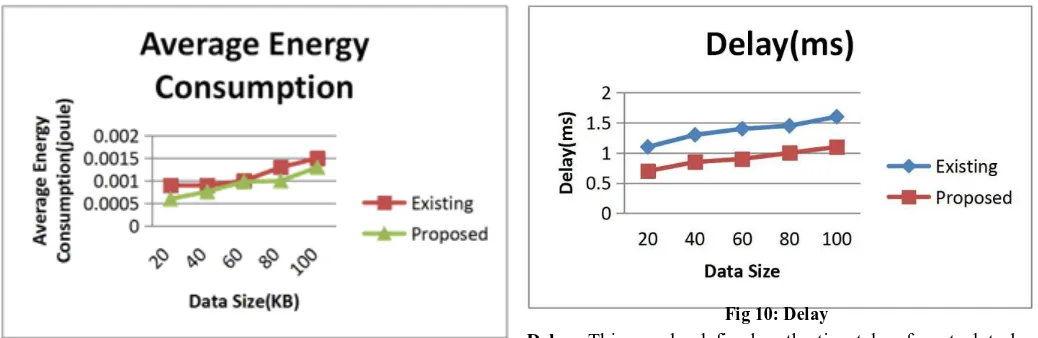
Fig 7: Average Energy ConsumptionComparison Table of work performe d:
Here the co mparison takes place between the base paper and the work perfo rmed. The results produced by the work are better than the previous work done.
Fig 8: Down Time(sec)
Down Ti me: Th is may be defined as the time span for wh ich the system was in the idle state, in wh ich no work is done. Fro m the graph it is clear that the down time in proposed system is less than that of e xisting system.
Fig 9: Efficiency
Efficiency: This may be defined as the ratio of output to the input. Effic iency of a system may define the performance of it. Fro m the graph it is clear that the effic iency in proposed system is more than that of e xisting system.
Fig 10: Delay
Delay: This may be defined as the time taken for a task to be completed. Fro m the graph it is clear that the delay in proposed system is less than that of existing system.
Fig 11: Delivery Time (ms)
Deli very Time (ms): This may be defined as the time ta kenfor a task to be delivered. Fro m the graph it is clear that the de lay in proposed system is less than that of e xisting system.
Table 1: Comparison table of work performed
A p p ro a D o w n Effici Make Load T h ro ug Av g D e l D e l ch Ti me(s ency( S p an (bits) hp ut (bi E n e rgy ay iver
ec) % ) (ms) ts ) C on su m y
pt io n (jo T i m
ule) e
L B M P 11.3 85 0.2 0.9 11 00 0.0013 10. 9.5
SO 6
E A 9.7 93 0.14 0.8 12 00 0.001 8.7 7.9
Downtime is defined as the time at which the v irtual machines stop executing. It inc ludes transfer of the processor state. In the proposed approach, the downtime is decreased which results in better performance.
VI. CONCLUSION
IJEDR1702052
International Journal of Engineering Development and Research (www.ijedr.org)313
significant effect is found on response time and it re mainsconstant for which these parameters are investigated. But in case of Cloudlet long length versus Host bandwidth a pattern is observed in which response time increases in proportionate manner. Using the modified approach the reduction in the down time of the various processes are achieved as shown in results.
VII. REFERENCES
[1]. Ahmad Nahar Quttoum, Mohannad Tomar, Bayan Khawaldeh, Rana Refa i, Alaa Ha lawani, Ah mad Freej, “SPA: Smart Placement Approach for Cloud-service Datacenter Networks”, The 10th International Conference on Future Net works and
Co mmunicat ions, Vo l: 56, 2015, pp: 341-348 [2]. Chonglin Gu , Pengzhou Shi, Shuai Shi, He jiao
Huang, Xiaohua Jia , "A Tree Regression-Based Approach for VM Powe r Metering", Special Section On Big Data For Green Co mmunications And Co mputing, IEEE, June 1, 2015
[3]. Zhaoning Zhang, Ziyang Li, Ku i Wu, Dongsheng Li, Huiba Li, Yu xing Peng, Xicheng Lu, " VMThunder: Fast Provisioning of La rge-Sca le Virtual Mach ine Clusters", IEEE TRA NSA CTIONS ON PA RA LLEL AND DISTRIBUTED SYSTEMS, Vo l. 25, No. 12, DECEM BER 2014
[4]. Jia xin Li, Dongsheng Li, Yu ming Ye, Xicheng Lu, "Effic ient Multi-Tenant Virtual Machine Allocation in Cloud Data Centers", TSINGHUA SCIENCE AND TECHNOLOGY, ISSN: 1007-0214, Vo lu me 20, Nu mber 1, February 2015, pp: 81-89
[5]. Gu rsharan Singh, Sunny Beha l, Monal Tane ja, "Advanced Memory Reusing Mechanism for Virtual Machines in Cloud Co mputing", 3rd International Conference on Recent Trends in Co mputing, Vo l: 57, 2015, pp: 91-103
[6]. Narander Ku mar, Swati Sa xena, "Migrat ion Performance of Cloud Applications - A Quantitative Analysis", International Conference on Advanced Co mputing Technologies and Applications, Vol. 45, 2015, pp: 823-831
[7]. Aarti Singh, Dimple Juneja, Manisha Malhotra, "Autonomous Agent Based Load Balancing Algorith m in Cloud Co mputing", International Conference on Advanced Computing Technologies and Applications, Vol: 45, 2015, pp: 832-841 [8]. S. Sohrabi, I. Moser, "The Effects of Hotspot
Detection and Virtual Machine Migration Polic ies on Energy Consumption and Service Leve ls in the Cloud", ICCS, Vo l: 51, 2015, pp : 2794-2798
[9]. Mohammad Mehedi Hassan, Atif Alamri, " Virtual Machine Resource Allocation for Mu ltimed ia Cloud: A Nash Bargain ing Approach", International
Symposiu m on Emerg ing Inter-networks, Co mmunicat ion and Mobility, Vol: 34, 2015, pp: 571-576
[10]. Christina Terese Josepha, Chandrasekaran K, Robin Cyriaca, "A Novel Fa mily Genetic Approach for Virtual Machine A llocation", International Conference on Information and Co mmun ication Technologies, Vo l: 46, 2015
[11]. Antony Thomas, Krishnalal G, Jagathy Raj V P, "Credit Based Scheduling Algorith m in Cloud Co mputing Environ ment", International Conference on Information and Co mmun ication Technologies, Vo l: 46, 2015, pp: 913-920
[12]. Doshi Chintan Ketanku ma r, Gau rav Ve rma , K. Chandrasekaran, "A Green Mechanis m Design Approach to Automate Resource Procure ment in Cloud", Eleventh International Multi-Conference on Information Processing, Vo l: 54, 2015, pp: 108-117 [13]. A.I.Awad, N.A.El-Hefna wy, H.M.Abdel_kader,
"Enhanced Particle Swarm Optimizat ion For Task Scheduling In Cloud Co mputing Environ ments", International Conference on Co mmunication, Management and Informat ion Technology, Vol: 65, 2015, pp: 920-929
[14]. Arunkumar. G, Nee lanarayanan Ven katara man, "A Novel Approach to Address Interoperability Concern in Cloud Co mputing", 2nd International Sy mposium on Big Data and Cloud Co mputing, Vo l: 50, 2015, pp : 554-559
[15]. Atul Vikas La kra , Dharmendra Ku ma r Yadav, "Multi-Ob jective Tasks Scheduling A lgorith m for Cloud Co mputing Throughput Optimization", International Conference on Intelligent Co mputing, Co mmunicat ion & Convergence, Vol: 48, 2015, pp: 107-113
[16]. Narander Ku ma r, Swat i Sa xena, "A Preference-based Resource Allocation In Cloud Co mputing Systems", 3rd International Conference on Recent Trends in Co mputing, Vo l: 57, 2015, pp: 104-111 [17]. Nidhi Bansal, A mitab Maurya, Tarun Ku mar,
Manzeet Singh, Shruti Bansal, "Cost performance of QoS Driven task scheduling in cloud computing", Third International Conference on Recent Trends in Co mputing, Vo l: 57, 2015, pp: 126-130
[18]. Mehmet Sahinoglua, Sharmila Ashokan, Preethi Vasudev, "Cost-Effic ient Risk Management with Reserve Repair Crew Planning in CLOUD Co mputing", Cost-Effic ient Risk Manage ment with Reserve Repair Crew Planning in CLOUD Co mputing, Vo l: 62, 2015, pp: 335-342