www.clim-past.net/8/683/2012/ doi:10.5194/cp-8-683-2012
© Author(s) 2012. CC Attribution 3.0 License.
Climate
of the Past
A multi-proxy perspective on millennium-long climate variability in
the Southern Pyrenees
M. Morell´on1,2,3, A. P´erez-Sanz3, J. P. Corella2,3, U. B ¨untgen4, J. Catal´an5, P. Gonz´alez-Samp´eriz3,
J. J. Gonz´alez-Trueba6, J. A. L´opez-S´aez7, A. Moreno2,3, S. Pla-Rabes5, M. ´A. Saz-S´anchez8, P. Scussolini9,12, E. Serrano10, F. Steinhilber1, V. Stefanova11, T. Vegas-Vilarr ´ubia12, and B. Valero-Garc´es2,3
1Eawag, Swiss Federal Institute of Aquatic Science and Technology, Department of Surface Waters, berlandstrasse 133,
8600 D¨ubendorf, Switzerland
2Laboratorio Internacional de Cambio Global (LINCGlobal), PUC-CSIC, Departamento de Ecolog´ıa, Facultad de Ciencias Biol´ogicas, PUC, Alameda 340, PC 6513677 Santiago, Chile
3Departamento de Procesos Geoambientales y Cambio Global, Instituto Pirenaico de Ecolog´ıa (IPE) – CSIC,
Campus de Aula Dei. Avda, Monta˜nana 1005, 50059 Zaragoza, Spain
4Swiss Federal Research Institute for Forest, Snow and Landscape (WSL) ETH domain Z¨urich,
8903 Birmensdorf, Switzerland
5Centre d’Estudis Avanc¸ats de Blanes (CEAB) – CSIC. C/ Acc´es a la Cala St. Francesc, 14, 17300 Blanes, Spain 6Departamento de Geograf´ıa, Prehistoria y Arqueolog´ıa, Calle Tom´as y Valiente s/n. 01006 Vitoria-Gasteiz, Spain 7Centro de Ciencias Humanas y Sociales, CCHS-CSIC, C/ Albasanz, 26-28, 28037 Madrid, Spain
8Departamento de Geograf´ıa y Ordenaci´on del Territorio, Facultad de Filosof´ıa y Letras, Universidad de Zaragoza,
Calle Pedro Cerbuna 12, 50009 Zaragoza, Spain
9Faculty of Earth and Life Sciences, Department of Marine Biogeology, Vrije Universiteit, De Boelelaan 1085,
1081HV Amsterdam, The Netherlands
10Subunidad de Geograf´ıa F´ısica Departamento de Geograf´ıa, Facultad de Filosof´ıa y Letras, Plaza del Campus s/n,
47011 Valladolid, Spain
11Limnological Research Center, University of Minnesota, 310 Pillsbury Drive SE, Minneapolis, MN 55455, USA 12Departament of Ecology, Faculty of Biology, University of Barcelona, Av, Diagonal 645, 08028 Barcelona, Spain
Correspondence to: M. Morell´on ([email protected])
Received: 23 September 2011 – Published in Clim. Past Discuss.: 4 October 2011 Revised: 5 February 2012 – Accepted: 12 March 2012 – Published: 30 March 2012
Abstract. This paper reviews multi-proxy paleoclimatic
re-constructions with robust age-control derived from lacus-trine, dendrochronological and geomorphological records and characterizes the main environmental changes that oc-curred in the Southern Pyrenees during the last millennium. Warmer and relatively arid conditions prevailed during the Medieval Climate Anomaly (MCA, ca. 900–1300 AD), with a significant development of xerophytes and Mediterranean vegetation and limited deciduous tree formations (meso-phytes). The Little Ice Age (LIA, 1300–1800 AD) was gen-erally colder and moister, with an expansion of deciduous taxa and cold-adapted montane conifers. Two major phases occurred within this period: (i) a transition MCA–LIA, char-acterized by fluctuating, moist conditions and relatively cold temperatures (ca. 1300 and 1600 AD); and (ii) a second pe-riod, characterized by the coldest and most humid condi-tions, coinciding with maximum (recent) glacier advances
(ca. 1600–1800 AD). Glaciers retreated after the LIA when warmer and more arid conditions dominated, interrupted by a short-living cooling episode during the late 19th to early 20th centuries. Some records suggest a response to solar ac-tivity with colder and slightly moister conditions during so-lar minima. Centennial-scale hydrological fluctuations are in phase with reconstructions of NAO variability, which ap-pears to be one of the main climate mechanisms influencing rainfall variations in the region during the last millennium.
1 Introduction
global warming scenario has provoked an increasing inter-est in studies of climate fluctuations prior to the industrial era (Jansen et al., 2007). Furthermore, long-term palaeocli-matic perspectives offer an excellent basis to improve predic-tive models (Solomon et al., 2007). Past climate conditions have been reconstructed using various proxies, such as tree rings (B¨untgen et al., 2011), lake sediments (Last and Smol, 2001), historical documents (Br´azdil et al., 2005, 2010), ma-rine sediments (Abrantes et al., 2005), corals (Goodkin et al., 2008), speleothems (Proctor et al., 2002), and, ideally, a combination thereof (Jones et al., 2009).
In spite of an wide range of associated uncertainties (Frank et al., 2010), most climate reconstructions agree on the exis-tence of two different stages with distinct climatic conditions during the last millennium: a period of relatively high tem-peratures at∼900–1300 AD, known as the Medieval Climate Anomaly (MCA); and a phase with relatively cooler tem-peratures at ∼1300–1800 AD, the so-called Little Ice Age (LIA). Unfavourable climate conditions during the LIA had also a considerable impact in European societies (Fagan, 2000). They likely contributed to the decline of health and economic wealth of medieval societies triggered by the Black Death (B¨untgen et al., 2011), for instance, and led to the abandonment of different areas such as Norse settlements in Greenland (Patterson et al., 2010; D’Andrea et al., 2011). Despite the precise chronology, the spatial extent and mech-anisms behind these climatic phases still remain a subject of debate (Paasche and Bakke, 2010).
The impact of the LIA on Central European ecosystems and societies has been widely documented (B¨untgen et al., 2011; Magny et al., 2011b; Denton and Broecker, 2008). However, environmental responses to the LIA in the Mediter-ranean region are not yet well understood (Touchan et al., 2011; Esper et al., 2007; B¨untgen et al., 2008, 2010b; Luter-bacher et al., 2005). Several studies have suggested that the hydrological impact of climate changes will dramati-cally affect snow-fed watersheds, such as the headwaters of many rivers located in the Pyrenees (Beniston, 2003; Garc´ıa-Ruiz et al., 2011). The Southern Pyrenees constitute the main source of water resources at present, supplying more than 45 % of the annual runoff to the surrounding semi-arid Ebro Basin, a relatively densely populated area of NE Spain (L´opez-Moreno and Garc´ıa-Ruiz, 2004). To understand fu-ture climate changes induced by global warming it is neces-sary to assess the impact of climate change on the hydrologi-cal cycle and through examination of climate variability and threshold values during the last millennia.
New information from different palaeoclimatic archives in the Pyrenees during the last millennium has become avail-able during recent years: lacustrine records (Valero-Garc´es and Moreno, 2011, and references therein), glacier exten-sion (Gonz´alez Trueba et al., 2008) and dendroclimatic re-constructions (B¨untgen et al., 2008). Together they pro-vide a unique opportunity to assess the timing, amplitude, and internal structure of this period, and a re-evaluation of
the environmental changes associated with the LIA phase in the Southern Pyrenees. This paper reviews the avail-able near millennium-long palaeoclimatic evidence from the Pyrenees, including: (i) glacier advances and retreats re-constructed from moraine sediments, (ii) the climatic and landscape changes evidenced by multi-proxy-based lake and shallow-marine sediments reconstructions, and (iii) the rain-fall and temperature fluctuations evaluated from tree-ring chronologies. Comparison of these paleoclimate sequences and correlation with regional records across the Mediter-ranean region and mountain areas of Europe allows a more precise evaluation of the spatial extent and chronology of the main climate and environmental changes that occurred dur-ing the last millennium, and permits the testdur-ing of possible climate mechanisms for this type of event.
2 Regional setting
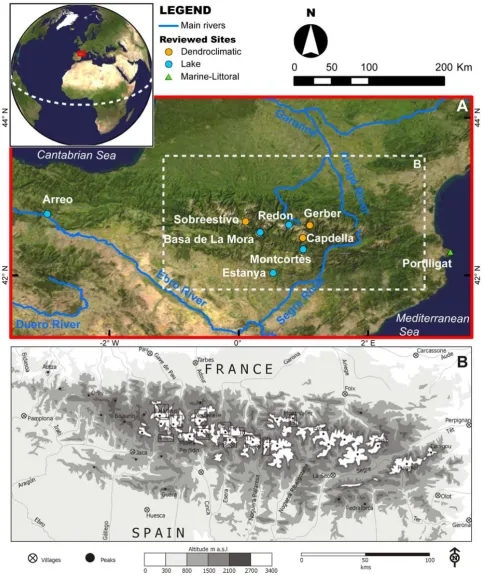
The Pyrenees are limited by the Bay of Biscay in the west and Cape Creus to the east (Fig. 1a) and represent a ∼440 km long longitudinal belt from the Atlantic Ocean to the Mediterranean Sea. This geographical location between these two climatic zones; their southern latitude and East– West orientation and its complex topography lead to a high climatic heterogeneity (L´opez-Moreno et al., 2008). Alti-tudes reach more than 3000 m above sea level (a.s.l.) with a highly contrasting relief (Del Barrio et al., 1990). The highest massifs are located in the central areas of the range and the altitude decreases towards the west and the east, as well as towards the Aquitaine (France) and Ebro Depressions (Spain) (north and south, respectively) (Fig. 1b). Annual precipitation exceeds 600 mm and sometimes even reaches 2000 mm at the highest altitudes. Most of the annual precip-itation occurs during the cold season in the Atlantic areas but during spring and autumn in the Mediterranean regions, with relatively dry summers. The annual averaged 0◦C isotherm is located at∼2700 m a.s.l. (Del Barrio et al., 1990).
1
Figure 1. (A) Location of the different records reviewed in this paper within the Pyrenees,
2
including lacustrine, dendroclimatic and marine-littoral reconstructions (see legend). (B)
3
Detailed map of the different massifs with the presence of glaciers during the LIA (modified
4
from González-Trueba et al., (2008)).
5
6
7
Fig. 1. (A) Location of the different records reviewed in this paper within the Pyrenees, including lacustrine, dendroclimatic and
marine-littoral reconstructions (see legend). (B) Detailed map of the different massifs with the presence of glaciers during the LIA (modified from Gonz´alez-Trueba et al., 2008).
depending on the annual precipitation. Foothills are mainly covered by Mediterranean pine (Pinus Sylvestris and Pinus Halepensis) and oak forests (Quercus ilex-rotundifolia, Q. faginea, Q. pubescens), with dense shrub land (Rhamnus, Pistacia, Arbutus, Prunus, Cornus, Buxus, Genisteae, Cis-taceae, etc.). Corylus avellana and other phreatophytes such as Salix, Fraxinus, Populus or Ulmus are only located on riverine soils (Blanco-Castro et al., 1997).
There are two main types of lakes in the Southern Pyre-nean domain (Fig. 1a): (i) karstic lakes, located at the Southern foothills of the Pyrenees, in the so-called External Ranges, between 600 and 1000 m a.s.l., in the transition be-tween Atlantic and Mediterranean climate types and vegeta-tion domains (Garc´ıa and G´omez, 2008) and subject to a con-siderable human influence during the last millennia (Arreo, Estanya, Montcort`es); (ii) high-mountain, glacial lakes lo-cated in the Axial Pyrenees, above 1800 m a.s.l., character-ized by colder and more humid conditions, near to the tim-berline (e.g. Basa de la Mora, Redon) where human impact is limited. Currently in the Pyrenees there are 21 active glaciers with a total extension of about 495 ha. On the Spanish side there are 29 ice bodies, of which only 10 can be consid-ered as glaciers (260 ha) (Gonz´alez Trueba et al., 2008), and thus, appear the most relevant for this study. Nevertheless, LIA remains such as moraines and proglacial materials do exist in more than 100 deglaciated cirques in the Pyrenean high mountains. These deposits are located in the current glaciated and non-glaciated massifs (Fig. 1b) (Serrano and Mart´ınez de Pis´on, 1994; Grove and Gellatly, 1995; Chueca et al., 1998a, b). Although the Pyrenean glaciers experienced an expansion during the LIA, they are currently reduced in thickness and spatially limited to the highest summits, dis-playing bevelled shapes, burials, and even some disappear-ance of ice bodies. From 1880 to 1980 AD at least 94 glaciers became extinct, while 17 glaciers have disappeared on the Spanish side since the 1980s.
3 Paleoclimate archives
For this study, we selected paleoclimate sequences from pub-lished studies that fulfill the following requirements: (i) re-constructions are based on natural archives, (ii) these records have independent chronologies based either on absolute dat-ing (tree rdat-ing or lacustrine varve countdat-ing, calibrated radio-metric dating) or documentary sources and (iii) climate vari-ability is considered as the main forcing mechanism of envi-ronmental changes reconstructed at these sites. Paleoclimatic archives analyzed here comprise: (i) dendroclimatic recon-structions (Fig. 1a), (ii) lake and marine-littoral sequences (Fig. 1a), and (iii) geomorphologic evidence of glacier ad-vances or retreats (Fig. 1b). Reconstructed environmental variables vary from climatic parameters (temperature, pcipitation) to evidence of environmental changes directly re-lated to these parameters (changes in vegetation cover, runoff and effective moisture fluctuations reconstructed by lake
level changes and/or salinity fluctuations). We consider this transect of multi-proxy reconstructions of climatic and envi-ronmental changes to represent the best strategy to discern between climate and human forcings in landscape changes, as demonstrated in previous research carried out in this area (Moreno et al., 2008; Morell´on et al., 2011; Rull et al., 2011).
3.1 Lake and marine-littoral sequences
Unravelling the complex interplay between climate changes and human impact in Pyrenean lakes and littoral marine se-quences is complex and requires the use of multiple proxy-data and robust chronologies based on either radiometric techniques (137Cs,210Pb,14C) or varve counting or a com-bination of these two methods. Furthermore, the correlation with historical events detected in most of the sequences pro-vides further chronological support (e.g. onset and/or inten-sification of farming, introduction of particular cultivars, de-forestation events (Rull et al., 2011)). Most of the lacustrine sequences used in this review have been analysed following a multidisciplinary strategy, comprising a variety of prox-ies: (i) sedimentology (sedimentary facies, microfacies and varve sub-layering), (ii) elemental and isotopic geochem-istry, and (iii) biological indicators (pollen, diatoms, chirono-mids and chrysophytes). Other lake and peatbog records (i.e. Tramacastilla and Bubal (Montserrat-Mart´ı, 1992), Bosc dels Estanyons (Miras et al., 2007), Riu dels Orris fen (Ejarque et al., 2010), Lake Burg (Bal et al., 2011) and Col d’Ech (Rius et al., 2012), among others), have not been considered for this paper because of the lack of a multi-proxy analysis or their exclusive focus on human activities.
3.1.1 Lake Arreo
Lake Arreo (42◦460N, 2◦590W, 655 m a.s.l.) is a karstic lake located in the transition between the Westernmost Ebro Basin and the foothills of the Pyrenees (Fig. 1a). The chronology of the sequence is based on the combination of varve count-ing,137Cs/210Pb, and14C dating and spans the last 2600 yr (Corella, 2011). The main paleoindicators analysed include sedimentary facies and microfacies, elemental geochemistry, pollen and diatoms. The sensitivity of some of these proxies has been demonstrated by their successful correlation with instrumental climate data series and limnological monitoring data at shorter timescales (Corella et al., 2011a).
points towards more arid conditions since the end of the LIA. An arid phase was detected between 1730–1790 AD, charac-terized by a deposition of clay-rich facies (Fig. 2) and high Sr content in the sediment (Corella, 2011) (Table 1, Fig. 3). Nevertheless, the presence of biogenic varves, and the dom-inant presence of Cyclotella disting¨uenda and the low Sr values indicates relatively high lake levels during the mid-19th–mid-20th century (Corella, 2011; Corella et al., 2011a). The increase in gypsum and Sr (Fig. 3) in the sediment sug-gests that lake waters were more concentrated than during the warmer mid-20th century.
3.1.2 Lake Estanya
The Balsas de Estanya karstic system (42◦020N, 0◦320E,
670 m a.s.l.) is located at the foothills of the External Ranges, in the central-eastern Pre-Pyrenees (Fig. 1a). The sedimentary sequence has been dated by 137Cs/210Pb and radiocarbon and spans the last 21 ka.
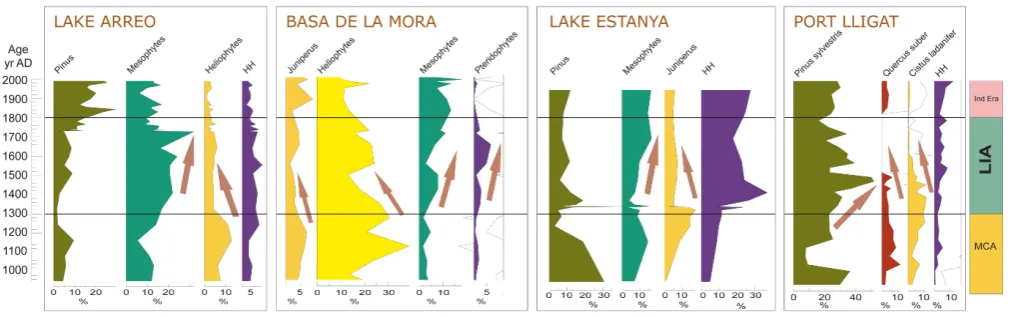
The multi-proxy analysis of sediment cores recovered in the distal areas of the main lake, including sedimentology, elemental and isotopic geochemistry and biological indica-tors (pollen, diatoms and chironomids) reveals arid condi-tions during the MCA followed by more positive water bal-ances during the LIA, starting at 1300 AD and lasting to 1850 AD. Consistently, pollen reflects warmer and drier con-ditions for the MCA, with a landscape dominated by junipers and Mediterranean elements, a relatively low abundance of mesophytes and a poorly developed aquatic component. The increase in water availability during the LIA is characterized by increase of riparian and hygrohydrophytes (Salix, Ulmus, Tamarix, Potamogeton, Myriophyllum, Nuphar, Lemna), and a recovery of mesophytes (Betula, Corylus, Alnus, decidu-ous Quercus, Abies) (Fig. 2, Table 1). Likewise diatom as-semblages suggests low water levels and saline conditions during the MCA (Morell´on et al., 2011).
A reconstruction of salinity, based on the results of Princi-pal Component Analyses applied to the high-resolution geo-chemical dataset (see details in Morell´on et al., 2011) iden-tifies large hydrological fluctuations. Other biological prox-ies (diatoms, chironomids) and sedimentological indicators show a coherent evolution (Table 1, Fig. 3). The LIA in Es-tanya is characterized by complex internal fluctuations with increased water balance during the solar minima.
3.1.3 Lake Montcort`es
Lake Montcort`es (42◦190N, 0◦590E, 1027 m a.s.l.) is located
50 km north-east of Estanya (Fig. 1a). The composite se-quence of Montcort`es spans the last 5.3 ka and constitutes the longest varved, annually resolved sequence recovered to date in the Iberian Peninsula (IP) (Corella, 2011; Corella et al., 2011b). The age model is particularly robust because of the combination of varve counting, 210Pb and radiocarbon dating.
The analysis of microfacies and sublayering of lam-inae revealed colder conditions during the LIA (1300–
1800 AD); (Corella, 2011). During this period, most of the calcite laminae show a fine-coarse sub-layering interpreted as a result of prolonged winter conditions with a delayed warming in spring, which may cause supersaturation leading to rapid nucleation of small calcite crystals. Higher Fe/Mn ratios also suggest more frequent and longer anoxic condi-tions at the hypolimnion (Corella, 2011), and increased abun-dance of planktic diatom Cyclotella cyclopuncta points to higher lake levels (Scussolini et al., 2011). The lack of di-atom valves during the MCA is explained though the synergy of arid conditions and higher anthropogenic pressure on the lake. The presence of the Mediterranean scrub community reflects warmer conditions during the MCA, and its disap-pearance during the LIA in the 15th century, together with the increase in forest, are interpreted as colder and more hu-mid conditions during the LIA (Rull et al., 2011). Towards the end of the LIA (ca. 1700 to 1900 AD) intermittent abun-dance of diatoms and occasional predominance of pennate, littoral taxa point to fluctuating lake levels; in more recent times, the presence of oligotrophic species marks the shift to poorer nutrient levels (Fig. 3).
3.1.4 Lake Basa de la Mora
Lake Basa de la Mora (42◦320N, 0◦190E, 1914 m a.s.l.) is a shallow, glacial-karstic lake located in the Cotiella Mas-sif, in the Central-Eastern area of the Internal Ranges of the Pyrenees (Fig. 1a).
This radiocarbon-dated sedimentary sequence displays the highest resolution for the Holocene period in the re-gion (117 cm kyr−1). The multi-proxy analyses of sediment cores revealed more arid conditions in medieval times (900– 1300 AD), as indicated by: a rise in Juniperus, a decrease in mesophytes and aquatic plants and the highest percentages of heliophyte herbs (including Artemisia, although this taxum could also indicate the existence of anthropogenic activities in the area) (Table 1, Fig. 2), and a decreased in clastic input, represented by lower silicon (Si) content (Fig. 3). The MCA is also characterized by high organic and carbonate produc-tivity related to a larger development of the palustrine area and, possibly, the lowest lake level of the last 2000 yr. During most of the LIA (1300–1750 AD), an opposite pattern occurs, leading to higher values of elements associated to detrital in-put due to an increase in runoff (Moreno et al., 2010; P´erez-Sanz, 2009; P´erez-Sanz et al., 2011). Sedimentological and geochemical signatures for the last 200 yr are coherent again with lower lake levels and drier climate conditions.
3.1.5 Lake Redon
Fig. 2. Selected pollen taxa and group diagrams from lakes Arreo, Basa de la Mora, Estanya and Portlligat and correlation between them.
In Arreo sequence Mesophytes curve is composed by deciduous Quercus, Fagus and Corylus; Heliophytes group by Artemisia, Chenopodi-aceae, Asteraceae; and Hydro-hygrophytes includes Cyperaceae and Typha. In Basa de la Mora, Heliophytes group is formed by Ephedra distachya, E. fragilis, Artemisia, Cichorioideae, Asteroideae, Carduaceae, Chenopodiaceae, Plantago, and Heliamthemum; whereas Mes-ophytes comprise: deciduous Quercus, Alnus, Carpinus, Salix, Ulmus, Populus, Fraxinus and Juglans. Estanya groups of MesMes-ophytes and Hydro-hygrophytes are composed by Betula, Corylus, Alnus, Tilia, Ulmus, Populus, Salix, Fagus, and deciduous Quercus; and Cyperaceae, Typha, Potamogeton, Myriophyllum, Nuphar and Lemna, respectively. Finally, Portlligat hydro-hygrophytes curve includes: Cyperaceae, Myriophyllum, Asplenium, Pteridophyta monolete and Pteridophyta trilete.
are used as proxies of winter-spring temperatures (Pla and Catal´an, 2005) and diatoms for water alkalinity (Catalan et al., 2009), which eventually can be related to air tempera-ture of the snow-free period (summer and autumn). For both proxies, transfer functions were developed, based on calibra-tion sets of more than one hundred lakes. A recent study has confirmed the relationship between chrysophyte assemblages and winter–spring temperatures, as well as the mechanism behind it (Pla-Rabes and Catalan, 2011).
Interestingly, the two records did not show a parallel behaviour (Fig. 3). A decrease of snow period tempera-tures (winter–spring) would have started earlier than a sim-ilar decrease in snow-free period temperatures (summer– autumn). While summer temperature was still high dur-ing 11th and 12th centuries, winter temperatures decreased sharply. According to the Redon record, summer cooling oc-curred abruptly by 1200 AD and reached the lowest temper-ature values by 1700 AD. The snow period tempertemper-atures im-proved progressively from the 12th century but showed cold phases in the 14th, 18th and early 20th centuries.
3.1.6 Portlligat Bay
Portlligat Bay (42◦170N; 3◦170E, 0 m a.s.l.) is a shallow
(maximum depth, 7.1 m) and small inlet located in the NE Mediterranean coast of the IP, connected to the sea (Fig. 1a). Pollen associations (L´opez-S´aez et al., 2009) (Fig. 2) indi-cate relatively dry conditions and high temperatures during the MCA, following the drop of Pinus sylvestris formations and the development of Mediterranean taxa such as Cistaceae and Quercus suber. The sequence shows a different pattern of forest evolution during the LIA with higher percentages of
Pinus sylvestris and lower Mediterranean formations. These could be related to colder temperatures. Concentration of fungal ascospores Type 18 has been used for the reconstruc-tion of humidity (Van Geel, 1978) and fluctuating but more humid conditions were reconstructed from 1250 AD to the early 1800s (Table 1). Maximum humidity was reached from 1450 to 1550 AD, whereas the most arid conditions took place during the 19th and 20th centuries and additionally, during the MCA (1000–1150 AD) (L´opez-S´aez et al., 2009) (Fig. 2).
3.2 Dendroclimatological reconstructions
3.2.1 Gerber-Sobreestivo (GER-SOB) chronology
Two timberline sites (GER and SOB) of similar ecological and climatic conditions were selected for this reconstruc-tion (see B¨untgen et al., 2008 for details). Samples include living and dry-dead pine trees (Pinus uncinata Mill.) of all age-classes. The Gerber site (GER) (42◦380N, 1◦600E, 2200–2350 m a.s.l.) is located within the central-eastern part of the Pyrenees, whereas the Sobreestivo (SOB) site (42◦410N, 0◦060E, 2300–2400 m a.s.l.), is located 70 km
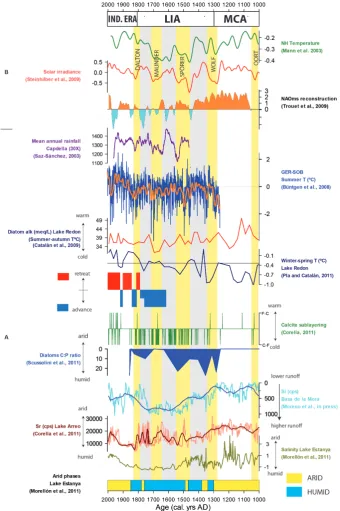
Fig. 3. (A) Selected records from the Southern Pyrenees reviewed in this paper, from top to bottom: Capdella tree-ring based mean
Table 1. Lacustrine and marine-littoral sequences from the Southern Pyrenees reviewed in this paper, including climate/hydrology and
vegetation conditions recorded for the different chronological stages defined in this paper: Late MCA (1000–1300 AD), LIA (1300–1800 AD) and Post-LIA (after 1800 AD).
Site and location Type Environmental conditions
Late MCA (1000–1300 AD) LIA (1300–1800 AD) Post-LIA (after 1800 AD)
Hydrology/ Climate Vegetation Hydrology/ climate Vegetation Hydrology/ climate Vegetation Arreo 42◦460N 2◦590W 655 m a.s.l.
Lake Low lake levels, high salinity, Holomictic conditions
Fall in mesophytes, mainly decidu-ous Quercus and development of ruderals, meadows and pastures.
High lake levels, Lower salinity, Meromictic condi-tions
Deciduous forest recovery (mainly Quercus sp. and Fagus). Decrease in human activities (meadows and pastures).
Low lake levels, higher salinity, Holomictic conditions
Deforestation of oak and beech forest and devel-opment of Pinus formations (includ-ing recent Pinus radiata cultivation)
Estanya 42◦020N 0◦320E 670 m a.s.l.
Lake Low lake levels, High salinity, variable runoff Increase of Juniperus and Mediterranean taxa. Reduced proportions and variety of aquatic plants.
Higher lake levels, lower salinity, variable runoff
Development of Mesophytes, peak of Pinus nigra type, and increase of aquatic taxa.
High lake levels, higher salinity, Reduced runoff
Recovery of open mixed Mediter-ranean/deciduous formations with Pine. Maximum expansion of cultivated areas Montcort`es 42◦190N 0◦590E 1027 m a.s.l.
Lake Warm conditions, reduced anoxia, higher runoff
Establishment of Mediterranean shrubland with increase in ever-green Quercus and decrease of pines. Development of cultivated taxa.
Cold conditions, Higher anoxia, lower runoff
Increase in AP for-mations, specially conifers and decid-uous taxa. De-crease in shrubland and heliophytes. Warm conditions, lower anoxia, higher runoff. Expansion of conifer formations and anthropogenic influenced areas (mainly pastures with ruderals).
Basa de la mora 42◦320N 0◦190E 1904 m a.s.l.
Lake High carbonate precipitation, decreased runoff
Development of Juniperus and heliophytes and decrease in all deciduous taxa.
Lower carbonate precipitation, higher clastic input
Fall in Juniperus and heliophytes and increase in Mesophytes and Pteridophytes.
High carbonate precipitation, decreased runoff
Recovery of mixed conifer (Pinus and Juniperus) / decid-uous taxa formations.
Redon 42◦380N 0◦460E 2240 m a.s.l.
Lake Higher summer– autumn tempera-tures Lower winter–spring conditions
– Lower summer–
autumn tempera-tures Relatively low winter–spring temperatures
– Relatively high summer–autumn temperatures High winter–spring temperatures – Portlligat 42◦170N 3◦170E 0 m a.s.l.
Shallow marine
– Increase in Quer-cus suber, de-ciduous Quer-cus forests and Mediterranean shurblands (Cistus ladanifer)
– Expansion of Pinus sylvestrys and re-duction in Quercus suber and Mediter-ranean shrublands
– Recovery of Quer-cus suber and deciduous Quercus forests in mixed formations with conifers
Relatively high summer temperatures were reconstructed during most of the 1300–1500 AD period and the 20th cen-tury, separated by a rather prolonged cooling from around 1500 to 1850 AD, within the LIA (Fig. 3). The six warmest decades occurred during the 20th century and the following four warmest during the period 1360–1440 AD (B¨untgen et al., 2008).
3.2.2 Capdella record
Five chronologies from several sites in the Southern Pyrenees were used for this reconstruction: Aig¨ues Tortes and Larra,
site chronologies (Cook and Kairiukstis, 1990). Rainfall records from Capdella weather station (42◦280N, 0◦590E,
1407 m a.s.l.) were used for proxy calibration. Finally, using PRECON (Fritts and Shashkin, 1995) chronologies and climatic data were calibrated in order to obtain a re-sponse function. Methodological details can be found in Saz S´anchez (2003) and Chueca C´ıa et al. (2005) (Fig. 3). The re-constructed precipitation shows relatively higher values than in recent times for the last 500 yr, with several marked decade – long humid periods around 1500, 1600, 1700 AD and the early 20th century; with relative rainfall minima centred at ca. 1800 AD, 1900 AD and an abrupt decreasing trend during the late 20th century.
3.3 Evidence of glacier fluctuations
Extensive research carried out by Gonz´alez-Trueba et al. (2008) demonstrated that glaciers occurred in more than 20 different massifs of the Pyrenees during the LIA, with a wide range of mean equilibrium line altitudes (ELAs) above and between 2650 m a.s.l. in the oceanic-influenced massifs (Balaitous and Infierno massifs among others) and 2900 m a.s.l. in the continental massifs (Maladeta and Posets massifs among others). Thirteen massifs with glaciers were considered relevant for this study (Fig. 1b). The most com-mon aspect was the development of cirque glaciers with re-duced or absent tongues. This study is based on geomor-phologic and morphostratigraphical surveys and historical archives and demonstrates the rapid response of these ice bodies to climatic variations.
The historical maximum extent of glaciers in the Pyre-nees took place between 1600 and 1750 AD, followed by a retreat during the next 50 yr, alternating with minor re-advances responsible for the development of numerous small moraines (Fig. 3). A secondary advance, characterized by a rapid, short-lived growth of ice bodies occurred during the 19th century, lasting until the 1920s. The temperatures esti-mated from the lowering of the ELAs are 0.7–0.9◦C colder than present-day conditions in this area. A generalized phase of glaciers retreat occurred since the 1870s, with minor re-advances during the last decades of the 19th century and the 1920s. Since then, glaciers underwent a continuous retreat, becoming ice patches in most of the cirques affected by LIA glaciations, with minor expansions in 1945 and 1964 AD in the French slopes. Since the 1970s–1980s, a drastic retreat started, continuing till the present (Fig. 3) (Gonz´alez Trueba et al., 2008).
4 Millennium-long environmental changes in the Southern Pyrenees
4.1 Evaluation of the reviewed records
Selected records from the Southern Pyrenees, including la-custrine and marine-littoral sequences, dendroclimatological records, and reconstructions of glacier fluctuations, provide
evidence of a broadly consistent pattern of climatic fluctua-tions during the last millennium. Nevertheless, before com-paring these records, the differences in chronological reso-lution and climate sensitivities of each type of sequence and proxies must be evaluated (North et al., 2006).
Tree rings provide annually resolved records and are sen-sitive to high-frequency climate fluctuations (Briffa, 2000). The two sequences reviewed in this paper respond to both temperature fluctuations (GER-SOB) and rainfall variabil-ity (Capdella). These two high-resolution sequences start at ca. 1260 and 1460 cal yr BP, respectively, which limits their record to intra-LIA (1300–1800 AD) variability and the transition between the LIA and recent warming (after 1800 AD). In contrast, lake sequences comprise the whole studied time interval and allow comparison with previous MCA, but they generally have radiocarbon-based chronolo-gies characterized by a lower resolution, and able to cap-ture only lower frequency variability (multi-decadal to cen-tennial). Karstic lakes reviewed in this paper are particu-larly sensitive to changes in the hydrological balance (pre-cipitation minus evaporation) reflected by different inorganic and biological proxies, as outlined in the previous section. Only lakes Arreo and Montcort`es have varved (i.e. annual) chronologies able to record higher-frequency fluctuations. Changes in sublayering in Montcort`es calcite laminae re-flect relative changes in water temperature (colder or warmer stages). Accordingly, higher density of Fine–Coarse (F–C) sublayering through this record are interpreted as periods of predominantly colder conditions.
Lake Redon also provides information about thermal con-ditions not only as relative changes (summer–autumn) but also as a semi-quantitative estimation (winter–spring), in-ferred from biological proxies. The chronological control is robust, obtained by combining different radiometric tech-niques (137Cs,210Pb,14C), but because of the comparatively lower sedimentation rate of this sequence the chronological resolution is relatively low and variable. In spite of these limitations, visual comparison of reconstructed summer– autumn temperatures reflects a relatively good match with the main trends in summer temperatures recorded in GER-SOB (Fig. 3). The relative maximum winter–spring temper-atures reconstructions also coincide with and major episodes of glacier retreat (1750–1900 and after the 1920s). Only the early 19th century glacier advance was not coincident with a winter temperature drop in Redon.
Pollen records from lake sequences are subject to the same chronological uncertainties derived from radiocarbon dat-ing. Despite the impact of anthropogenic activities, previ-ous research on these sequences has demonstrated the relia-bility of pollen as a proxy of climate fluctuations (Moreno et al., 2008, 2010; Morell´on et al., 2011; P´erez Sanz et al., 2011). The proportion between xerophytic and Mediter-ranean components and mesophytes, whose development is favoured under drier and more humid conditions, respec-tively, reflects changes in the regional hydrological condi-tions at a centennial timescale (Fig. 2). The coincidence of changes in the terrestrial vegetation components, aquatic taxa and other non-palynological proxies provides further support for this hypothesis. The geographical location of each of these pollen sequences determines differences in lo-cal vegetation, with an increasing content of Mediterranean elements towards the east and the south. These differences have also been taken into account for the selection of taxa indicative of dry conditions in each case: herbaceous he-liophyte taxa (westernmost lake Arreo), hehe-liophytes and ju-nipers (Central Pyrenees: Basa de la Mora and Estanya) or other Mediterranean taxa such as Cistus (easternmost Portlligat site) (Figs. 1a and 2).
Comparison among these sequences and correlation with other regional and global records enable us to investigate the timing, intensity and chronology of the main environmental changes occurring prior, during and after the LIA and their relationship with climatic forcing mechanisms (Fig. 3). The overall good agreement of a wide range of records with dif-ferent locations and altitudes, likely subjected to variable hu-man activity, suggests that they respond to common climatic forcings.
4.2 The last phases of the MCA
In agreement with the rest of the IP (Moreno et al., 2012, 2011), generally arid conditions have been reconstructed for the last phases of the MCA (1000–1200 AD) in the Pyre-nees. Lower lake levels and higher salinity occurred in lakes Arreo, Estanya, and Montcort`es. Relatively low clastic in-put, reflecting decreased runoff caused by less precipitation also occurred in Basa de La Mora. Pollen associations in these sites and Portlligat Bay (Fig. 2) also indicate dry con-ditions with the development of the xerophytic and Mediter-ranean component (Juniperus and heliophyte herbs increase, evergreen Quercus increased while deciduous Quercus de-creased), a decrease in mesophytes and the aquatic compo-nent. Despite spatial differences and the human influence on these watersheds, drier conditions can be interpreted for the MCA (Moreno et al., 2012).
Only two records provide indirect information about ther-mal conditions during this period. An increase in the cal-cite laminae thickness in Lake Montcort`es indicates gener-ally warmer conditions compared with the subsequent LIA-associated cooling. The discrepancy in lake Redon
re-constructions with the occurrence of higher but variable summer–autumn temperatures in Redon (Catalan et al., 2009) (Fig. 3) and the lowest winter temperatures (Pla and Catal´an, 2005) would be explained as a reflection of the strong seasonality during this period.
4.3 The LIA
Higher lake levels and hence, moister conditions started ca. 1300 AD in lakes Arreo, Estanya and Montcort`es. An increase in sediment delivery and runoff also occurred at this time in Basa de la Mora (Fig. 3). Pollen associations from Basa and Estanya sequences show a general decline of xero-phytes and Mediterranean taxa (Juniperus, evergreen Quer-cus), some expansion of deciduous trees (mesophytes) and a rise of the aquatic content (Potamogeton increase). Arreo and Montcort`es vegetation composition show similar patterns of changes. The Portlligat Bay sequence also suggests the start of a humid period, even though mediated by higher human – induced fires and an increase of cattle raising, resulting in a change to mesotrophic conditions (L´opez-S´aez et al., 2009) (Table 1, Fig. 2).
The increase in stream flow activity in the alluvial systems of the Central Ebro Basin, whose headwaters are located in the Pyrenees, also indicate increased water availability dur-ing this period (Sancho et al., 2007; Constante et al., 2011). An increased number of flood events was also recorded in the nearby Ebro watershed after 1300 AD (Benito et al., 1996). The occurrence of predominantly humid conditions during the LIA has been widely detected elsewhere in the IP (Moreno et al., 2012): (i) higher lake levels were recon-structed in the north (e.g. La Cruz Lake, Iberian Range (Juli`a et al., 1998)) and in the south of Spain (Mart´ın-Puertas et al., 2008, 2010), (ii) increased continental runoff reconstructed from marine sequences (e.g. Nieto-Moreno et al., 2011), (iii) increased Westerlies in the W Mediterranean (Moreno et al., 2012), (iv) increased storm activity in the nearby French Mediterranean Coast (Dezileau et al., 2011) and (v) more fre-quent floods in the Tagus headwaters (Moreno et al., 2008; Benito et al., 2003). Accordingly, increased water availabil-ity has been reconstructed in other areas of the W Mediter-ranean, such as Morocco (D´etrich´e et al., 2009; Esper et al., 2007) and in the Alps (Magny et al., 2008, 2010).
the LIA. In fact, B¨untgen et al. (2008) reconstructed the four warmest decades of pre-industrial times during the period 1360–1440 AD, which indicates the predominance of rela-tively mild thermal conditions during the first part of the LIA. However, a drop in temperatures occurred during the mid to late 15th century, consistent with a decrease in winter temperatures in Redon.
Other indirect evidence of temperature changes also in-dicate that the coldest conditions of the LIA in NE Iberian Peninsula did not take place until the 16th–19th centuries. As an example, the Ebro River (Fig. 1a), fed by many trib-utaries from the Southern Pyrenees, froze near its mouth in the town of Tortosa (Tarragona), 17 times since ca. 1400 AD (Puente, 2007). According to historical reports (Benito et al., 1996), the maximum frequency of frost episodes and in-tensity occurred between the 16th and 18th centuries. His-torical reports also document colder conditions in the IP be-tween the 16th and 19th centuries (Font-Tullot, 1986), with minimum temperatures during the 17th century. Accord-ingly, maximum (recent) glacier advances in the Southern Pyrenees took place from 1600 to 1750 AD, leading to a slower development during the late 18th and early 19th cen-tury. The chronology of this phase coincides with reconstruc-tions for the European Alps (Schaefer et al., 2009). How-ever, Calderone Glacier in Gran Sasso Massif (Italy), one of the southernmost glaciers in Mediterranean Europe, experi-enced a minor advance in the period 1313–1373 AD, prior to a maximum advance later on during the LIA, coinciding with higher lake levels in lakes Acessa and Fucino centered around 500 cal yr BP (Giraudi et al., 2011). In spite of the oc-currence of cold and humid conditions along the LIA, glacier advances required a combination of high winter precipitation and low summer temperatures (Paasche and Bakke, 2010). According to this dataset, these two conditions were prob-ably not fulfilled during the early phases of the LIA in the Pyrenees, between 1300 and 1600 AD. Coldest summer tem-peratures, accompanied by relatively cold winter conditions in Redon occurred from 1500 to 1700 AD. Consistently, the most humid conditions, indicated by minimum salinity and maximum lake levels and/or clastic input, were not reached until the period 1500–1600 AD (Fig. 3) and maximum pre-cipitation in Capdella was recorded by tree rings ca. 1600 AD (Saz S´anchez, 2003) (Fig. 3). Flood records also show an increase in the number of events in Ebro Basin and in the Eastern Pyrenean rivers after 1600 AD (Benito et al., 1996).
In summary, we can broadly identify two major phases of environmental change that occurred during the LIA in the Southern Pyrenees: (i) a transitional phase MCA–LIA, char-acterized by fluctuating, moist conditions and relatively cold temperatures, between ca. 1300 and 1600 AD; and (ii) a sec-ond period, extending from ca. 1600 to 1800 AD, charac-terized by lower temperatures and higher water availability, leading to maximum glacier advances. In spite of the pre-dominance of cold and humid conditions along the LIA, a lower amplitude hydrological and thermal internal
variabil-ity was recorded in most of the sites (Fig. 3), as discussed below.
4.4 LIA to recent warming transition
An aridification trend started synchronously in lakes Arreo, Estanya, Montcort`es and Basa de la Mora after ca. 1800 AD. Higher water concentration and/or more frequent oxic con-ditions in these settings indicate lower lake levels and de-creased water balance. Pollen records show a new increase of human pressure and no aridity trends can be clearly ex-tracted. Nevertheless, humidity reconstruction based on non-pollen palynomorphs in Portlligat indicates an abrupt de-crease starting ca. 1750 AD, coinciding with an abrupt reduc-tion of Castanea and Vitis culture while cereal cultivareduc-tion is completely interrupted; the percentage of several arboreal el-ements (Fagus, Abies, Corylus, Quercus suber type) are also reduced or even disappear.
Decreased water availability has been also recorded in lakes in the North of the IP (e.g. Taravilla (Moreno et al., 2008), Lake Enol (L´opez-Merino et al., 2012) and S Spain, (e.g. Do˜nana (Sousa and Garc´ıa-Murillo, 2003); Lake Zo˜nar (Mart´ın-Puertas et al., 2008)). Marine cores around the IP also documented reduced river input associated with lower runoff (e.g. Nieto-Moreno et al., 2011). A similar hydrologi-cal response was detected in other areas of the W Mediter-ranean, like the French Jura (Magny et al., 2008) or Mo-rocco (D´etrich´e et al., 2009). However, Capdella tree ring sequence display a more complex variability, characterized by relative rainfall minima centred at ca. 1800 AD, 1900 AD and an abrupt decreasing trend during the late 20th century (Fig. 3).
Arreo occurred right afterwards, since 1870 AD. Finally, a further decrease in temperatures occurred in the mid-20th century, as documented by GER-SOB and Redon records. Minor glacier stabilisation phases described by Gonz´alez-Trueba et al. (2008) might also be related to this short-lived climate deterioration phase, in the frame of a generalized warming trend.
5 Regional context and paleoclimatic implications of the LIA in the Pyrenees
Temperature fluctuations in the Southern Pyrenees display a similar pattern compared to other reconstructions from Cen-tral Europe (B¨untgen et al., 2010a), the Mediterranean Basin (Camuffo et al., 2010) and with other Northern Hemisphere palaeoclimate records at centennial timescales (e.g. Jones et al., 1998; Mann and Bradley, 1999), showing consistency with changes in solar activity (Steinhilber et al., 2009; Bard et al., 2000; Vaquero et al., 2002), global temperature fluc-tuations (Mann et al., 2008) and NAO index (Trouet et al., 2009). Comparison of climate records and volcanic activ-ity (Gao et al., 2008) does not show a clear pattern in the Southern Pyrenees. On the one hand, some climate records show the expected cooling after volcanic eruptions, for ex-ample after the eruption of Tambora in 1815 AD. On the other hand, the largest eruption in the past 1500 yr (about 2.5 times larger stratospheric sulphate injection than Tamb-ora) of an unknown volcano in the 1258 AD does not show up in any of the analysed climate records. Both low solar activity and volcanic eruptions lead to surface cooling com-pared with solar activity and no volcanic eruptions. In the past 1000 yr these eruptions coincided with times of low so-lar activity as, e.g. during the LIA and only a few of them occurred during the MCA, when solar activity was relatively high. Thus, reconstructed colder conditions are interpreted as a result of low solar activity partly influenced by volcanic eruptions.
5.1 The footprint of solar activity
In spite of the limited chronological resolution of most of the records, derived from radiocarbon dating, several oscillations in the hydrological and thermal dynamics of the reviewed sequences during the LIA suggest that colder temperatures and at least, more positive water balances and/or increased runoff dominated during periods of diminished solar activity, the so-called grand solar minima.
Contrasting patterns have been recorded for the Oort Min-imum (1010–1050 AD): although lower winter and summer temperatures were recorded in Lake Redon and relatively more humid conditions were reconstructed in Arreo, vari-able conditions occur in the rest of the lakes (Estanya, Mont-cort`es and Basa de la Mora). However, during the Wolf Minimum (1282–1342 AD) all lakes experienced more hu-mid conditions, evidenced by increased lake levels, lower water concentration and/or increased sediment delivery.
Al-though Portlligat Bay has recorded more humid conditions in the Eastern Pyrenees during the LIA, in contrast to drier environments during the MCA, no significant hydrological response occurs for this solar minimum. In agreement with the expected pattern, an abrupt decrease in temperature was recorded in tree-ring based reconstructions of GER-SOB and higher altitude (colder) conditions occurred in Lake Redon (Fig. 3).
Colder conditions also occurred in the Pyrenees during the Sp¨orer Minimum (1460–1550 AD), as indicated by lower temperatures in GER-SOB dendroclimatic reconstruction, calcite sublayering in Montcort`es and lower winter temper-ature in Redon. Interestingly, within this phase, lasting for almost 100 yr (1460–1550 AD), generally recorded as a rel-atively humid period, all the lacustrine sequences reviewed in this paper show a short lived reversed pattern (more neg-ative water balance) centred around 1500 AD. Higher mean annual rainfall was also recorded in Capdella tree-ring se-quence, with an abrupt decrease in precipitation at the end of this phase. During the Maunder Minimum (1645–1715 AD), reduced summer temperatures were recorded both in GER-SOB and Redon, coinciding with a major phase of glacier advances. Most of the lake sequences clearly evidence higher effective moisture and/or increased runoff. However, the easternmost records of the region reviewed in this paper (Montcort`es, Portlligat) show a less clear response, proba-bly due to particular, local conditions. Mean annual rainfall reconstructed from Capdella also shows a relative maximum, less evident than the one corresponding to the Sp¨orer Mini-mum (Fig. 3). In contrast, a clear temperature drop becomes evident in GER-SOB towards the end of the Dalton Mini-mum (1790–1830 AD), coinciding with a series of volcanic eruptions at the beginning of the 19th century, and contem-poraneous to a short phase of glacier advances, also recorded in the Pyrenees. The short duration of the Dalton Minimum event (ca. 40 yr) and the low resolution of the age models might be responsible for contrasting responses reconstructed from the lake sequences.
5.2 Hydrological variability and the potential influence of the NAO
Centennial-scale hydrological fluctuations in the Southern Pyrenees appear to be in phase with the NAO reconstruction (Trouet et al., 2009) for the last millennium. In agreement with most of the IP (Moreno et al., 2011), arid conditions prevailed during the MCA, when reconstructed NAO values were predominantly positive (Trouet et al., 2009), as a result of a positive radiative forcing (Shindell et al., 1999) (Fig. 3). During the instrumental period, there is clear evidence of interannual precipitation variations in the W Mediterranean area, with the highest positive rainfall anomaly located over N Iberia at the mean time as high pressure is dominant in N Europe (Cullen and deMenocal, 2000). Negative rain-fall anomalies during the MCA and vice-versa during the LIA for the W Mediterranean region have been also repro-duced by gridded high-resolution precipitation reconstruc-tions (Pauling et al., 2006) and ECHO-G model simulareconstruc-tions (Liu et al., 2009). Widespread proxy evidences for this centennial-scale pattern also exist (Graham et al., 2011). In spite of the complex spatial heterogeneity and the influence of other climate variability patterns, the NAO strongly af-fects the precipitation events in most parts of the IP (Trigo et al., 2004). Furthermore, correlation maps between NAO and winter precipitation over the IP for the period 1950–1990 re-produced by models display particularly high negative values for the Southern Pyrenees within the IP (G´omez-Navarro et al., 2011).
Accordingly, hydrological patterns reconstructed from the reviewed lake sequences agree on centennial timescales, re-producing this transition from arid conditions during the MCA into higher humidity during the LIA (Fig. 3). How-ever, lake records show an increase in water levels starting at ca. 1300 AD, whereas, although NAO values show a de-creasing trend after the MCA, most negative values are not reached until 1600 AD. Increased water availability recorded in lakes during the period 1300–1600 AD might have been amplified by increased aquifer recharge, resulting from re-duced evaporation and thus, more positive water balance driven by lower temperatures during the LIA (e.g. Cacho et al., 2010, and references therein). Glacier maximum de-velopment in both northern and southern slopes coincides with this coldest and most humid period of the LIA in the Southern Pyrenees (1600–1800 AD) and displays a similar pattern compared to other Mediterranean mountains, like the Apennines (Giraudi, 2005) and the Balkans (Hughes, 2010). At lower timescales, some of the relative maxima in pre-cipitation recorded in the Capdella tree-ring rainfall recon-struction during the last ca. 600 yr correlate with negative reconstructed NAO-values.
Main phases of environmental change during the last mil-lennium are synchronous at a regional scale with most of the Iberian Peninsula (Moreno et al., 2011) and also can be recognized across the Western Mediterranean area (Fletcher
and Zielhofer, 2012). Exceptions to this pattern occur in the northwestern Atlantic shore of the IP (R´ıa de Muros, (Le-breiro et al., 2006; Galop et al., 2011) and R´ıa de Vigo (Kan-ner et al., 2012)) and also in South (Mart´ın-Puertas et al., 2011), revealing an intra-regional complex variability in the hydrological conditions within the IP (Moreno et al., 2012). An antiphase behaviour in the hydrological signal, with wet MCA and dry LIA, has also been recorded in some eastern Mediterranean lakes (Roberts et al., 2011). This Mediter-ranean see-saw pattern might be related to the higher influ-ence of the NAO in westernmost areas, like the Southern Pyrenees. Thus, the NAO appears to be one of the main climatic mechanisms influencing rainfall variability in the Southern Pyrenees at a centennial timescale during the last millennium. Further research will clarify a more precise tim-ing a spatial variability of the reconstructed climate changes in the context of the IP.
6 Conclusions
Paleoclimatic records from the Southern Pyrenees, includ-ing lacustrine and marine-littoral sequences, tree rinclud-ings, and records of glacier fluctuations, evidence a broadly consistent pattern at centennial to multi-decadal timescales for hydro-logical and thermal fluctuations during the last millennium, likely due to a common climate forcing.
Warmer and arid conditions prevailed during the MCA (up to 1300 AD) and colder and humid conditions, evidenced by higher lake levels, increased runoff and a change in domi-nant vegetation during the LIA (1300–1800 AD). Although the LIA is characterized by a complex internal structure, two major phases of environmental change can be identified in all the records within this period: (i) a transitional phase MCA– LIA, characterized by fluctuating, moist conditions and rel-atively cold temperatures (ca. 1300 and 1600 AD); and (ii) a second period, characterized by lower temperatures, higher runoff and more positive water balances, coinciding with maximum (recent) glacier advances in the second half of the LIA (ca. 1600–1800 AD)
A synchronous increase in temperature and aridity, coin-ciding with glacier retreat is found in all the records after 1800 AD, coinciding with the end of the LIA. A short-living return towards colder conditions and glacier stabilisation oc-curred during the late 19th–early 20th century, leading to warmer and more arid conditions afterwards.
was not found. Hydrological changes in the Southern Pyre-nees correlate with reconstructed NAO variability, which ap-pears to be one of the main climate mechanisms influencing centennial-scale variations in precipitation totals during the last millennium.
Acknowledgements. This research has been funded by the Spanish InterMinistry of Science and Technology (CICYT), through the projects LIMNOCAL (CGL2006-13327-C04-01),
GLOBALKARST (REN2003-09130-C02-02),
GRACCIE-CONSOLIDER (CSD2007-00067), DINAMO (CGL2009-645-07992) and CRYOMONT (CGL2010-19724). Additional support was provided by the Spanish National Parks Agency through the project HORDA (083/2009). M. Morell´on is supported by a Post-doctoral fellowship funded by the Spanish Ministry of Education and Science through FECYT (Spanish Foundation for Science and Technology), A. P´erez-Sanz is supported by a pre-doctoral fellowship funded by the Regional Aragonese Government and A. Moreno acknowledges the “Ram´on y Cajal” postdoctoral program for funding. Miguel Sevilla is acknowledged for his help with Fig. 1. We thank Gerardo Benito, William Fletcher, Lourdes L´opez-Merino and anonymous referee for their helpful comments and their criticism, which led to a considerable improvement of the manuscript.
Edited by: F. Dom´ınguez-Castro
References
Abrantes, F., Lebreiro, S., Rodrigues, T., Gil, I., Bartels-Jonsdottir, H., Oliveira, P., Kissel, C., and Grimalt, J. O.: Shallow-marine sediment cores record climate variability and earthquake activity off Lisbon (Portugal) for the last 2000 years, Quaternary Sci. Rev., 24, 2477–2494, 2005.
Aniol, R. W.: Tree-ring analysis using CATRAS, Dendrochronolo-gia, 1, 45–53, 1983.
Bal, M.-C., Pelachs, A., Perez-Obiol, R., Julia, R., and Cunill, R.: Fire history and human activities during the last 3300 cal yr BP in Spain’s Central Pyrenees: The case of the Estany de Burg, Palaeogeogr. Palaeocl., 300, 179–190, 2011.
Bard, E., Raisbeck, G., Yiou, F., and Jouzel, J.: Solar irradiance during the last 1200 years based on cosmogenic nuclides, Tellus B, 52, 985–992, 2000.
Beniston, M.: Climatic Change in Mountain Regions: A Review of Possible Impacts, Climatic Change, 59, 5–31, 2003.
Benito, G., Machado, M. J., and P´erez-Gonz´alez, A.: Climate change and flood sensitivity in Spain, in: Global Continental Changes: The Context of Palaeohydrology, edited by: Bran-son, J., Brown, A. G., and Gregory, K. J., Special Publication-Geological Society of London, London (UK), 85–98, 1996. Benito, G., D´ıez-Herrero, A., and Fern´andez de Villalta, M.:
Mag-nitude and Frequency of Flooding in the Tagus Basin (Central Spain) over the Last Millennium, Climatic Change, 58, 171–192, 2003.
Bertran, P., Bateman, M. D., Hernandez, M., Mercier, N., Millet, D., Sitzia, L., and Tastet, J.-P.: Inland aeolian deposits of south-west France: facies, stratigraphy and chronology, J. Quaternary Sci., 26, 374–378, 2011.
Blanco-Castro, E., Casado, M., Costa, M., Escribano, R., Garc´ıa Ant´on, M., G´enova, M., G´omez, A., Moreno, J., Morla, C., Re-gato, P., and Sainz Ollero, H.: Los bosques ib´ericos. Una in-terpretaci´on geobot´anica, Planeta, Barcelona (Spain), 572 pp., 1997.
Br´azdil, R., Pfister, C., Wanner, H., Storch, H. V., and Luterbacher, J.: Historical climatology in europe – the state of the art, Climatic Change, 70, 363–430, 10.1007/s10584-005-5924-1, 2005. Br´azdil, R., Dobrovoln´y, P., Luterbacher, J., Moberg, A., Pfister,
C., Wheeler, D., and Zorita, E.: European climate of the past 500 years: New challenges for historical climatology, Climatic Change, 101, 7–40, doi:10.1007/s10584-009-9783-z, 2010. Briffa, K. R.: Annual climate variability in the Holocene:
inter-preting the message of ancient trees, Quaternary Sci. Rev., 19, 87–105, 2000.
B¨untgen, U., Frank, D., Grudd, H., and Esper, J.: Long-term sum-mer temperature variations in the Pyrenees, Clim. Dynam., 31, 615–631, 2008.
B¨untgen, U., Franke, J., Frank, D., Wilson, R., Gonz´alez-Rouco, F., and Esper, J.: Assessing the spatial signature of European climate reconstructions, Clim. Res., 41, 125–130, 10.3354/cr00848, 2010a.
B¨untgen, U., Trouet, V., Frank, D., Leuschner, H. H., Friedrichs, D., Luterbacher, J., and Esper, J.: Tree-ring indicators of German summer drought over the last millennium, Quaternary Sci. Rev., 29, 1005–1016, doi:10.1016/j.quascirev.2010.01.003, 2010b. B¨untgen, U., Tegel, W., Nicolussi, K., McCormick, M., Frank, D.,
Trouet, V., Kaplan, J. O., Herzig, F., Heussner, K.-U., Wanner, H., Luterbacher, Jr., and Esper, J.: 2500 Years of European Cli-mate Variability and Human Susceptibility, Science, 331, 578– 582, doi:10.1126/science.1197175, 2011.
Cacho, I., Valero-Garc´es, B., and Gonz´alez-Samp´eriz, P.: Revisi´on de las reconstrucciones paleoclim´aticas en la Pen´ınsula Ib´erica desde el ´ultimo periodo glacial, in: Clima en Espa˜na: pasado presente y futuro. Informe de evaluaci´on del cambio clim´atico regional, edited by: P´erez, F. F. and Boscolo, R., Red tem´atica Clivar-Espa˜na, Madrid, Spain, 2010.
Camarero, L., Masqu´e, P., Devos, W., Ani-Ragolta, I., Catalan, J., Moor, H. C., Pla, S., and Sanchez-Cabeza, J. A.: Historical Vari-ations in Lead Fluxes in the Pyrenees (Northeast Spain) from a Dated Lake Sediment Core, Water Air. Soil Pollut., 105, 439– 449, 1998.
Camuffo, D., Bertolin, C., Barriendos, M., Dominguez-Castro, F., Cocheo, C., Enzi, S., Sghedoni, M., della Valle, A., Garnier, E., Alcoforado, M. J., Xoplaki, E., Luterbacher, J., Diodato, N., Maugeri, M., Nunes, M., and Rodriguez, R.: 500-year tempera-ture reconstruction in the Mediterranean Basin by means of doc-umentary data and instrumental observations, Climatic Change, 101, 169–199, doi:10.1007/s10584-010-9815-8, 2010.
Catalan, J., Pla, S., Garc´ıa, J., and Camarero, L.: Climate and CO2
saturation in an alpine lake throughout the Holocene, Limnol. Oceanogr., 54, 2542–2552, 2009.
Chueca C´ıa, J., Juli´an Andr´es, A., Saz S´anchez, M. A., Creus No-vau, J., and L´opez Moreno, J. I.: Responses to climatic changes since the Little Ice Age on Maladeta Glacier (Central Pyrenees), Geomorphology, 68, 167–182, 2005.
O. d. T., Universidad de Zaragoza, Zaragoza (Spain), 1998a. Chueca, J., Pe˜na, J. L., Lampre, F., and Juli´an, A.: La Peque˜na Edad
del Hielo en el Pirineo Central y Meridional. Inferencias pale-oambientales a partir de datos geomorfol´ogicos, in: Las huellas glaciares de las monta˜nas espa˜nolas, edited by: G´omez Ortiz, A. and P´erez Alberti, A., Universidad de Santiago de Compostela, Santiago de Compostela (Spain), 307–328, 1998b.
Constante, A., Pe˜na, J. L., Mu˜noz, A., and Picazo, J.: Climate and anthropogenic factors affecting alluvial fan development during the late Holocene in the central Ebro Valley, northeast Spain, The Holocene, 21, 275–286, doi:10.1177/0959683610378873, 2011. Cook, E. R. and Kairiukstis, L. A.: Methods of dendrochronology,
Kluwer Academic Publishers, London (UK), 394 pp., 1990. Corella, J. P.: Climate and Human Impact in Northern Spain since
Mid-Holocene: the High Resolution Records of Lakes Arreo and Montcort`es, Unpublished Phd thesis, Department of Earth Sci-ences, University of Zaragoza, Zaragoza (Spain), 223 pp., 2011. Corella, J. P., Amrani, A., Sigr´o, J., Morell´on, M., Rico, E., and Valero-Garc´es, B.: Recent evolution of Lake Arreo, northern Spain: influences of land use change and climate, J. Paleolim-nol., 46, 469–485, 2011a.
Corella, J. P., Valero-Garc´es, B., Moreno, A., Morell´on, M., Rull, V., Giralt, S., Rico, M. T., and P´erez-Sanz, A.: Climate and human impact on a meromictic lake during the last 6000 years (Montcort`es Lake, Central Pyrenees, Spain) J. Paleolimnol., 46, 351–367, 2011b.
Cuadrat, J. M., Saz S´anchez, M. A., and Vicente Serrano, S. M.: Atlas clim´atico de Arag´on, Departamento de Medio Ambiente, Gobierno de Arag´on, 2008.
Cullen, H. M. and deMenocal, P. B.: North Atlantic influence on Tigris–Euphrates streamflow, Int. J. Climatol., 20, 853–863, 2000.
D’Andrea, W. J., Huang, Y., Fritz, S. C., and Anderson, N. J.: Abrupt Holocene climate change as an important factor for hu-man migration in West Greenland, Proc. Natl. Acad. Sci., 108, 9765–9769, doi:10.1073/pnas.1101708108, 2011.
Del Barrio, G., Creus, J., and Puigdefabregas, J.: Thermal Season-ality of the High Mountain Belts of the Pyrenees, Mt. Res. Dev., 10, 227–233, 1990.
Denton, G. H. and Broecker, W. S.: Wobbly ocean conveyor cir-culation during the Holocene?, Quaternary Sci. Revi., 27, 1939– 1950, 2008.
D´etrich´e, S., Br´eh´eret, J. G., Souli´e-M¨arsche, I., Karrat, L., and Macaire, J. J.: Late Holocene water level fluctuations of Lake Afourgagh (Middle-Atlas Mountains, Morocco) inferred from charophyte remains, Palaeogeogr. Palaeocl., 283, 134–147, 2009.
Dezileau, L., Sabatier, P., Blanchemanche, P., Joly, B., Swinge-douw, D., Cassou, C., Castaings, J., Martinez, P., and Von Grafenstein, U.: Intense storm activity during the Little Ice Age on the French Mediterranean coast, Palaeogeogr. Palaeocl., 299, 289–297, 2011.
Ejarque, A., Miras, Y., Riera, S., Palet, J. M., and Orengo, H. A.: Testing micro-regional variability in the Holocene shaping of high mountain cultural landscapes: a palaeoenvironmental case-study in the eastern Pyrenees, J. Archaeol. Sci., 37, 1468–1479, doi:10.1016/j.jas.2010.01.007, 2010.
Esper, J., Frank, D., B¨untgen, U., Verstege, A., Luterbacher, J., and Xoplaki, E.: Long-term drought severity variations in Morocco,
Geophys. Res. Lett., 34, L17702, doi:10.1029/2007GL030844, 2007.
Fagan, B. M.: The Little Ice Age: how climate made history, 1300– 1850, Basic Books, New York (USA), 2000.
Fletcher, W. J. and Zielhofer, C.: Fragility of Western Mediter-ranean landscapes during Holocene Rapid Climate Changes, CATENA, doi:10.1016/j.catena.2011.05.001, in press, 2012. Font-Tullot, I.: Cambios clim´aticos en la Pen´ınsula Ib´erica durante
el ´ultimo milenio, con especial referencia a la ”Peque˜na Edad Glacial”, in: Quaternary Climate in Western Mediterranean, Pro-ceedings of the Symposium on Climatic Fluctuations during the Quaternary in the Western Mediterranean Regions, edited by: L´opez-Vera, F., Universidad Aut´onoma de Madrid, Madrid, Spain, 1986.
Frank, D. C., Esper, J., Raible, C. C., Buntgen, U., Trouet, V., Stocker, B., and Joos, F.: Ensemble reconstruction constraints on the global carbon cycle sensitivity to climate, Nature, 463, 527–530, 2010.
Fritts, H. C.: Modeling tree-ring and environmental relationships or dendrochronological analysis, in: Forest growth: Process model-ing of responses to environmental stress, edited by: Dixon, R. K., Meldahl, R. S., Ruark, G. A., and Warren, W. G., Timber Press, Oregon (USA), 368–382, 1990.
Fritts, H. C. and Shashkin, A. V.: Modelling tree-ring structure as related to temperature, precipitation and day length, in: Tree Rings as Indicators of Ecosystem Health, edited by: Lewis, T. E., CRC Press, Boca Raton, FL, 17–57, 1995.
Galop, D., Houet, T., Mazier, F., Leroux, G., and Rius, D.: Grazing activities and biodiversity in the Pyrenees: new insight on high altitude ecosystems in the framework of a Human–Environment Observatory, PAGES News, 19, 53–55, 2011.
Gao, C., Robock, A., and Ammann, C.: Volcanic forcing of cli-mate over the past 1500 years: An improved ice core-based index for climate models, J. Geophys. Res., 113, D23111, doi:10.1029/2008JD010239, 2008.
Garc´ıa-Ruiz, J. M., L´opez-Moreno, J. I., Vicente-Serrano, S. M., Lasanta-Mart´ınez, T., and Beguer´ıa, S.: Mediterranean water re-sources in a global change scenario, Earth-Sci. Rev., 105, 121– 139, 2011.
Garc´ıa, M. B. and G´omez, D.: Flora del pirineo aragon´es. Patrones espaciales de biodiversidad y su relevancia para la conservaci´on, Pirineos, 162, 71–88, 2008.
Giraudi, C.: Middle to Late Holocene glacial variations, periglacial processes and alluvial sedimentation on the higher Apennine massifs (Italy), Quaternary Res., 64, 176–184, 2005.
Giraudi, C., Magny, M., Zanchetta, G., and Drysdale, R. N.: The Holocene climatic evolution of Mediterranean Italy: A review of the continental geological data, The Holocene, 21, 105–115, doi:10.1177/0959683610377529, 2011.
G´omez-Navarro, J. J., Mont´avez, J. P., Jerez, S., Jim´enez-Guerrero, P., Lorente-Plazas, R., Gonz´alez-Rouco, J. F., and Zorita, E.: A regional climate simulation over the Iberian Peninsula for the last millennium, Clim. Past, 7, 451–472, doi:10.5194/cp-7-451-2011, 2011.
G´omez Ortiz, A., Schulte, L., Salvador, F., S´anchez, S., and Sim´on, M.: Geomorphological Map of Sierra Nevada. Glacial and Periglacial Geomorphology, Consejer´ıa de Medio Ambiente, Junta de Andaluc´ıa, Granada, Spain, 2002.
and Plana-Castellv´I, J. A.: Evidences from historical documents of landscape evolution after Little Ice Age of a Mediterranean high mountain area, Sierra Nevada, Spain (eighteenth to twenti-eth centuries), Geografiska Annaler: Series A, Physical Geogra-phy, 91, 279–289, doi:10.1111/j.1468-0459.2009.00370.x, 2009. Gonz´alez-Trueba, J. J.: Topoclimatical factors and very small glaciers in Atlantic Mountain of SW Europe: The Little Ice Age glacier advance in Picos de Europa (NW Spain), Zeitschrift f¨ur Gletscherkunde und Glazialgeologie, 39, 115–125, 2006. Gonz´alez-Trueba, J. J.: La Peque˜na Edad del Hielo en los Picos de
Europa, Universidad de Cantabria, Santander, Spain, 2007. Gonz´alez Trueba, J. J., Moreno, R. M., Martinez de Pison,
E., and Serrano, E.: “Little Ice Age” glaciation and current glaciers in the Iberian Peninsula, The Holocene, 18, 551–568, doi:10.1177/0959683608089209, 2008.
Goodkin, N. F., Hughen, K. A., Doney, S. C., and Curry, W. B.: In-creased multidecadal variability of the North Atlantic Oscillation since 1781, Nature Geosci, 1, 844–848, 2008.
Graham, N., Ammann, C., Fleitmann, D., Cobb, K., and Luter-bacher, J.: Support for global climate reorganization during the “Medieval Climate Anomaly”, Clim. Dynam., 37, 1217–1245, doi:10.1007/s00382-010-0914-z, 2011.
Grove, J. M. and Gellatly, A. F.: Little Ice Age fluctuations in the Pyrenees, Zeitschrift f¨ur Gletcherkunde und Glacialgeologie, 31, 199–206, 1995.
Holmes, R.: Dendrochronology program library. Guide for com-puter program COFECHA, Laboratory of Tree-Ring Research, Arizona, USA, 1986.
Hughes, P. D.: Little Ice Age glaciers in the Balkans: low altitude glaciation enabled by cooler temperatures and local topoclimatic controls, Earth Surf. Proc. Land., 35, 229–241, 2010.
Jansen, E., Overpeck, J., Briffa, K. R., Duplessy, J.-C., Joos, F., Masson-Delmotte, V., Olago, D., Otto-Bliesner, B., Peltier, W. R., Rahmstorf, S., Ramesh, R., Raynaud, D., Rind, D., Solom-ina, O., Villalba, R., and Zhang, D.: Palaeoclimate, in: Climate Change 2007: The Physical Science Basis., Intergovernmental Panel on Climate Change, Cambridge, United Kingdom and New York, NY, USA, Contribution of Working Group I to the Fourth Assessment Report of the Intergovernmental Panel on Climate Change, edited by: Solomon, S., Qin, D., Manning, M., Chen, Z., Marquis, M., Averyt K. B., Tignor, M., and Miller, H. L., Cambridge University Press, , 2007.
Jones, P. D., Briffa, K. R., Barnett, T. P., and Tett, S. F. B.: High-resolution palaeoclimatic records for the last millennium: in-terpretation, integration and comparison with General Circula-tion Model control-run temperatures, The Holocene, 8, 455–471, doi:10.1191/095968398667194956, 1998.
Jones, P. D., Briffa, K. R., Osborn, T. J., Lough, J. M., van Om-men, T. D., Vinther, B. M., Luterbacher, J., Wahl, E. R., Zwiers, F. W., Mann, M. E., Schmidt, G. A., Ammann, C. M., Buck-ley, B. M., Cobb, K. M., Esper, J., Goosse, H., Graham, N., Jansen, E., Kiefer, T., Kull, C., Kuttel, M., Mosley-Thompson, E., Overpeck, J. T., Riedwyl, N., Schulz, M., Tudhope, A. W., Villalba, R., Wanner, H., Wolff, E., and Xoplaki, E.: High-resolution palaeoclimatology of the last millennium: a review of current status and future prospects, The Holocene, 19, 3–49, doi:10.1177/0959683608098952, 2009.
Juli`a, R., Burjachs, F., Das´ı, M. J., Mezquita, F., Miracle, M. R., Roca, J. R., Seret, G., and Vicente, E.: Meromixis origin and
recent trophic evolution in the Spanish mountain lake La Cruz, Aquatic Sciences – Research Across Boundaries, 60, 279–299, 1998.
Kanner, L. C., Burns, S. J., Cheng, H., and Edwards, R. L.: High-Latitude Forcing of the South American Summer Monsoon During the Last Glacial, Science, 335, 570–573, doi:10.1126/science.1213397, 2012.
Last, W. M. and Smol, J. P.: Tracking Environmental Change using Lake Sediments, Developments in Paleoenvironmental Research Series, Kluwer Academic Publishers, Norwell, MA, USA, 2001. Lebreiro, S. M., Franc´es, G., Abrantes, F. F. G., Diz, P., Bartels-J´onsd´ottir, H. B., Stroynowski, Z. N., Gil, I. M., Pena, L. D., Rodrigues, T., Jones, P. D., Nombela, M. A., Alejo, I., Briffa, K. R., Harris, I., and Grimalt, J. O.: Climate change and coastal hydrographic response along the Atlantic Iberian margin (Tagus Prodelta and Muros R´ıa) during the last two millennia, The Holocene, 16, 1003–1015, doi:10.1177/0959683606hl990rp, 2006.
Liu, J., Wang, B., Ding, Q., Kuang, X., Soon, W., and Zorita, E.: Centennial Variations of the Global Monsoon Precipitation in the Last Millennium: Results from ECHO-G Model, J. Climate, 22, 2356–2371, doi:10.1175/2008jcli2353.1, 2009.
L´opez-Merino, L., Moreno, A., Leira, M., Sigr´o, J., Gonz´alez-Samp´eriz, P., Valero-Garc´es, B. L., L´opez-S´aez, J. A., Brunet, M., and Aguilar, E.: Two hundred years of environmental change in Picos de Europa National Park inferred from sedi-ments of LagoEnol, northern Iberia, J. Paleolimnol., 46, 453– 467, doi:10.1007/s10933-011-9546-5, 2011.
L´opez-Moreno, J. I. and Garc´ıa-Ruiz, J. M.: Influence of snow ac-cumulation and snowmelt on streamflow in the central Spanish Pyrenees, Hydrolog. Sci. J., 49, 787–802, 2004.
L´opez-Moreno, J. I., Goyette, S., and Beniston, M.: Climate change prediction over complex areas: spatial variability of uncertainties and predictions over the Pyrenees from a set of regional climate models, Int. J. Climatol., 28, 1535–1550, 2008.
L´opez-S´aez, J. A., L´opez-Merino, L., Mateo, M. ´A., Serrano, ´O., P´erez-D´ıaz, S., and Serrano, L.: Palaeoecological potential of the marine organic deposits of Posidonia oceanica: A case study in the NE Iberian Peninsula, Palaeogeogr. Palaeocl., 271, 215–224, 2009.
Luterbacher, J., Xoplaki, E., Casty, C., Wanner, H., Pauling, A., K¨uttel, M., Rutishauser, T., Br¨onnimann, S., Fischer, E., Fleit-mann, D., Gonz´alez-Rouco, F. J., Garc´ıa-Herrera, R., Barrien-dos, M., Rodrigo, F., Gonzalez-Hidalgo, J. C., Saz, M. A., Gi-meno, L., Ribera, P., Brunet, M., Paeth, H., Rimbu, N., Felis, T., Jacobeit, J., D¨unkeloh, A., Zorita, E., Guiot, J., T¨urkes, M., Alcoforado, M. J., Trigo, R., Wheeler, D., Tett, S., Mann, M. E., Touchan, R., Shindell, D. T., Silenzi, S., Montagna, P., Ca-muffo, D., Mariotti, A., Nanni, T., Brunetti, M., Maugeri, M., De Zerefos, C., Zolt, S., and Lionello, P.: Mediterraneanclimatevari-ability over the last centuries: areview, in: The Mediterraneancli-mate: An overview of the main characteristics and issues, edited by: Lionello, P., Malanotte-Rizzoli, P., and Boscolo, R., Elsevier, Amsterdam, The Netherlands, 27–148, 2005.