6232
1.
INTRODUCTION
The high security necessities in work and management motivated prospering of biometric technologies. Countless upturn in banned entry and noteworthy enlargement in safety systems is now crucial aspect in public security. Currently iris recognition is largely endorsed system. Such sort of biometric systems are used during perimeter overpass and in authorised areas of work. Iris recognition is most exact and trustworthy biometric of all the biometric behaviour because of its statically exclusive feature for an individual. The iris feature doesn’t change with time. In all types of authorization systems using human body features Iris oriented Recognition is on the whole safe and verified authentication method. The literature review of iris recognition system gives us some insights into the current state of art. Though image processing is a vast and ever-changing field, certain observations can be made. An iris recognition using image processing begins with segmentation and finishes with matching with given database based on certain selected and extracted featuresQuality of iris image database plays an important role to determine overall system performance. Several iris image databases such as CASIA, MMU, Bath, UPOL, ICE, WWU, and UBIRIS are freely available for researches for experimentation and comparison purpose.
Farmanullah Jan et.al [1] have developed Hough transform based iris localization algorithm and utilized bivalued adaptive-threshold estimated upon the Histogram bisection using image gray level statistics. A pupil site technique based on the OTSU also Hough transform has been introduced by Zhonghua Lin et.al [2] and achieved pupil edge detection precision is 100%.
In literature, many feature extraction techniques are experimented; few are discussed below.
Gabor filters are used to eliminate high frequency noise and the low frequency illumination variation [3]. Wavelet transform alongwith Hough transform is used for removing eyelashes and modelling eyelid boundaries respectively[4]. Researcher Afsaan Ahamed et al. [5] has used curvelet transform to extract features from normalized and enhanced iris images and calculated iris code using zero crossings of the 4th level of approximation subband coefficients. Finally, the proposed method gives more than 97% recognition rate at minimum EER for all database and almost 99.3% recognition rate for CASIA database. A ridgelet based iris recognition system is proposed system by S. Arivazhagan et al. [6] which uses Daugmanrubber sheet model for normalization. The ridgelet transform coefficients are converted into co-occurrence matrix and Manhattan distance is used for classification with accuracy of 97.5% Author concluded that as number of subject increases, recognition rate decreases. Efficient algorithm proposed by Kazuyuki Miyazawa et al. [7]is based on phase-based matching, which uses phase components in 2D Discrete Fourier Transform of images. Phase-only correlation (POC) function is introduced for phase based image matching. Which achieved 93.2% verification rate at FMR = 0.1% on ICE2005 iris database. Various machine learning approaches like neural network [8],[9],[10],[11],[12] fuzzy and genetic algorithm [13],[14], SVM [15],[16] for iris recognition is adopted by many researchers and based on that following remarks can be made. Different sorts of neural networks are expereimented as feature classifiers such as BPNN, RBFNN, ANN etc. As neural networks takes high training time consequently researchers test technique to hybridize them with the GA together with PSO to minimize their complexity. SVM provides various kernel functions to avoid the explicit mapping of feature vectors onto a
A SVM Based Iris Recognition Using Wavelet
Packet Transform And Manhattan Distance
Suchitra Khoje, Sanjay Mohite
Abstract: The high security necessities in work and management motivated prospering of biometric technologies. Currently iris recognition is largely endorsed system. An expanding biometric identification technique which offers distinct verification based on distinguishing feature or characteristic possessed by the individual. Here, a fast methodology for classification and identification is suggested. The proposed system advances the effectiveness of iris recognition system. A joint tactic of SVM-Distance matching along with HAAR wavelet packet transform for feature extraction is used. For iris detection, Hough transform and Doughman's rubber sheet model for normalization is used. As in multi-faceted iris pattern, most of the information lies within zigzag collarette area, it is chosen for feature extraction. The proposed method shows a trade-off between two approaches SVM-HD and SVM-MD in terms of recognition accuracy and execution time. Maximum accuracy rate of 99.72% is achieved on CASIAV1.0 database.
Index Terms: HAAR wavelet, Wavelet Packet Transform, Support Vector Machine, Recognition Accuracy.
————————————————————
____________________
Suchitra Khoje, School of Electronics and Communication engineering, MIT World Peace University, Pune, India.. Email: [email protected]
higher dimensional space. Deep learning is a new paradigm of Machine Learning and has power to solve all the above problems.
GENERAL
FRAMEWORK
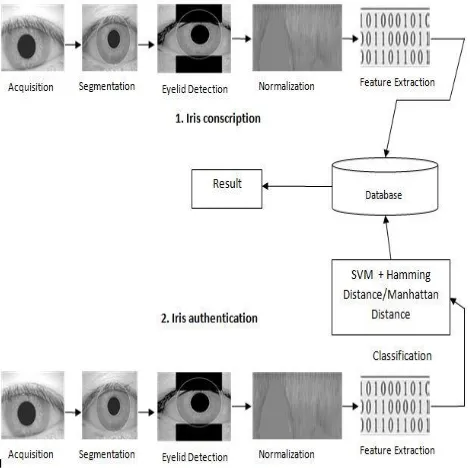
The framework of proposed system is shown in Figure 1 where, amalgamation of two classification methods is done as a substitute of using sole method. Preprocessing like segmentation, eyelid detection and normalization id done. Features are extracted and based on that classification is done and results are compared with database. For eyelid detection parabolic method is used and eyelashes are removed using median filtering technique. Haar wavelet packet transform based features are extracted and support vector machine is used at coarse classification level and at minute level, distance matching is opted. This union approach for classification technique (using blended SVM and Manhatten and hamming distance technique approach) is expereimtally tested for better accuracy of 99.72% on CASIA database. The projected authentication system is chiefly divided in two Processing steps. Step one is enrolment process in which iris patterns are required to record. The second step is identification process in which current iris image features are compared with the stored image features. Working of proposed system is shown in Fig 1.
Fig. 1.Proposed iris recognition system frame work
The proposed work was implemented using MATLAB 7.10.0.499(2010a) of Math Works, Inc, USA in the Windows 8.1 operating system with Intel Core i3 generation 5 Processor, 2.10 GHz and 4 GB RAM. Performance parameters FAR and FRR values are calculated on CASIA V1.0 described below. In the proposed method of iris recognition system, Hough transform is used for iris detection, Doughman rubber sheet model is used for normalization. For multi-faceted iris pattern most of the information lies within zigzag collarette area and hence, it is chosen for feature extraction algorithm. A combined approach of SVM along with Hamming/Manhattan distance is tested. In the current work, HAAR WPT at scale 3 is chosen for feature extraction. From WPT coefficients, entropy and mean features are extracted. Overall feature vector length of 32 is
calculated for classification, on normalization image of size 64X512. Depending on the final output of classifier and the matching technique authentication is provided to the specific user input image.
PERFORMANCE
PARAMETERS
The performance parameters for System's usefulness is weighed up on False Rejection Rate (FRR) and False Acceptance Rate (FAR). On the rate where system decides to decline the authorized person and to acknowledge the unauthorized person, precision of the system is described. the rate of the system to refuse the authorized person can be termed as False Rejection Rates (FRR) and rates of the system to allow the unauthorized person is termed as False Acceptance Rates (FAR). Both performance measures are can be expressed as:
(2)
(4)
Where,
NFR - No. of False Rejections NFA - No. of False Acceptance
NAA - No. of authorized person attempts NIA - No. of unauthorized person attempts.
The average accuracy rate for accurate recognition can be calculated as:
Accuracy rate(%) = {100- ( )}
RESULT
AND
DISCUSSION
For Experimentation total 110 images (37 People) three samples of each person for training and 148 images containing four samples of each person for testing from CASIA V1.0 database are considered. The various experiments are carried out to optimize algorithm in terms of parameters selection and design of classifiers.
1.1 Time Analysis at various stages of algorithm
To check time complexity of the proposed algorithm, Execution time at various stages are measured and expressed in Table 1.
Table 1
Time analysis at various stages of algorithm
Operation Execution Time
Iris Segmentation 469.630 ms
Eyelid Detection 843.929 ms
Normalization 467.293 ms
Feature Extraction 1.06508 s
6234 Being a binary classifier, SVM classifier is chosen for the
proposed iris recognition system. SVM classifier is used as it applies a function based upon a normal distribution at each data point, and sums these functions. Then a boundary is formed by the curve representing a certain value on that function. If the data is not linearly separable at each point then different kernel functions are used. After selection of SVM classifier, next task is selection of appropriate kernel function for current applicationTo do so various kernel functions are tested and comparative results in terms of FAR, FRR and accuracy are listed in Table 2.
Table 2
Selection of SVM Kernel function
Kernel is a function that simulates the projection of the initial data in a feature space with higher dimension. In this new space the data are considered as linearly separable. such as RBF and Polynomial giving better results than linear kernel. Table 2 shows that RBF kernel function has highest accuracy and it outperforms than linear, polynomial and MLP. The Gaussian RBF helps to classify the features which are not possible by linear kernel hence RBF is chosen as a SVM kernel function for further result analysis.
1.3 Selection of Classification Technique
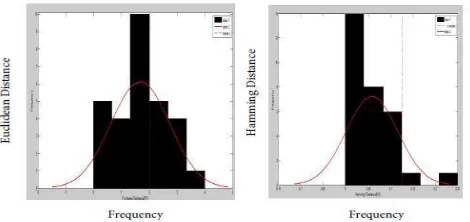
For Matching, various distance matching techniques are used such as Hamming Distance, Euclidean Distance and Manhattan Distance and various frequency distribution curves are obtained which are used for deciding overall threshold for uthorization. Which can be given in Figure 5.2.
Fig. 2. Frequency Distribution curves
To improve the overall accuracy of the system, various approaches for classification are tested such as SVM classifier and matching distance technique alone, hybrid approach of SVM and Various matchingtechniques and results are depicted in terms of FAR, FRR and Accuracy rates, as given in Table 3.
Table 3
Selection of Classification Technique Methodology FAR(%) FRR(%) Accuracy
Rate(%)
SVM only 2.08 1.44 98.24
Hamming Distance(HD)
1.77 1.02 97.23
Euclidean Distance(ED)
4.68 3.88 95.72
Manhattan Distance(MD)
1.77 1.49 98.37
SVM-HD 0.69 0.47 99.42
SVM-ED 1.56 0.62 98.91
SVM-MD 0.42 0.14 99.72
1.4 Time Complexity of various classifier
This system is tested on various distance matching techniques such as Hamming Distance, Euclidean Distance and Manhattan Distance. Execution time analysis is done on each matching technique and combination of it with SVM and the results are depicted as follows along with overall classification accuracy.
Table 4
Time Complexity of various classifier Methodology Classification
Time
Classification Accuracy(%) SVM only 389.836 ms 98.24 Hamming
Distance(HD)
191.019 ms 97.23
Euclidean Distance(ED)
204.871 ms 95.72
Manhattan Distance(MD)
156.721 ms 98.37
SVM-HD 244.390 ms 99.42 SVM-ED 440.402 ms 98.91 SVM-MD 400.801 ms 99.72
From the Table 4 we can see that execution time for Manhattan Distance is less than any other classifier alone. Apart from that in context of classification accuracy on combined methods it is observed that SVM-HD is faster than any other technique.
1.5 Accuracy comparison with previous approaches
System gives improved accuracy with combined approach than SVM, Hamming Distance and Manhattan Distance alone. Use of Wavelet Packet Transform for image decomposition at certain level also affects the overall accuracy of the system. WPT gives improved results over Wavelet transform because of detailed decomposition levels. The results with SVM-MD are better than SVM-HD. Thus, the recognition accuracy of SVM-MD as a prime system is compared with previous approaches given in Table 5.
Table 5
Accuracy comparison with previous approaches
Method Techniques used Accuracy
Rate(%) Ali et al. (2008)[17] ID Log-Gabor wavelets+SVM 80.20 Sarhan, 2009 [18] Artificial Neural Networks (ANN) 96
Patil and Patilkulkarani (2009)[19]
Wavelet transform + Euclidean distance
98.91
Fernando Gaxiola et.al, 2011 [20]
Modular Neural Network with type-2 fuzzy integration
97.98
Patricia Melin et.al, 2012[21]
ANN + Fuzzy Integrator + Genetic Algorithm
99.76 Kernel types FAR(%) FRR(%) Accuracy
Rate(%)
Linear 4.52 2.52 96.48
Polynomial 2.08 1.44 98.04
RBF 3.42 0.30 98.14
Himanshu Rai and Anamika Yadav (2014)[22]
Hamming distance+SVM 99.91
Vivek Srivastava et.al, 2014 [23]
Evolutionary fuzzy clustering and functional modular neural network
98.12
Saminathan et.al, 2015 [24]
Least square method of quadratic kernel SVM
98.5
Proposed method 0.42 99.72
1.6 Result Discussions
In order to evaluate the performance of the proposed scheme, CASIA V1.0 database is selected. The Daughman's rubber sheet model is used to normalize the iris ring into the rectangular fixed size of 64X512. Wavelet Packet Transform is used for decomposition feature extraction and further experimentation results are evaluated.
After choosing SVM as a classifier, various kernel functions are tested and maximum accuracy of 98.14% is obtained on RBF kernel function over other types. Thus, RBF kernel function is chosen for classification.
The proposed scheme is also tested on different distance matching techniques such as, Euclidean Distance(ED), Hamming Distance(HD), Manhattan Distance(MD). Out of all the Distance matching techniques Manhattan Distance provides maximum accuracy of 98.37%.
A combination approach is tested with SVM-Distance combination, it's been observed that the system gives excellent response to SVM-MD combination approach with 99.72% accuracy.
Time complexity analysis on all the classification is done, and SVM-HD proved to be faster approach over other techniques with execution time of 244.390 ms.
From results it can be stated that, 'There is a trade_off between SVM-MD and SVM- HD approaches in terms of accuracy rate and execution time'. Thus, In terms of accuracy rate SVM-MD is better while in terms of execution time SVM-HD is better in performance. System gives improved accuracy with combined approach than SVM or any Distance technique alone.
CONCLUSION
In this experimentation a unique and reliable approach for iris feature extraction and recognition is presented. For multi-faceted iris pattern most of the information lies within zigzag collarette area and hence, it is chosen for feature extraction and higher recognition rate has been achieved. Haar wavelet packet transform have been used for feature extraction. The entropy and mean feature vectors are also used for classification. These extracted features were utilized for iris identification using different kernel functions, Hamming Distance, Euclidean Distance, Manhattan Distance and combination of support vector machine-various distance approaches are compared with recognition accuracy of previously used approaches. The SVM-MD has better recognition rate than using SVM or any distance technique alone. It is also clear that the efficiency has been increased when we used SVM-Manhattan distance based classifier than the SVM-Hamming Distance classifier. The accuracy of the proposed method is excellent for the CASIA in term of FAR and FRR. There is a tradeoff between SVM-MD and SVM-HD approaches in terms of accuracy rate and execution time.
Thus, as per systems requirement any combination method among the two can be utilized.
REFERENCES
[1] Farmanullah Jan, Imran Usman, and Shahrukh Agha, ―Reliable iris localization using Hough transform, histogram-bisection, and eccentricity‖, Journal of Signal Processing Systems Vol.93, No.1,pp-230-241
[2] Zhonghua Lin, Hongfei Yu, ―The Pupil Location Based on the OTSU Method and Hough Transform‖, Procedia Environmental Sciences ,No.8 pp.352 – 356, 2011 [3] Chia-Te Chou, Sheng-Wen Shih, and Duan-Yu Chen,
―DESIGN OF GABOR FILTER BANKS FOR IRIS RECOGNITION‖, 2006 International Conference on Intelligent Information Hiding and Multimedia Signal Processing
[4] Mohammad Javad Aligholizadeh, Shahram Javadi, Reza Sabbaghi- Nadooshan, Kaveh Kangarloo, ―Eyelid and Eyelash Segmentation Based on Wavelet Transform for Iris Recognition‖, 4th International
[5] Congress on Image and Signal Processing, 2011
[6] Afsana Ahamed, Mohammed Imamul, and Hassan Bhuiyan ―Low Complexity Iris Recognition using Curvelet Transform‖, IEEE/OSA/IAPR International Conference on Infonnatics, Electronics & Vision, 2012
[7] S. Arivanzhagan, S. Shobana Priyadharshini, and J. Raja Sekar, ―Iris Recognition Using Ridgelet Transform‖, 2011 International Conference on Recent Advancements in Electronics, Electronics and
[8]Control Engineering, 2011
[9] Kayazuyuki Miyazawa, Koichi Ito, Takafumi Aoki, Koji kobayashi, and Hiroshi Nakajima, ―An Effective Approach for Iris Recog nition Using Phase-Based Image Matching‖, IEEE TRANSACTION
[10]Abiyev R.H. and Altunkaya, K. "Personal iris recognition using neural network", International Journal of Security and its Applications Vol. 2, No. 2, pp. 41-50, 2008
[11]Mohtashim Baqar, Sohaib Azhar, Zeeshan Iqbal, Irfan Shakeel, Laeeq Ahmed and Muhammad Moinuddin, "Efficient iris recognition system based on dual boundary detection using robust variable learning rate Multilayer Feed Forward neural network", In Information Assurance and Security (IAS), 2011 7th International Conference on, pp. 326-330, IEEE, 2011.
[12] Chen C.H. and Chu, C.T "Low complexity iris recognition based on wavelet probabilistic neural networks", In Neural Networks, 2005, IJCNN'05, Proceedings, 2005 IEEE International Joint Conference on, Vol. 3, pp. 1930-1935, IEEE, 2005.
[13]Muhammad Moinuddin, Mohamed Deriche and SYED SAAD AZHAR Ali, "A new iris recognition method based on neural networks", WSEAS Transactions on information science and applications, Vol. 1, No. 6 2004.
[14]Lei Nie, Ajay Kumar and Song Zhan, "Periocular recognition using unsupervised convolutional RBM feature learning", In Pattern Recognition (ICPR), 2014 22nd International Conference on, pp. 399-404, IEEE, 2014. [15]Fernando Gaxiola, Patricia Melin, Fevrier Valdez and
6236 [16]Patricia Melin, Victor Herrera, Danniela Romero, Fevrier
Valdez, and Oscar Castillo, "Genetic optimization of neural networks for person recognition based on the Iris",
TELKOMNIKA (Telecommunication Computing
Electronics and Control) Vol. 10, No. 2, pp. 309-320, 2012 [17]Jaishanker K. Pillai, Maria Puertas, and Rama Chellappa, "Cross-sensor iris recognition through kernel learning", IEEE transactions on pattern analysis and machine intelligence Vol. 36, No. 1, pp. 73-85, 2014.
[18]Roy Kaushik and Prabir Bhattacharya, ―Application of multi-objective genetic algorithm and asymmetrical support vector machine to improve the reliability of an iris recognition system‖, In Systems, Man and Cybernetics, 2007, ISIC, IEEE International Conference on, pp. 1952-1957, IEEE, 2007.
[19]Ali, Hasimah, and Momoh JE Salami. "Iris recognition system by using support vector machines." In 2008 International Conference on Computer and Communication Engineering, pp. 516-521. IEEE, 2008 [20]Sarhan, A.M. "Iris Recognition Using Discrete Cosine
Transform and Artificial Neural Network", Journal of Computer Science Vol. 5, No. 5, pp. 9-373, 2009.
[21]Patil, Chandrashekar M., and Sudarshan Patil Kulkarni. "An approach of iris feature extraction for personal identification." In 2009 International Conference on Advances in Recent Technologies in Communication and Computing, pp. 796-799. IEEE, 2009.
[22]Fernando Gaxiola, Patricia Melin, Fevrier Valdez and Oscar Castillo, "Modular neural networks with type-2 fuzzy integration for pattern recognition of iris biometric measure", In Mexican International Conference on Artificial Intelligence, pp. 363-373, Springer, Berlin, Heidelberg, 2011.
[23]Patricia Melin, Victor Herrera, Danniela Romero, Fevrier Valdez, and Oscar Castillo, "Genetic optimization of neural networks for person recognition based on the Iris",
TELKOMNIKA (Telecommunication Computing
Electronics and Control) Vol. 10, No. 2, pp. 309-320, 2012. [24]Rai, Himanshu, and Anamika Yadav. "Iris recognition using combined support vector machine and Hamming distance approach." Expert systems with applications 41, no. 2 (2014): 588-593.
[25]Vivek Srivastava, Bipin Kumar Tripathi and Vinay Kumar Pathak, "Biometric recognition by hybridization of evolutionary fuzzy clustering with functional neural networks", Journal of Ambient intelligence and humanized computing Vol. 5, No. 4, pp. 525-537, 2014.