March-April 2018 350
Research
Paper
Though a drug can be administered by several ways, the oral route of administration is the most obvious route of administration preferred by almost every patient. The oral route is the most economical and simplest route of administration that does not require use of any device and therefore self-medication is possible. About 40 % of new drugs have poor solubility in water and ultimately leads to poor oral bioavailability[1,2]. Since dissolution is the rate limiting step, formulation design can be a proper approach to enhance absorption and ultimately bioavailability of these drugs[3,4]. Many formulation approaches like complexation[5], solid dispersions[6] and nanosuspensions[7] are employed to solve this problem, but these approaches have some limitations like less stability, laborious and expensive methods.
The self-microemulsifying drug delivery system (SMEDDS) is known as one of the most useful approach to overcome problems of drug with low solubility and poor oral absorption. SMEDDS comprises isotropic mixtures of natural or synthetic oils, surfactants and
co-surfactants. These systems spontaneously emulsify
when exposed to gastrointestinal fluids to form oil
in water microemulsion with nanometric droplet size. SMEDDS enhances in vitro dissolution and improves the in vivo absorption of lipophilic drugs[8,9]. SMEDDS is system with droplet size ranging from 20- 200 nm[10,11]. The solubilisation capacity for was to investigate SMEDDS for piroxicam. In the present study, a stable SMEDDS formulation for different drugs in SMEDDS is different due to various intermolecular forces between drug and SMEDDS components[12]. The small-sized droplets of SMEDDS offer an increase in dissolution rate and bioavailability of drugs[13,14]. Other important advantages of SMEDDS include ease of manufacturing and scale-up[15].
Development and Optimization of Piroxicam-loaded
Solid Self-microemulsifying Drug Delivery System
SEEMA PATTEWAR*, S. B. KASTURE1, V. V. PANDE2, D. N. PATIL2 AND S. K. SHARMA
Department of Pharmacy, Banasthali University, Vanasthali-304 022, 1Pinnacle Biomedical Research Institute, Bhopal- 462 003, 2Sanjivani College of Pharmaceutical Education and Research, Kopargaon-423 603, India
Pattewar, et al.: Piroxicam-loaded solid self-microemulsifying drug delivery system
The aim of present study was to formulate and evaluate self-microemulsifying drug delivery system containing piroxicam and to use the ability of porous magnesium alumina metasilicate as a solid carrier for self-microemulsifying drug delivery system. It was developed to resolve the problems of piroxicam such as low water solubility, low bioavailability and gastrointestinal irritation. Self-microemulsifying drug delivery system containing varying proportions of Capmul MCM, Cremophor EL and Transcutol-P were prepared and optimized using response surface methodology of Design-Expert® software version 10. Liquid
self-microemulsifying drug delivery systems were subjected to in vitro evaluation, including self-emulsification efficiency study, droplet size, zeta potential measurement and in vitro drug release studies. Solid self-microemulsifying drug delivery system was prepared by adding liquid self-self-microemulsifying drug delivery system with Neusilin US2 and filled in hard gelatin capsule. The optimized formulation consists of 28.26 % of Capmul MCM, 44.16 % of Cremophor EL and 27.58 % of Transcutol-P. The results showed that the drug release profile of piroxicam from the self-microemulsifying drug delivery formulations was higher than the pure piroxicam powder. The release of piroxicam was rapid and complete. Solid self-microemulsifying drug delivery systems after filled in hard gelatin capsule, predicted to be a promising technique to deliver a liquid formulation in solid dosage form.
Key words: Bioavailability; SMEDDS, piroxicam, solubility, zeta potential
*Address for correspondence E-mail: [email protected]
This is an open access article distributed under the terms of the Creative Commons Attribution-NonCommercial-ShareAlike 3.0 License, which allows others to remix, tweak, and build upon the work non-commercially, as long as the author is credited and the new creations are licensed under the identical terms
351
But, SMEDDS possesses several shortcomings, in manufacturing and clinical practices such as potential risk of drug precipitation and migration of some of SMEDDS components into the capsule shells. To overcome these drawbacks, solid SMEDDS (S-SMEDDS) was investigated as an alternative. S-SMEDDS was developed by incorporating SMEDDS
into inert solid excipients. Solidification methods were
adsorption to solid carriers, spray drying, freeze drying, rotary evaporation, melt extrusion-spheronization and melt granulation. Among these methods, adsorption to solid carriers is a simple and easy technique, offering a
stable free-flowing S-SMEDDS[16]. Low density porous carriers with large surface area i.e. Neusilin UFL2, Neusilin US2 were used in order to improve dissolution rate of drugs such as carvedilol and indomethacin[17]. According to Biopharmaceutical Classification
System,piroxicam is a class II drug with low solubility and high permeability. Piroxicam is a non-steroidal
antiinflammatory drug with a long half-life. Piroxicam
is used to treat pain associated with rheumatoid arthritis, osteoarthritis, gout and in different musculoskeletal disorders. Piroxicam blocks cyclooxygenase and
ultimately inflammation, pain and fever are reduced[18]. The aim of this study piroxicam was developed and evaluated. The SMEDDS consisting of Capmul MCM, Cremophor EL, Transcutol P was characterized for the particle size, self-emulsifying ability and zeta potential. After development of SMEDDS it was converted into S-SMEDDS by adsorption technique using carriers
like Neusilin US2 and filled in hard gelatin capsule.
MATERIALS AND METHODS
Piroxicam was obtained as a gift sample from Apex Healthcare Limited, Ankleshwar, Gujarat, India. Capmul MCM (medium chain mono and diglyceride), Captex-300 (glyceryl tricaprylate/tricaprate), were obtained as gift samples from Intas Pharmaceuticals Limited, Ahmedabad, Gujarat. Cremophor-EL (macro glycerol ricinoleate), Transcutol P (diethylene glycol
monoethyl ether), Labrafil were gift samples from
Dr. Reddy's Laboratories Ltd., Hyderabad, India. Cremophor RH-40 (macrogolglycerol hydroxystearate) was a gift from Trans Chem Corporation, Bhiwandi, India. Neusilin US2 (magnesium aluminometasilicate) was obtained as a gift sample from Gangwal Chemicals Pvt. Ltd., Mumbai, India. Tween 80, Tween 20, oleic
acid, Brij-35, sunflower oil, sesame oil, polyethylene
glycol 400, propylene glycol were purchased from S. D. Fine-Chem Limited, Mumbai, India.
Drug-excipient compatibility studies:
The Fourier-transform infrared spectroscopy (FTIR) spectra of drug, excipients, SMEDDS and
self-microemulsifying mouth dissolving film formulation were recorded. Briefly, solid sample was compressed
along with about 100 mg dried potassium bromide into a disc. For liquid sample, few drops of the sample were dripped onto NaCl or KBr aperture plate and sandwiched it under another aperture plate, such that no gas bubbles were trapped. The sample allowed formation of a thin liquid membrane between the two aperture plates. Thereafter, sample was scanned for absorbance over the range from 4000 to 400 (cm-1) wave numbers. The obtained spectrum was then compared with standard group frequencies of piroxicam.
Solubility study of piroxicam:
Piroxicam solubility was determined in oil, surfactant,
and co-surfactant by shake-flask method. Oleic acid, Capmul MCM, Labrafil, Captex, sunflower oil, sesame
oil were used as oils for solubility study. It was carried out by solubilizing an excess quantity of drug in 2 ml of the vehicle. Mixture was then vortexed and kept for 72 h at 25° in an orbital shaking incubator (Dolphin) for solubilisation. After equilibrium, it was centrifuged at 10 000 rpm for 15 min. Supernatant liquid was diluted
with 0.1 M methanolic HCl and drug was quantified
at 334 nm[19] by using UV spectrophotometer by placing a blank. The blank was formulated by mixing respective oil, surfactant or co-surfactant in 0.1 M HCl in methanol with same dilution as for the sample[20]. Surfactant selection:
Piroxicam solubility was carried out in Tween 80, Cremophor EL, Tween 20, Brij 35 and Cremophor RH-40 as per above mentioned procedure. Thereafter
the surfactants were selected by their emulsification
study, water uptake capacity and percent transmittance of the selected oil phase. For water-uptake study, selected oil and various surfactants were mixed in ratio of 1:4 and vortexed to form homogenous mixture using a cyclomixer (model CM 101, Remi Instruments, Ltd., India). Oil-surfactant mixture (1 ml) was placed in test tubes and water was added drop-wise till the system became turbid and the quantity of
water uptake was noted. For emulsification study and percent transmittance study, surfactant of 200 μl was mixed with 200 μl of oil, which was selected and then 50 μl of this was diluted to 50 ml with water. After
352
March-April 2018
Co-surfactant selection:
Piroxicam solubility was then carried out in different co-surfactant such as propylene glycol, Transcutol P, PEG-400 by following the above-mentioned procedure.
For this study surfactant 40 μl was mixed with co-surfactant 20 μl (S:coS mix 2:1) and oil phase 60 μl
was added to mixture (oil:Smix, 1:1). Then mixture was heated to 45 to 50° in water bath for proper mixing,
from this mixture 50 μl was diluted up to 50 ml
double-distilled water. After 2 h, transmittance was taken at 650 nm[22].
Construction of pseudo-ternary phase diagrams:
It was constructed by titration of homogeneous liquid mixture of oil, surfactant and co-surfactant with water phase at 37°[23]. The ratio of surfactant to co-surfactant was taken as 1:1, 2:1. Oil and Smix were mixed properly in different weight ratios (1:9 to 9:1)[24]. Then each mixture titrated with distilled water until they exhibited turbidity. Only transparent mixtures were considered as microemulsions. Phase diagram plot was constructed using CHEMIX school software version 3.0 developed by Arne Standnes, Lakeland, USA.
Formulation of liquid SMEDDS (L-SMEDDS):
Different SMEDDS formulations were formulated on phase diagram plot. Oil (Capmul MCM), surfactant (Cremophor EL) and co-surfactant (Transcutol P) were selected for L-SMEDDS. The L-SMEDDS was prepared as reported in literature[25]. Piroxicam (10 mg) was transferred into a screw-capped glass vial containing selected oil, surfactant and co-surfactant mixture (S-Cos mix in 2:1 ratio) and stirred with vortex to obtain homogenous solution. The prepared SMEDDS was stored in room temperature in sealed transparent vials until used[26].
Experimental design:
Optimization of the piroxicam SMEDDS were done using 2 level factorial design. From the preliminary study, oil, surfactant and co-surfactant were selected for L-SMEDDS formulation. Quantities of Capmul MCM (X1) and Cremophor EL(X2) were selected as the two factors for optimization. Two levels for each factor were used to construct experimental design. Levels for Capmul MCM (25.88 and 30.88 %) and Cremophor EL (38.82 and 52.23 %) were selected from preliminary study. Drug content (Y1) and percent transmittance (Y2) was selected as a desire to response for optimization. Four experiments were planned as per 22 factorial designs. Response surface diagram was
constructed. Formulation was optimized by response surface diagram obtained from Design-Expert® software version 10- Stat-Ease.
Characterization of L-SMEDDS:
Precipitation was evaluated visually after 24 h. L-SMEDDS were categorized after 24 h as clear or turbid and stable or unstable. Those transparent formulations exhibiting no precipitation were used for further study[27]. Self-emulsification efficiency was carried out using USP dissolution apparatus II[28]. Each formulation (1 g) was mixed with distilled water (500 ml) maintained at 37° with paddle speed 50 rpm.
The self-emulsification performance of each SMEDDS
was observed visually using grading systems[29]. Formulations those passed self-emulsification efficiency test were selected for further evaluation. The SMEDDS was evaluated by thermodynamic stability study tests viz. freeze thaw cycles and centrifugation[30]. Three cycles of formulations subjected to the freezing at –4° for 24 h in deep freeze and followed by thawing at 40° for 24 h in hot air oven and visually inspected for phase separation. The SMEDDS was centrifuged at 5000 rpm for 30 min in centrifuge (Remi instruments, India). Piroxicam SMEDDS were diluted with water (1:100) and the emulsion was observed visually for precipitation. Percent transmittance was measured at 650 nm (FTIR-8400S, Shimadzu, Japan). Globule size and polydispersity index (PDI) of reconstituted piroxicam SMEDDS was studied using Malvern Zetaseizer. (Nano ZS, Malvern Instruments, United Kingdom). The zeta potential was determined by using Malvern Zetasizer. The samples were diluted with a ratio 1:100 (V/V) with distilled water. The percent drug content of formulations was determined from the calibration curve of piroxicam in 0.1 M methanolic HCl and assay of drug was done by UV/ Vis spectrophotometer at wavelength 334 nm. The viscosity of optimized formulation was evaluated by
Brookfield Viscometer (DV-E, Brookfield Engineering
Laboratories Inc., Middleboro, MA).
S-SMEDDS of piroxicam were prepared by adsorbing technique by using solid adsorbent. Piroxicam-loaded SMEDDS were added drop-wise over highly porous Neusilin US2 (magnesium aluminometasilicate) in ratio 1:1 by weight. Mixture was mixed properly after each addition. The granular mass obtained was passed through sieve with mesh no. 120 to get free
flowing powder. For one capsule 160 mg of Neusilin
353
filled in hard gelatin capsule size ‘0’[21]. S-SMEDDS formulations were evaluated for angle of repose, Carr’s compressibility index and Hausner’s ratio[31-33].
In vitro dissolution studies:
Drug releases of formulation were studied in 900 ml of 0.1 N HCl using USP dissolution II (paddle type) apparatus at 50 rpm and 37±0.5°. A quantity of S-SMEDDS, L-SMEDDS, piroxicam powder
equivalent to 10 mg of piroxicam were filled in size “0”
hard gelatin capsule and taken into vessel containing 900 ml of dissolution media. Five milliliter aliquots were taken out at time intervals such as 5, 10, 15, 25, 30, 35, 40, 45, 60, 90 and 120 min from medium and replace with same 0.1 N HCl solutions and were analysed at the wavelength 335 nm.
Stability studies:
Stability study was performed as per ICH Q1A (R2) stability guidelines[31]. For that purpose accurately weighed S-SMEDDS equivalent to one dose was filled capsule size ‘0’. Samples were placed at 30±2°/75±
5 % RH. The samples were analysed for percent drug content and percent drug released for 3 mo.
RESULTS AND DISCUSSION
Fig. 1A showed FTIR spectra of piroxicam. It has been reported that piroxicam has two inter convertible crystalline forms, namely the needle and cubic forms. The IR 1629.90 cm–1 was assigned to the stretching of amide carbonyl groups of cubic form, suggesting that the cubic form of piroxicam was used. Main characteristic peak of piroxicam were 3338 cm–1 for secondary amine N-H stretching, 3450 cm–1 for O-H stretch and 1180.47cm–1 for S=O asymmetric stretch. SMEDDS formulation (fig. 1B) gave peaks at 1728.28 cm–1 for C=O amide carbonyl, 3442.09 cm–1 for N-H stretch, 3604.11 for O-H stretch and 1217.12 for S=O asymmetric stretch. The N-H group of amide in piroxicam formed hydrogen bond with carboxyl group of SMEDDS excipients (soluble and dilute form for piroxicam) and this reduced electron density on nitrogen. This lead to shifting of C=O stretch of amide carbonyl. The IR spectra of formulation (SMEDDS with drug) indicates absence of remarkable changes in the location of the characteristic infrared absorption bands of the drug in formulation suggesting that there is no interaction between piroxicam and excipients. Results of solubility of piroxicam in various oils were
shown in fig. 2. It was observed that the Capmul MCM
possessed higher ester content, so drug showed higher solubility in Capmul MCM. Hence Capmul MCM was selected as oil phase.
Non-ionic surfactants are believed to be safer than the ionic surfactants[34]. They are expected produce reversible change in intestinal mucosal permeability[35]. Those having HLB 4.3 to 16 were screened. The final
surfactant was selected by their emulsifying ability and percent transmittance. Cremophor RH-40 (94.87 %) and Cremophor EL (99.22 %) showed better percent
transmittance, indicating good emulsification ability as
showed in Table 1. Piroxicam showed better solubility in these surfactants and they were used for further
study (fig. 2).
Co-surfactants were screened for improving the
emulsification ability of selected surfactant. The percent transmittance and emulsification time were
carried out using PEG 400 and Transcutol P as co-surfactants in combination with surfactant and oil are given in Table 1. Cremophor-EL showed very good ability to emulsify as compare to Cremophor RH-40. Among all the co-surfactants screened, Transcutol P showed highest percent transmittance (98.80 %) when used along with Cremophor EL. Cremophor EL having higher HLB i.e. 15. High HLB value surfactants lead to
more rapid dispersion and finer emulsion droplet size
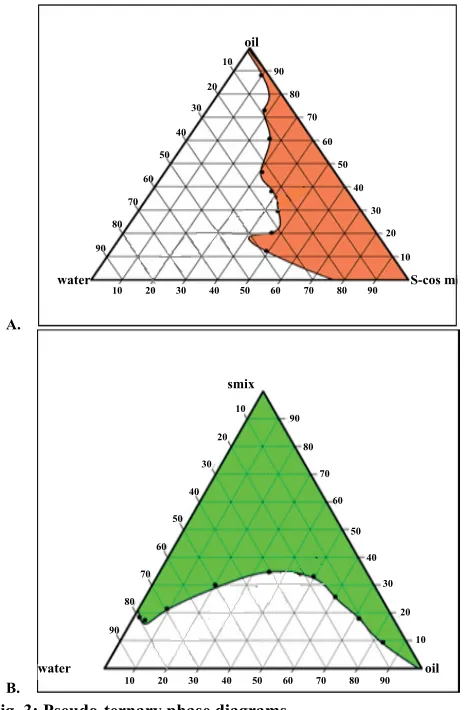
on addition to aqueous phase[36]. Piroxicam was more soluble in Capmul MCM (7.1372 mg/ml), Cremophor EL[36,37] (11.94 mg/ml) and Transcutol P (11.81 mg/ml). Solubility study was used to identify the area for stable and clear formulations in 1:1, 2:1 S-Cos mix ratio. The quantities of three components i.e. oil, surfactant and co-surfactant were selected from pseudo-ternary phase
diagrams (fig. 3). It was observed that micro-emulsion
formation area was increased with an increase in S-Cos mix and was highest at S-Cos mix 2:1. So Smix in 2:1 ratio was selected for formulation of SMEDDS.
354
March-April 2018
formulation were simultaneously fitted to models using Design-Expert® 10. It was observed that best fitted
model was linear. For linear model standard deviation (SD) was 0.65, R2 value was 0.9102, coefficient of variation (CV %) was 0.66, mean 98.13 and PRESS
value was 6.76. These values were significant for
linear model. A possitive value represents an effect that favours the optimization, while a negative value indicate an inverse relationship between the factor and the response. Y1 = 110.82–0.25 X1–0.12304 X2; Y2 = 118.21–0.479 X1–0.195 X2.
A.
B.
Fig. 1: FTIR spectra of piroxicam (A) and SMEDDS with piroxicam (B)
0 2 4 6 8 10 12 14
S o l u b i l i t y
i n
m g / m l
Fig. 2: Solubility of piroxicam in oils, surfactants and co-surfactants
Oil Surfactant Surfactant+co-surfactant Water uptake capacity (ml) Emulsification study transmittancePercent Remark
Capmul MCM CR-EL - 0.75 A 99.22 Pass
Capmul MCM CR-RH 40 - 0.35 B 94.87 Fair
Capmul MCM - CR EL+PEG 400 0.6 B 94.12 Fair
Capmul MCM - CR RH 40+PEG 400 0.3 C 84.33 Rejected
Capmul MCM - CREL+Transcutol 0.8 A 98.80 Pass
Capmul MCM - CR RH 40+Transcutol 0.3 B 93.23 Fair
TABLE 1: SELECTION OF SURFACTANT AND CO SURFACTANT
355
required to obtain an optimized formulation. A new formulation was prepared containing Capmul MCM 28.26 %, Cremophore EL 44.16 % and Transcutol P 27.58 % according to solution given by Design-Expert® 10. Each batch contained 10 mg of piroxicam in 150 mg of SMEDDS. The optimized formulation of piroxicam-loaded SMEDDS was transparent
and stable. For self-emulsification efficiency study,
distilled water was used to check the dispersion and
self-emulsification. The optimized batch showed ‘A’
grade. The optimized batch passed freeze thaw cycles and centrifugation test. Phase separation, cracking and creaming was not observed during this study. Hence the batch was proceeds for further study.
Percent transmittance was 96.06 % for optimized batch as per Table 3.The droplet size of optimized batch was
found to be 138.8 nm as showed in fig. 5A, which
could be due to the low concentration of oil. PDI value was found as 0.519 for SMEDDS. Zeta potential of
optimized batch was showed in fig. 5B. Zeta potential governs the degree of repulsion between adjacent or similarly charged and dispersed droplet, it shows the practical application in the stability. The negative charge on SMEDDS was due to esters and fatty acids in Capmul MCM, which was present in formulations as oil phase. The negative zeta potential values of
the formulations confirmed SMEDDS stability. Drug
content for optimized formulations were determined using UV/Vis spectrophotometric analysis employing a standard calibration curve. The optimized batch showed 98.32±0.008 % of drug as per Table 3.
Viscosity of the L-SMEDDS formulations was found as 0.8872 cps. S-SMEDDS prepared by adsorption of liquid SMEDDS using Neusilin US2. A 1:1 proportion
of Neusilin US2:L-SMEDDS was sufficient to obtain a free-flowing powder. S-SMEDDS prepared with 1:1
(adsorbent:L-SMEDDS of piroxicam) showed good
flow properties with Carr’s index as 13 i.e. between 12 and 15, Hausner’s ratio as 1.21 within 1.2-1.25 and angle of repose 25.9 between 25-30.
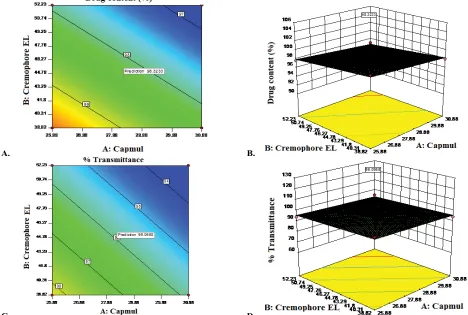
Two dimension contour plots and 3D surface plots
were prepared for all responses as showed in fig. 4 for
responses Y1 and Y2,respectively. These plots were known to study the interaction effect of the factor on the response properties. The percent relative error for batches was in between –0.3413 to +1.7. Experimental values and predicted values showed good agreement
with each other. This confirmed the validity of the
equations.
Thus, Chemix and response methodology was then used to predict the levels of the factor, amount of Capmul MCM (X1) and amount of Cremophor EL (X2)
A.
B.
oil
oil S-cos m water
water
smix
10
10 20
20 30
30 40
40 50
50 60
60
70
70
80
80
90
90
10 20 30 40 50 60 70 80 90
10
10 20
20 30
30 40
40 50
50 60
60
70
70
80
80
90
90
10 20 30 40 50 60 70 80 90
Fig. 3: Pseudo-ternary phase diagrams
(A) Formulation made up of Capmul MCM, Cremophore EL, Transcutol P (S/CoS 1:1); (B) Capmul MCM, Cremophore EL, Transcutol P (S/CoS 2:1)
Runs Batch Quantity of transcutol (%) Independent variables
Dependent variables
Observed value Predicted value
X1 X2 Y1 Y2 Y1 Y2
1 F1 30.3 30.88 38.82 98 94.22 98.33 95.85
2 F2 35.30 25.88 38.82 99.9 99.88 99.58 95.25
3 F3 21.89 25.88 52.23 97.6 94 97.92 95.63
4 F4 16.89 30.88 52.23 97 94.87 96.67 93.24
TABLE 2: FULL FACTORIAL DESIGN EXPERIMENT WITH RESULT FOR FORMULATION OF SMEDDS
356
March-April 2018
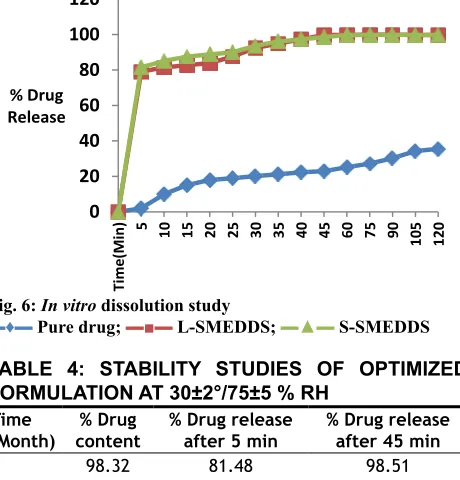
For L-SMEDDS, in vitro dissolution studies showed 80.65 % drug release in 5 min, 99.72 % within 45 min. For S-SMEDDS batch, in vitro dissolution studies showed 81.48 % in 5 min, 98.51 % in 45 min. Plain drug showed very less release 35.51 % after 120 min
in 0.1 N HCL as showed in fig. 6. A stability study was performed and there was insignificant difference
in percent drug content and percent drug release after 3 mo. Initially slight reduction in drug release was observed, however 98.51 % drug release was found in 45 min after 3 mo (Table 4). Optimization of formulation was performed using 2 factors, 2 level designs. The quantity of Capmul MCM and Cremophor EL showed
significant effect on the percent drug content and
percent transmittance of micro emulsion. Response
A. B.
C. D.
Fig. 4: Contour and 3D surface plots of the effect of amount of Capmul MCM and Cremophore EL on responses Y1 and Y2 The effect of amount of Capmul MCM (X1) and Cremophore EL (X2) on response Y1 (A and B) and Y2 (C and D). A and C. contour
plot; B and D. 3D surface plot
Parameter Optimized batch
Precipitation assessment No precipitation Assessment of
self-emulsification study: grade “A” Grade
Drug content 98.32±0.008165 %
% Transmittance 96.06 %
Emulsification time 11 s
TABLE 3: CHARACTERIZATION OF LIQUID SMEDDS
A.
B.
8 7 6 5 4 3 2 1 0
0.1 1 10 100 1000 10000
Size (d nm)
A
B Zeta potential (mV)
Intensity (%)
Total counts
1400
1300
1200
1100
1000
900
-200 -100 0 100 200
Fig. 5: Size distribution (A) and zeta potential (B) of SMEDDS
357
drug release studies. It showed improvement in drug release rate compared to pure drug. The improved in vitro dissolution from the S-SMEDDS is an indication of improvement in solubility, dissolution rate of the pure drug. Thus S-SMEDDS is a promising system for piroxicam.
Acknowledgements:
The authors are grateful to Apex Healthcare Limited, Gujarat, India for providing piroxicam drug. The authors are also grateful to Intas Pharmaceuticals Limited, Ahmedabad, Trans Chem Corporation, Bhiwandi, Dr. Reddy's Laboratories Ltd., Hyderabad, Gangwal Chemicals Pvt. Ltd., Mumbai for providing the gift samples of oils, surfactants, co-surfactants and adsorbents.
Conflicts of interest:
There are no conflicts of interest.
Financial support and sponsorship:
Nil.
REFERENCES
1. Obitte NC, Rohan LC, Adeyeye CM, Parniak MA, Esimone
CO. The utility of self-emulsifying oil formulation to improve the poor solubility of the anti HIV drug CSIC. AIDS Res Ther 2013;10:14.
2. Yang M, Gong W, Wang Y, Shan L, Li Y, Gao C. Bioavailability
Improvement Strategies for Poorly Water-soluble Drugs Based on the Supersaturation Mechanism: An Update. J Pharm Pharm Sci 2016;19:208-25.
3. Lipinski CA, Lombardo F, Dominy BW, Feeney PJ. Experimental and computational approaches to estimate solubility and permeability in drug discovery and development settings. Adv Drug Deliv Rev 2012;64:4-17.
4. Pouton CW. Formulation of poorly water-soluble drugs for oral administration: physicochemical and physiological issues
and the lipid formulation classification system. Eur J Pharm
Sci 2006;29:278-87.
5. Chaudhary VB. Cyclodextrin Inclusion Complex to Enhance Solubility of Poorly Water Soluble Drugs: A Review. Int J Pharm Sci Res 2013;4(1);68-76.
6. Sridhar I, Doshi A, Joshi B, Wankhede V, Doshi J. Solid Dispersions: an Approach to Enhance Solubility of poorly Water Soluble Drug. Int J Sci Innov Res 2013;2(3):685-94. 7. Shid RL, Dhole SN, Kulkarni N, Shid LS. Nanosuspension: A
Review. Int J Pharm Sci Rev Res 2013;22:98-106.
8. Singh SK, Verma PRP, Razdan B. Development and characterization of a lovastatin loaded self-microemulsifying drug delivery system. Pharm Dev Technol 2010;15:469-83. 9. Hong JY, Kim JK, Song YK, Park JS, Kim CK. A new
self-emulsifying formulation Itraconazole with improved dissolution and oral absorption. J Control Release 2006;110:332-38.
10. Mou D, Chen H, Du D, Mao C, Wan J, Xu H, et al.
Hydrogel-thickened system for topical delivery of lipophilic drugs. Int J Pharm 2008;353:270-76.
11. Porter CJ, Trevaskis NL, Charman WN. Lipids and lipid-based formulations: optimizing the oral delivery of lipophilic drugs. Nat Rev Drug Discov 2007;6:231-48.
12. Li S, Madan P, Lin S. Effect of ionization of drug on drug solubilization in SMEDDS prepared using Capmul MCM and caprylic acid. Asian J Pharma Sci 2017;12:73-82.
13. Nazzal S, Smalyukh OD, Mansoor AK. Preparation and in vitro characterization of a eutectic based semisolid
self-nanoemulsified drug delivery system (SNEDDS) of
ubiquinone: mechanism and progress of emulsion formation. Int J Pharm 2002;235:247-85.
14. Wang YP, Gan Y, Zhang XX. Novel gastroretentive sustained-release tablet of tacrolimus based on self-microemulsifying
mixture: in vitro evaluation and in vivo bioavailability test.
Acta Pharmacol Sin 2011;32:1294-302.
15. Gupta S, Kesarla R, Omri A. Formulation Strategies to Improve the Bioavailability of Poorly Absorbed Drugs with Special Emphasis on Self-Emulsifying Systems. ISRN Pharm 2013;848043:16.
16. Singh B, Bandopadhyay S, Kapil R, Singh R, Katare O. Self-emulsifying drug delivery systems (SEDDS): formulation development, characterization, and applications. Crit Rev Ther Drug Carrier Syst 2009;26:427-521.
17. Bahl D, Bogner RH. Amorphization of indomethacin by co-grinding with Neusilin US2: amorphization kinetics, physical stability and mechanism. Pharm Res 2006;23:2317-25. 18. Dahl SL, Ward JR. Pharmacology, clinical efficacy, and
adverse effects of piroxicam, a new nonsteroidal
anti-inflammatory agent. Pharmacotherapy 1982;2(2):80-90.
19. Dhage MA, Chhabra GS, Banerjee SK. Development and validation of UV-spectrophotometric method for piroxicam in bulk and pharmaceutical formulation. J Chem Pharm Res 2011;3:765-69.
0 20 40 60 80 100 120
Ti
m
e(
M
in
) 5 10 15 20 25 30 35 40 45 60 75 90
10
5
12
0
% Drug Release
Fig. 6: In vitro dissolution study
▬♦▬ Pure drug; ▬■▬ L-SMEDDS; ▬▲▬ S-SMEDDS
Time
(Month) content% Drug % Drug release after 5 min % Drug release after 45 min
0 98.32 81.48 98.51
1 99.03 78 98.51
2 98.45 79.05 98
3 98.36 79.05 98.51
358
March-April 2018
20. Kallakunta VR, Bandari S, Jukanti R, Veerareddy PR. Oral self-emulsifying powder of lercanidipine hydrochloride: formulation and evaluation. Powder Technol 2012;221:375-82. 21. Date AA, Nagarsenker M. Design and evaluation of
self-nanoemulsifying drug delivery systems (SNEDDS) for cefpodoximeproxetil. Int J Pharm2007;329:166-72.
22. Gupta S, Chavan S, Sawant K. Self nanoemulsifying drug delivery system for adefovirdipivoxil: Design, characterization, in vitro and ex vivo evaluation. Colloids Surf A: Physicochem Eng Asp 2011;392:145-55.
23. Shen H, Zhong M. Preparation and evaluation of self-microemulsifying drug delivery systems (SMEDDS) containing atorvastatin. J Pharm Pharmacol 2006;58:1183-91. 24. Liu W, Tian R, Hu W, Jia Y, Jiang H, Zhang J. Preparation
and evaluation of selfmicroemulsifying drug delivery system of baicalein. Fitoterapia 2012;83:1532-39.
25. Quan Q, Kim DW, Marasini N, Kim DH, Kim JK, Kim JO. Physicochemical characterization and in vivo evaluation of solid self-nanoemulsifying drug delivery system for oral administration of docetaxel. J Microencapsul 2013;30:307-14. 26. Zanchetta B, Chaud MV, Santana MHA. Design and
development of self-emulsifying drug delivery systems novel cardioactive N-acylhydrazone compound. Int J Nanosci Nanotechnol 2016;4:1-12.
27. Kyatanwar AU, Jadhav KR, Kadam VJ. Self-micro-emulsifying drug delivery system (SMEDDS): Review. J Pharm Res 2010;3:75-83.
28. Shafiq S, Shakeel F, Talegaonkar S, Ahmad FJ, Khar RK,
Ali M. Development and bioavailability assessment of Ramipril nanoemulsion formulation. Eur J Pharm Biopharm 2007;66:227-43.
29. Gurram AK, Deshpande PB, Kar SS, Nayak UY, Udupa N,
Reddy MS. Role of Components in the Formation of Self-microemulsifying Drug Delivery Systems.Indian J Pharm Sci 2015;77:249-57.
30. Singh AK, Chaurasiya A, Awasthi A, Mishra G, Asati D, Khar RK, et al. Oral Bioavailability Enhancement of Exemestane from Self-Microemulsifying Drug Delivery System (SMEDDS). AAPS PharmSciTech 2009;10:906-16.
31. Prajapat MD, Patel NJ, Bariya A, Butani S. Formulation and evaluation of self-emulsifying drug delivery system for nimodipine, a BCS class II drug. J Drug Deliv Sci Technol 2017;39:59.
32. Shah RB, Tawakkul MA, Khan MA. Comparative Evaluation of Flow for Pharmaceutical Powders and Granules. AAPS PharmSciTech 2008;9:250-58.
33. Yeom DW, Son HY, Kim JH, Kim SR, Lee SG, Song SH,
et al. Development of a solidified self-microemulsifying
drug delivery system (S-SMEDDS) for atorvastatin calcium with improved dissolution and bioavailability. Int J Pharm 2016;506:302-11.
34. Nazzal S, Smalyukh II, Lavrentovich OD, Khan MA. Preparation and in vitro characterization of a eutectic
based semisolid self-nanoemulsified drug delivery system
(SNEDDS) of ubiquinone: mechanism and progress of emulsion formation. Int J Pharm 2002;235:247-65.
35. Swenson ES, Milisen WB, Curatolo W. Intestinal permeability
enhancement: efficacy, acute local toxicity and reversibility.
Pharm Res 1994;11:1132-42.
36. Doney AB, Saroj S, Sabitha M. Mechanism of solubility of liquisolid formulation in non-volatile solvent: A review. Int J Pharm Pharm Sci 2012;4(3):710-15.