Article
A Performance Prediction Method for Pumps as Turbines
(PAT) Using a CFD Modeling Approach
Emma Frosina *, Dario Buono, Adolfo Senatore
Department of Industrial Engineering, University of Naples Federico II, Via Claudio, 21 - 80125, Naples, Italy; [email protected], [email protected]
* Correspondence: [email protected]
Abstract: Small and micro hydropower represents an attractive solution for electricity generation, with low cost and low environmental impact. The pump-as-turbine (PAT) approach has promise in this application owing to its low purchase and maintenance costs. In this paper, a new method to predict the inverse characteristic of industrial centrifugal pumps is presented. This method is based on results of simulations performed with commercial three-dimensional CFD software. Model results have been first validated in pumping mode using data supplied by pump manufacturers. Then, results have been compared to experimental data for a pump running in reverse condition. Experimentation has been performed on a dedicated test bench installed in the Department of Civil Construction and Environmental Engineering of the University of Naples Federico II. Three different pumps, with different specific speeds, have been analyzed. Using the model results, the inverse characteristic and the best efficiency point have been evaluated. Finally, results of this methodology have been compared to prediction methods available in the literature.
Keywords: energy saving; PAT; Urban Hydraulic Network; numerical modeling
Nomenclature
PRV Pressure Reducing Valve PAT Pump as Turbine
CFD Computational Fluid Dynamic BEP Best Efficiency Point
Hp Pump head Qp Pump flow rate Pp Pump power
Pump overall efficiency
Ht Turbine head Qt Turbine flow rate Pt Turbine power
Turbine overall efficiency
Specific head Specific capacity Specific power Ns Pump specific speed Nst Turbine specific speed
1. Introduction
fuels presents problems associated with the high cost, rapid depletion and detrimental environmental effects of these fuels. Renewable energy is probably the best solution for the environmental issues, and many solutions have been developed since the last century, such as hydropower, hydrogen, fuel cells, biofuels, and solar power generation.
Among the renewable sources, small hydropower represents a very attractive source of energy generation. In many countries, small and micro hydropower is an important means of electricity generation. An efficient solution, from the point of view of energy efficiency, is the adoption of a turbine, but the purchase and maintenance costs of turbines render their application economically unattractive, especially for small hydropower [1-6].
Reverse-running centrifugal pumps (also called PAT, pumps as turbines) are a solution for generating and recovering power in small and micro hydropower situations. Pumps are relatively simple machines, inexpensive (compared to a hydraulic turbine), and readily available worldwide. It is estimated that the capital payback period of a reverse-running pump in the 5-50 kW range is less than two years [7, 8]. Moreover, the use of PAT could be suitable because manufacturers of turbines worldwide are less numerous than pump producers, the market for turbines is small compared to that for pumps, and pumps are mechanically simple and require less maintenance. Moreover, an integral pump and electric motor can be purchased for use as a turbine and generator set; pumps are available in a wide range of heads and flows and in a large number of standard sizes. Generally, pumps have short delivery times, spare parts (such as seals and bearings) are easily available and the installation can be done using standard pipes and fittings.
The use of a pump running in reverse mode to generate electricity is not new; the first applications started almost 80 or 90 years ago and many theoretical and experimental studies have been done [2-6, 9, 10]. Much research is still being conducted, especially to predict the operating conditions and the efficiency of centrifugal pumps running in reverse [11].
The selection of a proper PAT for an existing site represents a critical issue because pump manufacturers do not supply the characteristic of the pump running in reverse. Many methods have been used to predict the inverse characteristic of a pump, based on numerical models, experiments, or theoretical procedures [5-6].
[5]. These correlations were based upon either pump efficiency or specific speed. However, the deviation between experimental and predicted reverse operation of standard pumps has been found to be more than 20% [12]. The objective of these correlations is to calculate the best efficiency point (BEP) of pumps for operation in turbine mode by using the pump operation data provided by the manufacturer. In 1962, Childs [13] presented a PAT prediction method based on the efficiency of the pump. A similar approach was then presented by McClaskey & Lundquist [14] and Lueneburg & Nelson [15] in 1976 and 1985, respectively. Hancock [16] stated that for most pumps the turbine BEP lies within 2% of the pump mode BEP. Grover and Hergt [17, 18] proposed a PAT prediction method based on specific speed for the turbine mode (obtained similar to the specific speed for a pump). Grover’s method is applicable for the turbine mode specific speed range 10-50 [17]. A comparison between experimental results and the methods proposed by the above researchers show relatively large deviations; therefore, the use of these formulae has been confined to approximate selection of PATs.
Finally, a large number of experimental studies can be used to evaluate the inverse characteristic. These are often limited to the specific pumps tested, so that they cannot serve as a valid tool for pump selection, but are very useful for tuning and validating theoretical and modeling analyses.
In this paper, authors show a methodology for obtaining the reverse characteristic of a pump, starting from the results of three-dimensional CFD models. The results are compared with data available in the literature.
2. Prediction Methods
In this paper, a methodology to calculate the inverse characteristic of a commercial pump is presented. This methodology is based on the results of CFD modeling using a commercial code developed to simulate centrifugal machines. In this paragraph, a short description is given of several prediction methods available in literature. These methods will be used to analyze the proposed methodology and to discuss the results.
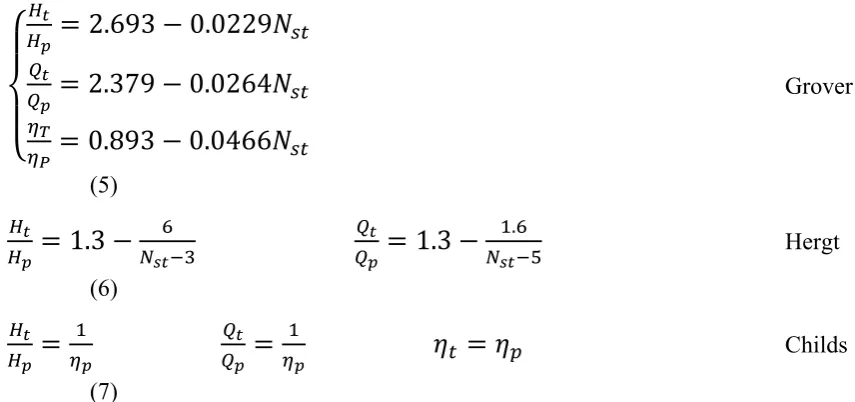
The following equations summarize different methods to predict the pump inverse characteristic. They are based on theoretical or experimental analyses [4, 12].
=
=
=
=
Stepanoff
(1)
=
. .=
. . ..=
− 0.03
Alatorre andFrenk (2)
=
.=
.=
=
Sharma(3)
= −1.4 +
.= −1.5 +
.= 1.158 − 0.265
Schmiedl= 2.693 − 0.0229
= 2.379 − 0.0264
= 0.893 − 0.0466
Grover
(5)
= 1.3 −
= 1.3 −
. Hergt(6)
=
=
=
Childs(7)
Derakhshan and Nourbakhsh [19] introduce a method based on theoretical analysis to evaluate the BEP of an industrial centrifugal pump. This method is based on the geometrical and hydraulic characteristics of the pump in direct mode. The final formula to evaluate the turbine’s maximum efficiency is:
=
∙ ∙
=
∙ ∙
∙ ∙
(8)
Presented methods are very different and based on different hypotheses. Each method can be used only for a limited set of pumps and none of them allows the reverse running conditions to be accurately predicted for all geometries and over a wide range of pump specific speeds.
3. Simulation Model
Three different centrifugal pumps have been modeled in order to obtain the data necessary to predict the performance of the pumps by the described procedures. The analyzed pumps are commercial ones and have three different specific speeds. The main characteristics are summarized in table 1.
Table 1. Pumps characteristics
Impeller Diameter [mm]
Delivery Outlet
Diameter [mm] Hbep [m] Qbep [m3/s]
(Ns 37.6) 190 80 39 148
(Ns 20.5) 200 70 60 45.4
(Ns 64.0) 120 80 3.9 54
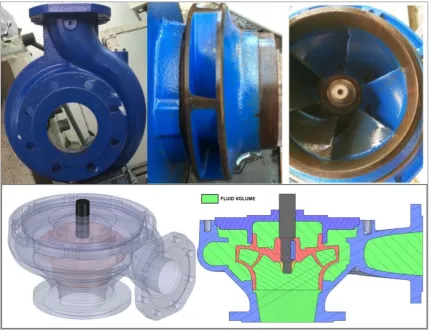
Figure 1. Geometry and fluid volume
The simulation models were built using the commercial code PumpLinx®, CFD software developed by Simerics Inc. [20 – 24]. It numerically solves the fundamental conservation equations of mass, momentum and energy and includes robust models of turbulence and cavitation. PumpLinx® has its own grid generator and uses a body-fitted binary tree approach. Moving and stationary fluid volumes are treated simultaneously, and each volume connects to the other via an implicit interface.
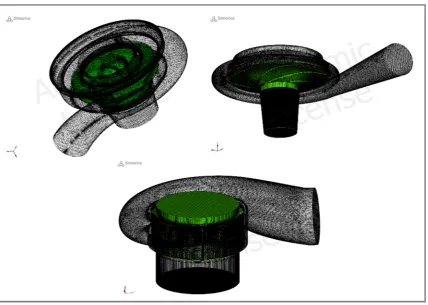
Figure 2. Binary tree mesh for three pumps
The details of the three-dimensional grids for each pump are shown below. Simulations have been run with an Intel(R) Xeon(R) CPU 2.66GHz (two processors).
PUMP 1 (NS=37.6):
- Total number of cells : 851.673 - Total number of faces : 3.383.745
- Total simulation time: 8.9 h as Pump, 9 h as PAT
PUMP 2 (NS=20.5):
- Total number of cells: 1.039.450 - Total number of faces: 3.926.412
- Total simulation time: 4.2 h as Pump, 4.8 h as PAT
PUMP 3 (NS= 64):
- Total number of cells: 324.596 - Total number of faces: 3.348.318
- Total simulation time: 4.5 h as Pump, 4.8 h as PAT
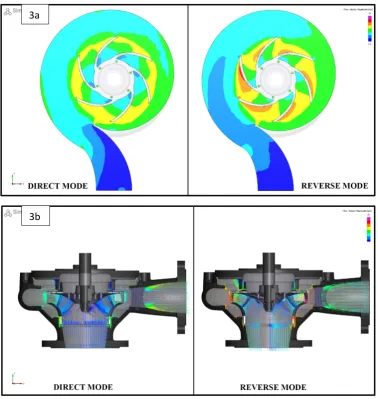
As said, using the presented models it is possible to investigate the internal fluid dynamics in the direct (as pump) and reverse (as turbine) modes. Model results for the Pump 1 are shown in figure 3; in figure 3a the pressure distribution at the BEP is presented for both working modes in the pressure range (0 ÷ 9) bar.
Figure 3b shows the velocity vectors in the fluid volume; the velocity range (0 ÷ 32) m/s is the same for the direct and reverse modes. In this picture (figure 3b), it is possible to visualize the flow evolution inside the machine and the acceleration/deceleration of the fluid.
Figure 3. Model results pump 1 (Ns = 37.6)
Similarly, figure 4 shows the pressure distributions for pump 2 (NS= 20.5) and pump 3 (NS= 64).
N
s=
20.5
N
s= 64
Figure 4. Pressure distribution in the fluid volume of pumps 2 and 3
For the direct mode, CFD models have been validated using the data supplied by the pump
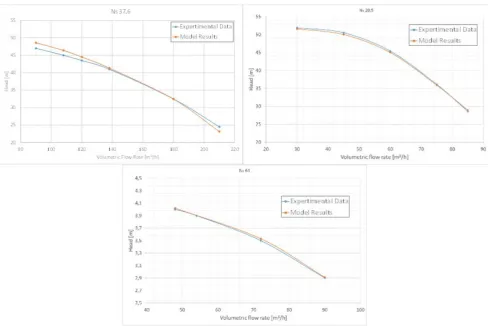
manufacturers. In Figure 5, the head vs. flow rate plot (as the blue curves) are shown. Across the range of flow rates (30 – 207 m3/h), the head varies from 47 to 3 m. Plots in Figure 4, the model results is in red.
Figure 5. Model validation: Comparison between manufacturer data and model results The comparison in figure 5 demonstrates the accuracy of the adopted methodology; in fact, the percentage error is always less than 4% while for many points the error is near zero.
4.
N
s37.6
PumpModel Validation with Experimental Data
Once the model had been validated in the pumping mode, it was decided to validate it also in the reverse mode, to assess whether the model reproduces the turbine mode well. Because the proposed methodology is based only on the results of the CFD model in reverse conditions, the validation in reverse condition was necessary to confirm the entire methodology.
The model of centrifugal Pump 1 has been validated with data from an experiment performed on a dedicated test bench of the Department of Civil Construction and Environmental Engineering of the University of Naples Federico II. The bench is enables testing a centrifugal pump running in reverse mode. The aim of this activity was to further validate the simulation model in reverse conditions.
The test bench reproduces a full-scale hydraulic network, made up of four nodes (figure 6). An external pump increases the water pressure to simulate the behavior of a real urban network while an air chamber stabilizes the flow rate. The tested pump has been installed in one node where two pressure-reducing valves (PRV) regulate the water flow rate and the pressure at the inlet and outlet of the pump.
model 8314), and a flow meter Q (Siemens® mag 500) have been installed. All test bench data have been acquired by a home-made acquisition system. Furthermore, a 360-tooth encoder has been installed on the electrical motor to acquire the shaft speed.
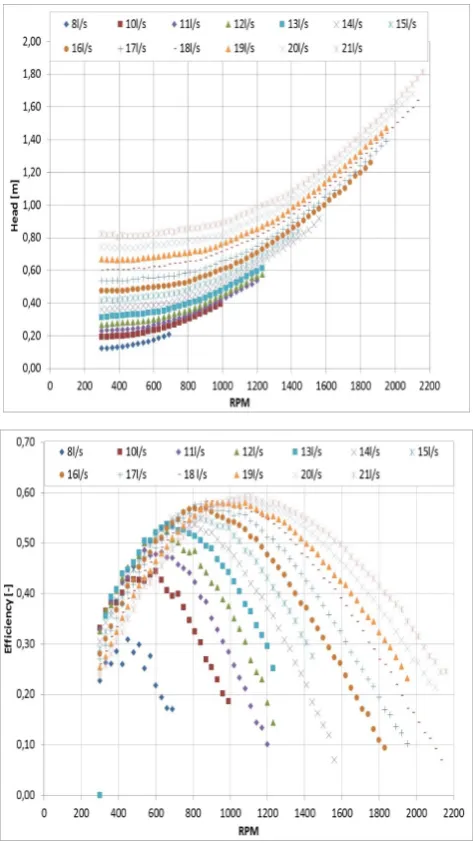
Experiments have been performed only in steady-state conditions, varying the water flow rate and the pressure at the inlet of the pump, for different shaft speeds. In particular, the flow rate has been varied between (8 - 21) l/s, and the shaft speed between 300 and 2200 rpm. During the test, pressure at the inlet and outlet of the pump have been acquired at a sample frequency of 1 Hz.
As stated above, the tests have been done in steady-state conditions, running the pump in reverse mode. The flow rate, the pressures at the inlet and outlet of the pump and the shaft rpm were measured. In figure 7, all results of the experimental campaign are shown.
To examine the PAT performance, the total head [m] versus shaft rpm is reported, varying the water flow rate for all the examined conditions. Results confirm what is known from the literature: the PAT head increases with the rpm and with the flow - rate, and it can be easily noted that, for the tested conditions, the head varies between 0.1 and 1.8 meters.
Figure 7. Experimental results
Figure 8. Model Validation
5. Model Results
After the validation phase in pump and turbine mode, simulation models have been used to predict the efficiency curves of the three analyzed pumps. Then, all the simulations have been performed to obtain the data necessary to evaluate the inverse characteristics. In the following, specific head, specific capacity, specific power and efficiency are defined as:
=
Specific head(9)
=
Specific capacity(10)
=
Specific power(11)
=
Efficiency(12)
Table 2. Boundary conditions
BOUNDARY
CONDITIONS PUMP 1 PUMP 2 PUMP 3
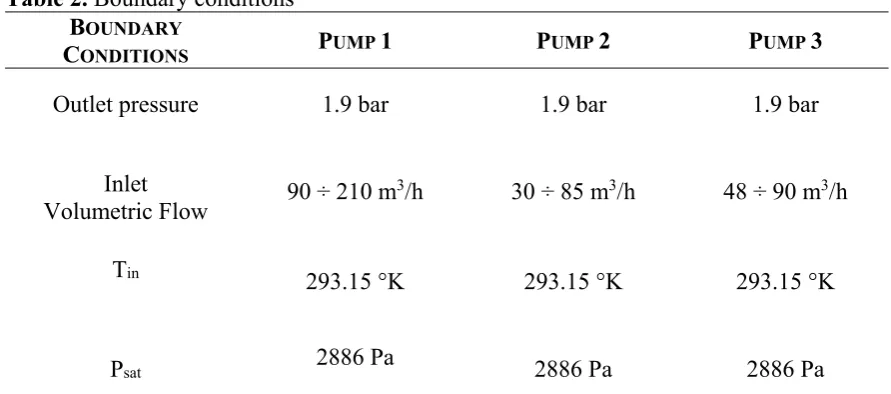
Outlet pressure 1.9 bar 1.9 bar 1.9 bar
Inlet
Volumetric Flow 90 ÷ 210 m
3/h 30 ÷ 85 m3/h 48 ÷ 90 m3/h
Tin 293.15 °K 293.15 °K 293.15 °K
Psat 2886 Pa 2886 Pa 2886 Pa
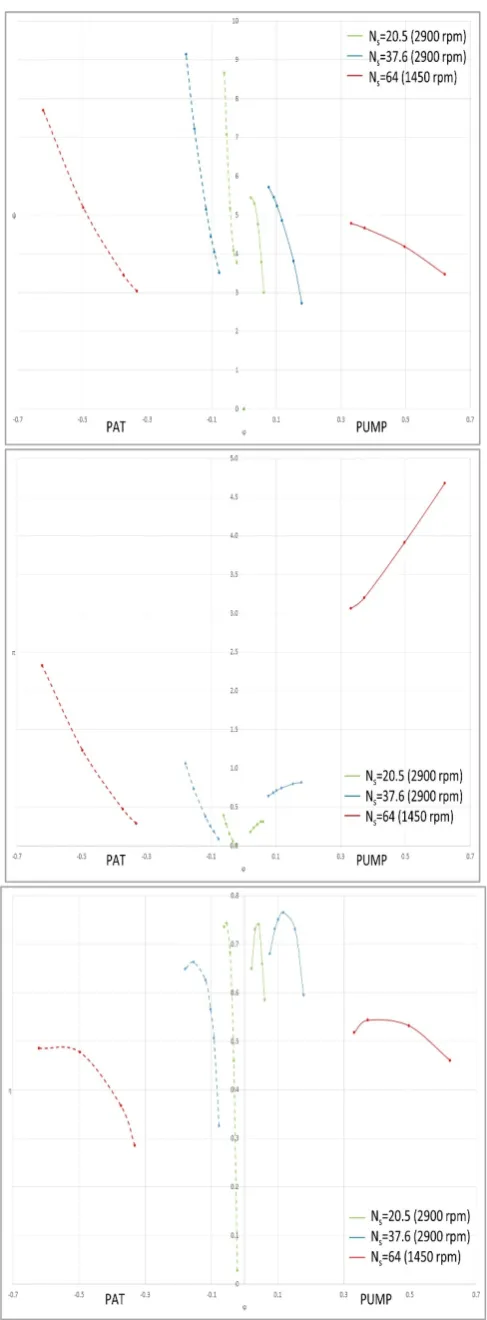
The specific head, the specific power and the efficiency have been evaluated for both pump and turbine mode and for all the studied pumps. These are plotted versus specific capacity in figure 9.
It is clear that at high capacity the specific head in reverse mode is always higher than in direct mode. In reverse mode, pumps have a larger power range than in direct mode. The trends are quite different and the curves arising at low flow rate and at higher capacities have a higher power value than in direct mode. In pump mode, the efficiency has a typical “bell shape” while in PAT mode its profile resembles that of a Francis turbine: it increases at low flow rates and reaches a maximum value at high flow rates.
Moreover, the pump with the low specific speed works with low flow rates but high heads in direct mode. In reverse mode at high flow rates, the head is higher than the direct-mode value. The pump with the high specific speed works at high flow rates but low heads. In reverse mode, working with the same flow rates, the maximum head is also higher than the direct-mode value.
Table 3. Boundary conditions
BOUNDARY
CONDITIONS
PUMP 1 PUMP 2 PUMP 3
Direct
mode Reverse mode Direct mode Reverse mode Direct mode Reverse mode
Head [m] 39 61 45.4 67 3.9 4.6
Capacity [m3/s] 0.041 0.05 0.017 0.021 0.015 0.022
Power [kW] 20.5 19.98 10.01 10.24 1.05 0.75
Efficiency 0.787 0.663 0.743 0.741 0.543 0.487
6. Comparison of Prediction Methods
After the evaluation of the inverse characteristics, the results of the proposed methodology have been compared to the prediction methods available in literature. To this end, all the previously discussed methods have been applied to the three analyzed pumps. Some methods predict only the head and flow rate, while others also predict power and efficiency. In table 2.6, all the results are shown for pump 1.
Table 4. Comparison for pump 1
METHODS H[M] Q[M3/S] P[KW] Η
Model results 61.42 0.05 19.98 0.663
Stepanoff 49.55 0.0463 22.5 0.787
Alatorre-Frenk 42.79 0.091 28.92 0.757
Sharma 51.99 0.0498 20.5 0.807
Schmiedl 43.94 0.0514 16.82 0.759
Grover 78.59 0.0657 36.92 0.729
Hergt 41.90 0.0508 - -
Childs 49.55 0.0522 19.96 0.787
D&N 58.56 0.0411 18.17 0.769
The flow rates calculated using the methods of Sharma and of Hergt and Schmiedl are very close to those of the proposed CFD methodology. Grover’s and Alatorre-Frenk’s methods overestimate this value while the other methods underestimated the value by a margin of 10-15%. All methods underestimate the head value except for Grover’s. These values diverge with errors of up to 30%.
Evaluating the percentage deviation as:
= ∙ 100
(13)
are plotted vs. the pump specific speeds for all three pumps.
Figure 10. Prediction methods comparison
It easy to observe that in some cases the deviation is very high.
Figure 11. Relative velocity magnitude
7. Conclusions
In this paper a methodology to predict the inverse characteristic of a centrifugal pump has been presented. This methodology is based on the results of a three-dimensional simulation model build with a commercial CFD code. Three industrial pumps have been analyzed, with different specific speeds. First, the simulation models have been validated with data supplied by the pump manufacturers. Then the results of an experimental campaign have been used to validate a model simulating the pump working in reverse conditions.
Starting from the CFD model results, the specific head, capacity, power and efficiency have been evaluated and the best efficient point of all the analyzed pumps was found. Furthermore, several prediction methods have been applied to the tested pumps and their predicted values were compared with those of the proposed methodology. Some methods (e.g., Childs’ method) are not in accord while others (e.g., Stepanoff’s method) show small relative differences.
Acknowledgments
This research has been supported by the Department of Industrial Engineering of the University of Naples “Federico II”. We appreciate the technical from Gennaro Stingo of the Department of Industrial Engineering and from colleagues of the Department of Civil Construction and Environmental Engineering of the University of Naples “Federico II”
References
1. Williams, A., 1995, “Pumps As Turbines: A user's guide”, London: Intermediate Technology Publications, ISBN 1 85339 285 5
2. Arriaga M., 2010, “Pump as turbine – A pico-hydro alternative in Lao People’s Democratic Republic”, Renewable Energy, 35(5), pp. 1109-1115 doi:10.1016/j.renene.2009.08.022
curves of centrifugal pumps working as turbines in different specific speeds”,
Experimental Thermal and Fluid Science, 32(3), pp. 800-807
doi:10.1016/j.expthermflusci.2007.10.004
4. Williams, A.A., Rodrigues, A., Singh, P., Nestmann, F. and Lai, E., 2003, “Hydraulic analysis of a pump as a turbine with CFD and experimental data”, IMechE seminar, Computational Fluid Dynamics for Fluid Machinery, London, UK, 18 November, 2003.
5. Nautiyal H., Varun, Kumar A., 2010, “Reverse running pumps analytical, experimental and computational study: A review”, Renewable and Sustainable Energy Reviews, 14(7), pp.2059–2067, doi:10.1016/j.rser.2010.04.006
6. Nautiyal H., Varun, Kumar Anoop, and Yadav S., 2010 “CFD Analysis on Pumps Working as Turbines”, HYDRO NEPAL, Issue 6, pp. 35-37, doi:10.1007/s11269-012-0114-1
7. Carravetta, A.; Del Giudice, G.; Fecarotta, O.; Ramos, H., 2013, “PAT design strategy for energy recovery in water distribution networks by electrical regulation”,
Energies, 6, pp. 411–424, doi:10.3390/en6010411
8. Carravetta, A.; Del Giudice, G.; Fecarotta, O.; Ramos, H., 2013, “Pump as Turbine (PAT) Design in Water Distribution Network by System Effectiveness”, Water 2013,
5, pp. 1211-1225; doi:10.3390/w5031211
9. [9] Derakhshan, S., Nourbakhsh, A. and Mohammadi, B., 2009, “Efficiency improvement of centrifugal reverse pumps” ASME Journal of Fluids Engineering,
131(2), doi:10.1115/1.3059700
10.[10] Natanasabapathi, SR. and Kshirsagar, JT., 2004, “Pump as turbine - an experience with CFX 5.6”, Corporate Research and Eng. Division, Kirloskar Bros. 11.[11] Barrio, R., et al., 2010, “Performance prediction of a centrifugal pump working
in direct and reverse mode using Computational Fluid Dynamics”, International
Conference on Renewable Energies and Power Quality (ICREPQ‘10), Granada,
Spain, 23 to 25 March, 2010
12.Chapallaz, J.M., Eichenberger P., Fischer, G., 1992, “Manual on pumps used as turbines”, Friedr Vieweg & Sohn Verlagsgesellschaft, Braunschweig. ISBN-10: 3528020695 ISBN-13: 9783528020699
13.Childs, S.M., 1962, “Convert pumps to turbines and recover HP”, Hydro carbon processing and petroleum refiner, 41(10), pp. 173-174.
14.McClaskey, B.M., Lundquist, J.A., 1976, “Hydraulic power recovery turbines”, Joint Petroleum Mechanical Engineering and Pressure Vessels and Piping Conference, Mexico City, pp. 1-11.
15.Lueneburg, R., Nelson, R.M., 1985, “Hydraulic power recovery turbines”,
Centrifugal Pumps: Design and Applications.
16.Hancock, J.W., 1963, “Centrifugal pump or water turbine”, Pipe Line News, 25-27, June 1963
17.Grover, K.M., 1980, “Conversion of pumps to turbines”, GSA Inter Corp., Katonah, New York, USA.
18.Lewinsky-Keslitz, 1987, “Pumpen als Turbinen fur Kleinkraftwerke”, Wasserwirtschaft, 77(10), pp. 531–537, ISSN: 0043-0978
19.Derakhshan, S. and Nourbakhsh, A., 2008, “Theoretical, numerical and experimental investigation of centrifugal pumps in reverse operation”, Experimental Thermal and Fluid Science, 32(8), pp. 1620-1627, doi:10.1016/j.expthermflusci.2008.05.004 20.E. Frosina, A. Senatore, D. Buono, L. Santato, 2013, “Analysis and Simulation of an
21. E. Frosina, A. Senatore, D. Buono, M. Olivetti, 2014, “A Tridimensional CFD Analysis of the Oil Pump of an High Performance Engine”. SAE 2014 World Congress and Exhibition; Detroit, MI; United States, 8 – 10 April, doi: 10.4271/2014-01-1712
22. E. Frosina, A. Senatore, D. Buono, M. Uncini Manganelli, M. Olivetti, 2014, “A Tridimensional CFD Analysis of the Oil Pump of an High Performance Motorbike Engine”, ENERGY PROCEDIA, 45, pp. 938-948, doi: 10.1016/j.egypro.2014.01.099 23. E. Frosina, A. Senatore, D. Buono, K. A. Stelson, F. Wang, B. Mohanty, M. J. Gust, 2015, “Vane pump power split transmission: three dimensional computational fluid dynamic modeling”, Proceedings of the ASME/BATH 2015 Symposium on Fluid Power and Motion Control, FPMC2015, October 12-14, 2015, Chicago, Illinois, USA
24. E. Frosina, A. Senatore, D. Buono, K. A. Stelson, 2016), “A Mathematical Model to Analyze the Torque Caused by Fluid-Solid Interaction on a Hydraulic Valve”, ASME Journal of Fluids Engineering, 138