RVC OPEN ACCESS REPOSITORY – COPYRIGHT NOTICE
This is the peer-reviewed, manuscript version of an article published in the Journal of Proteomics. The version of record is available from the journal site:
https://doi.org/10.1016/j.jprot.2017.11.007.
© 2017. This manuscript version is made available under the CC-BY-NC-ND 4.0 license http://creativecommons.org/licenses/by-nc-nd/4.0/.
The full details of the published version of the article are as follows:
TITLE: Integrative transcriptome and proteome analyses define marked differences between Neospora caninum isolates throughout the tachyzoite lytic cycle
AUTHORS: Horcajo, P., Xia, D., Randle, N., Collantes-Fernández, E., Wastling, J., Ortega-Mora, L. M. and Regidor-Cerrillo, J.
JOURNAL: Journal of Proteomics
PUBLISHER: Elsevier
PUBLICATION DATE: 14 November 2017 (online)
Integrative transcriptome and proteome analyses define marked differences 1
between Neospora caninum isolates throughout the tachyzoite lytic cycle 2
3
P. Horcajo1¥, D. Xia2¥, N. Randle3, E. Collantes-Fernández1, J. Wastling4, L.M. Ortega-4
Mora1, J. Regidor-Cerrillo1*. 5
1 SALUVET, Animal Health Department, Faculty of Veterinary Sciences, Complutense 6
University of Madrid, Ciudad Universitaria s/n, 28040 Madrid, Spain.
7
2 The Royal Veterinary College, Royal College Street, London, NW1 0TU, United 8
Kingdom.
9
3 Department of Infection Biology, Institute of Infection & Global Health, University of 10
Liverpool, Liverpool Science Park IC2, 146 Brownlow Hill, Liverpool, L3 5RF, United
11
Kingdom.
12
4 Faculty of Natural Sciences, Keele University, Keele, Staffordshire, ST5 5BG, United 13
Kingdom.
14
¥Authors contributed equally 15
*Corresponding author: Javier Regidor Cerrillo, Animal Health Department, Faculty of
16
Veterinary Sciences, Complutense University of Madrid, Ciudad Universitaria s/n 28040,
17
Madrid, Spain. E-mail: [email protected] 18
19
20
Co-authors e-mail addresses: PH: [email protected]; DX: [email protected]; NR:
21
[email protected]; ECF: [email protected]; JW: [email protected];
22
LMOM: [email protected]; JRC: [email protected] 23
Abstract 25
Neospora caninum is one of the main causes of transmissible abortion in cattle. Intraspecific 26
variations in virulence have been widely shown among N. caninum isolates. However, the 27
molecular basis governing such variability have not been elucidated to date. In this study label 28
free LC-MS/MS was used to investigate proteome differences between the high virulence isolate 29
Nc-Spain7 and the low virulence isolate Nc-Spain1H throughout the tachyzoite lytic cycle. The 30
results showed greater differences in the abundance of proteins at invasion and egress with 77 and 31
62 proteins, respectively. During parasite replication, only 19 proteins were differentially 32
abundant between isolates. The microneme protein repertoire involved in parasite invasion and 33
egress was more abundant in the Nc-Spain1H isolate, which displays a lower invasion rate. 34
Rhoptry and dense granule proteins, proteins related to metabolism and stress responses also 35
showed differential abundances between isolates. Comparative RNA-seq analyses during 36
tachyzoite egress were also performed, revealing an expression profile of genes associated with 37
the bradyzoite stage in the low virulence Nc-Spain1H isolate. The differences in proteome and 38
RNA expression profiles between these two isolates reveal interesting insights into likely 39
mechanisms involved in specific phenotypic traits and virulence in N. caninum. 40
41
Keywords: Neospora caninum, Low and high virulence isolates, Proteome,
42
Transcriptome
43
1. Introduction 45
Neospora caninum is a cyst-forming obligate intracellular protozoan parasite that is
46
closely related to Toxoplasma gondii, which infects different domestic or wild canids as
47
its definitive host and cattle and other ungulates as intermediate hosts [1]. N. caninum has
48
been recognized as one of the main causes of abortion in cattle, resulting in devastating
49
economic losses to the beef and dairy industries [2]. Although various factors are
50
potentially involved in determining the dynamics of N. caninum infection, experiments
51
in pregnant cattle have shown the key role of different isolates of N. caninum in the
52
severity of disease and its capacity to cause foetal mortality in cattle [3-6]. Host tissue
53
damage occurs as a consequence of the tachyzoite lytic cycle, a process that enables
54
parasite propagation and involves the following successive steps: parasite invasion,
55
adaptation to new intra-cytoplasmatic conditions, intracellular proliferation and egress
56
from host cells [7,8].Interestingly, the in vitro behaviour of a N. caninum population in
57
these processes has demonstrated the potential association of the phenotypic traits such
58
as the invasion rate and tachyzoite yield with pathogenicity observed in animal models
59
[9-11]. Nevertheless, the molecular basis and mechanisms that govern such biological
60
diversity in N. caninum remain largely unknown. N. caninum appears to be highly
61
conserved genetically [12], although previous proteomic approaches have identified some
62
differences between isolates [13-15]. Differences in secretory elements (rhoptry and
63
dense granule proteins) and protein related to gliding motility and oxidative stress have
64
been described among N. caninum isolates showing variations in protein expression,
post-65
translational modifications and protein turnover [15]. Recently, an in vitro study
66
comparing host cell modulation by N. caninum isolates with high (Nc-Spain7) and low
67
(Nc-Spain1H) virulence has shown a great similarity in host transcriptome modulation by
68
both isolates but marked differences in the parasite transcriptome between isolates [16].
In this study, we used a global approach to examine the changes between the N. caninum 70
Nc-Spain7 and Nc-Spain1H isolates throughout the fast replicating tachyzoite lytic cycle.
71
We exploited label free LC-MS/MS technology to investigate in deep proteome
72
differences across the tachyzoite lytic cycle: after tachyzoite invasion and adaptation in
73
the host cell at 12 hours post infection (hpi), during active parasite replication at 36 hpi
74
and at early egress at 56 hpi. Furthermore, we analysed the transcriptome status of
Nc-75
Spain7 and Nc-Spain1H using RNA-seq during tachyzoite egress from the host cell. We
76
determined specific patterns of protein abundance for each isolate in each phase of the
77
lytic cycle studied and differences between gene expression profiles that reveal
78
interesting insights into differences in virulence between these two isolates.
79
80
2. Materials and methods 81
2.1 Parasite culture
82
Parasites were cultured in confluent Marc-145 cultures as previously described [17].
83
Briefly, medium from Marc-145 cultures grown for 24 h in DMEM with 10% of heat
84
inactivated FBS and 1% antibiotic-antimycotic solution (Gibco, Gaithersburg, MD, USA)
85
was replaced with DMEM supplemented with 2% FCS and 1% of antibiotic-antimycotic
86
solution. Then, cell monolayers were inoculated with an adjusted multiplicity of infection
87
(MOI) of Nc-Spain1H and Nc-Spain7 tachyzoites for parasite passaging onto a new
88
Marc-145 monolayer each three – four days. All experiments in this study were conducted
89
with tachyzoites from both isolates with a limited number of passages (Nc-Spain1H and
90
Nc-Spain7, passage 13-18). All inoculations in in vitro assays were performed within one
91
hour after tachyzoite collection from flasks.
92
2.2 Experimental design and tachyzoite production for proteome and transcriptome
93
analyses
The overall experimental design is shown in Fig. 1. All experiments were carried out with
95
three biological replicates.
96
Confluent 24-h Marc-145 DMEM free of phenol red (Gibco, Gaithersburg, MD, USA)
97
and FBS were inoculated with purified Spain1H tachyzoites at a MOI of 7 and
Nc-98
Spain7 tachyzoites at a MOI of 4. Cell monolayers were recovered at 12 hpi (after
99
completion of invasion and prior to tachyzoite duplication), at 36 hpi (active proliferation
100
in the parasitophorous vacuole) and at 56 hpi (early egress), from T75 cm2 flasks by cell 101
scraping in 5 ml of PBS supplemented with protease and phosphatase inhibitor cocktail
102
(Sigma-Aldrich, St. Louis, MO, USA), passaged by 25 G needles for host cell disruption
103
and purified using PD-10 (Sephadex G-25 columns -GE-Healthcare, Barrington, IL,
104
USA). Tachyzoite purification was carried out at 4ºC. The number and viability of
105
tachyzoites was determined by trypan blue exclusion followed by counting in a Neubauer
106
chamber. Tachyzoites were pelleted by centrifugation at 1,350 x g for 10 min. and stored
107
at – 80ºC until tachyzoite proteome (TZP) analysis.
108
Tachyzoite samples for transcriptome analysis were obtained as described above. Cell
109
cultures were recovered at 56 hpi, and tachyzoites were purified using PD10 columns as
110
described above. Tachyzoite pellets were directly resuspended in 300 µl of RNAlater
111
(Invitrogen, Carlsbad, CA, USA) and stored at – 80ºC until RNA extraction.
112
The tachyzoite growth and lytic cycle was monitored daily by microscopy, and
113
photomicrographs for each time-point of sample collection were obtained at 400x on an
114
inverted microscope (Nikon Eclipse E400) connected to a digital camera for checking
115
lytic cycle progression and sample collection in the programmed lytic cycle phases
116
(Fig.1A).
117
2.3 LC-MS/MS analyses
Detailed materials and methods for sample preparation, LC-MS/MS, proteome data
119
analysis, and Western blot validation are shown in Supplementary file 1. Briefly, prior to
120
trypsin digestion, tachyzoite pellets were resuspended in 25 mM ammonium bicarbonate
121
and RapiGestTM(Waters MS Technologies, Milford, MA, USA) for protein 122
solubilization, reduced with DTT and alkylated with iodocetamide for trypsin digestion.
123
Then, the digests were analysed using an LC-MS/MS system comprising an Ultimate
124
3000 nano system coupled to a Q-Exactive mass spectrometer (Thermo Fisher Scientific,
125
Waltham, MA, USA). Reversed-phase liquid chromatography was performed using the
126
Ultimate 3000 nanosystem by a linear gradient of 5-40% solvent B (80% acetonitrile in
127
0.1% formic acid) in 0.1% formic acid (solvent A). The Q-Exactive was operated in
data-128
dependent mode with survey scans acquired at a resolution of 70,000 at m/z 200. Up to
129
the top 10 most abundant isotope patterns were selected and fragmented by higher energy
130
collisional dissociation with normalized collision energies of 30. The maximum ion
131
injection times for the survey scan and the MS/MS scans were 250 and 100 ms,
132
respectively.
133
For proteome data analyses, the Thermo RAW files were imported into Progenesis QI
134
(version 2.0, Nonlinear Dynamics, Durham, CA, USA). Replicate runs were time-aligned
135
using default settings and an auto-selected run as a reference. Spectral data were
136
transformed into .mgf files with Progenesis QI and exported for peptide identification
137
using the Mascot (version 2.3, Matrix Science, London, UK) search engine and the
138
database ToxoDB-26_Ncaninum LIV_Annotated Proteins (version 26, ToxoDB). The
139
false discovery rates were set at 1% and at least two unique peptides were required for
140
reporting protein identifications. Finally, protein abundance (iBAQ) was calculated as the
141
sum of all the peak intensities (from the Progenesis output) divided by the number of
142
theoretically observable tryptic peptides for a given protein (Fig. 1B).
The mass spectrometry proteomics data have been deposited in the ProteomeXchange
144
Consortium via the PRIDE [18] partner repository with the dataset identifier PXD007062.
145
The identified proteins were classified according to their parasite localization and
146
functionality according to the Gene Ontology (GO) terms (annotated and predicted) on
147
the ToxoDB website [19] for the Nc-Liverpool isolate
(ToxoDB-148
26_NcaninumLIV_AnnotatedProteins), T. gondii syntenic homologues (version 26,
149
ToxoDB) and previous reports [20-22].
150
Validation of LC-MS/MS results was performed by measuring the differential abundance
151
of the proteins MIC2 (NCLIV_022970), ROP2 (NCLIV_001970), and NTPase
152
(NCLIV_068400) between isolates by Western blot analyses using the SAG1 protein
153
(NCLIV_033230) as a housekeeping gene as previously described [23,24]. Images from
154
WB membranes were obtained using a GS-800 Scanner (Bio-Rad Laboratories, Hercules,
155
CA, USA) and were analysed with Quantity One quantification software v. 4.0 (Bio-Rad
156
Laboratories, Hercules, CA, USA) for protein quantification.
157
2.4 RNA extraction, sequencing and detection of differential mRNA expression
158
Total RNA was isolated from purified tachyzoites using an RNeasy Mini kit (Qiagen,
159
Hilden, Germany). RNA-Seq was undertaken at the Centre for Genomic Research,
160
University of Liverpool. Briefly, polyadenylated RNA was purified using the
161
Dynabeads® mRNA purification kit (Invitrogen, Carlsbad, CA, USA) and used to
162
prepare RNA-Seq libraries with the Epicentre ScriptSeq v2 RNA-Seq Library Preparation
163
kit (Illumina, San Diego, CA, USA). Libraries were sequenced on the HiSeq2500
164
(Illumina, San Diego, CA, USA) as 2 x 100-bp paired-end sequencing using rapid-run
165
mode chemistry. Filtered sequencing reads were aligned against the reference genome of
166
N. caninum (NcLiv26; ToxoDB.org) by the TopHat2 aligner and processed with the
Cufflinks software (version 2.1.1) to assemble transcripts, quantify expression levels and
168
analyse differentially expressed genes (DEGs) (Fig. 1C).
169
Validation of transcript expression was performed on three additional biological
170
replicates of tachyzoite samples at 56 hpi prepared as described above using SYBR green
171
quantitative PCR. More detailed material and methods for RNAseq and validation by
172
quantitative real-time PCR are provided in Supplementary file 1.
173
2.5 In vitro invasion analysis
174
The invasion capacity of N. caninum isolates was determined in a plaque assay in which
175
100 purified tachyzoites of each isolate per well were added to MARC-145 monolayers
176
in 24-well culture plates as previously described [10]. Briefly, the plates were incubated
177
at 37ºC in a 5% CO2-humidified incubator for 48 h, and cell monolayers were labelled
178
by immunofluorescence using anti-tachyzoite hyperimmune rabbit antiserum (1:4000) as
179
the primary antibody and Alexa 594-conjugated goat anti-rabbit secondary antibody
180
(1:1000) (Molecular Probes, Eugene, Oregon, USA). Plate wells were examined using a
181
fluorescence-inverted microscope Nikon Eclipse E400 (Nikon Instruments Europe) at a
182
magnification of 200x to count the labelled parasitophorous vacuoles and lysis plaques
183
(events) per well after parasite growth. Differences between isolates in invasion rates
184
were determined using the U Mann-Whitney test.
185
2.6 Tachyzoite cell cycle analysis
186
The cell cycle phase of the tachyzoite culture was studied by flow cytometry. Tachyzoite
187
samples were obtained under the same conditions as detailed previously for proteomic
188
and transcriptome analyses. Purified tachyzoites were pelleted for 10 min at 1350×g and
189
resuspended in 70% (v/v) ethanol with constant shaking, pelleted and resuspended in
190
PBS. Fixed tachyzoites were labelled by indirect immunofluorescence (IFI) for the
191
differentiation of individual parasites from those forming aggregates. Tachyzoites were
permeabilised with PBS containing 3% BSA and 0.25% Triton X-100 for 30 min at 37ºC
193
and labelled using anti-tachyzoite mouse antiserum (1:50 dilution) as the primary
194
antibody and a FITC-conjugated goat anti-mouse IgG at 1:1,000 dilution (Molecular
195
Probes, Eugene, Oregon, USA) as the secondary antibody. Then, the parasites were
196
treated with 250 U RNase A (Ambion, Austin, TX, USA) in the dark for 30 min,
197
resuspended in BD CellFIX™ (Becton-Dickinson, Erembodegem, Belgium), and stained
198
with propidium iodide (PI) (1 μg/ml final concentration). Tachyzoite populations with
199
lower FITC fluorescence were separated as individual tachyzoites. The nuclear DNA
200
content was measured based on the PI fluorescence using a 488 nm argon laser and a
201
Becton-Dickinson FACSCalibur flow cytometer (Becton-Dickinson, Erembodegem,
202
Belgium). Fluorescence was collected in linear mode (10 000 events), and the results were
203
quantified using CELLQuest™ v3.0 (Becton-Dickinson, Erembodegem, Belgium). The
204
percentages of G1 (1 N), S (1–2 N) and G2+M (2 N) tachyzoites were calculated based
205
on defined gates for each population. Two biological replicates were analysed for each
206
isolate.
207
208
3. Results and discussion 209
3.1 Nc-Spain1H and Nc-Spain7 tachyzoite proteomes resemble fast-growing,
210
metabolically active and invasive tachyzoites
211
A total of 1,390 proteins were identified with high confidence (FDR< 1% and containing
212
at least two uniquely identified peptides) and quantified using Progenesis software for the
213
Nc-Spain1H and Nc-Spain7 isolates across the tachyzoite lytic cycle. The identified
214
proteins covered ~19.6% of the predicted N. caninum proteins deposited in the UniProt
215
database (7,111 predicted proteins, UniProtKB;UP000007494, Neospora caninum strain
216
Liverpool) [25]. Raw data are deposited in ProteomeXchange under identifier
PXD007062. Each individual identified and quantified protein was categorized by the
218
cellular component and functional prediction. Of the proteins, 14.5% had an unknown
219
localization. Proteins with cytoplasmic (18.49%), nuclear (16.26%) and mitochondrial
220
(11.15%) localizations were also highly represented, followed by proteins associated with
221
the plasma membrane (glycolipid-anchored SAG1-related sequences [SRS] and other
222
proteins localized in the plasma membrane) (9.78%). Proteins from secretory organelles
223
(including micronemes, rhoptries and dense granules) represented approximately 5%
224
(corresponding to 70 proteins) of all those identified proteins (Supplementary Fig. 1Aand
225
supplementary file 2). A total of 66.47% of 1,390 proteins from the TZP were assigned
226
to a functional category (Supplementary Fig. 1Band supplementary file 2). The most
227
represented functional categories included proteins involved in metabolism (12%),
228
cellular transport (10%), protein synthesis (9.57%) and protein fate (9.35%). As expected,
229
protein localization and functional profiles identified in both N. caninum isolates
230
corresponded to the proteome for the fast growing, metabolically active and invasive
231
tachyzoites.
232
3.2 Relative quantification demonstrated different proteomes for Spain1H and
Nc-233
Spain7 throughout the tachyzoite lytic cycle
234
Progenesis analysis detected 351 proteins at 12 hpi, 136 proteins at 36 hpi and 214
235
proteins at 56 hpi, with a significant increase or decrease in relative abundance between
236
Nc-Spain1H and Nc-Spain7 TZPs (q < 0.05) (Supplementary file 3). These results
237
demonstrated marked differences in the TZP throughout the lytic cycle between the
Nc-238
Spain1H and Nc-Spain7 isolates. Focusing on significant changes (q < 0.05) in the
239
relative abundance with a fold change ≥ 2 between the Nc-Spain1H and Nc-Spain7
240
isolates, there were 77, 19 and 62 proteins with differing abundance at 12 , 36 and 56 hpi,
241
respectively (Fig. 2A, B and C, respectively and Supplementary file 3). Most of the
proteins that were differentially abundant between isolates were unique to each time-point
243
of the tachyzoite lytic cycle (Fig. 3 and supplementary file 4). There were only 7 out of
244
82 Nc-Spain1H proteins and 2 out of 36 Nc-Spain7 proteins that were consistently more
245
abundant across the tachyzoite lytic cycle.
246
Enriched GO terms or pathways associated with a particular isolate were not found likely
247
due to the high proportion of hypothetical proteins. Nonetheless, differences in the
248
abundance of proteins belonging well-established categories related with invasion
249
machinery, metabolism and response to stress were found between isolates and are
250
detailed below (Fig. 4).
251
The proteome results from LC-MS/MS were confirmed by WB analyses with available
252
antibodies. The WB results provided similar results to the LC-MS/MS quantification with
253
a higher abundance of NcMIC2 at 12 and 56 hpi in the Nc-Spain1H isolate and a similar
254
protein abundance of NcROP2 and NcNTPase in both isolates (Supplementary Fig. 2).
255
3.3 Abundance of proteins involved in host cell attachment and invasion varied between
256
Nc-Spain1H and Nc-Spain7 tachyzoite proteomes
257
Surface antigens differ in abundance between Nc-Spain1H and Nc-Spain7 tachyzoite 258
proteomes. 259
Members of the SRS protein family were differentially abundant between the
Nc-260
Spain1H and Nc-Spain7 isolates. SRS antigens exert a relevant role in host cell
261
attachment, modulation and evasion of host immunity, and the regulation of virulence
262
[26-28]. An orthologue of, but not syntenic to, TgSAG3 (NCLIV_034740) throughout the
263
tachyzoite lytic cycle and an orthologue of SRS67 (NCLIV_046140) at 56 hpi were
264
significantly more abundant in Nc-Spain1H. More interestingly, NcSAG4
265
(NCLIV_019580) showed larger fold changes at all time-points in Nc-Spain1H, with the
266
greatest differences compared with Nc-Spain7 at 36 and 56 hpi (12.8-fold and 14.6-fold,
267
respectively). NcSAG4 has been described as a N. caninum bradyzoite stage-specific
marker [29]. Furthermore, SRS6 (NCLIV_010050), which has been found
over-269
expressed in bradyzoites of T. gondii [30], was also significantly more abundant in
Nc-270
Spain1H at 56 hpi. Bradyzoite development of T. gondii has been correlated with a
271
reduction in the tachyzoite growth rate [31]. Nc-Spain1H has shown a low in vitro growth
272
rate [9] which may facilitate the conversion to the bradyzoite, although has been
273
previously shown that Nc-Spain1H produce only intermediate bradyzoites in vitro [32].
274
The transcriptome analysis, which is detailed in the next section, could corroborate the
275
hypothesis of a pre-bradyzoite stage in Nc-Spain1H since an important bradyzoite gene
276
profile was found to be over-expressed in this isolate. The only SRS protein that was more
277
abundant in Nc-Spain7 throughout the lytic cycle was the orthologue of SRS39
278
(NCLIV_023620), which is also predominantly expressed during the bradyzoite stage of
279
in the T. gondii [30]. It could be interesting to determine the relevance of SRS39 in N. 280
caninum.
281
The microneme protein repertoire is more abundant in Spain1H tachyzoites, but Nc-282
Spain1H displays a lower invasion rate. 283
Micronemes in Apicomplexan parasites are specialized secretory organelles that are
284
critical for essential cellular processessuch asattachment and penetration [33]. A total of
285
9 microneme (MIC) proteins were significantly more abundant in Nc-Spain1H at 56 hpi,
286
and most of them were also more abundant in Nc-Spain1H at 12 hpi, four with FC > 2
287
and the other four with FC very close to 2 (> 1.8). Only MIC8 (NCLIV_062770) had a
288
higher abundance at 12 hpi but not at 56 hpi. At 36 hpi, differences in the abundance of
289
MIC proteins were not found. Among MIC proteins with higher abundance in
Nc-290
Sapin1H, orthologues assembling the main TgMIC complexes (MIC1
291
[NCLIV_043270]/MIC4 [NCLIV_002940] /MIC6; MIC2 [NCLIV_022970]/M2AP
292
[NCLIV_051970]; and MIC8 [NCLIV_062770]/MIC3 [NCLIV_010600]) and others as
MIC2-like1 (NCLIV_033690), MIC10 (NCLIV_066250), MIC11 (NCLIV_020720) and
294
MIC17B (NCLIV_038110) were identified. Some of these proteins have been
295
characterized in N. caninum and have been associated with invasion processes [34-37].
296
In contrast to these results, in previous work comparing changes in the proteome
297
expression between these two isolates using DIGE, NcMIC1 was found more abundant
298
in the highly virulent isolate Nc-Spain7 [15]. However, these contrasting results are likely
299
due to differences in techniques, considering that DIGE analysis detects variations in
300
protein species that are likely also attributed to post-translational modifications.
301
NcAMA1 (NCLIV_028680), which is also involved in N. caninum invasion [38], was
302
also increased in Nc-Spain1H TZP at 12 and 56 hpi.
303
In addition to MIC proteins, proteases involved in micronemal protein processing or that
304
contribute to microneme-dependent processes, such as egress, gliding motility, and
305
parasite invasion of host cells, were also more abundant in Nc-Spain1H. Orthologues of
306
the protease SUB1 (NCLIV_021050), which is involved in micronemal protein
307
processing [39], the metalloproteinase toxolysin 4, TLN4, (NCLIV_044230) and the
308
cathepsin L-like protease CPL (NCLIV_004380), proteinase localized outside the
309
micronemes in the vacuolar component, which in T. gondii contributes to the proteolytic
310
maturation of proTgM2AP and proTgMIC3 [40], were also found more abundant in
Nc-311
Spain1H at 12 hpi (SUB1) and at 56 hpi (SUB1, TLN4 and CPL). Similarly, PLP1
312
(NCLIV_020990), a perforin-like protein secreted from micronemes that likely plays a
313
role in parasite egress more than invasion [41], and an orthologue of the chitinase-like
314
protein CLP1 (NCLIV_000740) related to macrophage stimulation to release
pro-315
inflammatory cytokines in T. gondii [42], were more abundant in Nc-Spain1H at 12
316
(PLP1) and at 56 hpi (PLP1 and CLP1).
All these results seem to indicate that the low virulent isolate Nc-Spain1H has powerful
318
machinery involved in host cell attachment and invasion. In this study, we tested the
319
ability of Nc-Spain1H and Nc-Spain7 to invade host cells. The Nc-Spain1H showed a
320
significant reduction of host invasion (p < 0.005) in comparison to Nc-Spain7 (Fig. 5A),
321
as demonstrated in previous work [9,11]. Considering these results, the Nc-Spain1H
322
isolate may be compromised in other unknown mechanisms that are relevant for
323
attachment/invasion processes and the over-expression of all of these factors could be an
324
attempt to compensate for some other deficiency.
325
Rhoptry proteins also differ in abundance between isolates. 326
Rhoptry proteins are recognized as one of the major virulence factors in T. gondii [43,44].
327
Three proteins from rhoptries had different abundances between isolates. NcROP1
328
(NCLIV_069110), which is involved in early invasion [45], showed an approximately
2-329
fold higher abundance in Nc-Spain1H at 12 and 56 hpi. Interestingly, a predicted member
330
of the rhoptry kinase family ROP20 specific for N. caninum (NCLIV_068850), which is
331
orthologous, but not syntenic, to the T. gondii virulence factor ROP24 had greater
332
abundance in the highly virulent isolate Nc-Spain7 across the lytic cycle. The orthologue
333
of the bradyzoite pseudokinase 1, BPK1(NCLIV_007770) was also more abundant in the
334
Nc-Spain7 isolate across the lytic cycle. BPK1 plays a crucial role in the in vivo 335
development of Toxoplasma cysts [46]. The abundances of BPK1 and SRS39 in
Nc-336
Spain7 are inconsistent with those other bradyzoite-related proteins that were more
337
abundant in the Nc-Spain1H. It remains to be determined if there is a functional role for
338
these proteins in the tachyzoite stage of N. caninum.
339
3.4 Metabolic processes are differentially regulated between Nc-Spain1H and Nc-Spain7
340
isolates
341
Eleven proteins related to carbohydrate metabolism were differentially abundant between
343
isolates, with the greatest differences at 12 hpi. Ten proteins were more abundant in
Nc-344
Spain1H: fructose-1,6-bisphosphatase (NCLIV_050070), fructose-1,6-bisphosphatase
345
class 1 (NCLIV_050080), glycerol-3-phosphate dehydrogenase (NCLIV_001180),
346
phosphoglucomutase (NCLIV_010960), phosphoenolpyruvate carboxykinase
347
(NCLIV_041900), glucosamine:fructose-6-phosphate aminotransferase
348
(NCLIV_031610), cytochrome c (NCLIV_060860) and orthologues of aspartate
349
aminotransferase (NCLIV_064760), glycosyltransferase (NCLIV_004200) and citrate
350
synthase I (NCLIV_037460), which showed a 2-2.7-fold higher abundance in
Nc-351
Spain1H. During exponential growth (36 hpi), only the
glucosamine-fructose-6-352
phosphate aminotransferase (NCLIV_031610) was 2-fold more abundant in Nc-Spain1H.
353
At 56 hpi, there were no differences in these proteins between the isolates. Some of these
354
proteins suggest that Nc-Spain1H fulfils a gluconeogenic function. Co-expression of
355
enzymes involved in glycolysis and gluconeogenesis is a mechanism to rapidly adapt to
356
changing nutrient conditions in their host cells [47] and could be an important glucose
357
regulatory mechanism [48]. Over-expression of the function of gluconeogenesis in
Nc-358
Spain1H may also indicate a failure in glucose salvage from the host cell and thus could
359
be an important limiting factor for parasite growth. In relation to this hypothesis, the
360
orthologue of the transporter/permease protein related to carbohydrate transport
361
(NCLIV_039290) was more abundant in the highly virulent isolate Nc-Spain7 (3.3-fold).
362
This carbohydrate transporter in Nc-Spain7 could facilitate the capture of glucose from
363
the host and consequently the faster growth of this isolate.
364
Fatty acid biosynthesis in the apicoplast (FAS II system) and the metabolism of 365
phospholipids are differentially regulated between isolates. 366
The apicoplast is indispensable for parasite survival and is the location of several anabolic
367
pathways such as type II fatty acid [49]. Interestingly, orthologues of apicoplast triose
phosphate translocator APT1 (NCLIV_026210) and beta-hydroxyacyl-acyl carrier
369
protein dehydratase FABZ (NCLIV_004340), showed 2.8 and 2.4-fold higher abundance,
370
respectively, in Nc-Spain7 at 12 hpi. The APT1 was again more abundant in Nc-Spain7
371
(2.3-fold) at 56 hpi. In T. gondii, APT1 is required for fatty acid synthesis in the
372
apicoplast, but it also supplies the apicoplast with carbon skeletons for additional
373
pathways and indirectly with ATP and redox equivalents [50]. In addition, APT1 has been
374
shown to be an essential protein for parasite survival in Toxoplasma and Plasmodium. 375
Conversely, it is striking that the low virulence isolate Nc-Spain1H exhibited
up-376
regulated recycling of the phospholipids pathway, (LAMP, http://www.llamp.net) at 36
377
and 56 hpi. Lipin protein (NCLIV_031190) and the glycerol-3-phosphate acyltransferase
378
(NCLIV_029980) had 2.3 and 2.2-fold higher abundances, respectively, in Nc-Spain1H
379
at 36 hpi. At 56 hpi, the glycerol-3-phosphate acyltransferase (NCLIV_029980) and the
380
acyl-CoA synthetase (NCLIV_054250) had a 2-fold increased abundance in Nc-Spain1H.
381
Phospholipids are the major lipid components of biological membranes, but lipids also
382
serve as signalling molecules, energy stores, post-translational modifiers, and
383
pathogenesis factors. It might be interesting to assess whether this up-regulation of
384
proteins in Nc-Spain1H may be a strategy to counteract the effect of the lack of an
385
apicoplast contribution.
386
All these metabolic differences between isolates could, at least partially, explain their
387
phenotypic variations in growth if, as in T. gondii, strain-specific growth rates and
388
virulence are driven by altered metabolic capacities [51].
389
3.5 Other key biological systems are also differentially represented between isolates.
390
Antioxidant and stress response systems 391
In N. caninum the importance of the production of IFN-gamma-induced NO in
392
macrophages as a mechanism for killing intracellular N. caninum has been demonstrated
[52]. To counteract this oxidative stress, parasites are equipped with specific
ROS-394
detoxifying mechanisms that are critical for parasite survival and the establishment of
395
infection [53].The superoxide dismutase SOD2 (NCLIV_058830) had a 2-fold higher
396
abundance in Nc-Spain1H TZP at 12 hpi. SOD2 in T. gondii is dually targeted to both the
397
apicoplast and the mitochondrion of T. gondii, two organelles that require protection from
398
oxidative stress [54]. Other proteins with oxidoreductase activity, such as the pyridine
399
nucleotide-disulphide oxidoreductase family protein (NCLIV_029160), also showed a
400
higher abundance in Nc-Spain1H at 12 hpi.
401
By contrast, another well-known antioxidant enzyme, the peroxiredoxin-2E-1
402
(NCLIV_014020), was more abundant in Nc-Spain7 throughout the entire tachyzoite
403
lytic cycle. Peroxiredoxins provide another defence mechanism against oxidative damage
404
and, in addition, some peroxiredoxins have been proposed as important
405
immunomodulators in parasites [55,56]. Additionally, the putative serine/threonine
406
protein phosphatase 5 (NCLIV_066900) and the orthologue of the NAD/NADP
407
octopine/nopaline dehydrogenase (NCLIV_042450) displayed higher abundance in
Nc-408
Spain7 at 12 hpi (2-2.5-fold) and 56 hpi (2.7-fold), respectively.
409
These findings could suggest that different ROS-detoxifying mechanisms are used by the
410
different N. caninum isolates, which may contribute to their differing resistances to the
411
host immune response.
412
Heat shock proteins are other stress-inducible proteins that can have important roles in
413
parasite survival, although their functions are still unknown. Stress conditions associated
414
with bradyzoite development induce the expression of HSPs such as HSP70 and HSP90
415
and HSP21 in T. gondii [57-59]. In the present work, the orthologue of HSP29
416
(NCLIV_041850), which is associated with the membrane of T. gondii [60], was 2-fold
417
more abundant in Nc-Spain1H at 12 hpi.
Ubiquitin-proteasome system. 419
The ubiquitin-proteasome system plays a role the biological processes of parasites such
420
as differentiation, cell cycle progression, proliferation and encystation [61]. The
421
orthologue of serine carboxypeptidase s28 protein (NCLIV_008320) and peptidase,
422
S9A/B/C family (NCLIV_063570), proteins related to the proteasome demonstrated a
423
higher abundance at 36 (2.6 and 2.4-fold, respectively) and 56 (3.6 and 2.5-fold,
424
respectively) hpi in Nc-Spain1H than in Nc-Spain7. Conversely, the ubiquitin family
425
domain-containing protein (NCLIV_012950) and ubiquitin conjugation factor
426
(NCLIV_019660), which are related to the ubiquitination process, were 2-fold more
427
abundant in Nc-Spain7 at 56 hpi. In T. gondii, proteasome inhibitors do not affect host
428
cell invasion but block parasite proliferation, daughter-cell budding, as well as DNA
429
synthesis [61]. Furthermore, a study of the ubiquitin proteome of T. gondii has revealed
430
a large number of ubiquitinated proteins localized to the cytoskeleton and inner
431
membrane complex, as well as their roles as critical regulators of cell division and cell
432
cycle transitions [62].
433
3.6 Nc-Spain1H and Nc-Spain7 tachyzoite transcriptome also showed marked variations
434
between isolates but were inconsistent with the proteome results
435
We also investigated the transcriptome of Nc-Spain1H and Nc-Spain7 during early egress
436
(56 hpi). Differential expression analysis revealed 550 DEGs between Nc-Spain1H and
437
Spain7. Among these genes, 369 were over-expressed in Spain1H and 181 in
Nc-438
Spain-7 (Supplemental file 5). The qPCR for RNA-Seq validation displayed a profile
439
similar to the RNA-Seq results, with a similar significance and direction of fold change
440
in the nine genes analysed (Supplementary Fig. 3).
441
Furthermore, a comparison of the differentially expressed transcripts and the
442
differentially expressed proteins at the same time-point showed that only 41 genes were
differentially expressed at both levels. Among them, only approximately 50% of genes
444
showed a consistent direction of fold change. When we compared DEGs and proteins
445
with different abundances (FC>2), 6 matches were obtained. A few studies have reported
446
a less than perfect correlation between transcript and protein expression, in Apicomplexan
447
[63,64] and mammalian systems [65,66]. The reasons for this phenomena are multiple
448
fold, including variations in protein degradation turn-over rates [67], differences in
449
posttranslational regulation [68], cellular functions [69] and last but not the least,
450
technical variations [70]. Despite the weak correlation found between the transcriptomic
451
and proteomic data in this work, transcriptome and proteome profiles highlight some
452
common distinctions among isolates.
453
Unfortunately, similarly to the proteomics results, a large portion (approximately 50%)
454
of these DEGs are annotated as hypothetical proteins or proteins with unknown function,
455
leading to a loss of interesting information. However, the transcriptome profiles showed
456
differences in tachyzoite-bradyzoite conversion, secretory elements, metabolism and
457
transcriptional regulation between isolates.
458
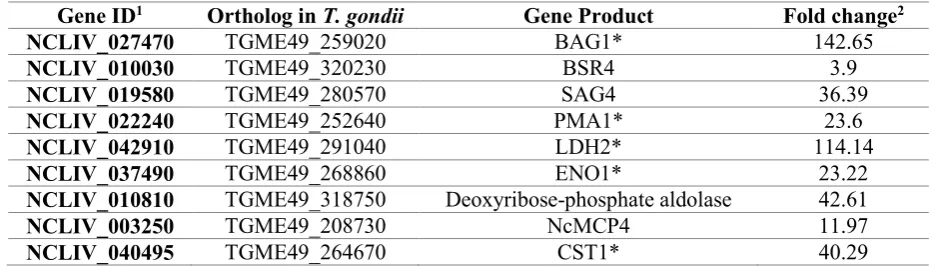
Bradyzoite-specific genes were highly expressed in the Nc-Spain1H isolate. 459
A remarkable result was the large number of bradyzoite-specific genes that were
over-460
expressed in the low virulent isolate Nc-Spain1H (Table 1). The gene encoding the
461
bradyzoite cytoplasmic antigen BAG1 (NCLIV_027470), which facilitates the transition
462
from the tachyzoite to bradyzoite in T. gondii [71] had the largest fold change between
463
isolates, demonstrating 140.6-fold higher expression in Nc-Spain1H. Other
over-464
expressed genes were the bradyzoite-specific surface antigens in N. caninum BSR4
465
(NCLIV_010030) and SAG4 (NCLIV_019580) [29,72]. Interestingly, as we have
466
previous commented, SAG4 protein was also more abundant in the Nc-Spain1H isolate
467
across the lytic cycle in this study. In addition to these stage-specific genes, the gene
related to early tachyzoite conversion into bradyzoites, PMA1 (NCLIV_022240) [73]
469
also displayed higher expression levels in the Nc-Spain1H isolate (23.6-fold). In addition,
470
some isoenzymes involved in glycolysis (lactate dehydrogenase, enolase, glucose
6-471
phosphate isomerase) that are stage-specifically expressed in T. gondii and N. caninum 472
bradyzoites [59,74] such as LDH2 (NCLIV_042910) and ENO1 (NCLIV_037490) were
473
expressed at higher levels in Nc-Spain1H. The N. caninum gene orthologue of T. gondii 474
deoxyribose phosphate aldolase-like, which is involved in the utilization of deoxyribose
475
as a carbon and energy source in the bradyzoite stage [75], also exhibited higher
476
expression in the Nc-Spain1H isolate. Genes related to the tissue cyst wall, such as
477
NcMCP4 (NCLIV_003250) [76] and CST1 (NCLIV_040495), which play essential roles
478
in the structural integrity and persistence of brain cysts [77], had 12-fold and 40.3-fold
479
higher expression levels in the Nc-Spain1H isolate, respectively. Furthermore, higher
480
expression levels of ribosomal proteins have been associated with strains that readily
481
switch from the tachyzoite to bradyzoite in T. gondii [78]. This phenotype was also
482
observed in the low virulence Nc-Spain1H isolate since 23 ribosomal proteins showed
483
higher expression. It has been shown that Nc-Spain1H can start tachyzoite-bradyzoite
484
conversion in vitro under induction conditions, although it is not really completed to
485
encysted bradyzoites [32]. The bradyzoite-transcriptome and proteome profile expressed
486
by the Nc-Spain1H isolate could be related to its slower growth rate. Interestingly, T. 487
gondii, bradyzoite formation is preceded by, and critically dependent on, a parasite cell
488
cycle shift towards slower growth [31]. These early switching parasites have
489
transcriptomes that are very similar to those of tachyzoites, indicating that these early
490
developing parasites are largely slow-growing tachyzoites that can be considered
pre-491
bradyzoites [79]. This pre-bradyzoite stage in Nc-Spain1H may explain, at least partially,
492
its lower virulence in terms of causing abortion in cattle since tachyzoite growth (lower
in strains that tend to form bradyzoites) is a phenotypic trait related to virulence in N. 494
caninum and T. gondii [9,44,80].
495
Host cell attachment and invasion machinery is also differentially expressed between 496
isolates. 497
Seventeen genes encoding for SRS displayed higher abundances in the Nc-Spain1H
498
isolate, while only four were over-expressed in Nc-Spain7. These proteins are highly
499
immunogenic, and their expression is thought to regulate the virulence of infection [26].
500
In the proteome analyses, only five proteins demonstrated different abundances between
501
isolates, and the only one that matched between the transcriptome and proteome was the
502
bradyzoite antigen SAG4.
503
In contrast to the proteome results, the transcriptome analyses revealed fewer microneme
504
genes than SRS genes with differential expression between isolates. Seven had higher
505
expression in Nc-Spain1H and only 2 in Nc-Spain7. According to the proteome results,
506
MIC17B (NCLIV_038110) had higher expression in the Nc-Spain1H isolate. However,
507
the gene encoding the TLN4 protein, with an increased abundance in the Nc-Spain7
508
proteome at 56 hpi, was expressed at a higher level in the Nc-Spain1H isolate.
509
Secretory effectors, rhoptry and dense granule proteins, also demonstrated differential 510
mRNA expression between isolates. 511
Similarly to the proteomic results, the non-syntenic orthologue of T. gondii ROP24 was
512
more highly expressed in the highly virulent isolate Nc-Spain7, and the non-syntenic
513
orthologue of T. gondii ROP1 (NCLIV_069110) was more highly expressed in the low
514
virulent isolate Nc-Spain1H, but at 56 hpi instead of 12 hpi in the proteome. Another
515
rhoptry protein with elevated expression in Nc-Spain1H was the predicted
lineage-516
specific rhoptry kinase, subfamily ROPK-Eten1 (NCLIV_017420), which is present in
517
the T. gondii ROP38/29/19 gene locus that has been found to be necessary to establish
chronic infection in mice [81]. The only dense granule protein with differential expression
519
(2-fold higher in Nc-Spain7) was GRA17 (NCLIV_005560), which in T. gondii leads to
520
more rapid growth [82]. In the proteome studies, fewer differences were also found in
521
these proteins, and no GRA proteins were differentially expressed at 56 hpi.
522
In T. gondii, two different sub-transcriptomes have been described, depending on the
523
tachyzoite cell cycle phase. The G1-subtranscriptome characterized by the expression of
524
genes related to biosynthetic and metabolic functions and the S/M-subtranscriptome
525
enriched in specific genes for specialized apicomplexan processes, in which are included
526
SAG, MIC and ROP proteins [83]. Because the observed differences in proteome
527
elements and DNA transcription could be a consequence of a different progression across
528
the tachyzoite cell cycle, we examined the DNA content in asynchronously growing
Nc-529
Spain1H and Nc-Spain7 at 12, 36 and 56 hpi. At all time-points analysed, the flow
530
cytometry results for the tachyzoites profiles showed that most parasites were in G1 and
531
there were no differences between isolates (Fig. 5B), supporting a similar tachyzoite cell
532
cycle status at the studied time-points.
533
Although these results showing elevated expression of host cell attachment and invasion
534
machinery and secretory effectors related to virulence in the isolate with a reduced
535
invasion rate and virulence are quite surprising, a recent study has shown that the genes
536
encoding these functions also exhibited elevated expressions in the Nc-Spain1H isolate
537
at 12 hpi [16].
538
Different ApiAP2 repertoire may lead to differences in RNA expression and proteomes. 539
Although the mechanisms underlying gene-specific regulation in Apicomplexan parasites
540
are not completely known, the AP2 transcription factors in T. gondii have been associated
541
with important functions including stage-specific gene activation, determination of
542
differences between strains, parasite virulence and host invasion [78,79,84,85]. Most of
the identified ApiAP2s in N. caninum (54 out of 68) are expressed during the tachyzoite
544
stage, similar to T. gondii [27]. In our study, seven AP2 factors displayed higher
545
expression in the highly virulence isolate Nc-Spain7 (AP2VIII-3, AP2VIII-4, AP2IX-8,
546
AP2X-2, AP2X-11, AP2XI-1 and AP2XII-8) and two in the low virulence isolate
Nc-547
Spain1H (AP2III-1 and AP2X-10). In the proteome, by contrast, no AP2 factors exhibited
548
a differential abundance between isolates, which was likely due to lower sensitivity of the
549
technique in comparison to RNA-Seq. Some of these factors have been found to be
550
functional in stage-specific or cell cycle-regulated or even strain-specific expression in T. 551
gondii [79], and thus a similar characterization in N. caninum would be very useful to
552
better understand the regulation of gene expression in this parasite.
553
4. Concluding remarks 554
In this study, we performed proteome and transcriptome comparisons between two
well-555
characterized N. caninum isolates and established marked differences and revealed the
556
mechanisms potentially associated with phenotypic traits and virulence displayed by
557
these isolates. The invasion machinery, metabolism, response to stress and the tendency
558
to form bradyzoites have emerged as principal key factors for isolate behaviour and likely
559
pathogenesis. However, it should be noted that the majority of DEGs and proteins
560
between isolates were annotated as hypothetical and proteins with unknown function.
561
Enhancing the knowledge of this issue could be the best approach to unravel the
562
mechanisms underlying the molecular basis of the virulence of N. caninum.
563
Furthermore, the weak correlation between gene expression and protein abundance
564
highlighted the importance of post-transcriptional regulation in these parasites.
High-565
throughput proteomics techniques such as LC-MS/MS therefore offer a more detailed
566
picture than the transcriptome of mechanisms involved in phenotypic diversity and
567
virulence in N. caninum. However, proteome analyses are also limited by additional
transduction mechanisms involved in protein regulation (activation and protein turn
569
over). Nevertheless, despite the weak correlation between the transcript and protein at the
570
individual gene level, both datasets have identified, on a gene family level, a
pre-571
bradyzoite status of the Nc-Spain1H isolate. This observation is very interesting since it
572
could, at least partially, explain the reduced virulence of this isolate.
573
Altogether, the current study provides a global vision of the transcriptional and
574
translational differences between isolates that display marked virulence differences,
575
shedding light on a subset of proteins that are potentially involved in the pathogenesis of
576
this parasite. New studies with a battery of well-characterized isolates may reveal
577
common mechanism of N. caninum virulence. Our results lay the foundations for further
578
investigations characterizing the relevance of such proteins in N. caninum pathogenesis
579
and virulence.
580
Conflict of interest statement 581
The authors have declared no conflict of interest.
582
Acknowledgements 583
This work was supported by the Spanish Ministry of Economy and Competitiveness
584
(AGL2013-44694-R), the Community of Madrid (PLATESA S2013/ABI2906) and the
585
BBSRC (BB/L002477/1). The funders had no role in study design, data collection and
586
analysis, decision to publish, or preparation of the manuscript. We acknowledge Dr.
587
David Sibley from the Washington University School of Medicine (St. Louis, MO, USA)
588
for the NcMIC2 antibody, Dr. Andrew Hemphill from the Institute of Parasitology,
589
Vetsuisse Faculty (University of Bern, Switzerland) for the NcSAG1antibody and Dra.
590
Aida Pitarch for advice in this work.
591
LMOM, JW, JRC, PH and ECF conceived and designed the experiments. JRC and PH
593
carried out the tachyzoite samples collection for analyses. DX and NR performed
RNA-594
Seq and LC/MS-MS analyses. PH performed the validation assays. DX performed
595
bioinformatics analyses. PH, JRC and DX analysed data and wrote the manuscript.
596
LMOM and NR critically revised the manuscript.
597
598
References 599
[1] J. Dubey, G. Schares, Neosporosis in animals—the last five years, Vet. Parasitol. 180
600
(2011) 90-108.
601
[2] M. P. Reichel, M. Alejandra Ayanegui-Alcérreca, L. F. P. Gondim, J. T. Ellis, What
602
is the global economic impact of Neospora caninum in cattle – The billion dollar question,
603
Int. J. Parasitol. 43 (2013) 133-42.
604
[3] A. L. Chryssafidis, G. Canton, F. Chianini, E. A. Innes, E. H. Madureira, S. M.
605
Gennari, Pathogenicity of Nc-Bahia and Nc-1 strains of Neospora caninum in
606
experimentally infected cows and buffaloes in early pregnancy, Parasitol. Res. 113 (2014)
607
1521-8.
608
[4] S. Rojo-Montejo, E. Collantes-Fernández, J. Blanco-Murcia, A. Rodríguez-Bertos, V.
609
Risco-Castillo, L. M. Ortega-Mora, Experimental infection with a low virulence isolate
610
of Neospora caninum at 70 days gestation in cattle did not result in foetopathy, Vet. Res.
611
40 (2009) 49.
612
[5] S. G. Caspe, D. P. Moore, M. R. Leunda, D. B. Cano, L. Lischinsky, J.
Regidor-613
Cerrillo, G. Álvarez-García, I. G. Echaide, D. Bacigalupe, L. M. Ortega-Mora, A. C.
614
Odeon, C. M. Campero, The Neospora caninum-Spain 7 isolate induces placental
615
damage, fetal death and abortion in cattle when inoculated in early gestation, Vet.
616
Parasitol. 189 (2012) 171-81.
617
[6] J. Regidor-Cerrillo, D. Arranz-Solís, J. Benavides, M. Gómez-Bautista, J. A.
Castro-618
Hermida, M. Mezo, V. Pérez, L. M. Ortega-Mora, M. González-Warleta, Neospora 619
caninum infection during early pregnancy in cattle: how the isolate influences infection
620
dynamics, clinical outcome and peripheral and local immune responses, Vet. Res. 45
621
(2014) 10,9716-45-10.
622
[7] A. Hemphill, B. Gottstein, H. Kaufmann, Adhesion and invasion of bovine endothelial
623
cells by Neospora caninum, Parasitology 112 ( Pt 2) (1996) 183-97.
624
[8] A. Hemphill, N. Vonlaufen, A. Naguleswaran, N. Keller, M. Riesen, N. Guetg, S.
625
Srinivasan, F. Alaeddine, Tissue culture and explant approaches to studying and
visualizing Neospora caninum and its interactions with the host cell, Microscopy and
627
Microanalysis 10 (2004) 602-20.
628
[9] J. Regidor-Cerrillo, M. Gómez-Bautista, I. Sodupe, G. Aduriz, G. Álvarez-García, I.
629
Del Pozo, L. M. Ortega-Mora, In vitro invasion efficiency and intracellular proliferation
630
rate comprise virulence-related phenotypic traits of Neospora caninum, Vet. Res. 42
631
(2011) 41.
632
[10] A. Dellarupe, J. Regidor-Cerrillo, E. Jiménez-Ruiz, G. Schares, J. M. Unzaga, M. C.
633
Venturini, L. M. Ortega-Mora, Comparison of host cell invasion and proliferation among
634
Neospora caninum isolates obtained from oocysts and from clinical cases of naturally
635
infected dogs, Exp. Parasitol. 145 (2014) 22-8.
636
[11] L. Jiménez-Pelayo, M. García-Sánchez, J. Regidor-Cerrillo, P. Horcajo, E.
637
Collantes-Fernández, M. Gómez-Bautista, N. Hambruch, C. Pfarrer, L. M. Ortega-Mora,
638
Differential susceptibility of bovine caruncular and trophoblast cell lines to infection with
639
high and low virulence isolates of Neosporacaninum, Parasit. Vectors 10 (2017) 463.
640
[12] H. Beck, D. Blake, M. Dardé, I. Felger, S. Pedraza-Díaz, J. Regidor-Cerrillo, M.
641
Gómez-Bautista, L. M. Ortega-Mora, L. Putignani, B. Shiels, A. Tait, W. Weir, Molecular
642
approaches to diversity of populations of apicomplexan parasites, Int. J. Parasitol. 39
643
(2009) 175-89.
644
[13] E. G. Lee, J. H. Kim, Y. S. Shin, G. W. Shin, Y. R. Kim, K. J. Palaksha, D. Y. Kim,
645
I. Yamane, Y. H. Kim, G. S. Kim, M. D. Suh, T. S. Jung, Application of proteomics for
646
comparison of proteome of Neospora caninum and Toxoplasma gondii tachyzoites, J.
647
Chromatogr. B. Analyt. Technol. Biomed. Life Sci. 815 (2005) 305-14.
648
[14] Y. S. Shin, G. W. Shin, Y. R. Kim, E. Y. Lee, H. H. Yang, K. J. Palaksha, H. J.
649
Youn, J. H. Kim, D. Y. Kim, A. E. Marsh, J. Lakritz, T. S. Jung, Comparison of proteome
650
and antigenic proteome between two Neospora caninum isolates, Vet Parasitol 134
651
(2005) 41-52.
652
[15] J. Regidor-Cerrillo, G. Álvarez-García, I. Pastor-Fernández, V. Marugán-Hernández,
653
M. Gómez-Bautista, L. M. Ortega-Mora, Proteome expression changes among virulent
654
and attenuated Neospora caninum isolates, J. Proteomics 75 (2012) 2306-18.
655
[16] P. Horcajo, L. Jiménez-Pelayo, M. García-Sánchez, J. Regidor-Cerrillo, E.
656
Collantes-Fernández, D. Rozas, N. Hambruch, C. Pfarrer, L. M. Ortega-Mora,
657
Transcriptome modulation of bovine trophoblast cells in vitro by Neosporacaninum, Int.
658
J. Parasitol. 47 (2017) 791-9.
659
[17] J. Regidor-Cerrillo, M. Gómez-Bautista, J. Pereira-Bueno, G. Adúriz, V.
Navarro-660
Lozano, V. Risco-Castillo, A. Fernández-García, S. Pedraza-Díaz, L. M. Ortega-Mora,
661
Isolation and genetic characterization of Neospora caninum from asymptomatic calves in
662
Spain, Parasitology 135 (2008) 1651-9.
663
[18] J. A. Vizcaíno, A. Csordas, N. del-Toro, J. A. Dianes, J. Griss, I. Lavidas, G. Mayer,
664
Y. Perez-Riverol, F. Reisinger, T. Ternent, Q. W. Xu, R. Wang, H. Hermjakob, 2016
665
update of the PRIDE database and its related tools, Nucleic Acids Res. 44 (2016) 447-56.
[19] B. Gajria, A. Bahl, J. Brestelli, J. Dommer, S. Fischer, X. Gao, M. Heiges, J. Iodice,
667
J. C. Kissinger, A. J. Mackey, D. F. Pinney, D. S. Roos, C. J. Stoeckert Jr, H. Wang, B.
668
P. Brunk, ToxoDB: an integrated Toxoplasma gondii database resource, Nucleic Acids
669
Res. 36 (2008) 553-56.
670
[20] D. Xia, S. J. Sanderson, A. R. Jones, J. H. Prieto, J. R. Yates, E. Bromley, F. M.
671
Tomley, K. Lal, R. E. Sinden, B. P. Brunk, D. S. Roos, J. M. Wastling, The proteome of
672
Toxoplasma gondii: integration with the genome provides novel insights into gene
673
expression and annotation, Genome Biol. 9 (2008) R116.
674
[21] L. Sheiner, J. L. Demerly, N. Poulsen, W. L. Beatty, O. Lucas, M. S. Behnke, M. W.
675
White, B. Striepen, A systematic screen to discover and analyze apicoplast proteins
676
identifies a conserved and essential protein import factor, PLoS Pathog. 7 (2011)
677
e1002392.
678
[22] L. Pollo-Oliveira, H. Post, M. L. Acencio, N. Lemke, H. van den Toorn, V. Tragante,
679
A. J. Heck, A. F. Altelaar, A. P. Yatsuda, Unravelling the Neosporacaninum secretome
680
through the secreted fraction (ESA) and quantification of the discharged tachyzoite using
681
high-resolution mass spectrometry-based proteomics, Parasit. Vectors 6 (2013) 335.
682
[23] I. Pastor-Fernández, J. Regidor-Cerrillo, G. Álvarez-Garcia, V. Marugán-Hernández,
683
P. García-Lunar, A. Hemphill, L. M. Ortega-Mora, The tandemly repeated NTPase
684
(NTPDase) from Neospora caninum is a canonical dense granule protein whose RNA
685
expression, protein secretion and phosphorylation coincides with the tachyzoite egress,
686
Parasit. Vectors 9 (2016) 352.
687
[24] I. Pastor-Fernández, J. Regidor-Cerrillo, E. Jiménez-Ruiz, G. Álvarez-García, V.
688
Marugán-Hernández, A. Hemphill, L. M. Ortega-Mora, Characterization of the Neospora 689
caninum NcROP40 and NcROP2Fam-1 rhoptry proteins during the tachyzoite lytic cycle,
690
Parasitology 143 (2016) 97-113.
691
[25] UniProt Consortium, Activities at the Universal Protein Resource (UniProt), Nucleic
692
Acids Res. 42 (2014) 191-98.
693
[26] C. Lekutis, D. J. Ferguson, M. E. Grigg, M. Camps, J. C. Boothroyd, Surface
694
antigens of Toxoplasma gondii: variations on a theme, Int. J. Parasitol. 31 (2001)
1285-695
92.
696
[27] A. J. Reid, S. J. Vermont, J. A. Cotton, D. Harris, G. A. Hill-Cawthorne, S.
Konen-697
Waisman, S. M. Latham, T. Mourier, R. Norton, M. A. Quail, M. Sanders, D.
698
Shanmugam, A. Sohal, J. D. Wasmuth, B. Brunk, M. E. Grigg, J. C. Howard, J. Parkinson,
699
D. S. Roos, A. J. Trees, M. Berriman, A. Pain, J. M. Wastling, Comparative genomics of
700
the apicomplexan parasites Toxoplasma gondii and Neospora caninum: Coccidia
701
differing in host range and transmission strategy, PLoS Pathog. 8 (2012) e1002567.
702
[28] Y. Adomako-Ankomah, G. M. Wier, A. L. Borges, H. E. Wand, J. P. Boyle,
703
Differential locus expansion distinguishes Toxoplasmatinae species and closely related
704
strains of Toxoplasma gondii, MBio 5 (2014) e01003-13.
[29] A. Fernández-García, V. Risco-Castillo, A. Zaballos, G. Álvarez-García, L. M.
706
Ortega-Mora, Identification and molecular cloning of the Neospora caninum SAG4 gene
707
specifically expressed at bradyzoite stage, Mol. Biochem. Parasitol. 146 (2006) 89-97.
708
[30] J. D. Wasmuth, V. Pszenny, S. Haile, E. M. Jansen, A. T. Gast, A. Sher, J. P. Boyle,
709
M. J. Boulanger, J. Parkinson, M. E. Grigg, Integrated bioinformatic and targeted deletion
710
analyses of the SRS gene superfamily identify SRS29C as a negative regulator of
711
Toxoplasma virulence, MBio 3 (2012) e00321-12.
712
[31] M. E. Jerome, J. R. Radke, W. Bohne, D. S. Roos, M. W. White, Toxoplasma gondii 713
bradyzoites form spontaneously during sporozoite-initiated development, Infect. Immun.
714
66 (1998) 4838-44.
715
[32] S. Rojo-Montejo, E. Collantes-Fernández, J. Regidor-Cerrillo, G. Álvarez-García,
716
V. Marugán-Hernández, S. Pedraza-Díaz, J. Blanco-Murcia, A. Prenafeta, L. M.
Ortega-717
Mora, Isolation and characterization of a bovine isolate of Neospora caninum with low
718
virulence, Vet. Parasitol. 159 (2009) 7-16.
719
[33] F. M. Tomley, D. S. Soldati, Mix and match modules: structure and function of
720
microneme proteins in apicomplexan parasites, Trends Parasitol. 17 (2001) 81-8.
721
[34] A. Naguleswaran, A. Cannas, N. Keller, N. Vonlaufen, G. Schares, F. J. Conraths,
722
C. Bjorkman, A. Hemphill, Neospora caninum microneme protein NcMIC3: secretion,
723
subcellular localization, and functional involvement in host cell interaction, Infect.
724
Immun. 69 (2001) 6483-94.
725
[35] N. Keller, A. Naguleswaran, A. Cannas, N. Vonlaufen, M. Bienz, C. Bjorkman, W.
726
Bohne, A. Hemphill, Identification of a Neospora caninum microneme protein (NcMIC1)
727
which interacts with sulfated host cell surface glycosaminoglycans, Infect. Immun. 70
728
(2002) 3187-98.
729
[36] N. Keller, M. Riesen, A. Naguleswaran, N. Vonlaufen, R. Stettler, A. Leepin, J. M.
730
Wastling, A. Hemphill, Identification and characterization of a Neospora caninum 731
microneme-associated protein (NcMIC4) that exhibits unique lactose-binding properties,
732
Infect. Immun. 72 (2004) 4791-800.
733
[37] J. Wang, D. Tang, W. Li, J. Xu, Q. Liu, J. Liu, A new microneme protein of Neospora 734
caninum, NcMIC8 is involved in host cell invasion, Exp. Parasitol. 175 (2017) 21-7.
735
[38] H. Zhang, M. K. Compaore, E. G. Lee, M. Liao, G. Zhang, C. Sugimoto, K. Fujisaki,
736
Y. Nishikawa, X. Xuan, Apical membrane antigen 1 is a cross-reactive antigen between
737
Neospora caninum and Toxoplasma gondii, and the anti-NcAMA1 antibody inhibits host
738
cell invasion by both parasites, Mol. Biochem. Parasitol. 151 (2007) 205-12.
739
[39] V. Lagal, E. M. Binder, M. H. Huynh, B. F. Kafsack, P. K. Harris, R. Diez, D. Chen,
740
R. N. Cole, V. B. Carruthers, K. Kim, Toxoplasma gondii protease TgSUB1 is required
741
for cell surface processing of micronemal adhesive complexes and efficient adhesion of
742
tachyzoites, Cell Microbiol. 12 (2010) 1792-808.
[40] F. Parussini, I. Coppens, P. P. Shah, S. L. Diamond, V. B. Carruthers, Cathepsin L
744
occupies a vacuolar compartment and is a protein maturase within the endo/exocytic
745
system of Toxoplasma gondii, Mol. Microbiol. 76 (2010) 1340-57.
746
[41] M. S. Roiko, V. B. Carruthers, Functional dissection of Toxoplasma gondii
perforin-747
like protein 1 reveals a dual domain mode of membrane binding for cytolysis and parasite
748
egress, J. Biol. Chem. 288 (2013) 8712-25.
749
[42] F. Almeida, A. Sardinha-Silva, T. A. da Silva, A. M. Pessoni, C. F. Pinzan, A. C.