USING A PERFORMATIVE APPROACH TO TEXTUAL ANALYSIS
INTRODUCTION
Tasked with teaching Scene Analysis and Textual Analysis, the most theoretical modules and the least favoured by the students, I needed to think of an engaging form delivery. The goal was to get students to participate actively and performatively. It is also essential that as performance students, they see how their decisions translate into performance. This paper will discuss the approach I took.
To begin with an observation, I have been working with Musical Theatre students, in which may be argued is the most mimetic area of the performing arts (bearing in mind the Mac-musical and the very tight restriction on staging). So, asking students to think of an alternative interpretation can be challenging.
The idea is to get students to see texts as blueprints for innovative ideas and new or other readings of the text. It is necessary for students to interrogate the “…institutions, social relationships and ideologies as part of the script of official power” (Giroux, 2011, p. 4).
The essential idea behind this approach is for students to see their analysis performed and staged (including set), using this as the barometer as to the effectiveness of the analysis.
DRAMATURGY
This approach uses the term dramaturgy inspired by Trencsényi’s (2015, p. xxi) definition of dramaturgy being the action through which practitioners create meaning by the recognition and arrangement of patterns through the hermeneutical engagement in dynamic dialogical-relationships. Caird (2010, p. 242) defines dramaturgy as the “…craft of analysing the structure of dramatic texts and the theatrical style in which they are performed. Pavis (1998, p. 123) describes dramaturgical analysis as the activity that defines the specific
characteristics of text and performance, continuing that it attempts to clarify the transition from dramatic writing to stage writing.
Shifting dramaturgy is venturing upon an action that would not be motivated by the need or demand for rightful procedure, reaction, direction, relation and position: positions, relations, directions, reactions and procedures, failure included, are only to be recurrently exposed to critical reflection – tested, altered, abandoned or transformed, dis-, mis-, re-, placed (Blažević & Čale Feldman, 2014).
The term shifting dramaturgy originally comes from a conference on mis performance. This term is interesting as the dramaturgy may not work, and the fact that a misperformance occurs allows for an enhanced learning experience.
DRAMATURGICAL GROUPS (D-G)
Students worked within groups that could function as sharing pods, termed ‘dramaturgical groups,’ in these groups they collaboratively interrogate, research, reflect, and evaluate their discovery (research and interpretations) of the text. Formed using a blend of Communities of practice (CoP) and Action Learning Sets these groups ‘facilitate’ their learning across the module.
This approach enhances the applied skills of working in groups, with the students
considering working practices setting up the best possible working processes, continually refining, and setting up the best approach to analysis, discussion, and staging. There is a marked difference between the work on the first and final cycle. (The Subject Benchmark Statement list group work as generic and graduate skills in the performing arts.). This approach also allowed for an action-research module allowing for action-reflection-action. Students improved on every project.
Students used De Bono’s (1999) Six Thinking Hats as a tool to aid decision making.
This approach is analogous to Freire’s concept of Praxis, that to make dialogue possible, the word has two dimensions: action and reflection (Freire, 1993, p. 68). The ‘dramaturgical groups’ worked on three projects. At the end of each project, they evaluated their
effectiveness, naming successes, agreeing on areas for refinement and finally, setting targets (SMART) for the next project. Students documented these in Campus Press - Electronic journals.
EARLIER EXPERIENCES
alternative readings. Some students find it difficult to let go of a production in which they performed, directed by their favourite teacher. Likewise encouraging the letting go of earlier teachings on that production or text. Having shown the ‘known’, we can now discover the ‘unknown.’ This first discussion is also an opportunity to discuss the apropos text genre, style, historical period, and established themes and so forth. With prior information, knowledge and understanding established, it is clear where learning or discovery begins. This step also gives an understanding of the frames of reference that everyone brings to the cycle.
BROADENING WORLD VIEW
Encouraging a broadening of all participants’ worldview, by listening to BBC World, Voice of America (VoA), Deutsche Welle (DW), Al-Jazeera, France 24, and watching world news bulletins and reading newspapers from around the world. A broader worldview is essential for contextualising the projects and placing their understanding within a global milieu. Debates around sociology, culture, ethnicity and so forth, need broader reading and research. Widening their information sources is an exciting departure for performance students who at times have a very narrow focus. The approach invites students to BYOD into the classroom which accelerates valuable information gathering.
INTERROGATION AND DISCOVERY
By dialogically sharing their research, they gather information, broaden their knowledge, and generate an individual and collective understanding of it. In this “genuine dialectic” process, students evaluate the relevance of their understanding, categorising it as follows:
behavioural, relational, environmental, or unsuited, following Giroux (2011, p. 5) idea that a pedagogical approaches should enable students to read texts differently as objects of interrogation rather than slavishly through a culture of pedagogical conformity that teaches unquestioning reverence.
RESEARCH AND INVESTIGATION
Working with Attempts on Her Life by Martin Crimp, African Folktales, Fairy Tales and Mythologies, D-Gs interrogated the text placing it within broadening circles of context. This approach stresses the importance of an international curriculum. Encouraging students to work with a variety of texts other than the standard British or American literature is
DRAMATURGICAL GROUPS INVESTIGATE SOME OR ALL, OF THE FOLLOWING.
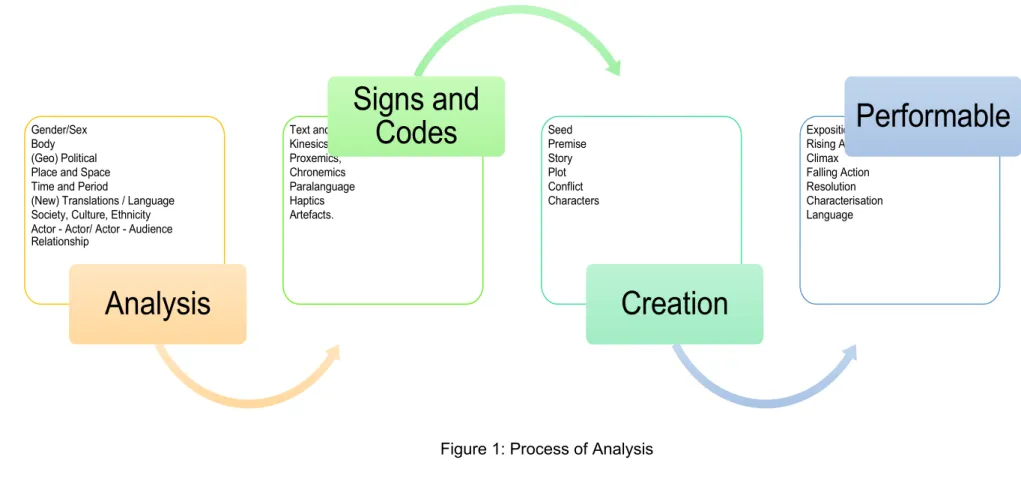
We approach the analysis from a performative perspective, following a line of action that moves from general topics to specifics requite for staging and performance. Students place these first topics within the context of the elements of a play/musical.
• Gender/Sex • Body
• (Geo) Political • Place and Space • Time and Period
• (New) Translations / Language • Society, Culture, Ethnicity
• Actor - Actor/ Actor - Audience Relationship
I encourage students to view their dramaturgy as a medium of communication, and as such, they use a semiotic or structural approach with emphasis on sharing meaning through the text and their interpretation and presentation of the dramaturgy. Viewing the above categories concerning signs and codes. Their work will look at non-verbal communication codes such as Kinesics, Proxemics, Chronemics, Paralanguage, Haptics, Artefacts. Students further look at language in terms of its referential, expressive, conative, phatic, poetic, and metalinguistic functions.
PERFORMATIVE APPROACH INVESTIGATES:
As this is a performative approach and it involves creating a dramaturgy, the sessions also focus on structure looking at Exposition and Introduction; rising action, climax, falling action
and resolution. Establishing the Seed, Premise, Story, Plot., Naming the conflict in the play/
musical, the characters – pivotal character, antagonist and focussing on the orchestration of
characters (Dunne, 2017a) within the dramaturgy. In studying these characters physiology, sociology, psychology, character’s physical life, character’s inner life, character’s life with others (Dunne, 2017a) are all considered. These character traits complete the circle of the first analysis.
When looking at Musicals the groups identify, the music, Ballad, Rhythm and Special Material, 'I Am', 'I Want' and new songs.
The process emphasises the structure of the scene, looking at the inciting event, - its cause and effect, the following conflict — what shapes it, and the orchestration of the characters around the conflict.
TEXT AND DISCOURSE
Students spend time studying the dialogue, mainly if it changes due to the new setting in the dramaturgy. Students consider the power of the words, the sentence structure as well as the imagery. They view the text as the linguistic and formal aspects of the verbal message, while discourse refers to the social process of using language to construct meaningful texts. Similarly, with non-verbal messages, which together form the theatrical text (Lang, 2017).
Students study the music and use of the song in detail.
Figure 1: Process of Analysis
Gender/Sex Body (Geo) Political Place and Space Time and Period
(New) Translations / Language Society, Culture, Ethnicity Actor - Actor/ Actor - Audience Relationship
Analysis
Text and Discourse Kinesics, Proxemics, Chronemics Paralanguage Haptics Artefacts.
Signs and
Codes
SeedPremise Story Plot Conflict Characters
Creation
Exposition Rising Action Climax Falling Action Resolution Characterisation Language
PERFORMABLE INTERPRETATIONS
This approach encourages students to show their research through the performance of the dramaturgy. In reviewing, they decide how noticeable and noteworthy the decisions they have made to the audience?
This approach uses varied analysis having a blend of traditional analysis techniques and the principles of Active Analysis. This adaptation allows students to try out their dramaturgy.
Frost and Yarrow (1990, p. 165) state that “improvisation promotes the capacity for creating meaning” and that “Improvisation underlies and underlines the fact that meaning is created in performance as the collision or negotiation of different sets of meaning: that, for instance, which appears to reside in the ‘text’ and that which individual performers perceive and/or mediate; that which the audience expects and that which they receive; and so on”.
Johnson (2006, p. 33) argues that improvisation is not only about the culture of research but that it offers the tools for individual and group learning. Through practice, participants can enhance a range of skills – social and personal. Dramatic improvisation strength lies in its ability to replicate social life.
Thomas (2014, p. 1) explains Active Analysis as a reduced Formalist analysis approach which gathers information from the play and then draws a general conclusion about the entire work. It uses a systematic collection of close-ups to assemble the big picture. This analysis tries to cover all the dramatic potentials of the dramaturgy. He suggests that action analysis is based on the events in the plot, looking at the action using improvised text. These improvised scenes, lead the actor towards creative assimilation of the author’s text. That is, using the author’s words as the principal means of stage expressiveness. Active analysis releases the creative individuality of actors, encouraging them to take personal responsibility for their creative work and to arouse their own psychological and physical resources
(Thomas, 2016, p. 87).
REVIEW AND EVALUATE
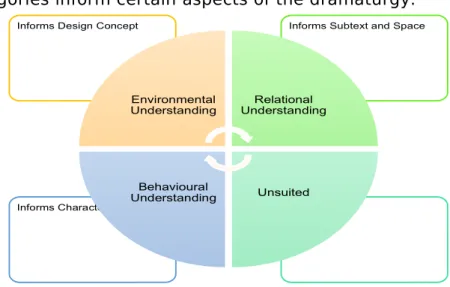
This categorisation directly informs the presentation/performance of the dramaturgy, in that:
BEHAVIOURAL understanding informs the performance, i.e., characterisation, relationships, physicality, (psycho-physical acting approach),
RELATIONAL understanding informs the subtext of the performance, i.e. the underlying context of the performance,
ENVIRONMENTAL understanding relates to the design concept and how this informs the “shifting dramaturgy,”
UNSUITED understanding which is set aside and not used in this performance.
Fig 2 shows categories inform certain aspects of the dramaturgy.
FIGURE 2: CREATING THE DRAMATURGY
Students see this analysis as three circles widening from the characters’ behaviour to relationships with others and the settings and finally the environment, the locale of the dramaturgy.
Fig 3 shows how the various contexts move from the individual to their relationships with others following it through to their relationship with the environment.
Set Aside Informs Characterisation
Informs Subtext and Space Informs Design Concept
Environmental
Understanding UnderstandingRelational
Unsuited Behavioural
FIGURE 3: CIRCLES OF ANALYSIS
FIGURE 4: ZONES OF INTERPRETATION
Figure 4 shows how the assorted topics of analysis can be looked at in various zones, this is purely for discussion and it some of the topics apply to more than one zone.
Enviromental Context
Relational Experiences
Behavioural Experiences
Environmental
Geo-Political
Place and Space
Time and Period
Actor- Audience relationship
Society, Culture, Ethnicity
Relational
Actor -Audience Relationship Gender / Sex Time and Period Society, Culture, Ethnicity
Body Place and Space
Behavioural
Gender/Sex Body Time and Period Culture, Society Ethnicity
New Translations/
Language
THIS APPROACH
Using the ideas of Action Analysis, students would frame their improvisation based on their discovery and (role)-play with this interpretation. Following this work, they could experience and play with the text informing their dramaturgy. The approach allows the student to ‘play’ with their interpretations seeing if they work in the overall framework of their context. The performability is the essence of this approach, and so it is essential that students have this opportunity. If the student-actors have embodied that reading, then they use it for their final presentation of the dramaturgy. However, playing with various interpretations is an integral part of their learning. Questions arise on how (through performance) you (re)present culture, gender and so forth. However, this is the task that drives this approach. Merely setting the scene in another culture is meaningless unless actors (students) can perform it. The way students show this achieves the secondary objective of learning to stage a dramaturgy.
The original concept of Active Analysis, the actor, would improvise around the themes of the text, using their own words. In this approach, actors, students would use the text to try out the various interpretations they have created.
The key for the students is to experience their analysis by performing the text or informing the mood-board, box set.
Following these decisions, students agree on the final readings and which they present in the dramaturgy.
CREATING NEW WORK
As an exercise, we “reverse engineered” and created a new piece of theatre using the techniques learnt. This exercise successfully reinforced the tools for analysis.
ROLE OF THE TUTOR
As part of the facilitation process, the tutor poses questions, creates doubt, and encourages the teams to “defend” their interpretations and their choices on performability. Together they make these choices and carry them through to the showing. The facilitator counters
WORKS CITED
Blažević, M. & Čale Feldman, L., 2014. Misperformance. In: B. Reynolds, ed. Performance studies: key words, concepts and theories. London: Palgrave, pp. 50-55.
Caird, J., 2010. Theatre craft: a director's practical companion from A - Z. London: Faber and Faber.
Dunne, W., 2017a. The dramatic writer's companion: tools to develop characters, cause scenes, and build stories.. 2nd ed. Chicago: University of Chicago Press.
Dunne, W., 2017b. Character, scene and story: new tools from the dramatic writer's companion. Chicago: University of Chicago.
De Bono, E., 1999. Six thinking hats®. Revised and Updated ed. London: Penguin Books.
Freire, P., 1993. Pedagogy of the oppressed. London: Penguin Books.
Frost, A. & Yarrow, R., 1990. Improvisation in drama. London: Macmillan.
Giroux, H., 2011. On critical pedagogy. New York: Continuum.
Johnston, C., 2006. The improvisation game: discovering the secrets of spontaneous performance. London: Nick Hern Books.
Lang, T., 2017. Essential dramaturgy. London: Routledge.
Merlin, B., 2001. Beyond Stanislavsky. London: Routledge.
Pavis, P., 1998. Dictionary of theatre: terms, concepts and analysis. Toronto: University of Toronto Press.
Thomas, J., 2014. Script analysis for actors, directors, and designers. 5th ed. New York: Focal Press.
Thomas, J., 2016. Stanislavsky's Active analysis: Including the formative essay on active analysis by Maria Knebel. London: Bloomsbury.