Two-Factor Remote Authentication Protocol with User
Anonymity Based on Elliptic Curve Cryptography
L. Zhang, Shanyu Tang*,Senior Member IEEE, J. Chen, S. Zhu
School of Computer Science, China University of Geosciences, Wuhan, 430074, China
*Corresponding author: [email protected], [email protected],Tel/Fax:+862767848563
ABSTRACT
In order to provide secure remote access control, a robust and efficient authentication protocol should realize mutual authentication and session key agreement between clients and the remote server
over public channels. Recently, Chun-Ta Li proposed a password authentication and user anonymity protocol by using smart cards, and they claimed that their protocol has satisfied all criteria required by
remote authentication. However, we have found that his protocol cannot provide mutual authentication between clients and the remote server. To realize ‘real’ mutual authentication, we propose a two-factor
remote authentication protocol based on elliptic curve cryptography in this paper, which not only satisfies the criteria but also bears low computational cost. Detailed analysis shows our proposed
protocol is secure and more suitable for practical application.
KEY WORDS: authentication; key agreement; user anonymity; elliptic curve; smart card
1. INTRODUCTION
A secure and efficient remote authentication mechanism is needed to make clients and the remote server authenticate each other and generate a session key for future communications. Since the
password is always chosen by the client freely and easy to remember, it is usually employed to achieve the authentication requirement between clients and the remote server over public channels. The first
good performance since only a one-way hash function was used in the protocol. Followed their work, many password-based authentication protocols have been proposed to improve the protocol’s security
and enhance their functionality [2-5]. However, these protocols require the server maintain a password table for verification purposes, thereby making them suffer from possible attacks such as insider attacks,
password disclosure attacks, stolen-verifier attacks and server-spoofing attacks. When large number of client registers on the remote server, maintenance and protection of the verification table will become an
intractable problem. Once the verification table is stolen by the adversary, the security of the system is crumbled [6]. Moreover, since the password or verification tables are usually very large, maintaining the
tables and the reset passwords makes these solutions hard to scale up. Furthermore, passwords might be forgotten or divulged. So the password-based authentication protocols cannot provide high security since its security solely depends on the sensitive verification tables.
In order to improve the security, some two-factor authentication protocols have been proposed [7-12]. In the two–factor authentication protocols, smart cards are employed to store some secrets and the clients
only need to remember the passwords. Since the smart cards can show what you have, and the passwords can verify what you know, through combining the password and the smart card, two
different data types, these two-factor authentication protocols can provide strong security authentication. However, most of these two-factor protocols cannot resist impersonation attacks, many logged-in
users’ attacks, password guessing attacks, and so on. The use of smartcards also evokes some new security problems such as stolen/lost smartcard attacks, and an evicted client may use an overdue
smartcard to access the server et al. [13]. Furthermore, the secrets stored in smart cards could be extracted by monitoring the power consumption and analyzing the leaked information in the smart cards [14-15].
On the basis of the above description and references [16-17], a robust and efficient remote authentication protocol should satisfy the following criteria: (1) The server needs not to maintain any security-sensitive
password or verification table; (2) Provide security in choosing and updating passwords freely; (3) Provide user anonymity to protect the user’s privacy; (4) Provision of mutual authentication and
session key agreement to protect their future communications; (5) Provision of perfect forward secrecy; (6) Prevention of clock synchronization problem and time-delay; (7) Provision of practicability and
Resistance to offline dictionary attacks with/without smartcards, password disclosure, stolen-verifier, known-key, corrupt insider and many logged-in users’ attacks; (11) Resistance to parallel session and
stolen/lost smart card attacks.
Recently, Chun-Ta Li [17] analyzed the authentication protocol proposed by Islam and Biswas [18],
proposed an authentication protocol by using password and smartcard based on elliptic curve cryptography, and they claimed that their protocol satisfied the criteria mentioned above. However, in
this paper we prove that Chun-Ta Li’s protocol cannot provide mutual authentication between clients and the remote server. We also propose a robust and efficient two-factor authentication protocol with
key agreement based on the elliptic curve discrete logarithm problem [19] which satisfies the above criteria at the same time. In addition, we use the GNY logic [20] to prove the security of our proposed protocol. Compared with the previous schemes [16-18], our protocol not only satisfies more security
requirements, but also achieves better performance.
The rest of this paper is organized as follows. In Section 2 a brief review of Chun-Ta Li’s protocol is
given. Section 3 describes a cryptanalysis of Chun-Ta Li’s protocol. Our authenticated key agreement protocol is presented in Section 4. In Section 5, the security of our proposed protocol is discussed. The
performance of the protocol is examined in Section 6, and the paper is concluded in Section 7.
2. REVIEW OF CHUN-TA LI’S PROTOCOL
In this section, we briefly review Chun-Ta Li’s password authentication protocol [17]. Their protocol
consists of four phases: registration, password authentication, password change and session key distribution phase, described as follows (as shown in Figure 1):
2.1. Registration phase
When a client A wants to become a new legal client, it performs the following steps with the server S.
Step R1: AS ID U: A, A
The client A chooses its identityIDA, its password pwA and a random integerrA. Next, it computes a password-verifier UApwA r GA and keeps rA secretly.
The server S stores each legal client’s identity, password-verifier and a status-bit in a write protected
file. Then it stores { ,G US,H( ), EK( ), DK( )} in a smart card and delivers this smart card to the user A in a secure channel.
Step R3: The user A stores rA in the smart card. Then the smart card contains
{ , ,r G UA S,H( ), EK( ), DK( )} .
2.2. Password authentication phase
When a client A wishes to login to the server S, the client A has to insert its smart card into the card
reader and type its identityIDA and passwordpwA. And then the smart card and the server S perform the following steps:
Step A1: '
: , ( , , , )
x
A K A A A A
AS ID E ID R W U
The smart card selects a random integer '
A
r , and computesRAr UA S r d GA s , WAr r PW GA A A ,
' '
A A A
U pw r Gand '
( , , , )
x
K A A A A
E ID R W U , where US is the public key of the server S and Kxis the x
coordinate of Kpw r UA A S pw r d GA A s (K Kx, y). Then it sendsIDA and
'
( , , , )
x
K A A A A
E ID R W U to
the server S.
Step A2: SA W: ( AWS),H W U( S, A' )
After receiving the message, the server S computesKd Us A pw r d GA A S (K Kx, y)to obtainKx, and
then it decrypts '
( , , , )
x
K A A A A
E ID R W U by using Kxto reveal
'
(ID R W UA, A, A, A). Next, the server S
compares the decryptedIDA with the received IDA and ˆ(e d R Us A, A)with ˆ(e W UA, S). If all the conditions are satisfied, it chooses a random integerrs and computes WS r Us S r d Gs s . Then it sends
(WAWS)and
'
( S, A)
H W U to the client A.
Step A3: '
: A, ( A, S, A)
AS ID H W W U
The client A obtains WSfrom the received information (WAWS)and computes
'
( S, A)
H W U . Next it
verifies whether the computed value '
( S, A)
H W U is equal to the received '
( S, A)
H W U . If so, the client A
Fig.1. Chun-Ta Li’s protocol
Step A4: SA:Access Granted/Denied
The server S computes '
( A, S, A)
H W W U by using its own WSand the received information
'
(W UA, A).
Then it checks whether the hashed result of '
( A, S, A)
H W W U is equal to the received '
( A, S, A)
H W W U . If
'
{(WAWS),H W U( S, A)}
' {ID H W W WA, ( A, S, A)}
Verify H W U( S, A')
RetrieveWS from (WAWS)
Verify
?
ˆ( S A, A) ˆ( A, S)
e d R U e W U
ServerS
ClientA
Store { ,G US,H( ), EK( ) / DK( )}
SelectIDA,pw rA, A, compute UApw r GA A {ID UA, A}
Replace UAwith
'
A
U
Registration Phase:
SMART CARD
StorerAinto SMART CARD
Password Authentication Phase:
Input , , '
A A A
ID pw r
Compute ' '
, ,
A A S A A A A A A A
R r U W r r pw G U pw r G
'
{ , ( , , , )}
x
A K A A A A
ID E ID R W U
DecryptEKx(ID R W UA, A, A, A')
S S S
W r U
VerifyH W W W( A, S, A')
Access Granted/Denied
Replace rAwith
'
A
r
Password Change Phase:
Input ' '
, , ,
A A A
ID pw pw r '
{ , ( , , , )}
x
A K A A A A
ID E ID R W U
'
{(WAWS),H W U( S, A)}
' '
{ID H W W WA, ( A, S, A),H W( SWAUA)}
Password Change Granted/Denied
Session Key Distribution Phase:
Input ' '
, , ,
A A A
ID pw pw r
'
{(WAWS),H W U( S, A,SK)}
' {ID H W W UA, ( A, S, A,SK)}
Key Distribution Granted/Denied
(A A A) S
SK r r pw W SK(r d WS S) A
so, the server S grants A’s login request and replaces UA pw r GA A with
' '
A A A
U pw r G, otherwise
denies A’s login request. Finally, if all the conditions are satisfied, the client A’s smart card will replace
A
r with '
A r .
After finishing the password authentication phase, the verifier table is updated.
2.3. Password authentication phase
When a client A wants to change its password, A must notify the server S to update the old password
verifier UApw r GA A with a new password verifier
' ' '
A A A
U pw r G.
Step P1: AS ID E: A, Kx(ID R W UA, A, A, A')
Step P2: '
: ( A S), ( S, A)
SA W W H W U
Step P3: ' '
: A, ( A, S, A), ( S A A)
AS ID H W W U H W W U
Step P4: SA:Password Change Granted/Denied
2.4. Session key distribution phase
The client A and the server S choose two random numbersr rA, S[1,n1], respectively. After above four phases, the server S replaces UAwith
'
A
U and A’s smart card replaces rAwith
'
A
r . And the client A
and the server S can compute the session key SKr r pw r d GA A A S S for a new password verifierUA' pw r G'A A' .
Step S1: '
: , ( , , , )
x
A K A A A A
AS ID E ID R W U
Step S2: '
: ( A S), ( S, A, )
SA W W H W U SK
Step S3: AS ID H W W U: A, ( A, S, A',SK)
Step S4: SA:Key distribution Granted/Denied
In this section, we demonstrate that the protocol proposed by Chun-Ta Li [17] cannot provide mutual authentication between the clients and the remote server.
Proof
∵RAr UA S r d GA S , UApw r GA A
∴ˆ( , ) ˆ( , ) ˆ( , )r r pw d dA A A SS S A A S A S A A
e d R U e d r d G pw r G e G G
∵WAr r pw GA A A US d GS
∴ˆ( , ) ˆ( , ) ˆ( , )r r pw dA A A S A S A A A s
e W U e r r pw G d G e G G
∵e G Gˆ( , )r r pw d dA A A S S e G Gˆ( , )r r pw dA A A S
∴e d R Uˆ( S A, A)e W Uˆ( A, S)
So, the verification ˆe d R U( S A, A)e W Uˆ( A, S)provided by Chun-Ta Li [17] is not correct. Even if the client is a legal client, she or he cannot pass the verification of the server S. Under this case, the server
S will not send any message to the legal client and will reject the legal client’s login request.
Moreover, since the extended protocol with user anonymity provided by Chun-Ta Li is based on the
protocol described above, the extended protocol also cannot provide mutual authentication.
According to above analysis, the protocols proposed by Chun-Ta Li cannot provide mutual
authentication between clients and the server.
4. OUR PROPOSED PROTOCOL
This section presents our newly designed two-factor (password, smart card) authentication key agreement protocol with user anonymity. The proposed protocol consists of five phases: system setup
phase, registration phase, pre-computation phase, authentication phase and password changing phase. The procedures of the proposed protocol are described in detail as follows (as shown in Fig. 2):
4.1. System setup phase
Step S1: The server S chooses an elliptic curve equation 2 3
( , ) : (mod )
p
E a b y x ax b p over a prime
finite fieldFp, where ,a bFpand
3 2
Step S2: The server S chooses a random integer *
R p
s Z as a secret key and computes public key
Ppub=sP, and chooses one secure one-way hash functionsh( ) :{0,1} *{0,1}k.
Step S3: The server S keeps s secret and publishes the public information{E a b P P hp( , ), , pub ( )} .
4.2. Registration phase
When the clientU wants to register with the server S, it performs the following steps with the server S.
Step R1: : (US ID h PW, ( r))
The client U selects its passwordPWand identity ID freely and chooses a random integerrR Z*p. Next, the client U computes (h PWr) and sends {ID h PW, ( r)}to the server S over a secure
channel.
Step R2: After receiving the message from the client U, the server S computes the secret information
( ( ) )
s
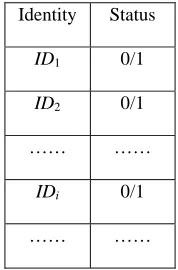
RE h PWr ID for the clientU . Then the server S records ID in an identity table as shown in
Table 1 which consists of two columns one is for storing the client’s ID and the other Status is used for checking whether the login ID is registered, revoked or not. Next it storesRin the memory of a smart
card and delivers the smart card to the client U in a secure manner.
Step R3: Upon receiving the smart card, the client U stores the secret random integer r in the smart card.
Then the memory of the smart card contains ( , )R r . The client U keeps the passwordPW ID, and the
smart card secretly for the registration process.
Table 1. Identity table
Identity Status
ID1 0/1
ID2 0/1
…… ……
IDi 0/1
…… ……
In the authentication phase, the smart card and the server S perform the following four steps.
Step A1: US: (W Z, )
The client U first inputs its password PWand its identityID. It then selects a random integer *
1 R p
r Z ,
and computesVh PW( IDr r P)1 ,W h PW( IDr r P)1 pub and ZEVco x_ (R h PW( r ID) ),
whereEVco x_ is an encryption function with the x-coordinate of elliptic curve pointV. Finally, it sends (W Z, ) to the server S.
Step A2: SU: ( , )X r3
After receiving the message, the server S computes * 1 1
1
( )
V s W s h PW IDr r sP
1
( )
h PW ID r r P
by using the server’s secret key s. It then obtains the x-coordinate of elliptic
curve point *
V denoted as * _
co x
V and decrypts Z by using it to get information , (R h PWr)andID.
Next, the server S checks whether ID is valid according to the identity table. If not, terminate the
authentication session. Otherwise, it decrypts R by using its secret key s to obtain (h PWr)and ID.
Then the server S compares the value of the ID in Z with that of the ID in R to make sure that the
message was indeed sent by the client U. Next it checks whether the value (h PWr) in Z is equal to
the value (h PWr)getting from R. If so, it generates two random integers *
2, 3 R p
r r Z , and computes
the session key *
_ 2
( co x )
SK h V r and authentication message *
_ 3
( )
s co x
Auth h V r . Then the server S
encrypts the secret random integer r2and authentication messageAuthsby using ( (h h PW r) ID). At last it sends the encrypted message XEh h PW( ( r) ID)(Auth rs 2) and random integerr3to the
clientU .
Step A3: US: (Authu)
Upon receiving the message, the client U inputs its password PW and identity ID to compute the
decryption key ( (h h PW r) ID). And then it can decrypt the message X to obtain the authentication
message Auths and the integer r2 . After that the client can compute the session
key '
1 _ 2
(( ( ) )co x )
SK h h PWIDr r P r . Then the client U checks whether the equation
?
_ 3
( )
s co x
Auth h V r holds. If the equation holds, it computes ' 3
( ( 1)) u
Step A4: After receiving the response message, the server S verifies whether the following equation
holds
?
3
( ( 1)) u
Auth h SK r . If the message is authenticated, the server S sets SKas the shared session
key with the clientU; otherwise, it deletes the received information and the protocol stops.
Fig.2. The proposed protocol
4.4. Password changing phase
3
{ , }X r
{Authu}
Compute Authuh SK( ' (r31))
Decrypt X by using h h PW( ( r) ID)
Check ID in the identity table ServerS
ClientA
Compute RE h PWs( ( r ID) )
Select *
, , R q
ID PW r Z , compute (h PWr)
{ID h PW, ( r)}
Registration Phase:
SMART CARD (R)
Storerinto SMART CARD
Authentication Phase:
Input ,ID PWand choose *
1 R q
r Z
Compute Vh PW( IDr r P W)1 , h PW( IDr r sP)1
{ , }W Z * 1
1
( )
V s W h PWIDr r P
Decrypt R by using s
Password Change Phase:
Select *, , * *
R q
PW N r Z
* * * *
{ ,N ESK( (h PW r) ID N h h PW( ( r) ID N))}
* *
( ( 1 ))
SK
E R h N R
_ ( ( ) )
cox V
ZE R h PWr ID
Decrypt Z by using Vco x*_
Compare two IDsand two values of (h PWr)
Select *
2,3 R q
r r Z
Compute *
_ 2
(co x )
SKh V r
* _ 3
( )
s co x
Auth h V r
( ( ) )( 2)
h h PW r ID s
XE Auth r
Compute '
1 _ 2
(( ( ) )co x )
SK h h PWIDr r P r
? _ 3
( )
s co x
Authh V r
? 3
( ( 1))
u
Auth h SK r
Compute * * * *
( ( ) ( ( ) ))
SK
E h PW r ID N h h PW r ID N
Verify the tag * *
( ( ) )
h h PW r ID N
Compute * * *
( ( ) )
s
R E h PW r ID
* *
( ( 1 ))
SK
E R h N R
Verify the tagh N( 1R*)
Store * *
If the client Uwants to change its passwordPWto a new password *
PW , it needs to agree on a session
key with the server S via the authentication phase in advance. And the client U must notify the server S
to update the old secret RE h PWs( ( r ID) )with a new secret
* * *
( ( ) )
s
R E h PW r ID . All steps
of the password changing phase are executed as follows:
Step P1: The client U selects a new random integer * *
R q
r Z , a new password *
PW and a nonceN for
freshness checking. Then it encrypts the new password messageh PW( *r*) ID by using the session
keySK. Next, it sendsESK( (h PW*r*) ID N h h PW( ( *r*) ID N)) andNto the server S.
Step P2: After receiving the message, the server S uses the session key SKto decrypt the encryption
message and verifies whether the authentication tag h h PW( ( *r*) ID N)is valid. If true, it computes
a new secret value * * *
( ( ) )
s
R E h PW r ID and sends ESK(R h N* ( 1 R*)) to the clientU . Otherwise, it rejects the password changing requirement.
Step P3: Upon receiving the message, the client U decrypts the message and verifies whether the
authentication tag *
( 1 )
h N R is valid. If so, the client Ustores * *
(R r, ) in its smart card. Otherwise, it
stops the password updating.
5. SECURITY ANALYSIS
5.1 Authentication proof based on Gong-Needham-Yahalom logic
In this section, first we introduce some formulae and statements that will be used in the Gong-Needham-Yahalom (GNY) logic; and then set the goals and list the assumptions of the protocol; finally we use the GNY logic to prove our proposed protocol. GNY logic has been widely used to formally
analyze the completeness of authentication protocols. It has successfully found defects in several
protocols and disclosed redundancies in many protocols. So in this paper, we adopt the GNY logic to
evaluate the security of the proposed protocol.
A formula is a name used to refer to a bit string, which has a particular value in a run [20]. Let X and Y
range over formulae. First we introduce some formulae used in our authentication proof and the
complete list of all logical postulates is shown in [20]. (1) (X, Y): conjunction of two formulae X and Y.
(2) {X}K and { }X K1: symmetrically encrypt and decrypt X with the key K. (4) h(X): a one-way function of X.
(5) *X: X is not originated here.
A basic statement reflects some property of a formula [20]. Let P and Q range over principals. Then we introduce some statements as follows:
(1)P< X: P is told formula X.
(2)PX: P possesses formula X.
(2)P~X: P once conveyed formula X.
(3)P#( )X : P believes that X is fresh.
(4)P( )X : P believes that X is recognizable.
(5)PS Q: P believes that S is a suitable secret for P and Q.
5.1.2 Protocol description
We first change some notations to fit the GNY logic and transform our protocol into the form of P→
Q:(X). In the following transformation, the notation x_V is regarded as Vco x in our protocol.
(1) _ (
) 1
1
: ( ( ) ,{ ( ) }x h PWID r r P)
US h PWIDr r sP R h PWr ID
(2) SU: ({ ( _ (h x h PWIDr r P r)1 3) r2}h h PW( ( r) ID), )r3
(3) US: ( ( ( _ (h h x h PWIDr r P r)1 2) (r31)))
5.1.3 Goals
We descript our goals as follows: (1) Message content authentication
Goal1: S believes that the message in the first run is recognizable.
_ ( ) 1
1
{ ( ) ,{ ( ) }x h PW ID r r P}
Goal2: U believes that the message in the second run is recognizable.
1 3 2 ( ( ) ) 3
{{ ( _ ( ) ) }h h PW r ID, }
U h x h PWIDr r P r r r
Goal3: S believes that the message in the third run is recognizable.
S{ ( ( _ (h h x h PWIDr r P r)1 2) (r31))}
(2) Message origin authentication
Goal4: U believes S conveyed the message in the second run.
1 3 2 ( ( ) )
~{{ ( _ ( ) ) }h h PW r ID}
U S h x h PWIDr r P r r
Goal5: S believes U conveyed the message in the third run.
1 2 3
~{ ( ( _ ( ) ) ( 1))}
SU h h x h PWIDr r P r r
(3) Session key material establishment
Goal6: U believes that S believes that r2 is a secret shared between U and S.
SK
U S U S
Goal7: U believes that r2 is a secret shared between U and S.
SK
U U S
Goal8: S believes that U possesses SK.
SUSK
Goal9: S believes that U believes that SK is a secret shared between U and S.
SK
S U U S
5.1.4 Assumption list
To derive our goals, some assumptions are made as follows:
(1) S possesses the secret key s.
Ss
(2) Since S keeps the identity table, S believes that ID is recognizable.
( )
S ID
(3) The random integer r1 and r are generated by U in the protocol, so U possesses r1 and r. The
password PW and ID are chosen by U in the protocol and are keep secret, therefore U possesses PW
1, , , , , #( ) Ur Ur U PW UP UID U ID
(4) We assume that U believes ( (h h PW r) ID)is a suitable secret for himself and S.
( ( ) )
h h PW r ID
U U S
(5) The SK generated by S is a temporal session key in the current run. So we assume that S
believes that SK is a suitable secret between U and S.
2
r
S U S
(6) The random integer r2 and r3 are generated by S in the protocol, so S possesses r2, r3 and
believes that r2 and r3 are fresh.
2, #( )2
Sr S r ,Sr S3, #( )r3
(7) U believes that the server S is an authority on generating a suitable session key material SK
shared between U and S.
SK
U S U S
5.1.5 Authentication proof by using Gong-Needham-Yahalom (GNY) logic
In this subsection, we use the GNY logic to analyze the proposed protocol. A complete list of all logical postulates and the index in the list is provided [20], such as (T1, P1), to show how to achieve
the goals defined in subsection 5.1.3.
(1) The first run:
1
1
( ) ,
_ ( )
S h PW ID r r sP S s
S x h PW ID r r P
<
(P1, P2, P3) (1)
If S is told a formula h PW( IDr r sP)1 and possesses a key s (Assumption 1), then it is consider to
possess the formulah PW( IDr r P)1 , as well as possess x-V.
( ),
{ ( ) , }s
S ID S s
S h PW r ID
(R1, R2) (2)
If S believes that ID is recognizable (Assumption 2) and possesses the secret key s (Assumption 1),
then S believes that the encrypted message { (h PWr ID), }s with ID as a component in it, is recognizable. So, S can recognize the secret RE h PWs( ( r ID) )in the smart card of the client U.
_
( ), _ { , ( ), }x V
S R S x V
S R h PW r ID
(R1, R2) (3)
If S believes that R is recognizable (A2) and possesses the key x_V (A1), then S believes that the
encrypted { , (R h PWr ID), }x V_ with R as a component in it, is recognizable. So, S can
recognize{ , (R h PWr ID), }x V_ .
_ 1 _ ({ , ( ), } ) ( ( ) ,{ , ( ), } ) x V x V
S R h PW r ID
S h PW ID r r sP R h PW r ID
(R1) (4)
If S believes { , (R h PWr ID), }x V_ is recognizable (A3), then it believes that
1 _
( (h PWIDr r sP R h PW) ,{ , ( r ID), }x V) of which { , (R h PWr ID), }x V_ is a component, is
recognizable.
According to A4, in the proposed protocol, the server S can recognize the message
_ ( ) 1
1
{ (h PWIDr r sP R h PW) ,{ ( r ID) }x h PW ID r r P}in the first run. (Goal 1)
(2) The second run:
, ,
( ), ( ) , ( ( ) )
U PW U ID U r
U h PW ID r U h PW r ID U h h PW r ID
(P2, P4) (5)
If U possesses PW, ID and r (Assumption 3), it is capable of possessingh PW( IDr) ,
( )
h PW r IDand ( (h h PW r) ID).
1
( ), ,
_
U h PW ID r U r U P
U x V
(P2, P3) (6)
If U possesses (h PWIDr)(A5), P and r1 (Assumption 3), it is capable of possessing x_V.
3
_ ( _ , )
U x V
U x V r
(P4, R6, R1) (7)
If U possesses x_V (A6), then U is entitled to believethat (x_V, r3) is recognizable.
3 3
( _ , ), _ ,
( )
U x V r U x V U r
U Auths <
(P1, P2, R5) (8)
If U believes that (x_V, r3)is recognizable (A7) and U possesses (x_V, r3) (P2, since U is told r3 and
possesses x_V (A6), then it possesses (x_V, r3)), then U is entitled to believe that Authsh V( co x r3) is
2 ( ( ) ) 2 ( ( ) ) 3
( ), ( ( ) )
({ , }h h PW r ID), ({ , }h h PW r ID, )
U Auths U h h PW r ID
U Auths r U Auths r r
(R1, R2) (9)
If U believes that the formula Auths (8) is recognizable and U possesses the key h h PW( ( r) ID)(5),
then U is entitled to believe that{Auths r, }2 h h PW( ( r) ID), of which Auths is a component, is recognizable.
And U also believe that ({Auths r, }2 h h PW( ( r) ID), r3) of which {Auths r, }2 h h PW( ( r) ID) is a component is
recognizable.
So, according to (9) we can say that in the proposed protocol, U can recognize the message
1 3 2 ( ( ) ) 3
{{ ( _ (h x h PWIDr r P r) )r}h h PW r ID, }r in the second run. (Goal 2)
#( ), ( )
# ( ( ) )
U ID P h PW r ID
U h h PW r ID
(F1, F10) (10)
If U believes that ID (Assumption 3) is fresh then it believes that (h PW r) IDis fresh. Since U
also possesses (h PW r) ID (A5), then it is entitled to believe that ( (h h PW r) ID)is fresh.
2 ( ( ) )
( ), ( ( ) ), # ( ( ) )
#{ , }h h PW r ID
U Auths U h h PW r ID U h h PW r ID
U Auths r
(F1, F7) (11)
If U believes that the formula Auths is recognizable (8) and U possesses the key ( (h h PW r) ID)
(A5) and believes that ( (h h PW r) ID) is fresh (10), and then U is entitled to believe that the
encrypted formula{Auths r, }2 h h PW( ( r) ID), of which Auths is a component, is fresh. Therefore, U can
identify that the message in the second run of the proposed protocol is fresh.
2 ( ( ) )
( ( ) )
2
2 ( ( ) )
*{ , } , ( ( ) ),
, ( , ), # ( ( ) )
~{ , } , ( ( ) )
h h PW r ID h h PW r ID
h h PW r ID
U Auths r U h h PW r ID
U U S U Auths r U h h PW r ID
U S Auths r U S h h PW r ID
<
(I1) (12)
If all of the following conditions hold: 1) U receives the formula (Auths, r2) encrypted with the key
( ( ) )
h h PW r ID and marked with a not-originated-here mark; 2) U possesses
( ( ) )
h h PW r ID (5); 3) U believes that ( (h h PW r) ID)is a suitable secret for himself and S
(Assumption 4); 4) U believes that the formula (Auths, r2) is recognizable (9); and 5) U believes that
( ( ) )
h h PW r ID is fresh (10).
Then U is entitled to believe that 1) S once conveyed (Auths, r2) encrypted with ( (h h PW r) ID)
According to the GNY logic, we assume thatU S S *, that is, U believes that S is honest and
competent, and then we can deduce the following statement:
2 ( ( ) ) 2 ( ( ) )
*, ~ ({ , } ~ SK ), #{ , }
h h PW r ID h h PW r ID SK
U S S U S Auths r S U S U Auths r
U S U S
(J2)
(13)
If U believes that S is honest and competent; and U receives a message
2 ( ( ) )
({Auths r, }h h PW r ID ~ S U SK S)(Assumption 5), which it believes S conveyed (12), then U
ought to believe that S really believes SK
US.
According to (13), U believes that S believes that SKis a suitable secret between U and S. (Goal 6)
,
SK SK
SK
U S U S U S U S
U U S
(J1) (14)
If U believes that S is an authority on the statement USK S (Assumption 7) and S believe inUSK S(13), then U ought to believe in USK Sas well.
According to (14), U believes that SK is a suitable secret between U and S. (Goal 7)
(3) The third flow:
2
2
( _ , )
S r
S x V r
(Assumption 6, P4, R6, R1) (15)
If S possesses r2 (Assumption 6) then it believes that r2 is recognizable, and (x_V, r2) is recognizable.
2 2
2
( _ , ), ( _ , ) ( ( _ , ))
S x V r S x V r
S h x V r
(A15, A1, Assumption 6, P2, R5) (16)
If S believes that (x_V, r2) is recognizable (15) and it also possesses (x_V, r2), then S believes that
h(x_V, r2) is recognizable.
2 2 3
2 3
( ( _ , )), ( _ , ), ( ( _ , ), ( 1))
S h x V r S x V r S r
S h h x V r r
(A16, R1, A1, Assumption 6, P2, P4, R5) (17)
If S believes that h(x_V, r2) is recognizable (16) , then it is entitled to believe that (h(x_V, r2),( r3+1)) is
recognizable (R1). And if S possesses (x_V, r2) (1, Assumption 6, P2) and r3 (Assumption 6), then it is
capable of possessing (h(x_V, r2),( r3+1)) (P4, P2) . So, according to R5, S is entitled to believe that
According to (17), we can say that S believes that the message
1 2 3
{ ( ( _ (h h x h PWIDr r P r) ) (r 1))}in the third run is recognizable. (Goal 3)
2
_ ,
S x V S r
S SK
(A1, Assumption 6, P2, P4) (18)
If S possesses x_V (A1) and r2 (Assumption 2), it is capable of possessing (x_V, r2), and so it is
capable
of possessingSKh x V r( _ 2).
3
3
, (( 1), )
S SK S r
S r SK
(A18, Assumption 6, P2) (19)
If S possesses SK (A18) and r3 (Assumption 6), then it is capable of possessing ((r3+1), SK).
2
#( ) #( )
S r
S SK
(Assumption 6, F1) (20)
If S believes r2 is fresh (Assumption 6) then it is entitled to believe that SK is fresh.
3 3
3 3
* (( 1), ), (( 1), ), , #( )
~ (( 1), ) , ~ (( 1), ) SK
S h r SK S r SK S S U S SK
S U r SK S U h r SK
<
(I3) (21)
If all of the following conditions hold: 1) S receives a formulaAuthuh SK r( (31)) consisting of a
one way function of (r3+1) and SK marked with a not-originated-here mark; 2) S possesses (r3+1) and
SK (19); 3) S believes SK is a suitable secret for himself and U (Assumption 5); 4) U believes that SK is fresh (20). Then S is entitled to believe that U once conveyed ((r3+1), SK) and h((r3+1), SK).
According to (21), we can say that S believes that the message Authu in the third run of the proposed protocol is conveyed from the U. (Goal 5)
3
~ (( 1), ) , #( )
S U r SK S SK
S U SK
(I6, I7, P3) (22)
If S believes that U once conveyed the formula ((r3+1), SK) (21), then it is entitled to believe that U
once conveyed SK (I7). Since S believes that SK is fresh (20) and U once conveyed SK, then S is
entitled to believe that U possesses SK.
According to (22), S believes that SK is possessed by U. (Goal 8)
According to the GNY logic, we assume thatU S S *, that is, S believes that U is honest and
competent, and then we can deduce the following statement:
*, ~ ( u ~ SK ), #( u)
SK
S U U S U Auth U U S S Auth
S U U S
If S believes that U is honest and competent, and S receives a message ~ SK u
Auth U U S which
it believes U conveyed(21), then S ought to believe that U really believesUSK S.
According to (23), we can say that in the proposed protocol, S believes that SK is a suitable secret between U and S. (Goal 9)
5.2 Discussion on possible attacks
5.2.1 Replay attacks
Supposing that an adversary Bob intercepts the client U’s previous message (W, Z) in Step A1 and
replays it to the server S to impersonate the client U. However, in Step A3,Bob cannot construct a
valid Authu to pass the verification process of the server S unless he can correctly guess the session
keySKh V( co x r2). In order to construct a valid Authu, Bob needs to extract V from the intercepted
message W, which is equivalent to solving an elliptic curve discrete logarithm problem without the
knowledge of the server’s secret key s. Moreover, Bob cannot obtain V by decrypting the intercepted message Z since it is protected by a secure symmetric encryption algorithm. Furthermore, Bob cannot correctly guess the random integer r2 from the intercepted message X without the knowledge of the
client’s password PW, the client’s identifier ID and a secret random integer r. So, Bob cannot generate a valid Authuto pass the verification process of the server S in Step A4. Therefore, the proposed
protocol can resist the replay attacks.
5.2.2 Man-in-the-middle attacks
In the proposed protocol, a session key SK can be shared only after mutual authentication between the
client U and the server S. So, if an adversary Bob attempts to make the server S believe that it is talking to the client U, he need to pass the verification process of the server S. But Bob cannot pass the verification without the knowledge of the client U’s password, client’s identifier ID and the secret
random integer r. On the other hand, for the same reason, Bob cannot construct a valid Auths to pass the verification process of the client U. So, Bob cannot cheat the client U to share a session key and make
the client U believe that the key is shared with the server S. Therefore, Bob cannot launch the man-in-middle attack to cheat either the client U or the server S.
Assuming an adversary Bob sends a fraud message (W’, Z’) to the serverSto impersonate the client.
But, Bob cannot construct a valid R without the knowledge of the server’s secret key s. Therefore, the
server S can easily find this attack by comparing the value of the ID in Z with that of the ID in R.
Moreover, the server S can also detect this attack by checking whether the value (h PWr) in Z is
equal to the value (h PWr)getting from R.
Supposing an adversary Bob modifies the message (X’, r3’) and sends it to the client U to impersonate
the server S. But Bob cannot correctly guess the decryption key ( (h h PW r) ID)and construct a
valid authentication message Auths to pass the verification process of the client U. Therefore the client
U can easily detect the attack by checking whether the equation
?
3
( )
s co x
Auth h V r is hold.
If an adversary Bob forges an authentication message Authu’ and sends it to the server S to impersonate the client U. The server S can find out that Authu’is not equivalent to its computed value, since Bob cannot correctly guess the value of SK without the knowledge of the client U’s password PW, identity
ID and the secret random integer (r, r1) or the server’s secret key s. Therefore, the proposed protocol
can resist the modification attacks.
5.2.4 Stolen-verifier attacks
In the proposed protocol, no password or verification tables are stored on the server S. Therefore, the protocol can resist the stolen-verifier attacks.
5.2.5 Offline dictionary attacks without the smart card
Suppose an adversary intercepts all messages relay between the client U and the server S through eavesdropping communications and then carrying out the offline dictionary attack. In order to obtain
the client U’s passwordPW, Bob needs to extract (h PWIDr)fromW h PW( IDr r sP)1 ,
which is equivalent to solving an instance of elliptic curve discrete logarithm problem. Even if Bob can
obtain the value (h PWIDr), he cannot correctly guess the client U’s password, since the entropy
of the secret random integer r is very large. So Bob cannot launch the offline dictionary attack by using
information Z, X or Authu.Therefore, the proposed protocol can withstand against the offline dictionary attack without the smart card.
5.2.6 Offline dictionary attacks with the smart card
Assuming an adversary Bob compromises the secret information (R, r) stored in the smart card of the client U and intercepts all the messages transmitted between the client U and the server U. Compared
with the offline dictionary attack without the smart card, the addition information known by Bob in this attack is (R, r). However, without the knowledge of the server’s secret key s, Bob cannot obtain
( )
h PWr from Rand know whether each of their guessed passwords is correct or not. Therefore, the
proposed protocol can resist the offline dictionary attack with the smart card.
5.2.7 Insider Attacks
In the proposed protocol, the server S needs not to store a password or verification table, so a privileged-insider of the server S cannot access other servers by stealing the identity and
password-verifier from the server S’s verification table. Therefore, the proposed protocol can resist the insider attacks.
5.2.8 Many logged-in users’ attacks
Assuming that the client U’s password PW and the identity ID are leaked to more than one adversary.
At this case, when adversaries try to login the server S using the client U’s password and identity at the same time, the server S will find the attacks by checking the client U’s login status Status stored in the
identity table. Therefore, the adversaries cannot launch many logged-in users’ attacks successfully.
5.2.9 Password disclosure attacks
In our protocol, in the register phase, the client U sends (h PWr)instead of its password to the server
S, since the password is protected by a high entropy random integer r chosen by the client U and keep
secret, so the server S cannot find an opportunity to obtain the client’s password in the register phase. Therefore, the proposed protocol can resist the password disclosure attacks.
In the proposed protocol, only the clientU and the server S can compute the session key
1(( ( )1 )co x_ 2)
SKh h PWIDr r P r at the end of the key exchange. If the adversary Bob attempts to
obtain the session key SK, he needs to extract h PW( IDr r P)1 from the intercepted message W,
which is equivalent to solving an instance of elliptic curve discrete logarithm problem. Furthermore, Bob cannot correctly guess the random integer r2 without the knowledge of the client’s password PW,
the client’s identifier ID and a secret random integer r or the server’s secret key s. So, the session key
SK is not known by anyone but only the client U and the server S. Therefore, the proposed protocol
provides session key security.
5.2.11 Provide known-key security
In the proposed protocol, the session key SK of each session is not connected with the session keys of any other sessions, since the random numbers r1and r2 generated independently by the client U and the
server S are different in each session process. Even if the adversary Bob compromises a session key SK,
he cannot compute other session keysSKh1(( (h PWIDr r P)1' )co x_ r2'). This is because the high
entropy random integers ' 1 r and '
2
r are differ in every session. Therefore, the proposed protocol provides
the known-key security.
5.2.12 Provide perfect forward secrecy
In the proposed protocol, the long-term private key of the client U is its password PW. Supposing that the adversary Bob compromises the client’s password PW and intercepts all messages relays between
the client U and the server S. But knowing above information is not enough for computing a previous session key SK, because Bob cannot correctly guess the valid random integer r2 and compute a
correcth PW( IDr r P)1 . When Bob tries to extract the valueh PW( IDr r P)1 from the message
W, he will face an elliptic curve discrete logarithm problem. Furthermore, Bob cannot correctly guess the random integer r2 without the knowledge of the client’s identifier ID and the high entropy random
integer r. Therefore, in the proposed protocol, even if the client’s password PWis compromised, the
secrecy of previous session keys established by them cannot be affected.
In the proposed protocol, the server S and the client U authenticate each other by checking Authuand
Auths, respectively. Therefore, the proposed protocol can provide mutual authentication.
5.2.14 Provide security in choosing and updating passwords
In order to helps users to remember their own passwords, the legitimate clients with the smartcards can freely choose their favorite passwords in the proposed protocol. Furthermore, an update password
phase for users to change their password is also provided in the proposed protocol. Even if the smart card has lost or has been stolen, any other person cannot change or update the password, since they do
not know the current session key SK shared between the client U and the server S.
5.2.15 Provide user anonymity
In the proposed protocol, the anonymity of the client U is obtained by hash function, symmetric
encryption technique and elliptic curve discrete logarithm problem. In the proposed protocol, the client’s identifier ID is protected by a secure symmetric encryption algorithm, elliptic curve discrete
logarithm problem. So, even if an adversary Bob compromises the secret ( , )R r stored in the smartcard
and record the used messages transmitted between the client U and the server S, he cannot derive the
real identifier ID of the client without the knowledge of secret key s.
6. COMPLEXITY ANALYSIS
In this section, we first evaluate the security and summarize the functionality of our protocol, and then
compare the computational cost of our protocol with other related protocols.
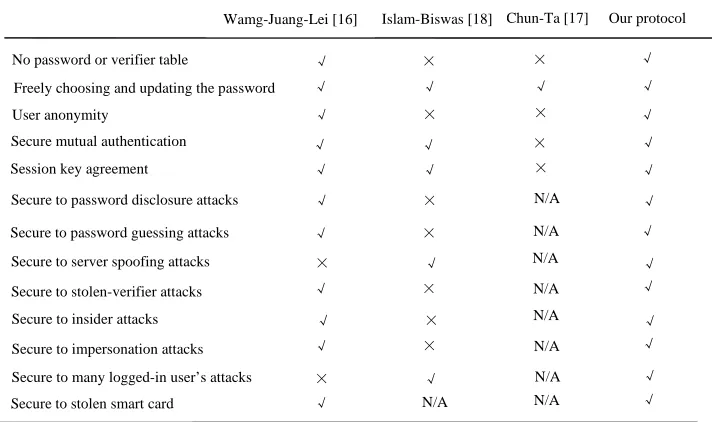
As shown in Table 2, compared with [17] and [18], our proposed protocol can provide more unique
features such as user anonymity and no password or verifier table. These new features are very important in implementing a practical and universal authenticated key agreement. Moreover, Table 2
also shows that the proposed protocol is more robust and secure than other related protocols. In the proposed protocol, since the server does not need to store any password table, the adversary cannot
protected by hash function, symmetric encryption technique and elliptic curve discrete logarithm problem, so the adversary cannot guess the client’s real identity correctly. In addition, the proposed
protocol is secure against other attacks mentioned in Section 5, such as the password disclosure attack, the insider attack, the impersonation attack, the many logged-in users’ attack, the stolen smartcard
attack, et al.
Table 2. Security and functionality comparisons between our protocol and other protocols
Next, we discuss the computational costs of the proposed protocol in each phase. In the registration
phase, one hash operations is required to compute (h PWr)on the client side, and one symmetric
key encryption operation is needed to obtain R on the server side. In the authentication phase, the client
takes two scalar multiplication operations of elliptic curve to compute
1
( )
Vh PWIDr r PandW h PW( IDr r P)1 pub; one symmetric key encryption operations to
compute Z; one symmetric key decryption operation to decrypt X; and five one-way hash function
operations to computeh h PW( ( r) ID), h PW( IDr), SK, Authu and Auths. The server takes
one scalar multiplication operation of elliptic curve and one modular inversion operation to get V*; one
symmetric key encryption operations to compute X; two symmetric key decryption operation to decrypt
Z and R; and four one-way hash function operations to computeh h PW( ( r) ID), SK, Authu and
Auths. In the password changing phase, the client takes three one-way hash function operations to
compute h PW( *r*), ( (h h PW*r*) ID N) and h N( 1R*) ; one symmetric key encryption
operation and one symmetric key decryption operation. The server takes two one-way hash function
Chun-Ta [17]
No password or verifier table
Freely choosing and updating the password
×
Session key agreement
Secure to server spoofing attacks
Secure to password guessing attacks N/A
×
N/A
User anonymity ×
Wamg-Juang-Lei [16]
√
√
√ √
×
√ √
Our protocol
√
√ √
√
Islam-Biswas [18]
×
√
× √
√ ×
Secure mutual authentication √ √ × √
√ √
√
Secure to stolen-verifier attacks × N/A √
Secure to password disclosure attacks √ × N/A √
Secure to insider attacks √ × N/A √
√
Secure to impersonation attacks × N/A √
Secure to many logged-in user’s attacks × √ N/A √
operations to computeh h PW( ( *r*) ID N) and *
( 1 )
h N R ; and one symmetric key decryption
operation and two symmetric key encryption operation.
For the convenience of evaluating the computational cost, some notations are defined as follows: (1)Tb : is the time for executing a bilinear map operation;
(2) Tm : is the time for executing a scalar multiplication operation of elliptic curve; (3) Ta : is the time for executing a point addition operation of elliptic curve;
(4) Th : is the time for executing a one-way hash function; (5) Tinv : is the time for executing a modular inversion operation;
(6) Te : is the time for executing a symmetric key encryption operation; (7) Td : is the time for executing a symmetric key decryption operation.
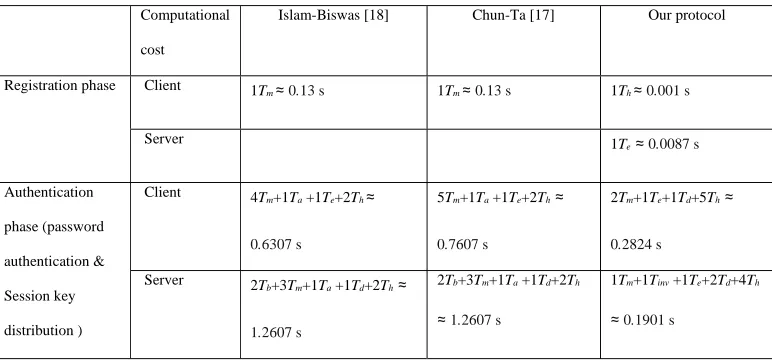
Experimental results [21–23] show that the time for executing a symmetric key encryption/decryption operation Te/Td, a bilinear pairing operation Tb, and a scalar multiplication operation of elliptic curve Tm are 0.0087, 0.38 and 0.13 s respectively. And the time for performing a point addition operation of
elliptic curve Ta, a modular inversion operation Tv, and a hash function operation Th are less than 0.1, 0.03, and 0.001 s respectively. According to Table 3, the total required computational time of
Islam-Biswas’s protocol, Chun-Ta’s protocol, and our protocol are 1.3624, 1.5224 and 0.3038 s at the client side respectively, and 2.4924, 2.3924 and 0.2269 s at the server side respectively. Close analysis of the
data in Table 3, shows that our proposed protocol is more efficient than Islam-Biswas’s protocol [18] and Chun-Ta’s protocol [17], because it eliminates the expansive operation bilinear pairing operations
and reduces the numbers of the operations of scalar multiplication of elliptic curve. Table 3. Computational comparisons between our protocol and others
Computational
cost
Islam-Biswas [18] Chun-Ta [17] Our protocol
Registration phase Client 1T
m ≈ 0.13 s 1Tm ≈ 0.13 s 1Th ≈ 0.001 s
Server 1T
e ≈ 0.0087 s
Authentication
phase (password
authentication &
Session key
distribution )
Client 4T
m+1Ta +1Te+2Th ≈
0.6307 s
5Tm+1Ta +1Te+2Th ≈
0.7607 s
2Tm+1Te+1Td+5Th ≈
0.2824 s
Server 2T
b+3Tm+1Ta +1Td+2Th ≈
1.2607 s
2Tb+3Tm+1Ta +1Td+2Th
≈ 1.2607 s
1Tm+1Tinv +1Te+2Td+4Th
Password
changing phase
Client 3Tm+2Ta +1Te+3Th ≈
0.6017 s
4Tm+1Ta +1Te+3Th ≈
0.6317 s
1Te+1Td+3Th ≈
0.0204 s
Server 2Tb+2Tm+2Ta +1Td+3Th ≈
1.2317 s
2Tb+2Tm+1Ta +1Td+3Th
≈ 1.1317 s
2Te+1Td+2Th ≈
0.0281 s
Overall Client 8Tm+3Ta +2Te+5Th ≈
1.3624 s
10Tm+2Ta +2Te+5Th ≈
1.5224 s
2Tm+2Te+2Td+9Th ≈
0.3038 s
Server 4Tb+5Tm+3Ta +2Td+5Th ≈
2.4924 s
4Tb+5Tm+2Ta +2Td+5Th
≈2.3924 s
1Tm+1Tinv +4Te+3Td+6Th
≈ 0.2269 s
From above discussion, we can conclude that our proposed protocol not only satisfies all the criteria
required by mutual authentication and key agreement protocol, but also reduces the computational cost to an extent.
7. CONCULSION
In this paper, we have found that Chun-Ta Li’s protocol cannot provide mutual authentication between the client and the server, and then we have proposed a robust and efficient authentication protocol
based on elliptic curve cryptography by using the password and the smart card. The proposed protocol satisfies all the criteria aforementioned which are very important for mutual authentication and key
agreement by using the password and the smart card. The security analysis has proved the proposed protocol can resist all possible attacks, and the performance analysis has shown that our protocol
achieves better performance that other related protocols. So the proposed protocol is more suitable for practical application.
ACKNOWLEDGMENT
This work was supported by the National Natural Science Foundation of China (Grant Numbers 61303237, 61272469, 61075063), the Fundamental Research Funds for the Central Universities (Grant