A Novel ICT Tool For Interactive Learning For
Electronics Engineering Based On Augmented
Reality
Dr. Gayatri Phade, Krishna Goverdhane, Omkar S. Vaidya, Dr. Sanjay Gandhe
Abstract— According to survey of India today, the present engineering education system, is now concluded to be insufficient to fulfil the current industrial market requirements. It is due to lack of required skill sets in the students. Talking about some engineering students, initially they anticipates some courses are difficult courses as an example, Electronics Engineering. Thus teaching such subjects becomes quite a challenging task for the teacher. Effective teaching learning of an engineering education mainly depends on theoretical and practical knowledge. As an example, Electronics Engineering includes logical and conceptual subjects in which things are to be imagined and visualized. Classroom teaching is provided through real papers, or books with additional web links, videos, or presentations, or static 3D model, simulations software helps up to some extent. Still there is need to develop some ICT based tools for conceptual understanding of the subject. Augmented Reality (AR) is one of the platforms to develop an ICT based tools. AR provides integration of both real and virtual world. Proposed system is developed using AR with which it is possible to find solutions to both the theoretical as well as practical approach by embossing the 4D images in the real world that include sound. Since high-end AR applications could be used on smart phones, Tablet PC’s etc., updated knowledge regarding the subjects can be easily made available for the students to understand the concept. This paper explores design and development of a novel and interactive ICT tool using AR. It include concept of AR Labs and AR classroom for engineering students. With this, AR Classroom which are virtual class room, will be available in student’s smart phone in the form of Mobile Application and AR Labs for lab experimentation will also be there whose output can be seen on Desktop or projector too.
Index Terms —Augmented Reality (AR), AR classrooms AR Labs, 3D models, homography, Pose estimation, CT tool
.
————————————————————
1
I
NTRODUCTIONPRESENTLY a big number of engineering students getting passed out yearly, but yet there is shortage of skilled employees in the market [1]. Major reason behind current engineering students lacking in potential of getting appropriate jobs in respective core field, is lack of upgraded theoretical knowledge and practical skills with methods of thinking. There is need of technology that can bridge the gap between industrial requirement and engineering schools to provide skilful employees [2]. Engineering is different from other pure sciences because of its applicable viewpoint. Engineering serves mankind by designing and creating new products for the service and welfare of humans. It is possible only after training engineering students with sufficient theoretical and adequate practical knowledge, along with experimental work during study years at universities. Practical experiments make science mortal because of two reasons; first, they supply students with better understanding of theories, Secondly labs symbolize heart and soul of Engineering. Education system includes teaching as a proportionate challenge since students consider some courses as most difficult courses. It has truly being known that labs present a well-established basis for future employment. As of most of future works of engineering students will be in practical fields, which demands from them more time and efforts in practicing the concepts and skill set required. After graduation, they will not only depend on their theories acquired during their study at the university, but also on their practical knowledge they acquired by engineering labs. It has been observed that students are lacking in practical industrial knowledge. Unfortunately, it is seen that practical’s sessions are available only for a limited time, that too for huge number of students. Also students are needed to remain updated with current technologies and inventions related to their respective
1887
includes Literature survey where students were asked about the difficult concepts and problems they face while understanding them. Section 4 presents the proposed architecture of the system of both AR classrooms and AR labs. Section 5 is having introduction to system components. Section 6 has the workflow of the system that it includes Section 7 introduces about the experimental setup that is required to present the interface that will be provided for the output.
2
A
NO
VERVIEW OFA
UGMENTEDR
EALITYThe word ―augmented‖ is originated from augment, which directly means to add or enhance something. In the case of Augmented Reality (also called AR), effects like graphics, sounds, and touch feedback are added into our natural world to create an enhanced user experience. So augmented reality can be defined as ―An enhanced version of reality where live direct or indirect views of physical real-world environments are (imposed) augmented with superimposed virtual images in real world. If we consider human brains they are 3D in nature. Our brain is said to be a one of the most powerful 3D supercomputer in the world. It stores and processes data in 3D form. Our brains works and remember things in 3D form at its backend. All memory artists remember all things using this same 3D feature of our brain by placing thing or images in a room or along a street. Since years there was no such technology that would tap our 3D brain, but at present Augmented Reality is a technology that can clearly enhance new, effective and logical way of thinking and learning .Gaining knowledge would have never ever been so easy before. In this paper we are going to study various approaches of Augmented Reality in learning and developing productive skillsets towards Education in various field from pre-primary to higher education. Also paper includes a review of work done using Augmented Reality in Education along with applications, characteristics, advantages etc. As per a researcher named Thomas Caudell coined the term augmented reality in 1990, to describe how the head-mounted displays that electricians used when assembling complicated wiring harnesses worked. In 1998 the first commercial applications of AR technology was when the first down yellow line that began sometimes appearing in televised football games. Accordingly to definition stated by Azuma, in 1997.defines augmented reality as ―Augmented Reality is a technology that involves the seamless overlay of the computer generated (virtual images) on the real world, in such a way that the virtual content is aligned with real world objects, and can be viewed and interacted with in real time[1]. AR also includes characteristics as follows:
1. existence of virtual elements in real world 2. highly Interactive with reality
3. Projecting virtual objects as per the reality along with senses, such as graphics, sounds etc.
All such characteristics are quite helpful contributes to interactive studies in the field of education [5]. Right now, augmented reality (AR) is one of the biggest technology trends, It is going to develop with accessible devices like smart phones, tablets, etc. Presently other devices of AR are quite costly, so the cheapest way of using AR Technology is
by using Smart phones. AR allows us to see the real-life environment right in front of them, surrounding with virtual images .Various researches are being working few decades ago on developing some innovative software and hardware for developing AR. Augmented reality is now reaching to mobile devices and now becoming reason for popularity in the education field. It is observed that, augmented reality technology will create a passive learning process which promotes critical thinking, meta cognition. Since augmented reality (AR) has been useful to have good potential in making the learning process more active, effective and meaningful [5] [6]. The reason behind this is its advanced technology that allows users to interact with virtual and real-time applications and brings the natural experiences to the students to learn. It has provide an alternative to traditional technology (such as e-learning) and traditional teaching methods (chalk and talk and traditional books).Initially hardware was an issue, but last few decades caused inventions of number of hardware as follows: Smartphones the first mobile devices to use AR. Tablets, such as Android based devices would definitely be use full. Another one with latest capabilities are Smart Glasses and AR Headsets such as Hololens and includes many more devices [6]. As to conclude, augmented reality (AR) research has matured to a level that its applications can now be found in both mobile and non-mobile devices and can be used for studying purpose. Let us have an overview of various surveys being done for augmented reality in Education.
3
LITERATURE SURVEYreal and virtual objects using AR ,but it require continuous internet connections[8]. In year 2014 an attempt was made to understanding about transistor in the electrical and electronic subject using similar technology but includes only problem based learning. Another paper in 2018 includes the efforts those are been made to fill the gap of design concepts in the field of preparation and accompanying tools for laboratory work, using AR Technology. Also enhance practical training skills of the students using AR [9]. For present project requirement a survey was needed to find out what were the difficult concepts that are to be required. For survey purpose to visit engineering and diploma students and meet their Electronics staffs so as to obtain list of difficult concepts and topics for practical’s that should be required to be implemented. Nearly 10 -15 Students from first to last year were surveyed belonging to all category of students. By forming a group of 2 or 3 from each year were provided with list of questions about difficult concepts that were faced. Also about what types of practical session would be required to be repeated or are difficult to understand or are to be implemented in the colleges, such types of questions were been asked. Also challenges faced by Electronics staff while teaching were asked and observed. Problems like drawing diagrams, getting points cleared quickly through teaching etc. were difficult. Even though multimedia ways like videos, links, some models etc. are available still , just by explaining and making students to imaging and think logically up to that level and make them imagine was difficult for all students. Survey was concluded by selecting few of the topics for practical attempts such as to identify components, circuits boards, and to make available models of updated devices (e.g. new updated PLC model) for learning functions connections etc. Up to end the of year 2018, near about Fifty-five studies were reported in 42 papers for AR in Educational application area .It was expected that all studies reported some kind of teaching and learning applications, with a few related to same areas, such as music training, educational games, and teaching body movements also including studies of applications related to Physically disabled people. Different types of hardware were used, Out of 55 studies, 24 used handheld displays,8 used HMDs, 16 used some form of desktop displays and 11 used spatial or large-scale displays. One study had augmented only sound feedback and used a head-mounted speaker Again, a trend of using handheld displays is prominent in this application area as well. Let us have an overview of various surveys being done for Augmented reality in Education.Few survey results are as follows in given table [10][11][12]. The display devices used are as S/LS spatial or large-scale displays S/LS are having much more flexible display just as projector screen. HH handheld are flexible devices like mobile smartphones, tablets also range of devices includes HMD i.e. head mounted devices e.g. Google hololens. Also DT are desktop devices can be used for lab or training purpose.
TABLE1
SURVEY OF AR IN EDUCATION AND HARDWARE’S USED
Reference Topic Display used
Dependent measures
No of Students
Anderson & Bischof, 2014
Training,
Learning DT
IMI Score, Isolation,Muscl
e control
12
Arvanitis et
al., 2009 Learning HMD
Rating, Physiological
measures
5
Asai et al., 2005
AR
Instructions HMD HH Rating 22 Chang et al.,
2013 Training S/LS
Error/Accur acy, Rating 3
Chiang et
al., 2014 Education HH
Learning
outcomes 57
Cocciolo and Rabina,
Learning,
Tourism S/HH
Interview
response 34
Fonseca et
al., 2014b Education HH
Rating, Learning test
scores
48
3.1 Market Survey
Recently there are number of fields in which AR technology is been used commercially for example having kids educational books related where interactive AR models are been rendered resulting in to interactive learning’s similarly number of other applications are been developed [14][17][18]. As to conclude, augmented reality (AR) research has matured to a level that its applications can now be found in both mobile and non-mobile devices and can be used for studying purpose.
4
PROPOSED
ARCHITECTURE
1889
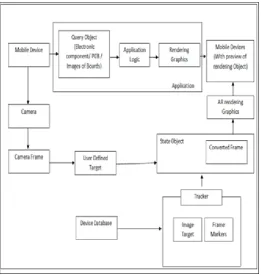
of great deal of available information and knowledge, that too at right place and right time is necessary, we deal with available information knowledge, adopting and applying information at right time. Augmented Reality (AR) is one technology that dramatically shifts the location and timing of education and training AR provides a realistic approach, concepts that are difficult are identified by students are consider. Our system consists of AR Technology by using two ways with concepts as AR classroom that can be used anywhere and anytime an app through which student can learn and understand practical knowledge about circuits with more proper and interactive approach. While other include concept of AR Labs that can be used in practical’s slots in schools and colleges for learning. For personal classrooms (using AR application) for students to start their study at anytime and anywhere. Smartphone’s Tablets etc. are used as hardware through which they can scan and model virtual images in real world for practical experience. Students just need to download applications in their phones to access and explore AR experience. Mobile application includes detecting target based image using camera convert respective frames of 3D model picked from database that is matched. Parallel to this continuous video tracking is done after frames conversion rendering 3D model is been projected on screen. For processing image and background process of tracking is been done by smart phones processor thus we can obtain rendering 3D model or rendering image is modeled base.
Fig 1. Block Diagram of the proposed system for AR Classroom
Fig 2. Block Diagram of the proposed system for AR Laboratory
With AR lab we are using Simple AR model through which students can easily determine the type of electronic components or elements, various types of boards, when placed in front of AR Camera. Along with the electronic components or elements, various types of boards identifications detailed information regarding components such as specifications, various INPUT/OUTPUT connections, operations of boards in various modes as per requirement are been displayed Even boards are been displayed in form of 3D Models for easy understanding features for students. Thus just by analyzing the views of 3D models students can easily understand the difficult concepts in easily manner so that can be easy to understand. For AR lab same concept of parallel tracking and frames conversion is been use same as for AR application. Here processing work is done by raspberry pi processor with coding done using opencv and python and HD camera /webcam is used to provide continuous tracking and for targeting image
5
SYSTEM
COMPONENTS
In system components for personal AR classroom we need any simple Smartphone, tablet etc. to process and provide required output on its screen.
5.1 Smartphone
Smartphone with android OS having capable camera embedded with it, to get real time video stream , with a processor to process the further steps of feature extraction, feature matching, homography , pose estimation (for this we need accelerometer, gyro meter etc. and other sensors values to calculate distance and angular values) , with any type of display screen. We have selected an android phone having all above features. For AR labs in schools and colleges we need to have a well-equipped components like camera, processor (we have raspberry pi b+ 3 model) and a TFT screen or any display screen.
5.2 Camera
Module includes Logitech webcam is used .Webcam with high megapixel capacity or a raspberry pi camera be sufficient to process and stream videos further to the processor. Web cam is preferred since it has high resolution capacity while raspy cam is sufficient though it won’t provide required resolution but it does not need to code the device it as being compatible with raspberry pi processor.
5.3 Processor
compatible. It is able to process multiple complex code and supports
5.4 Raspberry pi TFT screen
For a display module to get output, a TFT screen of (7‖ x 4‖) or projector or PC Screen a or Raspberry Pi Display Official - 7" Touch screen is sufficient to get the output on screen of rendering model and to provide explanatory outputs.
6 WORK FLOW OF SYSTEM
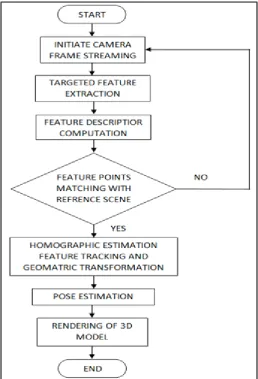
Our approach education using AR technology uses two approaches firstly for personal electronics classroom application and secondly for AR labs in colleges and schools for education. For personal classroom application we have developed an AR application using unity and Vuforia platform along with Android studio .While for AR electronics laboratory we are using raspberry pi as a processor for processing while a web cam to detect and track query objects. After detection homography process is to be followed using raspy. Also use TFT raspberry pi screen. For programming purpose Python and Open-c v are used. All the process for augmented reality includes following basic steps such as target Surface recognition, Homographic estimations, Pose estimations, model projections are been done and 3D models are projected. For AR classroom application all these steps such as Surface target detection, feature matching, homography and pose estimation are being done at backend of application. While processing for augmented reality are same for both AR classrooms and AR Labs. First we find the homographic matrix component that is required for with reference to z – plane. To calibrate our camera, S is homographic output pose estimated for camera calibration. These values are obtained by recovering and external camera calibration matrix and homography equation where S1 =r1, S2=r2, S3=t are reference coordinates of camera.
S = [S1 S2 S3] = D-1 H (1) Matrix for Camera calibration
First the query image is being captured. First step is target Surface recognition that includes three sub steps as feature detection or extraction, feature description and feature matching. The surface is detected, for along with its unique and other conditions such as orientations, lighting conditions etc. are been considered. For feature extraction special features of respective object/images are been extracted and stored for further reference in database. Now after obtaining the homographic equation only need is to project 3D model in a proper coordinate system
Projected 3D Matrix = D [R1' R21 R31 t] (2) Where D is camera calibration matrix (R1, R2) is trivial to get the value of R3 as the cross product of R1’and R2.
Fig 3: Workflow of Augmented reality
Thus the descriptors provide the required information representation accordingly to its feature and surrounding environment. Once the feature of the object and image in scene are computed, both scene and images are matched with each other. After that feature matching code is implemented in feature matching Algorithm. By identifying the reference surface in the (present frame) current frame and have a set of valid matches we can further proceed to estimate the homography between both images. We have to obtain homography of the both the objects to finding out the transformation that maps points from the surface plane to the image plane. For this process we use RANSAC algorithm. We now have to project our 3D model in frame is, and extend our homography matrix. For pose estimation to project 3D models in the frame, we have to first find the terms related to it such as degree of freedom of pose of object and model with certain calibration parameters like focal length, principal point, and aspect ratio along with skew. After finding such parameters we can project a model accordingly to base surface as per requirement. Codes for all these are being done in python.
1891
7
EXPERIMENTAL
SETUP
AND
INTERFACING STEPS
As we have used two methods for education in Electronics using AR by implementing an personal AR classroom Mobile application any time anywhere that clears their theoretical concepts and AR Laboratory for students to clear their practical concepts. For mobile application we use Hardware any android phone.
Fig 4. Augmented reality to identify components
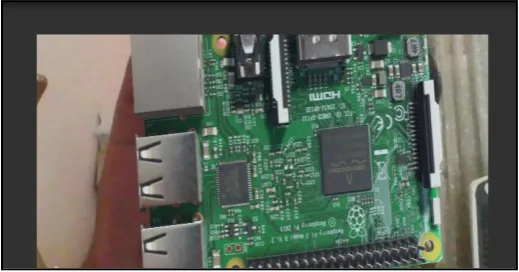
Fig 5. Augmented reality to identify circuit boards
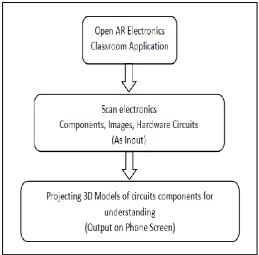
Software’s used are Android Studio for Building and editing application, Unity Platform for development and Vuforia SDK for models. The process includes just Open AR Electronics Classroom Application. We can easily scan
various Electronics Components, to know more Information & specifications about components. We can scan images from the textbooks to get information.
Fig 6. Augmented reality to Project 3D models
Fig 8. Real time rendering of 3D model on screen for mobile application
We can Scan Electronics circuits to know more information about the components, Subsystems e.g. types of connectors, identify components etc. Also we can scan image of circuits and get 3D models, specifications of circuits. The related steps are included in flow charts.
Fig 9 .Components identification using unity platform
For quantitative analysis we have implemented a calculated accuracy of the model used. We have considered three cases such as True positive (TP), True Negative (TN), False positive (FP), and False negative (FN).Where true positive case is when targeted images is detected and model is projected, False positive is when target image is absent still model is projected, True negative is when targeted image is present and still no model is projected, While false negative is when targeted image is absent and no model is projected. We tried total 70 attempt through which we obtain outputs as follows:
TABLE 2
QUANTITATIVE ANALYSIS ATTEMPTS
Output for TP TN FP FN Total Attempts
Components 42 18 6 4 70
Images
detection 47 20 2 1 70 Board
detection 38 26 4 2 70
GRAPH 1
QUANTITATIVE ANALYSIS FOR ARMODEL
Through these attempts certain parameters necessary for projection are been considered for each case of boards, images and components etc. We thus gets the accuracy of various parameters like Sensitivity, Specificity, Precision, True-Positive Rate, True-Positive Rate, True-Negative Rate, False-Negative Rate accuracy for images, circuit boards and components.
TABLE 3
QUANTITATIVE ANALYSIS PARAMETERS
8 CONCLUSION
Augmented reality technology is now a days creating a well-developed and passive learning process instead of regular critical thinking. Thus contributing to large extend in Educational field. By developing such a platform that can help students and teachers to easily understand the difficult concepts and get familiar with topics related to electronics engineering. Thus contributing for a proper hold on Theoretical and deepen their Practical knowledge and skills of respective subjects in electronics via getting trained through AR technology. Resulting into highly skilled and trained students that are industry ready and fulfil the needs and requirements accordingly to industrial revolution 4.0. And develop this technology further work wellbeing of mankind and future.
Parameters Formula
1893
R
EFERENCES[1] Miller MR, Jun H, Herrera F, Yu Villa J, Welch G, Bailenson JN
Social interaction in augmented reality. PLoS ONE 14(5): e0216290. May 14, 2019.
[2] RoopeRaisamo,IsmoRakkolainen,PäiviMajaranta,Katri Salminen
Jussi Rantala,Ahmed Farooq.Human Augmentation:past,present and future Science Direct,International Journal of Human-Computer 17 May 2019
[3] Doug A. Bowman,(17 April 2018)”A Systematic Review of 10 Years
of Augmented Reality Usability Studies: 2005 to 2014” Virginia Tech, United States systematic review Frontiers in Robotics and AI Volume 5 | Article 37, 1, April 2018.
[4] Lúcia Pombo and Margarida Morais Marques Marker-based
augmented reality application for mobile learning in an urban park: Steps to make it real under the EduPARK project Authors: URL: [email protected]; [email protected] ISSN No: 978-1-5386-0648-3/17, May 2017.
[5] R. T. Azuma, “The Most Important Challenge Facing Augmented
Reality,” Presence Teleoperators Virtual Environ., vol. 25, no. 3, pp. 234–238, Dec. 2016.
[6] Nor Saidin, Noor Abd Halim and Noraffandy Yahaya “A Review of
Research on Augmented Reality in Education: Advantages and Applications” Journals International Education Studies. Archives / Vol. 8, No. 13 May 2015
[7] Bacca, J., Baldiris, S., Fabregat, R., Graf, S., & Kinshuk. (2014). Augmented Reality Trends in Education: A Systematic Review of Research and Applications. Educational Technology & Society, 17 (4), 133–149.
[8] Pasc ildiko1, a, csokmai lehel,b , popentiu-vladicescu florin3,cand
tarca “Augmented Reality Used for Robot Remote Control in Educational Laboratories”. ISSN: 1662-7482, Vol. 658, pp 6726doi:10.4.28/www.scientific.net/AMM.658.672 , Oct 2014.
[9] Ramlee mustapha,Zaharatul laili abdul rahim, Mohamed nor azhari
azman, “Exploring the problems faced by technical school students in learning engineering courses” Journal of Engineering Science and Technology Vol. 9, No. 6 690 – 70,Oct 2014,
[10] Kangdon Lee “Augmented Reality in Education and Training”
Volume 56, Number 2 TechTrends May 2012.
[11] Jorge Bacca1 Fabregat1, Sabine Graf2 and Kinshuk2 Silvia Baldiris1,
Ramon Augmented Reality Trends in Education: “A
SystematicReview of Research and Applications” September 2014.
[12] Wu, H.-K., & Hsu, Y.-S. “Integrating a mobile augmented reality
activity to contextualize student learning of a socioscientific issue.” British Journal of Educational Technology, 44(3), E95–E99. 10.1111/j.1467-8535.2012.01379 .May 2013
[13] https://economictimes.indiatimes.com › Jobs
[14] https://www.indiatoday.in/educationtoday
[15]
https://www.peoplematters.in/article/how-to-bridge-the-gap-between-academia-and-industry-
[16] https://www.dailydot.com/what-is-augmented- reality-ar/
[17] https://thinkmobiles.com/blog/what-is-augmented-reality/
[18] https://www.augmentedminds.com/en/ augmented
-reality/ar-hardware-devices/