Stable Neutralization of a Virulence Factor in Bacteria Using
Temperate Phage in the Mammalian Gut
Bryan B. Hsu,
a,b,cJeffrey C. Way,
bPamela A. Silver
a,baDepartment of Systems Biology, Harvard Medical School, Boston, Massachusetts, USA bWyss Institute for Biologically Inspired Engineering, Boston, Massachusetts, USA cDepartment of Biological Sciences, Virginia Tech, Blacksburg, Virginia, USA
ABSTRACT
Elimination or alteration of select members of the gut microbiota is key
to therapeutic efficacy. However, the complexity of these microbial inhabitants
makes it challenging to precisely target bacteria. Here, we deliver exogenous
genes to specific bacteria by genomic integration of temperate phage for
long-lasting modification. As a real-world therapeutic test, we engineered
phage to
transcriptionally repress Shiga toxin by using genetic hybrids between
and other
lambdoid phages to overcome resistance encoded by the virulence-expressing
pro-phage. We show that a single dose of engineered phage propagates throughout the
bacterial community and reduces Shiga toxin production in an enteric mouse model
of infection without markedly affecting bacterial concentrations. Our work reveals a
new framework for transferring functions to bacteria within their native
environ-ment.
IMPORTANCE
With the increasing frequency of antibiotic resistance, it is critical to
explore new therapeutic strategies for treating bacterial infections. Here, we use a
temperate phage, i.e., one that integrates itself into the bacterial genome, to
neu-tralize the expression of a virulence factor by modifying bacterial function at the
ge-netic level. We show that Shiga toxin production can be significantly reduced
in
vitro
and in the mammalian gut. Alternative to traditional applications of phage
therapy that rely on killing bacteria, our genetics-based antivirulence approach
intro-duces a new framework for treating bacterial infections.
KEYWORDS
Shiga toxin, bacteriophage, microbiome, antivirulence
T
he human gut microbiota is a collection of microbes colonizing the gastrointestinal
tract and has been associated with various aspects of human health (1). While this
community typically works in concert with our bodies, substantial perturbations such
as antibiotics or infections can disrupt the microbial balance and lead to long-lasting
dysbiosis (2). In some instances, pathogenic bacteria do so by transmitting virulence
factors to commensal bacteria through plasmid-based (3) and phage-based (4)
hori-zontal gene transfer (HGT). Remediating diseases associated with these pathogens
while minimizing unintended and disruptive effects on the surrounding microbiota
remains challenging (5), especially with the limited tools available for targeting
partic-ular species (6).
Our ability to manipulate the composition and function of the gut microbiota is
presently limited in terms of precision and durability (6). Antibiotics nonspecifically
decimate swaths of gut species (7), dietary changes affect both the overall microbiota
and the mammalian host, probiotics poorly engraft due to colonization resistance (8),
and even highly specific lytic phages can cause unintended changes in the bacterial
community despite targeting specific species (9). While in some cases these strategies
may show transient efficacy, the emergence of resistant mutants can impact
therapeu-CitationHsu BB, Way JC, Silver PA. 2020. Stable neutralization of a virulence factor in bacteria using temperate phage in the mammalian gut. mSystems 5:e00013-20.https://doi.org/10 .1128/mSystems.00013-20.
EditorJack A. Gilbert, University of California San Diego
Copyright© 2020 Hsu et al. This is an open-access article distributed under the terms of theCreative Commons Attribution 4.0 International license.
Address correspondence to Bryan B. Hsu, [email protected], or Pamela A. Silver, [email protected].
Received6 January 2020 Accepted6 January 2020 Published
Therapeutics and Prevention
28 January 2020
on September 8, 2020 by guest
http://msystems.asm.org/
tic effect. Broadly resetting the gut microbiota through fecal microbiota transplants
(FMTs) has been promising especially for treating
Clostridium difficile
infections (10), but
they are difficult to characterize and may transmit unintended traits such as obesity
(11).
An alternative strategy is to modify bacterial function within its native environment.
For example, one approach has been to develop drugs that target the virulence factors
of antibiotic-resistant pathogens to specifically neutralize their deleterious effects while
minimizing selection for resistance. Although a number of antivirulence drugs are
under investigation, the targets for inhibition are generally limited to those accessible
by small molecules and biologics (i.e., surface-bound and secreted proteins), may
require multiple drugs targeting multiple virulence factors, and could have off-target
effects on other microbes and the host (12). While the principle of antivirulence is
attractive, it remains challenging in application.
Shiga toxin (Stx)-producing
Escherichia coli
is one example of a pathogenic infection
that is challenging to treat. Antivirulence drugs targeting the toxin have been
investi-gated but failed clinical trials (13). Antibiotics are contraindicated because of their
potential to exacerbate virulence (14). While there are multiple virulence factors in the
foodborne pathogen enterohemorrhagic
E. coli
(EHEC), Stx is significantly associated
with disease severity (15) and can lead to hemolytic-uremic syndrome (16). Of the two
main Stx variants—Stx1 and Stx2—the latter is
⬃
1,000-fold more toxic (17). This
stx
gene carried by temperate phages is expressed when the phage undergoes lytic
replication. Similarly to a number of other prophage-encoded virulence factors (18), the
region in which the
stx
gene is located is not expressed while the phage is in a
lysogenic state, i.e., stably integrated into the bacterial genome. It is not until induction,
whether occurring spontaneously or from stimuli such as antibiotics, that the lytic life
cycle is activated to produce Stx2 (19) and progeny phage that can spread virulence
genes to commensal
E. coli
species (20).
Instead of an antimicrobial strategy for killing pathogens, a genetics-based
antiviru-lence strategy could neutralize viruantiviru-lence before expression and minimize resistance
until the bacteria have been completely shed from the gastrointestinal tract. Temperate
phages offer a solution as they are genetically engineerable and can integrate into the
bacterial chromosome as prophages for long-lasting effects conferring fitness
advan-tages on the bacterial host (21). Instead of relying on a nonnative constituent of the gut
that could face practical barriers for efficacy, temperate phages are abundantly found
in human gut bacteria (22–24) and can constitute large portions of the bacterial
chromosome (25).
Here, we report the use of a genetically engineered temperate phage to repress Stx
from an established
E. coli
population colonizing the mammalian gut. We first show
that genetic hybrids between lambdoid phages can overcome phage resistance
mech-anisms while maintaining function. We then genetically encode a transcriptional
re-pressor of Stx in our engineered phage and show that it substantially reduces Stx
produced by
E. coli
MG1655
in vitro. Finally, we demonstrate that our engineered
phage, when administered to mice precolonized by this
E. coli
strain, can propagate
throughout the murine gut from a single dose to significantly reduce fecal Stx
con-centrations. Our work describes a new therapeutic framework for the
in situ
modifica-tion of gut bacteria for genetics-based antivirulence.
RESULTS
Engineered temperate phage to repress a bacterial virulence factor in the gut.
Modifying bacterial function with species and genetic-level specificity requires a high
level of precision, especially within their natural ecosystem. While the complexity and
heterogeneity of the mammalian gut make it an especially challenging environment for
targeted modifications, phages have adapted with high bacterial host specificity,
making them an attractive therapeutic tool. As shown in Fig. 1A, we used phages not
to kill bacteria in the phage therapy approach but to modify a specific function of the
targeted bacteria within the mammalian gut. Because antibacterial approaches can
on September 8, 2020 by guest
http://msystems.asm.org/
enrich for resistance, we aimed to engineer temperate phages to deliver an
antiviru-lence payload that neutralizes viruantiviru-lence without relying on killing the bacteria.
Expression of Stx2 is dependent upon induction of the 933W prophage. To
dem-onstrate the viability of our proposed antivirulence approach, we aimed to neutralize
the production of Stx2 from the 933W prophage, which is one of a number of
Stx2-producing prophages derived from enterohemorrhagic
E. coli
strains. As
schemat-ically depicted in Fig. 1B, panel i, the 933W prophage in
E. coli
(E. coli
933W) maintains a
dormant state by expression of its repressor protein, cI, which blocks expression of
cro
and consequently lytic genes including
stx2. Induction, which occurs spontaneously
and by stimuli such as antibiotics, causes activation of the bacterial SOS response and
RecA-mediated degradation of cI (26) (Fig. 1B, panel ii). This ultimately leads to
expression of the lytic genes that produce phage progeny and Stx2. As the
phage-encoded repressor for the 933W prophage, cI, is key to blocking lytic induction and
maintaining the dormant lysogenic state (27), we engineered a second exogenous
temperate phage to constitutively express a nondegradable mutant of this repressor
(933W·cI
ind-) that contains a Lys178Asn mutation (27). By maintaining repression despite
induction, this neutralizes production of progeny phage and Stx2 (Fig. 1B, panel iii).
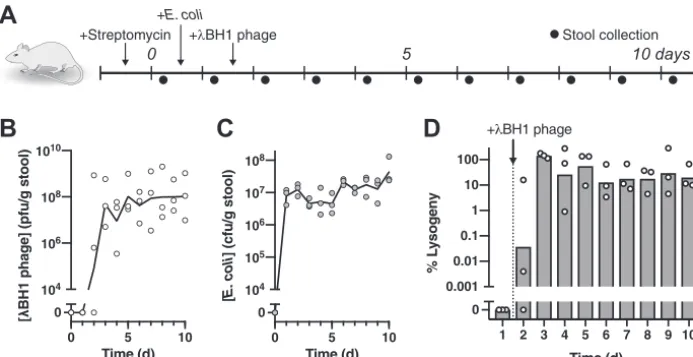
To illustrate the feasibility of using a temperate phage, we show that bacteriophage
transduces a substantial fraction of targeted bacteria in the mammalian gut. As
shown in Fig. 2A, we used a streptomycin-treated mouse model to quantitate
temper-ate phage lysogeny on
E. coli
colonizing the mammalian gastrointestinal tract. One day
after colonization with
E. coli
MG1655, we introduced
BH1 phage by oral gavage and
B
A
i) Lysogenic endogenous prophage
cI cro stx2
cI
expression
Induction
Lysogeny by anti-virulence
phage
cI cro stx2
sustained expression 933W cI
ind-anti-virulence prophage non-degradable
cI
ind-iii) Enforced lysogeny of endogenous prophage; stx2 repression
cI cro stx2
Cro
expression
degraded cI Stx2
ii) Stx2 production
E. coli 933W
Gut bacteria expressing a virulence factor
Induction
Oral anti-virulence
phage
In situ repression of the virulence factor
FIG 1 Neutralizing Stx2 production fromE. coliusing an engineered temperate phage. (A) As an alternative to bacteriolytic strategies that aim to block pathogenesis by killing bacteria, we propose an alternative approach that aims to reduce expression of the virulence factor. We do so by introducing a phage to lysogenize the targeted bacteria within the mammalian gut and to express a transcriptional repressor of the virulence factor. (B) (i) Genetic schemes ofE. coli933W
showing the 933W prophage expressingcIto maintain a lysogenic state in whichstx2is not expressed and (ii) induction that causes degradation of the cI protein leading to expression of the lytic genes includingcroandstx2. (iii) This leads to cell lysis, releasing phage progeny and Stx2 protein. Expression of a nondegradablecIfor the 933W prophage,933W·cIind-, from a genomically integrated engineered temperate phage (antivirulence prophage) can force the 933W prophage to remain lysogenic despite induction and degradation of endogenous cI protein.
on September 8, 2020 by guest
http://msystems.asm.org/
collected daily stool samples for analysis of bacterial and phage titers. We constructed
BH1 from
phage by inserting an antibiotic resistance cassette for quantification of
lysogens. After oral administration of
BH1 phage, we found that fecal phage levels
reached equilibrium approximately 2 days later and persisted at substantial
concen-trations (
⬎
10
6PFU/g stool) for the duration of the experiment (Fig. 2B). As phage in the
absence of its cognate bacterial host is undetectable in the stool of mice
⬃
2 days after
administration (28), our results indicate that
BH1 phage is capable of continuous
replication in the gut, enabling its expansion throughout the bacterial population from
a single dose. Furthermore, introduction of
BH1 phage did not significantly alter fecal
E. coli
concentrations (Fig. 2C), which is in sharp contrast to lytic phages that can cause
substantial reduction (9). The maintenance of high levels of phage indicates sustainable
phage production, likely from a subpopulation of bacteria undergoing spontaneous
induction
in vivo. With one bacterium capable of producing hundreds of wild-type
phage
in vitro
(29), it is possible that only a fraction of bacteria needs to undergo
induction. Using antibiotic selection, we quantified the number of fecal
E. coli
bacteria
harboring the
BH1 prophage and found that a substantial fraction (
⬃
17% to 30%)
remained lysogenized by days 7 to 10 (Fig. 2D). Overall, these results indicate that the
temperate phage
is capable of widespread modification of its cognate bacteria in
the gut.
Phage hybridization overcomes superinfection exclusion.
As gut bacteria harbor
numerous prophages including those encoding virulence (30), overcoming
superinfec-tion exclusion mechanisms is crucial for achieving efficacious
in situ
transduction. In the
foodborne pathogen EHEC, the lambdoid prophage 933W both produces Stx2 and
inhibits phage superinfection by other lambdoid phages (31).
E. coli
933Wexcludes
phage infection, but genetic hybrids of
with other lambdoid
phages restore infectivity. As shown schematically in Fig. 3A, the 933W prophage
inhibits infection from
phage by recognition of its immunity region, i.e., indispensable
genes responsible for the lysis-lysogeny decision in the phage life cycle. Because
lambdoid phages have similarities in genetic function and organization despite
dissim-ilar sequences, it is feasible to replace the
immunity region with orthologous
immunity regions from other lambdoid phages to overcome the superinfection
exclu-sion (32). We found that the efficiency of plating (EOP) of
phage against
E. coli
933Wwas
⬃
10
6-fold lower than against the nonlysogen (Fig. 3B), confirming its
superinfec-tion exclusion. We verified that this effect is not due to a cI-based immunity (see Fig. S1
in the supplemental material). We then tested the EOP for genetic hybrids of
phage
B
D
A
0 5 10 days
+Streptomycin
+E. coli
+OBH1 phage Stool collection
0 5 10
0 104 105 106 107 108
Time (d)
[
E. coli
] (cfu/g stool)
0 5 10
0 104 106 108 1010
Time (d)
[
BH1 phage] (pfu/g stool)
C
1 2 3 4 5 6 7 8 9 10
0 0.001 0.01 0.1 1 10 100
Time (d)
% L
ysogeny
+ BH1 phage
FIG 2 Temperate phage robustly transducesE. colicolonizing the mouse gut. (A) Experimental timeline examining the impact ofBH1 phage on precolonizedE. coliin mice. (B) Fecal concentrations of freeBH1 phage and (C)E. coli. (D) Percentage of fecalE. colilysogenized byBH1. Symbols represent distinct samples from individual mice (n⫽3) with lines or bars representing the geometric mean.
on September 8, 2020 by guest
http://msystems.asm.org/
in which the
immunity region is swapped with that of other lambdoid phages (e.g.,
21, 434, and P22) (Fig. S2 and Table S3). As shown in Fig. 3B, these hybrid phages had
substantially improved EOPs against
E. coli
933Wwith 6.0% for
imm21 and 6.7% for
imm434 phages. Moreover, hybridization with the
Salmonella
phage P22 resulted in
near-complete recovery of EOP to 78% for
immP22dis phage, indicating that lambdoid
phages from noncognate bacterial hosts could be a reservoir for genetic orthologs that
maintain phage function while circumventing superinfection exclusion mechanisms.
Efficient gene transduction enables the delivery of antivirulence genes. We inserted
genes for
933W·cI
ind-(to repress
stx2
expression) (Fig. 1B) and a kanamycin resistance
cassette (to quantitate lysogeny) into the nonessential
b2 region of
(26), producing
BH1 (Fig. 3C and Fig. S3). We confirmed that
933W·cI
ind-expressed from
BH1 was
functional (Fig. S4). To overcome superinfection exclusion from the 933W prophage, we
utilized a P22 immunity region instead of a
immunity region. A phage cross between
BH1 and
immP22dis resulted in the replacement of
⬃
6 kb of the immunity region of
BH1 with an
⬃
5-kb portion of that from
immP22dis while retaining
933W·cI
ind-and
Kan
rgenes (Fig. 3C, Fig. S3, and Table S3). This new phage,
BH2, showed improved
EOP to 90% (Fig. 3C) and demonstrated a functional loss of
immunity and gain of P22
immunity, as well as expression of functional
933W·cI
ind-(Fig. S4).
KanR 933W cI ind- O immunity
KanR 933W cI ind- P22 immunity
-7 -6 -5 -4 -3 -2 -1 0 Log10(Efficiency of Plating)
OBH1 phage
OBH2 phage
B
A
Oimm933W phage immunity region
O phage
Oimm21
phage
Oimm434 phage
OimmP22dis
phage 933W
immunity
21 immunity
434 immunity
P22 immunity
-7 -6 -5 -4 -3 -2 -1 0 Log10(Efficiency of Plating)
Not Determined
Phage is
excluded
Phage
infects cell
O phage
933W prophage
O immunity region
hybrid phage
E. coli 933W
lambdoid immunity region
X
Hybr
id Phages
C
non-essential b2 region
O immunity
FIG 3 Hybridphages overcome superinfection exclusion by prophage 933W. (A) Depiction of superinfection exclusion by the 933W prophage that inhibits infection byphage but is ineffective against a hybrid phage that contains the immunity region from another lambdoid phage in aphage background. (B) Schematic representation of a portion of thephage genome containing theimmunity region and its hybrids containing immunity regions from other lambdoid phages (933W, 21, 434, and P22) in aphage background. Efficiencies of plating (EOPs) forphage and its hybrids onE. coli933Ware shown
to the right. (C) Schematic representation ofBH1 phage, which is aphage with a kanamycin resistance cassette (Kanr) and
933W·cIind-inserted into the nonessentialb2 region of the phage genome.BH2 phage is a product of a phage cross between
BH1 andimmP22dis resulting in a phage containing Kanrand933W·cIind-genes with a P22 immunity region in aphage background. Their respective EOPs againstE. coli933Ware shown to the right. Symbols represent biological replicates with bars
representing the geometric mean.
on September 8, 2020 by guest
http://msystems.asm.org/
Antivirulence phage inhibits Stx2 production
in vitro
.
Transcriptional repression
delivered by
BH2 phage neutralizes Stx2 production. As outlined in Fig. 4A, we tested
the efficacy of
BH2 phage to inhibit Stx2 production from
E. coli
933Wby mixing them
at equal concentrations (multiplicity of infection [MOI] of
⬃
1) and culturing for 8 h. We
found significantly less Stx2 produced in
E. coli
933Wcultures treated with
BH2 phage
than in those untreated (“buffer”) or treated with
immP22dis phage, the parental
phage of
BH2 that is capable of infecting
E. coli
933Wbut lacks the
933W·cI
ind-gene
(Fig. 4B). Quantification of bacterial concentrations over time shows that
E. coli
933Wsteadily grows over 8 h in the absence of phage (“buffer”) whereas introduction of
immP22dis results in an initial drop in titer during the first 4 h followed by a recovery
(Fig. 4D, noninduced). For
BH2 phage, a similar drop in bacterial concentration was
F
G
H
B
A
933W prophage
933W CI
ind-D
E
C
Non-induced Induced
Non-induced Induced
n.d.
0 2 4 6 8
100 101 102
Time (h)
[Stx2] (ng/mL)
E. coli 933W E. coli 933W / BH1 E. coli 933W / BH2
0 2 4 6 8
100 101 102 103 104
Time (h)
[Stx2] (ng/mL)
Non-induced Induced
Buffer immP22dis BH2 Buffer immP22dis BH2 103
104 105 106 107 108 109 1010
[
E. coli
933W
] (cfu/mL)
0 hrs 2 hrs 4 hrs 6 hrs 8 hrs
Non-induced Induced
Buffer
imm
P22dis BH2
100 101 102
[Stx2] (ng/mL)
Buffer
imm
P22dis BH2
101 102 103 104
[Stx2] (ng/mL)
p = 0.0252
p < 0.0001
p = 0.0023
p = 0.0039 p = 0.0017
OBH2 phage
933W CI
ind-OBH1 or OBH2 prophage
933W prophage During phage infection and lysogeny
After established lysogeny
0 2 4 6 8 0 2 4 6 8 0.0001
0.001 0.01 0.1 1 10 100
Time (h)
B
H
2
ly
s
o
ge
ny
(%
)
FIG 4 Engineeredphage neutralizes Shiga toxin production fromE. coli933Win vitro. (A)E. coli933Wwas mixed
with buffer,immP22dis, orBH2 free phage (MOI of⬃1) att⫽0 from which the concentration of Stx2 was measured after 8 h ofin vitroculture under (B) noninduced and (C) induced conditions (0.5g/ml of mitomycin C). Significance was calculated by one-way ANOVA with thepost hocTukey test. (D) TotalE. coli933Wand (E) the
percentage of bacteria lysogenized byBH2 were measured over 8 h under noninduced and mitomycin C-induced conditions. (F)E. coli933Wlysogenized withBH1 orBH2 was culturedin vitroand analyzed for Stx2 produced
under (G) noninduced or (H) induced conditions. Symbols represent biological replicates with bars or lines representing the geometric mean.
on September 8, 2020 by guest
http://msystems.asm.org/
associated with increased lysogenic conversion of
E. coli
933Wthat reached 70% by 4 h,
indicating that both decreased bacterial titers and repressed
Stx2
expression may
contribute to the overall reduction of Stx2 concentration. To confirm that the latter
provides sustained antivirulence effect, we isolated
BH2 lysogens of
E. coli
933W, i.e.,
E.
coli
containing prophages of both 933W and
BH2 (Fig. 4F) and measured the Stx2
produced in culture. While an
E. coli
933Wculture accumulated 13.1 ng/ml of Stx2 over
8 h, no Stx2 was detected from
BH2 lysogens (Fig. 4G). Similarly,
BH1 lysogens did
not produce detectable concentrations of Stx2 despite their poor ability to initially
infect
E. coli
933W, confirming that once lysogenic conversion occurs, the resultant
lysogens do not produce Stx2.
Stx2 repression is maintained under inducing conditions. DNA-damaging agents
such as antibiotics can induce lambdoid prophages toward lysis by activating the
bacterial SOS response, leading to RecA-mediated degradation of cI (27). To test
whether
BH2 phage remains effective under these more aggressive lytic conditions,
we measured Stx2 produced in cultures of
BH2 phage mixed with
E. coli
933W(Fig. 4A)
in the presence of an inducing agent, mitomycin C. As shown in Fig. 4C,
E. coli
933Wreceiving buffer alone produces substantially more Stx2 when incubated with
mitomy-cin C due to induction of the 933W prophage. This induction also directs other phages
toward primarily lytic replication, and so the introduction of
immP22dis phage
significantly reduces
E. coli
933Wconcentrations (Fig. 4D, induced) and consequently
Stx2 concentrations (Fig. 4C). Ultimately,
BH2 phage treatment achieves significantly
lower Stx2 concentrations than those measured for buffer and
immP22dis phage
conditions (Fig. 4C) because it is capable of repressing
stx
2expression from a large
fraction of
E. coli
933Was shown by the substantial lysogenic conversion (Fig. 4E,
induced). Whether an established single lysogen or double lysogen, mitomycin C
induction led to lysis after 3 to 4 h (Fig. S5). To confirm that, once lysogeny is
established by
BH1 or
BH2 phage,
stx
2repression is maintained even during
induc-tion, we cultured
BH2 lysogens of
E. coli
933Wfor up to 8 h in the absence or presence
of mitomycin C (Fig. 4F). In the case of
BH2 lysogens of
E. coli
933W, we were unable to
detect the toxin, indicating that repression is maintained under both noninducing
(Fig. 4G) and inducing (Fig. 4H) conditions.
Antivirulence phage reduces Stx2 production
in vivo
.
BH2 reduces fecal Stx2
concentrations in mice. To determine if our phage-based antivirulence strategy is
effective
in vivo, we used a mouse model of enteric Stx2 intoxication from
Stx-producing
E. coli
(33). While it is challenging to model the effect of enteric pathogens,
including Stx-producing
E. coli, in mice (34), mitomycin C injections can induce
sub-stantial quantities of Stx that is otherwise too low to be detected in stool. Mice
precolonized by
E. coli
933Wwere orally treated with buffer,
immP22dis phage, or
BH2
phage and then received three doses of mitomycin C by intraperitoneal injection to
induce
stx
2expression (Fig. 5A). Daily fecal samples were collected for analysis of
bacterial and Stx2 concentrations. After mitomycin C injections, we quantified fecal
Stx2 and found that
BH2 phage treatment reduced fecal Stx2 titers compared to
buffer and
immP22dis phage treatment (Fig. 5B). Despite reduced fecal Stx2, all mice
began displaying morbidity issues after day 4 and inconsistently produced stool,
limiting the duration of the study. Although
BH2 phage did not completely repress
Stx2 production, these are highly inducing nonphysiological conditions with fecal Stx2
concentrations (
⬃
10
2to 10
3ng Stx2/g mouse stool) in excess of those encountered in
human Stx-producing
E. coli
infections (
⬃
2 to 50 ng Stx2/ml human stool) (35).
BH2 phage lysogenizes
E. coli
933Wand does not affect its titer in the murine gut.
Quantification of total fecal
E. coli
933Wgenerally did not reveal significantly different
concentrations between buffer-,
immP22dis phage-, and
BH2 phage-treated mice
(Fig. 5C). Notably, on day 4, mice receiving
immP22dis phage had significantly higher
fecal
E. coli
933Wconcentrations than those receiving
BH2 phage and approached
significance over buffer treatment (P
⫽
0.0521). This suggests a fitness benefit from
lysogeny with
immP22dis phage that is not encoded by the
BH2 phage, possibly in
on September 8, 2020 by guest
http://msystems.asm.org/
a region lost during generation of
BH2 phage by phage cross. Overall, maintenance of
high
E. coli
933Wconcentrations contrasts with our
in vitro
experiments where induction
substantially reduced bacterial concentrations (Fig. 4D) and is likely due to the
addi-tional
in vivo
complexities not present in liquid culture such as heterogeneity in
mitomycin C exposure and
E. coli
colonization, dietary and host factors, and influence
from the microbiota. Quantification of fecal
E. coli
933Wlysogenized by
BH2 (Fig. 5D)
showed that a substantial fraction of the population was transduced, with geometric
means between
⬃
0.9% and 2.6% and individual samples reaching as high as 71%.
Notably, there is a large spread in lysogeny between individual mice with daily means
lower than what we found in our previous experiment with
E. coli
lacking the 933W
prophage (Fig. 1D). Past work has shown that a high level of induction disfavors
lysogeny (36), and within the context of this study, our use of a mitomycin C mouse
0 1 2 3 4 days
-1
+Streptomycin +E. coli 933W Mitomycin C
+Phage (buffer,
OimmP22dis or OBH2)
A
B
C
D
Stool collection
E
Day 3 Day 4R2 = 0.568
p = 0.012
R2 = 0.716
p = 0.002
F
-4 -3 -2 -1 0 0
1 2 3 4 5
Log10[fraction lysogenic]
Log
10
[Stx2] (ng/g stool)
-4 -3 -2 -1 0 0
1 2 3 4 5
Log10[fraction lysogenic]
Log
10
[Stx2] (ng/g stool)
1 2 3 4
0 0.01 0.1 1 10 100
Time (d)
BH2 l
yso
gen
y
(%)
E. coli 933W
OBH2 phage
Day 0 Day 1 Day 2 Day 3 Day 4 0
105
107
109
[
E. coli
933W
] (cfu/g stool)
Buffer only immP22dis phage BH2 phage p = 0.0066
p = 0.0452
Buffer
imm
P22dis BH2 Buffer
imm
P22dis BH2 1
2 3 4
Log
10
[Stx2] (ng/g stool)
Day 3 Day 4
p = 0.0129 p < 0.0001
FIG 5 BH2 phage lysogenizesE. coli933Win the murine gut and reduces fecal Shiga toxin concentrations. (A)
Streptomycin-treated mice precolonized withE. coli933Wreceived one dose of 5⫻108PFU ofimmP22dis phage
orBH2 phage orally. Mitomycin C was administered three times at 3-h intervals by intraperitoneal injection to inducestx2expression in the gut. (B) Concentrations of fecal Stx2 after induction with mitomycin C. A one-way
ANOVA withpost hoc Tukey test was used to compare Stx2 levels between buffer,immP22dis, andBH2 conditions while a two-tailed Wilcoxon test was used to compare Stx2 levels afterBH2 phage treatment between days 3 and 4. (C) Concentrations of total fecalE. coli933Wwith significance calculated by two-way ANOVA withpost
hocTukey test and (D) percentage of fecalE. coli933Wfound to be lysogenized byBH2 phage. (E) Concentration
of fecal Stx2 as a function of fraction of fecalE. coli933Wlysogenic forBH2 phage on day 3 and (F) day 4. Solid and
dashed lines represent means and 95% confidence intervals of linear regression, respectively.Pvalue describes significance of slope being nonzero. Symbols represent individual mice for buffer (n⫽9),immP22dis (n⫽10), and BH2 (n⫽10) conditions. On days 3 and 4, oneimmP22dis phage-treated mouse and one buffer-treated mouse, respectively, were unable to produce stool for analysis. Bars or lines represent geometric means.
on September 8, 2020 by guest
http://msystems.asm.org/
model may underestimate the achievable degree of lysogeny in more typical,
less-inductive conditions such as those shown in Fig. 1.
Lysogeny by
BH2 phage reduces fecal concentrations of Stx2. Though treatment
with
BH2 phage shows a reduction in the average fecal Stx2 concentration between
treated and untreated groups, we aimed to confirm whether this reduction is indeed
associated with lysogenic conversion by
BH2 phage. By plotting the fecal
concentra-tion of Stx2 as a funcconcentra-tion of lysogeny by
BH2, we found that for both days 3 and 4
there is a significantly nonzero inverse correlation (Fig. 5E and F), confirming that
reduced fecal Stx2 is caused by the antivirulence effect from
BH2 phage.
DISCUSSION
Here, we demonstrate a genetic strategy for
in situ
antivirulence treatment of
bacteria colonizing the gut. We genetically engineer temperate phage
to express a
repressor that neutralizes Stx production in
E. coli
and take advantage of the genetic
mosaicism of lambdoid phages to create a hybrid phage that is capable of overcoming
phage resistance mechanisms. We found that our antivirulence phage not only
effi-ciently infects, lysogenizes, and inhibits Stx2 production from
E. coli in vitro
but is also
effective at propagating in the murine gut from a single dose to significantly reduce
Stx2 production
in vivo.
With the complexity and interconnectedness of microbes in the gut, perturbations
can have unexpected consequences. Modulating the impact of a bacterial species by
manipulating its concentration can lead to unintended effects mediated by
interbac-terial or bacterium-host interactions. While the typical strategy is to eliminate particular
bacteria, it is usually a specific function performed by the bacteria that is deleterious.
By precisely and robustly modifying this individual function, a therapeutic effect could
persist while minimizing disruption to the surrounding microbiota and avoiding the
selection for resistance. Here, we report a framework for making precise genetic
modifications that can be practically applied to bacteria within a complex biological
system such as the gut microbiome.
For treating pathogenic bacterial infections, disarming their pathogenicity by
tar-geting virulence factors provides a direct therapeutic strategy. Our work represents a
step forward; we demonstrate that expression of one such virulence factor,
stx2, by a
laboratory strain of
E. coli
can be significantly repressed in the murine gut, potentiating
its application toward clinically isolated pathogens. With the impending crisis of
antimicrobial-resistant infections, new strategies for combating pathogens are
desper-ately needed. Our work illustrates an approach by which bacteria can be specifically
modulated
in situ
with rationally designed function in an alternative manner, hopefully
inspiring new strategies for treating recalcitrant bacterial infections.
MATERIALS AND METHODS
Animal studies.Animal work was approved by the Harvard Medical School IACUC under protocol number 4966. Female BALB/c mice (Charles River Laboratories) 6 to 7 weeks old were acclimated for 1 week prior to experiments.
To study the effect of temperate phage on nonpathogenicE. coliin the mouse gut (Fig. 2), mice received 5 g/liter of streptomycin sulfate (Gold Bio) in their drinking water, which was replaced every 2 to 3 days. On day 0, 100l of streptomycin-resistantE. coliMG1655 was administered to mice by oral gavage. The bacterial gavage solution was prepared from an overnight culture in LB, washed twice with phosphate-buffered saline (PBS), and then diluted 100-fold into PBS, yielding⬃107CFU/ml. One day later
(day 1), mice received 100l ofBH1 phage which consisted of a 5⫻107-PFU/ml solution diluted 1:10
into 100 mM sodium bicarbonate immediately prior to gavage. Daily stool samples were collected for microbial quantification. To quantify fecal phage, fresh nonfrozen samples were gently suspended into 1 ml of phage buffer, incubated at 4°C for⬃10 min with a few drops of chloroform, and then pelleted at 4,000 rpm at 4°C. Phage concentration was determined using a double-agar overlay plaque assay (37) in which serially diluted phage solutions were incubated for 20 min at room temperature (RT) with a hardened overlay ofE. coliMG1655 in 0.3% agar in tryptone-NaCl-thiamine (TNT) medium over a 1.5% agar in TNT base. After aspiration, plates were incubated at 37°C overnight after which plaques were counted. To quantify fecalE. coli, frozen stool was thawed from⫺80°C and suspended into 1 ml of PBS by vortexing for 10 min at 4°C followed by low-speed centrifugation at 200 rpm for 20 min to settle fecal debris. The fecal suspension was then serially diluted into PBS, and 100l was plated onto MacConkey agar (Remel) plates supplemented with 100g/ml streptomycin sulfate to quantify total E. colior
on September 8, 2020 by guest
http://msystems.asm.org/
supplemented with 100g/ml streptomycin and 50g/ml kanamycin to quantifyBH1 lysogens ofE. coli.
To study the effect of the engineered temperate phage on Stx2-producingE. coli, mice were treated with similar conditions as described above with the following modifications. On day 0, mice received 100l of similarly prepared streptomycin-resistantE. coli933Win PBS by oral gavage. On day
1, mice received 100l of BH2 phage, which was a 5⫻1010-PFU/ml solution diluted 1:10 into
100 mM sodium bicarbonate immediately prior to gavage. On day 2, to induce Stx2 expression from engraftedE. coli, mice received three intraperitoneal injections of 0.25 mg/kg of body weight of mitomycin C at 3-h intervals (33). Stool samples were collected daily and stored at⫺80°C until analysis. FecalE. coliwas quantified by plating as described above, and fecal Stx2 was quantified from the same suspension of stool in PBS by mixing it 10:1 with 20 mg/ml of polymyxin B, incubating it at 37°C for⬃20 min, and then storing it at⫺20°C until analysis by enzyme-linked immunosorbent assay (ELISA) as described below.
Bacterial strains.Bacteria used in this study are listed in Table S1 in the supplemental material.E. coli933Wwas generated by a previously described method (38), in which 933W phage was produced from
the supernatant of a log-phase culture ofE. coliO157:H7 strain edl933 in modified LB medium (10 g/liter tryptone, 5 g/liter yeast extract, 5 mM sodium chloride, 10 mM calcium chloride, and 0.001% thiamine) and then stored at 4°C. Molten top agar containing 100l ofE. coliMG1655 and 3 ml of modified LB medium with 0.3% agar at 45°C was poured onto plates of modified LB agar and allowed to harden. Supernatants ofE. coliO157:H7 cultures were then spotted onto the top agar and incubated at 37°C overnight. Resulting plaques were picked and restreaked onto LB. Successful 933W lysogens ofE. coli were identified by screens for resistance toimm933W and the PCR amplification of thecI-to-croregion of 933W (fwd-AGCCACTCCCTTGCCTCG; rev-GCTTATTTCAAGCATTTCGCTTGC).E. colilysogens ofand imm933W were generated similarly using TNT medium instead of modified LB medium and screened for successful lysogeny by resistance toorimm933W, respectively, and ability to produce phage progeny.
Preparation of high-titer phage stocks.Phage was propagated via the double agar overlay method where 100l of serially diluted phage in phage buffer was mixed with 100l ofE. coliMG1655 for ⬃20 min at RT and then mixed with 3 ml of molten top agar (TNT medium with 0.3% top agar at 45°C) and poured onto prewarmed plates of TNT agar. After incubation overnight at 37°C, top agar from plates with the highest density of plaques was suspended into 5 ml of phage buffer and then gently rocked at 4°C for⬃2 h. Supernatants were sterile filtered to yield⬃109to 1010PFU/ml of phage. Phage stocks were
stored at 4°C.
Phage strains.Phage used in this study are listed in Table S2.BH1 phage was generated using the inherentred recombination system ofphage expressed during lytic replication. A crude phage lysate containing recombinant phage was produced by mixing 100l ofE. coliC600, containing a plasmid vector with Tn5-933W·cIind-flanked by 400-bp homology to ea59 and ea47 in a pJET1.2 backbone
(Table S3), with 100l of serially dilutedphage; incubated for 20 min at RT followed by addition of 3 ml of molten top agar (TNT medium with 0.3% top agar at 45°C); and poured onto TNT agar plates. After overnight incubation at 37°C, top agar from the plate with the greatest plaque density was resuspended into 5 ml of phage buffer (50 mM Tris, 100 mM sodium chloride, 10 mM magnesium sulfate, and 0.01% gelatin, pH 7.5), sterile filtered, and stored at 4°C. To isolate the recombinant phage, 50l of crude phage lysate was mixed with 50l ofE. coliC600 grown to log phase in LB and incubated for⬃3 h at 37°C. After incubation, 100l was plated onto LB containing 50g/ml of kanamycin and grown overnight at 37°C with individual colonies restreaked twice. To additionally purify them by plaque purification, colonies were grown overnight in LB and their sterile-filtered supernatants were spotted onto TNT top agar ofE. coliC600. Individual plaques were streaked onto LB containing 50g/ml of kanamycin and sequenced to confirm insertion in the correct locus ofphage.
BH2 phage was generated by a phage cross betweenBH1 phage andimmP22dis phage. Two hundred microliters of a log-phaseE. coliC600 culture (7⫻107CFU/ml) in T broth (1% tryptone and 0.5%
sodium chloride) with 0.4% maltose was mixed with a 200-l solution ofBH1 phage (1.5⫻108PFU/ml)
andimmP22dis (1.5⫻108PFU/ml) in phage buffer. After static incubation at 37°C for 20 min, this
mixture was diluted 100-fold into prewarmed T broth with 1% glucose and cultured with shaking at 37°C for 90 min. The culture was treated with drops of chloroform and pelleted, and then the supernatant was sterile filtered to produce a crude phage lysate. Residual chloroform was minimized by crossflowing air (Millipore Steriflip) at RT for 1 h. Ten milliliters of this phage lysate was mixed with 1 ml of mid-log culture of alysogen ofE. coliC600 grown in LB with 0.4% maltose, incubated at 37°C for 20 min. After⬃30-fold concentration by centrifugation, 200l was plated onto LB containing 50g/ml of kanamycin. Resulting colonies were restreaked twice and then tested for phage immunity by spot-testing 5l of phage against a top agar containing each candidate colony. Correctly engineered phages, as lysogens, were identified from colonies by susceptibility toimm434 (positive control) but resistance toimm933W (presence of 933W·cIind-gene) and resistance toimmP22dis (presence of P22 immunity region). Phage lysates were prepared by culturing colonies overnight in TNT medium, pelleting and sterile filtering the supernatant, and then incubating 100l of this phage mixture with 100l ofE. coliC600 (MOI of⬃0.1) at 37°C for 20 min and then plating it onto LB with 50g/ml of kanamycin. After overnight incubation at 37°C, phage was plaque purified by preparing phage lysates from individual colonies as described above and streaking 10l onto hardened top agar containingE. coliC600. After overnight incubation at 37°C, individual plaques were picked and restreaked onto LB with kanamycin. The resultantBH2 lysogen of E. coliwas confirmed susceptible toandimm434 as well as resistant toimm933W andimmP22dis
on September 8, 2020 by guest
http://msystems.asm.org/
(see Fig. S4 in the supplemental material). Sequencing confirmed the presence of the P22 immunity region and933W·cIind-gene (Fig. S3 and Table S3).
Quantifying phage and efficiency of plating. The infectivity of phage against E. coli was quantified by the double overlay agar method in whichE. coliMG1655 orE. coli933Wwas cultured
overnight in TNT medium, diluted 1:100 into fresh TNT medium, and cultured until mid-log phase of which 50l was mixed with 700l of molten top agar (TNT medium with 0.5% agar at 45°C) and poured into individual wells of a 6-well plate containing prepoured TNT medium with 1.5% agar. After hardening, 100l of phage serially diluted in phage buffer was added and incubated for 20 min at RT followed by aspiration. Plates were incubated at 37°C overnight and then examined for titers of PFU. Efficiency of plating was calculated as the titer of phage on theE. coli933Wdivided by
its titer on the nonlysogenicE. coli.
In vitroassay of phage effect.E. coli933Wwas cultured overnight in TNT medium at 37°C, and then
cells were washed once with fresh TNT medium and diluted to an optical density at 600 nm (OD600) of
0.1 (⬃8⫻107CFU/ml). Att⫽0, 5 ml ofE. colisuspension was mixed with 1 ml of 4⫻108PFU/ml ofBH2
orimmP22dis phage solution. To quantifyE. coliconcentrations in solution, aliquots were collected, serially diluted into PBS, and then spotted (10l) onto LB or LB with 50-g/ml kanamycin plates to quantify totalE. coliandBH2 lysogens, respectively. After 8 h, aliquots were mixed 10:1 with 20 mg/ml of polymyxin B, incubated at 37°C for⬃20 min, and stored at⫺20°C for quantification of Stx2 by ELISA. Stx2 concentrations in cultures ofE. coli933W, itsBH1 lysogen, or itsBH2 lysogen were prepared
similarly as described above, where overnight cultures were washed with fresh TNT medium and diluted to an OD600of 0.1. During incubation at 37°C, aliquots were collected, mixed with polymyxin B, and
stored at⫺20°C for quantification of Stx2 by ELISA.
In vitro assay of mitomycin C induction ofE. coli lysogens. Overnight cultures of E. coli (nonlysogen, 933W lysogen,BH2 lysogen, and 933W/BH2 double lysogen) in TNT medium at 37°C were diluted to an OD600of 0.1 in fresh TNT medium. The OD600of 100l of each sample in a 96-well
microtiter plate was then measured with shaking at 37°C continuously for 8 h (BioTek Synergy). ELISA quantification of Stx2.MaxiSorp plates (Thermo Scientific) were incubated with 100l/well of mouse monoclonal Stx2 antibody (Santa Cruz Biotechnology; sc-52727) diluted 1:2,500 into PBS for 1.5 h at RT. Plates were washed three times with PBST (PBS with 0.05% Tween 20) and then incubated with 200l of 1% bovine serum albumin (BSA) in PBS overnight at 4°C. After washing three times with PBST, 100l/well of samples and a standard curve of diluted Stx2 (List Biological Labs; catalog no. 164) were incubated at RT for 2 h. Following sample incubation, plates were washed three times with PBST and 100l/well of anti-Stx2 antibody-horseradish peroxidase (Ab-HRP) conjugate was incubated for 1 h at RT. The antibody-enzyme conjugate was previously prepared using an HRP conjugation kit (Abcam; catalog no. ab102890) with a rabbit anti-Stx2 antibody (List Biological Labs; catalog no. 765L) according to the manufacturer’s protocol. After washing three times with PBST, 100l/well of colorimetric reagent Ultra TMB (ThermoFisher) was incubated at 37°C for 30 min prior to the addition of 50l/well of 2 M H2SO4
to stop the reaction. Absorbance was measured at 450 nm.
Data availability.All materials are readily available from the corresponding authors upon request or are commercially available. There are no restrictions on availability of the material used in the study.
SUPPLEMENTAL MATERIAL
Supplemental material is available online only.
FIG S1
, EPS file, 49.2 MB.
FIG S2
, EPS file, 3.5 MB.
FIG S3
, EPS file, 0.8 MB.
FIG S4
, PDF file, 0.8 MB.
FIG S5
, PDF file, 0.04 MB.
TABLE S1
, DOCX file, 0.01 MB.
TABLE S2
, DOCX file, 0.01 MB.
TABLE S3
, DOCX file, 0.03 MB.
ACKNOWLEDGMENTS
This project was funded by the Bill & Melinda Gates Foundation through the Grand
Challenges Explorations Initiative (OPP1150555), the Defense Advanced Research
Pro-gram Agency (DARPA BRICS HR0011-15-C-0094), and funds from Harvard Medical
School. B.B.H. received support from the Rosenbloom postdoctoral fellowship.
We are grateful to James Kuo and Elizabeth Libby for their critical reading of the
manuscript.
B.B.H. and J.C.W. designed experiments and analyzed data. B.B.H. performed the
experiments. J.C.W. and P.A.S. supervised the research. B.B.H. and P.A.S. wrote the
manuscript.
The authors declare no competing financial interests.
on September 8, 2020 by guest
http://msystems.asm.org/
REFERENCES
1. Brestoff JR, Artis D. 2013. Commensal bacteria at the interface of host metabolism and the immune system. Nat Immunol 14:676 – 684.https:// doi.org/10.1038/ni.2640.
2. Sommer F, Anderson JM, Bharti R, Raes J, Rosenstiel P. 2017. The resilience of the intestinal microbiota influences health and disease. Nat Rev Microbiol 15:630 – 638.https://doi.org/10.1038/nrmicro.2017.58. 3. Pilla G, Tang CM. 2018. Going around in circles: virulence plasmids in
enteric pathogens. Nat Rev Microbiol 16:484 – 495. https://doi.org/10 .1038/s41579-018-0031-2.
4. Brüssow H, Canchaya C, Hardt W-D. 2004. Phages and the evolution of bacterial pathogens: from genomic rearrangements to lysogenic con-version. Microbiol Mol Biol Rev 68:560 – 602.https://doi.org/10.1128/ MMBR.68.3.560-602.2004.
5. Taroncher-Oldenburg G, Jones S, Blaser M, Bonneau R, Christey P, Cle-mente JC, Elinav E, Ghedin E, Huttenhower C, Kelly D, Kyle D, Littman D, Maiti A, Maue A, Olle B, Segal L, van Hylckama Vlieg JET, Wang J. 2018. Translating microbiome futures. Nat Biotechnol 36:1037–1042.https:// doi.org/10.1038/nbt.4287.
6. Schmidt TSB, Raes J, Bork P. 2018. The human gut microbiome: from association to modulation. Cell 172:1198 –1215.https://doi.org/10.1016/ j.cell.2018.02.044.
7. Dethlefsen L, Huse S, Sogin ML, Relman DA. 2008. The pervasive effects of an antibiotic on the human gut microbiota, as revealed by deep 16S rRNA sequencing. PLoS Biol 6:e280.https://doi.org/10.1371/journal.pbio .0060280.
8. Zmora N, Zilberman-Schapira G, Suez J, Mor U, Dori-Bachash M, Bashiardes S, Kotler E, Zur M, Regev-Lehavi D, Brik RB-Z, Federici S, Cohen Y, Linevsky R, Rothschild D, Moor AE, Ben-Moshe S, Harmelin A, Itzkovitz S, Maharshak N, Shibolet O, Shapiro H, Pevsner-Fischer M, Sharon I, Halpern Z, Segal E, Elinav E. 2018. Personalized gut mucosal colonization resistance to empiric probiotics is associated with unique host and microbiome features. Cell 174:1388 –1405.e21.https://doi.org/ 10.1016/j.cell.2018.08.041.
9. Hsu BB, Gibson TE, Yeliseyev V, Liu Q, Lyon L, Bry L, Silver PA, Gerber GK. 2019. Dynamic modulation of the gut microbiota and metabolome by bacteriophages in a mouse model. Cell Host Microbe 25:803– 814.e5.
https://doi.org/10.1016/j.chom.2019.05.001.
10. Allegretti JR, Mullish BH, Kelly C, Fischer M. 2019. The evolution of the use of faecal microbiota transplantation and emerging therapeutic indications. Lancet 394:420 – 431.https://doi.org/10.1016/S0140-6736(19)31266-8. 11. Alang N, Kelly CR. 2015. Weight gain after fecal microbiota transplantation.
Open Forum Infect Dis 2:ofv004.https://doi.org/10.1093/ofid/ofv004. 12. Dickey SW, Cheung GYC, Otto M. 2017. Different drugs for bad bugs:
antivirulence strategies in the age of antibiotic resistance. Nat Rev Drug Discov 16:457– 471.https://doi.org/10.1038/nrd.2017.23.
13. Trachtman H, Cnaan A, Christen E, Gibbs K, Zhao S, Acheson DWK, Weiss R, Kaskel FJ, Spitzer A, Hirschman GH, Investigators of the HUS-SYNSORB Pk Multicenter Clinical Trial. 2003. Effect of an oral Shiga toxin-binding agent on diarrhea-associated hemolytic uremic syndrome in children: a randomized controlled trial. JAMA 290:1337–1344. https://doi.org/10 .1001/jama.290.10.1337.
14. Rahal EA, Fadlallah SM, Nassar FJ, Kazzi N, Matar GM. 2015. Approaches to treatment of emerging Shiga toxin-producing Escherichia coli infec-tions highlighting the O104:H4 serotype. Front Cell Infect Microbiol 5:24.
https://doi.org/10.3389/fcimb.2015.00024.
15. Boerlin P, McEwen SA, Boerlin-Petzold F, Wilson JB, Johnson RP, Gyles CL. 1999. Associations between virulence factors of Shiga toxin-producing Escherichia coli and disease in humans. J Clin Microbiol 37:497–503.https://doi.org/10.1128/JCM.37.3.497-503.1999.
16. Tarr PI, Gordon CA, Chandler WL. 2005. Shiga-toxin-producing Esche-richia coli and haemolytic uraemic syndrome. Lancet 365:1073–1086.
https://doi.org/10.1016/S0140-6736(05)74232-X.
17. Louise CB, Obrig TG. 1995. Specific interaction of Escherichia coli 0157: H7-derived Shiga-like toxin II with human renal endothelial cells. J Infect Dis 172:1397–1401.https://doi.org/10.1093/infdis/172.5.1397. 18. Nanda AM, Thormann K, Frunzke J. 2015. Impact of spontaneous
pro-phage induction on the fitness of bacterial populations and host-microbe interactions. J Bacteriol 197:410 – 419.https://doi.org/10.1128/ JB.02230-14.
19. Wagner PL, Neely MN, Zhang X, Acheson DW, Waldor MK, Friedman DI. 2001. Role for a phage promoter in Shiga toxin 2 expression from a pathogenicEscherichia colistrain. J Bacteriol 183:2081–2085.https://doi .org/10.1128/JB.183.6.2081-2085.2001.
20. Gamage SD, Strasser JE, Chalk CL, Weiss AA. 2003. Nonpathogenic Escherichia coli can contribute to the production of Shiga toxin. Infect Immun 71:3107–3115.https://doi.org/10.1128/iai.71.6.3107-3115.2003. 21. Bondy-Denomy J, Davidson AR. 2014. When a virus is not a parasite: the
beneficial effects of prophages on bacterial fitness. J Microbiol 52: 235–242.https://doi.org/10.1007/s12275-014-4083-3.
22. Reyes A, Haynes M, Hanson N, Angly FE, Heath AC, Rohwer F, Gordon JI. 2010. Viruses in the faecal microbiota of monozygotic twins and their mothers. Nature 466:334 –338.https://doi.org/10.1038/nature09199. 23. Stern A, Mick E, Tirosh I, Sagy O, Sorek R. 2012. CRISPR targeting reveals a
reservoir of common phages associated with the human gut microbiome. Genome Res 22:1985–1994.https://doi.org/10.1101/gr.138297.112. 24. Breitbart M, Hewson I, Felts B, Mahaffy JM, Nulton J, Salamon P, Rohwer
F. 2003. Metagenomic analyses of an uncultured viral community from human feces. J Bacteriol 185:6220 – 6223.https://doi.org/10.1128/jb.185 .20.6220-6223.2003.
25. Casjens S. 2003. Prophages and bacterial genomics: what have we learned so far? Mol Microbiol 49:277–300.https://doi.org/10.1046/j.1365 -2958.2003.03580.x.
26. Hendrix RW, Roberts JW, Stahl FW, Weisberg RA (ed). 1983. Lambda II. Cold Spring Harbor Laboratory Press, Cold Spring Harbor, NY. 27. Tyler JS, Mills MJ, Friedman DI. 2004. The operator and early promoter
region of the Shiga toxin type 2-encoding bacteriophage 933W and control of toxin expression. J Bacteriol 186:7670 –7679.https://doi.org/ 10.1128/JB.186.22.7670-7679.2004.
28. Weiss M, Denou E, Bruttin A, Serra-Moreno R, Dillmann M-L, Brüssow H. 2009. In vivo replication of T4 and T7 bacteriophages in germ-free mice colonized with Escherichia coli. Virology 393:16 –23.https://doi.org/10 .1016/j.virol.2009.07.020.
29. Wang I-N. 2006. Lysis timing and bacteriophage fitness. Genetics 172: 17–26.https://doi.org/10.1534/genetics.105.045922.
30. Boyd EF, Brüssow H. 2002. Common themes among bacteriophage-encoded virulence factors and diversity among the bacteriophages involved. Trends Microbiol 10:521–529. https://doi.org/10.1016/S0966 -842X(02)02459-9.
31. Gamage SD, Patton AK, Hanson JF, Weiss AA. 2004. Diversity and host range of Shiga toxin-encoding phage. Infect Immun 72:7131–7139.
https://doi.org/10.1128/IAI.72.12.7131-7139.2004.
32. Friedman DI, Mozola CC, Beeri K, Ko C᎑C, Reynolds JL. 2011. Activation of a prophage᎑encoded tyrosine kinase by a heterologous infecting phage results in a self᎑inflicted abortive infection. Mol Microbiol 82:567–577.
https://doi.org/10.1111/j.1365-2958.2011.07847.x.
33. Shimizu K, Asahara T, Nomoto K, Tanaka R, Hamabata T, Ozawa A, Takeda Y. 2003. Development of a lethal Shiga toxin-producing Escherichia coli-infection mouse model using multiple mitomycin C treatment. Microb Pathog 35:1–9.https://doi.org/10.1016/S0882-4010(03)00065-2.
34. Mohawk KL, O’Brien AD. 2011. Mouse models of Escherichia coli O157:H7 infection and Shiga toxin injection. J Biomed Biotechnol 2011:258185.
https://doi.org/10.1155/2011/258185.
35. Yamasaki E, Watahiki M, Isobe J, Sata T, Nair G, Kurazono H. 2015. Quanti-tative detection of Shiga toxins directly from stool specimens of patients associated with an outbreak of enterohemorrhagic Escherichia coli in Ja-pan— quantitative Shiga toxin detection from stool during EHEC outbreak. Toxins 7:4381– 4389.https://doi.org/10.3390/toxins7104381.
36. De Paepe M, Tournier L, Moncaut E, Son O, Langella P, Petit MA. 2016. Carriage oflatent virus is costly for its bacterial host due to frequent reactivation in monoxenic mouse intestine. PLoS Genet 12:e1005861.
https://doi.org/10.1371/journal.pgen.1005861.
37. Kropinski AM, Mazzocco A, Waddell TE, Lingohr E, Johnson RP. 2009. Enumeration of bacteriophages by double agar overlay plaque assay. Meth-ods Mol Biol 501:69 –76.https://doi.org/10.1007/978-1-60327-164-6_7. 38. O’Brien AD, Newland JW, Miller SF, Holmes RK, Smith HW, Formal SB.
1984. Shiga-like toxin-converting phages from Escherichia coli strains that cause hemorrhagic colitis or infantile diarrhea. Science 226: 694 – 696.https://doi.org/10.1126/science.6387911.