R E S E A R C H
Open Access
Background initialization and foreground
segmentation for bootstrapping video sequences
Han-Hui Hsiao and Jin-Jang Leou
*Abstract
In this study, an effective background initialization and foreground segmentation approach for bootstrapping video sequences is proposed. First, a modified block representation approach is used to classify each block of the current video frame into one of four categories, namely,“background,” “still object,” “illumination change,”and“moving object.”Then, a new background updating scheme is developed, in which a side-match measure is used to determine whether the background is exposed. Finally, using the edge information, an improved noise removal and shadow suppression procedure with two morphological operations is adopted to enhance the final segmented foreground. Based on the experimental results obtained in this study, as compared with three comparison
approaches, the proposed approach produces better background initialization and foreground segmentation results.
Keywords:Background initialization, Foreground segmentation, Side-match measure, Block representation, Shadow suppression
1. Introduction
The main purpose of foreground/background segmenta-tion, a basic process of a computer vision application sys-tem, is to extract some interesting objects (the foreground) from the rest (the background) of each video frame in a video sequence [1]. Background subtraction is a popular foreground/background segmentation approach, which detects the foreground by thresholding the difference be-tween the current video frame and the modeled back-ground in a pixel-by-pixel manner [2]. The correctness of the modeled background is usually affected by three factors [3]: (1) illumination changes; (2) dynamic backgrounds: some “moving” objects, such as waving trees, fountains, and flickering monitors, are not interested for a vision-based surveillance system; and (3) shadows: foreground objects often cast shadows, which are different from the modeled background.
A background subtraction approach usually considers three main issues: background representation, background updating, and background initialization [1]. For the popu-lar background subtraction approach called the Gaussian background model, Stauffer and Grimson [4] presented a
pixel-wise background representation scheme using the mixture of Gaussians (MoG) and pixel-wise background updating to update the intensity mean and variance of each pixel in real-time. The MoG-based methods are ef-fective for dynamic background scenes with multiple background variations, but they are sensitive to noise and illumination changes. Several existing MoG-based approa-ches are proposed to improve their performances by adap-tation of some MoG parameters [5], such as the number of components [6,7], weights, mean, and variance [8-11], learning rate [8,9,12,13], and feature type [9,14-17], and by smoothing among spatially and temporally neighboring pixels using spatial and temporal dependencies [18]. In general, a training duration without foreground objects (non-bootstrapping) is required and some ghost (false positive) objects may be detected when some foreground objects change their motion status (static or moving) suddenly.
Recently, the background subtraction methods fo-cused on background initialization for bootstrapping video sequences [19-24], in which a training duration without foreground objects is not available in some cluttered environments [3,19]. That is, background initialization for bootstrapping video sequences can be defined as follows: given a video sequence captured by a
* Correspondence:[email protected]
Department of Computer Science and Information Engineering, National Chung Cheng University, Chiayi 621, Taiwan
stationary camera, in which the background is occluded by some foreground objects in each frame of the video se-quence, the aim is to estimate a background frame without foreground objects [22,24]. Background initialization for bootstrapping video sequences (or simply background initialization) is widely used in the intelligent video sur-veillance systems for monitoring crowded infrastructures, such as banks, subway, airports, and lobby.
Two simple background initialization techniques are the pixel-wise temporal mean and median filters over a large number of video frames [20,21]. For the pixel-wise temporal median filter, it is assumed that for each pixel within the estimation duration, the exposure of the background must be more than that of the foreground. Based on the block-wise strategy, Farin et al. [19] used a block similarity matrix to segment the input video frames into foreground and background regions, which contain the block-wise temporal differences between any video frame pair. Reddy et al. [22] proposed a block se-lection approach using the discrete cosine transform (DCT) among some neighboring blocks to estimate the unconstructed parts of the background. This approach is usually degraded by similar frequency content within a block candidate set and error propagation if some blocks in a video frame are erroneously estimated. Note that, to obtain the processing results, the whole video sequence should be available to Reddy et al.’s approach. Then, the DCT is replaced by the Hadamard transform to reduce the computation time for block selection [23]. In addition, a block selection refinement step using spatial continuity along block borders is added to prevent erroneous block selection. Most block-wise background initialization ap-proaches need large memories and are computationally expensive. Furthermore, one free-background video frame is usually obtained as its output during the “learning” duration.
For the frame-wise strategy with temporal smoothing, the first video frame of a video sequence is usually treated as the initial background for background initialization. Most background initialization approaches maintain a modeled background by iterative updating with tem-poral smoothing between each input video frame and the modeled background. Liu and Chen [25] proposed a background modeling method, in which the background similarity using the mean and variance information is adopted to identify the background image. Moreover, Scott et al. [26] updated the mean and variance informa-tion by Kalman filter updating equainforma-tions for maintaining the modeled background. Maddalena and Petrosino [27] automatically generated the background model without prior knowledge by using self-organizing artificial neu-ral networks. Each color pixel is represented by n × n weight vectors to form a neural map. It is claimed that they can handle bootstrapping scenes containing dynamic
backgrounds, gradual illumination changes, and shadows. Using the growing self-organizing map, Ghasemi and Safabakhsh [28] generated a codebook for detecting mov-ing objects in the dynamic background scenes. The major advantage of the methods using variant self-organizing maps [27,28] is low computational complexity. Chiu et al. [29] proposed a pixel-wise color background modeling ap-proach using probability theory and clustering. To esti-mate the modeled background completely, a suitable time duration is required, because each of the R, G, and B color components is iteratively updated by increasing/decreas-ing 1 in the range of 0–255. The main weakness for the background initialization and foreground segmentation approaches using the frame-wise strategy with temporal smoothing is that the “erroneous” parts in the modeled background are slowly updated. Furthermore, this type of approaches can work properly only when the video se-quence contains fast “moving”foreground objects so that the background is exposed most of the time.
On the other hand, within some existing approaches [30-34], temporal smoothing is not adopted in background updating. Chein et al. [30] proposed a pixel-wise video segmentation approach with adaptive thresholding to de-termine each pixel as a moving or stationary one. Each pixel in the modeled background is then replaced by the corresponding pixel in the current video frame if the pixel is detected as a stationary one for some time duration. That is, this type of approaches might not work well in illumination-changing environments. Verdant et al. [31] proposed three analog-domain motion detection algo-rithms in video surveillance, namely, the scene-based adaptive algorithm, the recursive average with estimator algorithm, and the adaptive wrapping thresholding algo-rithm, in which background estimation and variance of each pixel are computed with nonlinear operations to per-form adaptive local thresholding. Lin et al. [32] used a classifier to determine whether an image block belongs to the background for block-wise background updating. The classifier using two learning methods, namely, the sup-port vector machine and column generation boost, is trained by some training data, which are manually labeled as foreground/background blocks before back-ground initialization. In addition, some foreback-ground pre-diction approaches may segment accuracy foreground without background modeling. For example, Tang et al. [33] proposed a foreground prediction algorithm, which estimates each pixel in the current video frame belonging to the foreground one. Given a segmentation result (an alpha matte) of the previous video frame as an opacity
map, the opacity values [0–1] in an opacity map are
proposed a learning-based background subtraction ap-proach based on sparse representation and dictionary learning. They made two important assumptions, which enabled their approach to handle both sudden and gradual background changes.
In this study, an effective background initialization and foreground segmentation approach for bootstrapping vi-deo sequences is proposed, which contains a block-wise background initialization procedure and a pixel-wise fore-ground segmentation procedure. First, a modified block representation approach is used to classify each block of the current video frame into one of four categories. Then, a new background updating scheme is developed, in which a side-match measure is used to determine whether the background is exposed so that the modeled background can be well determined. Finally, using the edge informa-tion, an improved noise removal, and shadow suppression procedure with two morphological operations is adopted to enhance the final foreground segmentation results. The main contributions of the proposed approach include: (1) using motion estimation and correlation coefficient com-putation to perform block representation (classification); (2) developing four types of background updating for four types of block representation; (3) using side-match meas-ure to perform background updating of “moving object” blocks; and (4) using a modified noise removal and sha-dow suppression procedure to improve final foreground segmentation results.
This article is organized as follows. In Section 2, the proposed background initialization and foreground seg-mentation approach is addressed. Experimental results are described in Section 3, followed by concluding remarks given in Section 4.
2. Proposed background initialization and foreground segmentation approach
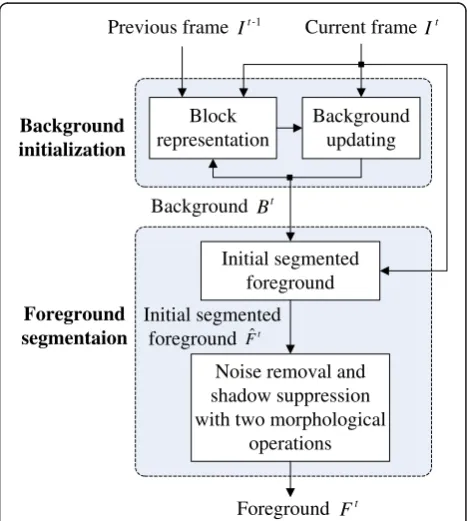
Figure 1 shows the framework of the proposed video back-ground initialization and foreback-ground segmentation ap-proach for bootstrapping video sequences, which contains four major processing steps, namely, block representation, background updating, initial segmented foreground, and noise removal and shadow suppression with two morpho-logical operations. In Figure 1, the input includes the current (gray-level) video frameItand the previous (gray-level) video frameIt–1of a bootstrapping video sequence, and the output includes the modeled background frameBt and the segmented foreground frame Ft, whereidenotes the frame number (index). Here, I(tx,y), I(t−x,1y), B(tx,y), and
F(tx,y)denote pixels (x,y) inIt, It–1, Bt, andFt, respectively. Each video frame isW×H(pixels) in size, and each video frame is partitioned into non-overlapping and equal-sized blocks of sizeN×N(pixels). Let (i,j) be the block index, wherei = 0,1,2,. . .,(W/N)–1 andj= 0,1,2,. . .,(H/N)–1. Here,b(ti,j)= {I(tiN+a,jN+b): a, b = 0, 1, 2,. . .,N−1}, b(ti−,j1)=
{It(iN−1+a,jN+b): a, b = 0, 1, 2,. . .,N − 1}, and eb
t i;j ð Þ ¼
Bt
iNþa;jNþb
ð Þ:a;b¼0;1;2;. . .;N1
n o
, denote blocks
(i,j) inIt,It–1, andBt, respectively. In addition, let ^Bt de-note the initial modeled background frame and b^ð Þi;jt¼
^
BtðiNþa;jNþbÞ:a;b¼0;1;2;. . .;N1
n o
; denote block
(i,j) in^Bt.
2.1. Initial modeled background processing
As the illustrated example shown in Figure 2, a sequence of initial modeled background frames ^Bt (t= 1,2,. . .) will be obtained in the initial modeled background processing procedure. At the beginning (t = 1), each block ^bð Þi;j1 of sizeN×N(pixels) in ^B1 is set to“undefined” (labeled in black), as shown in Figure 2l. Then, the initial modeled background frame B^t (t = 2,3,. . .,19) is obtained based on the “updated” modeled background frame Bt–1 (see Section 2.3) and the block motion representation frame
^
Rt. Each block of size N×N(pixels) in R^t is determi-ned as either a“static”block (labeled in blue) or a“ mo-ving” block (labeled in red) by motion estimation (see Section 2.2) between two consecutive (gray-level) video framesIt–1andItof the bootstrapping video sequence, as shown in Figure 2g–k. For one “undefined” block
^
bð Þi;jt1 in B^t1, if its corresponding block in R^t is
Initial segmented foreground
Noise removal and shadow suppression with two morphological
operations
Current frame Previous frame
Block representation
Background updating
Background initialization
t I
1
t I
Foreground segmentaion
Initial segmented foreground Fˆt
Background t B
Foreground t F
determined as a “static” block, i.e., its motion vector is (0,0), the“static”blockb^ð Þi;jtin^Bt is duplicated from the corresponding blockb(ti,j)inIt. Then, each“static”block
^
bð Þi;jt in B^t will perform the background updating pro-cedure (see Section 2.3) to obtain ebtð Þi;j inBtOtherwise, the“undefined” block ^bð Þi;jt1 in B^t1 will remain as the “undefined” block ^bð Þi;jt in B^t. That is, each “ un-defined”block^bð Þi;jtwill not participate the background updating procedure until ^bð Þi;jt is determined as a
“static”block. As shown in Figure 2, each block inR^t is determined by motion estimation between two consecu-tive (gray-level) video frames, It–1 and It, of the boot-strapping video sequence. Each block in the initial modeled background frameB^2is based onB1and^R2, in which some blocks in^B2are still“undefined”(labeled in
black). The initial modeled background frame B^3 is
obtained based onB2and^R3.R^4, R^5,. . ., andR^19 in the illustrated example can similarly be obtained. Note that, in the illustrated example shown in Figure 2, each initial modeled background frame B^t (t= 1,2,. . .,18) contains at least one“undefined”block.
Finally, as shown in Figure 2q, the initial modeled background frame B^19 contains no “undefined” block. Here, for the illustrated example shown in Figure 2, the performance indexT1(=19) is defined as the frame index for initial modeled background processing. Afterwards, the initial modeled background frame B^t (t= 20,21,. . .)
is duplicated from the “updated” modeled background
frameBt–1, i.e.,^Bt ¼Bt1(t= 20,21,. . .) [35].
2.2. Block representation
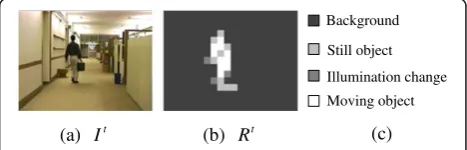
As the illustrated example shown in Figure 3, in the proposed block representation approach, each block of the current video frame It is classified into one of the four categories, namely, “background,” “still object,” “ il-lumination change,” and “moving object.” In Figure 3b, each block of the block representation frame Rtfor Itis labeled in four different gray levels. The block represen-tation frameRtis obtained based on the two consecutive video frames, Itand It–1, and the initial modeled back-ground frame B^t by the proposed block representation approach (as shown in Figure 4), in which motion esti-mation and correlation coefficient computation are used to perform block representation (classification).
Motion estimation is performed between the two con-secutive video frames,Itand It–1using a block matching algorithm so that each block inItis determined as either
“static” or “moving.” In this study, the sum of absolute differences (SAD) is used as the cost function for block matching between blockb(ti,j)inItand the corresponding block inIt–1and the search range for motion estimation is set to ±N/2 [35,36]. For a block inIt, if the minimum SAD, Dmv(u,v), for motion vector (u,v), is smaller than
Background
Still object
Moving object Illumination change
(a) It (b) Rt (c)
Figure 3An illustrated example of block representation: (a) the current video frame; (b) the block representation frame; (c) templates for different blocks in (b).
(a) 1
I (b) 2
I (c) 3
I (d) 7
I (e) 8
I (f) 19
I
(g) Rˆ2 (h) Rˆ3 (i) Rˆ7 (j) Rˆ8 (k) Rˆ19
(l) Bˆ1
(m) Bˆ2
(n) Bˆ3
(o) Bˆ7
(p) Bˆ8
(q) Bˆ19
90% of the SAD for the null-vector (0,0), Dmv(0,0), the block is determined as a“moving” block; otherwise, it is determined as a“static”block [19,35].
On the other hand, the correlation coefficient CB(i, j) between block b(ti,j) in It and block b^ð Þi;jt in the initial modeled background frame^Bt is computed as
CBð Þ ¼i;j
X bt
i;j ð Þμbt
i;j ð Þj j^b
t i;j ð Þμ^b
t i;j ð Þ
ffiffiffiffiffiffiffiffiffiffiffiffiffiffiffiffiffiffiffiffiffiffiffiffiffiffiffiffiffiffiffiffiffiffiffi X
jbt i;j ð Þμbt
i;j ð Þj
2
q
ffiffiffiffiffiffiffiffiffiffiffiffiffiffiffiffiffiffiffiffiffiffiffiffiffiffiffiffiffiffiffiffiffiffiffiffi X
j^btð Þi;j μ^btð Þi;jj2
r
ð1Þ
where μbis the mean of the pixel values in block b. As shown in Figure 4, based on CB(i,j) and the threshold THCBa“static”block can be further classified into either a “background” block (if CB(i,j) ≥ THCB) or a “still ob-ject”block (otherwise), whereas a“moving”block can be further classified into either an “illumination change” block (if CB(i,j) ≥ THCB) or a “moving object” block (otherwise). Afterwards, four different block represen-tations are obtained.
2.3. Background updating
By background updating, each block ^bð Þi;jt in the initial modeled background frame ^Bt can be updated to obtain the corresponding block ebtð Þi;j in the modeled background frameBtas follows. Both the“background”and “ illumin-ation change”blocks are updated by temporal smoothing, i.e., block ebtð Þi;j inBtis updated as the linearly weighted sum of block ^bð Þi;jt in B^t and block b(ti,j) in It. On the
other hand, both the “still object” and “moving ob-ject” blocks are updated by block replacement.
(a)Background: the modeled background blockebtð Þi;j in
Btis updated by
ebt i;j
ð Þ¼α:^bð Þi;jtþð1αÞ:btð Þi;j ð2Þ
whereα, the updating weight, is empirically set to 0.9 in this study.
(b)Still object: the modeled background blockebtð Þi;j in
Btis updated by
e
bð Þti;j ¼bð Þti;j; if Countð Þi;j≥THstill; e
btð Þi;j ¼b
^t
i;j
ð Þ; otherwise;
8 <
: ð3Þ
where Count(i,j)is the number of times thatb(ti,j)inItis successively determined as a“still object”block previously, and THstillis a threshold for the time duration (in terms of the number of frames) that a“still object”block will learn to be a“background”block. That is, if an object (or a blockb(ti,j)inIt) does not “move”for a sufficient time duration, it will become some part of the background. As the illustrated example shown in Figure5, the marked blockb(11,13)33 in
I33is detected as a“still object”block (inR33) for a sufficient time duration (THstill= 20). Then, its corresponding blockeb33ð11;13ÞinB33will be updated (replaced) byb(11,13)33 inI33.
(c)Illumination change: the modeled background block
e
btð Þi;j inBtis similarly updated by Equation (2).
(a) 33
I (b) 33
R (c) ˆ33
B (d) 33
B
Figure 5An illustrated example of background updating for a“still object”block: (a) the original video frame; (b) the block representation frame; (c) the initial modeled background frame; (d) the modeled background frame.
Motion estimation
Correlation coefficient computation
Static CB THCB (a) Background
(b) Still object
Moving
(d) Moving object (c) Illumination change
t j i t t j
i I (,) 1 ) , ( , ,bˆ
b 1 ) , ( , t t j i I
b tij
t j i,) (,) ( ,bˆ
b CB B TH C CB B TH C CB B TH C -≥ ≥ > >
(d)Moving object: the modeled background blockebtð Þi;j
inBtis updated by
e
bð Þti;j ¼bð Þti;j; if SM btð Þi;j
<SM b^tð Þi;j
e btð Þi;j ¼b
^t i;j
ð Þ; otherwise;
8 < :
ð4Þ
where SM(b(ti,j)) andSM ^b
t i;j ð Þ
denote the side-match measures for blockb(ti,j)fromItembedded in^B
t
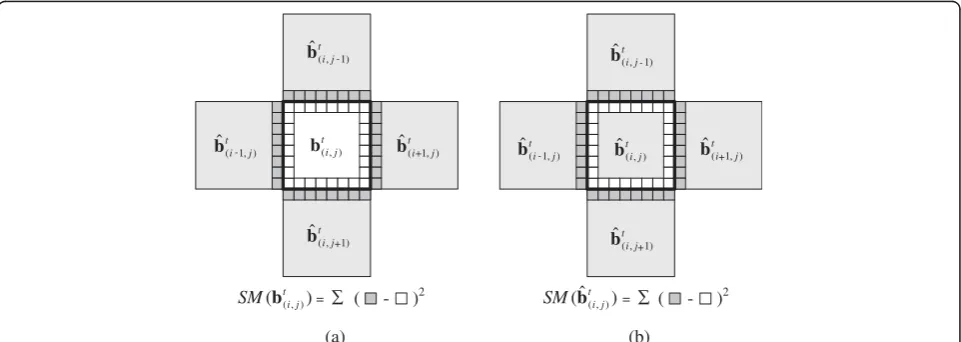
and that for block^bð Þi;jt“embedded”inB^t, respectively, as shown in Figure6. The side-match measure (or the boundary match measure) [37,38] is widely used in various image/video error concealment algorithms due to its good trade-off in complexity and visual quality. SM(b(ti,j)) is defined as the sum of squared differences between the boundary of the embedded blockb(ti,j)from
Itand the boundaries of the four neighboring blocks
^
bði1;jÞt;^bðiþ1;jÞt;^bði;j1Þt;and^bði;jþ1Þt;inB^t(Figure6a), i.e.,
SM btð Þi;j
¼XN1
b¼0 ^
BtðiN1;jNþbÞIðtiN;jNþbÞ
2
þXN1
b¼0 ^
BtðiNþN;jNþbÞIðtiNþN1;jNþbÞ
2
XN1
a¼0 ^
BtðiNþa;jN1ÞIt
iNþa;jN
ð Þ
2
þXN1
a¼0 ^
BtðiNþa;jNþNÞIðtiNþa;jNþN1Þ
2
ð5Þ
Similarly, SM b^tð Þi;j
is defined as the sum of squared
differences between the boundary of block ^bð Þi;jtand the
boundaries of its four neighboring blocks ^bði1;jÞt;
^
bðiþ1;jÞt;^bði;j1Þt;and^bði;jþ1Þt;in^Bt (Figure 6b), i.e.,
SM b^tð Þi;j
¼XN1 b¼0
^
BtðiN1;jNþbÞB^ðiN;jNþbÞt
2
þNX1 b¼0
^
BtðiNþN;jNþbÞB^ðiNþN1;jNþbÞt
2
NX1 a¼0
^
BtðiNþa;jN1Þ^BðiNþa;jNÞt
2
þNX1 a¼0
^
BtðiNþa;jNþNÞB^ðiNþa;jNþN1Þt
2
:
ð6Þ
Note that if a block in Rtis determined as a “moving object” block two times consecutively, the
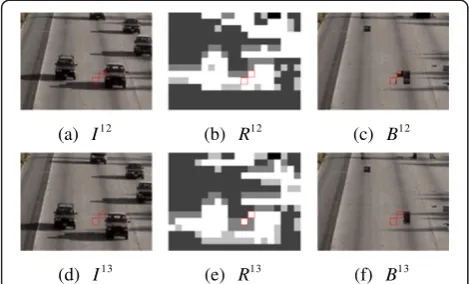
correspon-ding modeled background block ebtð Þi;j inBtis updated by Equation (4). The side-match measure uses the camou-flage of each “moving object” block to search the more suitable modeled background block so that we can speed up the background updating procedure. As the illustrated example shown in Figure 7, two marked blocksb(12,9)and
b(11,10)in bothI12andI13are detected as two“moving ob-ject”blocks in bothR12andR13consecutively. Thus, their
corresponding blocks eb13ð12;9Þ and eb13ð11;10Þ in B13 will be updated (replaced) by blocks b(12,9)13 and b(11,10)13 in I13, respectively.
2.4. Initial segmented foreground
Based on the modeled background frame Bt performing
background updating, as an illustrated example shown in
t j i,) (
b
( - )2
) ( (,) t j i SM b t j i1,) ( ˆ
b t
j i1,) ( ˆ
b
t j i, 1) ( ˆ
b t
j i, 1) ( ˆ
b
t j i,) ( ˆ
b
( - )2
) ˆ ( (,) t j i SM b t j i1,) ( ˆ
b t
j i1,) ( ˆ
b
t j i, 1) ( ˆ
b t
j i, 1) ( ˆ b (a) (b) -+ + -+ + =∑ =∑
Figure 8, the initial (binary) segmented foreground frame
^
Ftcan be obtained as
^
Ft ¼ 1; ifItBt≥THisf; 0; otherwise;
ð7Þ
where THisfis a threshold, which is empirically set to 15 in this study.
2.5. Noise removal and shadow suppression with two morphological operations
As shown in Figure 8, F^t usually contains some frag-mented (noisy) parts and shadows. To obtain the precise
segmented foreground frame Ft, a noise removal and
shadow suppression procedure is adopted, which com-bines the shadow suppression approach in [39] and the edge information extracted from It with F^t being the (binary) operation mask.
LetF^Stbe theS(saturation) component of the original
video frame (frame t) represented in the HSV color
space andF^Etbe the gradient image ofItusing the Sobel operator [40] withF^t being the (binary) operation mask. The segmented foreground frameFt is defined as
Ft¼ 1; if F^t\ ^FtS≥σ^FSt
[ F^tE≥THE
;
0; otherwise; (
ð8Þ
where\and[denote the logical AND and OR operators, respectively, σF^St is the standard deviation of F^St, and
THEis a threshold. Here, THEis empirically set to 120 in
this study. Figure 9 shows an illustrated example performing the noise removal and shadow suppression procedure. By applying the shadow suppression approach in [39], the“second”(binary) segmented foreground frame (shown in Figure 9b) is obtained based on ^Ft (shown in Figure 8c) and F^St≥σ^FSt (shown in Figure 9a). Based on
the“second”(binary) segmented foreground frame (shown in Figure 9b), combining the gradient image F^Et of It (shown in Figure 9c) preserving the edge information in the initial (binary) segmented foreground frame ^Ft, the segmented foreground frame Ft (shown in Figure 9d) is obtained by Equation (8). Finally, the final segmented fore-ground frame (shown in Figure 9e) is obtained asFtwith two morphological (erosion and dilation) operations [40].
3. Experimental results
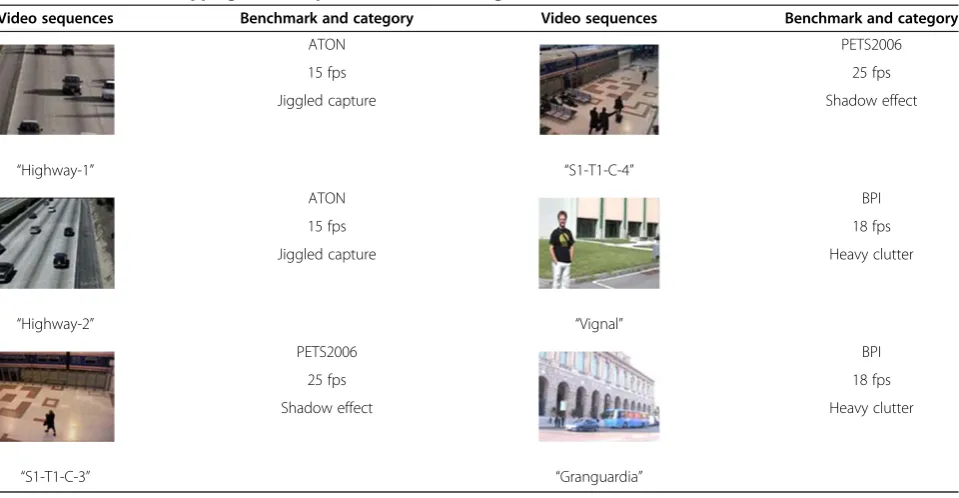
In this study, experimental results are performed using Borland C++ on Intel Core 2 Quad CPU 2.4 GHz Microsoft Windows XP platform. Six bootstrapping video sequences, selected from three benchmark datasets, namely, ATON (http://cvrr.ucsd.edu/aton/shadow/index. html), PETS2006 (http://www.cvg.rdg.ac.uk/PETS2006/ data.html), and BPI [24], are used in this study, which are listed and categorized in Table 1. In Table 1, the six boot-strapping video sequences are categorized as jiggled
(a) (b) (c)
(d) (e)
Figure 9An illustrated example for noise removal and shadow
suppression: (a)F^St≥σ^FSt, (b)^F t
\(^FSt≥σ^FSt);(c)F^Et≥TE;(d)Ft,
(e)Ftwith two morphological (erosion and dilation) operations.
(a) t
I (b) t
B (c) t
Fˆ
Figure 8An illustrated example of initial segmented foreground: (a) the current video frame; (b) the modeled background frame; (c) the initial segmented foreground frame.
(a) I12 (b) R12 (c) B12
(d) 13
I (e) 13
R (f) 13
B
capture, shadow effect, and heavy clutter. The video frames in Table 1 are 320 × 240 in size.
To evaluate the performance of the proposed approach, three comparison approaches, namely, MoG [4], Reddy background estimation (Reddy) [22], and self-organizing background subtraction (SOBS) [27], are implemented in this study. In MoG and Reddy, only the gray-level compo-nent of each video frame is employed, in SOBS, the H, S, and V components of each video frame are employed, and in the proposed approach, the gray-level video frames are used and additionally the S component is only used for shadow suppression. Note that, for the SOBS approach, each SOBS high-resolution video frame (3 W × 3H pixels) is downsampled to a video frame of the original resolution (W×Hpixels) by local averaging.
3.1. Parameter setting
THstill in Equation (3) is a threshold for the time dur-ation (in terms of the number of frames) that a“still ob-ject” block will learn to be a “background” block. If an object (or a block b(ti,j) in It) does not “move” for a sufficient time duration THstill it will be treated as some part of the background. If THstill is set to a small value,
the modeled background frame Bt will easily be
disturbed by moving objects in each bootstrapping video sequence. On the contrary, if THstill is set to a large
value, the modeled background frame Bt might not be
updated immediately. As the illustrated example shown
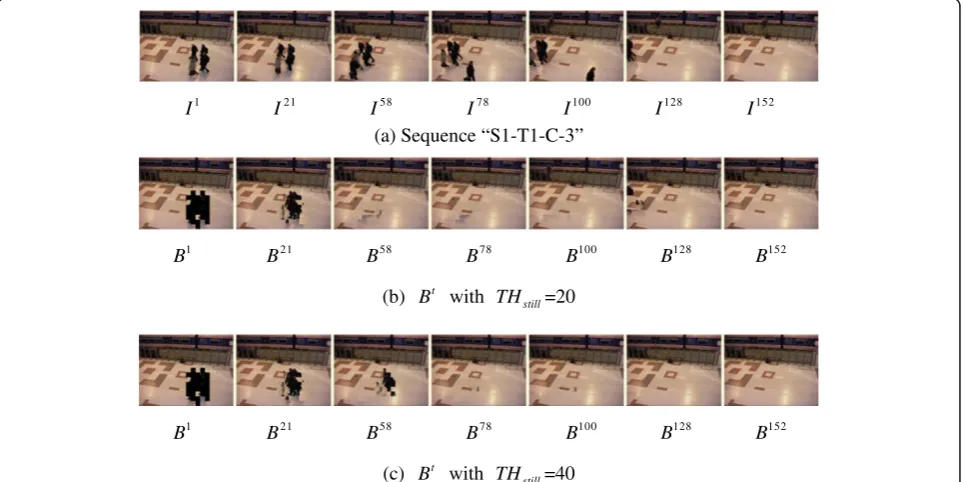
in Figure 10, the modeled background frames Bt with
THstill = 20 and THstill = 40 are illustrated, where
performance indexT1is defined as the frame index for initial modeled background processing (Section 2.1) and it is identically set to 21 for both THstill= 20 and THstill= 40. If performance indexT2is defined as the frame index for constructing the free (“true”) modeled background frame, for the illustrated example shown in Figure 10,T2= 152 for THstill= 20, whereasT2= 128 for THstill= 40. The
two performance indexes (T1 and T2) for different
thresholding values THstill of four bootstrapping video sequences, namely,“Highway-1,” “Highway-2,” “ S1-T1-C-3,”and“S1-T1-C-4,”are illustrated in Figure 11.
Actually, THstill depends on the sizes of moving
objects, the velocities of moving objects, and the frame rate (frames per second, fps) of each bootstrapping video sequence. LetAtbe the minimum bounding rectangle of a moving object in frame It and At-FR be the minimum bounding rectangle of the moving object in frame It-FR whereFR(fps) is the frame rate of a bootstrapping video sequence. Note that the time difference between the two frames, It-FR and It, is 1 s. Here, the moving object is roughly determined as “high-motion” if At-FR and Atdo not contain any overlapping part. Otherwise, the moving object is roughly determined as “low-motion.” In this study, if a bootstrapping video sequence contains“ high-motion” moving object(s), then (FR/2) ≤ THstill ≤ FR. Otherwise, FR ≤ THstill ≤ (FR + FR/2). The threshold
values THstill for the six video sequences, namely,
“Highway-1,” “Highway-2,” “S1-T1-C-3,” “S1-T1-C-4,”
“Vignal,” and “Granguardia,” by the proposed approach are empirically set to 15, 15, 35, 35, 20, and 20, respectively.
Table 1 The six bootstrapping video sequences and their categories
Video sequences Benchmark and category Video sequences Benchmark and category
ATON PETS2006
15 fps 25 fps
Jiggled capture Shadow effect
“Highway-1” “S1-T1-C-4”
ATON BPI
15 fps 18 fps
Jiggled capture Heavy clutter
“Highway-2” “Vignal”
PETS2006 BPI
25 fps 18 fps
Shadow effect Heavy clutter
3.2. Subjective comparisons
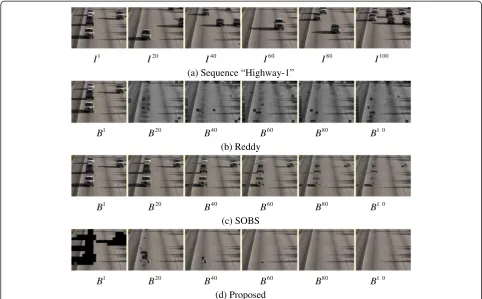
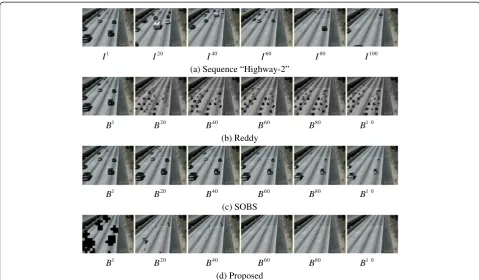
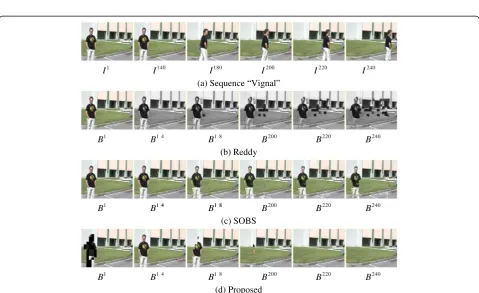
For background initialization, Figures 12, 13, 14, 15, 16, and 17 illustrate some frames of the six bootstrapping video sequences (a) and the corresponding modeled
background frames Btby Reddy (b), SOBS (c), and the
proposed approach (d) with block size of 16 × 16. For
the Reddy approach, given a video sequence of Tvideo
frames, each video frame is divided into non-overlapping blocks of size 16 × 16. Agglomerative clustering back-ground estimation is applied in a block-by-block manner. Background areas are iteratively filled by selecting the most appropriate (smooth) candidate blocks. For the
(a) (b)
(c) (d)
Highway-10 50 100 150 200
10 15 20 25 30 35 40 45 50
THstill t
T1 T2-T1
Highway-2
0 50 100 150 200
10 15 20 25 30 35 40 45 50
THstill t
T1 T2-T1
S1-T1-C-3
0 50 100 150 200
10 15 20 25 30 35 40 45 50
THstill t
T1 T2-T1
S1-T1-C-4
0 100 200 300 400
10 15 20 25 30 35 40 45 50
THstill t
T1 T2-T1
Figure 11The performance indexes (T1andT2) of four bootstrapping video sequences with different thresholding values THstill: the
performance indexes (T1andT2) of“Highway-1”(a);“Highway-2”(b);“S1-T1-C-3”(c); and“S1-T1-C-4”(d). 1
I I21 I58 I78 I100 I128 I152
(a) Sequence “S1-T1-C-3”
1
B B21 B58 B78 B100 B128 B152
(b) Bt
with THstill=20
1
B B21 B58 B78 B100 B128 B152
(c) Bt
with THstill=40
Figure 10An illustrated example for framesI1I21,I58,I78,I100,I128, andI152of the bootstrapping video sequence“S1-T1-C-3”(a) and
the corresponding modeled background framesBtwithT1= 21, TH
Reddy approach, a bootstrapping video sequence with a large number of video frames is required to obtain the free (“true”) modeled background frame, due to some blocks in each video frame might be erroneously estimated based on the corresponding candidate block set in the frequency domain. For the SOBS approach, the modeled background frameBl= Il. Then, each subsequent modeled background frame Bt is obtained by pixel-wise background updating. The SOBS approach can obtain the modeled background frame of a bootstrapping video sequence with suitable par-ameter values [27]. However, as a pixel-based approach, to obtain the free (“true”) modeled background frame, it needs a long time duration to eliminate the foreground
objects in Bl Based on our experimented results, the
performance indexes T2 for the six video sequences by
the SOBS approach are 220 for “Highway-1,” 306 for
“Highway-2,” 305 for “S1-T1-C-3,” 335 for “S1-T1-C-4,” >260 for “Vignal,” and >450 for “Granguardia,” respecti-vely. For each bootstrapping video sequence, the proposed approach can obtain the free (“true”) modeled background frame “completely” after T2 The performance indexes
T2
for the six video sequences, namely, “Highway-1,”
“Highway-2,” “S1-T1-C-3,” “S1-T1-C-4,” “Vignal,” and
“Granguardia,” by the proposed approach are 80, 48, 62,
236, 205, and 414, respectively, which are indeed less than the corresponding values by the SOBS approach.
For foreground segmentation, Figures 18, 19, 20, 21, 22, and 23 illustrate some segmented foreground frames
Ft by MoG (a), Reddy (b), SOBS (c), and the proposed
approach (d). For Reddy, SOBS, and the proposed ap-proach, the segmented foreground frames are obtained by background subtraction of the corresponding boot-strapping video sequences shown in Figures 12, 13, 14, 15, 16, and 17, whereas, for MoG, the segmented fore-ground frames are obtained by the pixel-wise MoG method in [4]. For SOBS, the contents of red rectangles in the segmented foreground frames indicate the ghost objects. As shown in Figures 18, 19, 20, 21, 22, and 23, the segmented foreground frames of the MoG approach are usually good for bootstrapping video sequences containing some dynamic background, but the seg-mented foreground frames of the MoG approach may obtain fragmented (noisy) foreground objects for boot-strapping video sequences containing some low-motion moving objects and some noisy background due to jiggled capture. The SOBS approach may obtain good segmented foreground objects without shadow.
How-ever, each modeled background frame Bt of the SOBS
1
I I20 I40 I60 I80 I100
(a) Sequence “Highway-1”
1
B B20 B40 B60 B80 B1 0
(b) Reddy
1
B B20 B40 B60 B80 B1 0
(c) SOBS
1
B B20 B40 B60 B80 B1 0
(d) Proposed
1
I 20
I 40
I 60
I 80
I 100
I
(a) Sequence “S1-T1-C-3”
1
B B20 B40 B60 B80 B1 0
(b) Reddy
1
B 20
B 40
B 60
B 80
B 1 0
B
(c) SOBS
1
B 20
B 40
B 60
B 80
B 1 0
B
(d) Proposed
Figure 14Some background initialization resultsBtof framesI1,I20,I40,I60,I80, andI100of the bootstrapping video sequence“
S1-T1-C-3”(a) by Reddy (b), SOBS (c), and the proposed approach (d) with block size 16 × 16 and THstill= 35. 1
I 20
I 40
I 60
I 80
I 100
I
(a) Sequence “Highway-2”
1
B B20 B40 B60 B80 B1 0
(b) Reddy
1
B 20
B 40
B 60
B 80
B 1 0
B
(c) SOBS
1
B 20
B 40
B 60
B 80
B 1 0
B
(d) Proposed
1
I 140
I 180
I 200
I 220
I 240
I
(a) Sequence “Vignal”
1
B 1 4
B 1 8
1 4 1 8
B 200
B 220
B 240
B
(b) Reddy
1
B 1 4
B 1 8
B 200
B 220
B 240
B
(c) SOBS
1
B 1 4
B 1 8
B 200
B 220
B 240
B
(d) Proposed
Figure 16Some background initialization resultsBtof framesI1,I140,I180,I200,I220, andI240of the bootstrapping video sequence “Vignal”(a) by Reddy (b), SOBS (c), and the proposed approach (d) with block size 16 × 16 and THstill= 20.
1
I 80
I 150
I 200
I 240
I 260
I
(a) Sequence “S1-T1-C-4”
1
B B80 B1 5 B200 B240 B260
(b) Reddy
1
B 80
B 1 5
B 200
B 240
B 260
B
(c) SOBS
1
B 80
B 1 5
B 200
B 240
B 260
B
(d) Proposed
Figure 15Some background initialization resultsBtof framesI1,I80,I150,I200,I240, andI260of the bootstrapping video sequence“S1-T1
1
F 20
F 40
F 60
F 80
F 100
F
(a) MoG
1
F 20
F 40
F 60
F 80
F 100
F
(b) Reddy
1
F 20
F 40
F 60
F 80
F 100
F
(c) SOBS
1
F 20
F 40
F 60
F 80
F 100
F
(d) Proposed
Figure 18Some foreground segmentation resultsFtof framesI1,I20,I40,I60,I80, andI100of the bootstrapping video sequence “Highway-1”by MoG (a), Reddy (b), SOBS (c), and the proposed approach (d) withT2= 80.
1
I 50
I 100
I 200
I 330
I 420
I
(a) Sequence “Granguardia”
1
B B50 B1 0 B200 B330 B420
(b) Reddy
1
B 50
B 1 0
B 200
B 330
B 420
B
(c) SOBS
1
B 50
B 1 0
B 200
B 330
B 420
B
(d) Proposed Figure 17Some background initialization resultsBtof framesI1,
I50,
I100,
I200,
I330, and
1
F 20
F 40
F 60
F 80
F 100
F
(a) MoG
1
F 20
F 40
F 60
F 80
F 100
F
(b) Reddy
1
F 20
F 40
F 60
F 80
F 100
F
(c) SOBS
1
F 20
F 40
F 60
F 80
F 100
F
(d) Proposed
Figure 20Some foreground segmentation resultsFtof framesI1,I20,I40,I60,I80, andI100of the bootstrapping video sequence“S1-T1
-C-3”by MoG (a), Reddy (b), SOBS (c), and the proposed approach (d) withT2= 62. 1
F 20
F 40
F 60
F 80
F 100
F
(a) MoG
1
F 20
F 40
F 60
F 80
F 100
F
(b) Reddy
1
F F20 F40 F60 F80 F100
(c) SOBS
1
F 20
F 40
F 60
F 80
F 100
F
(d) Proposed
Figure 19Some foreground segmentation resultsFtof framesI1,I20,I40,I60,I80, andI100of the bootstrapping video sequence
1
F 140
F 180
F 200
F 220
F 240
F
(a) MoG
1
F 140
F 180
F 200
F 220
F 240
F
(b) Reddy
1
F 140
F 180
F 200
F 220
F 240
F
(c) SOBS
1
F 140
F 180
F 200
F 220
F 240
F
(d) Proposed
Figure 22Some foreground segmentation resultsFtof framesI1,I140,I180,I200,I220, andI240of the bootstrapping video sequence “Vignal”by MoG (a), Reddy (b), SOBS (c), and the proposed approach (d) withT2= 205.
1
F 80
F 150
F 200
F 240
F 260
F
(a) MoG
1
F 80
F 150
F 200
F 240
F 260
F
(b) Reddy
1
F 80
F 150
F 200
F 240
F 260
F
(c) SOBS
1
F 80
F 150
F 200
F 240
F 260
F
(d) Proposed
approach may preserve some foreground objects in Il resulting in some ghost objects in the segmented
fo-reground frame Ft. The proposed approach has good
foreground segmentation results for bootstrapping video sequences, i.e., good segmented foreground objects (without shadow and ghost objects) can be obtained afterT2.
Table 2 lists the average processing times (s) of obtaining a segmented foreground frame for the six bootstrapping video sequences by MoG, Reddy, SOBS, and the proposed approach with block size 16 × 16. Note that the average processing times (s) of obtaining a segmented foreground frame for the six video sequences are evaluated by 100 bootstrapping video frames. The average frame processing times of each comparison ap-proach (except Reddy) for different bootstrapping video sequences are similar. However, the average frame processing times of Reddy for different video sequences
are not similar, which are influenced on the complexity (contents) of video sequences. Table 3 lists the average frame processing times (s) of the three processing steps, namely, block representation, background updating, and foreground segmentation, for the six bootstrapping video sequences by the proposed approach with block size 16 × 16. Note that foreground segmentation contains initial
segmented foreground (processing time≈ 0 second) and
noise removal and shadow suppression with two mor-phological operations. The average frame processing times (0.488 and 0.124 seconds) for the two processing steps, namely, block representation and foreground seg-mentation, depend on the total number of blocks/pixels of a bootstrapping video frame, which are relatively stable. On the other hand, the average frame processing time of the processing step, namely, background updat-ing, depends on temporal smoothing and block replace-ment for various block representations, which is relatively small. As the results listed in Table 3, motion estimation of block representation using a block matching algorithm constitutes the major part of the processing time of a bootstrapping video sequence by the proposed approach, which may be greatly reduced by parallel implementation.
1
F F50 F100 F200 F330 F420
(a) MoG
1
F F50 F100 F200 F330 F420
(b) Reddy
1
F F50 F100 F200 F330 F420
(c) SOBS
1
F F50 F100 F200 F330 F420
(d) Proposed
Figure 23Some foreground segmentation resultsFtof framesI1,I50,I100,I200,I330, andI420of the bootstrapping video sequence
“Granguardia”by MoG (a), Reddy (b), SOBS (c), and the proposed approach (d) withT2= 414.
Table 2 The average frame processing times (s) for the six bootstrapping video sequences by MoG, Reddy, SOBS, and the proposed approach with block size 16 × 16
MoG Reddy SOBS Proposed
3.3. Objective comparisons
For foreground segmentation, to perform objective comparisons between the three comparison approaches
(MoG, SOBS, and the proposed approach), the “
base-line”category of“changedetection.net”video dataset [41] is employed. For MoG, SOBS, and the proposed ap-proach, both the input video sequences and the processing results are processed in a frame-by-frame manner. On the other hand, for Reddy, to obtain the processing results, the whole video sequence should be available to Reddy. Therefore, Reddy is excluded in the
following comparisons. Let TP be number of true
positives,TNbe number of true negatives, FNbe
num-ber of false negatives, and FP be number of false
positives. The four evaluation metrics, namely, FPR, FNR, PWC, and FM, are employed in this study, which are defined as [41]
1. false positive rate (FPR):FP/(FP+TN), 2. false negative rate (FNR):FN/(TN+FP), 3. percentage of wrong classifications (PWC):
100 × (FN+FP)/(TP+FN+FP+TN), 4. f-measure (FM): 2 × (PR×RE)/(PR+RE).
Table 4 lists the objective performance comparisons by four evaluation metrics, FPR, FNR, PWC, and FM, for the four video sequences in the “baseline” category of
“changedetection.net”video dataset by MoG, SOBS, and the proposed approach. Table 5 lists the objective per-formance comparisons by four evaluation metrics, FPR, FNR, PWC, and FM, for the four video sequences in the
“baseline” category of “changedetection.net” video dataset by the proposed approach with different block sizes (8 × 8, 16 × 16, and 32 × 32). In Tables 4 and 5,
the best evaluation metrics FPR, FNR, PWC, and FM are marked in bold font. Note that the smaller FPR and FNR values respond the better performances, whereas the larger PWC and FM values respond the better performances. Here, for a fair comparison, the proposed approach does not perform the two morphological operations in the noise removal and shadow suppression procedure. Based on the experimental results listed in Table 4, in general, the foreground segmentation results of the proposed approach are better than those of MoG and SOBS. On the other hand, based on the experimen-tal results listed in Table 5, the foreground segmentation results of the proposed approach using three different block sizes (8 × 8, 16 ×16, and 32 × 32) are substantially similar. The average frame processing times of the proposed approach using three different block sizes (8 × 8, 16 × 16, and 32 × 32) are 0.256, 0.615, and 2.166 seconds, respectively. To reduce the average frame processing time of the proposed approach, block size 8 × 8 is recommended.
For background initialization, including the evaluation of foreground masks, we can also evaluate the perform-ance of the estimated background. In this study, the PSNR value of the estimated background, with
respect-ive to one “free” background (the groundtruth), is
employed. The “free” background (the groundtruth) is synthesized by the “static” parts in different frames of the whole bootstrapping video sequence. The average PSNR values of SOBS and the proposed approach for the “baseline” category of “changedetection.net” video dataset [41] are 26.46 and 28.96 dB, respectively.
Table 4 Objective performance comparisons by four evaluation metrics FPR, FNR, PWC, and FM for the four video sequences in the“baseline”category of
“changedetection.net”video dataset by MoG, SOBS, and the proposed approach
FPR FNR PWC FM
MoG 0.0158 0.0169 3.0802 0.5998
SOBS 0.0577 0.0007 5.5604 0.5076
Proposed 0.0043 0.0174 2.0448 0.6997
Table 5 Objective performance comparisons by four evaluation metrics FPR, FNR, PWC, and FM for the four video sequences in the“baseline”category of
“changedetection.net”video dataset by the proposed approach with different block sizes (8 × 8, 16 × 16, and 32 × 32)
FPR FNR PWC FM
8 × 8 0.0043 0.0174 2.0448 0.6997
16 × 16 0.0044 0.0178 2.0942 0.6992
32 × 32 0.0049 0.0189 2.2429 0.6730
Table 3 The average frame processing times (s) of the three processing steps, namely, block representation, background updating, and foreground segmentation, for the six bootstrapping video sequences by the proposed approach with block size 16 × 16
Background initialization Foreground
segmentation Block representation Background updating
4. Concluding remarks
In this study, an effective background initialization and foreground segmentation approach for bootstrapping video sequences is proposed, in which a modified block representation approach, a new background updating scheme, and an improved noise removal and shadow suppression procedure with two morphological ope-rations are employed. Based on the experimental results obtained in this study, as compared with MoG [4], Reddy [22] and SOBS [27], the proposed approach has better background initialization and foreground segmen-tation results. In addition, bootstrapping video sequen-ces with jiggled capture, shadow effect, and heavy clutter can be well handled by the proposed approach.
Competing interests
The authors declare that they have no competing interests.
Acknowledgment
This study was supported in part by the National Science Council, Taiwan, Republic of China under Grants NSC 99-2221-E-194-032-MY3 and NSC 101-2221-E-194-031.
Received: 4 February 2012 Accepted: 8 January 2013 Published: 28 February 2013
References
1. TB Moeslund, A Hilton, V Kruer, A survey of advances in vision-based human motion capture and analysis. Comput. Vis. Image Understand.
104(2), 90–126 (2006)
2. M Piccardi, Background subtraction techniques: a review, inProceedings of the IEEE International Conference on Systems, Man, and Cybernetics, vol. 4 (The Hague, The Netherlands, 2004), pp. 3099–3104
3. K Toyama, J Krumm, B Brumitt, B Meyers, Wallflower: principles and practice of background maintenance, inProceedings of the 7th IEEE International Conference on Computer Vision, vol. 1 (Kerkyra, Greece, 1999), pp. 255–261 4. C Stauffer, WEL Grimson, Adaptive background mixture models for real-time tracking, inProceedings of the IEEE International Conference on Computer Vision and Pattern Recognition, vol. 2 (Ft. Collins, CO, USA, 1999), pp. 246–252 5. T Bouwmans, FE Baf, B Vachon, Background modeling using mixture of
Gaussians for foreground detection—a survey. Recent Patents Comput. Sci. 1(3), 219–237 (2008)
6. A Shimada, D Arita, R Taniguchi, Dynamic control of adaptive mixture-of-Gaussians background model, inProceedings of the IEEE International Conference on Video and Signal Based Surveillance(Sydney, Australia, 2006), pp. 1–5 7. R Tan, H Huo, J Qian, T Fang, Traffic video segmentation using adaptive-k
Gaussian mixture model, inProceedings of the International Workshop on Intelligent Computing in Pattern Analysis/Synthesis(Xi'An, China, 2006), pp. 125–134
8. H Wang, D Suter, A re-evaluation of mixture-of-Gaussian background modeling, inProceedings of the IEEE International Conference on Acoustics, Speech, and Signal Processing, vol. 2 (Philadelphia, PA, USA, 2005), pp. 1017–1020
9. J Lindstrom, F Lindgren, K Ltrstrom, J Holst, U Holst, Background and foreground modeling using an online EM algorithm, inProceedings of the IEEE International Workshop on Visual Surveillance(Graz, Austria, 2006), pp. 9–16 10. B Han, X Lin, Update the GMMs via adaptive Kalman filtering, inProc SPIE,
vol. 5960 (Beijing, China, 2005), pp. 1506–1515
11. Y Zhang, Z Liang, Z Hou, H Wang, M Tan, An adaptive mixture Gaussian background model with online background reconstruction and adjustable foreground mergence time for motion segmentation, inProceedings of the IEEE International Conference on Industrial Technology(Istanbul, Turkey, 2005), pp. 23–27
12. B White, M Shah, Automatically tuning background subtraction parameters using particle swarm optimization, inProceedings of the IEEE International Conference on Multimedia and Expo(Beijing, China, 2007), pp. 1826–1829
13. HH Lin, JH Chuang, TL Liu, Regularized background adaptation: a novel learning rate control scheme for Gaussian mixture modeling. IEEE Trans Image Process.20(3), 822–836 (2011)
14. V Jain, B Kimia, J Mundy, Background modeling based on subpixel edges, in Proceedings of the IEEE International Conference on Image Processing, vol. 6 (San Antonio, Texas, USA, 2007), pp. 321–324
15. YL Tian, M Lu, A Hampapur, Robust and efficient foreground analysis for real-time video surveillance, inProceedings of the IEEE International Conference on Computer Vision and Pattern Recognition, vol. 1, 2005, pp. 1182–1187 16. P Tang, L Gao, Z Liu, Salient moving object detection using stochastic
approach filtering, inProceedings of IEEE International Conference on Image and Graphics(Chengdu, China, 2007), pp. 530–535
17. R Caseiro, JF Henriques, J Batista, Foreground segmentation via background modeling on Riemannian manifolds, inProceedings of International Conference on Pattern Recognition(Istanbul, Turkey, 2010), pp. 3570–3574
18. K Quast, A Kaup, Auto GMM-SAMT: an automatic object tracking system for video surveillance in traffic scenarios. EURASIP J. Image Video Process. 2011(814285), 1–14 (2011)
19. D Farin, PHN de With, W Effelsberg, Robust background estimation for complex video sequences, inProceedings of the International Conference on Image Processing(Barcelona, Spain, 2003), pp. 145–148
20. M Massey, W Bender, Salient stills: process and practice. IBM Syst J. 35(3–4), 557–573 (1996)
21. H Wang, D Suter, A novel robust statistical method for background initialization and visual surveillance, inProceedings of the 7th Asian Conf. on Computer Vision, Part I(Hyderabad, India, 2006), pp. 328–337
22. V Reddy, C Sanderson, BC Lovell, A Bigdeli, An efficient background estimation algorithm for embedded smart cameras, inProceedings of the IEEE International Conference on Distributed Smart Cameras(Como, Italy, 2009), pp. 1–7 23. D Baltieri, R Vezzani, R Cucchiara, Fast background initialization with
recursive Hadamard transform, inProceedings of the IEEE International Conference on Advanced Video and Signal Based Surveillance(Boston, MA, USA, 2010), pp. 165–171
24. A Colombari, A Fusiello, Patch-based background initialization in heavily cluttered video. IEEE Trans. Image Process.19(4), 926–933 (2010) 25. H Liu, W Chen, An effective background reconstruction method for complicated
traffic crossroads, inProceedings of the IEEE International Conference on Systems, Man, and Cybernetics(San Antonio, TX, USA, 2009), pp. 1376–1381 26. J Scott, MA Pusateri, D Cornish, Kalman filter based video background
estimation, inProceedings of the IEEE Applied Imagery Pattern Recognition Workshop(Washington DC, USA, 2009), pp. 1–7
27. L Maddalena, A Petrosino, A self-organizing approach to background subtraction for visual surveillance applications. IEEE Trans. Image Process. 17(7), 1168–1177 (2008)
28. A Ghasemi, R Safabakhsh, Unsupervised foreground-background segmentation using growing self organizing map in noisy backgrounds, in Proceedings of the IEEE International Conference on Computer Research and Development, vol. 1 (Shanghai, China, 2011), pp. 334–338
29. CC Chiu, MY Ku, LW Liang, A robust object segmentation system using a probability-based background extraction algorithm. IEEE Trans. Circuits Syst. Video Technol.20(4), 518–528 (2010)
30. SY Chien, YW Huang, BY Hsieh, SY Ma, LG Chen, Fast video segmentation algorithm with shadow cancellation, global motion compensation, and adaptive threshold techniques. IEEE Trans. Multimed.6(5), 732–748 (2004) 31. A Verdant, P Villard, A Dupret, H Mathias, Three novell analog-domain
algorithms for motion detection in video surveillance. EURASIP J. Image Video Process.2011(698914), 1–13 (2011)
32. HH Lin, TL Liu, JH Chuang, Learning a scene background model via classification. IEEE Trans. Signal Process.57(5), 1641–1654 (2009) 33. Z Tang, Z Miao, Y Wan, FF Jesse, Foreground prediction for bilayer
segmentation of videos. Pattern Recognit. Lett.32(14), 1720–1734 (2011) 34. C Zhao, X Wang, WK Cham, Background subtraction via robust
dictionary learning. EURASIP J. Image Video Process.2011(972961), 1–12 (2011)
35. HH Hsiao, JJ Leou, An effective foreground/background segmentation approach for bootstrapping video sequences, inProceedings of the 2011 IEEE International Conference on Acoustics, Speech, and Signal Processing(Prague, Czech Republic, 2011), pp. 1177–1180
37. L Atzori, FGB de Natale, C Perra, A spatio-temporal concealment technique using boundary matching algorithm and mesh-based warping (BMA-MBW). IEEE Trans. Multimed.3(3), 326–338 (2001)
38. T Thaipanich, PH Wu, CC Kuo, Video error concealment with outer and inner boundary matching algorithms, inProc. SPIE, vol. 6696 (San Diego, CA, USA, 2007), pp. 1–11
39. YP Guan, Spatio-temporal motion-based foreground segmentation and shadow suppression. IET Comput. Vis.4(1), 50–60 (2010)
40. RC Gonzalez, RE Woods,Digital Image Processing, 3rd edn. (Pearson Prentice Hall, Upper Saddle River, NJ, USA, 2008)
41. N Goyette, P Jodoin, F Porikli, J Konrad, P Ishwar, Changedetection.net: a new change detection benchmark dataset, inProceedings of the IEEE International Conference on Computer Vision and Pattern Recognition (Sherbrooke, Canada, 2012), pp. 1–8
doi:10.1186/1687-5281-2013-12
Cite this article as:Hsiao and Leou:Background initialization and foreground segmentation for bootstrapping video sequences.EURASIP Journal on Image and Video Processing20132013:12.
Submit your manuscript to a
journal and benefi t from:
7 Convenient online submission
7 Rigorous peer review
7 Immediate publication on acceptance
7 Open access: articles freely available online
7 High visibility within the fi eld
7 Retaining the copyright to your article