6417
Fuzzy Comprehensive Method for Human Capital
Evaluation in Select Indian Software Division: A
Methodological Paper
P.Sheela, R.L.N.Murty
Abstract: Human Capital evaluation has always been a challenge. This challenge is due to its intangible nature. Measuring human capital is an important task since it is through their ability and performance a firm can enhance its overall performance, profitability and strategic decision making. There have been many tools and methods. However, every method has some serious limitations. These limitations are posed by the fuzziness and uncertainty in measurement of human capital factors. The objective of this research paper is to evaluate human capital on experimental bases with a select Indian software division through the application of Fuzzy Comprehensive Method. Since software companies are highly human intensive organizations and their performance is mainly based on skills, experiences, attitude and knowledge their human resources possess and acquired. This study focused on the bottom four levels of the select Indian software division such as Systems Engineer Grade (CI), Assistant Systems Engineer Grade (CIY), Graduate Trainee Grade (YG) and Associate Engineer Trainee Grade (Y). The results show that systems engineer grade (CI) employees are the top contributors towards human capital from among the four levels considered in this research. Key Words: Human Resources, Human Resources Management, Human Capital, Fuzzy Comprehensive Appraisal, Fuzzy AHP, Fuzzy Human Capital Evaluation, Triangular numbers.
————————————————————
1 I
NTRODUCTIONH
uman resources are considered the most important resources for any organization. No other asset is of that use sans human resources. Human resources have the capacity to turn other resources into productive resources for the organization. Human resources with their knowledge, experience, skills and attitudes have the ability to provide competitive advantage to the organization. These abilities, knowledge, experiences and attitudes are the other form of capital of the organization. This other form of capital is named as human capital. The concept of Human Capital is very old. Many researchers trace it to the father of economics Adam Smith. But contributions to the concept have come from many authors. Schultz and Becker are the modern human capital theorists (Balogh [2]). There are various definitions available for Human Capital. Some authors defined it in Country perspective while some defined in company perspective, some in individual perspective and yet, some defined it in task perspective. There has been a great deal of work done by various human capital theorists. According to Schultz [23], human capital involves investment in education, health and training of the individuals so that their abilities can be enhanced. Becker [3] referred to human capital as “investment in education, training, skills, health, and other values that cannot be separated from the individual.” After thorough understanding of the various definitions by various human capital theorists, scholars and academicians, it is understood that human capital is the skills, abilities, knowledge embedded in people, which can be enhanced through investments in education, health and training for the improvement of the performances of human resources of an organization or a county for the growth and sustainability of economic, and competitive advantage of that country or organization.Human Capital has been evaluated either in monetary terms or Non-Monetary terms. Monetary methods evaluate Human Capital in Money Units (Rupee or Dollar Value of Human
Capital), whereas Non-Monetary methods explain Human Capital in qualitative terms. Monetary methods include Human Resource Accounting methods. Human Resource accounting is further divided into HR Cost Accounting and HR Value accounting. HR Cost Accounting methods include (1) Historical Cost accounting (2) Replacement cost accounting (3) Opportunity Cost accounting. The most widely accepted and used Human Resource Value accounting models are (1) Lev.B & Schwartz.A (1971) Model (2) Flamholtz E. G., (1971) Model (3) Morse W. J. (1973) Model. All these methods attempt to explain human capital of an organization in monetary terms by quantifying the human capital.
Non-Monetary methods are qualitative methods for evaluating human capital in an organization. Most popularly used non-monetary methods are (1) Skill Inventory method (2) Performance Evaluation Methods (3) Attitude measurement models [1]. These methods explain the qualitative factors of human resources of an organization. Balanced score card, Competency mapping, 360 degree appraisals etc. are some famous methods in this. There are several merits and demerits associated with qualitative and quantitative measures. However, quantitative measures such as Lev &Schwartz model [16] are widely used methods because of their simplicity to use. However, the major drawback of all quantitative methods is the assumption of certainty.
Qualitative methods, on the other hand, pose a challenge of ambiguity and vagueness in interpreting the qualitative factors. Hence, a method such as fuzzy technique comes handy in handling these problems. The proposed model in this research is easier to use and the evaluator can revise his evaluations in a timely fashion.
2
L
ITERATURE REVIEWperformance. Research had been proven that human capital is evaluated not only based on the tangible resources but more on intangible resources, emphasizing on Human Resources. Today recruitment and retention of talented human resources stands only to a particular equation, but the leverage of skills and capabilities of human resources must be initiated by the respective organization in order to create an environment in which such knowledge can be developed, shared and applied effectively. In this review of literature we will understand the Fuzzy AHP and the ways it has been used or applied in valuing or evaluate human capital.
Van Laarhoven and Pedrycz [26] extended Saaty‟s AHP [22] to deal with the imprecision and subjectivisms in the pair-wise comparison precision. They [26] compared fuzzy ratios that were described by triangular membership functions. Percin [21] adopted Chang‟s [6] extent analysis for the determination of weights for the factors and proposed Fuzzy AHP for evaluation of benefits of Information sharing decisions in Turkish supply chain firms. Celik & Ozokc [5] have applied Fuzzy AHP with Chang‟s [6] extent analysis method in the selection of Shipping Registry in Turkish Maritime Industry. Xin et.al [27] through their research had showed the application of fuzzy comprehensive appraisal in evaluation of human capital of a hypothecated organization.
Yanming & Weihua [28], through the application of fuzzy AHP model had showed the evaluation result can objectively reflect the intellectual capital management with special reference to construction enterprises. This research developed a new methodological way in evaluating the intellectual capital management with reference to the construction company. Lee [15], through his research had developed a model with the objective of evaluating intellectual capital in order toassess their performance contribution in a university. Mojtaba et al (2011), in their research had made an attempt to show a new methodological approach of human capital evaluation. They highlighted on how financial performance of hotel industry could be improved by development of intellectual capital. Calabrese, Costa and Menichini [4] applied Chang‟s [6] extent analysis method in their paper. Esfahani et.al [10] have used the fuzzy AHP with extent analysis for ranking the effective factors on the organizational indifference from employees‟ perspective in Damavand municipality on the basis of Motivational factors, Personal factors, Managerial factors, and Structural factors. Hung-Do and Chen [8] in their research had used Fuzzy AHP and comprehensive evaluation for evaluation of Teaching Performance. In their research they [8] have applied the Triangular Fuzzy Numbers for pair wise comparisons. But for this they [8] used Geometric mean and Eigen value method for determining weights of the factors.
Paktinat and Danaei [20] have adopted Fuzzy AHP with the application of Chang‟s [6] extent analysis method for ranking Human Resources Development Indices in Iran. Shaverdi et.al [24] adopted Fuzzy-AHP with Chang‟s extent analysis in the evaluation of financial performance of Iranian Petrochemical
Sector based on Profitability ratios, Liquidity ratios, Activity ratios and Growth ratios.
From the above literature review it was observed that the attempt of using fuzzy AHP method on evaluating human capital was carried out side India. With the growing market size and competition there is a need to carry out studies in Indian scenario and on developing ways of evaluating human capital by adopting the Fuzzy AHP way.
3
METHODOLOGY 3.1 Data collectionData for this research paper was collected through two simple questionnaires with reference to a select software company namely Tata Consultancy Ltd in India with special reference to its office at Bengaluru, Electronic City Phase II. One is to get the pair wise comparisons of human capital factors and the other one is to get evaluations of immediate subordinates by their respective superior. There are total 140 employees working in four levels considered. The Team Leader would be assisted by grade Y, grade YG, Grade CIY, and Grade C1. Hence, the team leader is responsible for evaluations of these levels. The whole human capital evaluation is as per his evaluations and expectations from his subordinates. Though an element of subjectivity can‟t be ruled out, the evaluator has been given a proper briefing of how to evaluate and why to evaluate the subordinates. He has also been apprised about the importance of human capital and the proposed method. This is study has primarily focused on human capital evaluation below the rank of team leader. The main objective of this article is to propose an alternative model for human capital evaluation. Because, human capital evaluations consist many linguistic variables and these are open for interpretation or vague to understand. Hence, a fuzzy technique is useful in those situations.
3.2 The Fuzzy comprehensive evaluation of human capital is carried out as follows
Step 1: Establishing the “factors set (U)”
Human capital comprises of various factors related to Skills, Experiences, Attitude, and Knowledge (can be coined as “SEAK”) factors of employees who are responsible for the success of an organization. The owner of “human capital” should determine the expectations from his/ her human resources (Employees) for measuring the Human Capital. Various main factors and their sub-factors have to be identified to evaluate human capital. Main factors and Sub-Factors at different grade levels have been identified through personal conversations and job advertisements by different companies for similar positions.
U = [U1, U2, U3, U4] = [knowledge factors, skills factors, experience factors, attitude factors]. Each of these are called as the first index factors. Each first index factor has its sub factors.
————————————————
Professor, GITAM (Deemed to be) University, Visakhapatnam, India Phone: +91-9848442773, email: [email protected]
6419 Figure 1 Example of HC factors and sub-factors
Step 2: Establishing the criteria set (V)
Certain Criteria has to be determined in order to evaluate the “human capital” in terms of each factor determined above in step 1. The evaluator (Decision maker or immediate boss or evaluator of human capital) will have to evaluate each employee on the basis of the linguistic variables given below.
V= [Excellent, Very good, Good, Just satisfactory, Unsatisfactory]
Each employee has to be evaluated for each sub factor under the every main index factors on the scale of 1 to 5, as 1 is for excellent, 2 is for very good, 3 for good, 4 for just satisfactory, and 5 for un-satisfactory. Researchers have taken only these 5 linguistic variables after discussions with the various software employees and personally understood from the discussions that it would be too dragging if linguistic variables exceed five variables.
Step 3: Establishing the “result matrix (R)” of sub factors
Evaluator has to establish a "result matrix” by calculating the percentages of people who get a certain comment (Linguistic criteria established in STEP-2) to each sub-factor of the each main factor and then divide this number by total number of people under consideration.
Suppose, the result matrix for Knowledge factors is as follows:
In the matrix above „kij’ , „i‟ is factor (Determined in STEP-1),
and „j‟ is a comment criteria (Determined in STEP-2). Suppose, k11 reflects the percentage of people who got
“Excellent” by the evaluator to the first sub-factor K1.
Step 4: Determining the “weights of factors of the same
level (W)”
Weights of the 4 main factors (Knowledge, Skill, Experience, and Attitude factors) and 12 sub-factors in the above example (K1 K2 K3, S1 S2 S3, E1 E2 E3, A1 A2 A3) are determined. A fuzzy AHP method called “Chang (1996)‟s Extent analysis method” is used in determining the weights. HC evaluator was asked to give his pair-wise comparisons on the basis of his priority of the each factor over the other factors of the same level. Following steps are followed to determine weights of same level factors.
Step 4.1: Pair wise comparison of same level factors
Step4.2 converting pair wise comparisons into TFNs Triangular Fuzzy Numbers)
A “fuzzy triangular scale” has been developed for converting pair wise comparisons into triangular fuzzy numbers.
Step 4.3 finding the fuzzy synthetic extent values
1
1 1 1
m n m
j j
i gi gi
j i j
s
M
M
(1)1 1 1 1
m m m m
j
gi ij ij ij
j j j j
M
l
m
u
(2)1
1 1
1 1 1
1
1
1
,
,
n m j
gi n n n
i j
ij ij ij
i i i
M
u
m
l
(3)
Step 4.4: finding the probability of V (Si≥ Sj)
Probabilities of “synthetic values of one factor ≥ synthetic values of other factors” are to be determined based on the following criteria.
1 0 ii j j i
i j
i i j j
if m m
V s s if l u
l u
otherwise
m u m l
(4)
Step 4.5: finding the weights
(5)
w
M`
d K
`
, `
d S
, `
d E
, `
d A
(6)We need to normalize these weights and after normalization to ensure that total weight equals to 1.
Step 5: Determining the fuzzy model (Bi=Wi*Ri)
Step 5.1: Fuzzy evaluation (Bi) is obtained by the product of
weights matrix (W) with result matrix (Ri). Here, “I” indicates the factors, i.e., Knowledge, Skills, Experience and Attitude factors. We have to obtain fuzzy model for each of these main factors by obtaining the procedure mentioned in step 1 to step 5.
Following is the example for obtaining fuzzy model for knowledge factors.
(7)
Step 5.2: Determining the fuzzy comprehensive evaluation (B=W*R)
(8)
(9)
Step 6: Making the final “Fuzzy Comprehensive evaluation of Human Capital”
“Fuzzy comprehensive evaluation of human capital (F)” is obtained by the following matrix operation.
(10)
“Fuzzy Comprehensive evaluation of Human Capital” with the help of the “degree of membership (L)” is obtained by the following formula.
(11)
11 15
1 1 2 3
31 35
1 2 3 4 5
K k k
k k k k k
K
K
B
w R
d K d K d K d K
K
K
b b b b b
K S M E A B B B W B B
1 2 3 4 5
1
2
3
4
5
F
b
b
b
b
b
5
F
L
1 5 1 51 2 3 4 5
K K
A A
b b
B W R d K d S d E d A
b b
b b b b b
min
,
1, 2, 3, 4;
i i j
d
A
V s
s
for j
j
i
6421
4
RESULTS AND ANALYSISThe human capital factors have been identified with the help of various advertisements given in newspapers and widely held deliberations with the HR managers and Team leaders of select software firms in and around Bangalore. All those efforts have helped to identify the human capital factors with reference to the select software company and the study attempted on an experimental base focused the bottom four level of organizational as follows.
(1) Associate Engineer Trainee-Grade Y the lowest level (2) Graduate Trainee- Grade YG the level above grade Y (3) Asst. Systems Engineer- Grade C1Y the third level above the lowest level
(4) Systems Engineer- Grade C1 the grade above the last three grade.
After identifying the factors, the researchers have used the data collection tools (the questionnaire) and evaluated human capital at the bottom level of the firm under consideration. The Fuzzy comprehensive method with Chang‟s (1996) extent analysis has been followed at each level of the 4 levels and then the comprehensive score has been calculated.
4.1FUZZY COMPREHENSIVE ANALYSIS OF HUMAN CAPITAL OF
GRADE-Y EMPLOYEES
Analysis of Table-1:
Knowledge Factors:
Knowledge is the most sought after factor at associate trainee engineer grade-Y level at TCS with a maximum membership of 0.74. Within the knowledge factors, decision maker is looking into knowledge of Text Editors and Debuggers (YK3) as the vital factor (membership value is 0.64). Knowledge in computer languages such as FORTRAN and C++ (Y-K1 with membership of 0.36) are also has importance after Text editors and debuggers within the knowledge factors. Human Capital of grade-Y employees with respect to Knowledge factors is just “Good” with a maximum membership value of 0.55. The human capital filled in knowledge factors is about 63% and there is a gap of 37%.
Skill Factors:
All three factors in skill factors, i.e.., communication skills (Y-S1), and Operating and network system design (Y-S2) have equal weights whereas Software Testing Methodologies (Y-S3) has been slightly rated high with 0.34 weight. Human Capital in skill factors is observed to be “Good” with a maximum membership of 0.55. Human Capital filled with skill factors at grade-Y level is about 68% and still there is a gap of 32%.
Experience Factors:
Completion and test of software programs (Y-E1) weighted slightly higher compared to other factors in experience factors. Training to Assistant S.E (Y-E2), and Updated skills in software programs and languages (Y-E3) have equal weights in
evaluating grade-Y employees with respect to experience factors. But, experience in the given three factors is just “good” for most of the employees as per the evaluations. Human Capital in experience factors is observed to be “Good” with a maximum membership of 0.68.
Human Capital filled with skill factors at grade-Y level is about 64% and still there is a gap of 36%.
Attitude Factors:
Being Punctual gives cutting edge to employees as per the decision maker (boss), because punctual (Y-A2) is the highly weighted factor with 0.64 membership value. Most of the employees are really very good at punctuality, 78% employees are very good in punctuality. After Punctuality (Y-A2), Result oriented factor has got the remaining weight leaving no weights to motivation as per the evaluator. Perhaps, as per the evaluator, motivation comes from result oriented behavior and punctuality. Human Capital in attitude factors is “Very Good” with a membership value of 0.73.
4.1.1 OVERALL COMPREHENSIVE ANALYSIS OF GRADE-Y
EMPLOYEES:
Knowledge seems to be the highly important factor amongst the four factors, i.e., Knowledge, Skill, Experience, Attitude factors with a maximum weight of 0.74. Associate Engineering Trainee level employees are expected to have a high degree of high level knowledge in text editors and debuggers, communication skills, network designing and software testing skills, experience in software testing, training and updating the software skills and to be punctual as the most important attitude. Punctual is in terms of work punctuality in delivering results.
Overall Human Capital in grade-Y employees is found to be “Good” with membership value of 0.55. Human capital filled in grade-Y is about 65% and there is still a gap of 35%. Attitude and Experience should also be considered to evaluate employees. These two factors have zero weight as per the evaluator. Attitude and experience should be capitalized and turned it around Knowledge and skills in order to improve the human capital efficiency of the organization at grade-Y level.
4.2FUZZY COMPREHENSIVE ANALYSIS OF HUMAN CAPITAL OF
GRADE-YG EMPLOYEES
Analysis of Table-2:
Knowledge Factors:
Knowledge in dot NET and Java is equally important at graduate trainee level. Human capital with respect to Knowledge factors is “Very good” with a maximum membership value of 0.40. The human capital filled in knowledge factors is about 72% and there is a gap of 28%.
Skill Factors:
“VERY GOOD” with a maximum membership of 0.50. Human Capital filled with skill factors at grade-YG level is about 71% and still there is a gap of 29%.
Experience Factors:
Fresher or experienced are equally weighted as experience factor. Human Capital in experience factors is observed to be “Good” with a maximum membership of 0.43. Human Capital filled with experience factors at grade-YG level is 53% and still there is a gap of 47%.
Attitude Factors:
Being disciplined is the most desirable attitude at this level. Human Capital in attitude factors is “Very good” with a membership value of 0.76. Human capital filled with respect to attitude factors is 77% with a gap of 23%.
4.2.1 OVERALL COMPREHENSIVE ANALYSIS OF GRADE-YG
EMPLOYEES:
Knowledge factor is absolutely important over other factors, i.e., Skill, Experience, Attitude factors. Graduate Trainees, being the basic level, are not expected to posses much skills. They are expected to have basic knowledge in Java and dot net, basic communication skills, and experience of less than a year with computer knowledge. Experience seems to be a problem. Graduate trainees experience is still not matching the TCS needs and hence experience factors explained the least percentage of human capital in this level. Human capital in experience factors is just “GOOD”. It is clear from the results that employees at this level are lacking basic communication skill, which is very important for better learning in any organization. Training team should encourage these people to have some certification courses in communication training programs. Talent hunt programs should be designed so to have people matching with the requirements because these people scale up in the hierarchy and have impact in the long-run. Overall Human Capital in grade-YG employees is found to be “Very Good” with membership value of 0.40. Human capital filled in grade-YG is about 72% and there is still a gap of 28%.
4.3FUZZY COMPREHENSIVE ANALYSIS OF HUMAN CAPITAL OF
GRADE-C1Y EMPLOYEES
Analysis of Table-3:
Knowledge Factors:
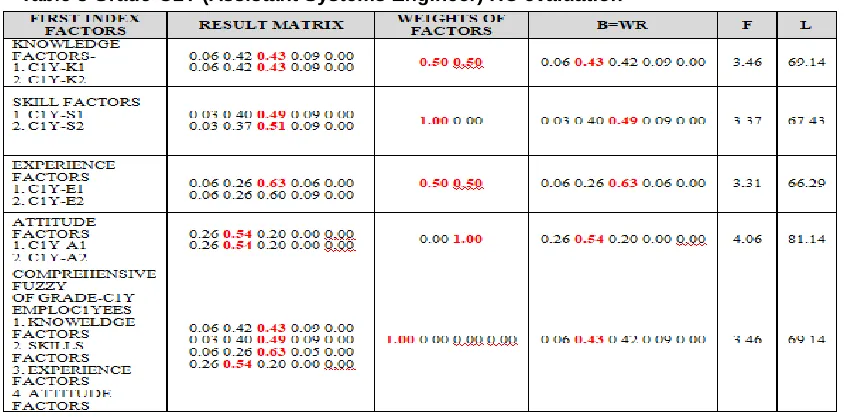
Knowledge in dot NET and Java is equally important at assistant systems engineer level (C1Y LEVEL). Human capital with respect to Knowledge factors is “Very good” with a maximum membership value of 0.43. The human capital filled in knowledge factors is about 69% and there is a gap of 31%.
Skill Factors:
Quick learning is the most desirable skill with absolute weight of 1. Human Capital in skill factors is observed to be “GOOD” with a maximum membership of 0.49. Human Capital filled with skill factors at grade-C1Y level is about 67% and still
there is a gap of 33%.
Experience Factors:
Working experience as a team member in software development and testing is equally important with equal weights. Human Capital in experience factors is observed to be “Good” with a maximum membership of 0.63. Human Capital filled with experience factors at grade-C1Y level is 66% and still there is a gap of 34%.
Attitude Factors:
Being ambitious is the most desirable attitude at this level. Human Capital in attitude factors is “Very good” with a membership value of 0.40. Human capital filled with respect to attitude factors is 81%.
4.3.1 OVERALL COMPREHENSIVE ANALYSIS OF GRADE-C1Y
EMPLOYEES
Knowledge factor is absolutely important over other factors, i.e., Skill, Experience, Attitude factors. Assistant Systems Engineer level employees are expected to possess the high levels of expert knowledge in dot net, expert knowledge in Java, having quick learning skills, experience of working in teams of software development and testing, and attitude of ambitious to the career development in the software design and development. As per the personal conversations with the evaluator, they often find people with low levels of quick learning skills. This is true as per the evaluations. This is the reason that human capital in skills factors at this level is just “GOOD”. Learning management teams should focus on these aspects to develop these learning skills. Overall Human Capital in grade-C1Y employees is found to be “Very Good” with membership value of 0.43. Human capital filled in grade-C1Y is about 69% and there is still a gap of 31%.
4.4FUZZYCOMPREHENSIVE ANALYSIS OF HUMAN CAPITAL OF
GRADE-C1 EMPLOYEES
Analysis of Table-4:
Knowledge Factors:
Expert knowledge in data structures has got outright weight of 1. Human capital with respect to Knowledge factors is “Very good” with a maximum membership value of 0.40 which means that systems engineers at TCS have very good knowledge of data structures as per their bosses.
The human capital filled in knowledge factors is about 78% and there is a gap of 22%.
Skill Factors:
6423 Experience Factors:
Working experience in various projects is a great experience at systems engineer level (C1-level). Human Capital in experience factors is observed to be “Very Good” with a maximum membership of 0.51. Human Capital filled with experience factors at grade-C1 level is 77% and still there is a gap of 23%.
Attitude Factors:
Knowledge sharing is the most desirable attitude at systems engineer level. Human Capital in attitude factors is “Very good” with a membership value of 0.40. Human capital filled with respect to attitude factors is 81%.
4.4.1 OVERALL COMPREHENSIVE ANALYSIS OF GRADE-C1
EMPLOYEES
Knowledge continues to play as the most important factor amongst the four factors, i.e., Knowledge, Skill, Experience, Attitude factors. According the evaluator, Systems Engineer should have high degree of expert knowledge in data structures, Technical skills, projects working experience, and the positive attitude to share the knowledge. Knowledge factors are the least explained human capital factors in this level. Software development, design, multitasking skills, problems handling experience and commitment are the most commonly expected factors from the employees but they posses relatively no weight in human capital evaluation. Overall Human Capital in grade-C1 employees is found to be “Very Good” with membership value of 0.40. Human capital filled in grade-C1 is about 79% and there is still a gap of 21%.
4.5OVERALL HUMAN CAPITAL EVALUATION AT BOTTOM LEVEL EMPLOYEES OF SELECT SOFTWARE ORGANIZATION
Analysis of Table-5:
Table 1Grade-Y (A.S.E trainee associate level) HC evaluation
Table 2 Grade-YG (Graduate trainee) HC evaluation
6425
Table 4 Grade-C1 (Systems Engineer) HC evaluation
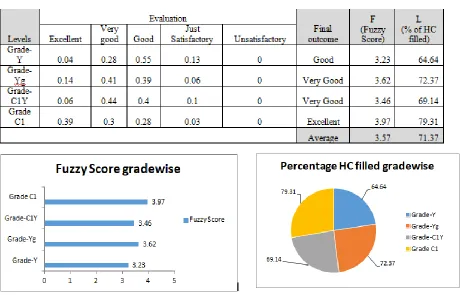
Table 5 Fuzzy HC evaluation of four bottom level staff at TCS Ltd.
Figure 1 Fuzzy score of each level of staff Figure 2 Percentage of HC filled at each level
5 C
ONCLUSIONHuman capital is inevitable for the success of any organization. It is indeed the human capital that singles out the organization from others. When all other opportunities or resources are equally available, the firm specific human capital that is developed over a period of time will enable the firm to outperform the other firms. This paper demonstrates about how to measure human capital filled in an organization at different levels with a special focus on a select software
organization. The research identifies the gaps and senses the need for additional measures such as training and rigorous recruitment process in order to fill a better human capital for a successful organization.
efficiency of human capital and helps in optimization of the software sectors performance.
R
EFERENCES[1] Badiyani, B. M. (2012). “Human Resource Accounting: Brief History and Popular Models”. Quest International Multidisciplinary Research Journal, 1 (2), 155-158.
[2] Balogh, B. (2013). "How to measure Human Capital: A short review". Network Intelligence Studies, 1 (1), 21-36.
[3] Becker, G. S. (1994). "Human Capital: A Theoretical and Empirical Analysis with Special Reference to Education" (3 Ed.). The University of Chicago Press.
[4] Calabrese, A., Costa, R., & Menichini, T. (2013). Using Fuzzy AHP to manage Intellectual Capital assets: An application to the ICT service industry. Expert Systems with Applications, 40(9), 3747-3755. [5] Celik, M., Er, I. D., & Ozokc, A. F. (2009). "Application of fuzzy
extended AHP methodology on shipping registry selection: The case of Turkish maritime industry". Expert Systems with Applications, 36 (1), 190-198.Chang, D.-Y. (1996). "Applications of the extent analysis method on fuzzy AHP". European Journal of Operational Research, 95, 649-655.
[6] Chang, D.-Y. (1996). “Applications of the extent analysis method on fuzzy AHP”. European Journal of Operational Research , 95, 649-655.
[7] Chao, C.-Y., & Yan, K.-F. (2011). "Combining Fuzzy Set theory and Extent Analysis to construct an Integrated Decision Making Approach in Medical Cosmetology Industry". Information technology Journal, 10 (10), 1950-1956.
[8] Do, Q. H., & Chen, J. F. (2013). A neuro-fuzzy approach in the classification of students‟ academic performance. Computational intelligence and neuroscience, 2013.
[9] Edvinsson, L., & Malone, S. M. (1997). “Human capital: Realizing your firm‟s true Value”. By finding its hidden brainpower, Harper Collins Publishers, New York
[10] Esfahani, D. N., Ghorbani, O., Amiri, Z., & Farokhi, M. (2013). "Identifying and Ranking the Effective Factors on the Organizational Indifference through Fuzzy Analytical Hierarchy Process (FAHP) (Damavand Municipality as a Case Study)". International Journal of Academic Research in Business and Social Sciences, 3 (6), 64-77. [11] Flamholtz, E. G. (1971). "A Model for Human Resource Valuation: A
Stochastic Process with Service Rewards". The Accounting Review, 46, 253-267.
[12] Kabir, G., & Hasin, D. M. (2011). "Comparative analysis of AHP and Fuzzy AHP Model for Multicriteria Inventory Classification". International Journal of Fuzzy Logic Systems (IJFLS), 1 (1), 1-16. [13] Kabir, G., & Hasin, M. A. (2011). "Evaluation of customer oriented success factors in mobile commerce using fuzzy AHP". Journal of Industrial Engineering and Management (JIEM), 4 (2), 361-386. [14] Kahraman, C., Cebeci, U., & Ulukan, Z. (2003). “Multi-criteria supplier
selection using fuzzy AHP”. Logistics Information Management, 16 (6), 382-394.
[15] Lee, S. H. (2010). Using fuzzy AHP to develop intellectual capital evaluation model for assessing their performance contribution in a university. Expert systems with applications, 37(7), 4941-4947. [16] Lev.B & Schwartz. A. (1971). "On the use of the economic concept of
human capital in financial statements". The Accounting Review, 49 (1), 103-112.
[17] Morse, W. J. (1973). "A Note on the Relationship between Human Assets and Human Capital". The Accounting Review, 48 (3), 589-593.
[18] Nazari, A., Salarirad, M. M., & Bazzazi, A. A. (2012). "Landfill site selection by decision- making tools based on fuzzy multi-attribute decision-making method". 65 (6), 1631-1642.
[19] Nikfarjam, A., Mavi, R. K., & Fazli, S. (2013). "Prioritizing Entrepreneurial University Factors by Fuzzy Analytic Hierarchy Process". International Journal of Economy, Management and Social Sciences, 2 (10), 876-884.
[20] Paktinat, M., & Danaei, A. (2014). "An application of fuzzy AHP for ranking human resources development indices". Management Science Letters, 4 (5), 993-996.
[21] Percin, S. (2008). “Use of fuzzy AHP for evaluating the benefits of information-sharing decisions in a supply chain”. Journal of Enterprise Information Management, 21 (3), 263-284.
[22] Saaty, T. L. (1980). “The Analytic Hierarchy Process” (New York: McGrew Hill. International, Translated to Russian, Portuguese‟s and Chinese,). New York: McGrew Hill; Paperback (1996, 2000), Pittsburgh: RWS Publications.
[23] Schultz, T. (1961). “Investment in Human Capital”. The American Economic Review, 51 (1), 1-17.
[24] Shaverdi, M., Heshmati, M. R., & Ramezani, I. (2014). "Application of Fuzzy AHP Approach for Financial Performance Evaluation of Iranian Petrochemical Sector". 2nd International Conference on Information Technology and Quantitative Management, ITQM 2014. 31, pp. 995-1004. Elsevier.
[25] Shu, B. T., Meng, C. J., & Meng, S. (2013). "Risk assessment research for power transformer based on fuzzy synthetic evaluation". Journal of Chemical and Pharmaceutical Research, 5 (12), 612-618. [26] Van Laarhoven, P. J., & Pedrycz, W. (1983). A fuzzy extension of
Saaty's priority theory. Fuzzy sets and Systems, 11(1-3), 229-241. [27] Xin, L., An-quan, Z., Man-hong, K., & Zhong-rong, T. (2009, October).
On the application of fuzzy comprehensive appraisal in human capital evaluation of logistics enterprises. In 2009 16th International Conference on Industrial Engineering and Engineering Management (pp. 2012-2015). IEEE.