United Kingdom
Vol. II, Issue 6, 2014
Licensed under Creative Common Page 1
http://ijecm.co.uk/
ISSN 2348 0386
THE IMPACT OF WORK-LIFE BALANCE POLICIES ON DEVIANT WORKPLACE
BEHAVIOR IN PAKISTAN
Shakir, Khurram
Department of Business Administration, Benazir Bhutto Shaheed University Lyari
Karachi, Pakistan
Siddiqui, Siraj Jamal
Business Studies, IQRA University, Karachi, Pakistan
Abstract
Purpose of this research is to explore the association between work-life balance policies and
deviant workplace behavior. For this purpose a survey was conducted from 282 employees of
several organizations in Karachi Pakistan. Results show that all dimensions of work life balance
except personal commitment have significant influence on deviant workplace behavior. This
research provides insight on that area of study which is not yet investigated and tested in
Pakistan. The limitation of study is sample population taken from one area of Pakistan that is
Karachi, limiting fully generalizability of the current findings.
Keywords: Deviant Workplace Behavior, Work-life Balance, HR Policies
INTRODUCTION
Deviant work place behavior (DWB) is not a new idea to discuss in corporate world but the
reasons which create deviance are still ushering new dimensions to examine with the time and
are subject to study. DWB is a vital issue for researchers due to its growing rate and possible
effects (Spector and Fox, 2005). The loss which organizations have suffered due to work place
deviance is in billions of dollars per year. The incidence of DWB is very expensive for
companies and employees. (Bennett and Robinson, 2003). There are several explanations
available for employees deliberate destructive behavior in organizations and every explanation
leads towards the conclusion that employee does not get what he/she expects from
organization and in return most of the employees do what they are not supposed to do at work or do things which are against employer or organization‟s expectations. In recent decades the
Licensed under Creative Common Page 2
employees thinking and expectation at work. In the era of globalization and 24/7 working
structure, the concept of work life balance has emerged and now become necessity of every employee. This study evaluates possibility of relationship between organization‟s work life
balance policies with deviant work place behavior, and also assesses the effect of improving
/introducing WLB policies in organization in reduction of deviance from work place.
LITERATURE REVIEW
Deviant work place behavior can be classified as deliberate behavior that breaches major
organizational standards and jeopardizes the organizations interests and or its employees
(Robinson and Bennett, 1997). Griffin and Lopez, (2004) recognized that every employee at
work has possibility to engage in this destructive behavior. Managers usually do not encourage
studies that highlight such behaviors as it refers organizational weakness and governance
issues. (Analoui and Kakabads, 1992).
Work place deviance usually occur where an employee feels victim of unfair treatment
.As Mitchel and Ambrose (2002) stated that deviant work place behavior is a retaliation of unfair treatment with an unfair treatment ‟an eye for an eye‟. Employees most likely encounter
feeling of resentment, aggravation and wish to retaliate when they sense they are being treated
unjustly (Bies and Tripp, 1996; Greenberg, 1990). Perceived discrimination is a foundation to
establish nonconforming workplace behavior (Bennett & Robinson, 2000; Fox, Spector, & Miles,
2001).
Clutterbuck (2003 p.8) defined work life balance as „„A state where an individual
manages real or potential conflict between different demands on his or her time and energy in a way that satisfies his or her needs for well-being and self-fulfilment‟‟. From this definition, it is
evident that work life balance is not a process of balance or equal distribution of your work and
non-work life but it is a measure of control over when, where and how you work which helps you
to achieve maximum satisfaction that you are living your life and your work is still beneficial and
acceptable as a standard for business.
WLB definition given by (Department of Trade and Industry,2001) makes this concept
clearer that it is not only belong to family and baby minding. Nor regarding fewer hours work.
The notion of WLB is working „smart‟ and sensing fresh enough to manage your work life and
personal life without compromising any one for other. WLB has become inevitable for everybody
regardless in which phase he/she is in of his/her life.
So WLB entire theme is based on minimizing the tension between work and different parts of people‟s lives and creating a productive work culture which has supportive management
and organizational system. But when an individual finds that the organization in which he/she is
Licensed under Creative Common Page 3
working smart then the feelings of breach of psychological contract emerge which leads
employee deviant behavior at work.
The term Psychological Contract (PC) was conceived by Argyris (1960) and refers to an “unwritten contract between employers and employees which covers a series of mutual expectations and satisfaction of needs arising from the people-organization relationship”
(Mullins, 2002 p 908). The important aspect of the PC is a notion of mutuality that integrates
sense of acceptance of promises and responsibilities by employer and employee. Such
commitments usually based on the subject of faithfulness, flexibility and job security. Moreover these commitments also include prospects for employee‟s development and career progress but
the current generation of employees gives more importance to quality of life, in respect to the
ever increasing work pressure (Mitchell , Holtom, Lee, 2001). The influence of work-life problems on younger employees‟ psychological contract investigated by Smithson and Lewis
(2001) reveals that some employees compromised on job insecurity and poor working
conditions in return of job flexibility and normal working hours, just because of they wanted to
have room for their relations or private lives. In fact, it has been argued that WLB can play an
important role in creating a positive psychological contract (i.e. established on shared faith)
(Coussey, 2000).
Work-life balance needs to be identified by employees as an important factor of
psychological contract between employees and organization that higher management really
needs its employees to be zestful at work and in personal lives (Clutterbuck, 2003). But when an employee expectation doesn‟t fulfill by employer then Psychological contract violation
comes into existence, and potential emotional response to this violation leads to deviant
workplace behavior (Tompru and Nikolau, 2010). Deviant workplace behavior is a type of
confrontation to organizations authority. Whilst an employee unable to acquire his right as per
his expectation at the beginning of job than he/she demonstrates deviant behavior at workplace
(Lawrence and Robinson, 2007). As stated by Appelbaum, Iaconi and Matousek (2007) at any
time employee finds that he is not receiving according to expectation he will be inclined to
display deviant workplace behavior.
Lack of opportunities to avail work life balance in any organization bring sense of
deprivation among employees and they feel frustrated .As per Ozler and Atlay (2011) statement
dissatisfy ,unpleased and aggravated employees become victim of burnout syndrome and
ultimately it produces negative results like leaving before office time, engaging in clashes with
other employees, censuring others, working slow and absenteeism. Burnout syndrome takes
place when an employee unable to cope work stress created by any reason i-e working long
Licensed under Creative Common Page 4
concluded that encountering work stressors have direct link to violent behaviors like sabotage ,
unfriendliness ,antagonism.
The longer numbers of hours people spend at work have negative effects on families‟
life. Burchell, Deaken and Honey (1999) discovered in the survey of 340 employees, about 50%
employees had the opinion that long working hours made their family life compromised over
work. The majority of frequently mentioned issue were sensing exhausted and bad-tempered,
not having sufficient time for spouses and offspring and limiting the family activities and
enjoyment. Furthermore, studies have recognized that rise in job stress has chances to promote
deviance or outcomes that encourage deviance like absenteeism, disappointment, stress, and
nervousness (Jackson and Schuler ,1985).
Researches propose that the intrusion of work with home or home with work is truly a
reciprocal relationship (Carlson and Kacmar, 2000). The interference of family responsibility with
work are well recognized as prime reason of absenteeism because employee mostly unable to
fulfill his family responsibility at work such as looking after school going sick children at home
(Anderson et al., 2002; Burke and Greenglass, 1999). Additional commonly established results
of work intrusion with home are low organizational commitment by employees (Lyness and
Thompson, 1997), and higher stage of burnout, or work-related tiredness ( Kinnunen and
Mauno, 1998). Study shows that work intrusion with home is more common than home intrusion
with work (Eagle, Miles and Icenogle, 1997; Gutek, Searle and Klepa, 1991).
Role conflict is also referred as issue of work life balance and one of the reason of
stressor where employee face clash between work and family role that which one needs to be
fulfilled it could be good father/mother against good employee (Kinney, 1995). Study has shown
that role conflict and role ambiguity influence number of attitudes and behaviors over different
work situations (Boles, Johnston and Hair., 1997). Einarsen, Raknes, and Matthiesen, (1994);
Chen and Spector, (1992) studies show that stress linked with role conflict is revealed to be
related with workplace bullying and workplace hostility. Research on effect of work-family
conflict and sales person deviance behavior by Darrat, Mahmoud , Amyx, Douglas, Bennett and
Rebecca (2010) revealed work-family conflict is a main forerunner of deviance at work as sales
persons were facing enhanced deviation in work family roles and responding by breaching the
organizational rules where forty percent of sales reps confess that they were involve in work
place deviance .
By introducing work life balance initiatives or improving the prevailing work life policies
organizations can create positive psychological contract and mange to avoid such burnout
syndrome and its repercussions. Appelbaum, Deguire and Lay (2005) suggest maintaining and
honoring the psychological contract, supports fair work environment and encouraging wellbeing
Licensed under Creative Common Page 5
METHODOLOGY
This research has been conducted on quantitative bases, the author attempted to examine the
link between the dependent variable (Deviant workplace behavior) and independent variables
(Long working hours, Family responsibilities, Role conflict and Personal commitments).
Data
In this research we have collected primary data by simple random sampling of sample size 282
from the staff of different banks, mobile companies, manufacturing companies and hospitals
with the help of self designed questionnaire based on likert scale (1 to 5).
1= strongly agree and 5=strongly disagree.
Model Equation
Deviant Workplace Behavior = Constant + Long Working Hours + Family Responsibilities + Role
Conflict+ Personal Commitments
DWBi = β0 + β1 . LWHi + β2 . FRi + β3 . RFi + β4 . RCi + β5 . PCi + Ui
ANALYSIS & FINDINGS
Sample Distribution
Total 282 questionnaires distributed and collected for data from employees of several
organizations and no data is missing.
Table 1 Sample Distribution
Gender Age Marital status Cadre Experience Segment
N
Valid 282 282 282 282 282 282
Missing 0 0 0 0 0 0
Table 2 Sample Distribution - Genderwise Gender
Frequency Percent Valid Percent Cumulative
Percent
Valid
male 196 69.5 69.5 69.5
female 86 30.5 30.5 100.0
Total 282 100.0 100.0
Licensed under Creative Common Page 6
Table 3 Sample Distribution - Agewise Age
Frequency Percent Valid Percent Cumulative
Percent
Valid
20-30 years 217 77.0 77.0 77.0
31-40 years 54 19.1 19.1 96.1
41-50 years 7 2.5 2.5 98.6
51and above 4 1.4 1.4 100.0
Total 282 100.0 100.0
Data frequency depicts age of contributors between 20-30 years is 77% , 31-40 years is
19%.,41-50 years is 2.5% and 51 and above years is 1.4% only.
Table 4 Sample Distribution – Marital statuswise
Marital status
Frequency Percent Valid Percent Cumulative
Percent
Valid
single 204 72.3 72.3 72.3
married 50 17.7 17.7 90.1
married with children 25 8.9 8.9 98.9
single parent 3 1.1 1.1 100.0
Total 282 100.0 100.0
Marital status of the participants who are single is 72% , married participants are almost 18%,
participants who are married with children are 9% and 1% single parent.
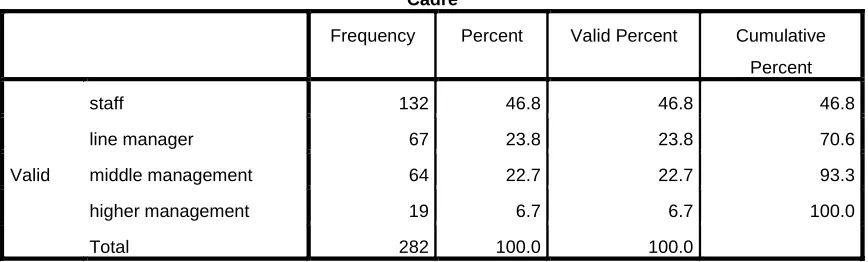
Table 5 Sample Distribution - Caderwise Cadre
Frequency Percent Valid Percent Cumulative
Percent
Valid
staff 132 46.8 46.8 46.8
line manager 67 23.8 23.8 70.6
middle management 64 22.7 22.7 93.3
higher management 19 6.7 6.7 100.0
Total 282 100.0 100.0
Licensed under Creative Common Page 7
almost 24% works under line manager cadre, almost 23% works under middle management
cadre and 7% of participants belongs to higher management.
Table 6 Sample Distribution - Experiencewise Experience
Frequency Percent Valid Percent Cumulative
Percent
Valid
1 year 79 28.0 28.0 28.0
2 years 54 19.1 19.1 47.2
3 years 65 23.0 23.0 70.2
4 years 28 9.9 9.9 80.1
5 years or more 56 19.9 19.9 100.0
Total 282 100.0 100.0
Experience of participants‟ shows that employees with one year experience are 28% , 2 years
experience are 19% , 3 years experience are 23% , 4 years experience are 10% and 5 years or
more experience are 20% of the data collected.
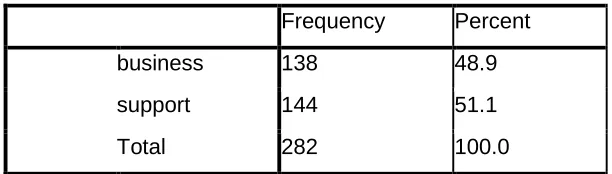
Table 7 Sample Distribution - Segmentwise
Frequency Percent
business 138 48.9
support 144 51.1
Total 282 100.0
Participants of this research belong to support segment of their organizations are 51% and rest
of 49% belongs to business segment.
Table 8 Case Processing Summary
N %
Cases
Valid 282 100.0
Excludeda 0 .0
Total 282 100.0
a. Listwise deletion based on all variables in the
Licensed under Creative Common Page 8
Reliability Estimation
Cronbach's Alpha Reliability test calculated to confirm the consistency of the measures we
applied in research. The observed Cronbach's Alpha value is .745 in this research which is
acceptable so measures we used in this study are reliable and appropriate.
Model Estimation
Table 9 Regression Model Summery
Model Summaryb
Model R R Square Adjusted R Square Std. Error of the
Estimate
Durbin-Watson
1 .360a .130 .117 .63742 1.584
a. Predictors: (Constant), PC, LWH, RC, RF
b. Dependent Variable: DB
Over all model is significant as its value is less than .05. The combine effect of the model is
shown by F-statistic which is 10.328.
Table 10 ANOVA Statistics
ANOVAa
Model Sum of Squares df Mean Square F Sig.
1
Regression 16.785 4 4.196 10.328 .000b
Residual 112.547 277 .406
Total 129.332 281
a. Dependent Variable: DB
b. Predictors: (Constant), PC, LWH, RC, RF
Table 11 Regression Coefficients
Coefficientsa
Model Unstandardized Coefficients Standardized
Coefficients
t Sig. 95.0% Confidence Interval for B Collinearity Statistics
B Std. Error Beta Lower Bound Upper Bound Tolerance VIF
1
(Constant) 2.146 .211 10.192 .000 1.731 2.560
LWH .264 .069 .243 3.818 .000 .128 .400 .779 1.284
RF -.152 .062 -.165 -2.439 .015 -.274 -.029 .688 1.455
RC .273 .067 .259 4.067 .000 .141 .405 .777 1.286
PC .003 .048 .005 .072 .943 -.091 .098 .807 1.239
Licensed under Creative Common Page 9
Table 11 shows the effect of each independent variable on dependent variable. The beta of
LWH is .243 which shows significant positive impact on deviance workplace behavior as sig
value is less than 5%. Beta of RF is -.165 which shows significant negative impact on deviance
behavior as sig value is less than 5%. Beta of RC is .259 which shows significant positive
impact on deviance workplace behavior as sig value is less than 5%. Beta value of PC is .005
which shows insignificant impact on deviance workplace behavior as sig value > 5%.
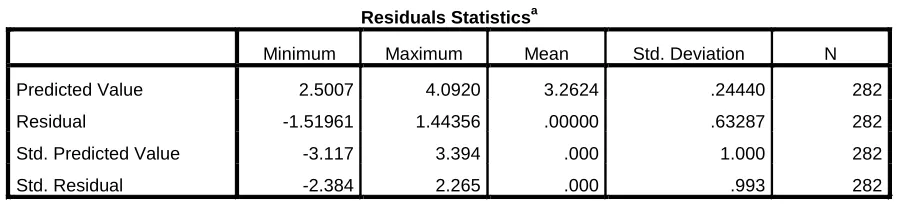
Table 12 Residuals Statistics
Model Equation
Deviant workplace behavior = 2164 +(.2.43) Long working hours + (-.165) Responsibilities of
family + (.259)Role conflict + (.005) Personal commitments
CONCLUSION
This study tries to find the relationship between organization‟s work life balance policies and
deviant workplace behavior and in this research we probed the contribution of work life balance
in deviant workplace behavior. On the basis of regression analysis results we can say that this
research empirically supports relationship between DWB and work life balance policies. In the
context of literature review of this research when an individual finds that the organization in
which he/she is employed is not giving him/her enough room to have control over work and
he/she is not working smart then the feelings of breach of psychological contract emerge which
leads employee deviant behavior at work such as behaving rudely with bosses ,colleagues and
subordinates, exchanging harsh comments with customers and staff, hearing gossips and
rumors about bosses at work, passing remarks on colleagues, not following the bosses
instructions at work, using abusive language at work , making fun of bosses and customers ,
discussing confidential information with people outside organization. Study results support the
impact of work life balance on deviant workplace behavior as long working hours, family
responsibilities and role conflict were observed as significant predictors of deviant workplace
behavior. Where work-life balance policies, which promote long working hour culture, create role
Residuals Statisticsa
Minimum Maximum Mean Std. Deviation N
Predicted Value 2.5007 4.0920 3.2624 .24440 282
Residual -1.51961 1.44356 .00000 .63287 282
Std. Predicted Value -3.117 3.394 .000 1.000 282
Std. Residual -2.384 2.265 .000 .993 282
Licensed under Creative Common Page 10
conflict and do not offer room to fulfill family responsibilities in organizations cause deviant
workplace behavior. The results of the research propose that organizations should practice such
policies that help employees to improve their work and life balance in a way that their
psychological contract remain intact with organization which results desirable behavior outcome
at work. However, further research is recommended to validate this relationship of deviant
workplace behavior and work life balance policies. The limitations of study are sample
population taken from one area of Pakistan only i-e Karachi and sensitivity of research due to
which the respondents may have not disclosed their acts of deviance at workplace in spite of
assurance of complete anonymity.
REFERENCES
Analoui, F., & Kakabadse, A. (1992). Unconventional Practices at Work: Insight and Analysis through Participant Observation. Journal of Managerial Psychology, 7, 1-31.
Anderson, S. E., Coffey, B. S., & Byerly, R. T. (2002). Formal organizational initiatives and informal workplace practices: Links to work-family conflict and job-related outcomes. Journal of Management, 28(6), 787-810.
Appelbaum, S.H., Deguire, K.J., & Lay, M. (2005). The Relationship of Ethical Climate to Deviant Workplace Behavior. Corporate Governance, Bradford, 5 (4), 43-57.
Argyris, C.(1960). Understanding Organizational Behavior. Homewood, Illinois: Dorsey Press.
Bies, R. J., & Tripp, T. M. (1996). Beyond distrust: Getting Even and the need for revenge. In R.M. Kramer & M.A. Neale (Eds.) Trust and organizations (pp.246-260). Thousand Oaks, CA: Sage.
Boles, J. S., Johnston, M. W. & Hair, Jr., J. F. (1997). Role stress, work-family conflict and emotional exhaustion: Inter-relationships and effects on some work-related consequences. Journal of Personal Selling and Sales Management, 17(1), 17-28.
Burchell, B, Deakin, S and Honey, S (1999), The employment status of individuals in non-standard employment, Department of Trade and Industry.
Burke, R. J., & Greenglass, E. R. (1999). Work-family congruence and work-family concerns among nursing staff. Canadian Journal of Nursing Leadership, 12 (2), 21-29.
Carlson, D. S., Kacmar, K. M., & Williams, L. J. (2000). Construction and initial validation of a multidimensional measure of work-family conflict. Journal of Vocational Behavior, 56, 249-276.
Chen, P. Y., & Spector, P. E. (1992). Relationships of work stressors with aggression, withdrawal, theft and substance use: An exploratory study. Journal of Occupational and Organizational Psychology, 65, 177-184.
Clutterbuck, D (2003) Managing Work-Life Balance: A Guide for HR in Achieving Organizational and Individual Change. Pp.8, 18,19,24,25 London: CIPD
Coussey, M. (2000). Getting the right work-life balance. London: Chartered Institute of Personnel Directors
Department of Trade & Industry (2001) Work-Life Balance: The Essential Guide to Work-Life Balance, p5
Developing an effective retention policy. Academy of Management Executive, 15(4), 96-109
Eagle, B. W., Miles, E. W., & Icenogle, M. L.1997. “Inter role conflicts and the permeability of work and family domains: Are there gender differences?” Journal of Vocational Behavior, Vol.50.
Licensed under Creative Common Page 11 Greenberg, J (1990). Employee theft as a reaction to underpayment inequity: The hidden cost of pay cuts,” Journal of Applied Psychology, vol. 75,pp. 561-568
Griffin, R.W. & Lopez V.P. (2004). Toward a mode of the person-situation determinants of deviant behaviour in organisations, Academy of Management. New Orleans.
Gutek, B. A., Searle, S., & Klepa, L. (1991). Rational versus gender role explanations for work-family conflict. Journal of Applied Psychology, 76(4), 560-568.
Jackson, Susan E., and Randall A. Schuler (1985), “A Meta- Analysis and Conceptual Critique of Research on Role Ambiguity and Role Conflict in Work Settings,” Journal of Organizational Behavior and Human Decision Processes, 36(August), 16–78.
Kinney, Joseph. 1995. Violence at Work. Prentice Hall
Kinnunen, U. & Mauno, S. (1998). Antecedents and outcomes of work-family conflict among employed women and men in Finland. Human Relations, 51(2), 157-177.
Lewis, S., & Smithson, J. (2001). Sense of entitlement to support for the reconciliation of employment and family life. Human Relations, 54(11), 1455-1481.
Lyness, K. S., & Thompson, D. E. (1997). Above the glass ceiling? A comparison of matched samples of female and male executives. Journal of Applied Psychology, 82(3), 359-375.
Mahmoud Darrat, Douglas Amyx & Rebecca Bennett (2010) An Investigation into the Effects of Work– Family Conflict and Job Satisfaction on Salesperson Deviance, Journal of Personal Selling & Sales Management, 30:3, 239-251
Mitchel, M. and Ambrose, M L. 2007. Abusive supervision and work place deviance and the moderating effects of negative reciprocity beliefs. Journal of Applied Psychology, 92 (4):1159-1168.
Mitchell, T. R., Holtom, B.C., & Lee, T. W. (2001). How to keep your best employees:
Mullins L J (2002) Management and Organizational Behavior, 6th Edition, London, Prentice Hall
Özler, D. E., & Atalay, C. G. (n.d.) (2011). A research to determine the relationship between organizational cynicism and burnout levels of employees in health sector. Business and Management Review, 1.
R. J. Bennett and S. L. Robinson (2003). The Past, Present and Future of Workplace Deviance Research,” J. Greenberg Ed. Organizational Behavior: The state of the Science, pp. 247-281, 2003. R. J. Bennett, and S. L. Robinson (2000). Development of a measure of workplace deviance,” Journal of Applied Psychology, vol. 85, no. 3, pp.349-360, 2000.
Robinson, S. L., & Bennett, R. J. (1997). Workplace deviance: Its definition, its manifestation, and its causes. In R. J. Lewicki, R. J. Bies, & B. H. Sheppard (Eds.), Research on negotiation in organizations (Vol. 6, pp. 3–27). Greenwich, CT: JAI.
S. Fox, P. E. Spector, and D. Miles (2001). Counterproductive work behavior (CWB) in response to work stressors and organizational justice: Some mediator and moderator tests for autonomy and emotions,” Journal of Vocational Behavior, vol. 59, 291-309
S.H. Appelbaum, G.D. Iaconi, and A. Matousek. Positive and negative deviant workplace behaviors: causes, impact, and solutions, Corporate Governance, 2007, Vol. 7, No. 5, p. 586-598.
Spector, P. E., & Fox, S. (2005). A model of counterproductive work behaviour. In S. Fox & P. E. Spector (Eds.), Counterproductive workplace behaviour: Investigations of actors and targets, (pp. 151–174). Washington, DC: APA.
Spector, P.E. (1992). A Consideration of the Validity and Meaning of Self-report Measures of Job Conditions. In Cooper, C.L., & Robertson, I.T., International Review of Industrial and Organizational Psychology, 7. New York: Wiley.
T.B. Lawrence and S.L. Robinson. (2007). Ain‟t Misbehavin: Workplace Deviance as Organizational
Resistance, Journal of Management, 2007, Vol. 33, No. 3, June, p. 378-394