3450
Modeling Structural Changes In The Industry And
Their Impact On Financial Policy
Olena Horokhova, Halyna Chmeruk, Oksana Storozhenko, Vitaliy Romanchukevych, Larisa Gromozdova
Abstract—The dynamics of the structural changes in the impact of the five factors on the gross value added formation by economic activity of the industry are calculated in the dynamics, which is the basis for a detailed analysis of the six-sector economic model. The purpose of the article is to find a comprehensive index of structural changes in the Ukrainian industry by calculating quantitative assessment of structural changes, which is the basis for a detailed analysis of the six-sector economic model in the plane of three main components: Mining and quarrying; Manufacturing; production and distribution of electricity, gas, steam and air conditioning supply. The object of the study is the processes of structural transformation of the six-sector economy model in the Ukrainian industry, which is investigated on the basis of the analysis of Gross Value Added. Calculated in dynamics Index of variable composition, which shows the growth rate average weighted values of gross value added by five factors and Index of fixed composition of rate change of the weighted average values for the current period without regard to the growth rate of factor. Impact factors in each sector of the economy have been identified, which determine the integrated value of the reliability of structural change as the weighted average of the assessment of the reliability of structural change in the industry. It is proved that improvement of the mechanism of budgetary compensation of the value-added tax, creation of an export-credit agency will have a stimulating influence on the development of export activity and will help to increase the confidence of foreign investors to domestic exporting enterprises, which is a prerequisite for the growth of the real economy in terms of the real economy.
Index Terms—Industry, Gross Value Added, aggregate index, structural shifts index, eigenvalue, expert comparisons.
—————————— ——————————
1
I
NTRODUCTIONThe importance of industry, its place and role in the modern world economy in the recent period have changed significantly. If in developing countries, it continues to play a leading role, then in developed postindustrial countries, the situation is different. Here the first place was the sphere of services, pushing the industry to the background. At the same time, the industry itself undergoes structural changes aimed at increasing the role of individual industries in the modern world economy.In the structure of the economy of Ukraine the industrial complex plays an important role. It forms logistical the basis of the national economy, provides its technical re-equipment, and also defines military-economic security, success market reforms and perspectives of postindustrial development of the country as a whole. One of the priorities of socio-economic reform in Ukraine is the modernization of the structure of the national economy and its growth. The transformational process of development of economy and society of Ukraine as country with market economy is constantly in progress. This process requires a qualitative analysis of factors that influence the formation of models of integration and competitiveness of Ukraine in the international space.
The study of the structure of Gross Value Added by type of economic activity allows you to develop a strategy to ensure stable economic growth, as well as to identify the main problems of development of the Ukrainian economy. Gross Value Added shows the level of production efficiency, and it shows the level of motivation of employees to productive work. Note that depreciation (the element of gross added cost) indicates the degree of equipment availability and the availability of its necessary equipment, advanced technologies. The basic picture of behavior of Gross Value Added of industry for investigated groups of years is almost identical. This is due of course with negative political and social situation in Ukraine last years. The next questions arise:
Is this qualitative growth?
Is it possible to find out the factors of influence? For which structural changes occurs this growth?
Among directions of researches of structural parameters of economy it is expedient to be stopped for description of structural changes of six-sectorial model of economy on the basis of analysis of Gross Value Added. At the same time, it is promising to study the basic methods of evaluation and quantitative assessment of structural changes, which will allow qualitative management of the process of structural changes in industry [1, 3, 20]. However, the study of the influence of factors on the formation of gross value added by the economic activity of industry and structural changes in the industry, which is the basis for a detailed analysis of the six-sector economic model, has not been sufficiently studied.
2
L
ITERATURER
EVIEWTheories and models that can be used to analyze the interaction of processes of development and improvement of the economic structure are central to the scientific discussions of experts today [22, 23]. In particular among them there is the theory of structural change, a new theory of economic growth, the theory of economic dynamics, the model of linear stages of growth and the neoclassical model are studied in [1]. Odotyuk [9] shows that given the technical progress "golden rule" is formulated as follows: for maximum indicators of consumption it is necessary that the pure marginal productivity of capital was equal to the growth rate of total production output. Thus, it
————————————————
Olena Horokhova, Candidate of Physical and Mathematical Sciences,
Associate Professor, Advanced Mathematics Department, Marketing Faculty,Kyiv National Economic University named after Vadym Hetman, Kyiv, Ukraine. Email: [email protected]
Halyna Chmeruk, PhD in Economics, Associate Professor,
Department of Cyber Security and Social Sciences, State University of Banking, Kyiv, Ukraine. Email: [email protected]
Оksana Storozhenko, Dean of the Department of Banking Technology
and Business, PhD in Economics, Associate Professor, Institute of
banking technologies and business, Kyiv, Ukraine. Email:
Vitaliy Romanchukevych, First Deputy Chairman of the Board of ACB
"Industrialbank", Member of the Board, PhD in Economics, Associate Professor, Kyiv, Ukraine. Email: [email protected]
Larisa Hromozdova, PhD in Economics, Associate Professor,
is created a system national economy with well-defined causal relationships that stimulate the development of high-tech production in all sectors of the economy.
Shinkorenko [14] points out that recently the vector of external economic activity of Ukraine moves exactly aside the EU. According [2], this is explained by achievers of exercised integration model in Europe, a significant size of internal market, the opportunity to receive a substantial financial assistance and advanced technologies.
Pyrozhkov [13] and Sidorenko [16] noted that this approach allows to obtain the systemically agreed prediction of structural changes in the economy in the long term, which accumulates in itself analysis of changes in the structure of production linkages between reproductive sectors, industries, taking into account the balance of labor resources, production volumes, the accumulation of productive capital, in line with forecasts components of final consumption and exports.
Kryuchkova [4] emphasizes that effective integration of domestic economy in world can have a place only on condition of achievement of high level of general competitiveness of country, and also by share of products and services on internal and external markets. Innovations (technological, organizational, structural and institutional) that create competitive advantages of countries are the basic of modern competitiveness.
According to [5, 17, 21], analysis of economic strategies, which must be directed at stimulating of innovative process, making of re-industrialization and increasing of export of commodities (first and foremost those which have a large share of value added), taking measures on providing of public support for innovative projects, creating of new research centers, shaping the positive conditions for the implementation of long-term investments is an urgent problem on present day. Lin [7] emphasizes the importance of developing and increasing the share of manufacturing, which causes design changes in units with high levels of production productivity. In turn, a higher level of productivity requires greater added value.
Warwick [25] argues that quantitative characteristics of structural change are determined by analyzing the dispersion of growth rates. There is also an intensity of structural shifts in the form of the elasticity of growth in productivity of production. Havlik [3] presents methodological approaches to assessing structural change in industry based on correlation analysis using Spearman rank correlation. Proper evaluation of resource creation capabilities structure of the industrial complex with domination of segments of the fourth and subsequent technological forms are given in the work of Odotyuk [9, 10]. In a scientific paper, Lin [7] identified that to overcome crises and the country's focus on economic growth is possible only in countries characterized by innovative industrial structure. Westkämper in [26] emphasizes the role of state industrial policy in the field of industrial complex restructuring.
The authors Shynkaruk in [15] emphasize that qualitative structural changes in the industrial complex are connected with the development of high-tech types of economic activity, including export orientation, the fourth, fifth and sixth technological processes. In the scientific work [12], the factors
based on the concept of innovative neo-industrialization. Researchers in [8, 18] analyze structural changes in the Serbian manufacturing industry, taking into account the share of employment and value added. On the basis of the analysis is an indicator of structural changes in the manufacturing industry, which makes it possible to determine the patterns of structural changes. Authors in [24] investigate structural changes in developing countries based on changes in employment and the transition from less intensive production to more.
Authors in [19] emphasize that in the context of globalization, production is distributed in global value chains that connect different regions of the world, that is, the shape of structural changes in industry is changing. Xianjia in [27] explores industry modernization in the face of changing industries and the transition of one industry to another. In our opinion, this creates the basis for the study of structural changes in industry in the context of changing industries. At the same time, in the face of the current challenges of stepping up European integration processes, deepening globalization processes and technological shifts do not sufficiently cover issues in the economic literature regarding the concept of structural modernization of the Ukrainian economy. In this context, the solution requires the development of new scientific approaches to measuring structural changes in the Ukrainian industry, which will increase the competitiveness of the state.
3 M
ETHODOLOGY3452
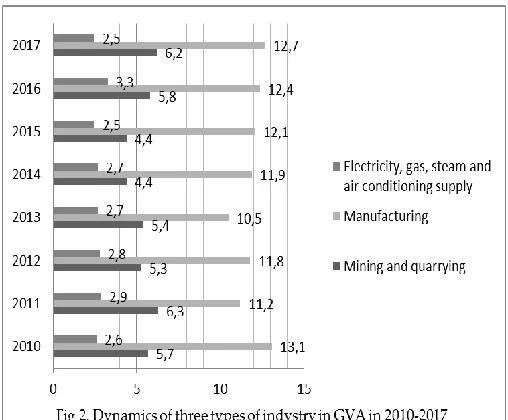
Let's take into account dynamics three basic components of the next types of economic activity of industry in Gross Value Added (at current prices; percent) in 2010-2017, Mining and quarrying, Manufacturing, production and distributing of Electricity, gas, steam and air conditioning supply, for the detailed analysis of structural changes to six-sectorial model of economy (Fig. 2).
Let us select the basic group of factors which influence on structural changes at forming of Gross Value Added in a cut three constituents of industry: Mining and quarrying, Manufacturing, production and distributing of Electricity, gas, steam and air conditioning supply (Fig.3).
Industry
(Mining and quarrying, Manufacturing, Production and distributing of Electricity, gas, steam and air conditioning supply)
Growth of innovative active
enterprises (І1)
Flow of investments in
fixed capital (І3)
Factors of direct influence
Growth of number of employees (Specialization)
(І2)
The establishment of industrial producer
prices (І5)
Flow of investment into Ukraine in the industry
(І4)
Fig. 3. Group of direct influence factors on structural shifts in industry
For measuring influence of factors of change of structural shifts on forming of gross value added we apply the methods of index factor analysis. Thus, it is possible to analyze structural changes in industry under act of five factors in the form of indexes of structural shifts on every factor.
The source data in accordance with Tables 1-3 about the impact factors on the change in the structure of Gross Value Added by economic activity in the industry in 2015-2017 are shown in Table 1.
TABLE 1
THE SOURCE DATA ABOUT AMOUNT OF INNOVATION ACTIVE ENTERPRISES
Types of economic activity (industry)
Gross Value Added (mln. UAH)
Amount of innovation active enterprises (percentage to the total)
2015 2016 2017 2015 2016 2017 Mining and
quarrying
95141 131650 181317 9 9.3 10.1 Manufactu-ring 236692 291471 369452 19.5 21.1 18 Production and
distributing of electricity, gas, steam...
53385 73809 86740 10.5 11.4 8.9
We are interested in the issue the effect of changes in the average annual number of employees to change the structure of Gross Value Added of industry (Table 2). We use the index of the average annual number of employees.
THE SOURCE DATA ON THE AVERAGE ANNUAL NUMBER OF EMPLOYEES AND THE CHANGE OF INDEX OF INVESTMENT IN FIXED
ASSETS
Types of economic activity (industry)
The average annual number of
employees (thousands)
Index of investment in fixed assets (percent to the previous year) 2015 2016 2017 2015 2016 2017 Mining and quarrying 255 232 213 73,9 115.6 151.4 Manufacturing 1339 1293 1265 86.3 114.4 129.1 Production and
distributing of Electricity, gas, steam …
326 320 300 72.3 129.9 90.8
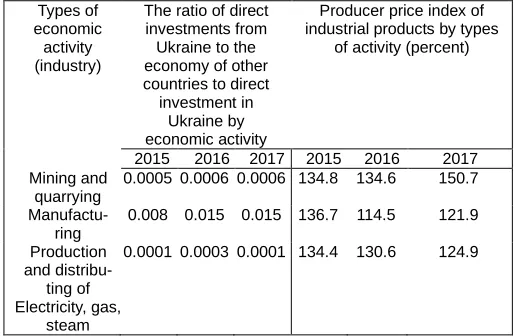
Let's analyze the effect of direct investment in Ukraine by types of economic activity of industry. It is known that official NBU rates are used to transfer foreign currency to the national currency and vice versa. This procedure does not reflect the real ratio of purchasing power of foreign currencies and hryvnia. Therefore, there is a problem of complications of calculations of export and import efficiency indicators. Note that the application of cost includes only the current cost of production. And so, effectiveness of production costs depends the index of export-import investment conditions – the ratio of direct investment from Ukraine to the economy of other countries to direct investment in Ukraine. It is known that attracting investment in the state economy is more profitable than taking loans. However, factors affecting Ukraine, such as corruption, currency instability and inhibition of reforms, create inappropriate conditions for foreign investors. In 2017, the inflow of foreign direct investment fell more than doubled compared with 2016. In 2018, the situation has improved, Ukraine rises in the ranking of investment attractiveness of the countries of the world. The Verkhovna Rada of Ukraine has adopted a bill that simplifies the attraction of foreign investments. In recent years, the peak investment in Ukraine of foreign investment fell to 2011 ($ 6 billion). Over the past four years, the size of the investment in Ukraine has not come close to this level. FDI fell in 2014, when the political situation in the country was extremely unstable. Then the Ukrainian economy received only 2.5 billion dollars – 55% less than in 2013. However, in 2014, the volume of investments amounted to $ 3.8 billion – twice as much as in 2013. The inflow of foreign investments grew in 2016, and in 2017 there was a fall. In the first half of 2018, the inflow of foreign investment in Ukraine amounted to 1.3 billion dollars. Over the past two years, foreign investors have invested the most in financial and insurance activities, as well as wholesale and retail trade, repair of motor vehicles. This year investments came in the sphere of scientific and technical activity. It is known that Russia has invested in the Ukrainian economy 34.6% of the total volume of investments. The funds are also invested by Cyprus, the Netherlands, Austria, Poland, Great Britain, France, Germany, Italy and Hungary.The largest share in the structure of foreign direct investment falls on industrial enterprises. As of 01.01.2016, $ 13280.1 million is concentrated. The United States (30.6% of their total volume) of foreign direct investment, directed from the countries of the
products on the structure of gross value added through the producer price index are represented in Table III. We used index analysis formulas (for example, Kevish, 1990) to calculate the indexes namely index variable composition, fixed composition and index of structural shifts for the factors discussed above at the periods 2015-2016 and 2016-2017. And so,
1) The weighted average values of gross value added which defined by five influence factors by the following formulas:
3 3
1 1
3 3
1 1
, .
j j i i
j i
i j
i j
i j
p q p q
x x
q q
(1)
where
i
– a number of the basic period 2015 (for the analysis of 2015-2016), and also a number of the basic period 2016(for the analysis of 2016-2017);
j
– a number of the current period 2015 (for the analysis of 2015-2016 ), and also a number of the next period 2016 (for the analysis of 2016-2017);TABLE 3
THE SOURCE DATA ON CHANGES IN THE INDEX OF EXPORT-IMPORT INVESTMENT CONDITIONS AND ABOUT CHANGE THE PRODUCER
PRICE INDEX OF INDUSTRIAL PRODUCTS BY TYPE ACTIVITY
Types of economic
activity (industry)
The ratio of direct investments from Ukraine to the economy of other countries to direct investment in
Ukraine by economic activity
Producer price index of industrial products by types
of activity (percent)
2015 2016 2017 2015 2016 2017 Mining and
quarrying
0.0005 0.0006 0.0006 134.8 134.6 150.7
Manufactu-ring
0.008 0.015 0.015 136.7 114.5 121.9 Production
and distribu- ting of Electricity, gas,
steam
0.0001 0.0003 0.0001 134.4 130.6 124.9
2) Index of variable composition, which show the growth rate of average weighted values of gross value added by the abovementioned five factors
3
1 3
1 3
1 3
1
j j i
i
i i i j
j j
i j x
q q
q p
q p
x x I
; (2)
3454
3 1 , 1 3 1 j i j i j j j x q p q p I; (3)
4) Index of structural shifts, which show how much has changed indexed rate of factors of influence due to changes in the structure of gross value added:
3 1 3 1 3 1 3 1 , 1 j j i i i i i j i j i sz q q q p q p I (4)Formulas of indexes of fixed composition and structural shifts is equally weighted, that provides connection between these indexes in the system
sz x
x
I
I
I
. (5)
Within the limits of index system we can determine the role of each factor, assess its influence on the dynamics of the result by factor analysis [11]. Next we find the weight value the importance of each factor by the method of Krylov [6] that will allow us to find the aggregate index of structural change taking into account the factors of influence the formation of GVA for some economic activities.
Indices were calculated by the formula (1)-(4) using the data Tables 1-3 separately for the periods 2015-2016 and 2016-2017. The results of calculations indices of the variable, fixed composition and structural shifts for group 3 factors of direct influence on structural shifts in industry are presented in Table 4.
TABLE 4
RESULTS OF CALCULATIONS INDICES І1,І2,І3
Appe -llatio n
І1 І2 І3
2015-2016 2016-2017 2015-2016 2016-2017 2015 -2016 2016 -2017 i
x
154674,5 196550,4 196550,4 250092,5 1,27 1,27j x 186768, 3 233622, 6 233622, 6 299212, 2
1,25 1,28
x
I
134697, 5 161574, 9 161574, 9 228142, 61,20 1,41
x
I
226330, 8 281333, 2 281333, 2 360461, 41,24 1,28
sz
I
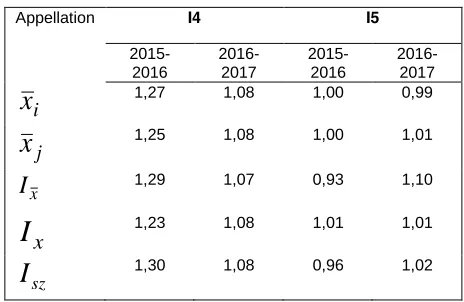
128986,8 159949,9 159949,9 209294,3 1,24 1,31The results of calculations indices of the variable, fixed composition and structural shifts for group 2 factors of direct influence on structural shifts in industry are presented in Table 5.
TABLE 5
RESULTS OF CALCULATIONS INDICES І4,І5
Appellation І4 І5
2015-2016 2016-2017 2015-2016 2016-2017 i
x
1,27 1,08 1,00 0,99j
x
1,25 1,08 1,00 1,01x
I
1,29 1,07 0,93 1,10x
I
1,23 1,08 1,01 1,01sz
I
1,30 1,08 0,96 1,02Interrelation of the indiсes in the system is consistent with the formula (5). We introduce a system of points for expert assessment groups factors when comparing among themselves in pairs: 1 point – the equally possible factors (when comparing with each other, or equal for possibilities); 2 points – there is an insignificant advantage of factor; 3 points – there is a significant advantage of factor; 4 points – there is a significant advantage of the factor; 5 points – there is an absolute advantage factor throughout all the assessment criteria. Group of experts has been involved for the calculation of pairwise comparison of factors groups of structural shifts on the degree of importance. If the first factor by expert estimates is regarded as an insignificant advantage of factor over the second, then this relation is estimated at 2 points, while the inverse relation advantages the second factor over the first will be estimated at 1/2 points. The results of expert comparisons are presented at a Fig. 4.
I1 I2 I3 I4 I5 2 1/2 1/3 3 1/3 1/3 1/3 1/3 3 3 3 3 1/4 4 2 1/2 2 1/2 3 1/3
Fig. 4. Flowchart of pairwise expert comparisons of factors groups of structural shifts depending on the degree of importance
I1 I2 I3 I4 I5 2 1/2 1/3 3 1/3 1/3 1/3 1/3 3 3 3 3 1/4 4 2 1/2 2 1/2 3 1/3
Data of the calculations expert assessments are presented by the next inverse-symmetric matrix (Table 6). By the method of Krylov [6] finding of the eigenvalues of symmetric matrices with inverse element and detecting of the adequacy according to the method comparing of the theory of random matrices, we find the weight value the importance of each factor:
1 2 3
4 5
0.153, 0.079, 0.389
0. 0.
,
177, 202.
TABLE 6
MATRIX OF EXPERT PAIRWISE COMPARISONS OF INDICES І1,І2,І3,І4,І5
І1 І2 І3 І4 І5
І1 1 2 1/3 3 1/4
І2 1/2 1 1/3 1/3 1/3
І2 3 3 1 2 3
І2 1/3 3 1/2 1 2
І2 4 3 1/3 1/2 1
The aggregate index of structural changes of influence of five factors on the formation of Gross Value Added by type of economic activity of industry, calculated by the formula
5
1
k
sz
k
I
kI
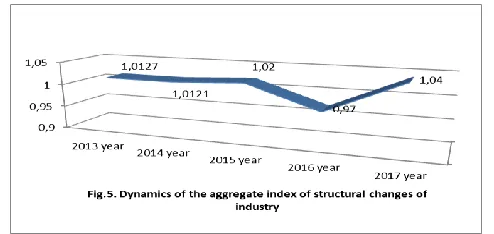
The results of calculations of the aggregate index are listed in Fig.5.
The total index of structural changes in the industry in 2017 has grown by 2.73 % in comparison with 2013. This is due to slight growth rates of Gross Value Added of the basic types of
is threatening the backlog development of extractive and processing types of activity in industry that on methodology of OECD form first two of the strategic sectors of the economy and today is one of the main factors of increase level of competitiveness and ensure sustainable dynamic growth of national economies.
5 D
ISCUSSIONSupport for conditions of stable economic development, effective integration into the global economy, resilience to external risks is possible only in the presence of sound economic fundamentals - strong real and dynamic financial sector, effective economic policy. Industry development is driving economic growth in many countries around the world. In Ukraine there is no systematic approach on the vectors of industrial development.Therefore, materials for discussion on industrial development in Ukraine are presented: quantitative assessment of structural changes in industry, which can become one of the elements of the economic development strategy for the application of further innovation and technological modernization of the industry with the use of the investment component. This will contribute to the availability of financial resources and the deepening of production links. It is necessary to create a system of transformations in the industry based on a quantitative assessment of structural changes in the industry. This will eliminate fragmentation of industrial policy and thus coordinate industrial mechanisms. Therefore, analysis of the concept of structural change, as well as methods of assessing structural change in industry, will contribute to a systematic analytical approach of strategic vectors for the development of structural policy of Ukraine. The industry must be ahead of its development, accompanied by structural changes towards the growth of their particles both in the general issue of the manufacturing industry and in the economy as a whole. Despite the variety and depth of research, the problem of justifying and finding effective statistical methods of economic analysis to investigate the sources and consequences of systemic structural transformations to achieve successful implementation of structural and sectoral priorities remains relevant.
6 C
ONCLUSION3456
identify the instruments for their further development and to form a system of measures of state financial support. Improvement of the mechanism of budgetary compensation of value added tax, creation of an export-credit agency will have a stimulating influence on the development of export activity and will help to increase the confidence of foreign investors to domestic exporting enterprises, which is a prerequisite for the growth of real gross domestic economy.
R
EFERENCES[1] Balyasnikova, Y.V. (2004). Preconditions of forming of innovation model of economic development of Ukraine. Actual problems of economy, 10, 127–134.
[2] Cоellі, T. (2005). An Introduction to Efficiency and Productivity Analysis. New York: Springer.
[3] Havlik, P. (2013). Structural Change and Economic Growth in the New EU Member States, Growth-Innovation-Competitiveness: Fostering Cohesion in Central and Eastern Europe. Vienna Institute for International Economic Studies.
[4] Kryuchkova, I.V. (2007). Competitiveness of Economy of Ukraine: status and prospects of increasing. Kyiv: Osnova.
[5] Kevish, P. (1990). Index Theory and Practice of Economic Analysis. Transl. with Hung. Moscow: Finance and Statistics.
[6] Krylov, B. L. (1956). Solution in the final form of the Riemann problem for the Gauss system, Proceedings of the Kazan Aviation Institute, 31, 203-445.
[7] Lin, Y.J. (2012). New structural economics: A Framework for Rethinking Development and Policy. Washington D.C.: The Word Bank.
[8] Ljubodrag Savić, Gorica Bošković, Vladimir Mićić.(2015) Structural Changes in Manufacturing Industry at Division Level. Serbia and New EU Member States. Industrija, 43 (4), 25-45.
[9] Odotyuk I.V. (2001). State priorities of technological development, its role and problems of economic evaluation in Ukraine. Problems science, 4, 34– 44. [10]Odotyuk, I.V. (Ed.). (2013). Hightech industry sector
Ukraine: resource development opportunities. Kyiv: NAS of Ukraine, Institute for economics and forecasting [in Ukrainian].
[11] Osipov, V.I. (1989). Methods of factor analysis and planning in industry: [study guide]. Kyiv: CMO VO at the Ministry of Higher Education of the Ukrainian SSR. [12]Pashev, K. (Ed.), Casini, P., Kay, N., Pantea, S. EU
Structural Change 2015 Luxemburg: Publications of the European Union, http://bookshop.europa.eu/en/eu-structuralchange-2015-pbETAA15001/
[13]Pyrozhkov, S.I. (2005). Problems acceleration of innovation development. Economist, 4, 31.
[14]Shinkorenko, T.P. (2003). Market transformation of post-socialist economy and macrostructural shifts in Ukraine. Nat. Security and Defence, 4, 19–23.
[15]Shynkaruk, L.V. (Ed.). (2015). the structural transformation in the economy of Ukraine: dynamics, contradictions and influence on economic development: research report. Kyiv: NAS of Ukraine, Institute for economics and forecasting [in Ukrainian].
[16] Sidorenko, M.N. (2006). Analysis of structural shifts in development of the processing of economic activities in
the whole of Ukraine in 2001-2005. Statystyka Ukrayiny, 4, 59–64.
[17]State Statistics Service of Ukraine (n.d.). Retrieved from http://www. ukrstat.gov.ua/
[18]Statistical Yearbook of Ukraine for 2017 / State Statistics Service of Ukraine [edited by O.H. Osaulenko, responsible for the production N.P.Pavlenko]. Kyiv: LLC "August Trade", 558.
[19]Taglioni, D., Winkler, D. 2016. Making Global Value Chains Work for Development. World Bank, Washington DC.
[20]Tetiana Bludova, Nataliya Danylyuk, Oleksandr Dyma, Olena Kachan, Olena Horokhova. Implementation of manufacturer and reseller interaction models, taking into account advertising costs. International Journal of Recent Technology and Engineering (IJRTE), November 2019,Vo. 8, Issue 4, pp. 4727-4736.
[21] Tetiana Bludova, Svitlana Usherenko, Larisa Gromozdova, Nelina Khamska, Olena Shaposhnik. Simulation depending profitability of sales variable costs on forming functions marginal profit enterprise in reengineering. International Journal of Innovative Technology and Exploring Engineering (IJITEE). December 2019. ISSN 2278-3075, Volume-9 Issue-2, рр. 4885-4890.
[22]Tetiana Bludova, Tetiana Galakhova, Volodymyr Tokar Modeling efficiency of advertising of enterprises in the conditions of the digital economy. Collective monograph. Volume 5. Economic security at risk: findings from digitalization of the national economy. Bydgoszcz. - 2019, рр. 186-214.
[23]Tetiana Bludova, Tetiana Galakhova, Volodymyr Tokar. Economic security of entrepreneurship: dimension of diversification. Collective monograph. Scientific development and achievements: monograph [Text]. LP22772, 20-22 Wenlock Road, London, N1 7GU, 2018, volume 1, P.129–141.
[24]Timmer, Marcel, P., Dietzenbacher, E., Los, B., Stehrer, R., Gaaitzen, J. de Vries. 2015. An illustrated user guide to the world input–output database: the case of global automotive production. Review of International Economics, 23 (3): 575–605.
[25]Warwick, K. (2013), Beyond Industrial Policy: Emerging Issues and New Trends, OECD Science, Technology and Industry Policy Papers, 2, OECD Publishing. http://dx.doi.org/10.1787/5k4869clw0xp-en
[26]Westkämper, E. (2013). Towards the Towards the Re-Industrialization of Europe: A Concept for Manufacturing for 2030. Hardcover, Springer, 119.
[27]Xianjia, Ye. (2016). Industrial Structural Change and the Shifts in Comparative Advantage in Globalized
Production. P.50.
http://jobsanddevelopmentconference.org/wp- content/uploads/2016/10/YE_Structural-Change-in-Globalized-Production.pdf
[28] Zbarazska, L.O. (2016). Neoindustrialization in Ukraine: the concept of national model. Economy of the industry, 3
(75), 5-32 [in Ukrainian].