Creating Online Lessons: A Faculty Development Seminar Series
Deborah Sleight, PhD, Christopher Reznich, PhD, Stephen Yelon, PhD, Professor Emeritus and John Williamson, MA
Office of Medical Education Research and Development Michigan State University
East Lansing, MI
Abstract: The World Wide Web is being used increasingly to deliver instruction in medical education. Consequently, there is a need to train faculty in developing and implementing online instruction. We developed and implemented a seminar series to teach faculty to create educationally sound, well-designed online instruction.
Instruction was delivered to 15 participants via a six-session seminar on developing web-based lessons, supplemented with web-based instruction. First, the participants learned the basics of instru c-tional design via a web-based module. They then completed content outlines for their online lessons prior to the first seminar. Lesson development, web site development and the use of a web-based in-structional shell to imp lement the online lessons were each taught in two two -hour sessions.
Eight participants developed online lessons and four actually implemented them. Feedback was mostly positive, with suggestions for improvement. All eight participants who completed the series said they would recommend it to their colleagues.
Because a longitudinal workshop type of seminar series requires a large amount of participant time outside of class, a six-month seminar series may be too long. It is important at the beginning of the se-ries to help participants select topics suitable for online instruction and to help them narrow their top-ics. We may change the attendance guidelines so faculty would attend only the session on instructional design and have their staff attend the technical sessions on web site design, HTML editing and online course delivery systems. This would better match the actual practice of faculty designing the instru c-tion and staff develo ping it.
The movement to situate family medicine clin i-cal education in community settings is well docu-mented.1 Medical students may find themselves in geographically dispersed settings, often far from the academic medical center. In order to deliver high quality instruction at a distance, the World Wide Web is being increasingly used to deliver instruction in medical education.2 Consequently there is a need to train faculty in developing and imple menting online instruction.3
Many institutions are offering faculty develop-ment in the area of distance education.4, 5These offer-ings range from workshops to manuals, from face-to-face to online instruction, from explanation of in-structional technology to explanation of inin-structional theory. We decided to limit our workshops to creat-ing one online lesson from start to finish rather than an entire course, so participants could have a worka-ble product to take away with them at the end of the series. This one completed lesson could then serve as a template for the other lessons, which participants could develop after the seminar series was com-pleted.
There are reports in the literature describing fac-ulty development programs on the design of distance learning. Many of these reports focus on smaller as-pects of the instruction, such as the use of course delivery techniques.6 Some reports use the instruction as a vehicle for describing other aspects of distance learning, such as challenges and strategies for deliv-ering distance learning,7 and the support needed for distance learning.8 Our report describes the seminar series in detail and offers a set of lessons learned, for those who might want to undertake a similar set of seminars.
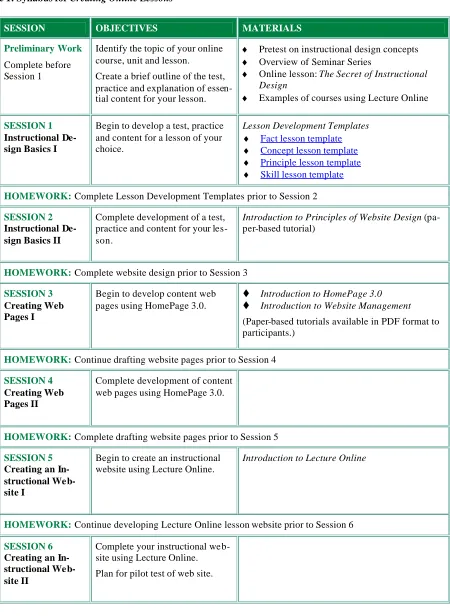
Table 1: Syllabus for Creating Online Lessons
SESSION OBJECTIVES MATERIALS
Preliminary Work
Complete before Session 1
Identify the topic of your online course, unit and lesson.
Create a brief outline of the test, practice and explanation of essen-tial content for your lesson.
♦ Pretest on instructional design concepts ♦ Overview of Seminar Series
♦ Online lesson: The Secret of Instructional
Design
♦ Examples of courses using Lecture Online
SESSION 1 Instructional De-sign Basics I
Begin to develop a test, practice and content for a lesson of your choice.
Lesson DevelopmentTemplates
♦ Fact lesson template ♦ Concept lesson template ♦ Principle lesson template ♦ Skill lesson template
HOMEWORK: Complete Lesson Development Templates prior to Session 2
SESSION 2 Instructional De-sign Basics II
Complete development of a test, practice and content for your les-son.
Introduction to Principles of Website Design
(pa-per-based tutorial)
HOMEWORK: Complete website design prior to Session 3
SESSION 3 Creating Web Pages I
Begin to develop content web pages using HomePage 3.0.
t Introduction to HomePage 3.0
t Introduction to Website Management
(Paper-based tutorials available in PDF format to participants.)
HOMEWORK: Continue drafting website pages prior to Session 4
SESSION 4 Creating Web Pages II
Complete development of content web pages using HomePage 3.0.
HOMEWORK: Complete drafting website pages prior to Session 5
SESSION 5 Creating an In-structional Web-site I
Begin to create an instructional website using Lecture Online.
Introduction to Lecture Online
HOMEWORK: Continue developing Lecture Online lesson website prior to Session 6
SESSION 6 Creating an In-structional Web-site II
Complete your instructional web-site using Lecture Online.
The committee that designed, developed and taught the seminar series had four members, three of whom were faculty with doctorates in educational psychology. The fourth was the departmental tech-nology coordinator, who had also earned a master’s degree in instructional design. All four had designed online lessons and had a special interest in instruc-tional design and distance learning. A fifth person, a faculty member who had designed and taught an online course in the college, acted as a consultant during the design of the series.
Program Design
Participants, who were faculty and staff from the College of Human Medicine at Michigan State Uni-versity, were required to come with a need to develop online instruction and an identified topic area. We surveyed the participants before the s eries began and asked them what they wanted to get out of the series. Respondents indicated the following interests:
• Obtain tools for delivering effective online in-struction,
• Learn instructional design for the web, and • Understand the process and tasks needed to get a
lesson to the web and the mechanics of the tech-nology and products used to do this.
We structured the seminar series into six two-hour sessions delivered once a month for six months. The core content of the seminar series was the principles of instructional design and of web site design. During each session we presented a didactic lesson followed by in-class work by the participants. Between sessions participants completed the work begun during the session. The syllabus for the series is shown in Table 1.
Principles of Instructional Design
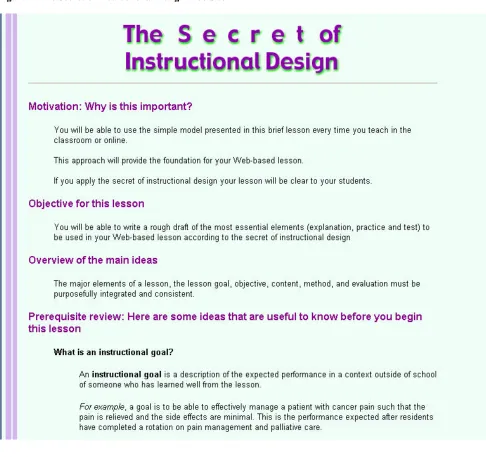
All four seminar designers felt that instructional design was the key to developing effective online instruction, so we decided to devote two sessions to that. In the first session we taught the participants how to design instruction to be delivered online. Be-fore the first session the participants were asked to go through a web site we created called The Secret of
Instructional Design (adapted from Yelon, 1996).9
This web site explained the principles of instruc-tional design, provided examples, tested the partic i-pants' knowledge and gave them feedback on their answers. During the explanation the web site was used as a model of how to design online instruction and how to lay out web pages. Figure 1 shows part of
the explanation page of the Secret of Instructional
Design web site.
The principles of instructional design can be described on two levels: a macro level that describes the entire lesson or even the entire curriculum, and a micro level that describes elements within an indi-vidual lesson.
At the macro level the elements of instruction are the goal, objectives, content, methods of instruction and learner evaluation strategies. The goal describes what the learner will be able to do after completing the instruction. The objectives describe what the learner will learn during the lesson. The content de-scribes what will be taught in order to achieve the objectives and the methods of instruction describe how the content will be taught. The learner evalua-tion strategies describe how the learner will be evalu-ated to see if he or she has obtained the objectives.
At the micro or lesson level are the elements found in the lesson plans. These can be categorized by where they occur during the lesson. At the begin-ning of the lesson the objectives and an overview of the main ideas to be learned are stated. The instructor also states the motivation for learning the content, the prerequisites the learner needs in order to learn the content, and the agenda for the lesson.
During the lesson the content will be explained and demonstrated, then the learner will practice doing what the instructor demonstrated (recalling facts, identifying concepts, predicting by using principles, or performing a psychomotor skill). The instructor will provide feedback on the practice and, if neces-sary, remediation. At the end of the lesson the in-structor summarizes what was learned, integrates the lesson with the previous and next lessons, restates the objective, and tests the learner.
The "secret" of instructional design is that all
instructional elements must be consistent with each
other. The content taught should be what the obje
c-tives specified, the tests should cover what was taught, and all should be consistent with the goal. Teach what you say they will learn, and test them on what they were taught. In the same way, the lesson-level elements must be consistent with each other and with the macro-level ele ments.
Templates for Lesson Design
knowledge should be taught differently. When learn-ing facts, learners are expected to be able to recall them, so the facts are presented in an organizing framework and learners are given practice recalling the facts. For example, the list of bones in the body can be organized by location in the body, use, size, and so on.
Concepts are categories, and learners are ex-pected to be able to identify items as examples or non-examples of a category. Concepts are taught by providing a definition of the category with defining characteristics, then comparing the characteristics of items to see if they fit the category. For example, a
bone with osteoporotic characteristics is a category, so learners would be taught to identify a bone as hav-ing or not havhav-ing those characteristics. First the char-acteristics would be described in detail, then learners would be given practice with examples and non-examples of bones with those characteristics.
teoporosis given a person's gender, age, and amount of calcium in the diet.
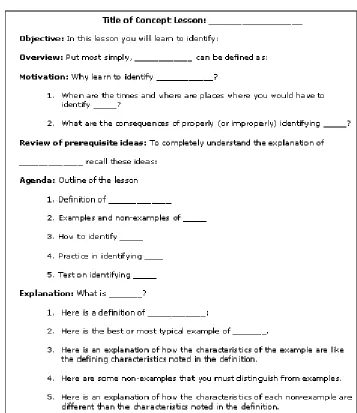
The instructional design templates provided a fill-in-the-blank framework for writing the lesson elements. After learning how to teach the different types of knowledge and what the lesson elements were, the participants in the seminars completed the appropriate template or templates for their lesson. The first page of the Concept Lesson template is
shown in Figure 2.
Principles of Website Design
It is important to develop the instructional design of the online lesson before designing the web pages that will hold the lesson. The participants brought to session two the instructional design of their online lesson they had developed during session one, in which the principles of web site design were e
plained. Designing a web site is different than design-ing instruction: Instructional design involves deciddesign-ing what to teach, how to teach it, and how to evaluate what the students have learned. Web site design in-volves deciding how to display text and graphics on a web page, how to organize the content pages, and how to provide navigation through the site.
The principles of web site design were organized into four categories: content layout, page layout, navigation, and delivery. The content layout princi-ples state how to organize the information to be pre-sented. The page layout principles describe how to design the web pages. The navigation principles de-scribe how to place the links. The delivery principles describe how to test the site so it is deliverable to its intended audience. The web site design principles are listed in Table 2.
Upon completion of session two the partic ipants worked on the design of their web page. In sessions three and four the participants learned how to use the HTML editor HomePage to create their web pages. We decided to use HomePage because it was inex-pensive and easy to use and it was cross platform (both Windows and Mac). We demonstrated how to create web pages with HomePage, then had the par-ticipants work on creating their own web pages based on the web site design they d id for session two.
The participants brought their completed web site to session four, where they learned how to upload
it to a web server and test it on different browsers and platforms.
In sessions five and six the participants learned to use LectureOnline (LOL), an online course deliv-ery system developed at Michigan State University. We decided to use it to manage the participants' online lessons because it had a robust testing module and a simple interface, and it was free and locally maintained.
Implementation
We implemented the "Creating Online Lessons" seminar series in the fall of 2000. Of the 15 faculty who started the series, eight completed it and four actually implemented their online lessons, but we did not gain access to these. All who completed the series liked the materials, methods, and the sequence of the content and agreed they would recommend it to their colleagues. One participant commented that: "My idea changed as I learned more about what could and what could not be accomplished through the online stuff." The most common reason given for failure to finish the series or complete the online lesson devel-opment was that work got in the way and that they had only a little time to work on it. One suggestion was that we provide more information on the other products used to created online lessons, such as HTML editors and course management software. Table 2: Principles of Web Site Design
Content Layout Principles
n Organized: whole and parts clearly related n Lean: expressed in most efficient way n Mapped: laid out for quick comprehension n Accessible: related information is linked
n Navigable: information is easy to find within and between sections
Page Layout Principles
n Provide structural cues.
n Keep important information at the top of the page. n Clearly indicate where users are in the site. Title all
pages.
n Include author and copyright information. n Make a design choice: short or long pages. n Make your site usable by people of different
abili-ties according to ADA guidelines.
Delivery Principles
n Offer help configuring learners’ browsers.
n Make sure everything in your website works and is up to date.
n Pilot test with different platforms, browsers, reso-lutions and with target learners.
n Refine and retest.
Navigation Principles
n Clearly identify selectable areas (hot spots). n Indicate progress made.
Discussion
We learned from this series that lots of partici-pant time outside of class is required and that perhaps a six-month seminar series is too long. It is important to determine what schedule would make the sessions not too far apart so that content is not forgotten, yet not too close together so that assignments could be completed.
It is important at the beginning of the series to provide help to the participants on narrowing their topic and thinking it through. They must think about the topic and its suitability for the web before the first session. It is also important to have the support of senior administrators so that faculty will participate.
We are currently determining if there is a further need for and interest in this training among faculty, and if they have the time to participate and to do the homework. We will assess participants' schedules to see how we can better accommodate them.
We are considering changing the attendance guidelines so that the faculty would attend only ses-sion one on instructional design. Then they could send staff to attend sessions two through six, the technical sessions on web site design, HTML editing and online course delivery systems. This would better match the actual practice of faculty designing the instruction and staff developing it. When we present this series again, we will ask for access to the com-pleted lessons so we can include a description of them in our report.
Given the increasing use of the web to deliver instruction to geographically dispersed learners, it is incumbent upon offices of medical education and other units responsible for faculty development to prepare faculty and staff to design, develop, and de-liver high-quality instruction via this remarkable me-dium. The faculty development seminar described in this article offers one possible mechanism to prepare faculty and staff for this task.
References
1. Hunt C, Kallenberg G, Whitcomb M. Trends in clinical education of medical students: Im-plications for pediatrics. Arch Pediatr Adolesc Med 1999; 153:297-302.
2. Caldwell R. Computer-based medical educa-tion: New ways to meet persistent needs. Per-formance and Instruction 1981; 20:11-14.
3. Lynch W, Corry M, Koffenberger W. Web-Based Distance Education: Faculty Recruit-ment and Training, WebNet 99 World Confer-ence on the WWW and Internet, Honolulu, HI, October 24-30, 1999. Association for the Ad-vancement of Computing in Education.
4. Kies D. Implementing Online Pedagogy. Vol. 2003: University of Western Sydney, Nepean.
5. Thomas_Jefferson_University. Distance Learn ing: Faculty Development. Vol. 2003.
6. Eastmond D, Lawrence B. Instructing Faculty To Develop and Deliver Distance Courses with Computer Network Technology. Journal of Educational Technology Systems 1998; 26:315-24.
7. Schweber C, Kelley K, Orr G. Training, and Retaining, Faculty for Online Courses: Chal-lenges and Strategies, Annual Conference on Distance Teaching & Learning, Madison, WI, August 5-7, 1998. Distance Learning '98. Pro-ceedings of the Annual Conference on Dis-tance Teaching & Learning.
8. Schauer J, Rockwell S, Fritz S, Marx D. Edu-cation, Assistance, and Support Needed for Distance Delivery: Faculty and Administrators' Perceptions, Annual Conference on Distance Teaching & Learning, Madison, WI, August 5-7, 1998.
9. Yelon S. Powerful Principles of Instruction. White Plains: Longman, 1996.
10. Yelon S. Performance-Centered Instruction. East Lansing, MI: Stephen L. Yelon, 2001.
Correspondence
Deborah Sleight, PhD OMERAD
MSU
A-206 East Fee Hall Michigan State University East Lansing, MI 48824