3533
Energy And SLA-Aware VM Selection Algorithm
For Resource Allocation In Cloud Data Centers
Satveer, Mahendra Sing Aswal
Abstract: High power consumption and quality of service degradation are the main challenging issues in worldwide cloud data centres. Ma ny of the VM selection models have been designed to address this challenge, however there is a need to further optimize the resources in order to get the performance of desired level. Unnecessary power consumption and SLA violation can be reduced with a suitable VM selection model that can select the required VMs from running set of VMs on overloaded host. In this paper, an energy efficient and SLA aware VM selection algorithm is proposed. The proposed algorithm optimizes the frequent power consumption and SLA violation and select the required VMs from overloaded ser vers in order to minimize the energy consumption, VM migrations and SLA violation. The performance of proposed algorithm was evaluated using cloudsim simulator. The outcome of experiments with real workload indicates that the proposed scheme has the good proficiency in reducing the pow er consumption at appropriate level of QoS. The proposed scheme also outperforms many previous state of arts.
Index Terms: Cloud computing, green cloud computing, energy consumption, SLA violation, VM selection, virtualization, datacenter —————————— ——————————
1.
INTRODUCTION
Cloud is delivering computing, storage and so many services over the interne [1]. Datacenters are the backbone of the services provided by the cloud. The power consumption of these datacenters is approximately 1.3% of total worldwide power supply and generating an appreciable amount of CO2 in
the environment. This power consumption can decrease from the predicted worst case of 8000 TWh to 1200 TWh by the 2030 if essential steps are taken [2],[3]. Insufficient utilization of the datacenter resources is the prominent cause of high power consumption. A server utilization dataset gathered from more than 5,000 production servers depicts that most of the time the servers in data centers are operating with 10% to 50% of their full capacity, the outstanding power consumption is due the low utilization of resources [4]. Virtualization is the backbone base of datacenter and plays a key role in minimizing the energy consumption [5]. On the other side, the same resources can be allocated to the various users at the same time by configuring the different computational resources in the form of VMs. Thus, VM consolidation is the additional trait supported by virtualization in which services and applications from under -loaded server can be consolidated into minimum no of servers and rest of the servers can be put into hibernation or standby mode with less transition time [6]. Thus, VM consolidation improves the resource usage and energy efficiency. VM consolidation process involves four steps: (a) determination of overloaded server (b) VM selection selects some required VMs from overloaded server for migration (c) VM placement algorithm allocates the selected VMs to other active servers (d) determination of the under-loaded server [7]. Our research contribution is confined for VM selection algorithm which is required to migrate some VMs from overloaded servers. However, high VM migrations degrades service level agreements (SLA) that is an agreement between cloud provider and user for quality of service (QoS) preservation [8].
Additionally, VM selection may result into different degrees of impact on the performance of the overloaded server in the different scenario. For instance, moving away a lightly loaded VM from the over loaded server may preserve the QoS, but can’t mitigate the load of overload servers properly and it will result in system performance degradation. On other side, migrating a highly loaded VM can significantly reduce the load of the overloaded server, however could bring out high migration and energy cost. VM migration is costly process in terms of energy and SLA violation [9]. Accordingly, minimizing the energy consumption, VM migrations, SLA violation and extra network traffic are the main objective of VM selection. In order to administrate the resources of the datacenter intelligently VM selection techniques must be analyzed and optimized much more, so that VM migrations can be minimized as much as possible. In order to select a VM for migration various the energy consumption, number of VM migrations, SLA violation, and extra network traffic are the main objectives of VM selection. In order to administrate the resources of the data center intelligently VM selection techniques must be analyzed and optimized much more, so that VM migrations can be minimized as much as possible. To deal with which VM should be selected for migration various. Minimizing VM selection algorithms have been proposed with the aim of improving resource utilization and performance. The existing approaches of VM selection generally optimizes one factor among power efficiency, SLA, and resource utilization rather than considering altogether. In our investigation, all these benchmarks are considered comprehensively to operate the data center at immense resource utilization, high-energy efficiency and enhanced SLA level [10]. With the development of virtualization and applications, some research contribution has been made on power modeling of VMs in virtualization environment [11], [12], [13]. In our research contribution power consumption and SLA violation of a VM is modeled using model proposed in [14] and [15] respectively. In this paper, an energy and SLA aware selection algorithm is proposed based on theoretical analysis and experimental investigation on cloudsim. The main contributions of this paper are:
Proposed a novel VM selection algorithm ESVA that selects the required VMs from overloaded servers to optimize the energy efficiency and the SLA violation. ___________________
Satveer is currently pursuing Ph.D. at Department of Computer Science in Gurukula Kangri Vishwavidyalaya, Haridwar, India, PH- 9897731079, Email: [email protected]
3534
In proposed policy, a VM selection criteria function has been developed based on estimating frequent power consumption and SLA Violation for each VM.
The cloudsim simulator has been used to evaluate the performance of the proposed algorithm and to compare the performance with other state of arts.
The rest of the sections of the research paper are organized as follows: Section 2 presents the brief study and analysis of the related research work. Section 3 demonstrates the system architecture energy model and performance metrics. The proposed research work and algorithm are presented in section 4. Section 5 explains simulation testbed used to investigate the performance of the proposed solution and section 6 discussed the simulation results. The conclusion and the scope of further improvement are discussed in section 7.
2
RELATED
WORK
In this section, various VM selection algorithms from the literature are reviewed. Anton is one of the few researchers who had contributed research solutions along with proposing an architectural framework after detail analysis of energy efficient computing techniques in the power optimization domain. Authors developed various resource allocation and scheduling algorithms. A. Beloglazov, and R. Buyya in [16], [17] have proposed Minimization of Migrations (MM), Highest Potential Growth (HPG) and Random Choice (RC) VM selection algorithms. The MM reduced the number of migrations to sorting the VMs according to their CPU utilization and select a single VM or combination of VMs. HPG select the lowest value of CPU usage of VMs to minimize the total likelihood and to maximize the resource utilization. The RC algorithm selects a VM based on the uniformly distributed discrete random variable whose value index a set of VMs allocated to a host. However, the proposed work does not satisfy QoS requirements. Furthermore, A. Beloglazov, and R. Buyya [18] analyzed resource usage and energy efficiency by proposing the VM consolidation using live migration in which unused sever can be turn into energy saving mode. Several sever overload techniques were developed based on statistical models along with a couple of VM selection algorithms such as Minimum Migration Time (MMT), Minimum Utilization (MU) and Random Selection (RS). The MMT checks migration time each VM and choose that VM which takes lowest time for migration. MU select VM with lowest CPU usage, RS randomly pic the VMs from the overloaded server and to place the selected VMs Power Aware Best Fit Decreasing (PABFD) algorithm was also proposed. The PABFD allocate the VMs on servers before estimating the increase in power consumption of the server due current VM allocation. The researchers claimed for significant reduction in power consumption and SLA violation. Later on E.Arianyan, H.Taheri, and S.Sharifian [19] developed prediction based algorithms i.e. Maximum Requested Resource (MRR), Minimum Downtime Migration (MDM) and Multi-criteria TOPSIS. MRR select the VMs based on highest resource demand of the VM and MDM takes the decision with reducing migration time of the VM. The MTPVS combines idea of both algorithms and select VMs. All the proposed policies work based on the predicated value of the required resource type instead of VM’s current CPU utilization and reduced the energy consumption of the datacenter.
H. Wang, H.Tianfield [20] proposed an energy efficient dynamic VMC framework consisting of VM selection and placement algorithms. The VM selection was named as high CPU utilization (HS) and to place the selected VMs was called as Space Aware Best Fit Decreasing (SABFD). The HS selects that VM, which has highest CPU demand as compared to other VMs until the server not stay back in normal state and SABFD place the VMs to that server which have sufficient space in terms of MIPS to include the current VM. S. Yahya, Z. Fard, M. Reza, S. Adabi [21] balanced the tradeoff among energy-QoS-temperature and proposed a novel VM selection algorithm maximum fit (MF). MF selects the VMs after estimating the deviation between utilization of the server and its threshold and choose that VM which has CPU utilization near to the deviation. The proposed algorithm reduced significant amount of temperatures of whole datacenter. R. Yadav, W. Zhang, O. Kaiwartya, and P.R. Singh, [3], [22] proposed two VM selection algorithms named as minimum utilization and maximum size (MuMs) and bandwidth aware (Bw). The MuMs select VMs based on optimizing memory size and CPU usage and migrates VMs. The Bw algorithm calculates current CPU utilization and the migration time of all VMs by determining the three factors i.e. Bandwidth Transfer Component (BTC) and Ping Time and available bandwidth. The Bw select that VM which has less CPU and migration time. The proposed work reduced the energy consumption of the datacenter. The existing VMs selection algorithms are focused only on reducing the SLA violation of overall system while optimizing different resources of the system. However, these algorithms ignored the frequent power consumption and SLA violation of single VM. The proposed VM selection method ESVA estimate the frequent power consumption and SLA violation of a single VM and it results into immediately reducing the power consumption and SLA violation on the server.
3 SYSTEM
ARCHITECTURE
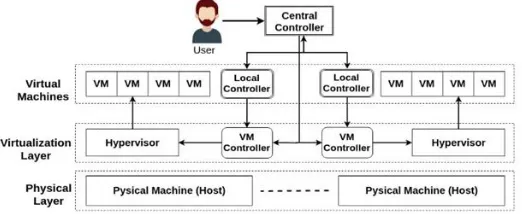
3535 three layers, the bottom layer of the architecture represents
the physical layer which consists of a large unit of computing nodes and storage resources and known as the Infrastructure as a Service (IaaS).
Fig 1. Layer Wise Cloud IaaS Architecture
Next, layer is virtualization, where numerous cloud users execute their application by configuring the heterogeneous VMs with various resources [22]. The presented model is handled by three key players’ central, local and VM controller. Separate VM is installed as the local controller into each server for monitoring the status and CPU usage of each VM running. Local controller decides when, and which VMs should be migrated. The central controller residing on master node, collects resource utilization information of the whole data center and optimally reallocate the VMs. Finally, VM controller is treated as the part of hypervisor and useful in resizing the VMs and changing the state of servers. The step by step working of the system is explained as follows:
The local monitor of each server monitors the CPU usage of each server which is categorized into three class overloaded, under loaded and normal server. The servers are categorized based on the following circumstances.
The upper threshold of CPU utilization of the server is determined by using MAD server overload detection algorithm. If upper CPU utilization threshold is lower than current CPU usage, then server is declared as the overloaded server. The local controller also choose the required VMs from the overloaded server using the proposed ESVA VM selection algorithm.
Next, under-loaded server is determined from the remaining servers after comparing current CPU utilization with lower threshold. If the current CPU utilization is less than the lower threshold then server is declared as underload and all running VMs are migrated to another server and set that sever into energy saving mode.
Rest of the servers are categorized as the normal-loaded server.
The central monitor regularly collects the resource utilization information of all servers supplied by the local controller and place the selected VMs using PABFD VM placement algorithm [18]. It places the VM consolidation commands to the local controller.
The VM controller is dedicated to migrate and resizing the VMs.
3.1 Energy Model of the Data Center
To estimate the power consumption of the servers, a linear power model has been used in literature. This model approximates the power consumption based on the linear relationship with CPU utilization. The idea of approximation comes from the CPU which is the major part of a server that consumes maximum power. However, the fact that CPU is the major factor of power consumption in not always true, as modern servers are having multi-core CPU with virtualization and power management. This fact signifies that to constitute the efficient approximation of power consumption in modern data centers, we need to make the analytical models for the complex research problem. Hence, in order to estimate the power consumption of the server, we utilized the real data of power consumption from SPECpower benchmark without going toward the analytical model [26]. The table I shows power consumption corresponding to CPU utilization rate of the servers. In literature, most of the researchers widely modelled the energy consumption as the summation of power consumed during a period of time [t0, t1] according to eq. (1) as in [18].
E(t) = ∫ P(t)dt (1)
Table 1: The energy consumption of servers in Watts (W)
3.2 Service-level Agreement Violation metrics
Cloud computing is a highly dynamic environment in which a vast number of users dispatch their request simultaneously in the form of VMs and VMs compete to each other to get the required resources from the resource pool over the network. The cloud users wish to obtain their services based on the SLA. The QoS is measured in terms of SLA and the minimum bandwidth, maximum response time and maximum downtime are the major metrics to assess the quality of SLA. In [18] overall SLA violation evaluation has been done by defining two sub metrics: (i) SLA violation Time per Active Server (SLATAH) and (ii) Performance degradation due to migration (PDM). The SLATAH is the percentage of the time in which servers experienced 100% utilization of the CPU. Formula to calculate SLATAH is shown in eq.2. The PDM is the overall performance degradation due to migrations or reallocation of the virtual machines from one server to another server in cloud data center. The PDM can be calculated as in equ.3.
= ∑
(2)
PDM = ∑
(3)
Where, N is the number of servers in data center, 𝑇 is the total time duration in which server has 100% CPU and generating the SLA violation; 𝑇 is server i active state time; M
is the number of VMs; 𝐶 indicate the performance degradation of the VMj due to migration which is intimated as
3536 migrations of the VMj; 𝐶 represent the total CPU demand
requested by the VMj meanwhile its lifetime. In order to
determine SLAV, Beloglazov et al., combined both SLATAH and PDM.
V = ∗ PDM (4)
3.3 Performance metric
In order to find out the energy and performance trade-off, authors have proposed a new metric and denoted by Energy and SLA Violation (ESV) in [18]. The ESV can be calculated as shown in equ.5.
E V = E ∗ V (5)
4 PROPOSED VM SELECTION ALGORITHM
VM consolidation is most widely used approach to increase utilization of resources in cloud datacenter. Determination of overloaded server is the first step of in this approach. Next, a VM selection algorithm selects the required VMs from overloaded server intelligently for migration to other server. However, a single VM migration consumes the processing power, memory and network resources both at source and destination server [9]. In this paper, a novel Energy and SLA efficient VM selection algorithm named as ESVA is proposed (Algorithm 1). The VM selection algorithm selects the VMs from the overloaded server after optimizing the power consumption and frequent SLA violation of each VM at virtualization level. Proposed algorithm provides an energy efficient and SLA aware resource allocation by making the smart VM selection on the required VMs from the overloaded servers. The ESVA primarily determines two factors for each VM in order to compute a linear selection function: (i) power consumption of a VM. (ii) The SLA violation of a VM. For estimating the power consumption by a VMi, the powermeasuring model of a VM proposed by Richarged et al., was used as shown in eq. (6).
VM_ = erver_ ∗ _
∑ _ _ (6)
The SLA violation of each VM can be calculated as eq. (7) (Shaw et al., 2017)
V = RR − R (7)
Where, VM_ is the frequent power consumption of a VMi , erver_ is the power consumption of the server, VM is the utilization of ith VM; ∑ _ VM_Util is the sum of CPU
utilization of all executing VMs on server, V is the frequent SLA violation of VMi,, RR, is the Requested Resource and 𝐴𝑅
is the Allocated Resource for ith VM. Here the selection for a particular VMi is made on the basis of estimating value of
selection criteria volume function called as Voli of each VM
and which is the sum of the VM_ and V and given as
eq. (8).
Vol = Vol(VM_ ) + Vol(𝑆𝐿𝐴𝑉) (8)
ESVA keeps on selecting that VM from the overloaded server whose frequent power consumption and SLA violation is highest from other running VMs till the overloaded server does not become a normal loaded server. The eq. (9) depict the selection of the VM from the overloaded server Hi as follows:
M = max*Vol , Vol , Vol … Vol + (9)
The pseudocode of the proposed work is shown in algorithm1.
5 PERFORMANCE EVALUATION
5.1 Experimental Setup
Advance modeling and simulation platforms are the fundamental elements of the performance evaluation.
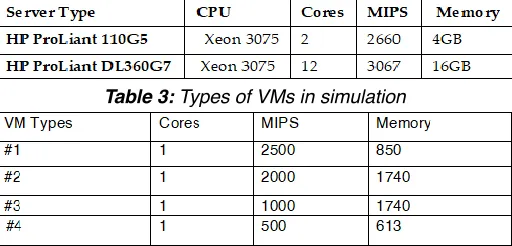
Simulation enables for evaluating the performance of several of resource leasing approaches using different kind workload and resource price distribution that without going for the costly prototyping required for complex, large-scale computing, control and communication systems. Our targeted platform is IaaS and it is presented as the configured setup of heterogeneous physical machines called server or hosts. To evaluate the performance of the proposed algorithm first we need to deploy the IaaS cloud. However, investigating the performance of any hypothesis with large-scale experiments on real infrastructure can be highly risky and pricy [27]. Hence to avoid such risks we have used cloudsim to simulate the proposed work and deployed an IaaS Service by installing two types of physical servers type, first one is HP ProLiant110G5 and second one is HP ProLiant DL360G7 with 800 units. The processing power of the servers is measured in MIPS. The MIPS of two servers is 2660 and 3067 respectively and network bandwidth of each server is 1Gbps. The configuration and characteristics of these servers and VMs taken in simulation are shown in table 2 and 3 respectively.
Table 2: Configuration of the installed servers in cloudsim.
3537 Table 4. Workload data (CPU utilization)
Table 5. Results of different VM selection policies.
5.2 Real Workload
To get more reliable results our proposed ESVA algorithm was evaluated on real workload. This workload data is collected in 2011 as the part of CoMon project. The selected real workload contains the data of CPU utilization belonging to thousands of heterogeneous VMs from more than 500 servers [28]. Table 4 represents the features of a given data set for each day.
6 SIMULATION RESULTS AND ANALYSIS
For the performance evaluation, the proposed VM selection algorithm ESVA was implemented along with server overload detection algorithm MAD in cloudsim. Standard performance metrics i.e. energy consumption, SLAV, VM migrations, PDM, SLATAH and ESV have been used for the performance assessment and comparison. The experimental results of MAD_ ESVA has been analyzed and compared with MAD_MU, MAD_MMT and MAD_RS. The assessment results shows that proposed algorithm ESVA outperforms the other existing VM selection algorithms such as MMT, MU and RS [18]. Table 5 shows comparison of experimental results of various state of arts. The following subsections discuss the results and analysis in detail.6.1 Energy Consumption
The simulation results of the proposed algorithm are analyzed and compared with existing algorithms like MMT, MU and RS. The results of simulation are shown in fig 2 and key notable fact is that proposed ESVA significantly reduces power consumption. It is quite clear that the proposed algorithm MAD_ESVA improves energy efficiency up to 27%, 20% and 7% as compared to MAD_MU, MAD_MMT and MAD_RS. It can be inferred that proposed algorithm is much energy efficient than other algorithms.
6.2 SLAV
The SLAV is the percentage of SLA violation which is occurred
when requested MIPS by a VM is not allocated to it. SLA is a big concern for the perspective of both users and cloud service providers perspective. It ensures the level of QoS and directly influences the performance of the running applications. As per the result of simulation are shown in fig.3. The proposed work not only maintain SLA but also improves the SLA up to 60%, 43% and 20% when compared to MAD_MU, MAD_MMT and MAD_Rs respectively. Thus, ESVA is more capable to reduce the performance degradation due to the server overloading and VM migrations.
6.3 VM Migrations
VM migration is the movement of the workload from one sever to another server. The less no of VM migrations are good for preserving the QoS. The no of VM migrations exhibited by proposed algorithm are reduced by a margin of 36%, 31%, and 12% as compared to MAD_MMT, MAD_MU and MAD_RS respectively. Fig 4 shows the VM migrations comparisons of simulated algorithms.
6.4 SLATAH
The metric SLA Violation Time per Active Server is the percentage of time in which server experienced 100% CPU utilization. The value of SLATAH is supposed to be low for the better QoS. The SLATAH results MAD_ESVA are reduced up to 37%, 15% and 9% in respective comparison to MAD_MU, MAD_RS and MAD_MMT as shown in fig 5.
6.5 PDM
PDM is the measure of performance degradation due to migration of VMs and its value represents overall SLA violation of the system. The proposed research contribution MAD_ESVA minimizes PDM by a value of 35%, 31% and 8% as compared to MAD_MMT, MAD_MU and MAD_RS respectively as indicated in fig 6.
6.6 ESV
3538
5 CONCLUSION
AND
FUTURE
WORK
3539
REFERENCES
[1] Mell, P. and Grance, T. (2011) ‘The NIST definition of
Cloud Computing’
http://csrc.nist.gov/publication/nistpubs/800-145/SP800-145.pdf. (Accessed on 22 Sep. 2019 )
[2] A.S.G. Andrae, T. Elder “On Global Electricity Usage of Communication Technology: Trends to 2030 Challenges”, vol.6, no.1, pp.177-157, Apr. 2015
[3] R. Yadav, W. Zhang, H. Chen, T. Guo, “MuMs: Energy-Aware VM Selection Scheme for Cloud Data Center” Proc. Int. Workshop on Database and Expert Systems Applications, Aug. 2017, doi.org/10.1109/DEXA.2017.43 [4] L. A. Barroso, U. Hölzle “The case for energy-proportional
computing” Computer, vol. 40, no.12 pp-33-37 available at https://ieeexplore.ieee.org/document/4404806/authors#au thors, Dec. 2007
[5] C. Clark, K. Fraser, S. Hand, J.G. Hansen, E. Jul, C. Limpach, I. Pratt, and A. Warfield, “Live Migration of Virtual Machines” Proc. of the 2nd Symp. Networked Systems Design and Implementation, vol. pp. 273–286, 2005
[6] M. Cardosa, M. Korupolu, A. Singh, “Shares and utilizes based power consolidation in virtualized server environments” Proc. IEEE Symp. on integrated Network Management, June 2009
[7] H. Liu, H. Jin, C., Zong, and X. Liao, “Performance and energy modelling for live migration of virtual machines” J. of Cluster Computing, vol. 16, pp. 249-264, June. 2013 [8] Z. Cao, S. Dong, “An energy-aware heuristic framework
for virtual machine consolidation in cloud computing,” J. Supercomputing, vol. 69, no. 1, pp. 429–451, April. 2014 [9] S.M. Melhen, A. Agarwal, N. Goel, and M. Zaman,
“Minimizing Biased VM selection in Live VM Migration”
Proc. In. Conf. of Cloud
ComputingTechnologiesandApplications2017/https://doi.or g/10.1109/CloudTech.2017.8284730
[10] A. Song, W. Fan, W. Wang, J. Luo and Y. Mo “Multi-objective Virtual Machine Selection for Migration in Virtualized Data Centers” Proc. In. Conf. on Pervasive Computing and Network world, pp.426-438, 2013
[11] A.E.H. Bohra and V.Chaudhary, “VMeter: Power modelling for virtualized clouds’’ Proc. parallel & Distributed Processing, Workshops and Phd Fourm (IPDPSW’10), pp. 1-8, 2010, April 2010
[12] A. Kansal, F.Zhao, J. Liu, N. Kothari, and A.A. Bhattacharyya, “Virtula Machine Power Metring and Provisioning” Proc. Symp. Cloud computing (SoCC ‘10), ACM, pp. 39-50, June, 2010
[13] G. Dhiman, K. Mihic and T. Rosing, “A System for online power prediction in Virtualized Environments Using Gaussian Mixture Models” Proc. Design Automation Conference, pp.807-812, June, 2010
[14] R. Kavanagh, D. Armstrong, K. Djemame, D. Sommacampagna and L. Blasi, “Towards an Energy-Aware Cloud Architecture for Smart Grids” Proc. In. Conf. on the Economics of Grids, Clouds, Systems, and Services, pp. 190-204, July, 2016
[15] S.B. Shaw, B., J.P. Kumar, A.K. Singh “Energy-performance Trade-off through Restricted Virtual Machine Consolidation in cloud Data Center” Proc Int. Conf. on Intelligent Computing and Control (I2C2), June. 2017
[16] A. Beloglazov, and R. Buyya, “Energy-efficient allocation of virtual machines in cloud data centers ” Proc. In. Conf. on Cluster, Cloud and Grid Computing (CCGrid), pp. 577-578, 2010
[17] A. Beloglazov, and R. Buyya (2012b) “Energy –aware resource allocation heuristics for efficient management of data centers for cloud Computing” J of Elsevier Future Generation Computer Systems, vol.28, no.5, pp.755-768, 2012
[18] A. Beloglazov, and R. Buyya (2012) “Optimal Online Deterministic algorithms and adaptive huresitices for energy and performance efficient dynamic consolidation of virtual machines in cloud data centers” J. of Concurrency Computat: Pract. Exper. vol. 24, no.13, pp.1397–1420, Sep. 2012
[19] E.Arianyan, H.Taheri, and S.Sharifian “Novel heuristics for consolidation of virtual machines in cloud data canters using multi-criteria resource management” J. of Supercomputing, vol.72, no. 2, pp. 688-717, Feb. 2016 [20] H. Wang, H.Tianfield, “Energy-aware Dynamic Virtual
Machine Consolidation for Cloud Datacenters” IEEE Trans, vol.6, pp.15259-15273, March 2018, https://doi.org/10.1109/ACCESS.2018.2813541
[21] S. Yahya, Z. Fard, M. Reza, S. Adabi, “A dynamic VM consolidation technique for QoS and energy consumption in cloud environment,” J. of Supercomputing vol. 73, no. 10, pp. 4347-4368, March 2017
[22] R. Yadav, W. Zhang, O. Kaiwartya, and P.R. Singh, “Adaptive energy-aware algorithms for minimizing energy consumption and SLA violation in cloud computing” IEEE Trans, vol.6, pp. 55923- 55936, Oct. 2018
[23] Aliyu, A., Abdul, A., Omparkash, K., Yue, C., Mohamme, U., Sushil, K., Daya, L., and Ram, “Cloud computing in VANETS: Architecture, taxonomy and challenges,” IETE Technical Review, vol. 35, no 5, pp.523-547, 2018
[24] Y. Wen, Z. Li, S. Jin, C. Lin, and Z. Liu, ”Energy-efficient virtual resource dynamic integration method in cloud computing” IEEE Access, vol. 5, pp. 12214-12223, June 2017, https://doi.org/10.1109/ACCESS.2017.2721548 [25] Satveer, M.S. Aswal, “A Comparative Study of Resource
Allocation Strategies for a Green Cloud” Proc. of the 2nd Int. Conf. Next Generation Computing Technologies, pp. 621-625, Oct. 2016
[26] https://www.spec.org/power_ssj2008/results/res2011q1/p ower_ssj2008-20110124-00338.html
[27] R. N. Calheiros, R. Ranjan, A.Beloglazov, C. A. F. Rose, and R. Buyya, “CloudSim: a toolkit for modeling and simulation of cloud computing environments and evaluation of resource provisioning algorithms,” J. of software- Practice & Experience, vol. 41, pp. 33-50, Jan. 2011