Radon Neutral work for Biomedical Image
Processing
1
Monal Shrivastava,
2Anish Francis
1Department of ECE,Laxmi Narayan College of Technology and science, Bhopal, India 2SENSE, Vellore Institute of Technology, TamilNadu, India
Abstract – we are presenting a novel method for lung image X ray image diagnosis with neural network. Lung X-ray images causes mis-diagnosis due to the similarity in Lung cancer and Tuberculosis. The image is preprocessed with Radon transform and analysed with Neural network. In this paper we compare the effect of feed foreward and Radial basis neural network in diagnosis performance. The present methodology reduces the diagnostic error in Lung image X ray processing.
Index term: Neural network, Radial basis neural network, Feed forward neural network
I. INTRODUCTION
Tuberculosis is one of the worst diseases that poses great problem for medical practioners for effective diagnosis. The diagnosis of TB should be done very carefully because of its great probability for under and mis diagnosis compared with several other diseases. The prevalency of TB is great and millions of people get affected to this disease every year. The radiological similarity of lung cancer and TB is another issue, and often mis treatment happens. [1, 6].Hence development of tools to aid such diagnosis is very important and critical. In the present work, we have tried to investigate the possibility of image processing coupled with machine learning technique to develop such a tool.
A number of previous works were conducted related to this area. The present work is an extended work of the authors in [1] in which radon transform is primarily used for the analysis. In [2] Authors used Hopfield network along with the popular Bayesian classification technique for sputum images for lung cancer identification. We closely followed the work of [5] and [6] for and image data base formation and work approach. In [5] hybrid technique was proposed for screening out pulmonary infection tuberculosis based on cavity detection.
Using of gradient inverse coefficient of variation and circularity measures to confirm true cavities and hence identifying the abnormal radiographs. In [6] the raw data was pre-treated just for proper weight updation. They have
Used BPNN for classification. Authors of [6-8] also used neural network as classifier for solving the same problem.
In the present work we have made novel contributions to above areas of the problem. For the first time we have used radon transforms or projection transform for pre treatment of the raw data to the artificial neural network. We claim that this sharpens the technology in two ways. One, it makes the classifier more accurate. Second, heavy prior image processing such as segmentation etc is not highly needed when radon transform is used or the computational complexity for radon processing is less compared to other image processing techniques to condition the image before being fed to the classifier.
The paper is organized as follows. In section I we explain the artificial neural network architecture, in section II, a short explanation of radon transform is given. We explain the methodology of the work and results together in section III. we conclude in section IV, with observations and suggestions.
I.NEURAL NETWORK STRUCTURE [1]
Neural networks imitates biological nervous system in its structure .The neural network is a mathematical model inspired by biological neural networks. Neural network are interconnected by a group of artificial neurons. It is used to model complex relationships between inputs and outputs. Different types of networks are available, and different algorithms are also there to train those network. The networks are best used in applications, where the data processed is highly non-linear and difficult to analyze. The neural
networks are used in pattern classification,
In the present work, we used a feed forward neural network with back propagation algorithm. The network has an input layer, hidden layer and output layer [14].The network is trained with Levenberg-Marquardt method that comes under back propagation algorithm for calculating the weights in the network based on minimizing the error.
The training, testing, validation, and the data volumes used were based on the percentages suggested in [12].
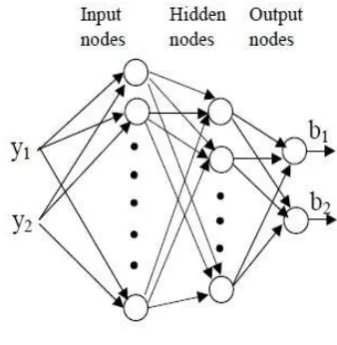
Fig 1:Neural Network structure For the present work, the radon transform of the X-ray images is given as the input data. The mode of presentation of data, and work flow will be discussed in the following sections.
FEEDFOREWARD NEURAL NETWORK
The feedforward neural network was the first and simplest type of artificial neural network devised. In this network, the information moves in only one direction, forward, from the input nodes, through the hidden nodes (if any) and to the output nodes. There are no cycles or loops in the network. In the present work we are using Feedforeward neural network with backpropagation algorithm. We are employing LM algorithm as the backward propagation algorithm in the present work.
II.RADON TRANSFORM AS
PREPROCESSOR[1]
Images can be represented by projection. Radon transform is a linear transform given by following equation the line in the Fig 3 can be represented by two ways
Fig2:Radon Example(circle)[10]
Fig 3: Projection representation of line.
The advantage of radon transform is that disorganized image data can be well expressed in simple projections and are completely invertible. Another advantage is the fast implementation.
III. WORK METHODOLOGY&RESULTS
A. Image Database Preparation
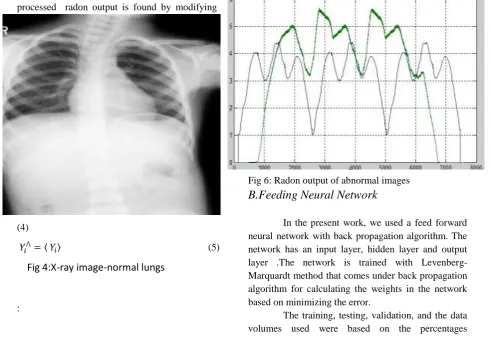
In the present work we have used 128 X-ray images of lungs, of which 64were normal and the rest 64 where abnormal affected with TB.A sample normal X-ray image is shown in Fig 3.
Let is an image vector with ,N is the total number of images in the data base, and V be the space for all image vectors
with indices K and L .Let be the
radon operator.
(4)
Is the radon output of image.
is the initial and final angles of projections.The output is then pre processed to reduce computational complexity be taking a single row,and reducing it into a size limit of K.This is to ensure uniformity in the data feeding to the neural network Hence the processed radon output is found by modifying
(4)
(5)
Fig 4:X-ray image-normal lungs
:
Fig 5: Radon output of Normal Images
Fig 6: Radon output of abnormal images
B.Feeding Neural Network
In the present work, we used a feed forward neural network with back propagation algorithm. The network has an input layer, hidden layer and output layer .The network is trained with Levenberg-Marquardt method that comes under back propagation algorithm for calculating the weights in the network based on minimizing the error.
suggested in [22].The architecture of the neural network configuration used in the present work is shown below in Fig 2.The hidden layer is made up of sigmoid neurons and output layer is made up of linear neurons
(Fig 7: Architecture of Neural network)
If vector correspond to
the input and correspond to the
target the error minimized is .The output
of hidden layer is computed as,
) + ……….. (5)
The final output is given by,
………. (6) The Target vector T is divided into two sub
matrices as one and rest as zero
corresponding to the decision of normal and abnormal
images. The weight vectors and correspond to
the synaptic weights in the hidden layer and the output layer and B is the fixed bias.
C.Evaluation of Generalization Ability of
Network
The images were tested with Backprogagation network with varying number of hidden neurons and varying training volumes.The detection results for varying with number of hidden neurons is given below.
IMAGES NO:HIDDDEN
NEURONS
ACCURACY
NORMAL 5 98.16
ABNORMAL 20 98.99
NORMAL 5 98.76
The results show that the increasing the number of neurons increases the accuracy of the detection. But the increase in accuracy is done on the price of more convergence time.
The detection tests were done based on the size of the training data also. The total training data was divided into 3 classes, A, B and C.
Class A: Training-90%, Testing-5%, Validation-5% Class B: Training-80%, Testing-10%, Validation-10% Class C: Training-70%, Testing-20% Validation-10%
Class Image MSE Accuracy
A normal 3.12×10⁻⁹ 98.816
A abnormal 7.17×10⁻⁸ 98.7
B normal 4.49×10⁻¹⁰ 98.56
B abnormal 3.02×10⁻¹⁰ 98.34
C normal 0.12×10⁻⁸ 97.98
C abnormal 7.92×10⁻⁹ 98.12
Table 1.2: Detection test with varying classes of Data
The results show that class a data has higher accuracy. Compared to other training classes. It is shown that more training data affects more optimum weight updation of the neural network. Mean Square Error and co-relation value are performance parameters of BP network.
The above results show more accuracy compared to the other proposals in this area. It shows that training effects of the neural network has great role in the diagnostic ability of the classifier we are proposing.
We tested for the time for decision making. The maximum time for network calculation was 0.07 seconds. Some sample simulation times are given in Table 1.3.It was found that execution time become more faster when test images are abnormal. The reason may be accounted for the specific nature of the chest radiographs.
IMAGES DECISION TIME
NORMAL 1 0.0657 seconds
NORMAL 2 0.0789 seconds
ABNOMRAL 1 0.055 seconds
ABNORMAL 2 0.49 seconds
Table 1.3: Execution Time
V.CONCLUSION
In the present work, we examined the image identification of X-ray classified normal and abnormal images with fast execution time and higher rate of accuracy.We have compared the performance of Radial basis network and LM algorithm in detection abnormal and normal images.The decision making
process is made automatic through artificial
VII.REFERENCES
[1] Radon transform processed neural network for lung X-ray image based diagnosis,"Anish Francis,Shafeena Bashir,I2CT,International conference on convergence of
Technology Pune, 6-8 April 2014,
10.1109/I2CT.2014.7092284,IEEE
[2] Fatma Tahler,Naoufel Werghi,” Bayesian Classification and Artificial Neural Network Methods for Lung Cancer Early Diagnosis”,IEEE,2012
[3] Lujia Tang, Lina Wang
,”
A Neural Network To Pulmonary Embolism Aided Diagnosis With A Feature Selection Approach”, 2010 3rd International Conference on Biomedical Engineering and Informatics (BMEI 2010)[4] Asha.T, Dr. S. Natarajan, Dr. K.N.B. Murthl,” Diagnosis of Tuberculosis using Ensemble methods”, IEEE 2010
[5] Rui Shen, Irene Cheng,, “A Hybrid Knowledge-Guided Detection Techniquefor Screening of Infectious Pulmonary Tuberculosis From Chest Radiographs”, IEEE transactions on biomedical engineering, vol. 57, no. 11, november 2010
[6] Yang Benfu, Song Hongmei,
“
Study on the artificial neural network in the diagnosis of smear negative pulmonary tuberculosis”, 2009 World Congress on Computer Science and Information Engineering[7] Ramana K.V, Khader Basha,” Neural Image Recognition System with Application to Tuberculosis Detection”, Proceedings of the International Conference on Information Technology: Coding and Computing (ITCC’04),IEEE 2004
[8] Jyh-Shyan Lin, Panos A. Ligomenides,” An Application of Convolution Neural Networks: Reducing False-Positives in Lung Nodule Detection”,IEEE 1995
[9] Y. S . Peter Chiou,” neural network image analysisand
classification in hybrid lung nodule detection (hlnd) system”,IEEE 1993
[10] Lecture slides on Radon transforms by Min wu,University of Maryland,{available
[11] Thesis on analysis and applications of Radon Transform,,Zhihong Cao,University of Calgary,[available online]