Evaluation of a Vector Space Similarity Measure in a Multilingual Framework
Romaric Besanc¸on, Martin Rajman
Artificial Intelligence Laboratory
Swiss Federal Institute of Technology, CH-1015 Lausanne, Switzerland {Romaric.Besancon,Martin.Rajman}@epfl.ch
Abstract
In this contribution, we propose a method that uses a multilingual framework to validate the relevance of the notion of vector based semantic similarity between texts. The goal is to verify that vector based semantic similarities can be reliably transfered from one language to another. More precisely, the idea is to test whether the relative positions of documents in a vector space associated with a given source language are close to the ones of their translations in the vector space associated with the target language. The experiments, carried out with both the standard Vector Space model and the more advanced DSIR model, have given very promising results.
1.
Introduction
The notion of textual similarity is very often used in Natural Language Processing applications designed for the exploration of large textual databases. For example, in In-formation Retrieval, the relevant documents retrieved by the system are in general the documents the most similar to the user’s query, according to the similarity measure used by the search engine (Salton and McGill, 1983). Similarly, in the case of automated clustering, the documents are also clustered according to a given similarity measure (Salton et al., 1975a).
The similarity between documents strongly relies on the choice of the representation method for the texts. The most frequent method is the vector space representation (imple-mented for instance in IR systems such as SMART (Salton, 1971)). In this approach, a document is represented by a vector in a vector space in which each dimension is asso-ciated with a specific linguistic unit, called indexing term (e.g. a word, a stem or a lemma).
The vector space representation, simple and easy to im-plement, has already proven its efficiency in the specific framework of several applications (in particular, informa-tion retrieval and automated classificainforma-tion). However, in this paper, we propose a novel validation method, indepen-dent from any application.
The idea is to use an aligned multilingual corpus to val-idate the robustness of the vector space representation of the documents, by showing that the relative positions of the vectors representing the documents in a source language are close to the ones of their translations in a target language. In other words, we try to check if the similarity between any two vectors representing two documents in the source space is close to the similarity between the vectors repre-senting their translations in the target space.
In section 2,we present the two vector space models used for our experiments, the standard vector space model, and the more advanced DSIR model, that integrates more semantic information using co-occurrences profiles; in sec-tion 3,we present the data with which the experiments have been carried out; in section 4,we present the first results ob-tained with a simple test on the similarity matrices. In sec-tion 5,we present another validasec-tion method and its results, and section 6 provides some preliminary conclusions.
2.
Vector Space representations
2.1. The standard vector space model
Within the standard vector space model (VS), each doc-umentdis represented by a vectordVS = (dVS
1 , . . . , d
VS
|T|),
called lexical profile.T is the set of indexing terms and the componentdVS
j represents the weight (or importance) in
the documentdof the indexing termtj associated with the
jth dimension of the vector space. Generally, this weight is a function of the frequency of the term in the document, and also integrates a global weighting and a normalization factor (with respect to the document length). The function used in our experiments corresponds to the ltn weighting scheme of SMART (Salton and Buckley, 1988; Singhal, 1997):
dVSj =wj=idf ×(1 +log(tf)) (1)
wheretf is the frequency of the indexing term in the doc-ument and idf is its inverse document frequency factor
idf = log 1
df, with df denoting the document frequency of the indexing term. Theidf factor allows to give more importance to terms that appear less frequently in the docu-ment collection and are therefore more discriminatory. No document length normalization factor have been used (no-tice however that an implicit normalization is performed through the choice of the cosine similarity, that is indepen-dent from the norm).
2.2. The DSIR model
The DSIR model is a vector model that integrates ad-ditional semantic information by taking into account the co-occurrences between terms (Rajman and Bonnet, 1992; Rajman et al., 2000; Besanc¸on, 2001).
Within this model, the considered linguistic unitsuiare
first represented by a vector ci = (ci1, . . . , ci|T|), called
the co-occurrence profile, each componentcij of which is
the co-occurrence frequency of the linguistic unitui with
the indexing term tj. A document dis then represented
as the weighted sum of the co-occurrence profiles of the linguistic units it contains, i.e. dis represented by a vector
dVS = (dVS
1 , . . . , d
VS
|T|)where eachd
VS
j is defined as:
dVSj =
X
ui∈d
where the weightwiis the same as the one defined by
equa-tion (1), for the VS model.
Notice that, in the pure DSIR model, the terms con-tained in the document are only taken into account through their co-occurrence profile, which often leads to unsatisfac-tory representations. To correct this property and to also directly take into account the presence of the term in the document, a hybrid DSIR model has been proposed (Rung-sawang, 1997; Rajman et al., 2000), in which:
dVSj =α wj+ (1−α)
X
ui∈d
wicij (2)
whereαis the hybridization coefficient controlling the rel-ative importance of the occurrence and co-occurrence in-formation.
3.
Aligned bilingual data
The goal of this paper is to use an aligned bilingual corpus to validate a vector-based similarity between doc-uments. The aligned bilingual data used for the tests were extracted from the JOC corpus, containing written ques-tions and answers of the Official Journal of the European Community, published in several languages. We considered a corpus containing 6729 documents in each languages and for our experiments, we first restricted to French and En-glish.
Formally, we can consider that our aligned bilingual corpus is composed of the corpora C andC0 respectively in the languagesLandL0.
A preprocessing phase has been performed to extract from each of the corporaC andC0 a corresponding set of indexing terms, denoted respectivelyTandT0:
• the corpora have been analyzed by a lemmatizer based on the syntactic analyzer SYLEX (Constant, 1995): each word has been associated with its part-of-speech and its lemma, the combination of which constitutes the considered linguistic units;
• the produced linguistic units have been filtered accord-ing to their document frequency (i.e. the number of documents containing the considered unit); the index-ing setTwas defined as the set of linguistic units with
document frequency inh100|C|,
|C|
10
i
, where|C|denotes
the number of documents in the corpusC. This inter-val is often considered as providing terms with good discriminating power (Salton et al., 1975b);
• similarly, the indexing setT0was derived fromC0. No-tice that the two lexica of linguistic units have been extracted independently.
The same selection process was used for French and En-glish, but in an independent way and each selection is only based on the corpus of the corresponding language. In par-ticular, the two indexing sets are not aligned: the term asso-ciated with the ith dimension in one of the vector spaces does not necessarily correspond to the translation of the term associated with theith dimension in the other vector space.
The sizes of the corpora, the lexica (lemmas of nouns, verbs, and adjectives) and the indexing sets (selected with document frequency in[70,700]) are given in table 1.
French corpus English corpus number of words
in the corpus 1 160 877 1 053 945
size of lexicon
(number of terms) 25 322 24 469
size of the
indexing set 1 062 1 102
Table 1: Sizes of corpora, lexica and indexing sets for the English and French parts of the JOC corpus
The interesting property of a bilingual corpus is the un-derlying hypothesis that a document and its identified trans-lation are assumed to share a similar semantic content. In such case, if the vector-based similarity is indeed represen-tative of a semantic proximity, then the similarity between two documents should be close to the similarity between their translations.
4.
Mantel test
We first propose to test whether the shape of the global representation of the document collection is stable when changing from one language to another. One way of repre-senting this global shape is the matrix of pairwise similari-ties between the documents.
The comparison of two similarity matrices can be per-formed with the Mantel test (Mantel, 1967; Legendre, 2000). This test is a widely used method for assessing the relationships between two distance matrices or, more gen-erally, two resemblance or proximity matrices. It involves a measure of the association between the elements in two matrices by a statisticr, and then assesses the significance of this measure by comparing it with the distribution of the values found by randomly reallocating the order of the el-ements in one of the matrices. The statistic rused in our experiments is the sum of the products of the standardized similarities; for two similarity matricesAandBof sizeN, it is defined by:
r = 1
N2
−N−1
N
X
i=1
N
X
j=1
(aij−a)
σa
(bij−b)
σb
wherea(resp.b) is the average similarity in matrixA(resp.
B), andσa(resp. σb) is the standard deviation of the
sim-ilarities in matrixA(resp. B). The statisticrranges from -1 to 1, respectively indicating perfect negative and positive correlation. The zero value indicates no correlation.
In our experiments, we used the implementation of the Mantel test by Eric Bonnet (Bonnet, 2001). For the En-glish and French corpora, we obtained a correlation value
how-ever necessary to analyze the precise nature of this correla-tion.
5.
Nearest translation test
To further test the stability of the representations by translation, we checked whether the translation of a given documentdcan be reliably recovered as the translated doc-ument the most similar tod. We call this test the nearest
translation test.
In order to compute a similarity between a document and its translation, we first represent any document by the vector of its similarities with the elements of an aligned ref-erence document set and then take as a measure of the simi-larity between a documentdin languageLand a document
d0in languageL0the similarity between the similarity
vec-tor associated with d and the similarity vector associated withd0.
The stability test procedure is then the following:
1. we build aligned bilingual test and reference sets;
2. we represent the source (resp. target) documents of the test set by their similarities with respect to the source (resp. target) documents of the reference set;
3. we compare the obtained representations to check how often the translation of a source document is indeed the nearest target document.
These three steps are presented in more details in the fol-lowing sections.
5.1. Building the test and reference sets
From the available corpus, we randomly extract a num-bernof documents (n = 500in our experiments), which constitute the test set. TheN =|C| −nremaining docu-ments constitute the reference set.
We denote:
• di the n documents of the test set TEST-L in the
source languageL;
• d0ithendocuments of the test set TEST-L0in the target
languageL0;
• DitheNdocuments of the reference set REF-Lin the
source languageL;
• D0i theN documents of the reference set REF-L0 in
the target languageL0;
5.2. Document representation
All documents in the test and reference sets are first rep-resented in the vector space associated with their own lan-guage. Notice that in this case, two documents from differ-ent language are not directly comparable, since they are not represented in the same space.
However, to each documentdi(resp. d0i) from the test
set TEST-L(resp. TEST-L0), we can associate a similarity
vector in which thejthcomponent is the similarity between this document and thejthdocument from the reference set REF-L(resp. REF-L0).
Let us denoteVs(di)(resp. Vs(d0i)) this similarity
vec-tor; we then have:
Vs(di) = (δ(di, D1), . . . , δ(di, DN))
Vs(d0i) = (δ(d0i, D01), . . . , δ(d0i, D0N))
whereδ is the chosen similarity. In our experiments, we took the cosine similarity, defined, for two document repre-sentationsdandd0, by:
δcos(d, d0) =
d·d0
||d|| ||d0||
The similarity vector characterizes the relative position of the considered document with respect to the documents in the reference set. Since the reference sets are aligned, the similarity vectors computed in different languages are still comparable. They can therefore be used to test the proxim-ity between a document and its translation and then to test the invariance by translation of the position of a document with respect to the reference set.
This representation of documents from different lan-guages with respect to a reference set is close to methods used in multilingual information retrieval, such as the Gen-eralized Vector Space Model (Carbonell et al., 1997; Yang et al., 1998) or to the application of the Latent Semantic
In-dexing model (LSI) to multilingual IR (Dumais et al., 1996;
Littman and Jiang, 1998).
5.3. Invariance test
For each documentdi∈TEST-L, we consider the
sim-ilarity between the associated simsim-ilarity vectorVs(di)and
each of the similarity vectors associated with then docu-ments in TEST-L0. The similarities between similarity
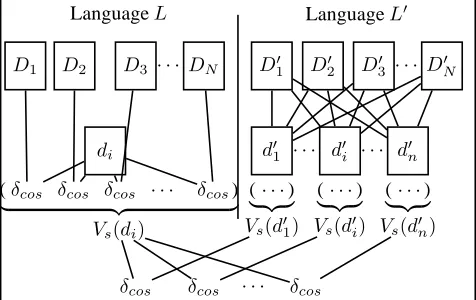
vec-tors are also evaluated using the cosine measure. The idea, illustrated by figure 1, is that if the invariance by transla-tion is indeed verified, then the similarity betweenVs(di)
and Vs(d0i) should be significantly larger than any of the
similarities betweenVs(di)andVs(d0j)withj6=i.
LanguageL
D1 D2 D3 · · · DN
LanguageL0
D10 D
0
2 D
0
3 · · · D
0 N
di
(δcos δcos δcos · · · δcos)
| {z }
Vs(di)
d01
(· · ·) | {z } Vs(d01)
· · · d0i
(· · ·) | {z } Vs(d0i)
· · · d0n
(· · ·) | {z } Vs(d0n)
δcos δcos · · · δcos
Figure 1: Validation method
In order to test this hypothesis, we count the num-ber of documents(d0
j)j6=i in TEST-L0 for which the
sim-ilarity δcos(Vs(di), Vs(d0j)) is smaller than the similarity
that have a relative position (with respect to the reference set) that is further away from the relative position ofdithan
the one ofd0
i. We denotefi the proportion of such
docu-ments in TEST-L0, we have:
fi=
1
n−1
{d0k ∈TEST-L0|k6=iand
δcos(Vs(di), Vs(d0k))< δcos(Vs(di), Vs(d0i))}
To test whether only few documents in language L0 are closer to a documentdi than its translation (according to
the chosen measure), we perform a statistical test on this proportion. More precisely, we want to test that the propor-tionfiis significantly larger than an a priori given threshold
p0, which corresponds to the following alternative:
(
H0 :fi=p0
H1 :fi> p0
For a large enough sample (in our case,n= 500), we reject the null hypothesisH0 at an error levelαif (Grais, 1986,
p. 261):
fi−p0
p
p0(1−p0)
×√n > tα
wheretαis the value of the standard normal random
vari-able for an error levelα. This leads to reject the hypothesis
H0if:
fi> p0+tα
r
p0(1−p0)
n (3)
5.4. Results
For the statistical test, we chosep0 = 0.9. The
con-sidered hypothesis is then that the proportion of documents having a relative position closer than the one of the trans-lation is less than 10%. The error level was chosen at
α = 2.5%, which corresponds totα = 1.96. With these
parameters, the equation (3) is then:
fi >0.9 + 1.96
r
0.09
500 = 0.9263 (4)
and one can verify that this leads to accept the null hypoth-esis H0 if there is more than 37 documents (out of 500)
which are ”better” than the translation itself.
In our experiments, we produced the following results:
• the number of documents NR (out of the 500) for
which the hypothesisH0 is accepted, i.e. the
docu-ments for which the invariance hypothesis is not veri-fied;
• the number of documents N0 (out of the 500) for
which the translation is the document the most similar to the source document (fi = 0), i.e. the documents
for which the invariance hypothesis is perfectly veri-fied;
For the chosen languages (French and English), the test has been performed in both directions:
- fr-en:{L=French,L0=English} - en-fr:{L=English,L0=French}
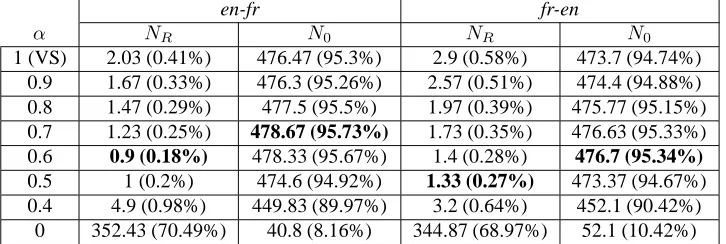
The table 2 presents the results obtained with a standard vector space (using the ltn weighting scheme) and with the hybrid DSIR model, for several hybridization values. The valueα = 1corresponds to the standard VS model. All results correspond to average values on 30 independently extracted random test sets.
From table 2, one can see that the invariance hypothesis is accepted for more than 99% of the documents within the VS model (99.4% for fr-en, 99.6% for en-fr). In addition, the results show that for 95% of the documents, the transla-tion is indeed the document most similar to the source doc-ument (according to the chosen measure) among the 500 documents of the test set.
These results constitute a strong support evidence for the fact that the relative position of the documents does not vary significantly when translated from one language to an-other. This is in itself an interesting confirmation of the robustness of a simple vector-based similarity measure be-tween documents.
Notice that this result was not obvious, in particular be-cause the indexing sets are selected independently. In other words, even if the representation of the documents in each language only depends on the corpus in this language, the model leads to a representation of the corpus that is stable from one language to another.
Although the results obtained for the standard vector space model are already very good, it is interesting to no-tice that the hybrid DSIR model further improves them. This model leads to a proportion of documents for which the invariance hypothesis is verified to almost 99.8% (see figure 2). The best hybridization value seems to be be-tween 0.5 and 0.6 but the representation based only on co-occurrences (α= 0) give very bad results. A possible ex-planation for this is that representing the documents only with co-occurrence profiles tends to smooth the represen-tations: vectors in the VS model are very sparse (the only non-zero values are the one associated to terms contained in the document), whereas vectors in the DSIR model are av-erage of co-occurrence profiles, and therefore correspond to less discriminatory profiles. Nevertheless, the experiments show that the co-occurrence information is useful and can be exploited through the hybrid model.
99 99.1 99.2 99.3 99.4 99.5 99.6 99.7 99.8 99.9
0.4 0.5 0.6 0.7 0.8 0.9 VS
document rate for which H0 is rejected (%)
alpha (DSIR hybridation)
en-fr fr-en
en-fr fr-en
α NR N0 NR N0
1 (VS) 2.03 (0.41%) 476.47 (95.3%) 2.9 (0.58%) 473.7 (94.74%) 0.9 1.67 (0.33%) 476.3 (95.26%) 2.57 (0.51%) 474.4 (94.88%) 0.8 1.47 (0.29%) 477.5 (95.5%) 1.97 (0.39%) 475.77 (95.15%) 0.7 1.23 (0.25%) 478.67 (95.73%) 1.73 (0.35%) 476.63 (95.33%) 0.6 0.9 (0.18%) 478.33 (95.67%) 1.4 (0.28%) 476.7 (95.34%) 0.5 1 (0.2%) 474.6 (94.92%) 1.33 (0.27%) 473.37 (94.67%) 0.4 4.9 (0.98%) 449.83 (89.97%) 3.2 (0.64%) 452.1 (90.42%)
0 352.43 (70.49%) 40.8 (8.16%) 344.87 (68.97%) 52.1 (10.42%)
Table 2: Validation results for the similarity measure within the VS model and the DSIR model
5.5. Tests with other languages
To further test the generality of our invariance hypoth-esis, we performed the tests with all the eight languages for which aligned data was available in the JOC corpus: French, English, Italian, Spanish, Portuguese, German, Dutch and Danish. For all these languages (but English and French), we did not have preprocessing advanced tools. We therefore performed a simple stemming of the corpus (using the Snowball stemmers (Porter, 2001)) and used stoplists to filter out the common words.
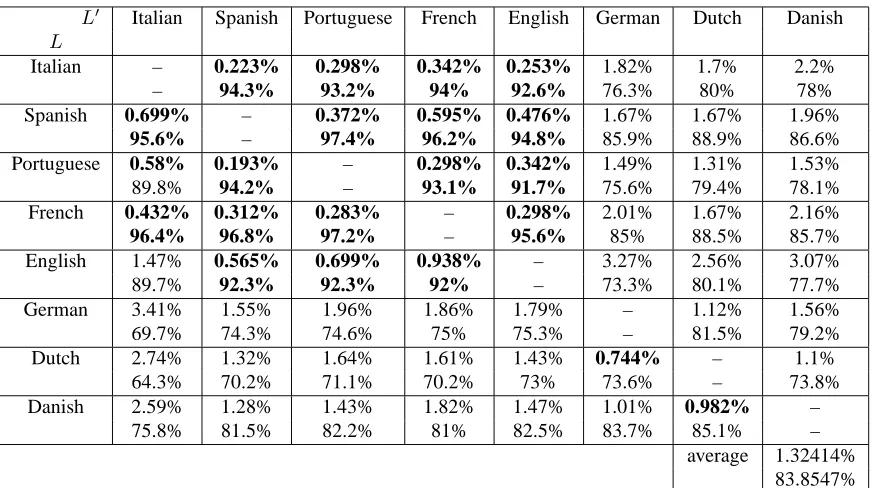
The documents were then represented in eight indepen-dent vector spaces, using the standard vector space model. We performed the nearest translation test for each pair of languages (in both directions), and the average values of
NRandN0for each pair are presented in table 3.
The average value on all pairs of languages show that the hypothesis is verified for almost 98.7%, and the num-ber of documents for which the translation is the closest document is more than 83.8%. Hence, the relevance of the vector-based similarity seems to hold for the other lan-guages as well.
A more detailed analysis shows that some languages seems to be closer than others (i.e. for these languages, the invariance hypothesis is better verified): in particular, French, English, Italian, Portuguese and Spanish seem to form a set of ”close” languages whereas German, Dutch and Danish lead to less significant results. This tendency is also confirmed by the correlations found with the Mantel test1, presented in table 4.
However, these observations have to be moderated since the results obtained depend on several parameters, includ-ing the quality of the translations and the quality of the pre-processing phase (i.e. the stemmers). Both have not been evaluated in these experiments.
6.
Conclusion
The notion of textual similarity, fundamental for numer-ous NLP systems, is still to be validated. In this paper, we propose a novel validation method relying on the invariance by translation of the relative positions of the documents rep-resented in a vector space. This validation is interesting
1
Due to a lack of time, the values presented here have been calculated only on a random subset of 672 documents (10% of the collection), and have a significance 0.001
as it confirms the hypotheses made on the robustness of a vector-based similarity measure.
The validation method can also be used to compare dif-ferent representation models: for instance, we showed that the DSIR model integrating co-occurrences improves the relevance of the textual similarity.
However, the results presented are global quantitative results. A more detailed analysis should be carried out, es-pecially in order to identify the properties of the documents for which the null hypothesis cannot be rejected, and to un-derstand why the DSIR model might improve the represen-tation of these documents.
The method presented also have applications for the au-tomated comparison of machine translation systems or for multilingual information retrieval, and further experiments for these applications should be undertaken.
7.
References
Romaric Besanc¸on. 2001. Int´egration de connaissances
syntaxiques et s´emantiques dans les repr´esentations vec-torielles de textes. Ph.D. thesis, Swiss Federal Institute
of Technology, Lausanne. ´
Eric Bonnet. 2001. simple mantel test – version 1.2. http://www.geocities.com/eb ce/mantel.html.
Jaime G. Carbonell, Yiming Yang, Robert E. Frederking, Ralf D. Brown, Yibing Geng, and Danny Lee. 1997. Translingual information retrieval: A comparative eval-uation. In International Joint Conference on Artificial
Intelligence (IJCAI), pages 708–715.
Patrick Constant, 1995. Manuel de d´eveloppement
SYLEX-BASE. INGENIA´ -LN, Paris, France.
Susan Dumais, Thomas Landauer, and Michael Littman. 1996. Automatic cross-linguistic information retrieval using latent semantic indexing. In SIGIR’96 - Workshop
on Cross-Linguistic Information Retrieval, pages 16–23,
August.
Bernard Grais. 1986. M´ethodes Statistiques. Dunod. P. Legendre. 2000. Comparison of permutation methods
for the partial correlation and partial mantel tests.
Jour-nal of Statistical Computation and Simulation, 67:37–73.
L0 Italian Spanish Portuguese French English German Dutch Danish
L
Italian – 0.223% 0.298% 0.342% 0.253% 1.82% 1.7% 2.2%
– 94.3% 93.2% 94% 92.6% 76.3% 80% 78%
Spanish 0.699% – 0.372% 0.595% 0.476% 1.67% 1.67% 1.96%
95.6% – 97.4% 96.2% 94.8% 85.9% 88.9% 86.6%
Portuguese 0.58% 0.193% – 0.298% 0.342% 1.49% 1.31% 1.53%
89.8% 94.2% – 93.1% 91.7% 75.6% 79.4% 78.1%
French 0.432% 0.312% 0.283% – 0.298% 2.01% 1.67% 2.16%
96.4% 96.8% 97.2% – 95.6% 85% 88.5% 85.7%
English 1.47% 0.565% 0.699% 0.938% – 3.27% 2.56% 3.07%
89.7% 92.3% 92.3% 92% – 73.3% 80.1% 77.7%
German 3.41% 1.55% 1.96% 1.86% 1.79% – 1.12% 1.56%
69.7% 74.3% 74.6% 75% 75.3% – 81.5% 79.2%
Dutch 2.74% 1.32% 1.64% 1.61% 1.43% 0.744% – 1.1%
64.3% 70.2% 71.1% 70.2% 73% 73.6% – 73.8%
Danish 2.59% 1.28% 1.43% 1.82% 1.47% 1.01% 0.982% –
75.8% 81.5% 82.2% 81% 82.5% 83.7% 85.1% –
average 1.32414% 83.8547%
Table 3: Results (NRandN0values) of the validation for 8 different languages, using the VS model: the results in bold
font are the ones verifyingNR ≤1%orN0≥90%.
L1 Spanish Portuguese French English German Dutch Danish L2
Italian 0.6 0.599 0.628 0.57 0.464 0.478 0.466
Spanish 0.641 0.62 0.57 0.479 0.502 0.491
Portuguese 0.638 0.573 0.484 0.51 0.511
French 0.593 0.491 0.506 0.487
English 0.474 0.495 0.483
German 0.52 0.509
Dutch 0.519
Table 4: Mantel test correlationsrfor 8 different languages: the results in bold font are the ones verifyingr≥0.5
N. Mantel. 1967. The detection of disease clustering and a generalized regression approach. Cancer Research, 27:209–220.
M.F. Porter. 2001. Snowball: A language for stemming algorithms. http://snowball.sourceforge.net/
Martin Rajman and Alain Bonnet. 1992. Corpora-base linguistics: new tools for natural language processing. In 1st Annual Conference of the Association for Global
Strategic Information, Bad Kreuznach, Germany.
Martin Rajman, Romaric Besanc¸on, and Jean-C´edric Chap-pelier. 2000. Le mod`ele DSIR : Une approche `a base de s´emantique distributionnelle pour la recherche documen-taire. Traitement Automatique des Langues, 41(2):549– 578.
Arnon Rungsawang. 1997. Recherche Documentaire `a
base de s´emantique distributionnelle. Ph.D. thesis, ENST, Paris.
Gerard Salton and Chris Buckley. 1988. Term weighting approaches in automatic text retrieval. Information
Pro-cessing and Management, 24:513–523.
Gerard Salton and M.J. McGill. 1983. Introduction to
Modern Information Retrieval. McGraw Hill.
Gerard Salton, A. Wong, and C. S. Yang. 1975a. A vector space model for automatic indexing. Communications of
the ACM, 18(11):613–620.
Gerard Salton, C. S. Yang, and Clement T. Yu. 1975b. A theory of term importance in automatic text analysis.
Journal of the American Society for Information Science,
26(1):33–44.
Gerard Salton, editor. 1971. The SMART Retrieval
Sys-tem – Experiments in Automatic Document Processing.
Prentice Hall.
Amit Singhal. 1997. Term Weighting Revisited. Ph.D. the-sis, Department of Computer Science, Cornell Univer-sity.
Yiming Yang, Jaime G. Carbonell, Ralf D. Brown, and Robert E. Frederking. 1998. Translingual information retrieval: Learning from bilingual corpora. Artificial