ISSN: 2231-5381
http://www.ijettjournal.org
Page 310
Poultry House Temperature Control Using
Fuzzy-PID Controller
Aborisade, David O. #1, Oladipo Stephen*2*1Associate professor, *2PG student 1,2
Electronic/Electrical Engineering Department, Ladoke Akintola University of Technology P.M.B. 4000, Ogbomoso, Oyo-State, Nigeria
Abstract— Temperature control of poultry house within
thermal neutral zone of poultry birds is essential in order to reduce their mortality and increase production. The most advanced method to control the highly complex and nonlinear behaviour of the poultry house temperature, is fuzzy logic. On the other hand, PID controllers are used in most of poultry house due to its functional and structural simplicity. This paper presents a method of controlling the poultry house temperature by the combined action of both Fuzzy and PID controllers. In the design, fuzzy controller uses the structure of two inputs and three outputs. Deviation e and deviation rate ė are the inputs of the system. These are translated into a fuzzy form, fuzzy processed according to IF…THEN rules to arrive at a single outcome value and then defuzzified to get accurate values of kp,ki,kd which are used to auto-tune PID controller to control the poultry house temperature. The performances of the Fuzzy-PID based poultry house temperature control scheme during hot weather are compared with the classical PID controller. The results show that the Fuzzy-PID scheme is able to control the poultry house temperature more effectively in terms of both the steady-state error and the settling time than that of PID controller.
Keywords—Poultry house temperature, Fuzzy-PID control, Defuzzification.
I. INTRODUCTION
The study of birds comfort in a poultry house has consumed the efforts of many poultry farmers over the decades. In general, birds comfort involves both physiological and psychological factors, many of which are directly related to the aggregate of characteristics that are intrinsic to the birds. A comprehensive investigation of studies has revealed that comfort satisfaction of poultry birds can be improved by dynamically monitoring the parameters such temperature, relative humidity, and solar radiation in the poultry house [1, 2]. While it good to control all the above factors, economic considerations have dictated the control of the most important single factor, namely temperature.
High poultry house temperature can have a severe impact on poultry performance. Production efficiency can be affected long before the temperature reaches a thermal neutral zone of the poultry bird. The body temperature of a bird normally runs between 39.4°C and 40°C. The thermal neutral zone which allows adult chickens to maintain their body temperature is between 18°C and 23.9°C [3], while for adult broilers it is between 26°C and 27°C [4]. If the poultry house temperature
is below the thermal neutral zone of the bird, energy from the feed will be is used to generate heat rather than for growth and development. If the temperature is above this zone, heat must be lost in some way; this tends to result in reduced feed conversion efficiency [5].
Traditional ways of controlling poultry house temperature within the thermal neutral zone of the bird include the followings; use of curtains, reduction in energy content of the feed intakes during the heat period, usage of fan, spraying of cold water on their bodies and putting of ice into their water. All these traditional means of controlling poultry house temperature are inefficient, time consuming, tedious and require a continuous monitoring [6]. Hence, most of the poultry farmers depend on better control techniques to reduce bird mortality and increase poultry birds’ production.
Although proportional-integral-derivative (PID) controllers are widely used advanced method in the process industry, their effectiveness is often limited due to poor tuning. The manual tuning of PID controllers, which requires optimization of three parameters, is a time-consuming task. To address this difficulty, much effort has been invested in developing systematic tuning methods [7]. Reviews of these methods are given in [8] and the survey paper [9]. Many of these methods are ineffective in the temperature control system with non-linear, time-varying and time-delay characteristics.
Control technique which based on fuzzy logic is alternative to conventional control method. It doesn’t need the precise mathematical model of the controlled object, and only depends on the experience, knowledge and manipulate data of operators. It is suit for controlling Nonlinear Time-Varying delays system [10, 11]. The most significant advantage of fuzzy controller is its low sensitivity to plant parameter variations. The application of fuzzy logic in tuning of PID parameters is a powerful strategy to facilitate fast convergence to the optimal gain values, and to protect the system against incorrect gain changes. Numerical simulations in tuning of PID controller based on fuzzy logic approach for the poultry temperature control demonstrate the effectiveness and robustness of optimization method.
The remainder of this paper is organized as follows. Sections II and III describe the mathematical modeling of dynamic systems temperature control of a poultry house and structure of Fuzzy-PID hybrid control system, respectively. Simulation results are shown in section IV. Finally the conclusion follows in section V.
ISSN: 2231-5381
http://www.ijettjournal.org
Page 311
II. MATHEMATICAL MODEL
This section presents the mathematical modelling of dynamic systems temperature control of a poultry house. The working principle is governed by the laws of thermodynamics [12, 13]. These laws describe the different behaviours of energy in air, liquids and solids. The equation describing the first law of thermodynamics is
dt Q d Q Qin out
) (
(1)
where Qinis the energy entering the poultry room space, Qout
is the energy leaving the space, and d(Q)/dt is the rate of change of the stored energy. The energy Q of air is defined by
) ( t C M
Q P (2)
where M is the mass of the air and defined as (Vairair),
P
C is the specific heat constant, and t is the room
temperature differential which is equal to
dt T d( air).
Considering the following five types of heat that makes the changes of poultry house temperature namely heat gain from the air-conditioner (Qaircon ), heat gain from opening the
window (Qairflow ), heat gain due to difference in temperature
between inside and outside through glass window only (Qdth), heat gain due to solar radiation (Qsr), and the sensible heat
gain and latent heat gain by birds (Qb ). Therefore, the dynamic poultry house temperature equation is generated as
dt T d Q
Qall out ph
) (
(3)
where
Qall QairconQairflowQdthQsrQb and Tphis poultry house temperature . is define asP ph airV C
(4)
where air is air density, Vph is poultry house volume, and
P
C is specific heat capacity of the house air.
The values of each heat equation in (3) are thus computed as follows
) (
08 .
1 sa ph
aircom CFM T T
Q (5)
where CFM is air volume flow and Tsa is setting temperature
of air-conditioner.
) ( So ph
air P airflow
airflow V C T T
Q (6)
where TSois the supplied outside temperature and Vairflow is
the ventilation rate required to remove heat from the occupied space computed as
VairflowAopCdVair
(7)
where Aop is the surface area of window opening, Cd is
effectiveness of air , and Vair denote air velocity leaving the opening.
) ( out ph
g g
dth U A T T
Q (8)
where Ug is Uvalue for glass and Agis the surface of glass window.
sg g S C sr F F A q
Q (9)
where FC is air node correction factor, FSis shading factor
for double glazing glass, and qsgis cooling load.
) ( )
(n shg clf n lhg
Qb (10)
where n is the number of birds in the poultry, shgis sensible heat gain by the birds, clfis cooling load factor for the birds and lhg is latent heat gain by the birds.
0 ) ( air leaving ph
M C T T
Qout P ph
(11) since Tph Tair leaving ph.
Combining equations 3, 5, 6, 8, 9, and 10, an equation of a single zone poultry house temperature is written as follows:
Q V T T dt
V
T sum airflow So ph
ph
ph ( )
1
(12)
where Qsum QaircomQsrQbQdth
and Cpair
.
III. FUZZY-PIDCONTROLLER
The structure of Fuzzy-PID hybrid control system is shown in Figure 1. Combining Fuzzy control with PID control will enable a process to reach a predetermined set point in the shortest time, with the minimum of overshoot and undershoot during power-up or external load disturbance.
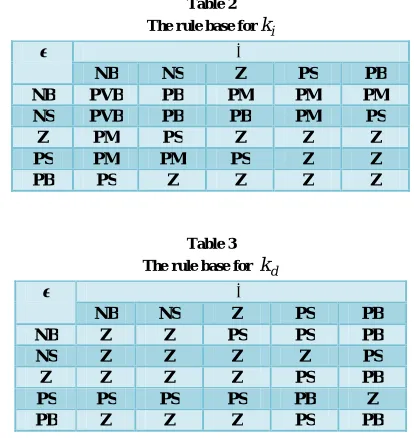
In the design, fuzzy controller uses the structure of two inputs and three outputs. Deviation e and deviation rate ė are the inputs of the system. Once the fuzzy controller receives the input data, it translates it into a fuzzy form and fuzzy processed according to IF…THEN rules. The controller evaluates the table of fuzzy control rules to arrive at a single outcome value and then proceeds on defuzzification process to get accurate values of kp,ki,kd which are the inputs of PID controller.
Mamdani’s fuzzy inference method is used in the system with two inputs and one output. A membership function is a curve that defines how each point in the input space is mapped to a membership value (on degree of membership) between 0 and 1. In this case, the triangle membership function is used for all variables shown in Figure 2 and 3. The physical domain of the inputs (e and ė) are all normalized in the interval of
] 1 , 1
ISSN: 2231-5381
http://www.ijettjournal.org
Page 312
p
K Ti Td
Fig. 1 Basic structure of poultry house with controller
Fig. 2 The membership functions for the inputs e and ė
Fig. 3 Membership functions for kp,ki and kd
Table 1 The rule base for kp
e Ė
NB NS Z PS PB NB PVB PVB PVB PB PM NS PVB PVB PB PB PM Z PB PB PM PS PS PS PM PS PS PS PS
PB PS PS Z Z Z
Table 2 The rule base forki
e Ė
NB NS Z PS PB NB PVB PB PM PM PM NS PVB PB PB PM PS
Z PM PS Z Z Z
PS PM PM PS Z Z
PB PS Z Z Z Z
Table 3 The rule base for kd
e Ė
NB NS Z PS PB
NB Z Z PS PS PB
NS Z Z Z Z PS
Z Z Z Z PS PB
PS PS PS PS PB Z
PB Z Z Z PS PB
The final output value from the Fuzzy-PID hybrid control system depends on the defuzzification method used to compute the outcome values corresponding to each label. The defuzzification process examines all of the rule outcomes after they have been logically added and then computes a value that will be the final output of the fuzzy controller. Defuzzication adopts weighted average method. Weighted average method gets the representative point, which is the center of the area made by fuzzy membership function curve and the abscissa. Theoretically, it should calculate the center of gravity of a series of points within the output scope. This is expressed mathematically as:
n
i i u n
i
i u i
u u u
U
1 1
) (
) (
(13)
where, uiand u(ui)are the fuzzy output in counts for labels and the fuzzy grade level for levels i.respectively.
IV. EXPERIMENTAL RESULTS
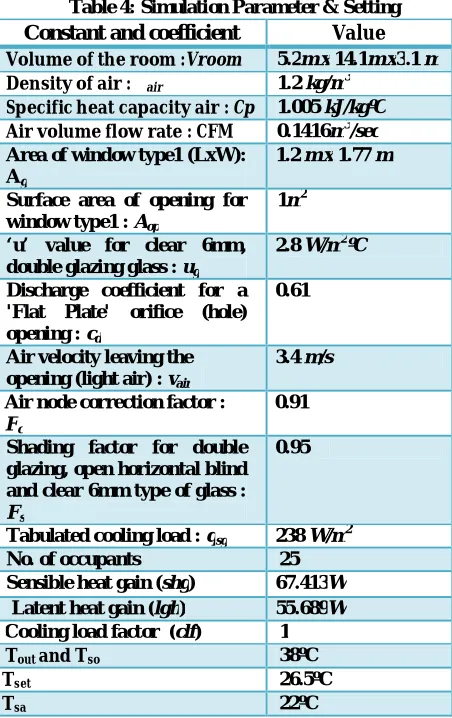
In this work, the poultry house temperature is controlled by conditioned supply air. The supply air handling unit consists of motorized dampers, heating coils, cooling coils, and supply air fans to maintain in-house temperatures within the birds’ comfort zone. Table 4 summarizes the parameters and values that are used in the simulation of the proposed temperature control system during hot weather.
ISSN: 2231-5381
http://www.ijettjournal.org
Page 313
developed and implemented in MATLAB/Simulink. The simulink model of both classical PID and Fuzzy-PID controllers is shown in Figure 4. The three-dimensional view of kp,kiand kdare shown in Figure 5.
For numerical simulation, the desired poultry house temperature has been set at 26.5ºC which falls within the
thermal neutral zone for adult broilers. Figure 6 shows the performance comparison of the simulation result of the Fuzzy-PID and classical Fuzzy-PID controller based temperature control of the poultry house during at outside temperature of 38ºC and 30ºC. It is clearly seen from this figure that by using fuzzy control for tuning the PID gains enable the poultry house temperature to reach a predetermined set point in the shortest time, with the minimum of overshoot and undershoot than classical PID control.
252.7769 s 2 Transfer Fcn1
252.7769 s 2 Transfer Fcn
piddata T o Workspace1
fispiddata To Workspace
Sum1 Step
Scope2
Scope1
Scope
PID PID Controller
In1 Out1
Out2
Out3
PID 1 Fuzzy Logic
Controller du/dt
Derivative
Add2 Add1 Add
Fig. 4 Simulation model of Fuzzy- PID temperature control system
III.CONCLUSION
This paper emphasizes on the effectiveness of controlling temperature of a poultry house with a Fuzzy-PID controller and its merit over classical PID controller.
The PID controller and Fuzzy-PID controller for the control of poultry house temperature is designed and is simulated using MATLAB/ SIMULINKpackage programme. The simulation results show that the Fuzzy-PID controller have better performance in terms of both the steady-state error and the settling time than that of PID controller.
(a)
(b)
(c)
ISSN: 2231-5381
http://www.ijettjournal.org
Page 314
0 0.2 0.4 0.6 0.8 1 1.2 1.4 1.6
26 28 30 32 34 36 38
Time (min)
T
e
m
p
e
ra
tu
re
(
oC
)
PID Fuzzy-PID
Fig. 5 The comparison of Fuzzy- PID and traditional System simulation
Table 4: Simulation Parameter & Setting
Constant and coefficient Value
Volume of the room :Vroom 5.2m x 14.1m x3.1 m
Density of air : ρair 1.2 kg/m3
Specific heat capacity air : Cp 1.005 kJ/kgºC
Air volume flow rate : CFM 0.1416m3/sec
Area of window type1 (LxW): Ag
1.2 m x 1.77 m
Surface area of opening for window type1 : Aop
1m2
‘u’ value for clear 6mm, double glazing glass : ug
2.8 W/m2ºC
Discharge coefficient for a 'Flat Plate' orifice (hole) opening : cd
0.61
Air velocity leaving the opening (light air) : vair
3.4 m/s
Air node correction factor :
Fc
0.91
Shading factor for double glazing, open horizontal blind and clear 6mm type of glass :
Fs
0.95
Tabulated cooling load : qsg 238 W/m 2
No. of occupants 25 Sensible heat gain (shg) 67.413W Latent heat gain (lgh) 55.689W cCooling load factor (clf) 1
7 Tout and Tso 38ºC
Tset 26.5ºC
Tsa 22ºC
REFERENCES
[1] Curtis S. (1983), “Environmental Management in Animal Agriculture”, Iowa State University Press, Ames.
[2] William J., (1995), “Extension Poultry Specialist”, Iowa State University, Ames.
[3] Sturkie, P.D. (1965) Avian Physiology, 2nd edn. Cornstock Press, Ithaca, New York.
[4] Van Der Hel, W., et al., (1991) The upper critical ambient temperature in neonatal chicks. Poultry Science 70, 1882–1887.
[5] MacDonald J. M (2008), “The Economic Organization of U.S. Broiler Production”, Economic Information Bulletin No. 38, Economic Research Service, U.S. Dept. of Agriculture.
[6] Czarick M. and Michael L. (1994), “Poultry Housing Tips: Environmental Controllers”, University of Georgia Cooperative Extension Service. College of Agricultural and Environmental Sciences, Athen, Georgia 30602, USA.
[7] Nick J. Killingsworth and Miroslav Krstic (2006), “PID Tuning Using Extremum Seeking: Online, Model-Free Performance Optimization”, IEEE Control Systems Magazine. Pp.70- 79.
[8] K.J. Åström and T. Hägglund, PID Controllers: Theory, Design and Tuning 2nd ed. Research Triangle Park, NC: Instrum. Soc. Amer., 1995. [9] K.J. Åström, T. Hägglund, C.C. Hang, and W.K. Ho, “Automatic tuning and adaptation for PID controllers—A survey,” Contr. Eng. Pract., vol. 1, no. 4, pp. 699–714, 1993.
[10] Jinkun Liu. Advanced PID Control and Simulation by MATLAB. Beijing: Publishing House of Electronics Industry, 2003.
[11] Xinyu Liu, Xianzhang Shen, Daoyin Qiu et al., (2003), “The application of self-adaption fuzzy PID in the process of agglomeration”, Journal of Zhong Yuan Institute of Technology.
[12] Nebil Ben-Aissa, Johnson Controls, Inc. (1997), VisSim Tutorial Series: Heating, Ventilation, and Air Conditioning (HVAC) Controls: Variable Air Volume (VAV) Systems.