© 2016 IJSRST | Volume 2 | Issue 2 | Print ISSN: 2395-6011 | Online ISSN: 2395-602X Themed Section: Science and Technology
A Trust-Aware Service Brokering Scheme for Multiple Clouds
Collaborative Services
Ramya P, Saraswathy S, Sharmila S, Sivakumar S
Information Technology, Dhanalakshmi College of Engineering, Chennai, TamilNadu, India
ABSTRACT
T-broker, a trust-aware service brokering scheme for efficient matching cloud services (or resources) to satisfy various user requests. T-broker acts as the middleware for cloud trust management and service matching. First, the trusted third party-based service brokering architecture is the proposed for multiple cloud and environment. T-broker uses the lightweight feedback mechanism, which can effectively reduce networking risk and the improve system efficiency. Then, T-broker uses the hybrid, adaptive trust model to compute the overall trust degree of service resources.
Keywords: Multiple Cloud Computing, Trust-Aware Service Brokering, Schedule To Resource, Automatic Delete.
I.
INTRODUCTION
MULTIPLE cloud theories and the technologies are hot directions in the cloud computing industry, which a lot of companies are putting much concern to make sure that they have benefited from this new innovation. Hence, compared with traditional networks, multiple cloud computing the environment has many unique features such as resources belonging to each of the cloud providers, and such resources being completely distributed, heterogeneous, and totally virtualized; these features indicate that is unmodified traditional trust mechanisms can no longer be used in the multiple cloud computing environments.
II.
METHODS AND MATERIAL
A. Motivation
Recently, the cloud brokering system have emerged as a promising concept to offer enhanced service of cloud environment, such as RESERVOIR, PCMONS, RightScale, SpotCloud, Aeolus and OPTIMIS. The cloud brokers can provide intermediation and aggregation capabilities to enable users to deploy their virtual infrastructures across the cloud system. The future of cloud computing will be permeated with the
emergence of cloud brokers acting as the intermediary between the cloud providers and users to negotiate, allocate resources among multiple sites.
B. Our Contribution
Based on previous work on trust management [10],[11],[30], [31], [36], this paper presents the T-broker for the efficient matching, computing resources to satisfy various user requests in multi-cloud environment. The main innovations of our scheme go beyond those of the existing approaches in terms of the following three aspects:
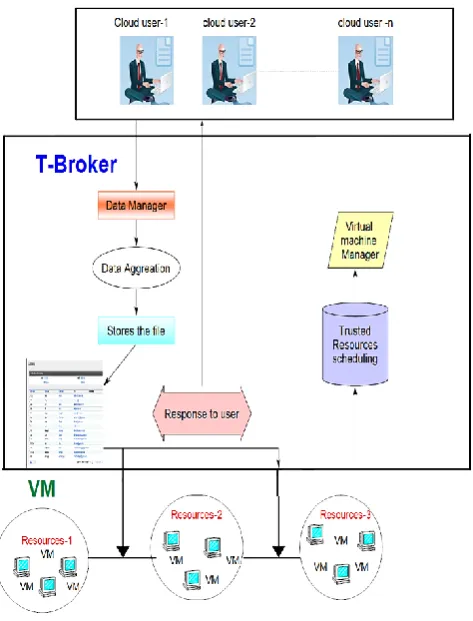
• T-broker uses a trust-aware service brokering architecture, in which the broker itself acts as a TTP for the trust management and resource scheduling. Through the distributed soft-sensors, this brokering architecture can be a real-time monitor for both dynamic service behavior of resource providers and feedbacks from users.
• T-broker uses a hybrid and adaptive trust model to compute the overall trust degree of the service resources, in which trust is defined as the fusion evaluation result from adaptively combining dynamic service behavior with the social feedback of service resources.
which can overcome the limitations of traditional trust models, in which the trusted attributes are all weighted manually or subjectively. At the same time, this method has a faster convergence than other existing approaches.
C. Related Work
The system worked under multiple users and providers that made collaboration issues and more memory storage. The system also faced the non-robustness in this existing approach and it also faced many problems under the delivery of the task because of the lack of scheduling to the resources. The system does not have the delete process to clear the memory which will help to maintain the memory storage.
D. Methodologies and Measures
The proposed system helps the user to get their task completed on time and it also helps the t-broker to analyze the task completed by the resources. The resources are also assembled as per the task given by the t-broker. The proposed system is developed to maintain memory storage and to control the collaboration issues.
III.
RESULT AND DISCUSSION
Experimental Work
A. Add Resources
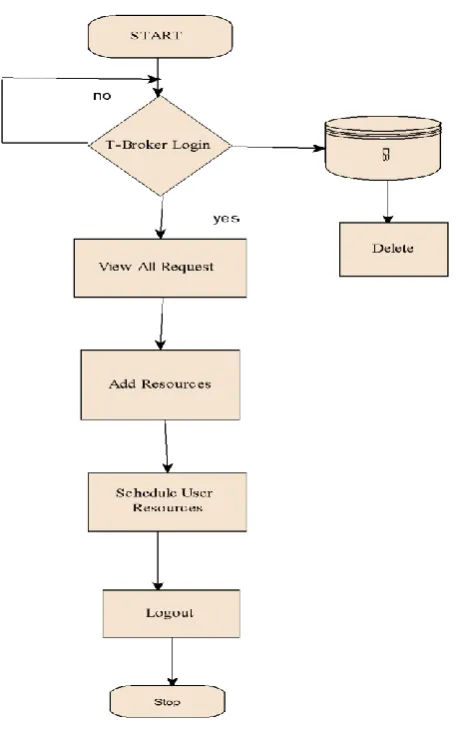
This the first field that we proposed in this approach that is the add resource which is mainly created to add the different types of resources that will be handling the different task that is allotted to the resources by the t-broker to fulfill the user request.
B. Schedule to the Resources
The resource scheduling is the second field in this approach, this field is to schedule the task to the resources which says when to start the task, when to complete the task and when to deliver the task to the user. This is mainly designed to reduce the collaboration
C. View all
The view field is developed to view all the details about the user their request and the allotted task to the resource, the status of the task and the delivery of the task.
D. Delete Process
This is the last field in the proposed approach which is developed to delete the unwanted content. The unwanted datas that are stored in the database will be deleted, that will help to maintain the storage memory in the system.
Techniques
A. Data coloring and Software Watermarking
Table 1 QoS Indicators (or Service Behavior)
Figure 2. Flow diagram for User activity
.
Figure 4. Flow diagram for Resource activity
IV.
CONCLUSION
In the future, we will continue our research from two aspects. First is how to accurately calculate the trust value of resources with only few monitored evidences reports and how to motivate more users to submit their feedback to the trust measurement engine. Implementing and evaluating the proposed mechanism in a large-scale multiple cloud system, such as distributed data sharing and remote computing, is another important direction for future research.
V.
REFERENCES
[1] M. Singhal et al., "Collaboration in multicloud computing environments: Framework and security issues,” Computer, vol. 46, no. 2, pp. 76–84, Feb.
Trans. Parallel Distrib. Syst., vol. 24, no. 6, pp. 1203–1212, Jun. 2013.
[3] F. Paraiso, N. Haderer, P. Merle, R. Rouvoy, and L. Seinturier, "A federated multi-cloud PaaS infrastructure,” in Proc. 5th IEEE Int. Conf. Cloud Comput. (CLOUD), Jun. 2012, pp. 392–399. [4] P. Jain, D. Rane, and S. Patidar, "A novel cloud
bursting brokerage and aggregation (CBBA) algorithm for multi cloud environment,” in Proc. 2nd Int. Conf. Adv. Comput. Commun. Technol. (ACCT), Jan. 2012, pp. 383–387.
[5] K. M. Khan and Q. Malluhi, "Establishing trust in cloud computing,” IT Prof., vol. 12, no. 5, pp. 20– 27, Sep./Oct. 2010.
[6] K. Hwang and D. Li, "Trusted cloud computing with secure resources and data coloring,” IEEE Internet Comput., vol. 14, no. 5, pp. 14–22, Sep./Oct. 2010.
[7] H. Kim, H. Lee, W. Kim, and Y. Kim, "A trust evaluation model for QoS guarantee in cloud systems” Int. J. Grid Distrib. Comput., vol. 3, no. 1, pp. 1–10, Mar. 2010.
[8] P. D. Manuel, S. Thamarai Selvi, and M. I. A.-E. Barr, "Trust management system for grid and cloud resources,” in Proc. 1st Int. Conf. Adv. Comput. (ICAC), Dec. 2009, pp. 176–181. [9] L.-Q. Tian, C. Lin, and Y. Ni, "Evaluation of user
behavior trust in cloud computing,” in Proc. Int. Conf. Comput. Appl. Syst. Modeling (ICCASM), Oct. 2010, pp. V7-576–V7-572.
[10] X. Li and Y. Yang, "Trusted data acquisition mechanism for cloud resource scheduling based on distributed agents,” Chin. Commun., vol. 8, no. 6, pp. 108–116, 2011.
[11] X. Li, H. Ma, F. Zhou, and X. Gui, "Service operator-aware trust scheme for resource matchmaking across multiple clouds,” IEEE Trans. Parallel Distrib. Syst., to be published, doi: 10.1109/TPDS.2014.2321750. 12(2014). OPTIMIS. Online]. Available: http://www.optimis-project.eu/ 13W. Fan and H. Perros, "A novel trust management framework for multi-cloud environments based on trust service providers,” Knowl.-Based Syst., vol. 70, pp. 392– 406, Nov. 2014. 14N. Ghosh, S. K. Ghosh, and S. K. Das, "SelCSP: A framework to facilitate selection of cloud service providers,” IEEE Trans. Cloud Comput., vol. 3, no. 1, pp. 66–79, Jan./Mar. 2015.
VI.
Author’s Profile
P.Ramya currently doing final year B.Tech IT in Dhanalakshmi college of Engineering, Tambaram, Chennai, India. Area of Interest is C language. Contact mail id: [email protected]
S.Saraswathy currently doing final year B.Tech IT in Dhanalakshmi college of Engineering, Tambaram, Chennai, India. Area of Interest is C language. Contact mail id: [email protected]
S.Sharmila currently doing final year B.Tech IT in Dhanalakshmi college of Engineering, Tambaram, Chennai, India. Area of Interest is C language.Contact mail id: [email protected]