ANALYZING THE GAP BETWEEN CLASSROOM TEACHING AND WEB-BASED TEACHING
SPECIAL REFERENCE FROM HIGHER NATIONAL DIPLOMA IN INFORMATION TECHNOLOGY PROGRAMME OF SRI LANKA
INSTITUTE OF ADVANCED TECHNOLOGICAL EDUCATION
Jeyarasa Pratheepan Lecturer in Information Technology Advanced Technological Institution
Trincomalee, Sri Lanka
ABSTRACT
The main aim of this research work is to analyse the gap between traditional classroom teaching and web-based teaching strategies and design and implement an improvedweb-based teaching system to fill the gap. Online degree programmes are growing rapidly and effectively on an international scale, but in Sri Lanka, public and academic interest in the web-based learning and teaching is clearly visiblenowadays. However, students and teachers feel that there is a gap between real classroom teaching and current web-based teaching system used in Sri Lankan educational organizations.In the first phase, thegap is identified from a comprehensive analysis on both methods based on the Higher National Diploma in Information Technology (HNDIT) programme of Sri Lanka Institute of Advanced Technological Education (SLIATE), Sri Lanka.An improved web-based teaching system, which is a virtual classroom plug-in for the existing Moodle learning management system, is designed in the next phase based on the outcomes of the first phase.In the final phase, the newly constructed web-based system is tested and the statistical results demonstrate the superior performance of our new system.
Key Words: Traditional classroom teaching and Web-based teaching strategies
1. Introduction
During the last decade, web-based teaching and learning environment have become anessential component in education and have given the impression of wide-spread changes in educational practices.At the present time conducting traditional classes are quiet expensive because of buildings, resources, maintenance and other expenses.The traditional classroom teaching has some other considerable limitations due to the number of students in a class and the geographical distribution of the students. Students like to attend a course without travelling to university or institute and students save money and time. Further there are many differently abled students in Sri Lanka who are unable to attend the traditional classes physically. Web-based learning provides flexibility because students can choose the time when they wish to participate. Therefore, instead of the traditional classroom teaching, moving towards to web-based teaching is compulsory these days.These technological advancements and completely different teaching and learning methods persuade the educational specialists and researchers to reorganize the fundamental processes of teaching and learning. Toachieve this, the researchers try to compare and contrast the new teaching methods with old teaching methods conceptually and statistically, to explore optimal solutions for better learning and teaching.
managed in a consistent and convenient manner. However, all educational practices with web-based teaching and learning are not positive. Many students still prefer class room teaching due to some important drawbacks of web-based teaching methods such as technical problems, isolated environment, and delayed feedback from the teacher, which are not ignorable. Moreover, the teachers cannot control over their students in the web-based teaching environment and sometime this environment increases complexity of learning. Students are also forced to determine their own learning strategies, which are correct or not, and manage their time and resources. Students, teachers and parents therefore agree that there is a gap between real classroom teaching and the current web-based teaching in Sri Lanka. The initial objective of this research is to identify the gap in current web-based teaching in Sri Lanka comparing with traditional classroom teaching quantitatively and qualitatively based on the HNDIT programme of SLIATE. The fundamental problems of existing inequality in classroom teaching and current web-based teaching are identified and formalized these problems as number of factors. In the second phase of this research, strategies exposed to overcome every problem identified in the previous phase and the strategies implemented directly as a virtual classroom plug-in using Moodle to fill the gap. In the final phase, the classroom teaching method and newly developed web-based teaching method compared quantitatively to confirm our newly developed virtual classroom restructured effectively.
2. Research Problem
“To find out the gap between classroom teaching and web-based teaching in Higher National Diploma in Information Technology programme of Sri Lanka Institute of Advanced Technological Education”
3. Research Objectives
The objectives of the research are identifying the gap in current web-based teaching in Sri Lanka comparing with traditional classroom teaching quantitatively and qualitatively and suggesting the possibility of introducing virtual classroom to fill the gap.
4. Literature Review
The impact of web-based teaching comparing with class room teaching has continuously been explored by researchers of education. Ya Ni (2013) identified that the student performance is independent of the two teaching methods by comparing student performance measures and assessments using high level online learning system. Some research groups [Kiser, K. (1999); Matthews, D. (1999); Swan, K., Shea, P., Frederickson, E., Pickett, A. Pelz, W., & Maher, G. (2000) ] found that the online learning can be effective and have many potential advantages such as increased convenience, flexibility, and customized learning. Some other research groups [Brown, K. M. (1996); Hara, N., & Kling, R. (2000)] concluded completely opposite results, which describes many limitations of online learning such as students in an online environment may feel isolated, confused, and frustrated and that student’s interest in the subject and learning effectiveness may be reduced [Maki, R. H., Maki W. S., Patterson, M., & Whittaker, P. D. (2000)]. Annika Andersson(2008) and Peter Mozelius et al. (2011)analysed the challenges of e-learning based on the Sri Lankan education environment. Hakim Usoof et al. (2012) investigated the impact of assessment practices on the learning process, student learning outcomes and student attitudes towards learning in a distance education programme in Sri Lanka. However, from our understandings, any paper, which is systematically compare the two teaching methods and identify the gap between them based on the Sri Lankan studies, has not been published previously.
technical colleges, private universities, foreign universities and professional institutions. Traditional class room teaching is still common in primary, secondary and high levels education institutions in Sri Lanka. Human teachers are always in front of the students so that teachers can directly observe the students and their behaviours. Teachers can easily identify the student’s understandings in the subject as well as their problems and quickly rectify them. Teachers can closely monitor student’s attendance and good understanding between students and teachers, and good understanding among students will be improved day by day.
During the last decades the country’s use of information and communications technology (ICT) has very much increased and the ICT infrastructure such as hardware, software and network facilities has improved in rural and urban areas. Internet facilities are also accessible in any part of the country. The idea for web-based teaching and online learning has been implemented successfully in Sri Lanka for many degree programs such as Colombo University’s BIT and MoratuwaUniversity’s BIT. On-line study materials are not only used for distance education, but also on-line components used by the classroom students that complement classroom activities in Sri Lanka. The Higher National Diploma in Information Technology (HNDIT) programme is offered by the Sri Lanka Institute of Advanced Technological Education (SLIATE) that allows with an interest in information technology to study for a diploma over a period of two years. The traditional class room teaching and learning method is followed in all the 9 Advanced Technological Institutes (ATIs) for the HNDIT programme with the help of Moodle, a well-known Learning Management System (LMS), which is playing a vital role in many of the academic institutions nowadays.
5. Hypothesis
The study explores the following hypothesis:
H0: There is no significant difference in learning effectiveness between classroom teaching method and web-based teaching method.
H1: Web-based teaching method differs from classroom teaching in learning effectiveness.
6. Methodology
6.1 Research Sample
The student population (200 students) of this study was selected from HNDIT students of Ampara, Badulla, Dehiwela, Galle, Kandy, Kurunagala, Jaffna, Trincomalee, and Kegalle ATIs under SLIATE in Sri Lanka. The selected students were randomly divided into two groups named as Group1 (100 students for Classroom Learning) and Group2 (100 students for Web-based Learning).
6.2 Data Collection and Quantitative Analysis
was used on the average marks of the three modules of each student in Group1 and Group2 to test the above hypothesis.
6.3 Gap between Classroom Teaching and Web-Based Teaching- A Qualitative Approach
The study was continued with the Group2 students and the special module lecturers were employed for qualitative study in addition to the quantitative data from student performances. Given the nature of the present study, the data collected from the primary and secondary sources. Primary data was collected through the questionnaires and feedbacks. A questionnaire was issued to the lecturers and other questionnaire was issued to the Group2 students. The questionnaire’s main focus was to identify the drawbacks of web-based teaching/learning when compared with classroom teaching/ learning. The student feedbacks were collected in addition to questionnaire of web-based teaching compared with classroom teaching in HNDIT programme. The main theme of the questionnaire was to ask questions like “What would help to increase your learning of the course module when taking the web-based teaching component with the classroom teaching?” The respondents were requested to write open ended answers.
Secondary data was collected from research studies, books, journals, newspapers and ongoing academic working projects. The collected data was processed, analysed and formulated in order to find the major drawbacks (gap) of the current web-based teaching method, which are the factors, to be improved in the next phase.
6.4 A New Virtual Classroom to Fill the Gap
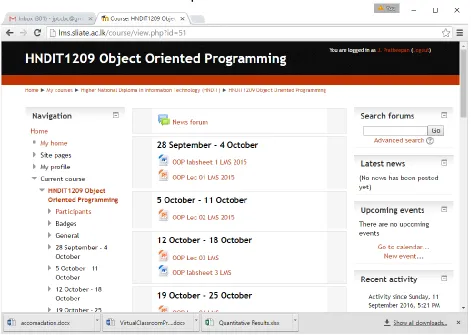
Current Web-based Teaching Environment:Moodle is used as the current teaching/learning management system of SLIATE and a sample course page is depicted in Figure 1. Using Moodle teachers can create a course and enrol students.The current web-based teaching environment supports uploading resources, creating quiz, news forums and assignments.Enrolled students can access those resources, attempt assignment, quizzes and also ask questions. Other features that can be useful are chat, forum, games etc.
Build a New Virtual Classroom Environment:Aweb-based virtual classroom was built as a plug-in in the current Moodle system, which is equipped with all factors which are identified in the previous phase. The plug-in is a discreet parcel of functionality that can be added on to Moodle platform to provide an extra feature. The plug-in consists of improved versions of real-time collaboration tools like, live chat, audio and live video streams for, whiteboard, screen, content sharingetc. according to the problems identified in the current web-based teaching system.
6.5 Examine the Performances of the Newly Build Web-based Teaching.
A same kind of analysis were performed as earlier using a different set of student population (200 students)from HNDIT students of Ampara, Badulla, Dehiwela, Galle, Kandy, Kurunagala, Jaffna, Trincomalee, and Kegalle ATIs, under SLIATE in Sri Lanka. The students were randomly divided into two groups. One group of students (classroom teaching-100 students) assigned for the weekly lecture classes and the other group of students (web-based teaching-students) used a newly build web-based virtual classroom. The performance evaluation, hypothesis and statistical analysis used as same as in the first phase of this project.
7. Results
7.1 Gap between Classroom Teaching and Web-based Teaching - A Quantitative Approach.
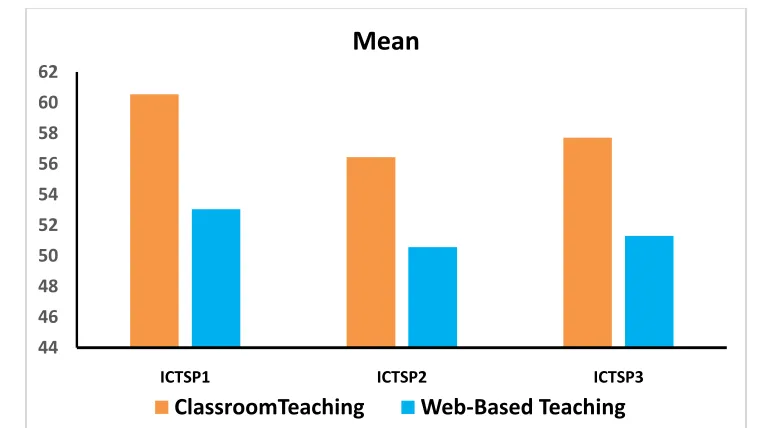
Based on the measurement of the student’s performanceresults on three modules,classroom teaching and current version of web-based teaching were compared. The descriptive statistics of the results are depicted in the Table 1 and the performance mean graph is illustrated in the Figure 1. Table1 and Figure 1 shows that the mean of the student performances of the web-based teaching method is less than the student performances of the classroom teaching significantly in all three modules.
Table1: Descriptive statistics of the student performances of the two teaching methods.
GROUP1- Classroom Teaching GROUP2- Web-Based Teaching
ICTSP1 ICTSP2 ICTSP3 ICTSP1 ICTSP2 ICTSP3
Mean 60.55 56.44 57.71 53.04 50.57 51.3
Figure 2: Mean student performances of the two teaching methods.
Table 2: T-test results of the two teaching methods.
t-Test: Two-Sample Assuming Equal Variances
Group 1 Group 2
Mean 58.23 51.63
Variance 305.83 302.42
Observations 100 100
Hypothesized Mean Difference 0
Degrees of freedom 198
P(T<=t) two-tail 0.008104228
To examine the hypothesis in 2.1, we performed the two-tail t-test based on the average performance of the three modules and Table 2 depicted the results of the t-test.From the t-test resultswe concluded that there are significant differences between two teaching methods (p value (0.008) < 0.05). The observed difference between the sample means (51.63 and 58.23) is convinced enough to say that the current web-based teaching/learning students performed poorly compared with classroom teaching/learning students and their performances were affected by the current web-based system.
7.2 Gap between Classroom Teaching and Web-Based Teaching- A Qualitative Approach.
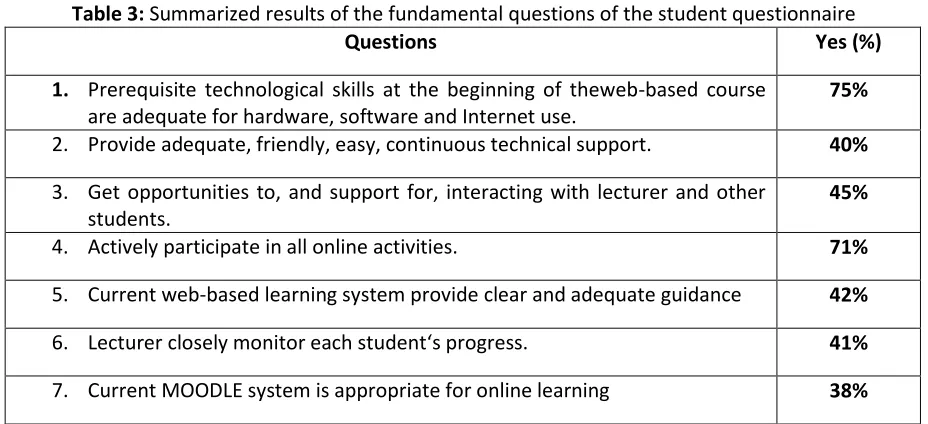
The primary data collected through the questionnaire and feedbacksfrom 100 students of Group2, who follow the web-based teaching in the first phase. Results of the fundamental questions (Part I) of the questionnaire are summarized in the Table 2. The results illustrated that the students already had technological skills to follow the web-based teaching and they actively participated in the course module activities. However, they were not satisfied with the current web-based teaching and the current MOODLE environment.
44 46 48 50 52 54 56 58 60 62
ICTSP1 ICTSP2 ICTSP3
Mean
Table 3: Summarized results of the fundamental questions of the student questionnaire
Questions Yes (%)
1. Prerequisite technological skills at the beginning of theweb-based course are adequate for hardware, software and Internet use.
75%
2. Provide adequate, friendly, easy, continuous technical support. 40%
3. Get opportunities to, and support for, interacting with lecturer and other students.
45%
4. Actively participate in all online activities. 71%
5. Current web-based learning system provide clear and adequate guidance 42%
6. Lecturer closely monitor each student‘s progress. 41%
7. Current MOODLE system is appropriate for online learning 38%
Based on the questionnaire, feedbacks from lecturers and students and collected secondary data, we identified the problems of the current web-based teaching and learning setup and proposed solutions for each problem, which are listed in Table 4.
Table 4: Summarized problems of current web-based system and the proposed solutions.
No Problem Identified in the Current Web-based Teaching
Solution: Characteristic of the New Virtual Classroom
1 Ensuring the actual participation of the student is difficult because any others can login instead of a particular student with his/her user name and password.
In addition to the user name and password, user’s image captured at the beginning of a classroom session should be viewable to the others.
2 Closely observing each and every
student is difficult.
If there is any decline in the continuous assessment result, the system should alert the teacher automatically.
3 Monitoring the attendance and treating irregular students are difficult.
Based on the login details, the system should automatically send email to the student copied to teacher and parent.
4 Less understanding between teacher and students.
System should notify the teacher automatically about students who are rarely interacting with the teacher so that the teacher can interact with those students more and more for better understanding.
5 Less understanding among students. System should provide video interaction among the students to improve mutual understanding.
6 Psychological advantages of eye contact between teacher and students is missing.
7 The benefits of traditional teaching tools such as whiteboard are missing.
System should provide real time video streaming for whiteboard also.
8 Maximum number of participants is limited by the bandwidth
The system should allow video streaming only for maximum possible number of streaming based on the bandwidth available. Except the targeted student and the neighbours, all the other video streaming should be stopped automatically.
9 Handling computer and Internet is difficult for some students and teachers
Interface must be designed as much as user friendly.
7.3 A New Virtual Class Room
The newly built virtual classroom plugin is well-defined and user friendly online system, which considered all the solutions in the Table 4. Figure 3 is demonstrated the sample page of a new virtual classroom environment.
7.4 Examine the Performances of the Newly Build Web-based Teaching.
Table 5: Descriptive statistics of the student performances of the two teaching methods.
GROUP1- Classroom Teaching Group2- Web-based Teaching
ICTSP1 ICTSP2 ICTSP3 ICTSP1 ICTSP2 ICTSP3
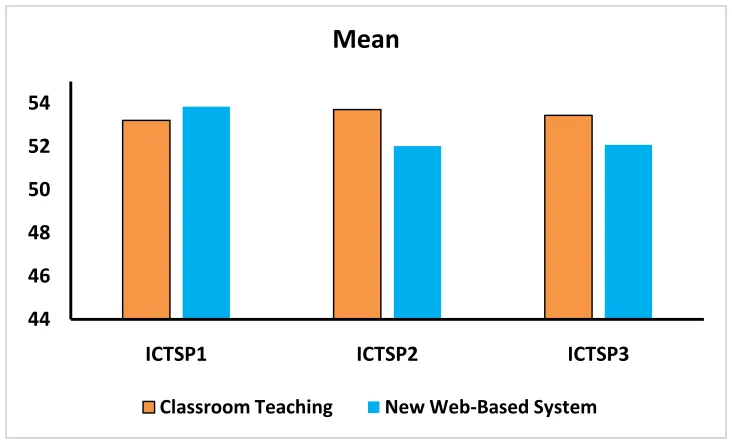
Mean 53.20 53.70 53.44 53.83 52.01 52.07
Standard Deviation 22.40 22.58 20.38 20.56 20.52 21.72
Based on the measurement of the student’s performance results on three modules, classroom teaching and new version of web-based teaching were compared. The descriptive statistics of the results are depicted in the Table 5 and the performance mean graph is illustrated in the Figure 3. The descriptive results illustrated that the student performances of the web-based teaching method is improved significantly and almost same as the student performances of the classroom teaching in all three modules.
Figure 3: Mean student performances of the two teaching methods.
Table 6: T-test results of the comparison of the two teaching methods.
t-Test: Two-Sample Assuming Equal Variances
Group 1 Group 2
Mean 53.48 52.63
Variance 303.02 288.80
Observations 100 100
Hypothesized Mean Difference 0
Degrees of freedom 198
P(T<=t) two-tail 0.73024
44 46 48 50 52 54
ICTSP1 ICTSP2 ICTSP3
Mean
To observe the significant differences between classroom teaching and newly constructed web-based teaching methods, we performed the two-tail t-test based on the average performance of the three modules and Table6 depicts the results of the t-test.The results shows that there is no significant difference between two teaching methods (p value (0.73) >0.05). The observed difference between the sample means (53.48 and 52.63) is clearly illustrated the newly builtweb-based learning students performed equally well as classroom teaching students.
8. Findings and Conclusion
The research project analysed the significant limitations of current web-based teaching in Sri Lanka compared with traditional classroom teaching. One of the important outcomes of this project is such limitations as factors, which we called as gap between classroom teaching and web-based teaching, based on the Sri Lankan education system. The paper comprehensively analysed the causes and consequences of existing inequality in classroom teaching and current web-based teaching. Based on the outcomes of the analysis phase we developed a new virtual classroom plug-in to merge the gap between these two types of learningand developed new strategies to solve the problems of current web-based teaching.
The newly designed and constructed plug-in for the Moodle fulfil the shortcomings of current Moodle as well as removing the disadvantages of real classroom teaching without losing the advantages of it. The new web-based teaching environment gives more satisfaction in teaching and learning, more accurate evaluation, more understanding between teacher and students as well as among students, No time barrier and No geographical barrier. However there are some limitations still experienced in our system such as bandwidth is not enough for many real time video streaming simultaneously as server has to support for Moodle as well as our plug-in which highly depends on real time video streaming. In future, we will consider this problem and reduce the workload of the server and more workload has to be assigned to client side.
9. Limitation and Scope for future study
The following limitations will be expected from this research.
Due to the difficulties of surveying the whole population, samples will be selected randomly for this research.
Data collection restricted to some extent cannot get the actual feedback of the students.
The researcher does not do the research widely, because of the Time and cost are limited.
References
1. Annika Andersson(2008) Seven major challenges for e-learning in developing countries: Case study eBIT, Sri Lanka International Journal of Education and Development using Information and Communication Technology (IJEDICT), Vol. 4, Issue 3, pp. 45-62.
2. BIT. Bachelor of Information Technology website, University of Colombo. Available at: http://www.bit.lk
3. BIT. Bachelor of Information Technology website, University of Moratuwa. Available at: http://www.codl.lk/webcodl/programmes/bit/
4. Brown, K. M. (1996). The role of internal and external factors in the discontinuation of off-campusstudents. Distance Education, 17, 14–71.
5. Hakim A. Usoof, Brian Hudson and Gihan N. Wikramanayake(2012) Technology Enhanced Assessment for Learning in a Distance Education IT Degree Programme in Sri Lanka he International Journal on Advances in ICT for Emerging Regions (ICTer) Vol 5, No 1
6. Hara, N., & Kling, R. (2000). Students’ distress with a web-based distance education course: An ethnographic study of participants’ experiences. Information, Communication, and Society, 3, 557–579.
7. HNDIT. Higher National Diploma in Information Technology. Available at:
http://www.sliate.ac.lk/
8. Kiser, K. (1999). 10 things we know so far about online training. Training, 36, 66–74.
9. Maki, R. H., Maki W. S., Patterson, M., & Whittaker, P. D. (2000). Evaluation of a web-based introductory psychology course: I. Learning and satisfaction in on-line versus lecture courses. Behavior Research Methods, Instruments and Computers, 32, 230–239.
10. Matthews, D. (1999). The origins of distance education and its use in the United States. THE Journal, 27(2), 54–66.
11. MOODLE https://docs.moodle.org/31/en/Main_page
12. Mozelius, Peter, Hansson, Henrik, Hewagamage, K. P (2011) Towards e-learning for all in Sri Lanka - progress and problems in some selected Sri Lankan 21st century initiatives. In: Proceedings of Cambridge International Conference on Open, Distance and e-Learning
13. Swan, K., Shea, P., Frederickson, E., Pickett, A. Pelz, W., & Maher, G. (2000). Building knowledge building communities: Consistency, contact, and communication in the virtual classroom. Journal of Educational Computing Research, 23(4), 389–413.
14. UGC. University Grant Commission Available at: www.ugc.ac.lk/