
© Global Society of Scientific Research and Researchers
http://ijcjournal.org/
A General Approach of Authentication Scheme and its
Comparative Study
Sanjeev Kumar Mandal
a*, A. R Deepti
baResearch Scholar, Department of Master of Computer Application, Acharya Institute of Technology
Bangalore-56010, India.
b
Associate Professor(fka), Dept. of Master of Computer Application, Acharya Institute of Technology
Bangalore-560107, India.
aEmail: [email protected]
bEmail: [email protected]
Abstract
The field of information security is a vast area which is continually evolving and expanding relative to network data and global communication security. This literature review contrasts the research that has been published in the area of cryptography and authentication protocols, by providing a comparative and analytical study to secure the web servers and services.
Keywords: Authentication; Certificate based authentication; Zero knowledge proof; Single sign on with
windows.
1.Introduction
Cryptography is the discipline of art and science by ensuring that messages are secure from possible attacks like eavesdropping, impersonation or corruption. Therefore cryptography is the study of mathematical techniques related to aspects of information security such as confidentiality, data integrity, access control, and authentication. There is an enormous increase in the development and use of networked and distributed systems, by providing increased functionality to the user and more efficient use of resources. To obtain such benefits, the parties have to cooperate by exchanging messages over networks. These parties may be users, hosts or processes; generally referred as principles in authentication literature. Authentication plays an important role in the security of Internet-based applications by providing two-party or multi-party communications.
---
A few types of authentication are user authentication, remote user authentication, mutual authentication, message authentication, and implicit authentication. Authentication is a fundamental concern of providing service related to identification in a secure distributed system. For example, in the established client-server computing paradigm, a server must verify a client’s identity before it can make authorization decisions; similarly, a client must ascertain a server’s legitimacy before it would proceed with its service request. In other words, authorization and accounting schemes can be built on top of authentication, resulting in the required security to the network system. Therefore, in distributed environment, authentication is typically carried out by protocols, called authentication protocols. The design of authentication protocols is notoriously error-prone. Indeed, many authentication practices have been published and later found to contain subtle weaknesses or flaws which are shown in this review paper. The rest of the paper is organized as follows: by describing the concept of related authentication factors and its environment in section 2. Comparative and analyses study of few authentication protocols is seen in section 3. Finally, the paper is summarized with conclusions and the future work in section 4.
2.Authentication Aspects
The ways in which someone can be authenticated usually fall into three categories known as the factors of authentication, which include: i) something the user knows, such as a password or shared secret. ii) Something the user has such as an ID card or a smartphone.iii) something the user is like face and voice recognition. Despite of the above well-known security issues, passwords are still the most popular method of end-user authentication. Here in this paper, we will focus and discuss on authentication factors over the networks which is given below.
2.1. Single-Factor Authentication (SFA) and Two-Factor Authentication (2FA)
Single-factor authentication (SFA) is a process to secure access to a given system, like network or website that identifies the party requesting access through only one category of credentials. Example of SFA is password-based authentication. As far as SFA services go, user ID and password are not the most secure. One problem with password-based authentication requires knowledge and diligence to create and remember strong passwords. Passwords require protection from many, like carelessly stored sticky notes with login credentials, old hard drives and exploits. Passwords are also prey to external threats, such as hackers using or attacks. Given enough time and resources, an attacker can usually breach password-based security systems. Because of low cost, ease of implementation and familiarity, passwords have remained the most common form of SFA. Also, multiple challenge-response questions can provide more security, depending upon their implementation, and stand-alone biometric verification methods to secure single-factor authentication.
recognizes and authenticates access for users who are using their tokens correctly. The tokens may be physical devices or software app to generate PIN codes for authentication which is summarized below. So, the organizations need to have some system in place to accept process to allow or deny access to users authenticating with their tokens. This may be server software, a dedicated hardware server or provided as a service by a third-party vendor.
2.2. Hardware Tokens
Hardware tokens are widely used in two-factor authentication, by providing tokens in hardware device for strong security and easy integration. This device may be in the form of a smart card, USB, Wallet-cards, mobile or may be embedded in a key fob. Examples of tokens applied in devices are car central lock remote system, mobile trusted device unlock system, and ATM etc., Even though the hardware token is used widely it has its own limitation like high cost of implementing the authentication procedure, securing the device, and the user’s chain-of-custody [2]. The chain-of-custody means it involves person-to-person delivery, identification checking and signing the token which goes from manufacturer to vendor to distributor and finally to the customer.
2.3. Soft Tokens
Soft tokens are software-based tokens or applications used to authorize the use of computer services by generating one time password (OTP). A one-time password (OTP) is an automatically generated pseudorandom number that authenticate the user for a single transaction or session to improve the security. One major advantage of using OTP is that no additional hardware or infrastructure is required to implement this method [14].Software tokens are stored on a general-purpose electronic device such as a desktop computer, laptop or a mobile phone. The widespread use of mobile devices has made soft tokens popular and convenient to use and less cost.
However,in contrast with hardware tokens, software tokens can be duplicated, because a user cannot physically possess them. Therefore, these token may be copied or stolenfrom any of these machines. Another threat is the intruder may use malicious software, to infect any machine to collect the stored soft tokens.
2.4. Certificate-Based Authentication
List (CRL) that may or may not be provisioned within an Online Certificate Status Protocol (OCSP) server. Then each application should check their login for the CRL/OCSP status. This introduces a time delays into the system between the time a PKI credential is reported as compromised and the time when the systems that rely on that credential actually start denying access. Thus the speed of status update can be accelerated to a greater system complexity cost. Finally, the CA still requires a password/pin which may be tampered by the intruder. EAP, MD5, CHAP are few certificate authentication protocol used in the organizations.
2.5. Zero Knowledge Proof authentications (ZKP)
A zero knowledge based entity authentication protocol, allows one party to prove to another party without revealing the secret. As the verifier does not learn anything about prover’s secret, he/she cannot impersonate the prover’s to a third person. Also the prover cannot cheat the verifier with several iterations of the protocol. The ZKP must satisfy three conditions because of interactive proof of nature: completeness, soundness and zero knowledge property. These protocol can be solved by using mathematical problems like discrete logarithms and integer factorization [8] etc., to improve security. It is simple to use, where critical encryption methods are not required. The drawbacks of ZKP are limited like, i) translation might be necessary if a secret is not a number. ii) Lengthy, as almost 2k entity, so it takes a lot of time to compute. iii) Imperfect, where the intruder can still intercept the message. Nowadays most of organization uses ZKP in real world like cellular radio tower, Network Authentications, Smart Cards, Key Exchanges, Graph coloring problem and cloud database management.
2.6. Single Sign-On with Windows
Single Sign-On with Windows or NTLM is a window Challenge/Response protocol based on data obtained during the interactive login process; consist of a domain name, a user name, and a one-way hash of the user’s password. Here it uses an encrypted challenge/response protocol to authenticate a user without sending the user’s password over the wire. Instead, the system request authentication by performing mathematical calculations to prove to access the secure NTLM credentials [9]. NTLM authentication comprises into three messages; Type 1 (negotiation), Type 2 (challenge) and Type 3 (authentication). This type of authentication establish a shared context between two parties that include a shared session key for signing and sealing operations by giving NTLM a proprietary authentication. The Single Sign-On with Windows has its own weakness like, NTLM authentication protocol does not support smart card log in. In a multi-tier application, authentication happens on different tiers. In such a setup, to set authorization on the database by using the user's identity, one should be capable of using the user's identity to authenticate on web and database server. Therefore, it is impossible to use NTLM for authentication on every link, because delegation is not supported. Also, the NTLM protocol is not supporting mutual and slower authentication because of pass-through authentication and also not specified in an open standard document (for example in an IETF RFC).
3.Comparative Study of Different Authentication Protocol
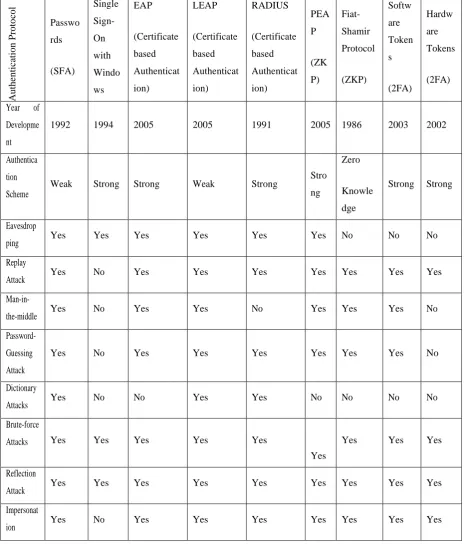
In this paper, a comparative study is done by selecting few authentication protocols and its practices in the real world. The table1 shows the different types of threats, attacks and its strength of different authentication schemes.
Table 1: Security comparison of the defined authentication protocols
3.2.Analyze protocols in the Protocol tab
A ut he nt ic at ion P rot o col Passwo rds (SFA) Single Sign-On with Windo ws EAP (Certificate based Authenticat ion) LEAP (Certificate based Authenticat ion) RADIUS (Certificate based Authenticat ion) PEA P (ZK P) Fiat-Shamir Protocol (ZKP) Softw are Token s (2FA) Hardw are Tokens (2FA) Year of Developme nt
1992 1994 2005 2005 1991 2005 1986 2003 2002
Authentica tion Scheme
Weak Strong Strong Weak Strong Stro ng
Zero
Knowle dge
Strong Strong
Eavesdrop
ping Yes Yes Yes Yes Yes Yes No No No Replay
Attack Yes No Yes Yes Yes Yes Yes Yes Yes
Man-in-the-middle Yes No Yes Yes No Yes Yes Yes No
Password-Guessing Attack
Yes No Yes Yes Yes Yes Yes Yes No
Dictionary
Attacks Yes No No Yes Yes No No No No Brute-force
Attacks Yes Yes Yes Yes Yes
Yes
Yes Yes Yes
Reflection
Attack Yes Yes Yes Yes Yes Yes Yes Yes Yes Impersonat
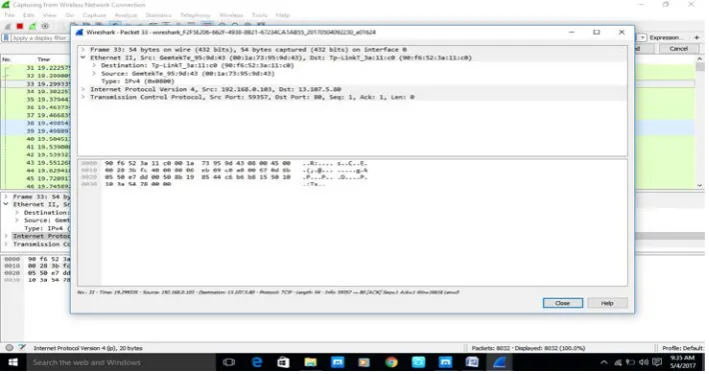
From the comparative study, it is proved that single sign on with window, hardware tokens and Fiat Shamir protocols are more secure. So, with the help of wireshark tool, used in sign on with window is analysed and shows that it is secure from ProRat, Google Hacks, Httrack, Site Digger threats and attacks which is given in Figure1.
Figure 1: Single Sign on with Window is analyzed with wireshark tool for its efficiency
The remaining protocols from table1 are also analyzed in order to check its security by using the Wireshark tool to show its weakness in Figure 1.1.
4.Conclusion and future work
In this paper, a general approach of authentication practices is presented. Then, a comparative study is made between the protocols to check its security complexity. Furthermore, analysis is done in order with the help of tool to provide a satisfying security level in terms of data transmission and time. Since the research on authentication protocols is a relatively young area, the number of new formulate protocols is increasing as long as many attacks are appearing so direction of the future research work is about verifying their efficiency.
References
[1] L.C.K. Hui, J.C.K. Yau, E.K. Wang, S.M. Yiu, Z.L. Jiang. The WHO Hardware Token Security Model. In June 26, 2006, HKU CS.
[2] Kingpin Attacks on and Countermeasures for USB Hardware Token Devices. 196 Broadway, Cambridge, MA 02139, USA.
[3] Manav Singhal and Shashikala Tapaswi, “Software Tokens Based Two Factor Authentication Scheme.” in International Journal of Information and Electronics Engineering, Vol. 2, No. 3, May 2012.
[4] LiPing Du, JianWei Guo Ying Li. “Research on Micro-Certificate based Authentication Protocol.” Proceedings of the 2nd International Conference on Computer Science and Electronics Engineering (ICCSEE 2013).
[5] Karthik Sadasivam, T. Andrew Yang. Evaluation of Certificate-Based Authentication in Mobile ad hoc Networks. University of Houston-Clearlake Houston, TX, USA.
[6] Davaanaym, Y.S. Lee, H.J. Lee, S.G. Lee, and H.T. Lim. “A ping pong based one-time-passwords authentication system.” In 2009 Fifth International Joint Conference (NCM ’09) on INC, IMS and IDC, pages 574–579. IEEE Computer Society, 2009.
[7] Yeen-Yin Choong, Kristen K. Greene, Mary F. Theofanos, “Authentication and Lifecycle Management.” Internet: www.pages.nist.gov/800-63-3/sp800-63b.html, [TBD 2017].
[8] U. Fiege, A. Fiat, A. Shamir. “Zero Knowledge Proofs of Identity.” in Proceedings of ACM Symposium on Theory of Computing (STOC), 1987.
[9] Microsoft. “Microsoft NTLM.” Internet: https://msdn.microsoft.com/enus/library/windows/desktop/aa378749 (v=vs.85).aspx.
[10]Eman El-Emam, Magdy Koutb, Hamdy Kelash, and Osama Farag Allah. “A Network Authentication Protocol Based on Kerberos.” IJCSNS International Journal of Computer Science and Network Security, Vol.9 No.8, August 2009.
[11]Sanket Bhat, Damle, Priyanka Chaudhari, Abhijeet. “An Authentication Protocol.” International Journal of Advance Research in Computer Science and Management Studies, [On-line]. Volume 2, Issue 2, Available: www. ijarcsms.com/docs/paper/volume2/issue2/V2I2-0081.pdf February 2014. [12]L. Gong, M. Lomas, R. Needham, and J. Saltzer, “Protecting Poorly Chosen Secrets from Guessing
Attacks." IEEE Journal on Selected Areas in Communications, [On-line]. Vol. 11, No. 5, June 1993,
pp.648-656, Available:
[13]M. Bellare, D. Pointcheval, P. Rogaway, “Authenticated key exchange secure against dictionary attacks.” in Advances in Cryptology— Eurocrypt 2000, Vol. 1807, Springer, Berlin, 2000, pp. 139– 155.
[14]S. M. Bellovin and M. Merritt, “Augmented Encrypted Key Exchange: A Password-Based Protocol Secure Against Dictionary Attacks and Password File Compromise." in Proc. of the First ACM Conference on Computer and Communications Security, 1993, pp. 244-250.
[15]M. Steiner, G. Tsudik, and M. Waidner, “Refinement and Extension of Encrypted Key Exchange." ACM Conference on Operating Systems Review, vol. 29, Iss. 3, pp. 22- 30 July 1995.
![一種基於知網的語義排歧模型研究 (A Study of Semantic Disambiguation Based on HowNet) [In Chinese]](data:image/gif;base64,R0lGODlhAQABAIAAAP///wAAACH5BAEAAAAALAAAAAABAAEAAAICRAEAOw==)