(PLATES 73-781)
IN HIS report ' of the work done in and about the Agora in 1949 Professor Homer
Thompson records the finding of the cremation burial of a warrior-craftsman dating from the late Protogeometric or early Geometric period. The discovery of a fairly rich grave of that hitherto little-known phase of transition is in itself a welcome archaeological event, and the contents of the tomb have a strong claim to attention. In the present instance the interest is perhaps increased through a comparison of the pottery from the grave with two vases, now in a private collection in Athens, that are said to have come, together with a bronze bowl, from a burial somewhere along Piraeus Street.
Little information is available concerning this accidental find, made some fifteen or twenty years ago. The vendor reported merely that he had come upon a burial while digging a trench for the foundations of a house, and the exact location of the latter was not divulged. The pots were taken out and thrust unceremoniously into a gunny sack by the finder, who thus conveyed them directly to Shoe Lane. The bronze bowl still sat in the mouth of a large oinochoe, where it may. have been placed as a lid, and a small jug was nested in the bowl. It has seemed worth while to give an account of this hitherto unpublished material; the bronze bowl and the two pots have, therefore, been described in a catalogue following that of the objects from the grave excavated in 1949.
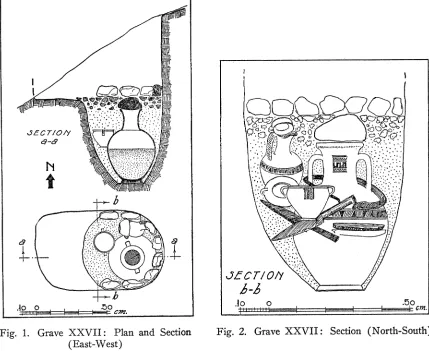
The Agora burial, designated as Grave XXVII, lay about 100 m. south of the boundary stone that stood at the southwestern corner of the Agora, barely 3 m. to the east of Grave XXVI, a rich cremation burial which was discovered in 1948 and has been published by R. S. Young,2 and approximately the same distance to the south of an infant's pithos burial of the late Geometric 'period (Grave XXVIII) which also came to light in 1949.3 Grave XXVII, like Grave XXVI, was a roughly rectangular shaft which had been sunk through earth on the west and a rising slope of bedrock on the east. The cutting was ca. 0.90 m. long from east to west, 0.60 m. wide and 0.60 m. deep against the rock (Fig. 1, plan and section). At the west only a shallow
'Hesperia, XIX, 1950, p. 330. For the privilege of publishing the grave I am indebted to Professor Thompson, for information about the excavation and the objects recovered as well as for much other help to Evelyn L. Smithson and Lucy Talcott, for the photographs to Alison Frantz, for the plans and sections to John Travlos, and for the drawings and watercolor to Marian Welker.
2 Hesperia, XVIII, 1949, pp. 275-297, pls. 66-72.
3 Hesperia, XIX, 1950, pp. 330 f.
IHesperia, XXI, 4
American School of Classical Studies at Athens is collaborating with JSTOR to digitize, preserve, and extend access to
Hesperia
depression remained to indicate the floor of the shaft. In the eastern half of the grave an oval pit had been dug to a depth of ca. 0.60 m. below the floor to receive the amphora that contained the burned bones of the cremated warrior. The urn, No. 15, a neck amphora 0.53 m. high, stood upright in the pit; its mouth was covered by a large field stone which projected slightly above the grave floor, as shown in the sections (Figs. 1, 2). As seen in the same illustrations, around the cover was a packing of small stones
.1 R
Fig. 1. Grave XXVII: Plan and Section (East-West)
Ao o .5o
I- 2.I -a1 I 1 r cSot
Fig. 2. Grave XXVII: Section (North-South)
enclosed in a ring of field stones which was open toward the west. On this side the packing had spread over on to the floor of the grave.
with the burial rites has been discussed by R. S. Young in his account of Grave XXVI (Hesperica, XVIII, 1949, p. 282). The sweepings lay scattered in the upper part of the packing, and did not appear below the rim of the amphora. The small stones had been packed closely around the neck and shoulder of the pot down to its greatest diameter, where the converging sides of the pit left little spare room about the jar.
To the north and above the shoulder of the amphora lay a cluster of four vases (P1. 73b), intact except for a few chips, and not burnt: a goblet (No. 18), a two-
23
4 7 6
+ + 3 0 10
+
+ 2 O 6I F M Rcm.
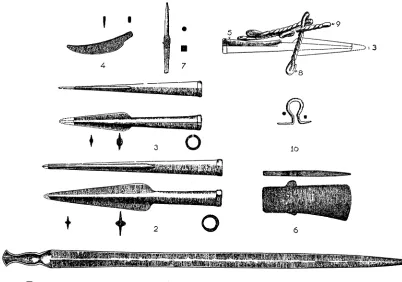
Fig. 3. Iron Objects from Grave XXVII: Nos. 1-10
long iron sword (No. 1), which had been bent into a band around the neck and shoulders of the amphora, two spearheads (Nos. 2 and 3), two knives (Nos. 4 and 5) and a broad axe or chisel (No. 6). There were also remains of what seem to have been two snaffle bits (Nos. 8 and 9), a loop with prongs (No. 10), and a small chisel
(No. 7).
The burial urn contained the partly burned bones of a male, determined by J. L. Angel to have reached the age of about 34 years. With these remains were also found two small bone rings (No. 13). The jar was filled to about half its height with silt which had sifted through the packing and had covered the bones. The weapons and the tools deposited in the grave suggest that the occupant was a warrior and perhaps also a craftsman.
Grave XXVII is of a type well known in the Agora ' and the Kerameikos.5 In the latter cemetery, as noted by Kiibler, graves that had the pit for the urn in the middle of the floor belong to the early or middle phases of the Protogeometric period, whereas in the late phase it became customary to dig the pit near one end (usually the east) of the shaft. Graves of the same kind continued to be used for a time in the Geometric period. It is clear, as will be shown below by an analysis of the pottery, that Grave XXVII must be assigned to a transitional phase between Pro- togeometric and Geometric.
The large neck amphora, No. 15 (P1. 74a and b), that was used as the urn is of a shape that has many analogies in the late phase of the Protogeometric period. From the Agora itself may be mentioned, e. g., Inv. P 364, from Grave XXIII, found a little to the southeast of Graves XXVI and XXVII; Inv. P 6674 from Grave XXV on the slopes of Kolonos Agoraios; Inv. P 1040, from the filling of a well, J, at the northernmost foot of the Areopagus; and Inv. P 3938, from a well, L, in the southern part of the Agora square. Numerous examples were recovered in the Kerameikos cemetery: e. g., No. 581 from Grave C (Kerameikos, I, pl. 33); Nos. 573 from Grave 7, and 571 from Grave 19 (ibid., pl. 57), Nos. 906 from Grave 31 and 2008 from Grave 40 (Kerameikos, IV, pl. 5), No. 1093 from Grave 43 (ibid., pl. 6), No. 2024 from Grave 44 (ibid., pl. 7). Similar amphorae continued to be made in the early phase of the Geometric period, for which several examples can be cited from the excavations in the Agora: e. g., Inv. P 3747 from well-group N, found near the southwest corner of the market square and Inv. P 6400 and 6423 from another well- group, 0, in the northern part of the square; but the form undergoes changes in detail as it descends to the middle and late Geometric stages. An example from Eleusis (No. 813: A. J. A., XLIV, 1940, pl. XVIII, no. 1) may be cited, and one from Corinth
4Hesperia, XVIII, 1949, p. 283.
is also comparable.6 The development of the shape of these neck amphorae from the early through the mature and late phases of the Geometric period has been discussed at length by Kahane (A.J.A., XLIV, 1940, pp. 464-482) who marshals the evidence that establishes the sequence. The popularity of the shape of No. 15 in any event may be taken as overlapping the end of Protogeometric and the beginning of Geometric.
In its decoration, too, our amphora seems to belong to the age of transition. The neck panels with their meanders as the principal motive point to early Geometric., though the subordinate motive of the zigzag is a characteristic Protogeometric one, as are the opposed diagonals in the body zone. The neat herringbone pattern on the handles seems also to be more common in Protogeometric than in Geometric contexts. The oinochoe, No. 16 (P1. 75a and b), is of a shape that occurs frequently toward the close of the Protogeometric period and in the early stages of the Geometric. Grave XXVI yielded three examples of the same general type and of approximately the same date: No. 5 (Hesperia, XVIII, 1949, pls. 67, 68), No. 6 (ibid., p. 292, fig. 5, pl. 67), and No. 7 (ibid., pls. 67, 68). The two latter are most like our No. 16. R. S. Young has called them Geometric, assigning them, however, to a transitional stage. Slightly earlier are Inv. P 6855, from Grave XI on the lower slopes of Kolonos Agoraios, which has no neck panel, and which carries a sawtooth pattern in its main zone, and Inv. P 20627 from a well-group, K, on the lower slopes of the Hill of the Nymphs, which bears a simple zigzag in its body zone, and has no neck panel. Two late Protogeometric pots from the Kerameikos cemetery, most closely analogous to our oinochoai, are Nos. 2009 and 2010 from Grave 40 (Keratmeikos, IV, pl. 14) which are decorated with the same motive of opposed diagonals in the zone around the body. Neither has a panel on the neck. No. 574 from Grave 7 (Kerameikos, I, pl. 73) with a simple zigzag in its main zone, and lacking a neck panel, may also be compared. Here in our No. 16 we thus have a vessel of essentially Protogeometric shape and decora- tion; but its neck panel, in spite of its Protogeometric pattern, may betray the new style that comes in at the beginning of the Geometric period.
The short-stemmed goblet, No. 18 (P1. 75a and b), finds its nearest analogies in four similar pots from Grave XXVI, Nos. 17-20 (Hesperia, XVIII, 1949, pp. 295- 296, fig. 11, pls. 67, 69). In its decorative motives, zigzag and herringbone, of Pro- togeometric origin, our cup looks somewhat earlier than those from Grave XXVI, but the chronological difference may be slight. Protogeometric predecessors from the Agora are Inv. P 20608 and P 20609, both from well-group L; from the Kera- meikos cemetery No. 750 from Grave 20 (Kerameikos, I, pl. 70), Nos. 919 from Grave 26, and 2031 from Grave 48 (Keratmeikos, IV, pl. 21). The latter (No. 2031) has a higher stem than our cup. Good analogies for these goblets seem to be lacking
6 S. S. Weinberg, Corinth, VII, 1: The Geometric and Orientalizing Pottery, Cambridge,
in a pure Geometric context, although the decorative patterns on the examples from Grave XXVI are characteristically enough Geometric as well as Protogeometric. The designs of herringbone and zigzags on No. 18 are well rooted in the earlier period.
In its shape the two-handled kantharoid cup, No. 19 (P1. 75a and b), appears to have few parallels in the material that has been published. A late Protogeometric kantharos, No. 919 from Grave 26 in the Kerameikos cemetery (Kerameikos, IV, pl. 21) is similar, but has had more emphasis given to its ring base. A fragment of a Geometric example, Inv. P 6420, from the Agora well-group 0, may be a descendant, but its side is more sharply curved and the rim more prominent; whether it had a second handle or not is uncertain. The decoration of our cup, a key pattern with a filling of dots, recalls the more elaborate meander on a late Protogeometric goblet from Grave 48 in the Kerameikos cemetery (No. 2031, Kerameikos, IV, pl. 21).
For the small flat-bottomed, one-handled cup, No. 20 (P1. 75a and b), there is an
excellent analogy, No. 582 from Grave C in the Kerameikos cemetery (Kerameikos, I,
pl. 33). A late Protogeometric well in the Agora (Gxroup L), yielded a comparable cup, Inv. P 3965, coated overall with red glaze except for a reserved band along the rim and a circle at the center of the interior. A similar black-glazed vessel of about the same date is Inv. P 1048 from well-group J.
The evidence of the goblet and the cups thus points directly to the stage of tran- sition between late Protogeometric and early Geometric.
In shape and decoration the pyxis, No. 21 (P1. 74c), restored from fragments recovered in the sweepings from the pyre, is almost identical, save for its slightly larger size, with No. 3 from Grave XXVI (Hesperta, XVIII, 1949, pl. 67 and p. 290,. fig. 3). For the shape, several Protogeometric analogies are available from the
Kerameikos cemetery, No. 575 from Grave 7 (Kerameikos, I, pl. 73), Nos. 912, 913
from Grave 28, No. 1105 from Grave 45, No. 2066 from Grave 48, and No. 2151 from Grave 35 (all illustrated in Keramneikos, IV, pl. 20). Two other late Proto- geometric pyxides, closely similar to the foregoing, were found in Grave XXII, on Kolonos Agoraios. As pointed out by R. S. Young (Hesperica, XVIII, 1949, p. 284), the type is characteristic of late Protogeometric, but the decoration of No. 3 from Grave XXVI is in the Geometric style. The patterns used on our pot, No. 21, would not be out of place at the close of the Protogeometric period.
P 18622 from still another well-group, M, found in the valley between the Areopagus and the Hill of the Nymphs. Three pots of the same general form found in graves at Eleusis (A.J.A., XLIV, 1940, pl. XVII, nos. 1-3) have been assigned by Kahane to the early phase of the Geometric period. The shape is also well represented at Corinth (Corinth, VII, 1, pls. 4-6, nos. 29-34).
Our pot No. 17 is the only vessel from Grave XXVII that can be called pure Geometric in all its details of shape and decoration. But it is of the earliest type in the series of such oinochoai, and it does not stand in the way of attributing the grave, as we have done, to a transitional stage from Protogeometric to Geometric.
The large oinochoe, B (Pls. 76, 78), from the Piraeus Street grave, though some- what plumper, is of essentially the same type as XXVII-16, and the comparisons cited above need not be repeated here. Grave XXVI, No. 5 (Hesperica, XVIII, 1949, pl. 68) is a fairly close analogy. The plumpness of form leads one to wonder if the oinochoe B was not perhaps made by a potter especially familiar with the shaping of amphorae, who might have been influenced thereby. The oinochoe was probably used as an urn in place of the more customary amphora. The best parallel for the contour of the body is at any rate offered by a late Protogeometric amphora, Inv. P 6674, from Grave XXV in the Agora.
of treatment and the delicacy of execution that characterize our oinochoe. The closest to it in general spirit is perhaps the shoulder amphora, No. 2131.
The extraordinary delicacy of the drawing is particularly noticeable in the fine zigzags, and in the herringbone on the handle. If not the same hand, the work of the same atelier may perhaps be recognized in the herringbone on the handle of the amphora No. 15 from Grave XXVII, in the like motive and the zigzags that occur on the panel and on the handles of the stemmed goblet No. 18, and in the herringbone on the handle of the kantharoid cup No. 19. The herringbone on the handle of the lekythos-oinochoe C is drawn with comparable delicacy. Is it going too far to see in these vases from Grave XXVII in the Agora and from the unrecorded grave some- where along Piraeus Street the products of one and the same potter's workshop?
The small jug C (P1. 77c and d) is an unusual type of vessel: it looks as if it was designed to be a lekythos and was for some reason, by the substitution of a trefoil lip, metamorphosed into an oinochoe. The potter here has thus matched his exploit in combining in the large oinochoe B some elements derived from the form of the am- phora. No exact parallel for this lekythos-oinochoe is known to me. Apart from its rare shape, its scheme of decoration, with a sawtooth pattern in its neck band and main zone, and a swastika in the shoulder panel, seems clearly to assign it to the phase of transition between Protogeometric and Geometric.
The iron weapons and implements recovered from Agora Grave XXVII are wholly consistent with this dating. The long sword, No. 1 (P1. 75c and Fig. 3), finds its best analogies in Protogeometric graves in the Kerameikos cemetery, where
four comparable blades have come to light. One, from Grave E (Keramtneikos, I, p.
106, fig. 8), has a low midrib and a flanged haft with three rivets for fastening the handle; save that it is shorter and less elegant, it is much like our sword. A similar short sword came from Grave 6 (ibid., pl. 76), and yet another, closely resembling ours, was found in Grave 2 (Kerameikos, IV, pl. 38). Grave 28 produced a sword that had been bent sharply into a hoop with the ends overlapping (ibi'd., M 51, pl. 38); it had no doubt been placed around the neck of the urn as in our Grave XXVII. This sword, with a length of 0.90 m., is perhaps the closest parallel to ours though the exact form of the hilt is not clear. An early Geometric sword was dis- covered in 1944 in a burial on the northeastern slope of the Areopagus (Hesperic, XVI, 1947, p. 196, fig. 1). The hilt is much like that of the sword from Grave XXVII, but the blade seems to have no midrib. Other iron swords of the Geometric period are known from earlier excavations (Aith. Mitt., XIII, 1888, p. 297, fig. 2; XVIII, 1893, p. 108). The first mentioned has a hilt comparable to that of our No. 1.
I, pl. 76) in a badly corroded state. Another, which has two rivet holes in the socket, came from Grave 34 (Keramneikos, IV, pl. 38); and the third, in highly oxydized condition, was recovered from Grave 32 (Kerameikos, IV, p. 36). Three spearheads of the same general type, but made of bronze, were discovered in early Protogeometric Graves A and B (Kerameikos, I, pls. 31 and 32).
Our two crescent-shaped iron knives, Nos. 4 and 5, are much like the examples from Grave XXVI (Hesperica, XVIII, 1949, p. 297, pl. 72), and from the early Geometric grave found on the northeast slope of the Areopagus in 1944 (Hesperia, XVI, 1947, p. 196, fig. 1, pl. XLI). A straight knife of middle Protogeometric date
was found in Grave 17 in the Kerameikos cemetery (Kercamneikos, I, p. 220, pl. 76);
and what looks like a long narrow stiletto came from the late Protogeometric Grave 28 (Kerameikos, IV, M 52, pl. 38). Knives are said to be of relatively rare occurrence in Geometric graves (ibid., p. 29).
The flat axe or broad chisel, No. 6 (P1. 75c and Fig. 3), may be compared with a similar implement of late Protogeometric times from Grave 40 in the Kerameikos
cemetery (Keramneikos, IV, pl. 38), which seems to have traces of lateral projections
like those on our piece.
For the snaffle bits, Nos. 8 and 9 (P1. 75c and Fig. 3), I have been unable to dis- cover good Protogeometric or Geometric parallels. A discussion of ancient horse- trappings and especially of bits may be found in Olynthus, X, pp. 487-495; but the subject, as there stated, seems still to need a thorough study. It is worth noting, at any rate, that the jointed bit, or snaffle, was already known at the turn of Proto- geometric to Geometric. Indeed this form was evidently used in Mycenean times, as shown by a jointed bronze bit that was found at Mycenae by Tsountas ('E+. 'ApX., 1891, col. 25) and illustrated by Reichel (Homerische Waffen, 2nd ed., p. 142, fig. 90). A pair of similar bits in the Berlin Museum (Archiv fur Orientforschung, X, 1935-1936, pp. 334-338, fig. 13; Bossert, Altancatolien, p. 60, fig. 600) is said to have come from a late Mlycenean tomb (unpublished) at Miletos. These Mycenean examples all have cheekbars, which are not present on the bridles from Grave XXVII in the Agora.
The other objects from Grave XXVII-the iron hasp and fragmentary pin, the
whetstone, and the two bone rings-seem to offer little basis for useful comparisons and nothing helpful for dat-ing.
phiale is not yet clearly known. It was formerly thought to make its appearance
in Greece about 700 B.C.,7 and Luschey suggests the possibility that the shallow bronze
bowl traces its origin to Assyria, a theory Mrs. Dohan found not altogether con- vincing.8 In any event we now have an example, that must be some two centuries earlier.
The omphalos in Bowl A rises in a conical form almost to a point; this feature may perhaps be a mark of relatively early date. In the later Geometric, at any rate, a broader, more rounded or flattened omphalos is the generally prevailing type. A bowl with a pointed conical omphalos was found in a Geometric grave at Corinth; Mrs. S. Weinberg, who has published it (Coritnth, XII, The Minor Objects, no. 517, pp. 68-70), dates it to the middle of the eighth century.
BI3ONZE 1OWL
__ ,_ Se_ --- _ cm .
Fig. 4. Profile of Bronze Bowl A from the Grave near Piraeus Street.
The foregoing survey and analysis of the pottery and the other objects recovered from the two graves here discussed will have called sufficient attention to the mixture of elements represented, Protogeometric and Geometric. On a quantitative basis the Protogeometric in the shapes of the pots and the decorative patterns-seems to predominate, but the Geometric also appears full-fledged-in the neck and shoulder panels and especially in the oinochoe No. 17. These graves may accordingly be assigned to the phase of transition between the two periods or, in terms of the usually
accepted chronology, to about 900 B.C. They may be a few years earlier than Agora
Grave XXVI, in which Geometric elements look slightly more advanced, but all three tombs probably belong to the same generation, and both Agora Grave XXVII and the Grave near Piraeus Street almost surely precede the " Grave of the Warrior "
in the Kerameikos (Arch. Anz., 1934, p. 240 and figs. 26, 27) to which Grave XXVII
bears an obvious resemblance.
7 Hans Luschey, Die Phiale, Bleicherode am Herz, 1939, p. 31.
8 A. J. A., XLV, 1941, pp. 125-127. On the history of the phiale, cf. also Dunbabin in Humfry
CATALOGUE OF OBJECTS FROM AGORA GRAVE XXVII
IRON
1. Sword. Pl. 75c and Fig. 3.
IL 1058. L. 0.883 m.; 1. of blade 0.775 m.;
1. of hilt 0.108 m.; w. of hilt at junction with blade 0.038 m.; w. of hilt at outer end 0.035 m. Badly rusted and bent into a hoop, but unbroken except for tip, which is missing.
From a width of 0.038 m. at the hilt the blade tapers to the point. Neither edge was sharp, and the narrow, relatively thick blade, which apparently was stiffened by a low midrib on each face, was clearly designed for thrust- ing rather than for slashing. The hilt, sym- metrically shaped in a quadruple curve on each side and an arc at the back, was edged with a projecting flange, which thus provided a socket on each face for the fitting of the handle. The latter was made of two flat plates which were held in place by four rivets, a pair, 0.024 m. apart, near the junction of hilt and blade, and single centered studs, 0.045 m. and 0.087 m. distant toward the back. Three of the rivets have survived, but there are no vestiges of the handle pieces, which were presumably made of wood.
2. Spearhead. Pl. 75c and Fig. 3.
IL 1057. L. 0.373m.; 1. of socket 0.15 m.; 1. of blade 0.223 m.; d. of socket at end ca. 0.035 m.; w. of blade at shoulder ca. 0.058 m. Broken across socket, badly rusted, but almost complete: only tip missing.
A heavy reinforcing rib runs down the middle on each side of the blade. The socket was made of a flat sheet of iron rolled over and welded to form a tube. No rivets or rivet- holes recognizable. The wooden shaft inserted in the socket was perhaps fastened by binding with wire.
3. Spearhead. P1. 75c and Fig. 3.
IL 1059. L. pres. 0.275 m.; 1. of socket 0.157 m.; 1. pres. of blade 0.124 m.; d. of socket at end ca. 0.035 m.; w. of blade at
shoulder ca. 0.04 m. Broken into three pieces and point missing; badly rusted.
Heavy mnidrib runs down each face of blade. Socket made from sheet of iron rolled over to form tapering tube. There is no sign of rivets or rivet-holes.
4. Knife. P1. 75c and Fig. 3.
IL 1061. L. ca. 0.143 m.; 1. of haft 0.026 m.; 1. of blade 0.117m.; w. of blade at heel ca.
0.02m. Not so badly corroded as the other pieces.
Blade of slightly lunate shape with convex cutting edge. The haft preserves no traces of rivets for fastening the handle.
5. Knife. P1. 75c and Fig. 3.
IL 1065. L. pres. 0.122 m.; w. at heel 0.025 m. Point missing. Badly rusted and still ad- heres to the spearhead No. 3 (IL 1059). Of curving shape like No. 4, with convex cutting edge. No clear division between haft and blade.
6. Axe or broad chisel. P1. 75c and Fig. 3. IL 1062. L. ca. 0.194 m.; w. at butt end 0.055 m.; w. of peen 0.076 m.; th. at butt 0.008 m.; th. in middle 0.013 m.
Peen convexly rounded; butt flat and almost straight. At ca. 0.05 m. from butt end there were projections of some kind from the top and bottom of the implement; the projections have rusted or been broken away and only the stumps are left. They were presumably meant to aid in the fastening of the handle.
7. Javelin point or small chisel. P1. 75c and Fig. 3.
8. Snaffle bit. P1. 75c and Fig. 3.
IL 1063. L. ca. 0.286 m. Complete in five fragments. Consists of two approximately equal sections, 0.142 m. and 0.144 m. long, joined by interlocking loops, each section ter- minating at the other end in a free loop. Made from two strands of thick wire twisted together in rope-fashion, the ends being tucked back to form the loops.
9. Snaffle bit. Pl. 75c and Fig. 3.
IL 1066. L. ca. 0.24 m. Almost complete in four fragments. Like No. 8 (IL 1063), it consists of two nearly equal sections, 0.12 m. long, joined together by interlocking loops. Each section terminates in a free loop at the other end. Made from two strands of thick wire twisted together, with the ends tucked back to form the loops.
10. Loop or hasp with ends bent out flat at right angles to longitudinal axis of loop. P1. 75c and Fig. 3.
IL 1064. L. of loop 0.055 m.; w. of loop 0.038 m.; w. across pronged ends 0.068 m. The loop is oval in shape made of a small bar or a thick wire (0.007 m. thick) roughly rounded in section. The ends are flattened, rectangular in section, and bent back as if meant to be fastened against a piece of wood. Traces of wood fibre were noted still adhering to the iron. No rivet holes recognized in ends.
11. Fragment of pin. P1. 75c.
IL 1067. L. pres. 0.049 m.; th. 0.0075 m. Rectangular in section. Part of shaft and point of nail or pin.
STONE
12. Whetstone. P1. 75c.
ST 463. L. 0.206 m.; max. w. 0.064 m.; th. ca. 0.025 m. Irregular in shape, rough on all sides except honing side, where it is smooth and hollowed longitudinally from wear.
BONE
13. Two small rings. P1. 75c.
BI 641. (a) H. ca. 0.005 m.; d. ca. 0.011 m. (b) H. ca. 0.003 m.; d. ca. 0.011 m. Two small sections sliced from a leg bone in clean-cut strokes. Purpose unknown.
CLAY OR TERRACOTTA
14. Ball. (Not illustrated).
MC 802. H. ca. 0.02 m.; d. ca. 0.016 m. Ir- regular in shape. Possibly knob from pyxis lid, No. 21.
POTTERY
15. Amphora. P1. 74 a and b.
P 20177. H. 0.517 m. to 0.525 m.; d. of lip 0.165 m.; d. of neck 0.116 n.; d. of body 0.337 m.; cracked and repaired; only a few small chips missing. Fine pinkish buff clay.
not of uniform size; the number of lines in each varies from 12 to 17, but is most fre- quently 14. The diagonal lines are somewhat irregular, and were painted freehand. The broad flat handles are crossed by four hori- zontal stripes at the top and seven at the bot- tom; the mid-section, bordered by a pair of lines on each side and divided into two longi- tudinal panels by another pair, is decorated with neatly painted opposed diagonals or feathering.
16. Oinochoe. P1. 75 a and b.
P 20178. H. 0.244m.; d. of mouth along axis of handle 0.095 m.; d. of lip (transverse) 0.094 m.; d. of neck 0.058 m.; d. of body 0.151 m.; d. of base 0.068 m. Small chips of rim missing. Pinkish buff clay.
Trefoil lip; neck slightly concave in profile; piriform body; well made ring base. Except for a reserve panel on the neck opposite the handle, a narrow zone around the middle of the body, and the top of the handle, the surface was coated solidly in black glaze. The glaze on the neck and one side of the body has almost en- tirely worn off, but where preserved it still retains much of its original lustre.
The neck panel, framed by two horizontal lines above and two below, is decorated with a band of the dogtooth or sawtooth motive. There are 15 elongated teeth in black pointing upward. The zone about the body, bordered by paired horizontal lines above and below, bears the familiar group of opposed diagonals. There are 16 groups all told, the number of lines varying from six to eleven, usually nine or ten. The outer surface of the handle, with a stripe along each edge, is filled with a ladder pattern of 21 horizontal strokes.
17. Oinochoe. P1. 74d.
P 20183. H. rest. 0.294 m. to 0.30 m.; d. of lip at right angles to axis of handle 0.108 mi.; d. of neck 0.072 m.; d. of body 0.192 m.; d. of base 0.14m. Restored from 32 fragments; greater part missing; upper part of body does
not make actual join with lower part, but resto- ration cannot be far wrong. Pinkish buff clay. The pot has a broad flat base edged with a low rolled ring, a truncated piriform body, high neck slightly concave in profile, trefoil lip, and relatively thick ribbon handle. Except for the handle and a panel on the neck, only scanty traces of the frame of which are preserved, the vessel was coated solidly in black glaze that has worn off almost everywhere, but is still lustrous where it survives.
The decorative motive in the neck panel is lost altogether. The handle bears five trans- verse lines at top and bottom, and the space between was filled with a herringbone pattern (or opposed diagonals) bordered by a line along each side and separated into two parts by a line down the middle.
18. Goblet. P1. 75 a and b.
P 20179. H., 0.124 m.; d. of rim across handles 0.142 in.; d. of rim, transverse, 0.148 m.; d. of body 0.15 m.; d. of stem 0.045m.; d. of foot 0.063 m. Intact except for small chips of rim and foot. Pinkish buff clay.
on the other) and above (four on each), and a herringbone in the middle section. The strokes everywhere were drawn free hand with a fine brush, and are for the most part neat and delicate, especially in the details of the panels. A stripe in the reserved band along the rim was drawn while the pot revolved on the wheel. 19. Kantharoid cup. Pl. 75 a and b.
P 20180. H. 0.087 m.; d. of rim along axis of handles 0.127 m.; d. of rim transverse, 0.135 m.; d. of body 0.137 m.; d. of base 0.07 m.
Intact save for small chip of rim.
Similar to P 20179 in shape, but the body is more truncated below and has a broad ring base, slightly hollow underneath, instead of a stemmed foot. Except for a reserved band along the rim, a shoulder panel on each side, a reserved circle in centre of interior, and the handles, the cup was coated overall in black glaze. The glaze, for the most part worn to a dull black, shows traces of its original lustre here and there.
The reserved band along the rim bears two stripes, regularly drawn while the pot revolved on the wheel. The shoulder panels differ in size, and, though the decorative patterns are similar, in details of execution. The large panel, with a lower border of three free hand lines, carries a key pattern of four sections; it is formed by two parallel lines, and the space between is occupied by a continuous single row of dots. The smaller panel, like the other in its lower border, has a three-sectioned key pattern; here there are two rows of dots, one along each side line of the key. The handles, with transverse lines above (three on each) and be- low (three on one, four on the other) are decorated in their main panels with a centrally ribbed herringbone. In these patterns the lines, drawn free hand, are somewhat irregular, but neat.
20. Small cup. P1. 75 a and b.
P 20181. H. 0.056m.; d. of rim 0.082m.; d. of body 0.085 m.; d. of base 0.04 m. Intact. Pinkish buff clay.
Fairly broad flat base, slightly hollowed underneath; slightly offset rim; one handle. Except for the handle and a reserved band along inside and outside of rim, and a circle in centre of interior, the cup is coated solidly with black glaze, which still shows a metallic- looking lustre. The glaze was evidently ap- plied while the cup revolved on the wheel, and the reserved band along the rim is neatly de- limited. It bears a regular stripe on the inside and outside of the lip. There are no shoulder panels. The only further decoration consists of six careless transverse lines on the upper surface and a few daubs on the under side of the handle.
21. Pyxis with lid. P1. 74c. P 20182 a and b.
a) Pyxis: H. rest. 0.133 m.; d. of rim 0.107 m.; d. of body ca. 0.146 m.; d. of base ca. 0.068 m. Restored from 14 fragments; badly damaged by fire, and about three fourths mis- sing; upper part makes no actual join with base. Globular form with fairly high ring base, hollow underneath, and broad outturned rim, flat on top. Set opposite each other in the rim are two pairs of string-holes. The pot was coated with black glaze overall, except for a wide zone about middle of body and perhaps a reserved band along the rim. The glaze has worn off, and little or no trace of its original lustre is now preserved.
The decorated zone is divided by four groups of quadruple parallel lines into three subordi- nate zones. The central one, which is wider than the others, carries the main pattern, a con- tinuous meander that is formed by two parallel lines enclosing a simple diagonal hatching. The narrower upper and lower-divisions have as their decoration a continuous zigzag. The hori- zontal dividing lines were drawn with great regularity while the pot revolved on the wheel. The meander and the zigzag were apparently done free hand, but with sure neat strokes of a fine brush.
0.047 m.; d. 0.10 m. Restored from eight f rag- ments; knob and almost one half of lid missing. Saucer-shaped with plain edge. One pair of string-holes 0.015 m. apart, near edge; cor- responding pair on opposite side missing. Upper surface was coated solidly, except for a re-
served zone, in black glaze, badly worn and damaged, retaining no trace of original lustre. The reserved zone has a triple line border above and below, the middle being filled with short transverse strokes.
CATALOGUE OF OBJECTS FROM GRAVE NEAR PIRAEUS STREET
A. Bronze Bowl. P1. 77b, Fig. 4.
H. 0.05 m.; d. 0.142m. to 0.145m.; d. of base 0.035 m. Complete when found, but part of one side disintegrated during process of cleaning. Shallow handleless bowl with small centered conical omphalos thrust up from be- low, and rising ca. 0.014 m. above inner floor. Walls of vessel 0.005 m. thick at bottom, grow thin along curving side, and thicken again to form plain rim, flat on top. Though it bears no decoration, the bowl was shaped with good lines and has an air of elegance.
B. Large Oinochoe. Pls. 76-78.
H. 0.512 m. to 0.521 m.; d. of mouth along axis of handle 0.193 m.; d. of mouth, trans- verse, 0.186 m.; d. of neck 0.122 m.; h. of neck 0.149 m.; d. of body 0.342 m.; d. of base 0.144 m. Cracked, but complete, save for small chips. Fine pinkish buff clay; smoothly finished surface.
Sturdy offset foot; ovoid body; broad neck with slightly concave profile; trefoil lip, pinched out to form a pour-channel opposite handle; large, broad ribbon-handle attached to lip, sharply bent and descending vertically to middle of shoulder. This oinochoe is unusually large; perhaps it was used as the urn instead of the more customary amphora. Apart from handle, strip along outer edge of rim, neck band, and broad zone around middle of body, the whole pot was coated with black glaze. The glaze is badly worn on one side of vessel, and has suf- fered considerable damage on the other, but wherever well preserved, it still retains its original lustre.
The strip along the edge of the rim, ca.
0.026 m. wide, bordered above by one and below by two parallel lines, bears a series of opposed diagonals, each group separated from the next by a triangle in solid black pointing alternately up and down. There is a triangle of this kind below the axis of the pour-channel. The num- ber of lines in the groups of diagonals is usually six, sometimes seven or eight.
The band, 0.037 m. wide, running all the way around the neck is bordered above by three, below by two lines. In the central space is a continuous sawtooth pattern, with re- served triangles pointing downward, and tri- angles in solid black pointing upward.
The main zone around the middle of the body is ca. 0.12 m. wide, bordered above and below by triple horizontal lines, and divided by two groups of similar triple lines into three strips. The upper and lower strips, which are narrow, carry a running zigzag. The main strip, 0.063 m. wide, is divided vertically into a series of panels, all of which are elaborately decorated in the miniature style.
The latter are 14 in number, chief among them being the checkerboard with fine squares, which appears eight times. No two of the latter are exactly alike in size or in number of squares. Beginning at the left in the drawing (PI. 78) they show the following variations: 6 by 19 squares, 10 by 17, 11 by 16, 10 by 14, 9 by 16, 9 by 16, 8 by 14, and 9 by 14 (the first figure referring to horizontal, the second to vertical count). The checkerboard panels are not sym- metrically spaced, though it may be noted that if the zone be bisected directly under the pour- channel, four checkerboards will be found in each half. In each half there is also one checkerboard of another type with large squares in three rows of three. Here the corner squares are filled with cross hatching, those between left blank, while the central square bears a fine checker design in the miniature style (the number being 6 by 6 in one instance and 6 by 5 in the other). The checkerboard is obviously the favorite motive of the painter of the oinochoe.
A panel of different design occurs three times. It shows a horizontal division into six (seven in one instance) narrow subdivisions which are variously decorated. One panel of this kind bears (reading from top to bottom) simple zigzag, sawtooth, zigzag, diamond, zig- zag, and sawtooth motives. Another has zigzag, sawtooth, zigzag, diamond, zigzag, and dia- monds. The third panel shows zigzag, saw- tooth, zigzag, checkerboard (16 by 3 squares), zigzag, sawtooth, and zigzag patterns. Here too the zigzag is the divider.
What may have been regarded as the cen- tral panel, directly beneath the spout and op- posite the handle, offers a complicated design of successively reduced panels within panels. Here the simple zigzag is the only filling pattern until the small central space is reached, where there is an upright column of six diamonds in solid black, point to point.
The decoration on the upper surface of the
handle is relatively simple. Beneath an upper border of ten transverse lines, the so-called ladder pattern, is a delicate herringbone design, edged on each side by a pair of parallel lines, and with a similar double division down the middle.
C. Small Lekythos-oinochoe. P1. 77 c and d.
H. ca. 0.164 m.; d. of mouth 0.054 m.; d. of neck ca. 0.024 m.; h. of neck 0.03 m.; d. of body 0.121 m.; d. of base 0.06 m. Intact. Fine light tan clay.
Trefoil mouth, slender neck of slightly con- cave profile, globular body, well made ring base, narrow, but fairly thick handle. The shape is unusual and original: it looks like a lekythos transformed by its trefoil mouth into an oino- choe. Save for a reserved band along the rim, a neck panel, a shoulder panel, zone around the middle of the body, and the upper surface of the handle, the pot was completely coated in black glaze. The glaze is now rather dull, but still retains some traces of its original lustre. The stripe along the outside of the rim is decorated with fine multiple chevrons, lying on their sides, with points toward the right. The panel which runs about three quarters of the way around the neck, bears a sawtooth motive, bordered above and below by triple parallel lines. The relatively small shoulder panel, which is not properly centered on the axis of handle and spout, carries a swastika; it is formed by two parallel lines, the space between which is filled with multiple chevrons in a some- what irregular arrangement.
The main zone, girdling the middle of the body, has an upper and lower border of three neatly drawn parallel lines that frame a band of bold sawtooth, in which the solid black teeth point upward.
The handle is coated with black glaze on either side; its upper surface is decorated with a delicate, centrally ribbed herringbone which is delimited by a single transverse line above and below.
CARL W. BLEGEN,
A. ol~~~~~~~~~o
'46;~~~~~~~~~~~~~~4
-.40_0,~~~~~~;w ~
-A ~ ~ ~ ~ ~~~~-C
.5~~~~~~~~~~~f--,i
J~~~~
a Gav XVI Pckngof mal toesabveUr frm ouhwstb rae XVI Tp f mpor ad Gou o Ptsfrm es
A~~~~~~~~~
A, i~ ~ ~~~~~~~~~~~~~~~n
.
14M -k
a. and b. Amphora from Grave XXVII, No. 15
P9xi; from Grave XXVII, No. 21 Oinohoe_from Grav N
_ _ .~~? . ;- . - . .
eq.
_ , !g_,7 _1|1_~~~~~~~~~~~,
_42,i,4 ... _-... r_l|
~.,Y
c. Iron Weapons and Implements, and Whetstone: XXVII-i through 13
a b
a. and b. Large Oinochoe B
a_==L__. O f Dea Pt
-7~~~~~~~~~~..
b. Bronze_Bowl A
D4
a. Large Oinochoe B: Detail of Decorative Pattems
b.