DNA Unit Practice Test
Modified True/False
Indicate whether the statement is true or false. If false, change the identified word or phrase to make the statement true.
____ 1. When Griffith mixed heat-killed, harmful bacteria with live, harmless bacteria and injected the mixture into mice, the mice died. _________________________
____ 2. A bacteriophage is larger than a bacterium. _________________________
____ 3. Bacteriophages inject protein into bacteria, altering the bacteria’s genetic information. _________________________
____ 4. The DNA that makes up an organism’s genes must be capable of storing, copying, and changing information. _________________________
____ 5. DNA is a nucleic acid made up of nucleosomes joined into long strands or chains by covalent bonds. _________________________
____ 6. The three parts of a DNA nucleotide are the phosphate group, deoxyribose, and the base. _________________________
____ 7. Hershey and Chase made the components of bacteriophages radioactive to learn which part carried genetic information.. _________________________
____ 8. When Griffith destroyed the DNA in his mixture containing various molecules from heat-killed bacteria, transformation no longer occurred. _________________________
____ 9. If protein had been responsible for carrying genetic information, Hershey and Chase would have observed that their bacteria were marked with radioactive sulfur. _________________________
____ 10. Watson and Crick discovered that covalent bonds hold base pairs together at the center of a strand of DNA. _________________________
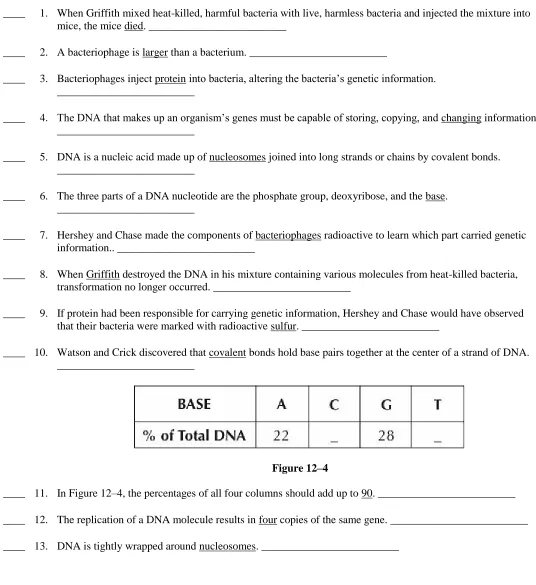
Figure 12–4
____ 11. In Figure 12–4, the percentages of all four columns should add up to 90. _________________________
____ 12. The replication of a DNA molecule results in four copies of the same gene. _________________________
_________________________
____ 15. In eukaryotes, DNA replication proceeds in one direction along the DNA molecule. _________________________
____ 16. The three types of RNA are messenger RNA, transfer RNA, and ribosomal RNA. _________________________
____ 17. If a nucleic acid contains uracil, it is DNA. _________________________
____ 18. During DNA replication, only one strand of DNA serves as a template. _________________________
____ 19. DNA contains the code for the DNA polymerase enzyme. _________________________
____ 20. A codon consists of four nucleotides. _________________________
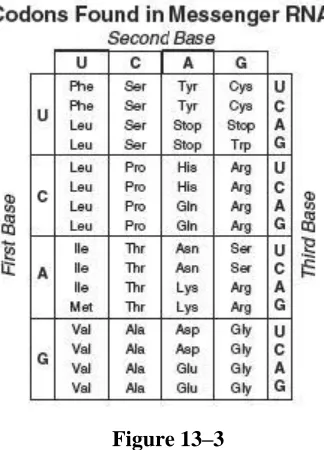
Figure 13–3
____ 21. According to the chart in Figure 13–3, the codes GGA and GGU both code for Ala. _________________________
____ 22. The anticodon AGA is complementary to the mRNA codon TCT. ___________________
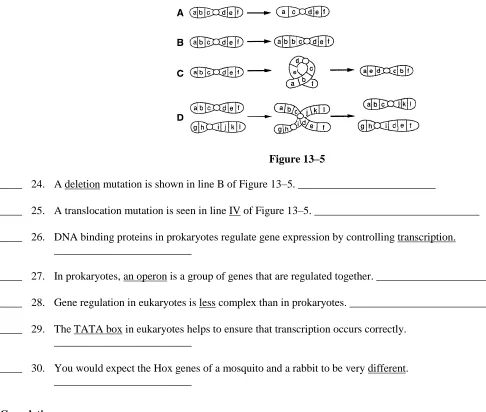
Figure 13–5
____ 24. A deletion mutation is shown in line B of Figure 13–5. _________________________
____ 25. A translocation mutation is seen in line IV of Figure 13–5. ______________________________
____ 26. DNA binding proteins in prokaryotes regulate gene expression by controlling transcription. _________________________
____ 27. In prokaryotes, an operon is a group of genes that are regulated together. _________________________
____ 28. Gene regulation in eukaryotes is less complex than in prokaryotes. _________________________
____ 29. The TATA box in eukaryotes helps to ensure that transcription occurs correctly. _________________________
____ 30. You would expect the Hox genes of a mosquito and a rabbit to be very different. _________________________
Completion
Complete each statement.
31. In Griffith’s experiment, he mixed heat-killed S-strain bacteria with live, harmless bacteria from the R-strain. When this mixtured was injected into mice, the mice _________________________.
Figure 12–6
33. Eukaryotic DNA molecules need to be carefully copied and sorted, especially in the formation of _________________________ cells during meiosis.
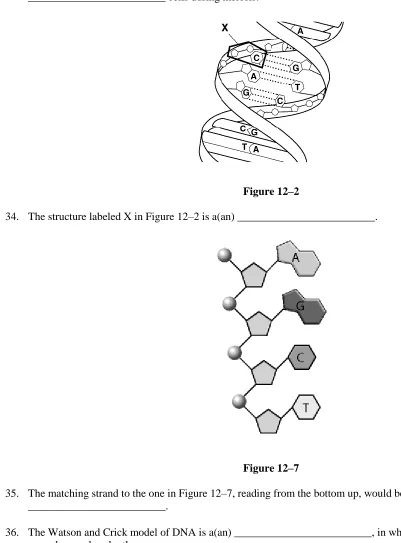
Figure 12–2
34. The structure labeled X in Figure 12–2 is a(an) _________________________.
Figure 12–7
35. The matching strand to the one in Figure 12–7, reading from the bottom up, would be _________________________.
36. The Watson and Crick model of DNA is a(an) _________________________, in which two strands are wound around each other.
38. _________________________ are weak bonds that hold the two strands of DNA together, but also allow the DNA to separate and replicate.
39. If covalent bonds held the two strands of nucleotides together, the two strands could not easily separate and _________________________.
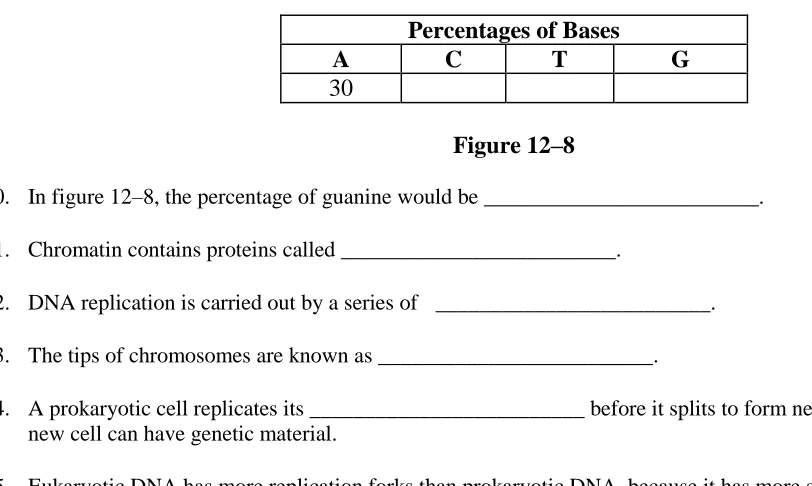
Percentages of Bases
A
C
T
G
30
Figure 12–8
40. In figure 12–8, the percentage of guanine would be _________________________.
41. Chromatin contains proteins called _________________________.
42. DNA replication is carried out by a series of _________________________.
43. The tips of chromosomes are known as _________________________.
44. A prokaryotic cell replicates its _________________________ before it splits to form new cells, so that each new cell can have genetic material.
45. Eukaryotic DNA has more replication forks than prokaryotic DNA, because it has more starting places, or _________________________.
Figure 13–6
46. In Figure 13–6, A, B, and C are three types of ____________________.
47. In RNA, _______________ is the sugar in the nucleotide.
48. A eukaryotic gene consists of regulatory regions, a(an) ____________________, and the nucleotide sequence that is transcribed.
49. During transcription, _________________________ binds to DNA and assembles nucleotides into a strand that is complementary to the DNA template.
52. The tRNA bases called the ____________________ are complementary to three consecutive nucleotides on an mRNA molecule.
53. Two cellular processes, _____________ and _____________, are the main activities described in the central dogma of molecular biology.
54. Suppose that part of an amino acid sequence of a protein changed from tyrosine-proline-glycine-alanine to tyrosine-histidine-glycine-alanine. This change was most likely caused by a point mutation called a(an) ____________________.
55. Insertions and deletions that change the entire genetic message that comes after the mutation are called ____________________.
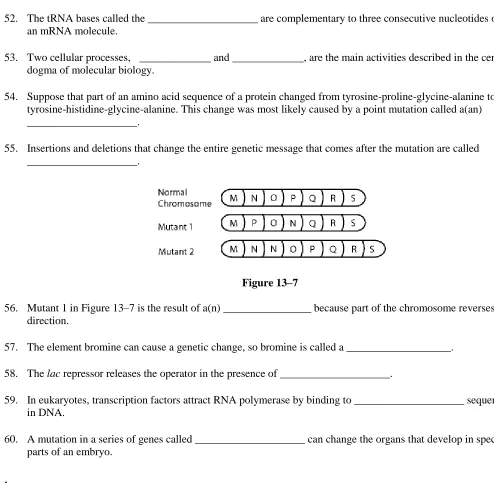
Figure 13–7
56. Mutant 1 in Figure 13–7 is the result of a(n) ________________ because part of the chromosome reverses direction.
57. The element bromine can cause a genetic change, so bromine is called a ___________________.
58. The lac repressor releases the operator in the presence of ____________________.
59. In eukaryotes, transcription factors attract RNA polymerase by binding to ____________________ sequences in DNA.
60. A mutation in a series of genes called ____________________ can change the organs that develop in specific parts of an embryo.
Short Answer
61. Explain how the bacteria in Griffith’s experiment were transformed.
62. What did Griffith conclude transformed the harmless bacteria in his experiment?
63. What is a bacteriophage?
64. What does DNA do with information?
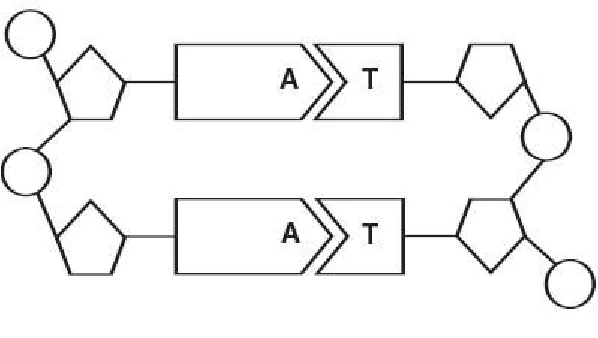
Figure 12–9
66. Identify the three main components in the nucleotides shown in Figure 12–9.
67. What are the roles of covalent bonds and hydrogen bonds in the structure of DNA?
68. How did Avery build on Griffith’s work?
69. How did Hershey and Chase know that it was the DNA that had infected the bacterial cells in their experiment?
70. How did Avery determine that DNA was the molecule carried the genes for transformation?
71. How did X-ray technology enable scientists to better understand the structure of DNA?
72. If the percentage of guanine in the DNA of a certain species decreased by 5 percent over time, what would you expect to have happened to the percentage of adenine in that DNA?
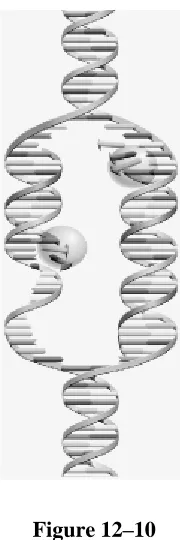
Figure 12–10
74. Identify and explain the role of the molecule, represented by the spheres in Figure 12–10.
75. Identify one difference between prokaryotic and eukaryotic DNA replication.
Figure 13–6
76. What is molecule B in Figure 13–6, and what is its function?
77. What are the three main parts of an RNA nucleotide?
78. What might be the effect of a mutation in the promoter sequence of a gene?
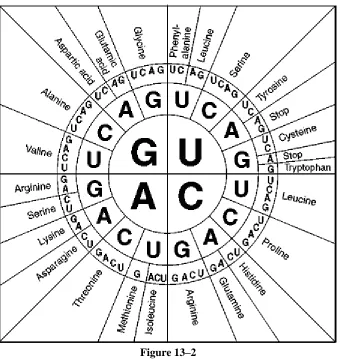
Figure 13–2
80. According to Figure 13–2, what codons specify the amino acid glycine?
81. How many amino acids could be specified if codons consisted of two nucleotides instead of three? What problem would this present for an organism making proteins using all 20 amino acids?
Figure 13–8
83. Describe the functions of the three kinds of RNA illustrated in Figure 13–8.
84. What is the central dogma of molecular biology?
85. What is a polyploid organism?
86. What is one beneficial mutations that has happened in humans?
87. What happens to lac repressors in E. coli when lactose is present?
88. How does miRNA function to help block gene expression?
89. Explain why the Hox genes that are found in different animals are so similar to each other.
90. How do internal and external factors work together to regulate gene expression in the metamorphosis of a frog?
Other
Figure 12–11
91. Interpret Visuals What process did Griffith identify in the series of experiments in Figure 12–11?
92. Compare and Contrast In which experiments in Figure 12–11 do the mice live?
93. Explain What happened to the bacteria and the mice in experiment 4, in Figure 12–11?
94. Predict What would happen if Griffith took some of the bacteria from Experiment 4 in Figure 12–11, grew them on culture plates, killed them with heat, and mixed them with harmless bacteria? How could he test this hypothesis?
95. Infer What can you infer about DNA and the bacterial cell membrane from Griffith’s experiments in Figure 12–11?
Figure 12–12
96. Interpret Tables In Figure 12–12, what do the A, T, G and C stand for?
97. Calculate In Figure 12–12, what percentage of thymine would you expect in yeast?
guanine and cytosine to rise or fall, compared to the values in the table in Figure 12–12?
100. Relate Cause and Effect In the last row of Figure 12–12, notice that the values adenine and cytosine are very different. If the value for adenine is high, does the value of cytosine have to be low? Explain your answer.
Figure 12–13
101. Interpret Visuals Who first did the experiments in Figure 12–13 and what did they confirm?
102. Infer Since both the protein and the DNA in Figure 12–13 were both radioactively labeled, how did the scientists determine that DNA was the material that infects the cell?
103. Predict What would the scientists have found if protein in Figure 12–13 had been the carrier of genetic information?
104. Infer In Griffith’s transformation experiments, the DNA from one organism had to function in another. Did the DNA in the experiments in Figure 12–13 have to make new bacteriophages in the bacteria for the scientists to draw their conclusion? Explain your answer.
Figure 13–9
106. Infer From which labeled structure in Figure 13–9 is structure D made? Identify that labeled structure.
107. Interpret Visuals Identify structure F in Figure 13–9. What does it specify?
108. Interpret Visuals What is structure E in Figure 13–9? What does it specify?
109. Predict What would happen to structure F in Figure 13–9 if structure C were deleted?
110. Predict In Figure 13–9, what effect would the deletion of structure C have on the process that occurs during step Y?
Figure 13–10
111. Interpret Visuals What process is illustrated in Figure 13–10?
114. Infer What is the relationship between the codons and anticodons? How is this relationship important to the structure of proteins? Use Figure 13–10 to explain your answer.
115. Predict In Figure 13–10, what will happen after the ribosome joins the methionine and phenylalanine?
Figure 13–5
116. Classify What term describes the general type of mutation occurring in A, B, C, and D in Figure 13–5?
117. Interpret Visuals In Figure 13–5, which process or processes involve two chromosomes?
118. Compare and Contrast Contrast process A and process B in Figure 13–5.
119. Interpret Visuals During which process in Figure 13–5 does a segment of a chromosome become oriented in the reverse direction?
120. Interpret Visuals In Figure 13–5, which process is a translocation?
Essay
121. How did Griffith arrive at the conclusion that a gene from one kind of bacteria transformed another kind of bacteria?
122. In what way did using a bacteriophage in an experiment on transformation make the Hershey-Chase investigation simpler than Avery’s investigation?
123. What are the roles of DNA in heredity? Predict what would happen to each of the roles if a mistake were made in the genetic code.
Figure 12–14
125. Figure 12–14 shows a short segment of DNA. Explain how the chemical components of a nucleotide give DNA a structure that allows it to hold itself together and yet come apart for replication.
126. Describe the Hershey-Chase experiment. Why were the results important?
127. Describe the structure of a DNA molecule.
128. If you unraveled a eukaryotic chromosome, what would you observe as it became unraveled?
129. Compare and contrast DNA replication in prokaryotes and eukaryotes.
130. Describe how two chromosomes separate after replication in a prokaryotic cell versus a eukaryotic cell?
131. Contrast the functions of the three main types of RNA.
132. How does transcription differ from DNA replication? Describe at least four differences.
Figure 13–3
134. Some substitution mutations have no effect on the final protein that is assembled by the ribosome. Use Figure 13–3 to provide specific examples that explain how having multiple codons specify the same amino acid makes this possible.
135. Explain the process of translation.
136. Why do some kinds of point mutations generally result in greater changes in proteins than others?
137. Why is pesticide resistance considered a beneficial mutation in mosquitoes?
138. What might be the effects of a mutation in the gene that codes for the lac repressor in E. coli?
139. How do eukaryotic cells regulate gene expression?
DNA Unit Practice Test
Answer Section
MODIFIED TRUE/FALSE
1. ANS: T PTS: 1 DIF: L1
REF: p. 338 | p. 339 OBJ: 12.1.1 Summarize the process of bacterial transformation. STA: UT.BIO.2.1.d TOP: Foundation Edition
BLM: knowledge 2. ANS: F, smaller
PTS: 1 DIF: L1 REF: p. 340
OBJ: 12.1.2 Describe the role of bacteriophages in identifying genetic material. STA: UT.BIO.4.3.b | UT.BIO.4.3.e TOP: Foundation Edition
BLM: evaluation
3. ANS: F, DNA, genetic material
PTS: 1 DIF: L1 REF: p. 340 | p. 341
OBJ: 12.1.2 Describe the role of bacteriophages in identifying genetic material. STA: UT.BIO.4.3.b | UT.BIO.4.3.e TOP: Foundation Edition
BLM: comprehension 4. ANS: F, transmitting
PTS: 1 DIF: L2 REF: p. 342 | p. 343
OBJ: 12.1.3 Identify the role of DNA in heredity. STA: UT.BIO.4.3.b | UT.BIO.4.3.c TOP: Foundation Edition BLM: comprehension
5. ANS: F, nucleotides
PTS: 1 DIF: L1 REF: p. 333
OBJ: 12.2.1 Identify the chemical components of DNA. STA: UT.BIO.4.3.a TOP: Foundation Edition BLM: knowledge
6. ANS: T PTS: 1 DIF: L2
REF: p. 344 | p. 345 OBJ: 12.2.1 Identify the chemical components of DNA. STA: UT.BIO.4.3.a TOP: Foundation Edition
BLM: comprehension
7. ANS: T PTS: 1 DIF: L2
REF: p. 340 | p. 341
OBJ: 12.2.2 Discuss the experiments leading to the identification of DNA as the molecule that carries the genetic code. STA: UT.BIO.4.3.a | UT.BIO.4.3.e TOP: Foundation Edition
BLM: comprehension 8. ANS: F, Avery
PTS: 1 DIF: L3 REF: p. 338 | p. 339 | p. 340
OBJ: 12.2.2 Discuss the experiments leading to the identification of DNA as the molecule that carries the genetic code. STA: UT.BIO.4.3.a | UT.BIO.4.3.e TOP: Foundation Edition
BLM: analysis
genetic code. STA: UT.BIO.4.3.a | UT.BIO.4.3.e BLM: analysis 10. ANS: F, hydrogen
PTS: 1 DIF: L1 REF: p. 348
OBJ: 12.2.3 Describe the steps leading to the development of the double-helix model of DNA. STA: UT.BIO.4.3.a | UT.BIO.4.3.e TOP: Foundation Edition
BLM: knowledge 11. ANS: F, 100%
PTS: 1 DIF: L3 REF: p. 345
OBJ: 12.2.3 Describe the steps leading to the development of the double-helix model of DNA. STA: UT.BIO.4.3.a | UT.BIO.4.3.e TOP: Foundation Edition
BLM: analysis 12. ANS: F, two
PTS: 1 DIF: L2 REF: p. 350
OBJ: 12.3.1 Summarize the events of DNA replication. STA: UT.BIO.4.3.b TOP: Foundation Edition BLM: application
13. ANS: F, histones
PTS: 1 DIF: L2 REF: p. 352
OBJ: 12.3.1 Summarize the events of DNA replication. STA: UT.BIO.4.3.b BLM: analysis
14. ANS: F, ATGCAA
PTS: 1 DIF: L3 REF: p. 350
OBJ: 12.3.1 Summarize the events of DNA replication. STA: UT.BIO.4.3.b TOP: Foundation Edition BLM: application
15. ANS: F, two directions
PTS: 1 DIF: L2 REF: p. 352 | p. 353
OBJ: 12.3.2 Compare DNA replication in prokaryotes with that of eukaryotes STA: UT.BIO.4.3.b TOP: Foundation Edition
BLM: comprehension
16. ANS: T PTS: 1 DIF: L2
REF: p. 363 OBJ: 13.1.1 Contrast RNA and DNA. STA: UT.BIO.4.3.a TOP: Foundation Edition BLM: knowledge
17. ANS: F, RNA
PTS: 1 DIF: L2 REF: p. 362 OBJ: 13.1.1 Contrast RNA and DNA. STA: UT.BIO.4.3.a BLM: application
18. ANS: F, RNA transcription
PTS: 1 DIF: L2 REF: p. 364
OBJ: 13.1.2 Explain the process of transcription. STA: UT.BIO.4.3.c TOP: Foundation Edition BLM: comprehension
19. ANS: T PTS: 1 DIF: L2
BLM: analysis 20. ANS: F, three
PTS: 1 DIF: L1 REF: p. 366
OBJ: 13.2.1 Identify the genetic code and explain how it is read. STA: UT.BIO.4.3.a TOP: Foundation Edition BLM: knowledge
21. ANS: F, Gly
PTS: 1 DIF: L3 REF: p. 367
OBJ: 13.2.1 Identify the genetic code and explain how it is read. STA: UT.BIO.4.3.a BLM: application 22. ANS: F, UCU
PTS: 1 DIF: L2 REF: p. 368 | p. 369
OBJ: 13.2.2 Summarize the process of translation. STA: UT.BIO.4.3.c TOP: Foundation Edition BLM: application
23. ANS: F, proteins
PTS: 1 DIF: L2 REF: p. 370
OBJ: 13.2.3 Describe the "central dogma" of molecular biology. STA: UT.BIO.4.3.c TOP: Foundation Edition BLM: comprehension
24. ANS: F, duplication
PTS: 1 DIF: L2 REF: p. 374
OBJ: 13.3.1 Define mutations and describe the different types of mutations. STA: UT.BIO.4.3.d TOP: Foundation Edition BLM: application
25. ANS: T PTS: 1 DIF: L3
REF: p. 374 OBJ: 13.3.1 Define mutations and describe the different types of mutations. STA: UT.BIO.4.3.d BLM: analysis
26. ANS: T PTS: 1 DIF: L2
REF: p. 377 OBJ: 13.4.1 Describe gene regulation in prokaryotes. STA: UT.BIO.2.1.b BLM: comprehension
27. ANS: T PTS: 1 DIF: L1
REF: p. 377 OBJ: 13.4.1 Describe gene regulation in prokaryotes. STA: UT.BIO.2.1.b TOP: Foundation Edition BLM: knowledge
28. ANS: F, more
PTS: 1 DIF: L1 REF: p. 379
OBJ: 13.4.2 Explain how most eukaryotic genes are regulated. STA: UT.BIO.2.1.b TOP: Foundation Edition BLM: knowledge
29. ANS: T PTS: 1 DIF: L2
REF: p. 379 OBJ: 13.4.2 Explain how most eukaryotic genes are regulated. STA: UT.BIO.2.1.b BLM: synthesis
STA: UT.BIO.2.1.b | UT.BIO.2.3.a BLM: synthesis
COMPLETION
31. ANS: developed pneumonia, died
PTS: 1 DIF: L2 REF: p. 339
OBJ: 12.1.1 Summarize the process of bacterial transformation. STA: UT.BIO.2.1.d TOP: Foundation Edition BLM: comprehension
32. ANS: protein coat
PTS: 1 DIF: L1 REF: p. 340
OBJ: 12.1.2 Describe the role of bacteriophages in identifying genetic material. STA: UT.BIO.4.3.b | UT.BIO.4.3.e TOP: Foundation Edition
BLM: knowledge 33. ANS: reproductive
PTS: 1 DIF: L2 REF: p. 343
OBJ: 12.1.3 Identify the role of DNA in heredity. STA: UT.BIO.4.3.b | UT.BIO.4.3.c BLM: analysis
34. ANS: nucleotide
PTS: 1 DIF: L2 REF: p. 345
OBJ: 12.2.1 Identify the chemical components of DNA. STA: UT.BIO.4.3.a TOP: Foundation Edition BLM: comprehension
35. ANS: AGCT
PTS: 1 DIF: L3 REF: p. 345
OBJ: 12.2.1 Identify the chemical components of DNA. STA: UT.BIO.4.3.a TOP: Foundation Edition BLM: application
36. ANS: double helix
PTS: 1 DIF: L1 REF: p. 347
OBJ: 12.2.2 Discuss the experiments leading to the identification of DNA as the molecule that carries the genetic code. STA: UT.BIO.4.3.a | UT.BIO.4.3.e TOP: Foundation Edition
BLM: knowledge 37. ANS: DNA, genes
PTS: 1 DIF: L2 REF: p. 338 | p. 339
OBJ: 12.2.2 Discuss the experiments leading to the identification of DNA as the molecule that carries the genetic code. STA: UT.BIO.4.3.a | UT.BIO.4.3.e TOP: Foundation Edition
BLM: analysis
38. ANS: Hydrogen bonds
PTS: 1 DIF: L2 REF: p. 348
BLM: knowledge 39. ANS: replicate
PTS: 1 DIF: L3 REF: p. 348
OBJ: 12.2.3 Describe the steps leading to the development of the double-helix model of DNA. STA: UT.BIO.4.3.a | UT.BIO.4.3.e TOP: Foundation Edition
BLM: evaluation 40. ANS: 20%
PTS: 1 DIF: L3 REF: p. 345
OBJ: 12.2.3 Describe the steps leading to the development of the double-helix model of DNA. STA: UT.BIO.4.3.a | UT.BIO.4.3.e TOP: Foundation Edition
BLM: analysis 41. ANS: histones
PTS: 1 DIF: L1 REF: p. 352
OBJ: 12.3.1 Summarize the events of DNA replication. STA: UT.BIO.4.3.b BLM: knowledge
42. ANS: enzymes
PTS: 1 DIF: L2 REF: p. 351
OBJ: 12.3.1 Summarize the events of DNA replication. STA: UT.BIO.4.3.b TOP: Foundation Edition BLM: analysis
43. ANS: telomeres
PTS: 1 DIF: L1 REF: p. 352
OBJ: 12.3.1 Summarize the events of DNA replication. STA: UT.BIO.4.3.b TOP: Foundation Edition BLM: knowledge
44. ANS: DNA, chromosome
PTS: 1 DIF: L2 REF: p. 353
OBJ: 12.3.2 Compare DNA replication in prokaryotes with that of eukaryotes STA: UT.BIO.4.3.b TOP: Foundation Edition
BLM: synthesis
45. ANS: origins of replication
PTS: 1 DIF: L3 REF: p. 353
OBJ: 12.3.2 Compare DNA replication in prokaryotes with that of eukaryotes STA: UT.BIO.4.3.b BLM: synthesis
46. ANS: RNA
PTS: 1 DIF: L2 REF: p. 363 OBJ: 13.1.1 Contrast RNA and DNA. STA: UT.BIO.4.3.a TOP: Foundation Edition
BLM: application 47. ANS: ribose
PTS: 1 DIF: L1 REF: p. 362 OBJ: 13.1.1 Contrast RNA and DNA. STA: UT.BIO.4.3.a TOP: Foundation Edition
PTS: 1 DIF: L2 REF: p. 365
OBJ: 13.1.2 Explain the process of transcription. STA: UT.BIO.4.3.c BLM: comprehension
49. ANS: RNA polymerase
PTS: 1 DIF: L2 REF: p. 364
OBJ: 13.1.2 Explain the process of transcription. STA: UT.BIO.4.3.c TOP: Foundation Edition BLM: application
50. ANS: amino acids
PTS: 1 DIF: L2 REF: p. 336
OBJ: 13.2.1 Identify the genetic code and explain how it is read. STA: UT.BIO.4.3.a TOP: Foundation Edition BLM: comprehension
51. ANS: stop codon
PTS: 1 DIF: L1 REF: p. 367
OBJ: 13.2.2 Summarize the process of translation. STA: UT.BIO.4.3.c TOP: Foundation Edition BLM: knowledge
52. ANS: anticodons
PTS: 1 DIF: L2 REF: p. 369
OBJ: 13.2.2 Summarize the process of translation. STA: UT.BIO.4.3.c TOP: Foundation Edition BLM: comprehension
53. ANS: transcription, translation
PTS: 1 DIF: L3 REF: p. 370 | p. 371 OBJ: 13.2.3 Describe the "central dogma" of molecular biology. STA: UT.BIO.4.3.c BLM: synthesis 54. ANS: substitution
PTS: 1 DIF: L3 REF: p. 372 | p. 373
OBJ: 13.3.1 Define mutations and describe the different types of mutations. STA: UT.BIO.4.3.d BLM: evaluation
55. ANS: frameshift mutations
PTS: 1 DIF: L2 REF: p. 373
OBJ: 13.3.1 Define mutations and describe the different types of mutations. STA: UT.BIO.4.3.d TOP: Foundation Edition BLM: comprehension
56. ANS: inversion
PTS: 1 DIF: L2 REF: p. 374
OBJ: 13.3.1 Define mutations and describe the different types of mutations. STA: UT.BIO.4.3.d TOP: Foundation Edition BLM: application
57. ANS: mutagen
OBJ: 13.3.2 Describe the effects mutations can have on genes. STA: UT.BIO.4.3.d BLM: evaluation
58. ANS: lactose
PTS: 1 DIF: L2 REF: p. 378
OBJ: 13.4.1 Describe gene regulation in prokaryotes. STA: UT.BIO.2.1.b TOP: Foundation Edition BLM: application
59. ANS: enhancer
PTS: 1 DIF: L2 REF: p. 379
OBJ: 13.4.2 Explain how most eukaryotic genes are regulated. STA: UT.BIO.2.1.b BLM: comprehension
60. ANS: Hox genes
PTS: 1 DIF: L1 REF: p. 382
OBJ: 13.4.3 Relate gene regulation to development in multicellular organisms. STA: UT.BIO.2.1.b | UT.BIO.2.3.a TOP: Foundation Edition
BLM: knowledge
SHORT ANSWER
61. ANS:
The harmless living bacteria took in pneumonia-causing DNA (genes) from the heat-killed,
pneumonia-causing bacteria, as a result of which the harmless bacteria changed into bacteria that cause pneumonia.
PTS: 1 DIF: L3 REF: p. 350 | p. 351 OBJ: 12.1.1 Summarize the process of bacterial transformation. STA: UT.BIO.2.1.d BLM: synthesis 62. ANS:
He concluded that a chemical factor, a gene, had transformed the bacteria.
PTS: 1 DIF: L1 REF: p. 339
OBJ: 12.1.1 Summarize the process of bacterial transformation. STA: UT.BIO.2.1.d TOP: Foundation Edition BLM: comprehension
63. ANS:
A bacteriophage is a kind of virus that infects and kills bacteria.
PTS: 1 DIF: L1 REF: p. 340
OBJ: 12.1.2 Describe the role of bacteriophages in identifying genetic material. STA: UT.BIO.4.3.b | UT.BIO.4.3.e TOP: Foundation Edition
BLM: comprehension 64. ANS:
DNA stores, copies, and transmits information.
PTS: 1 DIF: L1 REF: p. 342 | p. 343
It is most important during the formation of reproductive cells, because the loss of any genetic material then means the loss of valuable information for offspring.
PTS: 1 DIF: L2 REF: p. 343
OBJ: 12.1.3 Identify the role of DNA in heredity. STA: UT.BIO.4.3.b | UT.BIO.4.3.c BLM: synthesis
66. ANS:
The circles are the phosphate group, the pentagons are deoxyribose, and the A and T (adenosine and thymine) are the bases.
PTS: 1 DIF: L2 REF: p. 345
OBJ: 12.2.1 Identify the chemical components of DNA. STA: UT.BIO.4.3.a TOP: Foundation Edition BLM: application
67. ANS:
The nucleotides in a strand of DNA are joined by covalent bonds between their sugar and phosphate groups, and by hydrogen bonds between the complimentary bases.
PTS: 1 DIF: L3 REF: p. 344
OBJ: 12.2.1 Identify the chemical components of DNA. STA: UT.BIO.4.3.a TOP: Foundation Edition BLM: synthesis
68. ANS:
Avery repeated Griffith’s experiment, and identified the component of the cell that caused transformation.
PTS: 1 DIF: L3 REF: p. 338| p. 339
OBJ: 12.2.2 Discuss the experiments leading to the identification of DNA as the molecule that carries the genetic code. STA: UT.BIO.4.3.a | UT.BIO.4.3.e TOP: Foundation Edition
BLM: synthesis 69. ANS:
Hershey and Chase labeled the DNA of a bacteriophage with 32P, and found that after the bacteria were infected with the bacteriophage, the 32P was in the bacteria.
PTS: 1 DIF: L1 REF: p. 341
OBJ: 12.2.2 Discuss the experiments leading to the identification of DNA as the molecule that carries the genetic code. STA: UT.BIO.4.3.a | UT.BIO.4.3.e TOP: Foundation Edition
BLM: comprehension 70. ANS:
He systematically destroyed all the other kinds of molecules besides DNA in the dead-cell mixture before using the mixture to successfully transform harmless bacteria into helpful bacteria.
PTS: 1 DIF: L2 REF: p. 340
OBJ: 12.2.2 Discuss the experiments leading to the identification of DNA as the molecule that carries the genetic code. STA: UT.BIO.4.3.a | UT.BIO.4.3.e TOP: Foundation Edition
BLM: synthesis 71. ANS:
Rosalind Franklin used powerful X-ray beams to make diffraction photographs that gave Watson and Crick the clues they needed to determine DNA’s structure.
PTS: 1 DIF: L2 REF: p. 346 | p. 347
STA: UT.BIO.4.3.a | UT.BIO.4.3.e TOP: Foundation Edition BLM: synthesis
72. ANS:
The percentage of adenine would have increased by about 5 percent.
PTS: 1 DIF: L3 REF: p. 345
OBJ: 12.2.3 Describe the steps leading to the development of the double-helix model of DNA. STA: UT.BIO.4.3.a | UT.BIO.4.3.e BLM: analysis
73. ANS:
The hydrogen bonds between the base pairs must be broken, and the molecule must unwind.
PTS: 1 DIF: L2 REF: p. 350| p. 351
OBJ: 12.3.1 Summarize the events of DNA replication. STA: UT.BIO.4.3.b TOP: Foundation Edition BLM: analysis
74. ANS:
The molecule is DNA polymerase, an enzyme that joins individual nucleotides to make a strand of DNA.
PTS: 1 DIF: L1 REF: p. 351
OBJ: 12.3.1 Summarize the events of DNA replication. STA: UT.BIO.4.3.b TOP: Foundation Edition BLM: knowledge
75. ANS:
In prokaryotes, DNA replication starts in one place, and in eukaryotes DNA replication starts in many places.
PTS: 1 DIF: L1 REF: p. 353
OBJ: 12.3.2 Compare DNA replication in prokaryotes with that of eukaryotes STA: UT.BIO.4.3.b TOP: Foundation Edition
BLM: knowledge 76. ANS:
Molecule B is tRNA, which carries amino acids to the ribosomes.
PTS: 1 DIF: L2 REF: p. 363 | p. 364 OBJ: 13.1.1 Contrast RNA and DNA. STA: UT.BIO.4.3.a TOP: Foundation Edition BLM: analysis 77. ANS:
A ribose molecule, a phosphate group, and a nitrogenous base are the three main parts of an RNA nucleotide.
PTS: 1 DIF: L1 REF: p. 362 OBJ: 13.1.1 Contrast RNA and DNA. STA: UT.BIO.4.3.a TOP: Foundation Edition
BLM: knowledge 78. ANS:
RNA polymerase might be unable to bind to the promoter, and, as a result, the gene would not be transcribed.
PTS: 1 DIF: L3 REF: p. 364 | p. 365
OBJ: 13.1.2 Explain the process of transcription. STA: UT.BIO.4.3.c BLM: synthesis
79. ANS:
The DNA molecule must be separated into two strands.
80. ANS:
GGU, GGC, GGA, and GGG specify glycine.
PTS: 1 DIF: L2 REF: p. 367
OBJ: 13.2.1 Identify the genetic code and explain how it is read. STA: UT.BIO.4.3.a BLM: application 81. ANS:
There could be 16 combinations of nucleotides, which is too few combinations for all 20 amino acid to have a unique code.
PTS: 1 DIF: L3 REF: p. 366 | p. 367 OBJ: 13.2.1 Identify the genetic code and explain how it is read. STA: UT.BIO.4.3.a BLM: evaluation 82. ANS:
A stop codon on the mRNA causes translation to stop.
PTS: 1 DIF: L1 REF: p. 367
OBJ: 13.2.2 Summarize the process of translation. STA: UT.BIO.4.3.c TOP: Foundation Edition BLM: knowledge
83. ANS:
Messenger RNA provides the code for the translation, ribosomal RNA reads the code, and a tRNA molecule brings the next amino acid specified by the code.
PTS: 1 DIF: L2 REF: p. 368 | p. 369
OBJ: 13.2.2 Summarize the process of translation. STA: UT.BIO.4.3.c BLM: comprehension
84. ANS:
Information is transferred from DNA to RNA to protein.
PTS: 1 DIF: L1 REF: p. 363
OBJ: 13.2.3 Describe the "central dogma" of molecular biology. STA: UT.BIO.4.3.c TOP: Foundation Edition BLM: comprehension
85. ANS:
A polyploid organism is one that has many sets of chromosomes.
PTS: 1 DIF: L2 REF: p. 376
OBJ: 13.3.1 Define mutations and describe the different types of mutations. STA: UT.BIO.4.3.d TOP: Foundation Edition BLM: comprehension
86. ANS:
Sample answer: Mutations in humans have resulted in stronger bones and better disease resistance.
PTS: 1 DIF: L2 REF: p. 376
OBJ: 13.3.2 Describe the effects mutations can have on genes. STA: UT.BIO.4.3.d TOP: Foundation Edition BLM: knowledge
87. ANS:
PTS: 1 DIF: L2 REF: p. 377 | p. 378
OBJ: 13.4.1 Describe gene regulation in prokaryotes. STA: UT.BIO.2.1.b BLM: application
88. ANS:
A molecule of miRNA is a small loop of RNA that combines with proteins to create a silencing complex that binds to and destroys mRNA that matches the miRNA’s sequence.
PTS: 1 DIF: L3 REF: p. 380
OBJ: 13.4.2 Explain how most eukaryotic genes are regulated. STA: UT.BIO.2.1.b BLM: synthesis
89. ANS:
The Hox genes descended from the genes of common ancestors.
PTS: 1 DIF: L2 REF: p. 382
OBJ: 13.4.3 Relate gene regulation to development in multicellular organisms. STA: UT.BIO.2.1.b | UT.BIO.2.3.a TOP: Foundation Edition
BLM: analysis 90. ANS:
External forces (such as a drying pond) trigger internal factors (such as hormonal changes) that change the rate of metamorphosis.
PTS: 1 DIF: L2 REF: p. 383
OBJ: 13.4.3 Relate gene regulation to development in multicellular organisms. STA: UT.BIO.2.1.b | UT.BIO.2.3.a TOP: Foundation Edition
BLM: comprehension
OTHER
91. ANS:
Bacterial transformation
PTS: 1 DIF: L2 REF: p. 339
OBJ: 12.2.2 Discuss the experiments leading to the identification of DNA as the molecule that carries the genetic code. STA: UT.BIO.4.3.a | UT.BIO.4.3.e TOP: Foundation Edition
BLM: analysis 92. ANS:
The mice live in experiments 2 and 3.
PTS: 1 DIF: L1 REF: p. 339
OBJ: 12.2.2 Discuss the experiments leading to the identification of DNA as the molecule that carries the genetic code. STA: UT.BIO.4.3.a | UT.BIO.4.3.e TOP: Foundation Edition
BLM: analysis 93. ANS:
The harmless bacteria were transformed by the heat-killed bacteria, making the harmless bacteria deadly. The mice that were injected with the mixture died.
PTS: 1 DIF: L2 REF: p. 339
The harmless bacteria would be transformed into disease-causing bacteria. To test this hypothesis, he could inject the bacteria in to mice and see if the mice develop pneumonia, or he could grow them on plates and observe the colonies that grow.
PTS: 1 DIF: L3 REF: p. 338 | p. 339 OBJ: 12.1.1 Summarize the process of bacterial transformation. STA: UT.BIO.2.1.d BLM: evaluation 95. ANS:
The bacterial cell membrane can somehow permit very large molecules like DNA to enter the cell.
PTS: 1 DIF: L3 REF: p. 338| p. 339 OBJ: 12.1.1 Summarize the process of bacterial transformation. STA: UT.BIO.2.1.d BLM: synthesis 96. ANS:
adenine, thymine, guanine, and cytosine
PTS: 1 DIF: L1 REF: p. 345
OBJ: 12.2.3 Describe the steps leading to the development of the double-helix model of DNA. STA: UT.BIO.4.3.a | UT.BIO.4.3.e TOP: Foundation Edition
97. ANS: 32.9 percent
PTS: 1 DIF: L1 REF: p. 345
OBJ: 12.2.3 Describe the steps leading to the development of the double-helix model of DNA. STA: UT.BIO.4.3.a | UT.BIO.4.3.e TOP: Foundation Edition
BLM: application 98. ANS:
27.4 percent
PTS: 1 DIF: L3 REF: p. 345
OBJ: 12.2.3 Describe the steps leading to the development of the double-helix model of DNA. STA: UT.BIO.4.3.a | UT.BIO.4.3.e BLM: analysis
99. ANS:
The values would both fall.
PTS: 1 DIF: L3 REF: p. 345
OBJ: 12.2.3 Describe the steps leading to the development of the double-helix model of DNA. STA: UT.BIO.4.3.a | UT.BIO.4.3.e BLM: evaluation
100. ANS:
Yes if A is high, C will be low. Adenine pairs with thymine. So, there will be as much thymine as there is adenine. Together, A and T make up about 62 percent of the bases. That means only 38 percent of the bases can be a combination of G and C. So, G and C are each only about 19 percent of the total.
PTS: 1 DIF: L2 REF: p. 345
OBJ: 12.2.3 Describe the steps leading to the development of the double-helix model of DNA. STA: UT.BIO.4.3.a | UT.BIO.4.3.e BLM: analysis
101. ANS:
PTS: 1 DIF: L2 REF: p. 341
OBJ: 12.2.2 Discuss the experiments leading to the identification of DNA as the molecule that carries the genetic code. STA: UT.BIO.4.3.a | UT.BIO.4.3.e TOP: Foundation Edition
BLM: comprehension 102. ANS:
The DNA was labeled with 32P, and the protein was labeled with 35S. The two labels can be distinguished in the lab.
PTS: 1 DIF: L2 REF: p. 341
OBJ: 12.2.2 Discuss the experiments leading to the identification of DNA as the molecule that carries the genetic code. STA: UT.BIO.4.3.a | UT.BIO.4.3.e TOP: Foundation Edition
BLM: analysis 103. ANS:
They would have found that the bacteria contained 35S.
PTS: 1 DIF: L1 REF: p. 341
OBJ: 12.2.2 Discuss the experiments leading to the identification of DNA as the molecule that carries the genetic code. STA: UT.BIO.4.3.a | UT.BIO.4.3.e TOP: Foundation Edition
BLM: application 104. ANS:
No, the DNA did not have to function and make new bacteria for Hershey and Chase to draw their conclusion. The DNA was radioactively labeled, so they could detect it inside the bacteria, even if the DNA did not function.
PTS: 1 DIF: L3 REF: p. 341
OBJ: 12.2.2 Discuss the experiments leading to the identification of DNA as the molecule that carries the genetic code. STA: UT.BIO.4.3.a | UT.BIO.4.3.e BLM: analysis
105. ANS:
These experiments confirm the result that Avery found: that genes are made of DNA. The conclusion is made much stronger because it is reached through two very different sets of experiments.
PTS: 1 DIF: L3 REF: p. 341
OBJ: 12.2.2 Discuss the experiments leading to the identification of DNA as the molecule that carries the genetic code. STA: UT.BIO.4.3.a | UT.BIO.4.3.e BLM: evaluation
106. ANS:
Structure D is made from structure A, which is one of the strands of DNA.
PTS: 1 DIF: L2 REF: p. 368 | p. 369
OBJ: 13.1.2 Explain the process of transcription. STA: UT.BIO.4.3.c TOP: Foundation Edition BLM: application
107. ANS:
Structure F is a codon that specifies the amino acid alanine.
PTS: 1 DIF: L2 REF: p. 368 | p. 369 OBJ: 13.2.1 Identify the genetic code and explain how it is read. STA: UT.BIO.4.3.a TOP: Foundation Edition BLM: analysis
PTS: 1 DIF: L3 REF: p. 368 | p. 369 OBJ: 13.2.1 Identify the genetic code and explain how it is read. STA: UT.BIO.4.3.a BLM: synthesis 109. ANS:
The base sequence of the codon (structure F) would change from GCU to GUG.
PTS: 1 DIF: L3 REF: p. 367 | p. 368 | p. 369 OBJ: 13.3.1 Define mutations and describe the different types of mutations. STA: UT.BIO.4.3.d BLM: synthesis
110. ANS:
The deletion of structure C would shift the reading frame of the codons during translation. As a result, the sequence of the amino acids that follows after structure C might change.
PTS: 1 DIF: L3 REF: p. 373
OBJ: 13.3.1 Define mutations and describe the different types of mutations. STA: UT.BIO.4.3.d BLM: synthesis
111. ANS:
Translation (or protein synthesis) is illustrated.
PTS: 1 DIF: L2 REF: p. 368 | p. 369
OBJ: 13.2.2 Summarize the process of translation. STA: UT.BIO.4.3.c TOP: Foundation Edition BLM: knowledge
112. ANS:
Structure C is a ribosome.
PTS: 1 DIF: L2 REF: p. 368 | p. 369
OBJ: 13.2.2 Summarize the process of translation. STA: UT.BIO.4.3.c TOP: Foundation Edition BLM: comprehension
113. ANS:
Structure F is a codon.
PTS: 1 DIF: L2 REF: p. 367 | p. 368 | p. 369
OBJ: 13.2.2 Summarize the process of translation. STA: UT.BIO.4.3.c TOP: Foundation Edition BLM: comprehension
114. ANS:
The codons and anticodons have complementary nitrogenous bases, allowing them to base pair. Because the kind of amino acid attached to a tRNA depends on the tRNA’s anticodon, the base pairing between the anticodons and codons brings a specific sequence of amino acids to the ribosomes. For example, the codon labeled F is complementary to the anticodon UAC and codes for the amino acid methionine.
PTS: 1 DIF: L3 REF: p. 367 | p. 368 | p. 369
OBJ: 13.2.2 Summarize the process of translation. STA: UT.BIO.4.3.c BLM: evaluation
115. ANS:
The bond between the methionine and its tRNA will be broken. The tRNA will move away from the
ribosome, allowing it to bind with another methionine. The ribosome will move down the mRNA to the next codon.
OBJ: 13.2.2 Summarize the process of translation. STA: UT.BIO.4.3.c BLM: application
116. ANS:
A chromosomal mutation results from processes A, B, C, and D.
PTS: 1 DIF: L1 REF: p. 374
OBJ: 13.3.1 Define mutations and describe the different types of mutations. STA: UT.BIO.4.3.d TOP: Foundation Edition BLM: knowledge
117. ANS:
Process D involves two chromosomes.
PTS: 1 DIF: L2 REF: p. 374
OBJ: 13.3.1 Define mutations and describe the different types of mutations. STA: UT.BIO.4.3.d TOP: Foundation Edition BLM: application
118. ANS:
Process A results in the deletion of a segment of a chromosome. Process B results in the duplication of a segment of a chromosome.
PTS: 1 DIF: L2 REF: p. 374
OBJ: 13.3.1 Define mutations and describe the different types of mutations. STA: UT.BIO.4.3.d BLM: analysis
119. ANS:
A segment of a chromosome becomes oriented in the reverse direction during process C.
PTS: 1 DIF: L2 REF: p. 374
OBJ: 13.3.1 Define mutations and describe the different types of mutations. STA: UT.BIO.4.3.d TOP: Foundation Edition BLM: analysis
120. ANS:
Process D is a translocation.
PTS: 1 DIF: L2 REF: p. 374
OBJ: 13.3.1 Define mutations and describe the different types of mutations. STA: UT.BIO.4.3.d TOP: Foundation Edition BLM: comprehension
ESSAY
121. ANS:
Griffith killed disease-causing bacteria and mixed them with live, harmless bacteria. The harmless bacteria transformed into disease-causing bacteria. Because the ability to cause disease was an inherited by the offspring of the transformed bacteria, Griffith concluded that the transforming factor had to be a gene.
PTS: 1 DIF: L2 REF: p. 339
label just two parts to find out which part was responsible for transmitting the genetic code. Avery had to run many experiments in which he destroyed various kinds of biological chemicals, one at a time, to see which chemical was responsible for transmitting genetic information.
PTS: 1 DIF: L3 REF: p. 340 | p. 341
OBJ: 12.1.2 Describe the role of bacteriophages in identifying genetic material. STA: UT.BIO.4.3.b | UT.BIO.4.3.e BLM: evaluation
123. ANS:
The three roles of DNA in heredity are storing information, copying information, and transmitting information. If a mistake is made in storing information, an existing cell might not be able to make all the materials it needs to function as a cell. If a mistake is made copying DNA, then a new cell would have a faulty code and might not have all the information needed to function as a cell. If a mistake is made in making the cells that transmit information to the next generation, then the offspring might not get all the information it needs to function as an organism.
PTS: 1 DIF: L3 REF: p. 342 | p. 343
OBJ: 12.1.3 Identify the role of DNA in heredity. STA: UT.BIO.4.3.b | UT.BIO.4.3.c BLM: evaluation
124. ANS:
DNA has three functions: to store, copy, and transmit information. DNA is like a book, because books also have those functions. They hold information until the information is needed. The information in the books can be copied, and each copy of the book has the same information as the original book.
PTS: 1 DIF: L2 REF: p. 342| p. 343
OBJ: 12.1.3 Identify the role of DNA in heredity. STA: UT.BIO.4.3.b | UT.BIO.4.3.c TOP: Foundation Edition BLM: comprehension
125. ANS:
Each nucleotide is made of three parts: a phosphate group, deoxyribose, and a base. Covalent bonds between the phosphate and the deoxyribose molecules gives DNA stability. There are two long bases (adenine and guanine), and two short bases (thymine and cytosine). There is always a long base and a short base in each pair: adenine always pairs with thymine, and guanine always pairs with cytosine. Because a long and a short base are always together, the backbones of the DNA molecule can be parallel and uniform and hydrogen bonds can form between the base pairs. This hydrogen bond is easily broken so DNA can “unzip” for replication, and the individual strands stay securely intact.
PTS: 1 DIF: L3 REF: p. 344 | p. 345 | p. 348
OBJ: 12.2.1 Identify the chemical components of DNA. STA: UT.BIO.4.3.a BLM: synthesis
126. ANS:
Hershey and Chase grew bacteriophages in cultures containing radioactive isotopes of 32P and 35S. The 32P became incorporated into the bacteriophage’s DNA, because DNA contains phosphorus. The 35S became incorporated into the bacteriophage’s protein coat, because proteins contain sulfur. After the bacteriophages were allowed to infect bacteria, Hershey and Chase found that nearly all the radioactivity in the bacteria was from 32P. This indicated that the bacteriophage’s DNA was injected into the bacteria. The results were important because they showed that the bacteriophage’s genetic material was DNA, not protein.
PTS: 1 DIF: L2 REF: p. 341
BLM: application 127. ANS:
A DNA molecule has the shape of a double helix, or that of a twisted ladder. Each strand of the helix is a chain of nucleotides. The two strands are held together by hydrogen bonds between the nitrogenous bases of the nucleotides on opposite strands. The nitrogenous bases form hydrogen bonds with one another in pairs. Adenine forms hydrogen bonds with thymine, and guanine forms hydrogen bonds with cytosine.
PTS: 1 DIF: L2 REF: p. 344 | p. 345 | p. 346 | p. 347 | p. 348 OBJ: 12.2.3 Describe the steps leading to the development of the double-helix model of DNA. STA: UT.BIO.4.3.a | UT.BIO.4.3.e TOP: Foundation Edition
BLM: application 128. ANS:
The chromosome would first unravel into supercoiled strands of nucleosomes, which would unravel into looser coils. Then, the coils would unravel into strands of nucleosomes. The nucleosomes would unravel into clusters of histones and a single DNA molecule.
PTS: 1 DIF: L3 REF: p. 352
OBJ: 12.3.1 Summarize the events of DNA replication. STA: UT.BIO.4.3.b BLM: application
129. ANS:
In both prokaryotes and eukaryotes, DNA replication begins with the breaking of the hydrogen bonds between the DNA’s base pairs, causing the two DNA strands to separate and unwind. Each strand serves as a template for the attachment of complementary bases, forming a new strand of DNA. As a result, two identical DNA molecules are formed, each with one original strand of DNA and one new strand of DNA. In most prokaryotes, however, DNA replication begins at a single point on the chromosome and often proceeds in two directions. In the larger chromosomes of eukaryotes, DNA replication begins at hundreds of points on the chromosomes and proceeds in two directions.
PTS: 1 DIF: L3 REF: p. 352 | p. 353
OBJ: 12.3.2 Compare DNA replication in prokaryotes with that of eukaryotes STA: UT.BIO.4.3.b TOP: Foundation Edition
BLM: synthesis 130. ANS:
Often, the two chromosomes in a prokaryotic cell attach to different points inside the cell membrane and are separated when the cell splits to form two new cells. In eukaryotic cells, the chromosomes separate from each other during anaphase of mitosis.
PTS: 1 DIF: L2 REF: p. 353
OBJ: 12.3.2 Compare DNA replication in prokaryotes with that of eukaryotes STA: UT.BIO.4.3.b BLM: synthesis
131. ANS:
Messenger RNA carries copies of instructions for assembling proteins from DNA to the ribosomes. Ribosomal RNA is a component of the ribosomes. Transfer RNA carries amino acids to the ribosomes for assembly into proteins.
PTS: 1 DIF: L2 REF: p. 363 OBJ: 13.1.1 Contrast RNA and DNA. STA: UT.BIO.4.3.a TOP: Foundation Edition
polymerase is involved in DNA replication. During transcription, free nucleotides base pair with the
nucleotides on only one strand of a DNA molecule, not both strands as in DNA replication. In transcription, the free nucleotides are RNA nucleotides, not DNA nucleotides. Transcription continues until a stop signal is reached on the DNA strand. DNA replication continues until the entire chromosome is replicated. At the end of transcription, one single-stranded RNA molecule is formed, not two double-stranded DNA molecules. The newly formed RNA molecule leaves the nucleus, whereas the newly formed DNA molecules stay in the nucleus.
PTS: 1 DIF: L3 REF: p. 364 | p. 365
OBJ: 13.1.2 Explain the process of transcription. STA: UT.BIO.4.3.c BLM: evaluation
133. ANS:
After being transcribed from DNA, the pre-mRNA molecule is reduced in size by having nonexpressed sequences, called introns, cut out from it. The remaining expressed sequences, called exons, are then spliced together. Next, a cap and a tail are added to the opposite ends of the mRNA molecule, forming the final mRNA molecule.
PTS: 1 DIF: L2 REF: p. 365
OBJ: 13.1.2 Explain the process of transcription. STA: UT.BIO.4.3.c BLM: application
134. ANS:
Most amino acids can be specified by more than one codon. This can help neutralize the effect of some substitution mutations. If a substitution mutation results in a new codon that specifies the same amino acid, the mutation will have no effect. For example, if a substitution mutation occurs in a “CUG,” codon, and a U is substituted for the C, the resulting codon, “UUG,” still codes for the amino acid Leu. In fact, if another substitution mutation happens and “UUG,” is changed to “UUA,” the codon would still specify Leu.
PTS: 1 DIF: L3 REF: p. 367 | p. 373 OBJ: 13.2.1 Identify the genetic code and explain how it is read. STA: UT.BIO.4.3.a BLM: evaluation 135. ANS:
After a molecule of mRNA is transcribed in the nucleus it moves to the cytoplasm. A ribosome then positions itself at the start codon on the mRNA molecule. As each successive codon passes the ribosome, a molecule of tRNA brings an amino acid to the ribosome. Only a tRNA molecule with an anticodon that is
complementary to the codon on the mRNA can attach an amino acid to the growing polypeptide chain. The ribosome attaches each new amino acid to the chain, and the bond holding the tRNA to the amino acid is broken. The ribosome moves to the next codon, and the process repeats until the entire mRNA molecule is translated.
PTS: 1 DIF: L2 REF: p. 368 | p. 369
OBJ: 13.2.2 Summarize the process of translation. STA: UT.BIO.4.3.c TOP: Foundation Edition BLM: comprehension
136. ANS:
PTS: 1 DIF: L2 REF: p. 373
OBJ: 13.3.1 Define mutations and describe the different types of mutations. STA: UT.BIO.4.3.d TOP: Foundation Edition BLM: analysis
137. ANS:
When pesticides are present, mosquitoes that have a mutation that allows them to be resistant to pesticides have an advantage over mosquitoes without that mutation. In an area being sprayed with pesticide,
mosquitoes lacking the mutation would die, and the resistant mosquitoes would live. So, having the mutation is beneficial to the mosquitoes.
PTS: 1 DIF: L3 REF: p. 375 | p. 376
OBJ: 13.3.2 Describe the effects mutations can have on genes. STA: UT.BIO.4.3.d BLM: evaluation
138. ANS:
The lac repressor might be unable to bind with the operator. As a result, RNA polymerase would not be prevented from beginning the process of transcription, and the lac genes would be turned on permanently. Another effect of the mutation might be that the lac repressor would be unable to bind with lactose. As a result, the repressor would permanently bind with the operator, RNA polymerase would be prevented from binding to the promoter, and the lac genes would be turned off permanently.
PTS: 1 DIF: L3 REF: p. 377 | p. 378
OBJ: 13.4.1 Describe gene regulation in prokaryotes. STA: UT.BIO.2.1.b BLM: evaluation
139. ANS:
Eukaryotic cells use DNA-binding proteins to regulate gene expression. The proteins bind to specific sites, called enhancer sequences, near the gene. Some of the proteins activate the transcription of the gene when they bind to the DNA. Others inhibit the transcription of the gene.
Eukaryotic cells also use RNA interference to block gene expression. A Dicer enzyme cuts a small loop of miRNA into tiny pieces. Then, the pieces bind with proteins to make a silencing complex. When the complex finds a piece of mRNA that has a code that matches its own code, it sticks to the mRNA and shuts it down.
PTS: 1 DIF: L3 REF: p. 379 | p. 380
OBJ: 13.4.2 Explain how most eukaryotic genes are regulated. STA: UT.BIO.2.1.b BLM: synthesis
140. ANS:
Every cell that has a nucleus in a multicellular organism has all the genes to build that organism. But not every cell needs every gene, so it is important that the unneeded genes are switched off. For example, nerve tissue needs to be flexible, not stiff and rigid. So, the genes that code for the proteins that create the rigidity of bones would be inappropriate in nerves. Genes that create bone structure need to be turned off in nerve cells.
PTS: 1 DIF: L2 REF: p. 379 | p. 380
OBJ: 13.4.3 Relate gene regulation to development in multicellular organisms. STA: UT.BIO.2.1.b | UT.BIO.2.3.a TOP: Foundation Edition