Lincoln University Digital Dissertation
Copyright Statement
The
digital
copy
of
this
dissertation
is
protected
by
the
Copyright
Act
1994
(New
Zealand).
This
dissertation
may
be
consulted
by
you,
provided
you
comply
with
the
provisions
of
the
Act
and
the
following
conditions
of
use:
you
will
use
the
copy
only
for
the
purposes
of
research
or
private
study
you
will
recognise
the
author's
right
to
be
identified
as
the
author
of
the
dissertation
and
due
acknowledgement
will
be
made
to
the
author
where
appropriate
Stand-‐off pad wintering system: effect of surface type on cow
welfare and behaviour
A Dissertation
submitted in partial fulfilment
of the requirements for the Degree of
Bachelor of
Agriculture Science
with Honours
at
Lincoln University
by
Annika Coveney
Abstract of a Dissertation submitted in partial fulfilment of
the requirements for the Degree of
Bachelor of
Agriculture
Science
with Honours
Abstract
Stand-‐off pad wintering system: effect of surfcae type on cow welfare and
behaviour
by
Annika Coveney
Removing cows off pasture to a stand-‐off area is becoming a common practice in New Zealand to mitigate nitrate leaching, particularly in winter. However, limited data is available on how standoff pad surface materials effect cow’s welfare and behaviour. An experiment was conducted over four weeks during winter to investigate the effect of different surface types on dairy cow lying behaviour, cleanliness and lameness scores, social interactions within the herd, cow’s intake and utilization and standoff pad temperatures (C0) and moisture (%). The trial consisted of 250 kiwi-‐cross pregnant non-‐
lactating dairy cows and were blocked and assigned to three feeding and stand-‐off treatments: grazed fodder beet in situ and stayed in the paddock for 24 hours (control); fed harvested fodder beet bulb in the paddock for six-‐seven hours (8:30h-‐15:00h) then moved to a standoff pad with a surface of woodchip (harvested); grazed fodder beet in situ for six-‐seven hours (8:30h-‐15:00h) then moved to a standoff pad with a surface of woodchip (grazed). Surface type had no effect on lying (averaging 10.35 hours/day) with 95.5% of cows lying for more than eight hours and only 0.26% of cows lying for less than five hours. Surface type also had no effect on lameness (average score of 0.06) and cleanliness (average score of 0.96) scores. Current studies show a slight or no effect for surface type on cow welfare and behaviour during winter. The significance of the results could be improved if the study was conducted over a longer period over the winter to reduce inconsistencies.
Acknowledgements
I would like to extend my gratitude to my supervisor Professor Grant Edwards, for his guidance and support throughout my course of study.
I would like to extend my immense gratitude to Doctor Racheal Byrant and Omar Al-‐Marashdeh who supported me throughout my study, providing constructive criticism, moral support and guidance. The completion of the study would not have been possible without your knowledge.
I would also like to thank my colleague Anna Arends who completed a similar study to myself. Anna, we have made a great team and I have really enjoyed working with you. Thank you for all your support and help throughout this eye opening experience.
I would also like to extend my gratitude to the members of Lincoln University and post graduate students that took time out of their busy lives to assist the completion of my studies which include, Aimi Hussein, Helen Hague, Sarah Taylor and Caleb Sixtus.
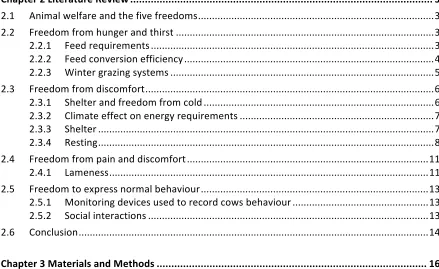
Table of Contents
Abstract ... ii
Acknowledgements ... iii
Table of Contents ... iv
List of Tables ... vi
List of Figures ... vii
List of Photographs ... viii
Chapter 1 Introduction ... 1
1.1 Objectives ... 2
Chapter 2 Literature Review ... 3
2.1 Animal welfare and the five freedoms ... 3
2.2 Freedom from hunger and thirst ... 3
2.2.1 Feed requirements ... 3
2.2.2 Feed conversion efficiency ... 4
2.2.3 Winter grazing systems ... 5
2.3 Freedom from discomfort ... 6
2.3.1 Shelter and freedom from cold ... 6
2.3.2 Climate effect on energy requirements ... 7
2.3.3 Shelter ... 7
2.3.4 Resting ... 8
2.4 Freedom from pain and discomfort ... 11
2.4.1 Lameness ... 11
2.5 Freedom to express normal behaviour ... 13
2.5.1 Monitoring devices used to record cows behaviour ... 13
2.5.2 Social interactions ... 13
2.6 Conclusion ... 14
Chapter 3 Materials and Methods ... 16
3.1 Experimental Site and location ... 16
3.2 Management of animals ... 16
3.3 Crop Measurements ... 17
3.3.1 Intake pre and post grazing ... 17
3.3.2 Nutritive value ... 18
3.4 Animal Measurements ... 19
3.4.1 Lying time ... 19
3.4.2 Social Interactions ... 19
3.4.3 Lameness ... 19
3.4.4 Cow cleanliness ... 20
3.5 Standoff pad measurements ... 20
3.6 Statistical Analysis ... 21
4.1 Climate ... 22
4.2 Intake pre and post grazing ... 22
4.3 Behaviour ... 24
4.3.1 Lying behaviour ... 24
4.3.2 Social interactions ... 24
4.4 Lameness ... 25
4.5 Cow cleanliness ... 26
4.6 Standoff pad temperature and moisture content ... 26
Chapter 5 Discussion ... 29
5.1 Intake, utilization and nutritional requirements ... 29
5.2 Behaviour ... 29
5.2.1 Lying behaviour ... 29
5.2.2 Social interactions ... 30
5.2.3 Lameness ... 31
5.3 Surface effects ... 32
5.3.1 Hygiene ... 32
5.3.2 Standoff pad and control; moisture and temperature levels ... 33
5.4 Implications ... 33
5.5 Future work ... 34
5.6 Conclusion ... 34
Appendix A Ashely Dene farm map ... 35
Appendix B Cleanliness Scoring ... 36
List of Tables
Table 1: The effects of surface type on cow lying behaviour in Waikato (A) and Southland (B) (Stewart et al., 2002) ... 9 Table 2: Effect of lying surface and area/cow on their total lying time (hour/day) in Southland and
South Otago winter 2011 (Dalley et al. 2012) ... 11 Table 3: Pre mass (t/ha), post mass (t/ha), utilization (%) and intake (kgDM/cow) values for fodder
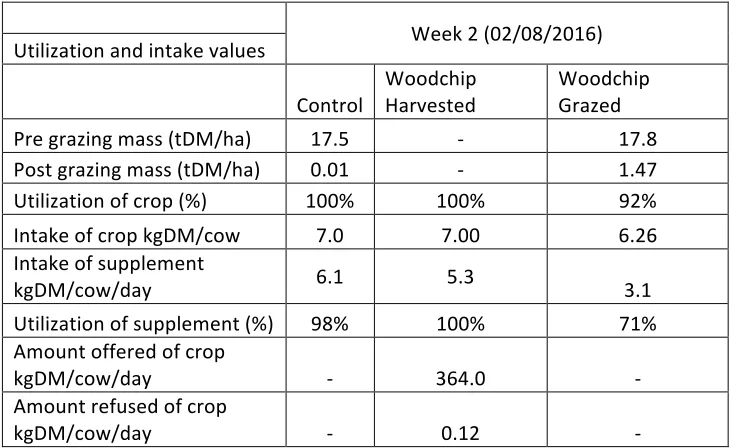
beet and lucerne and barley supplement ... 23 Table 4: Nutritive values for fodder beet and lucerne and barley supplement ... 23 Table 5: Social interactions with number of average interactions and average dominance values
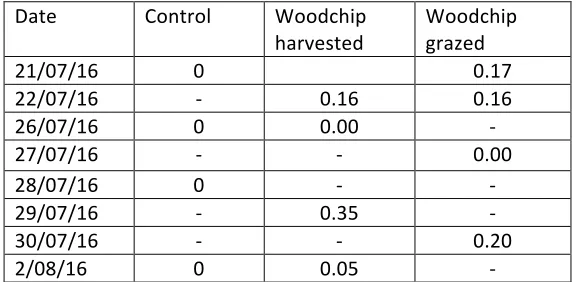
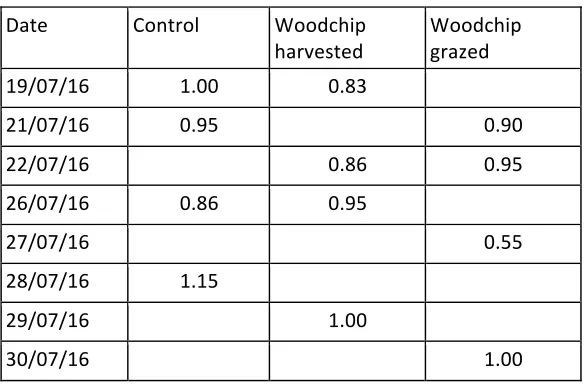
for control, woodchip (harvested) and woodchip (grazed) ... 25 Table 6: Lameness scoring for control, woodchip (harvested) and woodchip (grazed) ... 25 Table 7: Cow cleanliness score for control, woodchip (harvested) and woodchip (grazed) ... 26
List of Figures
Figure 1: Average daily: maximum (grey line), mean (orange line), and minimum (yellow line) air temperatures (0C) and total rainfall (blue bars) (mm). Figure is calculated from June to July 2016, from the Lincoln, Broadfields weather station (-‐(43.630N, and 172.470 E)
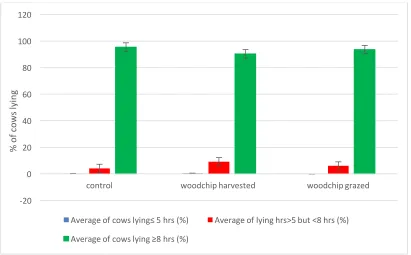
11.2km from Ashely Dene Main Block (NiWa, 2007) ... 22 Figure 2: Lying times (%) for cows lying <5hrs, >5but <8hrs and >8hrs on the control, woodchip
pulled and woodchip grazed. ... 24 Figure 3: Ground temperature for control, woodchip (harvested) and woodchip (grazed) where
cows were occupied. Green line= control, blue line= woodchip (harvested) and red line= woodchip (grazed). ... 27 Figure 4: Ground temperature for control, woodchip (harvested) and woodchip (grazed) where
cows were not occupied. Blue line= woodchip (harvested) and red line= woodchip (grazed) ... 27 Figure 5: Moisture (%) for control, woodchip (harvested) and woodchip (grazed) with cows
occupied on treatments. Green line= control, blue line= woodchip (harvested) and red line= woodchip (grazed). ... 28 Figure 6: Moisture (%) for woodchip (harvested) and woodchip (grazed) with no cows occupied on treatment. Blue line= woodchip (harvested) and red line= woodchip (grazed). ... 28
List of Photographs
Photograph 1: Woodchip (pulled) and eating fodder beet (10:00h) ... 16
Photograph 2: Woodchip (grazed) grazing fodder beet (10:00h) ... 18
Photograph 3: Fodder beet bulb being prepared for blending and oven drying ... 19
Photograph 4: Woodchip (pulled) on fresh woodchips ... 20
Photograph 5: Cows first encounter on the woodchip standoff pads ... 21
Chapter 1
Introduction
New Zealand is a pasture based system of ryegrass-‐white clover pasture. The main issues associated with this, is the inability to grow sufficient pasture during the winter period to meet the daily feed requirements for the cattle. Ryegrass-‐white clover pastures have a low dry matter (DM) yield during the winter period. Winter growth typically is less than 10kgDM/ha/day (Dalley, unpublished data; www.siddc.org.nz) and for Canterbury it ranges from 0-‐15kgDM/ha/day (Dairy NZ, 2010). With limited growth it makes pasture based wintering systems an impractical option due to the area of land required to accumulate enough pasture to meet energy requirements (Dairy NZ, 2014; Mandok et al., 2013). Alternative options such as wintering off the platform on brassica forages such as kale and fodder beet with a higher DM yield than pastures, are becoming more a more practiced system in New Zealand (Judson, Dalley, Edwards, Stephens, & Gibbs, 2010).
The aim of drying cows off during the winter period is to regain body condition which has been lost during the lactation period (D. E. Dalley, 2011). Target body condition score for dairy cattle is four and a half at drying off and five at calving (Judson et al., 2010). If targets are achieved, then springer cows (two-‐three weeks before calving) should be consuming 80% of their energy requirements. This is to avoid metabolic issues such as milk fever and ketosis prior to lactation. With diligent
management of feeding stock and monitoring their body condition score, farmers should be able to avoid metabolic disorders and achieve a BCS of five at calving (Dairy NZ, 2014).
Environmental issues are a significant concern during the New Zealand wintering period. This is due to damage occurred throughout the winter period as pasture grazing results in soils becoming waterlogged (particularly Southland), which makes grazing difficult and costly. Through grazing wet soils, the risk of nitrate leaching particularly from nitrogen excretion and urine concentrations (94%) is increased and soil losses into waterways (D. E. Dalley, 2011). Intensification of New Zealand dairy farming has led to increased stocking rates in both the North (at 3.28cows/ha) and South Island (at 3.23cows/ha) (Dairy NZ, 2008). With increased stocking rates this can lead to severe pugging damage and nitrate leaching potential (De Klein, Paton, & Stewart, 2000).
the duration of the wintering period and feed silage. Alternatively dry cows are kept in an indoor facility on or near the milking area for the duration of the wintering period and fed mixed rations (Beukes, Gregorini, Romera, & Dalley, 2011). The standoff pad provides mitigation against leaching potential and protecting pastures, however animal welfare is an issue.
The importance for animal welfare is to ensure that the Five Acts of Freedom, as stated in the Animal Welfare Act (1999) are followed. The Five Freedoms provide a simple yet understandable reasoning of why standoff wintering systems are the potential future of New Zealand dairy farming. In the context of incorporating standoff pads for dairy cows during winter the listed Freedoms 1-‐4 (National Animal Welfare Advisory Committee, 2010) are of particular interest in the review as fear and
distress were not analysed.
1.1
Objectives
The objectives of the trial were to:
• Identify key behavioral activities, which demonstrate how standoff pad surface materials effects cow’s welfare and behaviour.
• Assess the animal welfare aspects of the standoff pads and determine if they meet the requirements of the Animal Welfare Act (1999).
Chapter 2
Literature Review
2.1
Animal welfare and the five freedoms
The Animal Welfare Act 1999 (amended in 2015) established welfare obligations for which every person who owns an animal is obliged to follow. The Five Freedoms were created by Brambell (1965 ) in the UK and have formed a global ritual for modern animal welfare. They are recognised
internationally and represent the fundamental requirements of all animals.
The Five Freedoms are used as a guideline for the report, as all aspects of the project have been identified as an act of one or more of the Freedoms. The Five Freedoms are shown below: 1. Freedom from hunger and thirst -‐ by ready access to water and a sufficient diet to maintain full health and vigour.
2. Freedom from discomfort -‐ by providing an appropriate environment including shelter and a comfortable resting area.
3. Freedom from pain, injury and disease -‐ by prevention or rapid diagnosis and treatment. 4. Freedom to express normal behaviour -‐ by providing sufficient space, proper facilities and company of the animal’s own kind.
5. Freedom from fear and distress -‐ by ensuring conditions and treatment, which avoids mental suffering (Dairy NZ, 2016b) .
2.2
Freedom from hunger and thirst
2.2.1
Feed requirements
The first freedom is that from hunger. To prevent hunger it is important to understand the nutritive requirements of livestock. These requirements can vary according to their physiological state, external environment and their feed conversion efficiency. The main requirements are energy for maintenance, pregnancy and live weight gain and loss.
give rise to any product (such as milk) and does not perform any work on its environment (Rattray et al., 2007 ). Holmes and Grainger (1982) suggested a figure for maintenance of 0.55MJ ME/kg W0.75for
dry cows. In New Zealand, seasonal supply farming system dairy cows have an eight-‐week dry spell
prior to calving in spring. During this time, they require energy for maintenance, pregnancy and live weight gain (Rattray et al., 2007 ).
Energy requirements for pregnancy is influenced by the level of nutrition the animal is given, the faster the animals grow and the faster it reaches maturity (Maynard, 1979 ). It is also dependent on their physiological factors such as the stage of pregnancy and number of offspring, which can have an effect on their nutritional requirements . Energy metabolism during gestation is influenced by the increase in heat production nearing the end of gestation, this increases the additional energy requirements by the foetus for both maintenance and growth. For each additional mega joule (MJ), only about 0.13 MJME is retained in the foetus (Maynard, 1979 ). An increase in a cows daily ME requirements prior to birth is just over 1. 0 MJME/kg of the calf birthweight and total cost for the cow’s entire pregnancy is about 60 MJME/kg of calf birthweight (Rattray et al., 2007 ).
Live weight gain (LWG) or loss is related to ME restrictions, as fat and protein in body tissues are mobilized to supply energy for both pregnancy and production. Rattray et al. (2007 ) suggests that a non-‐ lactating adult cow requires 48 MJME/kg gained feed on a diet of 11 MJME/kg DM.
Maintenance, pregnancy and LWG all have influential effects on the cow’s requirements for ME. Adequate nutrition and meeting requirements is a challenge faced on many dairy farms (Rattray et al., 2007 ).
The crude protein is the second limiting nutrient for non-‐lactating dairy cows. During late gestation dairy cows require a diet with a minimum of 12% crude protein content to meet their requirements for maintenance and pregnancy (Corp, 2015 ). However, surplus dietary protein is generally excreted in the urine, and can contribute to environmental pollution including nitrate leaching to the ground water and nitrous oxide emission (Waghorn, 2011). Both energy and protein requirements have an influence on the animal’s state of hunger, which is an indication of their welfare.
2.2.2
Feed conversion efficiency
Feed conversion efficiency (FCE) has an effect on the animal’s ability to meet their energy
requirements to prevent hunger. It is a key measure of feeding system efficiency on a dairy farm, as it impacts the feed cost/unit of milk and milk profit.
Agriculture research council (1980); Moe and Tyrrell (1972) suggested ME required for maintenance of 0.43 MJ of ME/kg of BW0.75. Holmes et al. (2002 ); Nicol and Brookes (2007) further suggested that
requirements are then increased once pregnancy is added up to 0.55-‐0.58 ME/kg of BW0.75 for non-‐
lactating dairy cows, which are similar to Nutrition (2001) recommendations. However, results concluded by Mandok et al. (2013) suggest that cows requirements for maintenance, pregnancy and activity is 1.07 ME/kg of BW0.75which is 117 MJ of ME/day. This suggests that current ME
recommendations are underestimated for the requirements for zero energy balance by 45%. The reasoning for inconsistent ME requirements is associated with genetic differences in maintenance, as increased milk yield breeds require 20% more ME for maintenance.
Current estimated ME requirements are too low, as supported by Mandok et al. (2013). Estimated ME values have been suggested to increase by 30-‐45% through good genetics and adequate diets, which meet ME requirements (Mandok et al., 2013).
2.2.3
Winter grazing systems
There are multiple alternative systems to meet cow’s nutrient requirements and prevent hunger over the winter period. These systems include conventional grazing, nil grazing and restricted grazing. Through the use of grazing systems most appropriate to the season, it allows for maximum feed intake and reduces the chance of hunger and thirst welfare issues.
As well, appropriate feeding systems must ensure animals maintain their body condition score. Body Condition Score (BCS) provides a qualitative assessment of body fat and production due to its association with lactation (Roche, Kolver, & Kay, 2005). In New Zealand increasing BCS over the winter period possess a number of challenges in the New Zealand environment, as many cows fail to achieve pre-‐calving BCS targets (Dalley, Verkerk, Geddes, Irwin, & Garnett, 2012). Dairy NZ (2012) suggest that the ideal BCS for pre-‐calving is 5 for mixed aged cows and 5.5 for first and second calvers. A realistic target for farmers is to aim for 90% of the herd to be at a BCS between 4.5 and 5.5 at calving. Body condition scoring is a useful tool enabling farmers to keep accurate records of their herd’s performance and make adjustments to their feeding if required.
Conventional grazing is defined as a typical New Zealand dairy grazing system where pastures are grazed all year round. This is important to our low-‐cost system that characterizes New Zealand farming (Bryant, Holmes, Lopez-‐Villalobos, Macdonad, & Brookes, 2003 ). However, with
environmental concerns rising and lack of welfare of the animal’s, farmers are having to consider alternative winter grazing options such as nil and restricted grazing.
(Klein & Ledgard, 2001). Longhurst, Miller, Williams, and Lambourne (2006) suggested two
alternative forms of nil grazing, being a combination of feeds pads and standoff pads and have the ability to be used on a 24-‐hour basis. The other option was a wintering barn which is covered shelter for housed cows, with metal roofs and soft lying surfaces.
The final grazing system is restricted grazing, this is a combination of conventional and nil grazing. From late spring to early summer animals are grazed conventionally and during autumn and winter under a nil grazing regime to reduce the risk of nitrate leaching from urine (Cuttle, Hallard, Daniel, & Scurlock, 1992; Sherwood & Fanning, 1989). Any pasture required in the autumn/winter is harvested and fed to animals, or animals are restricted to grazing times (Klein & Ledgard, 2001). According to Christensen, Hanly, Hedley, and Horne (2010) who conducted a study at Massey University, the strategic use of restricting grazing hours in autumn and winter was able to reduce the deposition of urinary nitrogen in concentrated patches in paddocks. Instead urine was collected when the cows were being stood off. Through the use of duration controlled grazing the trial was able to limit the cows to eight hours per 24-‐hour period to graze in situ and the remaining hours to be spent on the standoff pad. Jenkinson, Edwards, and Bryant (2014 ) also found that the rate of fodder beet was 90% utilization for six hours/day grazing. This study was based on non-‐lactating Friesian x Jersey cows varying in crop allowance (8and 6kgDM of fodder beet/day and grass silage). The grazing behaviour, DM intake and DM utilization were recorded for six hours following the morning crop allocation. After six hours the utilization of the crop was 90% and the total DM intake was 7.2kgDM/cow. Results concluded that high DM crop utilization and DM intake during six hours can be achieved, which allow for the capture of nutrients on standoff pads. Similar results were found by Thompson and Stevens (2012) who suggested cows consumed 4.8kg DM of swedes (which are in the same brassica family as fodder beet) in over five hours. This corresponds to Dobos, Fulkerson, Sinclair, and Hinch (2009) who suggested that cows achieve 70% of a cows daily intake in the first four hours of grazing on perennial ryegrass. Gregorini et al. (2009) also found that cows offered pasture once a day consumed 10kgDM/cow after three hours of grazing. Literature suggests that if cows are well
transitioned then they are able to meet their daily intake requirements in a relatively short period of time. With alternative wintering systems farmers are able to meet nutrient requirements and maintain freedom from hunger and thirst.
2.3
Freedom from discomfort
2.3.1
Shelter and freedom from cold
of condition or fatality. Standoff facilities are used to provide animals with an area to rest on. However, the material surface of the standoff facilities is a huge influential factor for the cow’s comfort.
2.3.2
Climate effect on energy requirements
The climate can have an effect on the animal’s energy requirements and freedom from discomfort for maintenance, pregnancy and live weight gain. A combination of cold temperatures, wind and rain can decrease the effective environmental temperature sensed by an animal to below their ‘’lower critical temperature’’. This is defined as additional heat which the animal generates to maintain body heat, resulting in additional requirements for ME (Rattray et al., 2007 ).Animals which are well fed (above maintenance) and well insulated are unlikely to experience going below the lower critical temperature in New Zealand. Ruminants have a wider thermoneutral zone than non-‐ ruminants, due to greater capacity to regulate evaporative heat losses, and higher heat increment results from digestion. This is supported by a cow with a 20mm coat over the winter period which has the ability to withstand temperatures up to -‐20 degrees with wind speeds at 15kmph before reaching their lower critical temperature (Rattray et al., 2007 ).
Cows typically reduce grazing time and hence energy intake when they are subjected to cold temperatures (Maynard, 1979 ). However, current literature showed that animals are able to maintain normal physiological state under negative temperatures (up to -‐20degrees).
2.3.3
Shelter
To prevent freedom from discomfort animals should have access to shelter, particularly in winter. New Zealand is starting to adopt alternative wintering systems such as housing and standoff systems. Shelter is defined as providing means of protection for animals to minimize effects of adverse
gained condition, whereas outside cows body condition remained the same, as New Zealand dairy cows are exposed to the effects of weather; heat, cold, rain, snow and rain. With the exception of young animals, mature animals are able to meet their nutritional requirements, as they are able to tolerate weather variations well. However, occasions do arise when weather extremes can create welfare risks. Farmers are encouraged to have management plans in place to provide shelter where welfare risks are likely to occur (National Animal Welfare Advisory Committee, 2010).
2.3.4
Resting
The amount of time spent resting by dairy cows is a significant contributor to dairy cows comfort and welfare (Fisher, Stewart, Verkerk, Morrow, & Matthews, 2003). If the cow is unable to rest for at least eight hours/day, then she is at risk of not meeting her daily feed intake requirements and becoming more susceptible to injury and disease. This is associated with the animal’s health and comfort, which is an influential factor for the cow’s overall production. Krohn and Munksgaard (1993); Dairy NZ (2014); Fisher et al. (2003) all agree that dairy cows typically will spend nine-‐twelve hours/day lying and a preference to lie for at least eight hours/day in a typical wintering system on crops. To do this there must be enough space and the surface must be appropriate and if not, then the lying time is likely to be significantly reduced and results in cows lying once they are returned to crop, instead of grazing, which results in underfeeding (Dairy NZ, 2014; Fisher et al., 2003).
pads than concrete pads. The total average lying times for all the on-‐farm observations in Waikato and Southland are demonstrated in Table 1. The average lying time was 11.3 hours/day on the woodchip pads, for cows from the Waikato farms, which is similar to studies by Singh, Ward,
Lautenbach, Hughes, and Murray (1993) who recorded 10.3 hours/day for cows on pasture (exclusive of the Waikato trial). The lying times were recorded for the concrete pads and farm races used as standoffs, were shown to be considerably below the required minimum lying time of eight hours, suggesting that resting on these materials are suboptimal. Southland cows lying on the covered and uncovered sawdust pads and crops were all similar to lying times on the woodchip pads in the Waikato. Cows on crop were observed to lie near the crop as it was less muddy and more
comfortable (Stewart et al., 2002). The on farm observations are consistent with previous findings by Fisher et al. (2002) which found that cows spent longer laying on a woodchip pad (11.9 hours/day) than they did on concrete yards (7 hours/day), race (5.7 hours/day) or a muddy sacrifice (stood off on a paddock for wet periods and then returned back to normal grazing on the milking platform) paddock (6.9 hours/day).
Overall results from the on farm observations in Southland and the Waikato suggested that lying times for cows on concrete or races were suboptimal, and crop and woodchip/sawdust allowed for better opportunities to rest. Concrete or races may be more suitable if they are used in a
combination with other systems, such as woodchip standoff pads (Stewart et al., 2002).
Table 1: The effects of surface type on cow lying behaviour in Waikato (A) and Southland (B) (Stewart et al., 2002)
The ability for a cow to comfortably lie down for at least eight hours/day is of high importance. Comfortable bedding or lying surface needs to be substantial enough for the cow to easily lie down for this required time.
Another factor effecting cows lying times are associated with stocking density and the minimum area required for a cow to be deemed comfortable in a confined space. To do this, there must be enough space and the surface must be appropriate. Farming systems where cows graze for a few hours before being returned to a standoff area for the rest of the day, have previously failed to supply cows with enough space and proper surface to lie down on the standoff pad. This may result in cows compensating by resting in the paddock, instead of grazing during feeding time and hence underfeeding (Dairy NZ, 2014; Fisher et al., 2003).
Not suppling adequate lying areas can have an impact on cows meeting nutrient requirements, lying time and overall animal welfare (Dexcel, 2005), suggesting a minimum stocking density of 5m2 , if
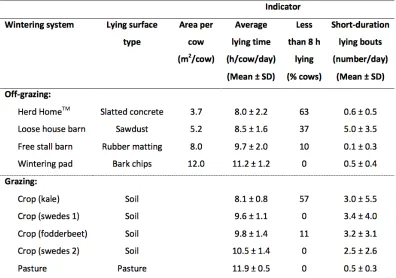
cows are only on pads for 12 hrs/day. Any longer than 3 days on pads, the recommended area increased up to 8m2(Dexcel, 2005) . Dalley et al. (2012)also demonstrated the effect of area/cow and
as demonstrated in Table 2. Results concluded that there was a clear relationship in off grazing systems, as the area/cow increased so did the lying times. The area/cow in the barn systems were generally less than those on crops, pasture and wintering pads, hence the pasture system achieved the highest lying time. Cows which were in the herd home spent less time lying and had the largest proportion of cows which failed to reach their minimum of eight hours lying target. All wintering systems with the given area (m2/cow) as shown in Table 2, met the industry recommendations of an
average of eight hours lying time. For the wintering pads, pasture and swede grazing systems, all individual cows reached the industry targets.
Table 2: Effect of lying surface and area/cow on their total lying time (hour/day) in Southland and South Otago winter 2011 (Dalley et al. 2012)
Both stocking density and lying surfaces are important factors which can have a significant
influence on the cow’s comfort and resting ability within a range of wintering systems.
(Dalley et al., 2012). Typically, the more space the cows have the more opportunity for them
to rest.
2.4
Freedom from pain and discomfort
2.4.1
Lameness
behaviour, resulting in loss of production (Green, Hedges, Schukken, Blowey, & Packington, 2002; Hernandez-‐Mendo, von Keyserlingk, Veira, & Weary, 2007; Warnick, Janssen, Guard, & Gröhn, 2001) and a negative impact on reproduction performance (Garbarino, Hernandez, Shearer, Risco, & Thatcher, 2004; Hernandez-‐Mendo et al., 2007). The major risks associated with lameness is cow comfort, cows diet and the overall management of farmers in preventing lameness. Poor cow comfort with minimal lying time, uncomfortable lying surfaces and inadequate walking surfaces, can lead to sole and heel ulcers, laminitis and hock damage/swelling. Cows with poor hygiene resulting from slurry and poor biosecurity leads to digital dermatitis, heel erosion and other infectious causes of lameness. Poor diet can increase a cow’s chance of ruminal acidosis and macro and micro
deficiencies, resulting in white line disease. With correct management of cow’s feet, by providing adequate cow comfort, dry environments and required nutrient requirements and feet trimming if required, lameness is significantly reduced and more evenly balances the weight load on the lateral and medial claw, reducing lameness(Christoph et al., 2006).
The prevalence of lameness is increased by poor hygiene as a result of infections. The cleanliness of the cow is a good indicator for hygiene, and dry feet tends to reduce lameness as there is less chance for bacteria to invade tissues. Wet conditions, on the other hand, soften the horn and weaken or disrupt the skin barrier allowing bacteria to enter (Christoph et al., 2006).
A recent study in a Northland dairy farm by Wynn, Adams, McGowan, and Verkerk (2011),
investigated the effect of surface management on cows lameness score, including two treatments of post peelings (type of woodchip) standoff pads, which were either aerated or not aerated over a six-‐ week period, and observed the overall cow welfare. Measurements for lameness showed that <2.2% of cows were lame across both treatments. The only difference between the treatments was slightly higher lying bouts on the aerated standoff pads.
dairy cattle to reach 14% lameness within the herd. This has a significant effect on the economic losses to the New Zealand Dairy industry.
Gait length is also effected by lameness and hygiene. Fisher et al. (2002) showed a greater reduction in the gait length for cows on concrete standoff pads (0.07m) than cows on woodchip (0m), laneway standoffs (0m) and small paddock standoffs (0.01m). This suggests that cows tend to reduce their gait length as they become lame under uncomfortable surfaces.
Minimising lameness can result in greater productivity and overall well-‐being of the animal. This could be achieved through rapid diagnosis and treatment and providing adequate bedding material when a stand-‐off pad farming system is used.
2.5
Freedom to express normal behaviour
2.5.1
Monitoring devices used to record cows behaviour
The changes of animal behaviour are a good indicator of animal discomfort and expressing their normal behaviour. There are devices such as accelerometer technology, which allow 24 hour monitoring, recording and reporting of cow activity. Thus, lying, standing, and stepping behaviour (step counts) can be monitored to measure animal comfort and welfare. This could be done by using the Icetag activity monitor (McGowan, Burke, & Jago, 2007) (IceRobitics, Scotland). The device can be strapped to the cow’s back leg just above the hoof, and data will be stored and downloaded onto the IceTagAnalyser software on a computer. The activity monitors have huge potential to enhance research for measuring the behaviour of animals continuously, automatically and without human interference. It is important, as lying and locomotion of animals is an important indicator of animal welfare in dairy cows. (McGowan et al., 2007)
2.5.2
Social interactions
more frequent when in narrow spaces or alleys where they have difficulty passing other cows (DeLaval Milk Production, 2007 ). The effect of social interactions is similar to Hussein (2016) who demonstrated different stocking rates and herd size for 252 spring calving Frisian x Jersey cows grazing perennial ryegrass and observed for three months’ early lactation to determine their dominance values (DV). Cows on low stocking rate (LSR), medium stocking rate(MSR) and high stocking rate (HSR), had DV scores of 40.7, 50.3 and 43.9 respectively. The interactions/cow were 10, 3, and 14 respectively. The total interactions were 297, 589 and 475 respectively. Social dominance was suggested to be positively related to age and size of animals such as BCS and LW (Phillips & Rind, 2002; Schein & Fohrman, 1955b; Sołtysiak & Nogalski, 2010). Dickson, Barr, Johnson, and Wieckert (1970); Guhl and Atkeson (1959); Potter and Broom (1987) all suggested that confined spaces in indoor feeding systems have an effect on cows social interactions. Hussein, Al-‐Marashdeh, Bryant, and Edwards (2016) further explained in relation to the different stocking rates, the smaller the group, the fewer social interactions between cows in larger MSR groups, as it could be due to lack of recognition between group mates, which ends in relationship breakdown and aggressive behaviour. Hussein et al. (2016) also found that larger groups resulted in fewer interactions which is in
agreement with (Lindberg & Nicol, 1996) who claimed that larger groups lead to fewer interactions. Social interactions in confined areas such as the wintering barns and standoff pads can effect cows comfort and natural behaviour, through dominant cows restricting submissive cows from lying and exhibiting normal behaviour.
2.6
Conclusion
The main purpose for using standoff pads in New Zealand is to reduce soil pugging and nitrate leaching to the ground water. The New Zealand dairy industry is exploring a range of standoff surface materials in order to identify low cost materials and to meet animal welfare requirements. Current literature suggests that cow welfare is determined by the Five Acts of Freedom from the Animal Welfare Act (1999). Freedom from hunger was recognised as animals meeting their nutrient
by the lying behaviour, which was suggested that cows were required to have at least eight hours resting, otherwise this had an effect on their welfare. Social interactions between the animals was also apparent to show their ability to lie down for the required time, due to dominance effects from cows that were restricted in the pads due to discomfort. Overall standoff facilities are an applicable option for dairy farmers wanting to mitigate against nitrate leaching and maintain required animal welfare standards.
Chapter 3
Materials and Methods
3.1
Experimental Site and location
The experiment was conducted with the approval of the Lincoln University Animal Ethics Committee. The forage crops and standoff facilities were located on the Lincoln University Ashely Dene dairy farm (-‐43.395 degrees East, 172.21 degrees North) on Lismore/ Balmoral shallow stony loam soil structure (Landcare Research, 2013). The experimental design was a parallel group design comparing three treatment wintering regimes. Treatment one cows stayed in the paddock for 24 hours and grazed fodder beet whole crop (control). Treatment two cows stayed on a woodchip stand-‐off for 17 hours and were offered harvested fodder beet bulb in the paddock (woodchip harvested). Treatment three cows stayed on a woodchip stand-‐off for 17 hours and grazed fodder beet in situ crop
(woodchip grazed). A farm map is shown (appendix A) to show where the groups were located. Two hundred and twenty five kiwi-‐cross, pregnant, dry cows were ranked according to calving date (8th
August) and live weight and randomly allocated to one of the three treatments. Each group was offered 8 kg DM fodder beet and 4 kg DM of Lucerne and barley baleage/cow/day.
Photograph 1: Woodchip (pulled) and eating fodder beet (10:00h)
3.2
Management of animals
commencement of the experiment until the 10th of July 2016. Cows were transitioned onto the
stand-‐off areas for five days.
Cows were moved between the standoff pad and paddock, where they received supplement (08.30 h) followed by crop (10.00h) and returned to the standoff pads (15.00h). The area per cow on the stand-‐off pad was the same each day (10m2/cow), in line with the recommended 8-‐10m2 /cow for
wintering pads with no on-‐off grazing (Dairy NZ, 2014), while the area in the paddock was increased each day by 1-‐2m2/cow. Total area of each paddock for the three treatments were 5.98ha (control), 1.99ha (woodchop harvested) and 2.99ha (woodchip grazed). By the 10th of July the paddock area
was equivalent to 1-‐2 m2/cow in all treatments. Cows walked between 100-‐800m/day return to the standoff pad. Water was available ad lib from trough’s in paddocks and stand-‐off. As treatment cows commenced calving (8th August), allocation area’s and stand-‐off areas were adjusted to maintain a
constant allocation for the duration of the trial.
3.3
Crop Measurements
3.3.1
Intake pre and post grazing
Pre grazing herbage mass (kgDM/ha) was for each crop determined (fodder beet crops 10 times between 6th May-‐ 28th August). Total fresh weight of all crop material (fodder beet bulb pulled and leaf separately weighed) contained in three metre drill row lengths of fodder beet, and recorded in the field. A sub-‐sample of two plants (fodder beet plant) per replicate were split into leaf or bulb and were diced and crushed through a blender -‐ leaves were washed and placed in paper bags. Samples were then force draft dried (Conthem Thermotec 2000 standard oven) at 650C to constant weight for
DM percentage.
The Utilization percentage of each fodder beet crop and supplement received by cows was
determined (27th July and 2nd August). Total fresh weight of fodder beet (after grazing) contained in
six randomly positioned quadrats (1m2) was recorded in the field.
Total fresh weight of barley and lucerne supplement (before and after eating) was also measured in six randomly positioned quadrats (1m2) along the fence line and marked with spray paint to identify
where the samples were taken. Subsamples of the fodder beet and supplement were collected to be force draft dried (Conthem Thermotec 2000 standard oven) at 650C to constant weight for DM
Photograph 2: Woodchip (grazed) grazing fodder beet (10:00h)
3.3.2
Nutritive value
For the NIRS, after the sample (fodder beet bulb) was dried it was ground into fine particles (<1mm) and was scanned to find nutritive value. The same process was duplicated for the leaf. This yield information was used to calculate break size for each paddock and therefore DM and nutritive value of the cow’s dietary intake.
A large handful of supplement (lucerne and barley silage) was taken at each time of sampling to determine DW, DM and NIRS. For DW, the silage sample was cleaned and weighed. It was then dried in the oven for 24-‐48 hours and reweighed for DW and DM determination. The sample was then
ground into particles (<1mm) and was scanned to determine NIRS.
Photograph 3: Fodder beet bulb being prepared for blending and oven drying
3.4
Animal Measurements
3.4.1
Lying time
Prior to the behavioural trial, all cows were fitted with an AfiAct pedometer above their rear fetlock joint for the duration of the trial (see AEC 598 R for a further description of these methods).
Information on lying time, lying bouts, standing, and cumulative steps were sent every minute (if cows were within range of the data storage box), otherwise accumulated and transferred once cows were in range. Data was collected daily and analysed through a software programme , which
generated total lying times per cow, lying bouts, standing time and steps. The percentage of cows lying <five hours, >than five hours but <eight hours and >eight hours was also found.
Pedometers were required to be validated against visual observations, similar to Borchers, Chang, Tsai, Wadsworth, and Bewley (2016) data. Ten cows were picked at random to visually observe their lying and walking behaviour for two hours, twice per day, for five consecutive days prior to the trial. Observations were recorded every five minutes. Visual lying times were compared with the
pedometer lying times and graphed to produce a R2 correlation (R2.96), which was similar to Borchers
et al. (2016) data.
3.4.2
Social Interactions
Social interactions were recorded based on the master chart, which was provided by (Schein & Fohrman, 1955a). Observation occurred twice a day on the paddock (8:30h) and the standoff pad (15:00h) for two hours each. Observation included bunting, pushing, mounting and allogrooming. Behaviours were allocated points, from bunting being four to allogrooming being one. Bunting interactions included any physical contact with the head to another cow implying force. Pushing interactions was when cows would purposely push another cow to get to feed or just walking past. Mounting interactions was seen through cows mounting one another. Allogrooming interactions were shown through signs of affection such as licking and gentle rubbing. Cows initiating the interaction won and opposing cows lost, allowing a dominance value for each individual cow that was observed.
3.4.3
Lameness
Lameness scores were randomly allocated to 25 individual cows in each treatment (twice a week, for the three-‐week trial). Cows lameness was determined by a scoring range from 0-‐3 (Dairy NZ, 2016a). Cows were recorded when walking down the track to paddock or from supplement to crop.
Lameness score 0, this cow is walking evenly, and no action is required. Lameness score 1 is a result of not walking evenly, minor action is required. Lameness score 2, cow is lame and action is required. This cow is lame and needs to be recorded, drafted and examined within 48 hours.
Lameness score 3, this cow is very lame. Urgent action is required, cow should be drafted and examined as soon as possible within 24 hours and may require a vet (Dairy NZ, 2016a).
3.4.4
Cow cleanliness
Cow cleanliness was determined through the Dairy NZ hygiene scoring chart. The scoring ranged from 0-‐2 (as seen in Appendix b).
Cows with a score of zero had no dirt or less than 10% (a hand size) is splashed with fresh or dry material.
Cows with a score of one have at least a hand-‐sized area of dirt, but less than 50% of the area is dirty. Cows with a score of two have more than 50% of their body as very dirty and hair is difficult to see. The tail may have significant dags.
The hygiene scoring enables farmers to estimate the current cleanliness of a herd and the standoff facilities. Most cows should ideally be between zero or one. If there is more than 20% of cows scoring two, then they may be at greater risks of animal health issues and milk quality issues.
Photograph 4: Woodchip (pulled) on fresh woodchips
3.5
Standoff pad measurements
Standoff pad temperatures (C0) moisture (%) and relative humidity (%) were recorded daily (8:00h)
with a moisture-‐testing device (FLIR MR77). Weather was recorded as well as relative humidity of air and air temperature. Standoff pads were tested for ground temperature (C0), moisture (%) and
three on non-‐occupied woodchip pads). All measurements on the control were also taken, excluding the relative humidity. All data was recorded and transferred to excel.
Photograph 5: Cows first encounter on the woodchip standoff pads
Photograph 6: Comparison of occupied and non-‐occupied woodchip pads during a frost
3.6
Statistical Analysis
Chapter 4
Results
4.1
Climate
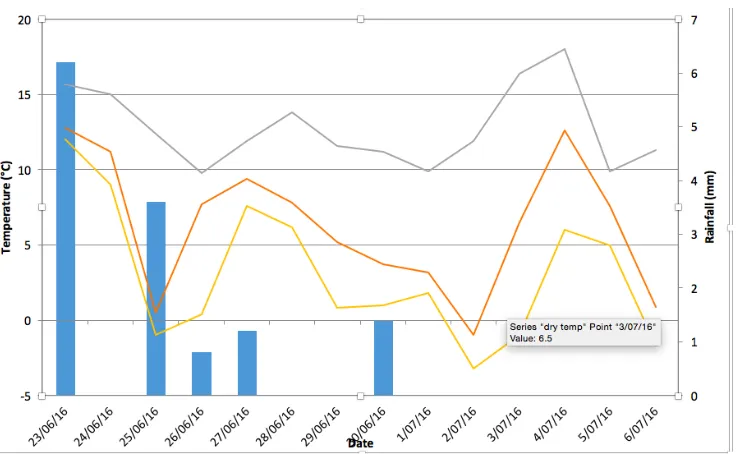
Rainfall and air temperature prior to the study and for the duration of the study, June and July 2016. The average monthly rainfall and temperature is shown in Figure 1.
Figure 1: Average daily: maximum (grey line), mean (orange line), and minimum (yellow line) air temperatures (0C) and total rainfall (blue bars) (mm). Figure is calculated from June to July 2016, from the Lincoln, Broadfields weather station (-‐(43.630N, and 172.470 E) 11.2km from Ashely Dene
Main Block (NiWa, 2007)