HYBRID AND INTEGRATED
APPROACH TO SHORT TERM LOAD
FORECASTING
Mrs. J. P. Rothe
Deptt of Electrical Engg, SVPCET, Nagpur.
Dr. A. K. Wadhwani
,
MITS, Gwalior.
Dr. S. Wadhwani
,
MITS, Gwalior.
Abstract: The forecasting of electricity demand has become one of the major research fields in Electrical Engineering. In recent years, much research has been carried out on the application of artificial intelligence techniques to the Load-Forecasting problem. Various Artificial Intelligence (AI) techniques used for load forecasting are Expert systems, Fuzzy, Genetic Algorithm, Artificial Neural Network (ANN). This research work is an attempt to apply hybrid and integrated effort to forecast load. Regression, Fuzzy and Neural along with Genetic Algorithm will empower the analysts to strongly forecast fairly accurate load demand on hourly base.
Keywords: short term load forecasting, artificial neural network, genetic algorithm, fuzzy systems, regression method.
1. INTRODUCTION
With the skyrocketing growth of power system networks and the increase in their complexity, many factors have become influential in electric power generation, demand or load management. Load forecasting in one of the critical factors for economic operation of power systems. Forecasting of future loads is also important for network planning, infrastructure development and so on. However, power system load forecasting is a two dimensional concept: consumer based forecasting and utility based forecasting. Thus the significance of each forecast could be handled disjointedly. Consumer based forecasts are used to provide some guidelines to optimize network planning and investments, better manage risk and reduce operational costs. In basic operations for a power generation plant, forecasts are needed to assist planners in making strategic decisions with regards to unit commitment, hydro-thermal co-ordination, interchange evaluation, and security assessments and so on [1]. This type of forecast deals with the total power system loads at a given time, and is normally performed by utility companies.
The techniques used for load forecasting are time series based models, similar-day approach and intelligent system based models. Some of the conventional forecasting methods have major drawbacks especially their inability to map the non-linear characteristic of the load, thus a substitute of classical methods with intelligent system based models is to a great extent essential. Most forecasting models use statistical techniques or artificial intelligence algorithms such as regression, neural networks, fuzzy logic, and expert systems. [9]
J.P.Rothe et al. / International Journal of Engineering Science and Technology Vol. 2(12), 2010, 7127-7132
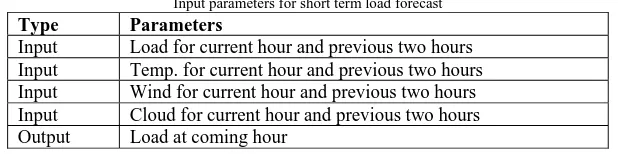
Table – I
Input parameters for short term load forecast Type Parameters
Input Load for current hour and previous two hours Input Temp. for current hour and previous two hours Input Wind for current hour and previous two hours Input Cloud for current hour and previous two hours Output Load at coming hour
3. DATA PARAMETERS
Following input data parameter were recorded. Such 99 sets were utilized as basic data for forecasting electrical load demand at coming hour.
Load at Current Hour
Load at Previous Two Hours Load at Previous Hour
Temp at Current Hour
Temp at Previous Two Hours Temp at Previous Hour
Wind at Current Hour
Wind at Previous Two Hours Wind at Previous Hour
Cloud at Current Hour
Cloud at Previous Two Hours Cloud at Previous Hour
Demand Forecast
Load at Coming Hour
Fig. 1 Schematic Forecast Model
We have used several approaches one after another to get this load demand as accurately as possible.
The first stage is Using Genetic Algorithm for selection of best 99 cases in the past history from a pool of 65000 cases observed in recent past. Survival of the fittest, crossover and mutation related to genetic reduces considerable burden of computation time by random selection of very few cases still picking up the best ones in shortest possible time. Hence accuracy of further approaches using the genetically selected cases will be very high.
Moreover hybrid combination of statistical and artificially intelligent techniques with genetically selected cases is a new approach and has rare references and reported success in recent past. Several stages such as single parameter regression, mutilparameter regression, ANN based prediction based on training by previous records (genetically selected) and fuzzy correction over the reported forecasting are dealt in depth during the course of research.
4. STATISTICAL REGRESSION
Steps for Carrying Multiparameter Regression
The program works using load data for 99 sets of observed values (along with temp, wind and cloud parameters at current and previous two hours).
Multiple regression tries to fit an equation for forecasting load at coming hour based on 12 parameters using Matlab procedure for regression.
Data in text form is successfully written using a program.
Fig. 2 Results of Regression Method
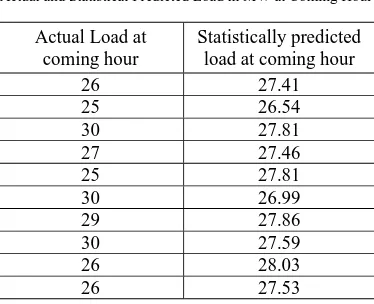
Table-II
Actual and Statistical Predicted Load in MW at Coming Hour
Actual Load at coming hour
Statistically predicted load at coming hour
26 27.41 25 26.54 30 27.81 27 27.46
25 27.81
30 26.99
29 27.86 30 27.59 26 28.03 26 27.53 Forecasted load (in MW) = 26.8942
5. GENETIC ALGORITHM
Genetic Algorithm was applied for selection of 100 sets of best data required for forecasting using ANN and later on Fuzzy Correction over it. Following are the steps for output of genetic program.
An m file is created carrying record of previous huge heap of forecasted values (65537 values) along with identification number.
Fitness function is absolute difference between actual load demand observed and previously forecasted result.
Using only random selection of 100 members out of initial pool fitness function is calculated and rejected the unfit members based on error in previous forecasting after crossover.
Mutation was not required since got best members after crossover itself. Final selected lot carried only correctly forecasted results.
The genetically selected population later given to ANN and fuzzy programs which were trained and fuzzy corrections were also applied to the ANN output.
J.P.Rothe et al. / International Journal of Engineering Science and Technology Vol. 2(12), 2010, 7127-7132
6. STEPS FOR ANN BASED FORECAST
Two Layer Neural Network Power Systems architecture was chosen for analysis. Backpropagation algorithm was implemented with and without training. Tan-sigmoid function as in has been chosen in the hidden layer and purelin (linear) transfer function in the output layer. This is a useful structure for function approximation problem. Forecasting was tested to the neural networks based on designed network architecture described in Table-IV.
Table-IV Neural Network Architecture
Layer Data type No.& type of T.F/Neuron Input Load for current hour and previous
two hours 3
Input Temp for current hour and
previous two hours 3
Input Wind for current hour and
previous two hours 3
Input Cloud for current hour and
previous two hours 3
Hidden N/A
Output Load at coming hour Input pattern fed to ANN was 12 above parameters. 99 sets of such data were given for training.
After training such ANN architecture, predicted output was compared with actual load demand. Same ANN was used for new set of parameters found at any hour for forecasting load demand at
altogether different values of input parameters.
Fig.4 Prediction of Load at coming hour with training
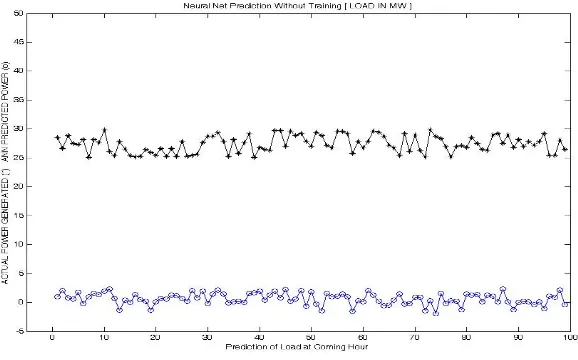
The first graph represents input data i.e. power demanded by load along with neural network simulated demand without training.
The second graph represents the same but with training. It was observed that neural network model moulds itself after training only which is the case with human beings also.
Once the model is ready, it can be utilized for any new set of data at coming hour and output will be forecasted load demand at that instant or hour.
ANN forecasted power for 5 sets: 26.8372 27.5271 27.5271 28.4822 27.2016 7. FUZZY BASED REGRESSION ANALYSIS FOR LOAD FORECASTING
Research carried out single parameter and multiparameter regression for load forecasting. The results of forecasted were compared with actual and error was analyzed in fuzzy sense and accordingly correction was applied to forecasted values which improved the forecasted result a lot and closeness to actual values was evidence of the efforts.
J.P.Rothe et al. / International Journal of Engineering Science and Technology Vol. 2(12), 2010, 7127-7132
Fig.6 Error correction for Multi parameter in load forecasting
Final error (after passing through several stages such as genetic, ANN and Fuzzy) was observed to be in the range 1 to 3 %.
CONCLUSION
Although statistical approach is still widely used conventionally, newer techniques offer a lot of promise for this developing and rapidly changing field. The rapidly increasing power of the personal computer is making it possible to apply more complicated solution techniques. New load forecasting methods based on fuzzy logic, genetic algorithms, expert systems, and neural networks offer new hopes in this direction of research. Over the last few years, the integrated efforts are rare. Hence this research work will be quite useful in several aspects. The main purpose of the research was to investigate application of various computational intelligence methods for short term load forecasting. In this research work lot of efforts were to collect data and correctly analyze using such techniques which gave fairly wise results. These forecasted values are useful for unit commitment, operation and fuel reserve planning in the power system.
Integrated approach of forecasting using genetic selection and later on training with ANN and Fuzzy correction improves the accuracy of forecasted values. Confidence margin also increases since forecasting is done based on selected cases in which errors of forecasting were less. Results of regression, ANN, fuzzy and genetic were quite encouraging and hence there is a strong need for prediction and forecasting based on integrated approach.
REFERENCES
[1] Gross and F. Galiana ,“Short Term Load Forecasting,” Proc. IEEE, Vol. 75, No. 12, pp.1558-1573, 1987.
[2] Kyung-Bin Song, Young-Sik Baek, Dug Hun Hong, Jang G., “Short-term load forecasting for the holidays using fuzzy linear regression method,” IEEE Transactions on Power Systems, Vol. 20, No.1, pp. 96- 101, Feb. 2005.
[3] Kyung-Bin Song, Seong-Kwan Ha, Jung-Wook Park, Dong-Jin Kweon , “Hybrid Load forecasting method with analysis of temperature sensitivities,” IEEE Transactions on Power Systems, Vol. 21, No.2, pp. 869- 876, May 2006.
[4] Wang Wu, Wang Guozhi, Zhang Yuanmin, Wang Hongling, “Genetic Algorithm Optimizing Neural Network for Short-Term Load Forecasting,” 2009 International Forum on Information Technology and Applications pp. 583-585, 2009.
[5] Gwo-Ching Liao, Ta-Peng Tsao, “Application of a fuzzy neural network combined with a chaos genetic algorithm and simulated annealing to short-term load forecasting,” IEEE Transactions on Evolutionary Computation, Volume 10, Issue 3, , pp 330 - 340 , June 2006.
[6] Gwo-Ching Liao, Ta-Peng Tsao, “Novel GA-based approach and neural fuzzy networks application in short-term load forecasting,”IEEE Power Engineering Society General Meeting, Vol.1, pp. 589 - 594 ,6-10 June 2004.
[7] Gwo-Ching Liao, Ta-Peng Tsao, “Integrated genetic algorithm/tabu search and neural fuzzy networks for short-term load forecasting,”IEEEPower Engineering Society General Meeting, Vol.1, pp1082 – 1087, 6-10 June 2004.
[8] Khotanzad, A., Afkhami-Rohani, R., Tsun-Liang Lu, Abaye, A, Davis M., Maratukulam D.J. “ANNSTLF-a neural-network-based electric load forecasting system,” IEEE Transactions on Neural Networks, Volume 8, Issue 4, , pp. 835 – 846, July 1997. [9] Tranchita, C., Torres, A., “Soft computing techniques for short term load forecasting,”
Power Systems Conference and Exposition, IEEE PES, Vol.1, pp. 497 – 502, 10-13 Oct. 2004.