Study on Strength Development of High
Strength Concrete Containing Fly ash and
Silica fume
1
A R Hariharan
1
Research Scholar,
Structural & Geotechnical Engineering Division, School of Mechanical and Building Sciences,
VIT University, Vellore.
2
A S Santhi
2
Professor and Division Leader, Structural & Geotechnical Engineering Division,
School of Mechanical and Building Sciences, VIT University, Vellore.
3
G Mohan Ganesh
3
Professor,
Structural & Geotechnical Engineering Division, School of Mechanical and Building Sciences,
VIT University, Vellore.
Abstract:
This paper presents the results of an experimental investigation carried out to evaluate the compressive strength of High Strength Concrete. High Strength Concrete is made by partial replacement of cement by fly ash (FA) and silica fume (SF). In this study the Class C fly ash used in various proportions 30%, 40% and 50% and that of silica fume by 6% and 10% by weight of cement. The mix proportions of concrete had a constant water binder ratio of 0.4 and super plasticizer was added based on the required degree of workability. The total binder content was 450 kg/m3. The concrete specimens were cured on normal moist
curing under normal atmospheric temperature. The compressive strength was determined at various ages up to 90 days. The results indicate the concrete made with these proportions generally show excellent fresh and hardened properties since the combination is somewhat synergistic. The addition of silica fume shows a early strength gaining property and that of fly ash shows a long term strength. The ternary system that is Portland cement-fly ash-silica fume concrete was found to increase the compressive strength of concrete on all age when compared to concrete made with fly ash and silica fume alone.
Keywords: Compressive strength, High strength concrete, fly ash, silica fume.
1. Introduction
Fly ash is widely used in blended cements, and is a by-product of coal-fired electric power plants. Two general classes of fly ash can be defined: low-calcium fly ash (LCFA: ASTM class F) produced by burning anthracite or bituminous coal; and high-calcium fly ash (HCFA: ASTM class C) produced by burning lignite or sub-bituminous coal. Utilization of waste materials such as fly ash in construction industry reduces the technical and environmental problems of plants and decreases electric costs besides reducing the amount of solid waste, greenhouse gas emissions associated with Portland clinker production, and conserves existing natural resources. Despite the benefits of fly ash, practical problems remain in field application. At early stages of aging, the strength of concrete containing a high volume of fly ash as a partial cement replacement is much lower than that of control concrete, due to the slow pozzolanic reactivity of fly ash.
slag, silica fume etc. The initial interest in the use of silica fume was mainly caused by the strict enforcement of air-pollution control measures in various countries to stop release of the material into the atmosphere. Silica fume is a pozzolanic material which is a bye-product of the silicon smelting process. It is used to produce silicon metal and ferrosilicon alloys which have a high content of glassy-phase silicon dioxide (SiO2) and consist of very small spherical particles. Silica fume is known to produce a high-strength concrete and is used in two different ways: as a cement replacement, in order to reduce the cement content (usually for economic reasons); and as an additive to improve concrete properties (in both fresh and hardened states). Therefore, utilization of silica fume together with fly ash provides an interesting alternative and can be termed as high strength and high performance concrete.
One of the main advantage of high-volume mineral admixtures in high-strength concrete is reducing the cement content, which is not only economic and environmental benefits but also means reducing the rise in temperature at the same time increasing the compressive strength and durability properties. As a rule of thumb, the total temperature produced by the pozzolanic reactions involving mineral admixtures is considered to be half as much as the average heat produced by the hydration of Portland cement.
This paper reports the results of an experimental investigation of compressive strength of blended cements. Twelve concrete mixtures were made in this investigation.These included a control mixture, mixture containing 30%, 40% and 50% fly ash alone as cement replacement (C+FA), mixtures with 6% and 10% silica fume alone as replacement for cement (C+SF), and a mixture combining both fly ash and silica fume as cement replacement (C+FA+SF) as given in the Table 3. The water-cementitious materials ratio was kept constant at 0.40 for all mixtures; super plasticizer was added on different dosages based on the degree workability to be obtained. A large number of cube specimens were casted and subjected to normal curing at atmospheric temperature after demoulding. The compressive strength was determined at various ages up to 90 days.
2. Experimental Study
The experimental study carried out at the laboratory is explained as given below
2.1 Concrete Materials
The concrete mixtures were made in the laboratory as per standard of ASTM C 192M-07 and it was made using the following materials:
Cement
Ordinary Portland cement was used, the physical and chemical properties of the cement is tabulated in Table 1 and Table 2 respectively.
Fly ash
High-calcium fly ash (ASTM Class C) from NLC Ltd, Neyveli, India was used in this investigation. The specific gravity of the fly ash is 2.04. The chemical compositions of the fly ash are shown in Table 2.
Silica fume
Uncompacted silica fume from Elkem, India was incorporated in this study. The physical properties and chemical analysis of the silica fume are shown in Table 1 and Table 2 respectively.
Aggregates
The fine and coarse aggregates were local natural sand and crushed gravel, respectively. The fine and coarse aggregates were sieved into different size fractions that were then recombined to a specific grading. The grading and the physical properties are in conformity with the ASTM Methods.
Superplasticizer (SP)
A new generation PolyCarboxylic Ether (PCE) based super-plasticizer was used. This super -plasticizer is available as a medium brown colored aqueous solution with standard specifications of ASTM C 494 Type G. The specific gravity and pH value of the super plasticizer is 1.056 and 6.5 respectively.
Description of test ASTM Type I Portland cement
Silica Fume
Physical Test
Specific Gravity Fineness-Passing 45 m Initial Setting Time(min) Final Setting Time(min) Specific Surface(m2/g) Bulk Density(kg/m3)
3.15 94.1 150 265 329 -
2.02 85
- - 19 602
Table2. Chemical analysis of cementitious materials
Description of test ASTM Type I Portland cement
Fly ash ASTM Class C Silica Fume
Chemical Analysis
Silicon dioxide(SiO2) Aluminium
oxide(Al2O3)
Ferric oxide(Fe2O3)
Calcium oxide(CaO) Magnesium oxide(MgO) Sulphur trioxide(SO3)
Sodium oxide(Na2O3)
Potassium oxide(K2O)
Loss of Ignition(LOI)
20.32 4.94 2.55 62.58
1.18 3.46 0.19 0.86 1.28
60.09 18.63
- - 1.10 1.54 0.31 0.05 2.41
85.72 0.06 0.45 - - - - - 1.96
2.2 Mixture Proportions
The concrete mixture proportions are given in Table 3 for 450kg/m3. The total binder content was kept as 450 kg/m3 and a constant W/B of 0.4. The CF series, cement was replaced at three proportions (30%, 40% and 50%) with FA. In the CS series the cement was replaced with silica fume, at two proportions (6% and 10%). Finally, CFS series both fly ash and silica fume were added, at six proportions of cement weight. The super plasticizer was added based on the degree of workability and slump to be obtained and the percentage added is shown in the Table 3.
Table 3.Proportioning of Concrete Mixtures for 450kg/m3
of cement content
Mixture ID W/C Water
Quantities (kg)
Cement Fly Ash Silica Fume SP CA FA
C100 0.4 29.3 73.39 - - - 173.20 115.23
CF30 0.4 29.3 51.37 22.02 - 0.07 173.20 115.23
CF40 0.4 29.3 44.04 29.35 - 0.11 173.20 115.23
CF50 0.4 29.3 36.69 36.69 - 0.14 173.20 115.23
CS6 0.4 29.3 68.98 - 4.40 0.15 173.20 115.23
CS10 0.4 29.3 66.05 - 7.33 0.17 173.20 115.23
CFS541 0.4 29.3 36.69 29.35 7.33 0.18 173.20 115.23
CFS631 0.4 29.3 44.04 22.02 7.33 0.11 173.20 115.23
CFS546 0.4 29.3 39.63 29.35 4.40 0.11 173.20 115.23
CFS636 0.4 29.3 46.96 22.02 4.40 0.07 173.20 115.23
CFS451 0.4 29.3 29.35 36.69 7.33 0.29 173.20 115.23
CFS456 0.4 29.3 32.29 36.69 4.40 0.22 173.20 115.23
2.3 Casting and Testing of Specimens
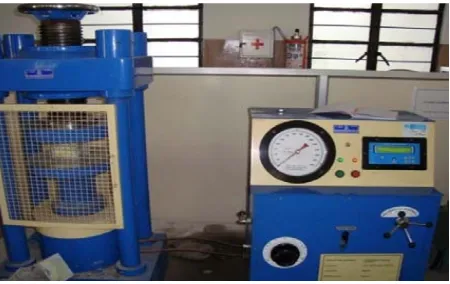
using a vibrating table. After casting, the molded specimens were left in the casting room at 23 ± 1.7°C for 24 h. They were then demoulded and cured. The cube specimens were cured for different ages like 1, 3, 7, 28 and 90 days period to determine the compressive strength at these ages. Figure 1 shows the view of compressive testing machine along with the specimen.
Figure 1: View of Compressive Testing Unit
3. Results and Discussion
The results of fresh concrete tests and compressive strength of test specimens up to 90 days, with different amounts of FA, SF and FA + SF addition are discussed in the following paragraphs.
3.1 Properties of Fresh Concrete
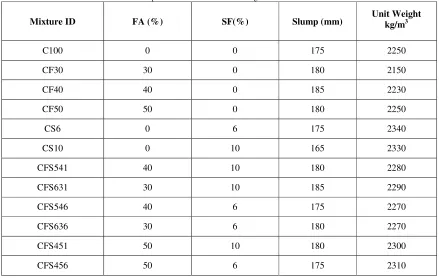
The properties of the freshly mixed concrete, i.e. slump and unit weight are given in Table 4. The slump of all concrete mixtures was greater than 165 mm. The mixture in CS series, which contains 10% and 6% SF as a cement replacement and a constant water binder ratio, with increase in silica fume content in concrete, the value of slump decreases and hence the optimum super plasticizer dosage increases, which can be attributed to high specific surface of silica fume. The effectiveness of super plasticizer is enhanced in the presence of silica fume.The addition of fly ash has just the opposite effect on the mix properties in terms of workability and optimum dosage of super plasticizer as compared to silica fume. The increase in FA content lowered the plastic viscosity of mixes while maintaining the flow values approximately equal. In other words incorporation of FA and SF increased the super plasticizer demand. This is probably due to the increasing paste volume with FA and SF since the specific gravities of these mineral additives are lower than cement.
From the above discussion, it can be stated that fly ash act improves flowability and silica fume has a reverse effect, when added individually. Thus, it is thought that when used in combination, the beneficial effect of fly ash on fluidity is used to compensate the loss of slump with silica fume addition. Furthermore, the other factor may be the effect of SF and FA on the cohesion of the fresh concrete. Generally, similar workability properties were obtained at all mixes in fresh state. However, it must be kept in mind that measured properties are also related to the dosages of super plasticizer.
Table 4. Properties of fresh concrete for 450 kg/m3
of cement content
Mixture ID FA (%) SF(%) Slump (mm) Unit Weight kg/m3
C100 0 0 175 2250
CF30 30 0 180 2150
CF40 40 0 185 2230
CF50 50 0 180 2250
CS6 0 6 175 2340
CS10 0 10 165 2330
CFS541 40 10 180 2280
CFS631 30 10 185 2290
CFS546 40 6 175 2270
CFS636 30 6 180 2270
CFS451 50 10 180 2300
CFS456 50 6 175 2310
3.2 Compressive Strength
The compressive strength development of CF series within time is presented in Figure 2. The results show that the compressive strength decreases with the increase in FA content at all initial ages. It can be seen from Figure 2 that, the compressive strength of control (0% FA), 30% FA, 40% FA and 50% FA mixtures showed a similar trend of strength gaining on all early ages. The curing and ageing of concrete tends to change the behavior of concrete replaced with 40% and 50% FA which showed a increase in strength compared to 30% FA on 28 days and 90 days correspondingly. All mixes show strength gain at 90 days when compared to control mixture. The higher the cement replacement with FA higher the strength with time. The mix with 40% FA showed a maximum strength of 60.2 MPa compared to all other FA replacements. However, it is clear that, it is possible to produce a high strength concrete with a compressive strength value of 50 MPa with 30–50% FA replacements.
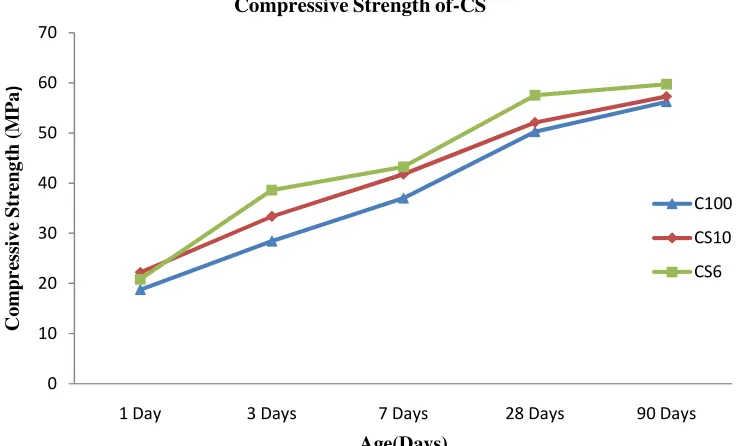
The relationship between compressive strength and time for CS series is presented in Figure 3. It can be observed from Figure 3 that SF addition to the concrete as a cement replacement affects the compressive strength and it helps to the production of high strength concrete. From Figure 3, the compressive strength of silica fume concrete on all initial age has a higher strength than control concrete. The strength of control (0% SF), 10% SF and 6% SF mixtures followed a gradual increase in strength on all ages. The SF with 6% was having a higher strength compared to 10% SF on all ages of concrete. The SF with 6% replacement shows a maximum compressive strength of 61.2 MPa. It is clear that incorporating SF accelerates the initial strength as well the long term strength compared to control concrete. This was because of the hydration of Portland cement which produces many compounds including Calcium Silicate Hydrates (CSH) and Calcium Hydroxide (CH). When silica fume is added to fresh concrete, it reacts with the CH to produce additional CSH which improves the bond between the cement and the surface of the aggregate.
SF replacements at 90 days. Moreover, at all FA contents 6% SF shows a higher strength at all ages compared to 10% SF.
Figure 2: Relationship between FA content and Compressive Strength for CF Series
Figure 3: Relationship between SF content and Compressive Strength for CS Series
0 10 20 30 40 50 60 70
1 Day 3 Days 7 Days 28 Days 90 Days
C
o
m
p
re
ss
iv
e
S
tr
en
g
th
(M
P
a
)
Age(Days) Compressive Strength of-CF
C100
CF40
CF30
CF50
0 10 20 30 40 50 60 70
1 Day 3 Days 7 Days 28 Days 90 Days
C
o
m
p
re
ss
iv
e
S
tr
en
g
th
(
M
P
a
)
Age(Days)
Compressive Strength of-CS
C100
CS10
Figure 4: Relationship between (FA+SF) content and Compressive strength for CFS Series
4. Conclusion
It is apparent that ternary cementitious blends of Portland cement, silica fume, and fly ash offer significant advantages over binary blends and even greater enhancements over plain Portland cement. The combination of silica fume and high CaO fly ash is complementary: the silica fume improves the early age performance of concrete with the fly ash continuously refining the properties of the hardened concrete as it matures. In terms of durability, such blends are vastly superior to plain Portland cement concrete. In some cases, price differences between the individual components may allow the ternary blend to compete with straight Portland cement on the basis of material costs.
• Silica fume compensates for low early strength of concrete with high CaO fly ash. • Fly ash increases long-term strength development of silica fume concrete.
• Fly ash offsets increased water demand of silica fume.
• Very high resistance to chloride ion penetration can be obtained with ternary blends.
• The addition of 6% SF to different FA replacements has a high compressive strength than 10%
SF.CFS546 ternary system had high compressive strength than all other mixes. The optimum and high strength concrete can be obtained with 6% SF and 40% FA.
• The relatively low cost of fly ash offsets the increased cost of silica fume.
Reference
[1] M.D.A. Thomas, M.H. Shehata, S.G. Shashiprakash, The use of fly ash in concrete: classification by composition, Cement, Concrete, and Aggregates, 21 (2) (1999).
[2] P. McGrath, R.D. Hooton, Influence of voltage on chloride diffusion coefficients from chloride migration tests, Cement, Concrete Research 26 (8) (1996) 1239–1244.
[3] E.R. Dunstan, The effect of fly ash on concrete alkali-aggregate reaction,Cement, Concrete and Aggregates 3 (2) (1981) 101–104. [4] M.-A. Bérubé, J. Duchesne, D. Chouinard, Why the accelerated mortar bar method ASTM C 1260 is reliable for evaluating the
effectiveness of supplementary cementing materials in suppressing expansion due to alkali-silica reactivity, Cement, Concrete, and Aggregates 17
(1) (1995) 26–34.
[5] R.P.Khatri and V.Sirivivatnonon, “Effect of Different Supplementary Cementitious Materials on Mechanical Properties of High Performance Concrete”, Cement and Concrete Research, Vol 25, pp.209-220, 1995.
[6] Manjit Singh and Mirdul Garg , “Durability of cementing binders based on fly ash and other wastes” Construction and Building Materials , Vol 21, pp.2012-2016,2007.
[7] P. Pipilikaki & M. Katsioti , “Study of the hydration process of quaternary blended cements and durability of the produced mortars and concretes", Construction and Building Materials, Vol 23, pp. 2246-2250, 2009.
0 10 20 30 40 50 60 70
1 Day 3 Days 7 Days 28 Days 90 Days
C
o
m
p
re
ss
iv
e
S
tr
en
g
th
(M
p
a
)
Age(Days) Compressive Strength of-CFS
C100
CFS541
CFS631
CFS546
CFS636
CFS451