R E S E A R C H A R T I C L E
Open Access
Does an educational intervention improve
parents
’
knowledge about immunization?
Experience from Malaysia
Ammar Ihsan Awadh
1,2*, Mohamed Azmi Hassali
2, Omer Qutaiba Al-lela
3, Siti Halimah Bux
1,
Ramadan M Elkalmi
1and Hazrina Hadi
4Abstract
Background:Parents’knowledge about immunization is an important predictor factor for their children’s
immunization status. The aims of this study were to assess parents’knowledge and to evaluate the effect of a short educational intervention on improving parents’knowledge of childhood immunization.
Methods:A cross-sectional study using a pre- and post-test intervention survey of a single group was conducted among Malaysian parents. Changes in total knowledge score before and after the intervention were measured using a validated questionnaire. The intervention consisted of an animated movie and lecture using simple understandable language. Wilcoxon signed ranks test and the McNemarx2test were applied to compare the differences in knowledge before and after the intervention.
Results:Seventy-three parents were enrolled in this study; the majority were mothers (n = 64, 87.7%). Parents’ knowledge about childhood immunization increased significantly after the intervention compared to the baseline results (p< 0.001). There were significant differences between parents’knowledge and their educational level and monthly income (p< 0.001 andp= 0.005), respectively.
Conclusions:A short educational intervention designed for parents had a positive effect on their knowledge about immunization. Educational interventions targeting parents with low levels of education and income are needed. Further studies investigating the actual effectiveness of such interventions on immunization rates and statuses are required.
Keywords:Immunization, Parents, Educational intervention, Knowledge, Malaysia
Background
In recent years, vaccine hesitancy has been the subject of growing attention as an emerging term in the litera-ture [1,2]. Vaccine-hesitant individuals have been defined as“a heterogeneous group in the middle of a continuum ranging from total acceptors to complete refusers” [3]. The three key determinants of vaccine hesitancy are: contextual influences, individual and group influences (including knowledge and awareness), and vaccine and vaccination-specific issues [3,4]. The global substantial
reduction in the prevalence of vaccine preventable dis-eases makes parents have little or no experience with such diseases, and as a result, the benefits of vaccination and the risks of not vaccinating are not appreciated as much as they were in 20th century.
The success of childhood vaccination has made seeing a child with measles or polio very rare. However, there are constantly reports in the media and internet about adverse vaccine reactions and concerns about the safety of vaccines. Parents’decisions can be negatively influenced by the huge amount of conflicting vaccine-safety informa-tion and misinformainforma-tion on the internet [5,6].
Factors related to immunization services and parental knowledge and attitudes were the main reasons for incom-plete or no vaccinations. In a review of 126 documents of
* Correspondence:[email protected] 1
Department of Pharmacy Practice, Kulliyyah of Pharmacy, International Islamic University Malaysia, 25200 Kuantan, Malaysia
2
Discipline of Social and Administrative Pharmacy, School of Pharmaceutical Sciences, Universiti Sains Malaysia, 11800 Penang, Malaysia
Full list of author information is available at the end of the article
the grey literature to identify reasons why eligible children had incomplete or no vaccinations, lack of parental knowledge was the most cited factor in 58 of the docu-ments [7]. Many studies have found that parents’lack of knowledge about vaccines is a problem that leads to low vaccination coverage [8-13]. It has been found that chil-dren of mothers who have knowledge about immunization and its importance had much greater immunization rates compared to children whose mothers did not have immunization knowledge [14]. Caregivers who vaccinated their children on time had higher vaccine related know-ledge than those who delayed [15]. Parents’ knowledge about vaccine schedules is a predictor factor for children’s immunization status [16,17]. The negative attitudes among parents are mainly due to a lack of knowledge about the importance and safety of vaccines [8].
According to the Department of Public Health, Malaysia has high immunization coverage≥95 [18]. The continued success of the Expanded Programme of Immunization (EPI) in Malaysia relies on high immunization coverage, which in turn requires parental understanding of the im-portance of vaccination and the willingness to vaccinate children. Parents’ lack of knowledge about the timing of the immunization schedule was a significant predictor of incomplete immunization in Malaysia [19].
Recently, there has been a paradigm shift from efforts to increase not just immunization coverage but also to im-prove immunization timeliness. Around the world, more attention and understanding by health care professionals about the health and well-being of young children is dependent on parents (especially mothers) who under-stand the importance of immunization and follow the rec-ommended immunization schedule [20-22]. Taking into account the importance of both parents and health care workers in decision making, educational strategies to in-crease their knowledge in the area of vaccine safety sys-tems might change beliefs and improve trust in the system [23]. Attention should be given to mothers with incorrect knowledge and poor perception of immunization; more-over, it is important to consider that in the immunization programmes [24].
Educating mothers whose children are at risk of not completing the immunization schedule is an important strategy to improve immunization coverage [25]. An educa-tional programme about the importance of immunization is needed, especially for parents with a lower educational level, in order to improve the immunization rate [26-29]. To our knowledge, no study in Malaysia has assessed the im-pact of educational programming for improving Malaysian parents’knowledge of their children’s immunization.
Study objectives
The objectives of this study were to assess the knowledge of Malaysian parents about childhood immunization and
to evaluate the effectiveness of an educational seminar for improving parents’ knowledge about childhood immunization, and to compare parents’knowledge scores across select demographic characteristics.
Methods
Study site and research design
This study was conducted in Kuantan, the state capital of Pahang, the largest state in Peninsular Malaysia, with an area of 2,960 km2 and population of 450,211 (2010 census). Parents who were attending the Health Clinic Indera Mahkota, which provides maternal and child health services to Malaysian citizens, were invited to participate in an educational seminar on immunization. This study utilised a one group pre-test –post-test de-sign to assess the impact of an educational seminar among Malaysian parents. Seventy-three fathers and mothers agreed to participate in this educational sem-inar. The original educational session content was pre-pared in English by the experts from the School of Pharmacy and was translated into the Malaysian lan-guage (Bahasa Melayu) and delivered via a pharmacist with expertise in the field of immunization. In order to get the baseline knowledge about immunization, pre-evaluation questionnaires were administered to parents who attended the seminar. A post evaluation after the educational seminar was conducted and aimed to evalu-ate parents’ knowledge towards immunization and the impact of the intervention.
Recruitment and enrolment
Before the study began, the researchers met with the medical officer in charge and nurses in the clinic and provided them with a detailed description of the purpose of the study. Parents who were visiting the clinic for any reason, had a child younger than two years old, and lived in Kuantan were invited to attend the seminar. Parents who did not have a child younger than two years old and lived outside Kuantan were excluded. Two posters with information about the seminar were displayed in the clinic for a two-week period. The nurses in the clinic gave more details and an explanation of the study to eli-gible parents as well as a brochure explaining the purpose and content of the seminar. Parents who were interested in attending the seminar were asked to register and to attend the seminar on the proposed date.
Intervention
prepared in order to include issues on the importance of immunization, immunization type, immunization sched-ule, side effects and contraindications, and immunization doses. Face and content validity of the material after trans-lation was made by three Malaysian pharmacists who are experts in the field, and modifications were made to suit the culture and context of Malaysia. The seminar was delivered through an educational animated movie (10 minutes) and a didactic lecture using a PowerPoint slide presentation (50 minutes). At the end of the sem-inar, the platform was open to parents to ask questions and get their feedback and concerns. The parents were expected to gain better knowledge about immunization in order to increase the immunization rate and maintain their child’s/children’s immunization status.
The key learning outcomes of the seminar included: understanding the importance of immunization as an important way to protect the children and society in general from the vaccine preventable disease, highlight-ing the diseases that can be prevented by vaccines, the role of the parents (as they are the decision maker for their children) and to weigh the facts of disease side ef-fects and vaccine side efef-fects and the importance of get-ting the vaccine at the right time.
Survey instrument
To achieve the objective of the study, a questionnaire in the Malaysian language (Bahasa Melayu) designed mainly to assess parents’ knowledge about immunization was used. The questionnaire was validated by three specialist pharmacists, who are experts in this field, and then the questionnaire was piloted among 88 Malaysian par-ents. Reliability was assessed by internal consistency of the questionnaire reporting Cronbach’s alpha coeffi-cient of 0.757.
The questionnaire consisted of two parts: (I) sociode-mographic characteristics of the parents such as gender, age, race, religion, marital status, place of living, number of pre-school children, family size, employment status, educational level, and family income and (II) structured items concerning basic knowledge about immunization (10 questions). The questions consisted of closed-ended questions (yes/no).
Data collection
Before becoming involved in the study, all parents who agreed to attend the seminar were given a cover letter describing the study objectives and time needed to complete the questionnaire as well as a written informed consent form. The educational seminar was delivered to the parents who were registered and attended the sem-inar. One group pre-test/post-test survey was conducted and the differences in the scores on knowledge before and after the seminar were measured. Ethical approval
for the study was obtained from the Medical Research Ethic Committee (MREC) and the National Institutes of Health (NIH), Ministry of Health Malaysia (Registration ID: NMRR-13-485-15673). Participation was voluntary and the responses were anonymous. The evaluation ses-sion was held at the seminar room at the Health Clinic Indera Mahkota in Kuantan in September 2013. The seminar was planned over one hour and a seminar man-ual containing relevant material was prepared. All par-ents were asked to complete a questionnaire regarding sociodemographic characteristics and knowledge about immunization before and after the educational seminar.
Statistical analysis
SPSS version 20.0 software package (SPSS Inc., Chicago, IL, USA) was used to analyse the data. Both descriptive and inferential statistics were used whenever appropriate. Frequency and percentage of each demographic data par-ameter, namely gender, race, religion, place of living, and age, were determined. Next, family data, including marital status, number of pre-school children, family size, employ-ment status, educational level, and family income, were also evaluated.
The percentages and frequencies of parents’demographic data (categorical variables) were evaluated, and means and standard deviations were calculated for knowledge scores (continuous variables). Scoring of the questions was determined by giving one point (1) for each correct answer and zero (0) for incorrect answers or no response (don’t know).
Mean and median scores for each parent and state-ment were calculated. The maximum possible score was 10, in the case that the respondents chose all the correct answers for each statement. Kruskal-Wallis and Mann– Whitney tests were used to determine the differences among groups pre and post seminar for non-parametric distributions. The Wilcoxon signed ranks test was used for continuous data, and the McNemarx2test was used for categorical data to compare the differences in know-ledge before and after the educational programme for non-parametric distributions. A p-value of 0.05 or less was considered to be significant.
Results
Sociodemographics characteristics
Parents’knowledge scores
The pre-test and post-test results for the individual items in the knowledge assessment are presented in Table 2. The number of parents answering correctly increased on
all of the ten items. Of these ten items, the pre- and post-test scores for seven items were significantly different: (1) Healthy children do not need immunization (78.1% vs. 94.5%;p= 0.002); (2) Vaccination is for all ages (52.1% vs. 79.5%; p< 0.001); (3) In some health situations, vaccines should not be given (58.9% vs. 82.2%; p< 0.001); and (4) Vaccines can be given in combination (67.1% vs. 93.2%; p <0.001).
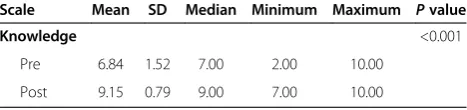
The parents’overall pre-test and post-test scores were compared based on the number of questions answered correctly. The pre-assessments and post-assessments were completed by all of the 73 parents. The mean total knowledge score for the pre-test was 6.84 ± 1.52 and 9.15 ± 0.79 for the post-test, with a significant improvement of 2.31 points (p< 0.001, Table 3).
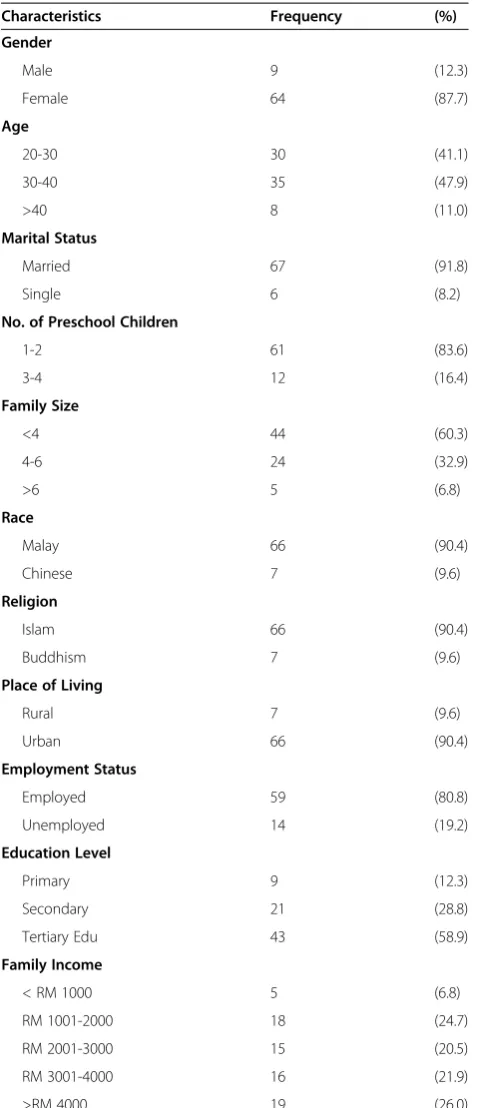
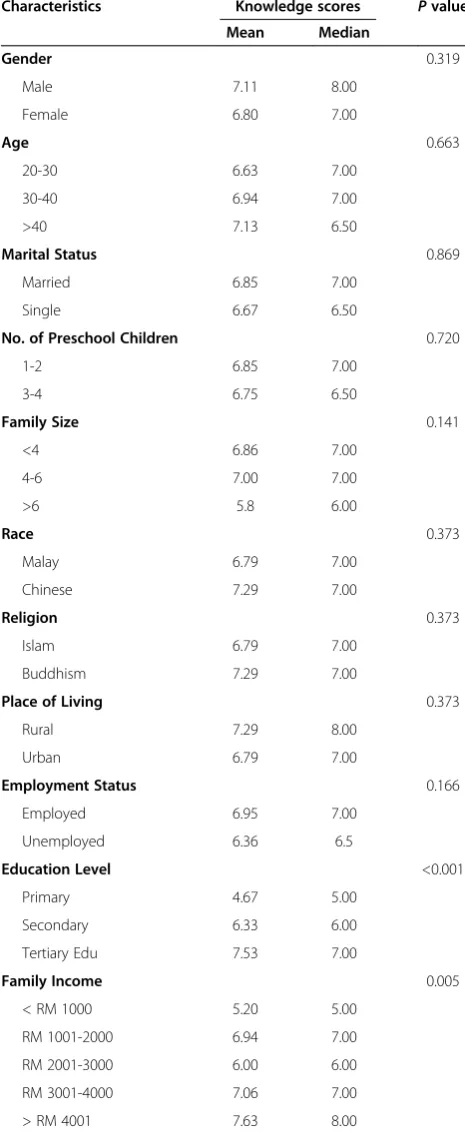
In the baseline results there were no significant differ-ences regarding knowledge about childhood immunization in subgroups pertaining to gender, age, marital status, number of preschool children, family size, race, religion, place of living, or employment status. However, there was a significant difference between parents’knowledge and their education level and income (p< 0.001 and
p= 0.005 respectively) (see Table 4).
Parents’questions and concerns
At the end of the seminar, some of the parents asked questions and shared their concerns about immunization. One mother asked, “Why should I vaccinate my child against diseases that do not existe anymore? Where can my child get them from?” She admitted that she stopped vaccinating her third and fourth child. A few parents also asked about the measles, mumps, and rubella (MMR) vac-cine and if it really caused autism. A few parents admitted they did not vaccinate their children against measles, mumps, and rubella because they were afraid the vaccine might cause autism. Many parents also asked about the credibility of the information that they get from social media such as Facebook. One parent shared a story posted on Facebook about a child that got meningitis after an MMR vaccine and passed away. His parents believed it was due to the vaccine. The story made this parent change her mind about vaccinating her daughter. All the ques-tions and concerns were answered and necessary explana-tions were given to the parents.
Discussion
To our knowledge, this is the first study of its kind that used a short educational seminar to improve parents’ knowledge about immunization in Malaysia. This study demonstrated that providing a one-hour educational seminar to parents in a primary care clinic is an effective and practical strategy to improve parents’knowledge about childhood immunization. However, the actual effectiveness
Table 1 Socio-Demographic Characteristics of the participants (N = 73)
Characteristics Frequency (%)
Gender
Male 9 (12.3)
Female 64 (87.7)
Age
20-30 30 (41.1)
30-40 35 (47.9)
>40 8 (11.0)
Marital Status
Married 67 (91.8)
Single 6 (8.2)
No. of Preschool Children
1-2 61 (83.6)
3-4 12 (16.4)
Family Size
<4 44 (60.3)
4-6 24 (32.9)
>6 5 (6.8)
Race
Malay 66 (90.4)
Chinese 7 (9.6)
Religion
Islam 66 (90.4)
Buddhism 7 (9.6)
Place of Living
Rural 7 (9.6)
Urban 66 (90.4)
Employment Status
Employed 59 (80.8)
Unemployed 14 (19.2)
Education Level
Primary 9 (12.3)
Secondary 21 (28.8)
Tertiary Edu 43 (58.9)
Family Income
< RM 1000 5 (6.8)
RM 1001-2000 18 (24.7)
RM 2001-3000 15 (20.5)
RM 3001-4000 16 (21.9)
of such interventions on immunization rates and status has not been studied.
Regarding demographic characteristics of the partici-pants, mothers constituted the vast majority of the par-ticipants, indicating that child immunization is mainly under the mother’s responsibility, rather than the fa-ther’s. In this single group design study, a significant im-provement in parents’ knowledge about immunizations was observed compared to baseline results, thus indicat-ing that the one-hour educational seminar is an effective way to improve Malaysian parents’ knowledge about childhood immunization. It is well documented that par-ents’, and especially mothers’, knowledge has a great im-pact on the children’s immunization rate and maintaining up-to-date immunization status [7-13].
Our study identified some sociodemographic charac-teristics of the parents that were related to significant differences in immunization knowledge scores. Parents with a lower educational level or lower monthly income have lower overall knowledge about immunization com-pared with those who had better education and higher monthly income. This finding is consistent with previous studies [24,27,30-32]. There was no significant difference found between parents’knowledge and other independent variables including, age, gender, marital status, number of preschool children, family size, race, religion, place of liv-ing, and employment status.
As health care providers are the main source of in-formation for parents, it is important that they under-stand parents’ knowledge and familiarise themselves with the different demographic profile of their patients in order to remain updated about the issues of vaccine hesitancy [33,34].
Educational interventions designed for parents can have important implications for improving vaccine up-take. Educating low-literate mothers by using pictorial messages and very simple language improved the com-pletion rates of DPT-3/Hepatitis B vaccine by 39% [22]. In Germany, a study has showed that using balanced health information leaflets can increase girls’and parents’ knowledge of the human papillomavirus vaccination and vaccination uptake [35]. A 20-minute educational presen-tation about human papillomavirus vaccination increased college females’ intent to vaccinate by nearly threefold [36]. Parents in Guatemala repeatedly revealed that work-shops at the community level are the best way to increase their awareness and knowledge of vaccinations [37].
Our study results provide new data on parents’ know-ledge and concerns about immunization. This information can enable policy makers to develop short, community-based, educational programmes at the clinics that provide vaccinations, especially for parents who have lower in-come and educational levels.
Limitations
This study had some limitations: (1) a pre-post test for a single group without a follow up to determine the real effectiveness of the intervention on immunization rate and status and (2) whether the study succeeded to pro-mote positive changes. These issues warrant further in-vestigation in a longitudinal study. Furthermore, the study was conducted only with parents from Kuantan, the state capital of Pahang, and the findings may not to
Table 2 Comparison of parents’knowledge about immunization before and after the educational intervention (N =73)
Questions Correct response before
intervention n (%)
Correct response after
intervention n (%) P
value
Healthy children do not need immunization 57 (78.1) 69 (94.5) 0.002
There are different types of vaccines 60 (82.2) 71 (97.3) 0.003
Active immunization is a killed or weakened form of a disease-causing agent
49 (67.1) 65 (89.0) 0.001
Vaccination is for all ages 38 (52.1) 58 (79.5) <0.001
Children get too many vaccines in the first two years of life 68 (93.2) 73 (100.0) 0.063
The immunization of the children should be started At birth 70 (95.9) 72 (98.6) 0.500
In some health situations, vaccines should not be given 43 (58.9) 60 (82.2) <0.001
Vaccines can be given in combination 49 (67.1) 68 (93.2) <0.001
If the child receives extra immunization, it is more effective and safer.
54 (74.0) 63 (86.3) 0.078
More than one dose of vaccine may be required for complete protection
50 (68.5) 70 (95.9) <0.001
Table 3 Total knowledge score before and after the intervention
Scale Mean SD Median Minimum Maximum Pvalue
Knowledge <0.001
Pre 6.84 1.52 7.00 2.00 10.00
be extrapolated to the parents in the other states in Malaysia. However, the study generated data about par-ents’knowledge of childhood immunization in Malaysia,
thus providing baseline data to improve the current immunization rate and status. The study is not qualita-tive in nature. However, many questions were raised by parents post seminar when the platform was open for questions, and these questions were reported and in-cluded in the results due to their importance. The study findings may not reflect the knowledge of all Malaysian parents; rather, they reflect only the knowledge of those who actually participated in the programme. Therefore, the findings need to be interpreted within the context of study limitations.
Conclusions
The educational intervention used in this study focused on improving parents’ knowledge about childhood immunization in Malaysia and has brought about a sig-nificant positive change in their knowledge about childhood immunization, compared with the baseline results. Further studies using a larger sample of parents from other states in Malaysia are required in order to assess the actual effectiveness of improving parents’ knowledge about childhood immunization and the immunization status of their children, and also to de-termine the cost-effectiveness of such an intervention.
Competing interests
The authors declare that they have no competing interests.
Authors’contributions
This paper is a part of AA PhD. The research was conducted by AA and supervised by MH, OA, and HB. AA, AH, and OA designed the project. The ethical approval was obtained by AA and HB. HB and HH delivered the seminar. Date collection was done by AA. RE contributed in the statistical analysis, and HH helped in drafting the manuscript. All authors read and approved the final manuscript.
Acknowledgements
The authors would like to thank Dr. Nazrah Zarira Bt Hamzah, the medical officer in charge, and the nurses at the Health Clinic Indera Mahkota for their support in this study, and also the parents who agreed to participate in this study.
Author details
1Department of Pharmacy Practice, Kulliyyah of Pharmacy, International
Islamic University Malaysia, 25200 Kuantan, Malaysia.2Discipline of Social and
Administrative Pharmacy, School of Pharmaceutical Sciences, Universiti Sains Malaysia, 11800 Penang, Malaysia.3School of Pharmacy, Faculty of Medical
sciences, University of Duhok (UOD), Duhok, Iraq.4Department of
Pharmaceutical Technology, Kulliyyah of Pharmacy, International Islamic University Malaysia, 25200 Kuantan, Malaysia.
Received: 9 July 2014 Accepted: 29 September 2014 Published: 6 October 2014
References
1. Opel DJ, Mangione-Smith R, Taylor JA, Korfiatis C, Wiese C, Catz S, Martin DP:
Development of a survey to identify vaccine-hesitant parents: the parent attitudes about childhood vaccines survey.Hum Vaccin2011,7(4):419. 2. Luthy KE, Beckstrand RL, Peterson NE:Parental hesitation as a factor
in delayed childhood immunization.J Pediatr Health Care2009,
23(6):388–393.
3. Larson HJ, Jarrett C, Eckersberger E, Smith DMD, Paterson P:Understanding vaccine hesitancy around vaccines and vaccination from a global
Table 4 Parents’characteristics and baseline knowledge scores
Characteristics Knowledge scores Pvalue
Mean Median
Gender 0.319
Male 7.11 8.00
Female 6.80 7.00
Age 0.663
20-30 6.63 7.00
30-40 6.94 7.00
>40 7.13 6.50
Marital Status 0.869
Married 6.85 7.00
Single 6.67 6.50
No. of Preschool Children 0.720
1-2 6.85 7.00
3-4 6.75 6.50
Family Size 0.141
<4 6.86 7.00
4-6 7.00 7.00
>6 5.8 6.00
Race 0.373
Malay 6.79 7.00
Chinese 7.29 7.00
Religion 0.373
Islam 6.79 7.00
Buddhism 7.29 7.00
Place of Living 0.373
Rural 7.29 8.00
Urban 6.79 7.00
Employment Status 0.166
Employed 6.95 7.00
Unemployed 6.36 6.5
Education Level <0.001
Primary 4.67 5.00
Secondary 6.33 6.00
Tertiary Edu 7.53 7.00
Family Income 0.005
< RM 1000 5.20 5.00
RM 1001-2000 6.94 7.00
RM 2001-3000 6.00 6.00
RM 3001-4000 7.06 7.00
perspective: A systematic review of published literature, 2007–2012.
Vaccine2014,32(19):2150–2159.
4. SAGE working group dealing with vaccine hesitancy (established March 2012)http://www.who.int/immunization/sage/sage_wg_vaccine_ hesitancy_apr12/en/.
5. Zimmerman RK, Wolfe RM, Fox DE, Fox JR, Nowalk MP, Troy JA, Sharp LK:
Vaccine criticism on the World Wide Web.J Med Internet Res2005,
7(2):e17.
6. Betsch C, Renkewitz F, Betsch T, Ulshöfer C:The influence of vaccine-critical websites on perceiving vaccination risks.J Health Psychol2010,15(3):446–455.
7. Favin M, Steinglass R, Fields R, Banerjee K, Sawhney M:Why children are not vaccinated: a review of the grey literature.Int Health2012,
4(4):229–238.
8. Esposito S, Principi N, Cornaglia G:Barriers to the vaccination of children and adolescents and possible solutions.Clin Microbiol Infect2014,
20(s5):25–31.
9. Sheikh A, Iqbal B, Ehtamam A, Rahim M, Shaikh HA, Usmani HA, Nasir J, Ali S, Zaki M, Wahab TA:Reasons for non-vaccination in pediatric patients visiting tertiary care centers in a polio-prone country.Archives of Public Health2013,71(1):19.
10. Bozzola E, Bozzola M, Tozzi AE, Nicolosi L, Vittucci A, Villani A:Impact of health care providers’advice on vaccine refusal for children with an acute nervous system infection.Eur J Pediatr2014,173(8):1121–1122. 11. Kepka D, Warner EL, Kinney AY, Spigarelli MG, Mooney K:Low human
papillomavirus (HPV) vaccine knowledge among Latino parents in Utah.
J Immigr Minor Health2014, 1–7.
12. Wiysonge CS, Uthman OA, Ndumbe PM, Hussey GD:Individual and contextual factors associated with low childhood immunisation coverage in sub-Saharan Africa: a multilevel analysis.PLoS One2012,
7(5):e37905.
13. Kawakatsu Y, Honda S:Individual-, family-and community-level determinants of full vaccination coverage among children aged 12–23 months in western Kenya.Vaccine2012,30(52):7588–7593.
14. Naeem M, Khan MZUI, Adil M, Abbas SH, Khan A, Khan MU, Naz SM:
Coverage and causes of non immunization in national immunization days for polio; A consumer and provider perspective study in Peshawar.
JPMI: J Postgraduate Med Institute2012,26(1):48–54.
15. Montasser E-H, Abd N, Helal RM, Eladawi N, Mostafa E, El Rahman FA, Saad M, Hamza S:Knowledge, attitude and beliefs of caregivers of children below 2 years of age towards immunization.Br J Medicine & Med Res2014,
4(14):2757–2767.
16. Animaw W, Taye W, Merdekios B, Tilahun M, Ayele G:Expanded program of immunization coverage and associated factors among children age 12–23 months in Arba Minch town and ZuriaDistrict, Southern Ethiopia, 2013.BMC Public Health2014,14(1):464.
17. Han K, Zheng H, Huang Z, Qiu Q, Zeng H, Chen B, Xu J:Vaccination coverage and its determinants among migrant children in Guangdong, China.BMC Public Health2014,14(1):203.
18. Ministry of health Malaysia, Health facts 2013.2013 [http://www.moh.gov. my/english.php/pages/view/56]
19. Norlijah O, Menon B, Azlyna M:Risk factors associated with incomplete immunisation in hospitalised infants.Med J Malaysia2005,60(5):563–569. 20. Renkert S, Nutbeam D:Opportunities to improve maternal health literacy
through antenatal education: an exploratory study.Health Promot Int
2001,16(4):381–388.
21. Davis TC, Fredrickson DD, Kennen EM, Arnold C, Shoup E, Sugar M, Humiston SG, Bocchini JA:Childhood vaccine risk/benefit communication among public health clinics: a time-motion study.Public Health Nurs2004,
21(3):228–236.
22. Owais A, Hanif B, Siddiqui AR, Agha A, Zaidi AK:Does improving maternal knowledge of vaccines impact infant immunization rates? A community-based randomized-controlled trial in Karachi, Pakistan.
BMC Public Health2011,11(1):239.
23. MacDonald NE, Smith J, Appleton M:Risk perception, risk management and safety assessment: What can governments do to increase public confidence in their vaccine system?Biologicals2012,40(5):384–388. 24. Tagbo B, Uleanya N, Nwokoye I, Eze J, Omotowo I:Mothers’knowledge,
perception and practice of childhood immunization in Enugu.Nigerian J Paediatrics2012,39(3):90–96.
25. Fatiregun AA, Okoro AO:Maternal determinants of complete child immunization among children aged 12–23 months in a southern district of Nigeria.Vaccine2012,30(4):730–736.
26. Al-lela OQB, Bahari MB, Al-Qazaz HK, Salih MR, Jamshed SQ, Elkalmi RM:Are parents’knowledge and practice regarding immunization related to pediatrics’immunization compliance? a mixed method study.
BMC Pediatr2014,14(1):20.
27. Wang B, Clarke M, Afzali HHA, Marshall H:Community, parental and adolescent awareness and knowledge of meningococcal disease.Vaccine
2014,32(18):2042–2049.
28. Bugvi AS, Rahat R, Zakar R, Zakar MZ, Fischer F, Nasrullah M, Manawar R:
Factors associated with non-utilization of child immunization in Pakistan: evidence from the demographic and health survey 2006–07.BMC Public Health2014,14(1):232.
29. Dindod SM, Makwana NR, Yadav SB:Knowledge of caretakers about routine immunization and reasons for partial immunization in rural areas of Jamnagar District.Int J Medicine & Public Health2014,4(1):57–61. 30. Yousif M, Albarraq A, Abdallah M, Elbur A:Parents’knowledge and
attitudes on childhood immunization, Taif, Saudi Arabia.J Vaccines Vaccin
2013,5(215):2.
31. Asim M, Malik N, Yousaf H, Gillani I, Habib N:An assessment of parental knowledge, belief and attitude toward childhood immunization among minorities in rural areas of district Faisalabad, Pakistan.Mediter J Soc Sci
2012,3:153–159.
32. Al-lela OQ, Bahari MB, Salih MR, Al-abbassi MG, Elkalmi RM, Jamshed SQ:
Factors underlying inadequate parents’awareness regarding pediatrics immunization: findings of cross-sectional study in Mosul-Iraq.BMC Pediatr
2014,14(1):29.
33. Freed GL, Clark SJ, Butchart AT, Singer DC, Davis MM:Sources and perceived credibility of vaccine-safety information for parents.Pediatrics
2011,127(Supplement 1):S107–S112.
34. Kennedy A, Basket M, Sheedy K:Vaccine attitudes, concerns, and information sources reported by parents of young children: results from the 2009 HealthStyles survey.Pediatrics2011,127(Supplement 1):S92–S99. 35. Wegwarth O, Kurzenhäuser-Carstens S, Gigerenzer G:Overcoming the
knowledge–behavior gap: The effect of evidence-based HPV caccination leaflets on understanding, intention, and actual vaccination decision.
Vaccine2014,32(12):1388–1393.
36. Gross MS, Tran CH, Sutherland KH, Castagno JC, Amdur RJ:Pilot study: can an educational intervention increase human papillomavirus vaccination in female college students?Obstet Gynecol2014,123:114S–115S. 37. Barrera L, Trumbo SP, Bravo-Alcántara P, Velandia-González M,
Danovaro-Holliday MC:From the parents’perspective: a user-satisfaction survey of immunization services in Guatemala.BMC Public Health2014,
14(1):231.
doi:10.1186/1471-2431-14-254
Cite this article as:Awadhet al.:Does an educational intervention
improve parents’knowledge about immunization? Experience from
Malaysia.BMC Pediatrics201414:254.
Submit your next manuscript to BioMed Central and take full advantage of:
• Convenient online submission
• Thorough peer review
• No space constraints or color figure charges
• Immediate publication on acceptance
• Inclusion in PubMed, CAS, Scopus and Google Scholar
• Research which is freely available for redistribution