IJEDRCP1501020
International Journal of Engineering Development and Research (www.ijedr.org)105
Enhancing Quality of Multiple Access Data of the
System in Cloud with Caching Algorithm
1
Siva Chandran R,
2Jothi B
Student, Assistant Professor SRM University,Chennai
________________________________________________________________________________________________________
Abstract— Cloud Computing is one of the most reliable technologies in recent trend in terms sharing data and resource.
But sharing of multimedia files such as audio, video, image or document is seems to be more complicated these days since the availability of user has been increased rapidly which result in data traffic. And hence to overcome the problem occurs in multimedia sharing resources we use the concept of Multi-Variant response system with Caching. Multi-Variant response system processes the Multimedia streaming files to different user response with proper Service Level Agreement (SLA) using Quality of Service (QoS) premises. Caching is the method proposed in the system that acts as local server which keeps tracks on temporal copy of data that accessed frequently. A priority process of detection is carried in the system that manages the accessibility in cloud based on different privilege user. The ultimate aim of the system is provide effective file processing in cloud system and quick access of multimedia data resources to the large user.
Keywords— Cloud, SaaS, QoS, SLA, Multi-Variant system, Caching.
________________________________________________________________________________________________________
I. INTRODUCTION
Cloud computing is a computing paradigm, where a large pool of systems are connected in private or public networks, to provide dynamically scalable infrastructure for application, data and file storage. With the advent of this technology, the cost of computation, application hosting, content storage and delivery is reduced significantly. Security issues in cloud concerns and mainly associated with security issue faced by cloud service providers and the service issues faced by customers.
Cloud resource management requires complex policies and decisions for multi-objective optimization. It is extremely challenging because of the complexity of the system, which makes it impossible to have accurate global state information. Storing files or data locally presents businesses with more security concerns whereas encrypted data on online storage services prevents unauthorized use or access in an easy way.
Multi-variant data such as JPG, AUDIO, and TEXT FILES can propose by the Client-Server model. Cache frequently accessed user data’s are cached in the local server. The cache is an area of cloud storage that is used to store content for dissemination. The cache is mounted within the system drive as a folder. The process of history cleanup has been done to the cache data’s in the staging invoked local server. A priority process of detection is carried out to erase off the cache details from the local server. Cloud resource management requires complex policies and decisions for multi-objective optimization. It is extremely challenging because of the complexity of the system, which makes it impossible to have accurate global state information. Thus the proposed methodology is efficient as when compared to the existing and override the drawback.
II. RELATEDWORKS
We have been focused on some of the research methodology determined by the expert in the area of quality evaluation cloud. Our work is mainly focused on Service Level Agreement, Quality of Service, and Cloud data sharing.
A quality model for evaluating SaaS service in cloud is introduced by Jae Yoo Lee and Jung Woo Lee. In this system they determine the comprehensive framework for SaaS quality Evaluation .First they determine the key element of SaaS Quality Assurance and then they derive the quality attribute of SaaS and then their metrics of Quality attributes. To validate the quality model for SaaS, they conduct assessment based on IEEE 1061. By using this suggested SaaS quality model, SaaS can be determined by both service providers. Furthermore, the evaluation results are utilized as an indicator for SaaS quality management.
Yen-Ming Chu and Nen-Fu Huang determine the quality of service for cloud provision system for multimedia delivery files which support this paper very much. This article proposes a robust, scalable, highly available and service level provisioning cloud-based storage system designed specifically for distributing multimedia content. They use Adaptive Quality of Service (AQoS) algorithm in order to provide differential service levels. This paper determine the QoS-provisioning cloud storage system, which is particularly aiming at distributed parallel accessing of media asset for millions of users with different service levels
IJEDRCP1501020
International Journal of Engineering Development and Research (www.ijedr.org)106
probability distribution of the response time is derived considering the effect imposed by retrying tasks in case of service failures happening. As another important performance metric that can better reflect requirements of customers, the percentile of response time that characterizes a threshold response time so that a certain percentage of requests can be served in under the threshold value is also studied.The above survey determines some of the possible works based on our current work focus such SaaS security, file sharing, Quality of Service and so on.
III.SYSTEMOVERVIEW
The ultimate use of the system is to enhance the quality in cloud using Multivariate response system. The existing system uses the Quality of Service (QoS) provision. In which the user access in the server side validate in QoS. In QoS- provisioning cloud storage system the file system is partially aiming at distributed parallel accessing of media assets for millions of users with different Service level. The principal concepts of multimedia cloud computing from multimedia cloud and cloud multimedia. In addition, they proposed a media-edge cloud (MEC) architecture. The hardware infrastructure and software strategy adopted by the storage system are considered with a lot of terms, such as cost, performance requirement, expected capacity, co-local on public or private cloud and delivery networks. Storage system plays a significant role in providing QoS provisions. The different resources are scattered in various places, system may not be able to obtain the resources needed in different environments and conditions. An important indicator here is how to properly handle different situations in order to provide robustness of the system to achieve the goal of fault tolerance. But the major disadvantage of using only QoS is unless a contract specifically identifies a measurable process for quality service reporting, there could be a poor service quality experience. Some contracts are written to intentionally leave service levels out to save on costs. And also Storing files or data locally has less security.
IJEDRCP1501020
International Journal of Engineering Development and Research (www.ijedr.org)107
Figure 1: Architecture view of the system
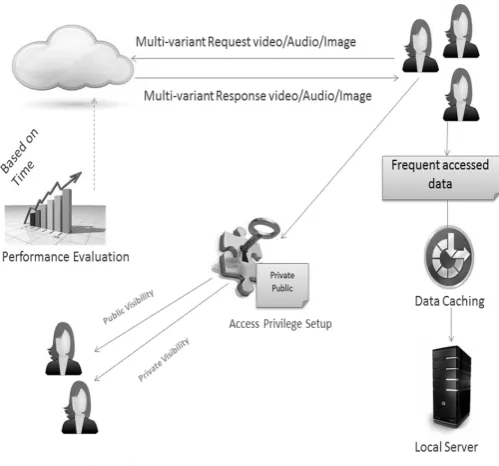
The above diagram shows the architectural view of the system in which data files stored in cloud system such as audio, video and image can be accessed using Multi- Variant request or response by user. The frequently accessed data are stored in data caching. Once the data had been accessed first time by the user then it is automatically saved in local server system. So as when the user is accessing the file for another time they don’t need to go for cloud again whereas the data is stored in local server system itself. Hence there is no traffic when multiple user access the system at same time and it increase the availability of the system.
The algorithm used here is Adaptive Quality of Service (AQoS) and Data Cache algorithm. Adaptive QoS routing is a cross-layer optimization adaptive routing mechanism. The cross-cross-layer mechanism provides up-to-date local QoS information for the adaptive routing algorithm, by considering the impacts of node mobility and lower-layer link performance.
The complete routing mechanism for AQoS includes three parts:
A modified dynamic source routing algorithm that handles route discovery and the collection of QoS related parameters. A local statistical computation and link monitoring function located in each node.
An integrated decision-making system to calculate the number of routing paths, coding parity length, and traffic distribution rates.
A Data cache algorithm is a detailed list of instructions that decides which items should be discarded in a computer's cache of information. It uses three level of mechanism.
Least Frequently Used (LFU): This cache algorithm uses a counter to keep track of how often an entry is accessed. With the LFU cache algorithm, the entry with the lowest count is removed first.
Least Recently Used (LRU): The oldest element is the Less Recently Used (LRU) element. The last used timestamp is updated when an element is put into the cache or an element is retrieved from the cache with a get call.
Most Recently Used (MRU): This cache algorithm removes the most recently used items first. A MRU algorithm is good in situations in which the older an item is, the more likely it is to be accessed.
IV.SYSTEMDESIGN
IJEDRCP1501020
International Journal of Engineering Development and Research (www.ijedr.org)108
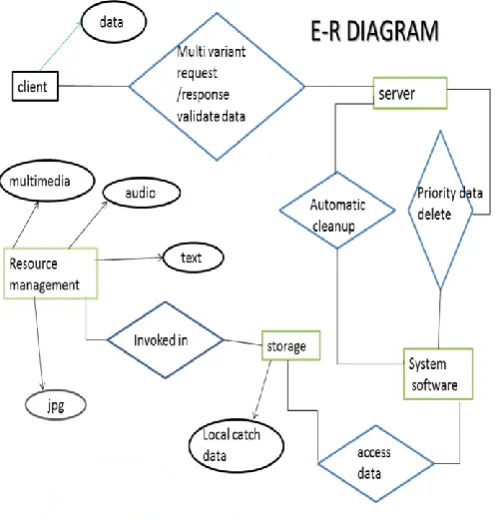
Figure 2 : Entity Relationship diagram
The above is the entity relationship diagram which clearly expalins the function of the system. Data access refers to a user's ability to access or retrieve data stored within a database or other repository. Users who have data access can store, retrieve, move or manipulate stored data, which can be stored on a wide range of hard drives and external devices. In order to reduce the accessing time and cost ,all the accessed data are stored in the local server in which the data accessed by the user frequently.
Figure 3: Frequently data access system
IJEDRCP1501020
International Journal of Engineering Development and Research (www.ijedr.org)109
Figure 4: Performance evaluation system
In performance evaluation we can share the any type of information on the cloud services with more security and lower cost. All the accessed data through cloud are stored in the local catch automatically. It is easy to retrieve the data from the local catch not from the main server. So that can reduce the accessing time.
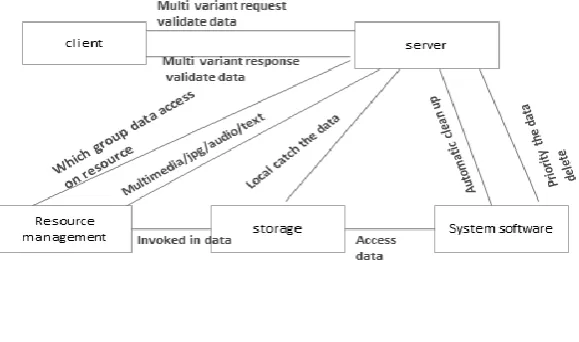
Figure 4: DFD Overall View
The Data Flow diagram is a graphic tool used for expressing system requirements in a graphical form. The DFD also known as the “bubble chart” has the purpose of clarifying system requirements and identifying major transformations that to become program in system design.
Thus DFD can be stated as the starting point of the design phase that functionally decomposes the requirements specifications down to the lowest level of detail.
The DFD consist of series of bubbles joined by lines. The bubbles represent data transformations and the lines represent data flows in the system. A DFD describes what that data flow in rather than how they are processed. So it does not depend on hardware, software, data structure or file organization.
V. CONCLUSION
IJEDRCP1501020
International Journal of Engineering Development and Research (www.ijedr.org)110
2. P. Mell and T. Grance The NIST Definition of Cloud Computing, 2009 :National Institute of Standards and Technology,Information Technology Laboratory
3. C.-H. R. Lin, H.-J. Liao, K.-Y. Tung, Y.-C. Lin and S.-L. Wu "Network traffic analysis with cloudplatform", J. Internet Technol., vol. 13, no. 6, pp.953 -961 2012
4. Q. Huang , C. Yang , D. Nebert , K. Liu and H. Wu "Cloud computing for geosciences: Deployment of GEOSS clearinghouse on Amazon\'sEC2", Proc. ACM SIGSPATIAL Int. Workshop on High Performance and Distributed GeographicInformation Systems, pp.35 -38 2010
5. K.-H. Kim, S.-J. Lee and P. Congdon”On cloud-centric network architecture for multi-dimensional mobility", ACM SIGCOMM Compute. Commun. Rev., vol. 42, no. 4, pp.1 -6 2012
6. W. Zhu, C. Luo, J. Wang and S. Li”Multimedia cloud computing", IEEE Signal Process. Mag., vol. 28, no. 3, pp.59 -69 2011
7. S. K. Garg, S. Versteeg, and R. Buyya, "A framework for ranking of cloud computing services, " Future Generation Computer Systems, vol. 29, no. 4, pp. 1012-1023, Jun. 2013.
8. M. H. Cancian, J. Carlo, R. Hauck, C. G. Von Wangenheim, and R. J. Rabelo, "Discovering Software Process and Product Quality Criteria in Software as a Service, " Product-Focused Software Process Improvement. Springer Berlin Heidelberg, pp. 234-247, 2010.
9. S. Wang, Z. Liu, Q. Sun, H. Zou, and F. Yang, "Towards an accurate evaluation of quality of cloud service in service-oriented cloud computing,” Journal of Intelligent Manufacturing, May 2012.
10. C.-F. Lai, H. Wang, H.-C. Chao and G. Nan "A network and device aware QoS approach for cloud-based mobile streaming", IEEE Trans.Multimedia, vol. 15, pp.747 -757 2013