Shared Decision-Making and
Children With Disabilities:
Pathways to Consensus
Richard C. Adams, MD, FAAP, a Susan E. Levy, MD, MPH, FAAP, b, c COUNCIL ON CHILDREN WITH DISABILITIES
aUniversity of Texas Southwestern Medical Center, Texas Scottish Rite
Hospital for Children, Dallas, Texas; bCenter for Autism Research,
Division Developmental and Behavioral Pediatrics, The Children’s Hospital of Philadelphia, Philadelphia, Pennsylvania; and cPerelman
School of Medicine at University of Pennsylvania, Philadelphia, Pennsylvania
Drs Adams and Levy were each responsible for all aspects of conceptualizing, writing, and editing the document; they were both responsible for reviewing and responding to questions and comments from reviewers and the Board of Directors.
This document is copyrighted and is property of the American Academy of Pediatrics and its Board of Directors. All authors have filed conflict of interest statements with the American Academy of Pediatrics. Any conflicts have been resolved through a process approved by the Board of Directors. The American Academy of Pediatrics has neither solicited nor accepted any commercial involvement in the development of the content of this publication.
The guidance in this report does not indicate an exclusive course of treatment or serve as a standard of medical care. Variations, taking into account individual circumstances, may be appropriate.
Clinical reports from the American Academy of Pediatrics benefit from expertise and resources of liaisons and internal (AAP) and external reviewers. However, clinical reports from the American Academy of Pediatrics may not reflect the views of the liaisons or the organizations or government agencies that they represent.
All clinical reports from the American Academy of Pediatrics automatically expire 5 years after publication unless reaffirmed, revised, or retired at or before that time.
DOI: https:// doi. org/ 10. 1542/ peds. 2017- 0956
abstract
Shared decision-making (SDM) promotes family and clinician collaboration, with ultimate goals of improved health and satisfaction. This clinical report provides a basis for a systematic approach to the implementation of SDM by clinicians for children with disabilities. Often in the discussion of treatment plans, there are gaps between the child’s/family’s values, priorities, and understanding of perceived “best choices” and those of the clinician. When conducted well, SDM affords an appropriate balance incorporating voices of all stakeholders, ultimately supporting both the child/family and clinician. With increasing knowledge of and functional use of SDM skills, the clinician will become an effective partner in the decision-making process with families, providing family-centered care. The outcome of the process will support the beneficence of the physician, the authority of the family, and the autonomy and well-being of the child.
CLINICAL REPORT
Guidance for the Clinician in Rendering Pediatric CareIntrODuctIOn
Families of children with disabilities face many decisions about medical treatment. These choices may be added stressors for the child, family, and the clinicians involved. The nature and complexity of decisions are highly variable and may involve diagnosis, evaluation, treatment, care management, and support services. Shared decision-making (SDM) promotes family and clinician collaboration, with ultimate goals of improved health and satisfaction. This clinical report provides the following: (1) a basis for a systematic approach to implementation of SDM; (2) a narrative overview of the literature for application of SDM techniques; (3) exemplars and guidance for use of SDM for children with intellectual, physical, and/or neurodevelopmental disabilities and their families; and (4) information on tools available for clinical or research use. The decision-making process related to acute management of life-threatening conditions or end-of-life care is outside of the scope of this clinical report.
BackgrOunD
Concepts of SDM have been described in publications over the past 2 decades. Although multiple definitions of SDM have been offered, 1–3 key features
include the following: (1) at least 2 parties are involved, (2) information is exchanged in both directions, (3) all parties are aware of treatment options and what they are, and (4) all bring their knowledge and values-related priorities equally into the decision-making process. For this clinical report, the following working definition is used: SDM is an interactive process in which patients (families and children, especially more cognitively able children) and physicians (and other involved professionals) simultaneously participate in all phases of the decision-making process and together arrive at a treatment plan to be implementated.2, 4, 5
SDM is best characterized as a process that actively uses words or phrases such as “collaborative, ” “patients and health professionals, ”
“together, ”“informed, ”“best scientific evidence available, ” “patient’s values and preferences, ” “family/patient centered, ”“options, ” and “supports needed.” The
construct of SDM is founded in ethics, law, clinical care, cultural tenets, and standards within public and private health care delivery systems1
and is the basis of patient-centered care.6 This process sets the stage for
consensus about routine decisions building up to more significant decisions.
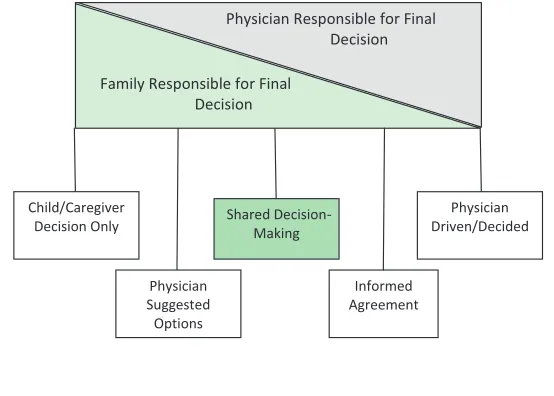
Too often, in the discussion of treatment plans, gaps exist between the child’s/family’s values, priorities, and understanding of perceived “best choices” and those of the clinician. An “either-or” approach to decision-making supposes 1 approach “wins out” with acquiescence of the other. However, when conducted well, SDM affords an appropriate balance incorporating all voices, ultimately
supporting both the child/family and clinician7 (Fig 1).
Much of the evidence for SDM comes from adult medicine, with fewer pediatric studies available. Nonetheless, there are many opportunities for its application in pediatric care, particularly for children with disabilities. SDM is applicable for chronic and acute care encounters. Added complexity occurs in the SDM process in children who have made developmental progress and have the skills to become an active participant.8
Presenting children with information (appropriate for their developmental age) can help their understanding of their condition and treatments, reduce fear, and enhance self-confidence.9 A recent review
underscores the need for studies that support active participation of the child, along with the family and clinician, 10 and that assist in
decisions focused on acute or long-term concerns and future planning. The timing of SDM is important, because it must be implemented for routine decisions and well in advance of predictable (or unpredictable) crises, such as those requiring intensive care or do-not-resuscitate
decisions. Crisis and emergency situations change the process to accomplish SDM. In children who require complex care management, such as those with chronic illness requiring teams of professionals, additional complexity exists where teams must integrate SDM among all members.11
research aBOut sDM
Research in pediatric SDM is in its early stages.12–19 Most published
studies are observational and/or qualitative in nature. Descriptive studies have focused on the evolution of commonly accepted definitions of SDM, facilitators or barriers to the use of SDM, and the impact on families. Few studies exist on efficacy and effectiveness of decision aids or other SDM interventions.20
Studies of parental decision-making on behalf of their child reveal a diversity of influences. Parental or family factors include cultural norms, community standards, impact on siblings or extended family, previous experiences, religious faith, and impact of acuity and stability of the child’s health status.21–23
Descriptions of cultural influences
FIgure 1
on the physician-patient interaction continue to inform the process of decision-making.6, 24–29
Barriers and facilitators may be divided into categories of knowledge, attitudes, agreement, lack of expectancy/hope, and behaviors.30 Barriers to SDM include
patient (family) characteristics, health system constraints (time for consultation, lack of continuity of care with physician, reimbursement issues, inadequate environmental conditions), power imbalance in a relationship, language barriers between families and clinicians, lack of availability of evidence and tools for decision support, attitudinal biases, knowledge deficits of clinicians, 31 and lack of applicability
(eg, patient characteristics or situations of unusual life-threatening events requiring intensive emergency intervention).32
Common facilitators for the use of SDM include provider motivation, positive impact on the clinical process, and patient outcomes.33
Pediatric clinician motivation may include the consideration of cost-effectiveness of the additional time. To address cost-effectiveness, American Academy of Pediatrics’
resources on coding/billing are available and continually updated. Information on face-to-face and time-based billing and other avenues of support can be found at https:// www. aap. org/ en- us/ professionalresou rces/ practice- support/ Coding- at- the- AAP/ Pages/ Evaluation- and- Management. aspx. Data from the National Survey of Children with Special Healthcare Needs and the Medical Expenditure Panel Survey describe the frequency of SDM, associations with the
likelihood of its use, characteristics of providers using SDM, and impact on quality and satisfaction with care.34, 35
Studies of effectiveness have been rare and have examined the impact of different tools to implement SDM. Standardized tools available
for clinical use and/or research are listed in Supplemental Table 5. Tools included in Supplemental Table 5 and Supplemental Fig 2 might be useful to inform clinicians of the anticipated components by which they are likely to be measured and to use as a template for designing the SDM conversation(s) needed.
Decision aids have been designed to provide education about specific disorder(s), outline treatment options, exchange evidence about treatment risks and benefits, and support families’ values and priorities. A 2014 Cochrane review reported that decision aids improve patients’ knowledge of options, expectations of benefits and harms, and participation in SDM.36
Other benefits include reduced decisional conflict, increased active participation by families, and fewer undecided patients.37
Clinical tools to measure patient preferences, clinician behaviors, frequency of use of decision aids and/ or patient educational materials, and satisfaction and comfort (family or clinician) with decisions38 have been
studied. A Cochrane Collaboration review of interventions to improve the adoption of SDM by clinicians described 2 studies meeting strict criteria for quality and effect size.20
No studies have reported measures related to medical/surgical outcomes. As interest in SDM has increased, tools to promote its use, such as decision aids, have been constructed. Historically, these tools were related to specific conditions (acne, diabetes medication regimen, prostate cancer, and others) and were for adult patients/conditions. Some tools focus on patients’ perceptions of physicians’ performance in support of the decision-making process. Others encompass theory, practical guidance, and clinical use.39, 40
Toolkits are available online through the Agency for Healthcare Research and Quality and the Dartmouth-Hitchcock Center for Shared Decision
Making. See Supplemental Table 5 for examples of tools and toolkits. The 9-item Shared Decision Making Questionnaire (SDM-Q-9) was developed by Kriston et al.3 This tool
can be used (1) to investigate the effectiveness of interventions aimed at the implementation of SDM, (2) as a quality indicator in health services assessments (eg, for Maintenance of Certification projects), and (3) as a guide for use in the “real world”
clinical setting for structuring the
“practical steps” in support of SDM. A copy of the SDM-Q-9 is included in Supplemental Fig 2.
PeDIatrIcIans anD the sDM PrOcess
For children with disabilities and their families, issues of health-related quality of life occur at different and repeating periods. Variables such as developmental stage and the ability of the child or adolescent and timing, context, severity, acuity or chronicity of primary conditions, and comorbidities present unique challenges to child/family-physician interaction. Family-centered care is a valuable construct for all children, but especially for those with special health care needs. Family-centered care serves as a good foundation when questions arise and the application of an SDM process is needed.41
As difficult decisions need to be made (such as those in the case examples described later), focused leadership by the clinician will assist the family’s arrival at a confident decision. Too often, as the clinician engages in conversation about options for care, the efforts are met with a lack of decisional closure, a “stalling out”
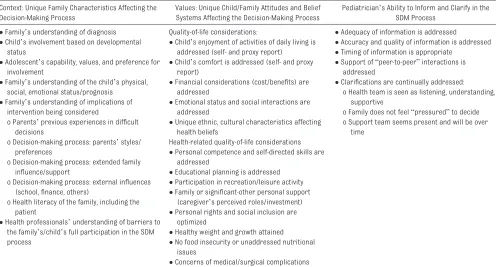
of the process. Table 1 outlines needed steps and components of SDM.42, 43 Items bulleted in Table
“sticking points.” For example, if the family’s understanding of the underlying diagnosis (or potential complications) is unclear, if financial stressors are not addressed,
if cultural traditions are not acknowledged, or if the adequacy of support systems for the child/ family is not explored, the decisional process may feel “stuck.” Although conversations with a specific child/ family may not require a point-by-point inclusion of all components of Table 1, the clinician’s access to such an outline may help direct the decisional discussions.
“Practical steps”3 that are common
to any SDM process are outlined in Table 2. Awareness of these steps improves the clinician’s efficient use of consultation time and effective leadership and support to the family. At times, the process will seem smooth and natural, with a relatively quick consensus. Other times, the complexities of the individual situation may require that the steps in Table 2 be explored more deeply.
Elwyn et al44, 45 have outlined 3 types
of “talks” that might help clinicians:
“choice talk, ”“options talk, ” and
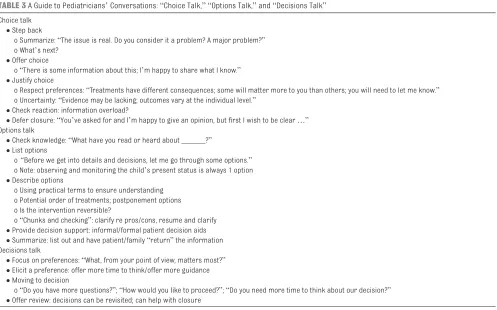
“decisions talk.” This model works well alongside that of Kriston et al, 3 discussed previously. Table 3
provides an outline of the 3 talks with an example narrative to serve as a guide for the clinician. These components support the steps of prioritization, negotiation, and finalization of the SDM process. If the family perceives “too many options”
are in play, this can cause stagnation of the decision-making process.46
The component talks can allow a natural but more gradual progression over time. As an example, a
detailed discussion of SDM related to gastrostomy tube placement was central to a recent American Academy of Pediatrics’ clinical report, “Nonoral Feeding for Children and Youth With Developmental or Acquired Disabilities.”42 Specific SDM
guidance for the pediatrician was outlined in that report.
Additional resources for clinicians and their partnering families
are provided in Supplemental Information 1. The SDM-Q-9 (Supplemental Fig 2) is a tool adapted for use in clinical practice; other measures may be better applied to outcomes review or research within a practice.3 For
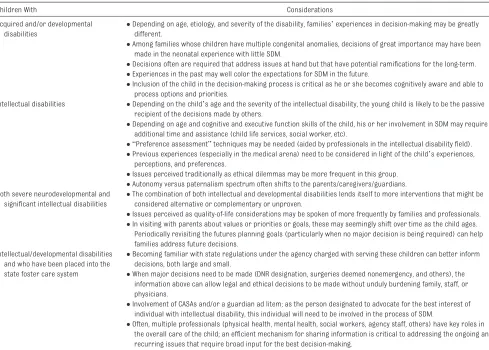
potentially unique considerations for SDM in specific cohorts, see Table 4.
Not uncommonly, the process of SDM requires more than 1 critical conversation. Notes can be entered into the medical record to assist with the “next step” meeting if one is needed. This process can either incorporate actual decision aid measures or can be documented by narrative summary. Summarization might include the following: people present, issues and concerns brought forward, pertinent comments and concerns expressed, perceived joint understanding, and status of the plan.
Finally, children with disabilities may be hospitalized for acute or chronic medical issues. Fox et al47
outlined a structure for “family care conferences” to discuss
taBLe 1 A Guide to Pediatricians’ Active Listening: Considering Context and Family Values in SDM Context: Unique Family Characteristics Affecting the
Decision-Making Process
Values: Unique Child/Family Attitudes and Belief Systems Affecting the Decision-Making Process
Pediatrician’s Ability to Inform and Clarify in the SDM Process
• Family’s understanding of diagnosis Quality-of-life considerations: • Adequacy of information is addressed
• Accuracy and quality of information is addressed • Timing of information is appropriate
• Support of “peer-to-peer” interactions is addressed
• Clarifications are continually addressed: o Health team is seen as listening, understanding,
supportive
o Family does not feel “pressured” to decide o Support team seems present and will be over
time • Child’s involvement based on developmental
status
• Child’s enjoyment of activities of daily living is addressed (self- and proxy report)
• Adolescent’s capability, values, and preference for involvement
• Child’s comfort is addressed (self- and proxy report)
• Family’s understanding of the child’s physical, social, emotional status/prognosis
• Financial considerations (cost/benefits) are addressed
• Family’s understanding of implications of intervention being considered
o Parents’ previous experiences in difficult decisions
o Decision-making process: parents’ styles/ preferences
o Decision-making process: extended family influence/support
o Decision-making process: external influences (school, finance, others)
o Health literacy of the family, including the patient
• Health professionals’ understanding of barriers to the family’s/child’s full participation in the SDM process
• Emotional status and social interactions are addressed
• Unique ethnic, cultural characteristics affecting health beliefs
Health-related quality-of-life considerations • Personal competence and self-directed skills are
addressed
• Educational planning is addressed • Participation in recreation/leisure activity • Family or significant-other personal support
(caregiver’s perceived roles/investment) • Personal rights and social inclusion are
optimized
• Healthy weight and growth attained • No food insecurity or unaddressed nutritional
issues
treatment decisions. Depending on the clinical situation, the SDM process should be used to help in the process. Unfortunately, time and circumstances can present constraints. But, as Fox et al47
suggested, the primary care clinician (who knows the family and has been a part of the larger, longer SDM process) should be an invited participant to provide ongoing support to the family/child and to the hospitalist/specialists.
cOncLusIOns
• Future needs for pediatric research. Three areas in need of further investigation include the following: (1) consensus definition of SDM, (2) measures specific to SDM-related constructs, and (3) selection of outcome measures (eg, child satisfaction, family satisfaction, and positive medical/developmental outcomes, particularly in chronic nonacute conditions).
•Children, when cognitively competent, should be involved in decisions about their care. Providing children information (on the basis of developmental age) can help them gain an understanding of the condition and treatments, reduce fear, enhance self-confidence9 as
well as acceptance, and improve collaboration with treatment decisions. Providers should partner with adolescents and
taBLe 2 Practical Steps Common to the SDM Process • Acknowledge that a decision is at hand and needs to be made
• Identify salient stakeholders and formulate an equality of partners for the process • Present, without bias, the spectrum of treatment options reasonably available
o Review risks and benefits of the options being considered o Present at appropriate cognitive/developmental level for the child • Investigate the child’s/family’s understanding and expectations of the decision • Identify preferences and priorities of all parties actively involved
•“Negotiate” evenly and with sensitivity the aspects without early concordance • Reach a decision for action
• Arrange follow-up or a revisiting of the decision to ensure closure
• See Supplemental Information 1 for tools and strategies to support discussions with families, such as “Ask-Tell-Ask, ”“Tell Me More, ” and others
Modified with permission from Kriston L, Scholl I, Hölzel L, Simon D, Loh A, Härter M. The 9-item Shared Decision Making Questionnaire (SDM-Q-9): development and psychometric properties in a primary care sample. Patient Educ Couns. 2010;80(1):94–99.
taBLe 3 A Guide to Pediatricians’ Conversations: “Choice Talk, ”“Options Talk, ” and “Decisions Talk”
Choice talk • Step back
o Summarize: “The issue is real. Do you consider it a problem? A major problem?” o What’s next?
• Offer choice
o “There is some information about this; I’m happy to share what I know.”
• Justify choice
o Respect preferences: “Treatments have different consequences; some will matter more to you than others; you will need to let me know.” o Uncertainty: “Evidence may be lacking; outcomes vary at the individual level.”
• Check reaction: information overload?
• Defer closure: “You’ve asked for and I’m happy to give an opinion, but first I wish to be clear …”
Options talk
• Check knowledge: “What have you read or heard about ______?”
• List options
o “Before we get into details and decisions, let me go through some options.” o Note: observing and monitoring the child’s present status is always 1 option • Describe options
o Using practical terms to ensure understanding
o Potential order of treatments; postponement options
o Is the intervention reversible?
o “Chunks and checking”: clarify re pros/cons, resume and clarify • Provide decision support: informal/formal patient decision aids • Summarize: list out and have patient/family “return” the information Decisions talk
• Focus on preferences: “What, from your point of view, matters most?”
• Elicit a preference: offer more time to think/offer more guidance • Moving to decision
o “Do you have more questions?”; “How would you like to proceed?”; “Do you need more time to think about our decision?”
• Offer review: decisions can be revisited; can help with closure
parents to solicit preferences about capacities and preferences for involvement as well as consent and confidentiality issues.48, 49
•Development of SDM support technologies. The development of better decision-support tools and technologies is needed. These tools should support validity in areas of information presentation, values clarification, and the decision deliberation process. Integration of decision-support tools into electronic medical records would support easier and more widespread use. In addition, means of promoting dialogue with families through the use of communication tools, such as patient portals and mobile applications, will support the use of SDM.
• Implement the application of SDM into daily clinical care. Three clinical cases are included as examples of complex decisions that many families face. Often, a family will set up a consultation with the hope/expectation that the clinician will answer the question
“What would you do?” Offering a quick, prescriptive response negates the process of SDM and the values inherent in the process. The variations in issues addressed by families of children with disabilities are seemingly limitless; constructing SDM algorithms for each is not feasible. Standard questions may not apply. Rather, the elements of the process are key. Three examples have been chosen to allow the use of the
approaches and tools included in the report (see Supplemental Information 2, cases 1, 2, and 3). With increasing knowledge of and functional use of SDM skills, the clinician will become an effective partner in the decision-making process with families, providing family-centered care. The outcome of the process will support the beneficence of the physician, the authority of the family, and the autonomy and well-being of the child.
LeaD authOrs
Richard C. Adams, MD, FAAP Susan E. Levy, MD, MPH, FAAP
cOuncIL On chILDren WIth DIsaBILItIes executIve cOMMIttee, 2016–2017 Kenneth W. Norwood Jr, MD, FAAP, Chairperson taBLe 4 Considerations for SDM in Specific Cohorts
Children With Considerations
Acquired and/or developmental disabilities
• Depending on age, etiology, and severity of the disability, families’ experiences in decision-making may be greatly different.
• Among families whose children have multiple congenital anomalies, decisions of great importance may have been made in the neonatal experience with little SDM.
• Decisions often are required that address issues at hand but that have potential ramifications for the long-term. • Experiences in the past may well color the expectations for SDM in the future.
• Inclusion of the child in the decision-making process is critical as he or she becomes cognitively aware and able to process options and priorities.
Intellectual disabilities • Depending on the child’s age and the severity of the intellectual disability, the young child is likely to be the passive recipient of the decisions made by others.
• Depending on age and cognitive and executive function skills of the child, his or her involvement in SDM may require additional time and assistance (child life services, social worker, etc).
• “Preference assessment” techniques may be needed (aided by professionals in the intellectual disability field). • Previous experiences (especially in the medical arena) need to be considered in light of the child’s experiences,
perceptions, and preferences.
• Issues perceived traditionally as ethical dilemmas may be more frequent in this group. • Autonomy versus paternalism spectrum often shifts to the parents/caregivers/guardians. Both severe neurodevelopmental and
significant intellectual disabilities
• The combination of both intellectual and developmental disabilities lends itself to more interventions that might be considered alternative or complementary or unproven.
• Issues perceived as quality-of-life considerations may be spoken of more frequently by families and professionals. • In visiting with parents about values or priorities or goals, these may seemingly shift over time as the child ages.
Periodically revisiting the futures planning goals (particularly when no major decision is being required) can help families address future decisions.
Intellectual/developmental disabilities and who have been placed into the state foster care system
• Becoming familiar with state regulations under the agency charged with serving these children can better inform decisions, both large and small.
• When major decisions need to be made (DNR designation, surgeries deemed nonemergency, and others), the information above can allow legal and ethical decisions to be made without unduly burdening family, staff, or physicians.
• Involvement of CASAs and/or a guardian ad litem; as the person designated to advocate for the best interest of individual with intellectual disability, this individual will need to be involved in the process of SDM.
• Often, multiple professionals (physical health, mental health, social workers, agency staff, others) have key roles in the overall care of the child; an efficient mechanism for sharing information is critical to addressing the ongoing and recurring issues that require broad input for the best decision-making.
reFerences
1. Moumjid N, Gafni A, Brémond A, Carrère MO. Shared decision making in the medical encounter: are we all talking about the same thing? Med Decis Making. 2007;27(5):539–546 2. Charles CA, Whelan T, Gafni A, Willan
A, Farrell S. Shared treatment decision making: what does it mean to physicians? J Clin Oncol. 2003;21(5):932–936
3. Kriston L, Scholl I, Hölzel L, Simon D, Loh A, Härter M. The 9-item Shared Decision Making Questionnaire (SDM-Q-9): development and psychometric properties in a primary care sample.
Patient Educ Couns. 2010;80(1):94–99 4. Charles C, Gafni A, Whelan T. Shared
decision-making in the medical encounter: what does it mean? (or it takes at least two to tango). Soc Sci Med. 1997;44(5):681–692
5. Godolphin W. Shared decision-making. Healthc Q. 2009;12(Spec No Patient):e186–e190
6. Barry MJ, Edgman-Levitan S. Shared decision making: pinnacle of patient-centered care. N Engl J Med. 2012;366(9):780–781
7. Moulton B, King JS. Aligning ethics with medical decision-making: the quest for
informed patient choice. J Law Med Ethics. 2010;38(1):85–97
8. Coyne I, Harder M. Children’s participation in decision-making: balancing protection with shared decision-making using a situational perspective. J Child Health Care. 2011;15(4):312–319
9. McCabe MA. Involving children and adolescents in medical decision making: developmental and clinical considerations. J Pediatr Psychol. 1996;21(4):505–516
10. Coyne I, O’Mathúna DP, Gibson F, Shields L, Sheaf G. Interventions for promoting participation in shared decision-making for children with cancer. Cochrane Database Syst Rev. 2013;(6):CD008970
11. Cohen E, Lacombe-Duncan A, Spalding K, et al. Integrated complex care coordination for children with medical complexity: a mixed-methods evaluation of tertiary care-community collaboration. BMC Health Serv Res. 2012;12:366
12. Légaré F, Stacey D, Pouliot S, et al. Interprofessionalism and shared decision-making in primary care: a stepwise approach towards
a new model. J Interprof Care. 2011;25(1):18–25
13. Bauchner H. Shared decision making in pediatrics. Arch Dis Child. 2001;84(3):246 14. Butler CC, Kinnersley P, Prout H,
Rollnick S, Edwards A, Elwyn G. Antibiotics and shared decision-making in primary care. J Antimicrob Chemother. 2001;48(3):435–440 15. Strauss K, Benvenuto A, Battan B, et al.
Promoting shared decision making to strengthen outcome of young children with autism spectrum disorders: the role of staff competence. Res Dev Disabil. 2015;38:48–63
16. Hodgetts S, Nicholas D, Zwaigenbaum L, McConnell D. Parents’ and professionals’ perceptions of family-centered care for children with autism spectrum disorder across service sectors. Soc Sci Med. 2013;96:138–146 17. Fiks AG, Mayne S, Localio AR, Feudtner C, Alessandrini EA, Guevara JP. Shared decision making and behavioral impairment: a national study among children with special health care needs. BMC Pediatr. 2012;12:153 18. Yin HS, Dreyer BP, Vivar KL,
MacFarland S, van Schaick L, Mendelsohn AL. Perceived barriers
Timothy Brei, MD, FAAP Lynn F. Davidson, MD, FAAP Beth E. Davis, MD, MPH, FAAP Kathryn A. Ellerbeck, MD, FAAP Amy J. Houtrow, MD, PhD, MPH, FAAP Susan L. Hyman, MD, FAAP Dennis Z. Kuo, MD, MHS, FAAP Garey H. Noritz, MD, FAAP Mary O’Connor Leppert, MD, FAAP Larry Yin, MD, MSPH, FAAP
Susan E. Levy, MD, MPH, FAAP, Autism Subcommittee Chairperson
Nancy A. Murphy, MD, FAAP, Immediate Past Chairperson
Sandra L. Friedman, MD, MPH, FAAP, Immediate Past Member
Richard C. Adams, MD, FAAP, Immediate Past Member
LIaIsOns
Peter J. Smith, MD, MA, FAAP – Section on Developmental and Behavioral Pediatrics
Georgina Peacock, MD, MPH, FAAP – Centers for Disease Control and Prevention
Marie Mann, MD, MPH, FAAP – Maternal and Child Health Bureau
Jennifer B. Pitre, MA, JD – Family Voices
staFF
Stephanie Mucha, MPH
aBBrevIatIOns
SDM: shared decision-making SDM-Q-9: 9-item Shared Decision
Making Questionnaire
Address correspondence to Richard C. Adams, MD, FAAP. E-mail: [email protected]
PEDIATRICS (ISSN Numbers: Print, 0031-4005; Online, 1098-4275).
Copyright © 2017 by the American Academy of Pediatrics
FInancIaL DIscLOsure: The authors have indicated they have no financial relationships relevant to this article to disclose.
FunDIng: No external funding.
to care and attitudes towards shared decision-making among low socioeconomic status parents: role of health literacy. Acad Pediatr. 2012;12(2):117–124
19. Légaré F, Labrecque M, LeBlanc A, et al. Training family physicians in shared decision making for the use of antibiotics for acute respiratory infections: a pilot clustered randomized controlled trial. Health Expect. 2011;14(suppl 1):96–110 20. Légaré F, Ratté S, Stacey D, et al.
Interventions for improving the adoption of shared decision making by healthcare professionals.
Cochrane Database Syst Rev. 2010;(5):CD006732
21. Lipstein EA, Brinkman WB, Britto MT. What is known about parents’ treatment decisions? A narrative review of pediatric decision making.
Med Decis Making. 2012;32(2): 246–258
22. Denboba D, McPherson MG, Kenney MK, Strickland B, Newacheck PW. Achieving family and provider partnerships for children with special health care needs. Pediatrics. 2006;118(4):1607–1615
23. Butler AM, Weller B, Titus C. Relationships of shared decision making with parental perceptions of child mental health functioning and care. Adm Policy Ment Health. 2015;42(6):767–774
24. Gunzburg R. Clinical decision- making and patients expectations: is there a link? Eur Spine J. 2015;24(2):217
25. Suurmond J, Seeleman C. Shared decision-making in an intercultural context: barriers in the interaction between physicians and immigrant patients. Patient Educ Couns. 2006;60(2):253–259
26. Parsapoor A, Parsapoor MB, Rezaei N, Asghari F. Autonomy of children and adolescents in consent to treatment: ethical, jurisprudential and legal considerations. Iran J Pediatr. 2014;24(3):241–248
27. Charles C, Gafni A, Whelan T, O’Brien MA. Cultural influences on the physician-patient encounter: the case of shared treatment
decision-making. Patient Educ Couns. 2006;63(3):262–267
28. Cura JD. Respecting autonomous decision making among Filipinos: a re-emphasis in genetic counseling.
J Genet Couns. 2015;24(2): 213–224
29. Durand MA, Carpenter L, Dolan H, et al. Do interventions designed to support shared decision-making reduce health inequalities? A systematic review and meta-analysis. PLoS One. 2014;9(4):e94670
30. Légaré F, Ratté S, Gravel K, Graham ID. Barriers and facilitators to implementing shared decision-making in clinical practice: update of a systematic review of health professionals’ perceptions. Patient Educ Couns. 2008;73(3):526–535 31. Levy SE, Frasso R, Colantonio S,
et al. Shared decision making and treatment decisions for young children with autism spectrum disorder. Acad Pediatr. 2016;16(6):571–578 32. Joseph-Williams N, Elwyn G,
Edwards A. Knowledge is not power for patients: a systematic review and thematic synthesis of patient-reported barriers and facilitators to shared decision making. Patient Educ Couns. 2014;94(3):291–309
33. Gravel K, Légaré F, Graham ID. Barriers and facilitators to implementing shared decision-making in clinical practice: a systematic review of health professionals’ perceptions. Implement Sci. 2006;1:16
34. Kenney MK, Denboba D, Strickland B, Newacheck PW. Assessing family-provider partnerships and satisfaction with care among US children with special health care needs. Acad Pediatr. 2011;11(2):144–151 35. Butler AM, Elkins S, Kowalkowski
M, Raphael JL. Shared decision making among parents of children with mental health conditions compared to children with chronic physical conditions.
Matern Child Health J. 2015;19(2):410–418
36. Stacey D, Légaré F, Col NF, et al. Decision aids for people facing health
treatment or screening decisions.
Cochrane Database Syst Rev. 2014;(1):CD001431
37. Simmons M, Hetrick S, Jorm A. Shared decision-making: benefits, barriers and current opportunities for application. Australas Psychiatry. 2010;18(5):394–397
38. Scholl I, Koelewijn-van Loon M, Sepucha K, et al. Measurement of shared decision making—a review of instruments. Z Evid Fortbild Qual Gesundhwes. 2011;105(4):313–324
39. Scholl I, Kriston L, Dirmaier J, Härter M. Comparing the nine-item Shared Decision-Making Questionnaire to the OPTION scale—an attempt to establish convergent validity. Health Expect. 2015;18(1):137–150
40. Durand MA, Stiel M, Boivin J, Elwyn G. Where is the theory? Evaluating the theoretical frameworks described in decision support technologies. Patient Educ Couns. 2008;71(1):125–135
41. Zajicek-Farber ML, Lotrecchiano GR, Long TM, Farber JM. Parental perceptions of family centered care in medical homes of children with neurodevelopmental disabilities. Matern Child Health J. 2015;19(8):1744–1755
42. Adams RC, Elias ER; Council on Children With Disabilities. Nonoral feeding for children and youth with developmental or acquired disabilities. Pediatrics. 2014;134(6). Available at: www. pediatrics. org/ cgi/ content/ full/ 134/ 6/ e1745
43. Mahant S, Jovcevska V, Cohen E. Decision-making around gastrostomy-feeding in children with neurologic disabilities. Pediatrics. 2011;127(6). Available at: www. pediatrics. org/ cgi/ content/ full/ 127/ 6/ e1471
44. Elwyn G, Frosch D, Thomson R, et al. Shared decision making: a model for clinical practice. J Gen Intern Med. 2012;27(10):1361–1367
46. Iyengar SS, Lepper MR. When choice is demotivating: can one desire too much of a good thing? J Pers Soc Psychol. 2000;79(6):995–1006
47. Fox D, Brittan M, Stille C. The pediatric inpatient family care conference: a proposed structure toward shared
decision-making. Hosp Pediatr. 2014;4(5):305–310
48. Kon AA. The shared decision-making continuum. JAMA. 2010;304(8): 903–904
49. Cooley WC, Sagerman PJ; American Academy of Pediatrics; American
DOI: 10.1542/peds.2017-0956 originally published online May 29, 2017;
2017;139;
Pediatrics
DISABILITIES
Richard C. Adams, Susan E. Levy and COUNCIL ON CHILDREN WITH
Shared Decision-Making and Children With Disabilities: Pathways to Consensus
Services
Updated Information &
http://pediatrics.aappublications.org/content/139/6/e20170956 including high resolution figures, can be found at:
References
http://pediatrics.aappublications.org/content/139/6/e20170956#BIBL This article cites 49 articles, 8 of which you can access for free at:
Subspecialty Collections
http://www.aappublications.org/cgi/collection/disabilities_sub
Children With Special Health Care Needs
with_disabilities
http://www.aappublications.org/cgi/collection/council_on_children_
Council on Children with Disabilities
http://www.aappublications.org/cgi/collection/current_policy
Current Policy
following collection(s):
This article, along with others on similar topics, appears in the
Permissions & Licensing
http://www.aappublications.org/site/misc/Permissions.xhtml in its entirety can be found online at:
Information about reproducing this article in parts (figures, tables) or
Reprints
DOI: 10.1542/peds.2017-0956 originally published online May 29, 2017;
2017;139;
Pediatrics
DISABILITIES
Richard C. Adams, Susan E. Levy and COUNCIL ON CHILDREN WITH
Shared Decision-Making and Children With Disabilities: Pathways to Consensus
http://pediatrics.aappublications.org/content/139/6/e20170956
located on the World Wide Web at:
The online version of this article, along with updated information and services, is
http://pediatrics.aappublications.org/content/suppl/2017/05/18/peds.2017-0956.DCSupplemental Data Supplement at:
by the American Academy of Pediatrics. All rights reserved. Print ISSN: 1073-0397.