The Impact of the Unified Vehicular Volume
Reduction Program (UVVRP) in Reducing
Air Pollution
Arjan Paulo S. Salvanera1, Gianmarco Anton D. Sibayan2, Matthew C. Tan3 and Marie Antoinette L. Rosete4
Background/Objectives and Goals
The MMDA-implemented Modified Unified Vehicle Reduction Program, a type of Traffic Demand Management, is a road rationing scheme that addresses the issue of the traffic congestion through driving restrictions. The study will determine the effectiveness of the UVVRP in not only the reduction of traffic congestion in Metro Manila but also the atmospheric air quality. Air quality has been drastically declining due to the emissions brought by mobile sources. The results in this study have shown that transport policies and air pollution regulations would have a very significant impact on urban transport inefficiencies like congestion.
Methods
The researchers need to estimate the unknown parameters. A regression analysis must be carried out to avoid the risk of autocorrelation of errors between explanatory variables. In order to avoid this, we used the Two Stage Least Squares (TSLS) method to determine the impact of the UVVRP on air pollution based on time-series data at the metro-wide level. Simultaneity problems also exist. The econometric specifications estimated the instrumental variables which was only correlated to the explanatory variables.
Results/Conclusions/Contributions
Based on the research, since congestion has an insignificant impact on air pollution and the current specification of UVVRP does not greatly impact the congestion, thr UVVRP policy does not impact the air pollution in Metro Manila. This is opposite to the UVVRP version in other countries where it aims in reducing air pollution. The researchers suggest modifying the coding scheme by reducing the vehicle usage from once a week into an odd-even scheme. This may be drastic but it certainly calls for the situation given that there is a lot of current infrastructure construction. This study would interest any polices that are related to addressing congestion and pollution problems.
Keywords: UVVRP, Fuel Price, Congestion, Air pollution, Two-stage least squares method
IntroductIon
Pollution has brought numerous problems to the society especially in urban areas. One of the major factors contributing to air pollution are vehicle emissions. Vehicles are one of the major sources of pollution that emit various particulates that, at some degree, causes a loss of valuable resources to the society. The air quality in urban areas has been slowly deteriorating including that in Metro Manila. With the lack of needed resources, the increase of air
1Business Economics Department, University of Santo Tomas, Philippines
pollution has been inevitable especially in the case of developing countries like the Philippines. Despite this, there is an existing provision of a law that pursues balancing economic development and environmental protection. Section 3c of the Republic Act 8749 or the Clean Air Act of 1999 (An Act providing for a comprehensive air pollution control policy and for other purposes) mentions “Focus primarily on pollution prevention rather than on control and provide for a comprehensive management program for air pollution”. One example of preventing air pollution is to locate the sources and determine the means of achieving a significant drop in air pollution, especially in Metro Manila. Vehicle emissions are defined as “Mobile source” by RA 8749.
The Metro Manila Development Authority (MMDA) has implemented the Modified Unified Vehicle Reduction Program (UVVRP), commonly known as the “Colour Coding scheme”, a type of Traffic Demand Management that addressed the issue of the traffic congestion through the use of driving restrictions. In June 1996, the coding scheme was only imposed for the purpose of reducing the number of vehicles traversing Metro Manila roads during the ongoing road construction period in the metro, using the odd-even scheme. Eventually, the temporary program turned into a long-term program that has been the basis of the permanent policy of the government in addressing the traffic situation. The program has evolved with numerous modifications until it reached the current scheme, where the number of vehicles were assumed to be equally distributed into ten digits (ending license plate number from 0 to 9) and two numbers were allocated on each weekday (Monday to Friday, restrictions were lifted on weekends and holidays), ideally, a 20 % decrease in the number of vehicles traversing Metro Manila roads was expected. Some cities in the metro implemented the 7:00 am to 7:00 pm car restriction, some had window hours starting from 10:00 am to 3:00 pm and others did not promulgate it at all (due to the fact that vehicles only went to the Central Business District areas. The latest modification of the UVVRP was made in 2010 whereas the vehicle restriction included public transportation vehicles.
However, there was a 1999 study by the MMDA that showed that there was no significant reduction of vehicles on the road. In fact, from the ideal 20% reduction, there was only 4.3 % reduction in the number of vehicles traversing during the coding scheme hour. The impact of the UVVRP affected the vehicle owners who have responded differently in order for them to adjust to the UVVRP restrictions. People who belonged to an upper class tended to purchase new cars, while the middle class tended to buy 2nd hand cars. Owners also drove the vehicles before and after the restriction hours (but these adjustments resulted in a longer rush hour time) or shifted into using public transportation. These adjustments differed greatly thus affecting the changes in the amount of pollution in the metro. In this work, the impact of the UVVRP or the coding scheme in traffic congestion and the air quality of Metro Manila was investigated to determine whether there was an alteration in the amount of travel demand. We assumed that there was a short term effect and a long term effect of the coding scheme since the policy was originally designed for short-run travel demand management in response to the temporal effects of road construction in Metro Manila. This paper only aimed to study air pollution emitted by the mobile sources since they were the major emitters of air pollutants.
This policy is very important for Metro Manila since the traffic causes significant economic losses of about 6 billion pesos from 2.4 billion pesos if there is no government initiative that will address this problem, according to a Japan International Cooperation Agency (JICA) study. There are already queries regarding the effectiveness of the Unified Vehicular Volume Reduction Program since it was only designed for short-run travel demand management. The outdated program was also expected to address more traffic problems as the government started numerous road constructions on the Metro Manila Road. The first implementation of the UVVRP coincided with heavy road construction at that time. The efficient volume reduction of vehicles crossing the metro would most likely reduce “mobile sources”. These mobile sources were also considered harmful to well-being of the people. According to the Environmental Management Board of the Department of Environment and National Resources (EMB-DENR) and the World Health Organization (WHO), there was a significant improvement of the air quality of 130ug/Ncu.m in Manila but this was still not acceptable as the air quality standard set by the WHO was below 90ug/Ncu.m.
In this work, the impact of the Unified Vehicle Volume Reduction Program on air pollution was investigated. This study would determine the effectiveness of the UVVRP on the reduction of the traffic congestion in Metro Manila and also the air quality in Metro Manila.
Methodology
Our study (The Impact of Unified Vehicular Volume Reduction Program in Air Quality) sought to know the impact of the travel demand management scheme in reducing the air pollution of Metro Manila.
The researchers gathered their quantitative data from government institutions and an international institution. For the UVVRP, the researchers used the number of violators for the Unified Vehicular Volume Reduction Program in Metro Manila. MMDA only publishes the number of violators on a monthly basis due to the length of time needed for processing the application of the driver’s license for the violators, starting from the day of confiscation of the driver’s license to the day of repossession of the driver’s license, which was usually a month-long procedure. Fuel price data was collected from the Organization of Petroleum Exporting Countries (OPEC), called OPEC Basket Price (OBP) as petroleum products were imported from these countries (ex. Saudi Arabia and United Arab Emirates). OBP is the weighted average oil prices for oil-producing country members of OPEC, measured in dollars per barrel. For the congestion variable, we used the Traffic Advisory announcement of the Metro Manila Development Authority (MMDA) as an auxiliary for congestion. There were five degrees of traffic used by MMDA, namely light traffic, light to moderate traffic, moderate traffic, moderate to heavy traffic and heavy traffic. We assumed that this could be treated as a categorical variable and assigned increasing numerical values as the degree of traffic increased. Data for air pollution was obtained from the Air Quality Management Section of the Environmental Management Bureau (EMB-AQMS), an enforcement and implementation arm of the Department of Environment and Natural Resources (DENR) in compliance with the Philippine Clean Air Act of 1999. The EMB-AQMS recently shifted from Total Suspended Particulate (TSP) to Particulate Matter with an aerodynamic diameter of less than or equal to 10 (ug/Ncu.m) (PM-10) (Environmental Protection Agency). Although EMB-AQMS releases a daily monitoring status of air pollution around Metro Manila, these data are subject to the National Ambient Air Quality Guideline’s Quality Assurance and Quality Control (QA/QC), which only publishes a monthly average of the continuous ambient air quality.
The unknown parameters had to be estimated; however, a regression analysis was necessary to avoid the risk of autocorrelation of errors between explanatory variables. In order to avoid this, we used a Two Stage Least Squared (TSLS) method to know the impact of the UVVRP on air pollution based on time-series data at the metro-wide level. Simultaneity problems also existed. The econometric specifications estimated the instrumental variable which was only correlated to the explanatory variable. This was patterned after the model used by Souche (2010).
The first stage of regression was multiple regressions of the UVVRP and fuel price as the independent variable while the congestion was the dependent variable. For the second stage, congestion was used as an independent variable while air pollution was the dependent variable.
These are the regression equations:
θ = β0 + β0UVRP– χ1FP + ϶ (1)
Function (1) describes the effect of the UVVRP and fuel price on congestion.
γ = λ0 + λ1Cong + ϶ (2)
Function (2) describes the effect of congestion on the air pollution in Metro Manila.
results
the lowest was at 900 violators. Figure 1 shows the line plots of the monthly number of apprehensions starting from January 2012 until December 2014.
Source: MMDA
Figure 1. Number of UVVRP Violators
The Organisation of Petroleum Exporting Countries (OPEC) Basket Price covers the oil prices of its member states. OPEC controls almost 40% percent of oil world market. Philippines is a highly oil-dependent country and imports its oil from these member countries. The drop in oil price was mainly due to the drop in demand of oil. Figure 2 shows the line plots of the monthly average of crude oil prices starting from January 2012 until December 2014.
Source: OPEC
Figure 2. Historical prices of crude oil per barrel in dollars
Source: MMDA
Figure 3. Number of mentions of traffic advisory in Metro Manila
The air quality of Metro Manila is recorded by the Environment Management Bureau – Air Quality Management Section of the Department of Science and Technology. The data is measured through particulate matter with an aerodynamic diameter of less than or equal to 10 (ug/Ncu.m) (PM.10). Figure 4 shows the line plots of monthly treated quality assurance/quality control of air pollution (PM.10) in Metro Manila starting from January 2012 until December 2014.
Source: DENR-EMB
Figure 4. Particulate matter diameter in Metro Manila
In finding the impact of the UVVRP on air pollution, the researchers needed to have a method that addressed simultaneous scenarios. The researchers came up with TSLS as the method for the model. The model was divided into two parts and the regression was carried out: using the first part and second part ordinary least squares method.
in strong evidence of positive autocorrelation. The autocorrelation could also be affirmed by the Breusch-Pagan Test for Heteroscedasticity, as in Table 2. It resulted in a 0.05 p-value for the Chi-Square probability which rejected the null hypothesis of homoscedasticity.
Table 1. First Stage OLS
Table 2. Heteroscedasticity Test: BGP
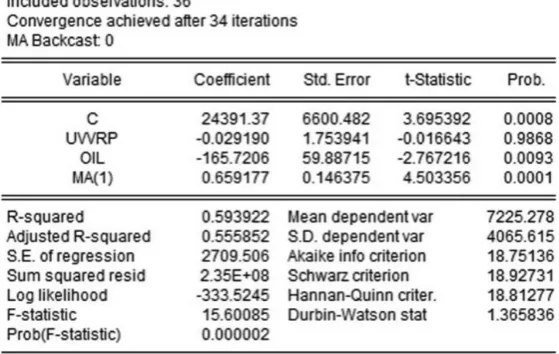
In order to solve the problem of autocorrelation (and heteroscedasticity), the researchers added a variable that could explain the current and lagged values of error terms. This was possible with the Box-Jenkins (BJ) methodology using the moving average (MA) model. The MA model was determined by the use of a correlogram. There was a significant spike through the lags in the Autocorrelation function pattern which indicated a MA as the type of model to be used. The data in Table 3 showed a more favourable result in comparison with the former.
Table 4 and Table 5 verified the methodology used through the use of the BG LM Test and the BPG Heteroscedasticity test.
Table 4. BG LM Test
Table 5. Heteroscedasticity Test: BPG
The null hypothesis of no serial correlation was accepted since the chi-qquare probability of 0.06 was more than 0.05. Also, the null hypothesis of homoscedasticity was accepted since the chi-square probability of 0.11 was more than 0.05. By comparing the adjusted R-squared values (since multiple regression models were used), the result improved from 25% to 56% which meant that a 56% variation of traffic in Metro Manila could be explained by the UVVRP violators and oil prices. The p-value of oil prices which was 0.009 was less than 0.05; therefore, the impact of oil price to traffic was significant. However, the p-value of the UVVRP which was 0.9868 was more than 0.05; therefore, the impact of the UVVRP to air pollution was insignificant.
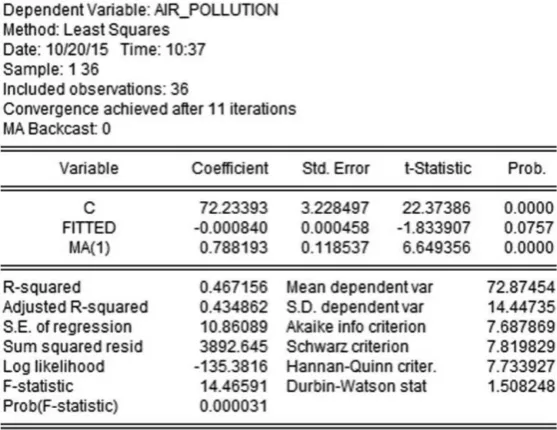
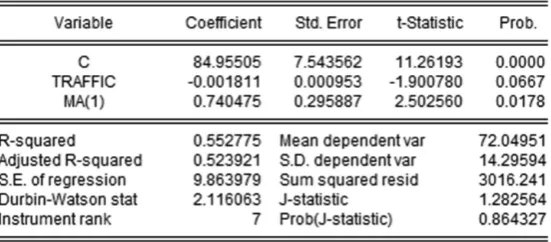
The second part of the TSLS model also used OLS with BJ methodology using the moving average (MA) model. The MA model was determined by the use of a correlogram. There was a significant spike through the lags in the autocorrelation function pattern which indicated MA was a suitable model to use. The Durbin-Watson value of the second stage, which was 1.5, satisfied the condition of critical values for 36 observations with three variables (1.35 to 1.59). The adjusted R-squared value could explain 43% of variation of air pollution explained by the traffic (fitted). There was an inverse relation between congestion and air pollution, however, this was insignificant as the p value was more than 0.05. The researchers also ran the method using TSLS directly which supported the first method of running two OLS.
Table 7. TSLS (MA) Model
dIscussIon
The researchers aimed to analyse the impact of the UVVRP on reducing air pollution in Metro Manila (EDSA in particular). The effects of each variable were parallel to what the researchers have hypothesised. In other words, oil price had an inverse relationship with congestion while UVVRP Violators also had an inverse but insignificant relationship. This could be because drivers have realised how to bypass the Unified Vehicular Volume Reduction Program. At the same time, congestion did not have a strong impact on air pollution. This could be due to some factors as when congestion increased, the gravity of pollution contributed by vehicle combustion could increase, remain the same or decrease. Technological advancements in the automobile industry in the Philippines was likely the contributing factor.
references
Armah, F. A., Yawson, D. A., & Pappoe ,A. A.N.M., “A Systems Dynamics Approach To Explore Traffic Congestion And Air Pollution Link In The City Of Accra, Ghana'”. Sustainability 2, pp 252-265, 2010.
Barnett, A., and Knibbs, L., “Higher fuel prices are associated with lower air pollution levels”,
Environment International, vol 66, pp 88-91, 2014.
Bento, A., Hughes, J., and Kaffine, D., “Carpooling and driver responses to fuel price changes: Evidence from traffic flows in Los Angeles”, Journal of Urban Economics, vol 77, pp 41-56, 2013.
Brand, D., “Impacts of Higher Fuel Costs”, U.S. Department of Transportation Federal Highway Administration, 2009.
Boquet, Y. (2013). “BATTLING CONGESTION IN MANILA: THE EDSA PROBLEM”. Transport and Communications Bulletin for Asia and the Pacific 82, 2013.
Chakravorty, U., Nauges, C., & Thomas, A, “Clean Air regulation and heterogeneity in US gasoline prices”, Journal of Environmental Economics and Management, vol 55, Issue 1, pp 106-122, 2008.
Congressional Budget Office, “Effects of gasoline prices on driving behaviour and vehicle markets no.2883”, 2008.
Cozad, M., and Lariviere, J., “Fuel price increases and the timing of changes in household driving decisions, Journal of Environmental Economics and Management”, vol 65, Issue 2, pp 194-207, 2013.
Davis, L., “The Effect of Driving Restriction on Air Quality in Mexico City”, Journal of Political Economy, vol 116, pp 38-81, 2008.
Gallego, F., Montero, J, and Salas C., “The effect of transport policies on car use: Evidence from Latin American cities”, Journal of Public Economics, vol 107, pp 47-62, 2009.
Hsu, W.T. & Zhang, H., “The fundamental law of highway congestion revisited: Evidence from national expressways in Japan, Journal of Urban Economics”, vol 81, pp 65-76, 2014.
MacKerron, G., and Mourato, S., “Life satisfaction and air quality in London”, Ecological Economics, vol 68, pp 1441-1453, 2013.
Proost, S., and Dender K., “Energy and environment challenges in the transport sector, Economics of Transportation”, pp 77-87,
2012.
Quah, E., and Boon, T., “The economic cost of particulate air pollution on health in Singapore, Journal of Asian Economics”, vol 14, pp 73-90, 2003.
Regidor, J., “Traffic Congestion in Metro Manila: Is the UVVRP still effective?”, Philippine Engineering Journal, vol 34, pp 66-75,
2013.
Rivasplata, R., “Congestion pricing for Latin America: Prospects and constraints, Research in Transportation Economics”, vol 40, Issue 1, April 2013, pp 56-65, 2013.
Small, Kenneth, and Kazimi, C., “ON THE COSTS OF AIR POLLUTION FROM MOTOR VEHICLES”. Journal of Transport
Economics and Policy, pp 1-33, 2000.
Sun, C., Zheng, S., and Wang, R., “Restricting driving for better traffic and clearer skies: Did it work in Beijing?”, Transport Policy,
vol 32, pp 34-41, 2014.