Cooperative Data Caching for Cloud Data Servers
Mingcong Yang
1,∗, Kai Guo
1, Yongbing Zhang
11Graduate School of Systems and Information Engineering, University of Tsukuba, Japan
Abstract
Thanks to the advance of cloud computing technologies, users can access the data stored at cloud data centers at any time and from any where. However, the data centers are usually sparsely distributed over the Internet and are far away from end users. In this paper, we consider to construct a cache network by a large number of cache nodes close to the end users in order to minimize the data access delay. We firstly formulate the problem of placing the replicas of data items to cache nodes as a mixed integer programming (MIP) problem. Then, we proposed an efficient heuristic algorithm that allocates at least one replica of each data item in the cache network and attempt to allocate more data items so as to minimize the total data access cost. The simulation results show that our proposed algorithm behaves much better than a well-known LRU algorithm and the computation complexity is limited.
Receivedon 29 June 2016;acceptedon 15 July 2016;publishedon 09 August 2016
Keywords: cloud data centers, data allocation, mixed integer programming
Copyright © 2016 Mingcong Yang etal., licensedto EAI. This isanopen access articledistributedunderthe termsof theCreativeCommonsAttributionlicense(http://creativecommons.org/licenses/by/3.0/),whichpermitsunlimited use,distributionandreproductioninanymediumsolongastheoriginalworkisproperlycited.
doi:10.4108/eai.9-8-2016.151632
1. Introduction
In recent years, the rapid development of Internet technologies has brought many new challenges to data services across the Internet. Many data-sensitive applications such as those for online video distribution and data sharing require increasingly transmission speed and wide bandwidth. Furthermore, most of or a large percentage of users located in the same or nearby areas may require the same kinds of data and the data request patterns may not change frequently. In order to reduce the data access latency and save the scarce network bandwidth, allocating the replicas of the required data at the locations close to end users is an efficient approach. However, when using a single cache node for multiple users like web cache servers [2, 8], the cache node may be overloaded and its service becomes unavailable if the cache node fails. In addition, if a data item required by a user is not stored at the cache node the user has to obtain the data item from the data center directly, resulting in a long access time and extra data traffic
HPlease ensure that you use the most up to date class file, available from EAI at http://doc.eai.eu/publications/transactions/ latex/
∗
Corresponding author. Email:[email protected]
over the network [12]. Therefore, other researchers proposed a cooperative caching approach [4] in which a number of caching nodes are interconnected and all the caching nodes work together to provide better data services to users. Compared with the single node caching, the cooperative caching approach can reduce the processing time of data requests, improve the cache hit rates, and provide higher fault tolerance. In a cooperative caching approach, each node makes its caching decisions using the information of data access and data caching in the network, yielding better overall data access performance [10,16].
The main disadvantage of previous cooperative caching approaches is that a node has to know the network topology and also the data cache information and therefore when the network size is large the overhead for exchanging the data cache information should be significantly high. However, when a node makes a caching decision it takes into account of only its surrounding nodes. When a data miss occurs a node has to obtain the data from a node far away or in the worst case from the data center. In this paper, we propose an overall caching approach in which data caching decisions are made by using the information of the whole nodes in the network. We formulate the data allocation problem as a mixed integer programming (MIP) problem. When the problem size becomes large,
the problem is NP-hard, and therefore we propose an efficient heuristic algorithm. In order to evaluate our proposed heuristic algorithm, we use a well-known caching approach, called least recently used (LRU), and a simple caching algorithm in which copies of data items are randomly allocated to the nodes.
The remainder of this paper is organized as follows. In Section 2, we summarize the related researches on caching technologies. In Section 3, we describe the network model considered in this paper and formulate the data replica allocation problem as a MIP problem and show it is NP-hard. In Section 4, we describe our proposed heuristic algorithm in detail. The results of our simulation experiments are given in Section 5. Finally, in Section6, we conclude the paper briefly.
2. Related Work
Many researchers focused on various cooperative caching techniques [4,6,15,16,18,19]. Chankhunthod et al. [4] proposed a hierarchical caching mechanism for web applications in which lower cache servers can resolve misses through a higher level cache servers. Researchers also proposed cooperative caching protocols such as internet cache protocol (ICP) [19], cache array routing protocol (CARP) [18], and summary cache [6]. Cooperative caching approaches can be classified into hierarchical cooperative caching and distributed cooperative caching[15,16].
Ramaswamyet al. [14] proposed a cache deployment scheme based on the expiration age which is defined as the time difference that an object be replaced out and be cached depending on the statistical information. It shows the time difference between a document that is removed and the document that is accessed since it has been accessed last time; or the time which is the time difference between an document is removed and an document entering a cache divided by the number of hits. When a node receives a document, it determines if the document should be cached through exchanging the expiration age information with other nodes.
Bhattachrjeeet al. [3] proposed a cache deployment scheme for self-organizing wide-area network. The authors proposed the concept ofcaching radius, which is defined by the number of hops between nodes. When a message called reply message is transferred between two nodes, the number of hops will gradually increase when a node receives the reply message. If the number of hops of the reply message is an integer multiple of it’s caching radius, the node will store this object. however, this paper does not consider the impact of data’s popularity.
Li et al. [10] proposed a local optimization cache deployment scheme using a modified Dijkstra algo-rithm to obtain an optimal caching path. Eum.Set al. [5] and Liuet al. [11] proposed a randomly cache selection
approach and a dynamic linear programming approach in which the information of nodes such as node status and the demand patterns are taken into account when deciding the cache locations on the path from a cache node to the data source.
Minget al. [13] proposed a cache deployment scheme based on theagewhich is defined as the distance to the server and its popularity. The further a content is from a server or the more popular the content is, the longer age it has. A data item with a longer age is to be kept longer in the cache. This paper did an overall optimization for the data distribution of all nodes on the paths from the requesting node to the data center.
The core idea of those approaches is to replace the data items according to data requests dynamically in order to improve the cache hit rate and reduce the data access delay. However, there are two important factors that are not taken into account in those approaches. One is that each node needs to maintain acached data table, which contains the location information of the cached data items in the network, and the cached data table should be updated frequently. This greatly increases the computational overhead of nodes[14]. Another is that the decision of whether to cache a data item at a node is made using only the information of the transmission path from the node to the original data source, say, data center, instead of the neighboring nodes around the node[5,10,11,13].
Cloud data centers generally store all the data provided to users but are usually located in locations far away from end users. On the other hand, the users residing in the same or nearby areas may access the same kinds of data frequently and furthermore the data request patterns may not change frequently. Therefore, it is a good way to place the replicas of data frequently accessed by users at locations near to the users in order to reduce the data access delay and also to reduce the workload at the data center and save network bandwidth. Due to the storage limitation of a cache node, it is beneficial to construct a cache network by a number of cache nodes so that a user can easily find the required data at a nearby cache node. This paper focuses on how to allocate the replicas of data items that are originally stored at the data centers in order to minimize the total cost for data access.
3. Model and Problem Formulation
In this section, we first introduce the network model and describe the assumptions considered in this paper. Then we formulate the data allocation problem as a mixed integer programming (MIP) problem.
3.1. NetworkModel
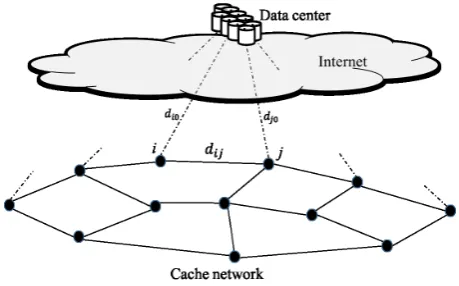
Figure 1. Data cache network.
data center are denoted byN ={n1, n2, . . . , n|N|}andn0, respectively. We letN0=N ∪n0. The shortest distance between nodesiandj, which can be determined using an appropriate shortest path algorithm, is denoted by dij, and we assume that the data transmission between
nodesiandjpasses through the shortest path between nodesiandj. We assume that the distance from a cache node to the data center is much longer than the distance between any two cache nodes, i.e.,di0dij (i, j∈N).
The set of data items stored at data centern0is denoted
by M={d1, d2, . . . , d|M|}. The demand of data item k arrival at nodeiis denoted byφki and the set of the total demands at nodeiis denoted byΦi ={φ1
i, φ2i, . . . , φ
|M|
i }.
The size of data itemk is denoted bysk and the cache
capacity of node i is denoted by Ai. We assume that X
i∈N Ai ≥
X
k∈M
sk.The cost for data transmission per unit
data per unit distance is denoted byξwhich is a positive constant value. We assume that the cost for transferring a data item from a node to another node depends only on the size of the data item and the distance between the two nodes.
We define the cost that nodeirequests data itemskat
nodejas follows.
ckij=skdijφkiξ, ∀i∈N , j∈N
0
. (1)
We also define the caching decision variables for nodes j(j∈N) byΛjsuch that
Λj ={λ1
j, λ2j, . . . , λ
|M|
j }, (2)
where
λkj = (
1, if nodejcaches data itemk, 0, otherwise.
We assume that a user accesses data itemkfrom one and only one nearest cache node that keeps the replica of data time k and a variable rijk is used to show the decision. If nodei accesses data itemk stored at node
j,rijk = 1 andrijk = 0 otherwise. For node i, if there are more than one nearest nodes keeping data itemk, node ican choose any node to obtain data itemk. If data item kis not cached at any node, a node requesting data item k should obtain data itemk from the data center. The notation used in this paper is shown in Table1.
Table 1. Notationused in the paper.
N set of cache nodes in the network
N0 set of nodes including data center in the network dij shortest distance between nodesiandj
M set of data items sk size of data itemk
φki demand of data itemkof nodei Φi total demand of nodei
Ai cache capacity of nodei
ξ cost for data transmission per unit data per unit distance
cijk cost for requesting data itemkfrom nodeito nodej
λkj caching decision variable,
λkj = (
1, if nodejcaches data itemk, 0, otherwise
Λj caching decision vector of nodej,
i.e.,Λj={λ1
j, λ2j, . . . , λ
|M|
j }
rijk accessing decision variable,
rijk =
1,if nodeiaccesses data itemkstored at nodej,
0,otherwise
3.2. ProblemFormulation
min X
i∈N X
j∈N0
X
k∈M cijkλkjrijk
=X
i∈N X
j∈N0
X
k∈M
skdijφikλkjrijkξ (3)
subject to X
j∈N0
rijk = 1, i∈N , k∈M, (4)
λkj ≥rk
ij, i, j∈N , k∈M, (5) X
k∈M
skλkj ≤Aj, j∈N , (6)
λkj ∈ {0,1}, j∈N , k∈M, (7)
rijk ∈ {0,1}, i∈N , j∈N0, k∈M. (8)
Constraint (4) means that nodei retrieves the data from exactly one location, either a cache node or the data center. Constraint (5) indicates that the data request of node i cannot be served by node j unless the data replica is cached at node j. Constraint (6) shows that the total size of data replicas cached at nodej can not exceed its cache capacity. Furthermore, constraints (7) and (8) are the integrality constraints on the decision variables. It is well-known [7,9] that an MIP problem like problem (3) is NP-hard, so when the number of nodes become large, it will be difficult to calculate. Therefore, in this paper we propose a heuristic algorithm to solve the problem.
4. Proposed Heuristic Algorithm
In our proposed algorithm, we initially allocate each data itemk∈Mto the cache nodes without considering the node capacity constraints. Then, we check whether there are any nodes exceeding their node capacities and reallocate the data copies to other nodes. Finally, we attempt to additionally allocate more data items to cache nodes that still have available caches.
4.1. Initialdata itemallocation
We define the cost of all the nodes accessing data itemk cached at nodejas follows.
ljk=X
i∈N
ckij, i∈N . (9)
Then, we order the nodes according toljk (j∈N) in the ascending order. That is, we let
Θk = {jk
1, j2k, . . . , j|kN|}, k∈M,
such that lkjk
1 ≤lk
j2k ≤. . .≤l k j|kN|
.
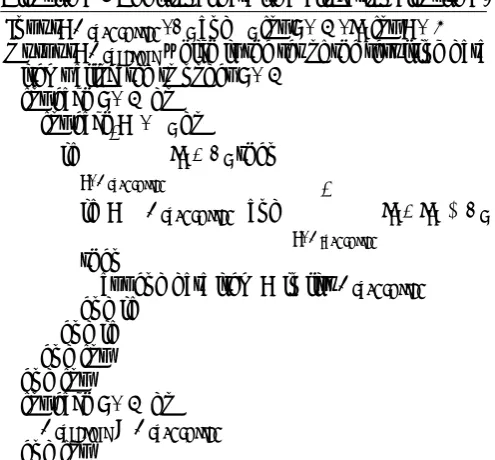
Figure 2. Data item allocation without considering node capacities.
Data itemkis allocated to nodej1kthat is the head node on listΘk(k∈M). We letGjdenote the set of data items allocated to nodejand the total size of those data items may exceed the capacity of nodej.
Here, we defineΘk[x] to represent thex-th item inΘk
and therefore the copy of each data itemk is allocated to Θk[1]. An example is shown as in Figure 2 where there are three cache nodes, denoted by 1, 2, and 3, and nine data items, denoted by 1,2, . . . ,9. In this example, G1={2,3,4,7,9},G2={1,5,6}, andG3 ={8}. Note that
some nodes may violate the node capacities, e.g., the total size of data items in G1 exceeds the capacity of
node 1.
4.2. Data itemreallocation
For node j which capacity constraint is violated, we calculate the cost difference, denoted by Dk, for the
allocations of data itemk(k∈Gj) between nodesΘk[1] andΘk[2] as follows:
Dk =ljkk
1 −lk
j2k. (10)
We order the data items inGj byDk in the descending
order and letGj_sorted denote the new set keeping the
descending order. Here, we also define Gj_sorted[x] to
represent the x-th data item in Gj_sorted. We will not
move the data items at the head of Gj_sorted at node j until the node capacity is violated but attempt to move the data items at the tail to other nodes that still have available cache spaces. The data reallocation algorithm is described in detail in Algorithm 1. Since Algorithm 1 is activated only for the nodes, denoted by the setNv, which capacity constraints are violated,
therefore we should have|Nv| |N|. The computation complexity of Algorithm1is governed by the sorting for lkj (j∈N) and the data reallocation for nodes violating capacity constraints, and therefore should be bound by O(MNlogN +M2logM) in the worst case.
4.3. Additionaldata itemallocation
Algorithm 1Data item reallocation algorithm.
Input: Gj_sortedandAjforj ∈N,Θkandskfork∈M Output: Gj_adjusted (j∈N) which is the set of data
items allocated to nodes f = 1
whilef ,0do
f = 0
foreachj∈N do
while X
k∈Gj_sorted
sk > Ajdo
klast=Gj_sorted[kGj_sortedk]
move data item klast from node j to it’s
suboptimal caching node based onΘklast[2]. delete the first itemΘklast[1] in listΘklast. end while
end for
foreachj∈N do
if X
k∈Gj_sorted
sk > Ajthen
f = 1 end if end for end while foreachj∈N do
Gj_adjusted =Gj_sorted
end for
order l
k j X
i∈N φkisk
(k∈M) in the ascending order; that is,
ηj = {k1j, k2j, . . . , k
|M|
j } such that
lk
1
j j
X
i∈N φk
1
j i skj1
≤ l
kj2 j
X
i∈N φk
2
j i skj2
≤. . .≤ l
kj|M| j
X
i∈N φk
|M|
j i skj|M|
.
We see that the data item at the head of ηj yields
the least cost for data access and therefore we attempt to allocate additionally the data items at the head to nodej if the data items are not cached. Here, we use ηj[x] to denote thex-th data item inηj. The additional
data item allocation algorithm is shown in Algorithm
2. Since the data allocation at each node is performed independently, therefore the computation complexity of Algorithm 2 is O(N MlogM). Therefore, the total computation complexity of the proposed algorithm in the worst case isO(MNlogN +M2logM+MNlogM).
5. Simulation Experiments
In this section, we describe the performance evaluation of our proposed data allocation algorithm by simulation experiments. The simulation experiment was done
Algorithm 2Additional data item allocation algorithm.
Input: Gj_adjusted,Ajandηjforj∈N,skfork∈M Output: Gj_resultwhich is the set of the resulting data
items allocated to nodesj ∈N foreachj∈N do
foreachk∗∈ηjdo
if X
k∈Gj_adjusted
sk < Ajthen
if k∗
<Gj_adjusted and
X
k∈Gi_adjusted
sk+sk∗ ≤Aj
then
append data itemk∗in listGj_adjusted end if
end if end for end for
foreachj∈N do
Gj_result=Gj_adjusted
end for
under the environment as shown in Table 2. We
compare our proposed algorithm with a cooperative least recently used (LRU) algorithm that is extended based on the well-known LRU algorithm and a random algorithm in which data items are randomly allocated to cache nodes. In the cooperative LRU algorithm, each node determines its only caching decisions independently and when a cache miss occurs the node determine whether to obtain the required data from the data center or from a neighboring node.
Table 2. Simulationenvironment
Operating system Windows 10
Programming language Python 3.2
Processor Type Intel(R) Core(TM)
i5-4570 CPU @ 3.20GHz[4]
Memory size 200MB
Percentage distribution of resources 30 percent
Figure 3. E˙ect of nodecapacity.
5.1. E˙ect of nodecapacity
Figure 3 shows the total cost for data allocation of our proposed algorithm compared with the random data allocation algorithm and the cooperative LRU algorithm when changing the capacity of node cache. We see from this figure that our proposed algorithm performs much better than random algorithm and the LRU algorithm especially when the node capacity of the nodes is small. As we mentioned in Section 1, the capacity of a cache node is generally much smaller than that of the data center and therefore it is crucial to take the cooperation of nearby nodes into consideration in caching decisions. The LRU algorithm behaves the worst since the cache hit misses occurs frequently and to cache a new data item, a old cached data item has to be removed from the cache. The random algorithm performs worse than our proposed algorithm since it determines the data allocation without considering the demands of users.
5.2. E˙ect of data demand
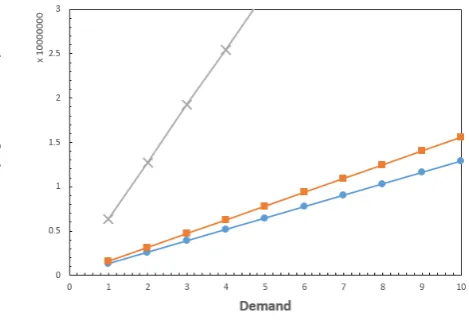
Figure4shows the simulation results when multiplying the data demand of each node from 1 to 10 times that in the results shown in Figure 3 while the node capacity is fixed to be 20, that is, one tenth of the whole data items. We see from Figure 4 that when the data demand becomes large, the performance of the LRU degrades very fast and that our proposed algorithm behaves better than others. We also see that when the data demand becomes larger the superiority of our proposed algorithm over the random algorithm is more significant.
5.3. E˙ect of networksize
Figure 5 shows the performance comparison of our proposed algorithm with the LRU and the random
Figure 4. E˙ect of data demand.
Figure 5. The changeof numberof nodesand data items.
algorithms. The capacity of each node is fixed to be 10, while the number of cache nodes was changed from 10 to 100. The number of data items was changed from 50 to 500 corresponding to the number of nodes, that is, on average two copies of each data item can be cached in the network. From Figure5, we can see that when the network size becomes larger, our algorithm performs better than other two algorithms. Not surprisingly, the cooperative LRU algorithm behaves worse than others. The computation times of our proposed algorithm was 1969 seconds when the number of cache nodes was 100 and the number of data items was 500.
6. Conclusion
allocation problem as an MIP problem and showed the problem is NP-hard. Then, we proposed a heuristic algorithm that first allocates at least one copy of each data item in the cache network and then attempts to allocates more data items until the node capacity constraints are violated. We evaluated our proposed algorithm in comparison with a previous well-known LRU algorithm and a simple random allocation algorithm and showed that our proposed algorithm performs much better than the other algorithms over a wide range of system parameters.
Recently, many researchers have been attracted by a new Internet infrastructure called the information-centric networks [1,17,20] where in edge routers are equipped with disk storages to store data frequently accessed by nearby end users. Thus we can construct a cache network using those edge routers and allocate the replicas of data using our proposed algorithm in order to minimize the data access delay. As shown in Section 4.3, the computation complexity of our proposed algorithm is limited and therefore our approach should be useful even in a large-scale network.
References
[1] Bengt Ahlgren, Christian Dannewitz, Claudio Imbrenda, Dirk Kutscher, and Borje Ohlman. A survey of information-centric networking. IEEE Communications Magazine, 50(7):26–36, 2012.
[2] Martin Arlitt, Ludmila Cherkasova, John Dilley, Rich Friedrich, and Tai Jin. Evaluating content management techniques for web proxy caches. ACM Performance Evaluation Review, 27(4):3–11, 2000.
[3] Samrat Bhattacharjee, Kenneth L. Calvert, and Ellen W. Zegura. Self-organizing wide-area network caches. In Proceedings in Conference on Computer and Communica-tions (INFOCOM’98), volume 2, pages 600–608. IEEE, 1998.
[4] Anawat Chankhunthod, Peter B. Danzig, Chunk Neer-daels, Michael F. Schwartz, and Kurt J. Worrell. A hierarchical Internet object cache. In Proceedings of USENIX Annual Technical Conference (ATEC’96), pages 3–13. ACM, 1996.
[5] Suyong Eum, Kiyohide Nakauchi, Masayuki Murata, Yozo Shoji, and Nozomu Nishinaga. Catt: potential based routing with content caching for icn. InProceedings of the second edition of the ICN workshop on Information-centric networking, pages 49–54. ACM, 2012.
[6] Li Fan, Pei Cao, Jussara Almeida, and Andrei Z. Broder. Summary cache: a scalable wide-area web cache sharing protocol. IEEE/ACM Transactions on Networking (TON), 8(3):281–293, 2000.
[7] Marshall L. Fisher. The lagrangian relaxation method for solving integer programming problems.Management Science, 50(12):1861–1871, 2004.
[8] Nikolaos Laoutaris, Sofia Syntila, and Ioannis Stavrakakis. Meta algorithms for hierarchical web
caches. InPerformance, Computing, and Communications, 2004 IEEE International Conference on, pages 445–452. IEEE, 2004.
[9] Claude Lemarechal. Lagrangian relaxation, pages 112– 156. Eds. M. Junger and D. Naddef, LNCS 2241. Springer-Verlag, Berlin Heidelberg, 2001.
[10] Wen-Zhong Li, Dao-Xu Chen, and Sang-Lu Lu. Graph-based optimal cache deployment algorithm for dis-tributed caching systems.Journal of Software (in Chinese), 21(7):1524–1535, 2010.
[11] Waixi Liu, ShunZheng Xu, Jun Cai, and Ying Gao. Scheme for cooperative caching in icn.Journal of Software (in Chinese), 24(8), 2013.
[12] Jiangang Ma, Le Sun, Hua Wang, Yanchun Zhang, and Uwe Aickelin. Supervised anomaly detection in uncertain pseudoperiodic data streams. ACM Transactions on Internet Technology (TOIT), 16(1):4, 2016. [13] Zhongxing Ming, Mingwei Xu, and Dan Wang. Age-based cooperative caching in information-centric net-working. In2014 23rd International Conference on Com-puter Communication and Networks (ICCCN), pages 1–8. IEEE, 2014.
[14] Lakshmish Ramaswamy and Ling Liu. A new document placement scheme for cooperative caching on the internet. In Proceedings in International Conference on Distributed Computing Systems (ICDCS2002), pages 95– 103. IEEE, 2002.
[15] Pablo Rodriguez, Christian Spanner, and Ernst W Biersack. Analysis of web caching architectures: hierarchical and distributed caching. Networking, IEEE/ACM Transactions on, 9(4):404–418, 2001.
[16] Renu Tewari, Michael Dahlin, Harrick M Vin, and Jonathan S Kay. Design considerations for distributed caching on the internet. In Distributed Computing Systems, 1999. Proceedings. 19th IEEE International Conference on, pages 273–284. IEEE, 1999.
[17] Gareth Tyson, Nishanth Sastry, Ivica Rimac, Ruben Cuevas, and Andreas Mauthe. A survey of mobility in information-centric networks: challenges and research directions. In Proceedings of the 1st ACM workshop on Emerging Name-Oriented Mobile Networking Design-Architecture, Algorithms, and Applications, pages 1–6. ACM, 2012.
[18] Vinod Valloppillil and Keith W. Ross. Cache array routing protocol, v1, 1998. IETF, Internet-Draft, Available at https://tools.ietf.org/html/draft-vinod-carp-v1-03.
[19] Duane Wessels and K. Claffy. Internet cache protocol (ICP), v2, 1997. IETF, RFC2186, Available at https://tools.ietf.org/html/rfc2186.