Kojic Acid Esters: Comparative Review on its Methods of Synthesis
Nurazwa Ishak
1, Ahmad Firdaus B. Lajis
1,2, Rosfarizan Mohamad
1,2, Arbakariya B. Ariff
1,2, Murni Halim
1,2and
Helmi Wasoh
1,2*
1Department of Bioprocess Technology, Faculty of Biotechnology and Biomolecular Sciences, Universiti Putra Malaysia, 43400 UPM SERDANG, Selangor, Malaysia.
2Bioprocessing and Biomanufacturing Research Centre, Faculty of Biotechnology and Biomolecular Sciences, Universiti Putra Malaysia, 43400 UPM SERDANG, Selangor, Malaysia.
*Corresponding author: Dr. Helmi Wasoh,
Department of Bioprocess Technology, Faculty of Biotechnology and Biomolecular Sciences, Universiti Putra Malaysia, 43400 UPM SERDANG, Selangor, Malaysia.
Tel: 03-8947 1947 Email: [email protected]
INTRODUCTION
5-hydroxy-2-hydroxymethyl-4-pyrone is commercially known as kojic acid (KA), an organic acid best produced from several carbon sources in an aerobic fermentation by many species of
Aspergillus, Penicillium and Acetobacter [1, 2]. The importance of KA is recently focused on its role as skin depigmenting agent in cosmetic formulation. KA is water soluble and has low stability towards light exposure. KA has also been criticised for weak depigmenting effect and unstable for long storage. The hydrophilic property of KA has restricted its application in cosmetic, oily food and pharmaceutical products [3, 4]. In order to improve the chemical and biological activities of KA, its derivatives with new and improved chemical properties and biological activities needs to be developed. Various KA derivatives such as KA esters have been synthesized at industrial scale. The chemical and biological activities of KA could be improved by the development of new kojic acid derivatives.
KA does not exert any antifungal activity but KA derivatives (azidokojate) exert strong antifungal activity when compared to other newly prepared compounds [5]. KA peptide and KA-halogen derivatives inhibited growth of various bacteria and fungus species such as Pythium graminicola,
Fusarium oxysporum, Rhizoctonia solani species, Bacillus subtilis, Psedomonas aeruginosa, and Candida albicans [6-8].
The radioprotection of KA-manganese and zinc complexes against chronic dose of γ-irradiation in mice has been reported
by Emami et al. [9], suggesting that these derivatives may be used as radioprotecting agents. KA-manganese derivative also showed neuroprotective activity against neurological disorders [10]. Pyronyl-acrylic acid esters which share structural features of kojic acid and hydroxylated cinnamic acid and their abilities to inhibit tyrosinase and melanin production have been evaluated [11]. Kojic acid derivatives possessing diethylene glycol moieties were found to inhibit melanin production by 20%, which was higher than that obtained bykojic acid (15.8%). KA esters as prospective anti-oxidants were also reported where the capability of KA-3,4-methylenedioxy cinnamic acid ester to inhibit lipid peroxidation in HaCaT keratinocytes is about 47% higher than tertbutylhydroperoxide, which was used as a positive control [12]. KA esters also have radical scavenging activity that prevents wrinkles and the aging process [13].
Kojic Acid Ester
Kojic acid esters, one type of kojic acid derivatives, are high molecular weight esters derived from kojic acid and long chain fatty acids. The fatty acid reacts at the C-5 and C-7 of hydroxyl
HISTORY
Received: 27th November 2016
Received in revised form: 2nd December 2016
Accepted: 15th of December 2016
ABSTRACT
In this paper, the syntheses of kojic acid esters via chemical and enzymatic methods are reviewed. The advantages and disadvantages of chemical process in term of process, safety and efficiency are discussed. In enzymatic process, the significant process parameters related to the synthesis of kojic acid esters such as the lipases, solvent, temperature and water content are highlighted. Possible enzymatic synthesis using solvent and solvent-free system taking into consideration of the difference in these systems involving cost, lipase reusability and efficiency is comparatively reviewed. The possible approach for large scale production using various enzyme reactor designs is also discussed and re-evaluated.
KEYWORDS
kojic acid derivatives organic synthesis solvent-free system biological reactors lipases
JOURNAL OF BIOCHEMISTRY, MICROBIOLOGY
AND BIOTECHNOLOGY
group of kojic acid. Although kojic acid itself has high ability of inhibiting the activity of tyrosine, the ability is further increased by converting kojic acid into its ester with an aliphatic carboxylic acid. Kojic acid ester are stable to wide pH range from 4-9, heat and light, resulting in excellent storability since it is not easily oxidized which results in changes in colour [14]. Kojic acid ester oil solubility is also increased and the ester can be easily absorbed into the skin when it is incorporated in a cream [15].
Vanishing cream containing one percent by weight of kojic acid diesters compound shows no or less color change in storage at 45°C for 4 weeks compared to a vanishing cream containing one percent by weight of kojic acid shows color change to deep yellowish brown and a vanishing cream containing one percent by weight of monoester show colour change to light yellow brown in storage at 45°C for 4 weeks. Kojic acid palmitate, which is also known as kojyl palmitate, is a kojic acid monoester compound with molecular formula of C22H3605, molecular weight of 380.5 and optimum wavelength value at 285 nm [16].
Chemical process: Chemical Synthesis in organic solvent
At present, many esters are industrially manufactured by chemical methods since it is more economical [17]. However, chemical method involves high temperature and high pressure, it limits the esterification of unstable compound. Furthermore, the regio-specific acylation of polyols requires the protection and deprotection steps [18]. These steps cause a rise in manufacturing costs. There are other problems when the products are used in food processing and cosmetics industry. One of them is that the reagents which can be used in the process are restricted. This method has disadvantages of low reaction rates and the yields of unwanted side products which increase cost of product purification. Currently, the production of biodiesel is based on the use of base catalyst such as sodium and potassium methoxides where the overall process suffers several serious limitations that translate into high production cost due to the formation of soap as by product. The use of acid catalyst such as super phosphoric acid (SPA) has been proposed to overcome some problems faced by the base catalyst method with improvement in yield by about 5% [19]. However, the reaction time is about 4000 times slower than the base catalyst method and occurred under high reflux temperature (120°C).
At industrial scale, sugar fatty ester is produced by transesterification of methyl esters of the corresponding fatty acid in the presence of a basic or metallic catalyst at temperature of above 100°C and a reduced pressure. For example, sucrose ester is synthesised at temperature ranging from 170°C to 185°C and reduced pressure ranging from 133 to 400 Pa, using lithium oleate as catalyst, which gave a relatively low yield (38%) [20]. This chemical process, which involved high energy and cost, also produces a lot of contaminants at different degrees of esterification. Thus, multisptep separation is requires for the purification of product.
A new kojic acid derivative, kojic acid cinnamate, has been synthesised by esterification, where kojyl chloride is reacted with a potassium salt of 3,4-(methylenedioxy)cinnamic acid in dimethylformamide (DMF) solvent at high temperatures (110°C to 120°C) with yield up to 67% [21]. However, this low volatility DMF solvent is toxic and not permitted for use in food industry in most developed countries such as Germany and USA [22]. It is also important to note that nearly all chemical methods use for the synthesis of KA derivatives involve the use
of DMF, dimethylsulfoxide (DMSO) and pyridine as solvent [23].
Kobayashi et al. [24] focused on ten amino acid derivatives of kojic acid to improve the tyrosinase inhibitory activity of kojic acid with N-kojic-L-phenylalanyl kojiate was the strongest inhibitor. The synthesis was performed by using DSC (N, N’-disuccinimidyl carbonate) and DMAP (4-dimethylaminopyridine) in which OH group at position 7 of kojic acid was joined with amino end of an amino acid to form a urethene type bond. In their present study, they attempt to produce a new compound with much stronger inhibitory potency against tyrosinase.
Enzymatic process: Enzymatic Synthesis in organic solvent
Preparation of kojic acid esters through enzymatic synthesis can be considered as natural in which it appears more appealing to the customers. Enzymatic synthesis offers low-energy as reaction often proceeding at temperature of 40°C to 60°C and environmentally benign alternative to chemical synthesis [16, 25]. Enzymatic route offer a high degree of specificity where the product is typically a monoester, although traces of diester may occur. A relatively simple product mixture simplifies further downstream purification as compared to chemical synthesis [26].
Much work has been done on the synthesis of kojic acid ester by varying materials such as substrate, fatty acid, immobilized lipases and reaction conditions. Among these, esterification is the main reactions route catalyzed by lipase to produce kojic acid ester. Liu and Shaw [27] studied the esterification of KA and several acyl donors to produce KA monolaurate and KA monooleate. Among nine lipases tested, lipase of Pseudomonas cepacia and Penicillium camembertii
showed the best catalytic efficiency and specificity towards synthesis of KA monolaurate and KA monooleate in acetonitrile at 50°C.
Kobayashi et al. [24] have proposed the esterification of KA and lauric acid in semi-continuous system where the unreacted substrates were reused after the product recovery. The reaction was carried out in acetonitrile and catalyzed by C. antartica lipase. Chen et al. [28] have succeeded in optimizing the production of KA monolaurate using 5-level-5-factor central composite rotatable design (CCRD). The esterification using lipase of P. cepacia as biocatalyst in acetonitrile gave conversion of KA to KA ester of 82%. This result was achieved in optimal reaction conditions in which reaction time and temperature were set at 19h and 44°C with 38% enzyme amount, 2:1 substrate molar ratio and 10% added water content.
Later, Khamaruddin et al. [16] have proposed the esterification of KA with palm oil. Five lipases were screened and of several fatty acids existed in palm oil, lauric acid was the best substrate with P. cepacia as the biocatalyst. Optimization of enzymatic esterification using lipase of Rhizomucor miehei
for the synthesis of kojic acid monooleate through five-level-four-factor central composite rotatable design managed to improvea yield up to 37.21% [29]. Lajis et al. [30] has successfully produced KA ester of laurate, oleate and palmitate using lipase of R. miehei. Recently, esterification of kojic acid and ricinoleic acid in solvent free system by lipase of
ratio, amount of enzyme, reaction time and reaction temperature.
Lipases as Biocatalysts: a key component to enzymatic process
Lipases (triacylglycerol ester hyrolases, EC 3.1.1.3), are most widely used enzymes in biotechnology due to their versatile applications. The physiological role of lipase is the catalytic conversion of triglycerides into diglycerides and monoglycerides, fatty acids and glycerol. Interfacial activation of lipase is the unique structural characteristic of lipase which differs from classic esterases in that their natural substrates are insoluble in water and their maximum activity occurs at lipid-water interface [32]. An essential catalytic feature of lipase is the surface loop, the helical oligopeptide unit that shields the active site (triad composed of serine residue, histidine residue and aspartic or glutamic residue) [33]. This so-called lid, upon interaction with a hydrophobic interface such as lipid droplet, undergoes movement in such a way that exposes the active site providing free access for the substrate (interfacial activation) [34-36].
Since lipases are physiologically necessary for living organisms, they are ubiquitous and can be found in diverse source, such as in plants, animals and microorganisms. More abundantly, however, only microbial flora lipases comprising of bacteria, fungi and yeast are found to be industrially important since they are diversified in their enzymatic properties and substrate specificity [37]. Furthermore, lipase producing microorganisms have the shortest generation time, high yield of conversion of substrate into product, great versatility to adapt to environmental conditions and simplicity in genetic manipulation as well as in cultivation condition [38]. Table 1 shows some commercially available microbial lipases.
Table 1. Some commercially Microbial Lipases as biocatalyst for
organic synthesis.
Type Source Producing Company References Fungi C. rugosa Amano, Biocatalysts, Boehringer
Mannheim, Fluka, Genzyme, Sigma
[88,91]
C. antarctica Boehringer Mannheim, Novo
Nordiska [28]
T. lanuginosus Boehringer Mannheim, Novo
Nordiskb [31,37]
R. miehei Novo Nordiskc, Amano,
Biocatalysts
[30,92]
Bacterial Burkholderia cepacia
Amano, Fluka, Boehringer Mannheim
[39]
Ch. viscosum Asahi, Biocatalysts, Toyo Jozo, Merck
[39,73]
P. aeruginosa Unilever [6-8]
B. glumae Biocatalysts [39]
Commercial names of lipase: aNovozyme®, bLipolase®, cLipozyme®, dLipomax®, eLumafast®
Specificity and Selectivity of Lipases
The main advantage of lipase, which differentiates enzymatic reaction from chemical reaction, is lipase specificity. Lipase exhibits positional, substrate and stereo-specificity toward their substrates [39]. Regiospecificity or also known as positional specificity is the preference of one direction of chemical bond making or breaking over all other possible directions. Certain lipases are responsible from the hydrolysis of all glyceride bonds formed between fatty acids and glycerides randomly where the position of glycrides is not important. The example of this non-specific lipase include lipase derive from Candida rugosa and Candida antarctica. Meanwhile, 1,3 specific lipase have specificity towards ester bonds in position sn-1, 3 of triacylglycerol. Lipase that are 1,3-specific include those from
Thermomyces lanuginosus and Rhizomucor miehei. Fatty acid specific lipase prefers hydrolysis of those esters which are formed from long chain fatty acids with double bonds in between. Lipase from Geotrichum candidum is specific toward long chain fatty acids containing cis-9 double bond [40].
Some lipases with substrate specificity have preference for certain fatty acids or groups of fatty acid. This lipase also exhibit fatty acid chain length specificity. Lipase from
Penicillium roquefortii can hydrolyse ester of short-chain but not medium and long-chain fatty acid, whereas lipase from
Rhizomucor miehei can hydrolyze fatty acid esters as long as C22. Stereospecificity is defined as the ability of lipase to distinguish between sn-1 and sn-3 position on the triglicerides. Lipase from Pseudomonas sp. and P. aeruginosa shows preference towards sn-1 while C. antartica lipase B exhibits sn-3 preference [41].
RMIM showed better fatty acid specificity to C12:0 (short saturated fatty acid) than C18:1, 18:2, 18:3, 20:4, 20:5 and 22:6, in which, the fatty acid specificity pattern deceased with increasing number of carbon atom and double bond in the fatty acids chain [42]. Lipase of Thermomyces lanuginosus was also found to be regiospecific for the hydroxyl 6-OH, which may be due to substrate specificity of T. lanuginosus lipase to preferentially hydrolyse EPA over DHA from both 2 and sn-1,3 positions. TLL showed higher specificity on the transesterification of the lauric acid into ethyl laurate than PFL. The narrow range of pH may also affect acyl migration, as TLIM has optimum catalytic pH of 6 to 8 compared to N435 (pH 5-9) [43].
Immobilized Lipases
Both native and immobilized lipases are available commercially. Immobilization can be achieved through several ways such as binding into a carrier (adsorption), entrapment and cross-linking [44]. However, immobilization by adsorption is preferable due to an easiest, economical, and little time consuming technique. Furthermore, the weak linkages established between enzyme and support has little effect on catalytic activity. For this reason and due to simplicity of adsorption procedure, the used of adsorbed lipases is widespread for catalysis in water immiscible solvents on an industrial scale. Immobilization serves several objectives, first to improve some significant drawbacks of free enzyme such as thermal instability, susceptibility to attack by proteases, activity inhibition and high sensitivity to several denaturing agents [45]. Secondly, immobilization facilitates a decrease in enzyme consumption as the enzyme can be readily retrieved and reused for many repeated cycles of reactions [39]. Immobilization also generates continuous economic operations, automation and ease in product with greater purity [44].
Enymatic synthesis in organic solvent: Factors Affecting Catalytic Activity of Lipase
Organic Solvent
(triester) formation was suppressed and that the monoester formation was preceded by changing the solvent from hexane to tert-alcohols for the synthesis of xylitol oleic acid esters where the differences in equilibrium conversion was based on the polarity of the solvent. It is also found that the equilibrium conversions for the syntheses of lauroyl mannose [48] and vinylacetyl glucose [49] in tert-alcohols were lower than those in acetonitrile. However, the reason for the difference has not been elucidated. The role of organic solvent in biocatalysis is very much related to the solubility of the substrate [50], polarity of the organic solvent indicated by the log P value [38, 51] and the ability of the solvent to strip off the essential water surrounding the enzyme.
Biocatalyst in organic solvent offered several advantages but ones has to consider the nature of the solvent in order to fully exploit the advantages of organic solvent. In conjunction with this idea, the term Log P is used to quantify the polarity of organic solvents. Since polarity of solvents and the activity of biocatalyst parallels the ability of organic solvent to distort the essential water layer that stabilizes the biocatalyst activity is low in polar solvents having Log P<2.0, moderate in solvents having Log P between 2.0 and 4.0 and high in polar solvent having Log P>4.0. However, other factors such as solubility of the substrate and the product and the biocatalyst have to be taken into consideration [14].
Temperature
In general, chemical derived esterification reaction, the rate of reaction increased with increasing temperature because the energy from higher temperature is received to increase the frequency of the combination of substrate and catalyst. In lipase-catalyzed esterification reaction, the rate increase to a maximum point and then declined sharply when the temperature reached a particular point at which the lipase started to unfold (denatured) or the three-dimensional conformation of the lipase was altered [52]. The breaking of the hydrophobic bonds and salt bridges in the globular protein structure of the lipase molecule as the temperature increased is the possible explanation of this phenomenon [39].
Most of lipase show optimum activity at temperature ranging from 30°C-60°C and begin to unfold at above 60°C [53]. But some lipase produced by thermophilic bacteria or fungus such as thermophilic Geobacillus sp T1 and P. cepacia
are stable at temperature above 60°C [53, 54]. Furthermore, immobilized lipase such as Lipozyme from Mucor miehei can resist to higher temperature where the catalytic activity can be maintained at temperature higher than 70°C [55].
Water Content
Lipase catalyzes a reversible reaction and the direction and equilibrium of the reaction are determined by the activities of the substrates and products, temperature, and pressure [26]. Although enzyme-catalyzed reaction is usually performed in an aqueous solution, hydrolysis predominates to cause the production of desired product to fail when a lipase-catalyzed reaction is attempted in an aqueous solution [26]. Thus, reduction of water in the reaction system would be effective for improvement in the conversion through the condensation reaction. Some lipases have catalytic activity even in the presence of little or a small amount of water [14]. For this reason, lipase-catalyzed condensation in non-aqueous medium, such as organic solvents and ionic liquids, has attracted much attention in this decade [56].
Many researchers have proposed several methods for water removal such as headspace evacuation, pervaporation, use of molecular sieve, salt hydrate pairs, saturated salt solution, adsorption and sparging of dry inert gas through the reaction medium [57]. However, continuous water removal might result in enzyme inactivation when water content is too low. Therefore, controlling the correct water level in a lipase-catalysed reaction is very important [58]
Due to the feasibility of using molecular sieve, the effect of the addition of molecular sieves (5%) at time intervals on conversion of ascorbyl palmitate had been studied [59]. The percentage of conversion (92%) obtained in reaction with the addition of molecular sieves irrespective of the time of addition was significantly higher compared to the conversion (50%) in reaction without molecular sieves. Recently, an online sensor that allowed measurement of the thermodynamic water activity was developed [60]. Using this sensor coupled with a membrane capable of selectively removing water, the thermodynamic water activity of the reaction mixture can be precisely controlled.
Solvent-free system: An enzymatic approach without solvent
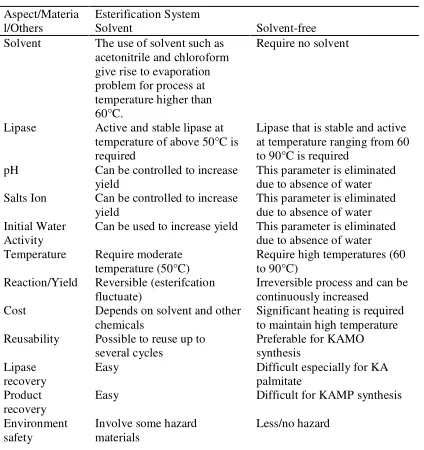
In solvent-free system, the water from the process of esterification can be removed from the system either using a vacuum pump, a large amount of n-hexane and the addition of molecular sieves [47, 61]. This results in irreversible esterification process of KA monoesters. The quantity of immobilized lipase and temperature greatly influenced the esterification process. Other parameters that may affect the performance of enzymatic reaction in solvent system such as water content, initial water activity, salts content and pH are eliminated under solvent-free system. The advantages and disadvantages of enzymatic esterification of KA esters in solvent and solvent-free system is summarized in Table 2.
Table 2. Advantages and disadvantages of the solvent and solvent free
system for the synthesis of KA esters in stirred tank reactor.
Aspect/Materia
l/Others Esterification System Solvent Solvent-free Solvent The use of solvent such as
acetonitrile and chloroform give rise to evaporation problem for process at temperature higher than 60°C.
Require no solvent
Lipase Active and stable lipase at temperature of above 50°C is required
Lipase that is stable and active at temperature ranging from 60 to 90°C is required pH Can be controlled to increase
yield This parameter is eliminated due to absence of water Salts Ion Can be controlled to increase
yield This parameter is eliminated due to absence of water Initial Water
Activity Can be used to increase yield This parameter is eliminated due to absence of water Temperature Require moderate
temperature (50°C)
Require high temperatures (60 to 90°C)
Reaction/Yield Reversible (esterifcation fluctuate)
Irreversible process and can be continuously increased Cost Depends on solvent and other
chemicals
Significant heating is required to maintain high temperature Reusability Possible to reuse up to
several cycles
Preferable for KAMO synthesis Lipase
recovery Easy Difficult especially for KA palmitate Product
recovery
Easy Difficult for KAMP synthesis
Environment
The water molecule, which is the by-product of esterification, can be removed via evaporation. There are several factors that determine the evaporation rate of water as the water can evaporate at any temperature between the melting point and boiling point. Evaporation is where water molecule change from liquid to gas water vapour. This is where under vacuum condition, water vapour can be removed out from the vessel or tank. As temperature increased, the kinetic energy of water molecule increased and allowed the formation of water vapour, which in turn, increased the rate of evaporation.
Lipase reusability
The yield of KA esters production may decrease after several cycles, which may be due to various factors such as shear effect and solvent incompatibility for lipase recovery purposes. However, in another study, it was reported that the use of DMSO for enzyme washing and cleaning purpose for immobilized lipase Candida sp. 99–125 and immobilized lipase
Licheniformis MTCC-10498 did not affect the yield of phytosterol oleic esters and methyl cinnamate synthesis, respectively [61, 62]. Moreover, lipase reusability in solvent-free system was complex due to the difficulty to separate large quantity of substrate mixed with the lipase.
Optimization of Enzymatic Synthesis Using RSM
Optimizing refers to improving the performance of a system, a process or a product in order to obtain the maximum benefit from it. The term optimization has been commonly used in analytical chemistry as a means of discovering conditions at which to apply a procedure that produces the best possible response [63]. In the last decades, the different mathematical tools, response surface methodology (RSM) and an artificial neural network (ANN) have been applied for optimization and process modelling. Both methodologies have a wide applicability in various disciplines of science. In fact, these models approximate the functional relationship between input variables and the output (response) of the process using experimental data. Afterwards, the models are used to estimate the optimal settings of input variables to maximize the response [64].
RSM has been successfully applied in studying and optimizing condition in lipase-catalyzed synthesis of various types of esters such as kojic acid ester [29, 65], sugar esters [66], ascorbyl esters [67], wax esters [68] and amino acid surfactant [69, 70]. The most frequent factors that influence the reaction process evaluated among these works are substrate ratio, amount of enzyme, reaction temperature, reaction time and added water content. Whereby, in most cases, these factors and their corresponding levels are selected based on preliminary experiments using conventional one-variable-at-a-time approach.
The central composite rotatable design (CCRD) of RSM was the most preferable designs in enzymatic reaction. The design was used by Chen et al. [26] and Ashari et al. [29] for the optimization reaction, where four or more factors were studied at five-level. Experimental data resulting from such design were then fitted into a mathematical equation, most often a second order polynomial. While researchers like Hari Krishna
et al. [38] had excluded the insignificant terms from their final equation, others like Yuan et al. [71] and Ashari et al. [29] had retained both significant and insignificant factors to minimize error. Most of the studied have reported high R2 values of more
than 0.9 for the adopted models with insignificant lack of fit characteristics.
Subsequent validations of the selected models were carried out by performing additional experiments, the actual outcome obtained were then compared with the predicted one. Such independent experiment may represent suggested optimized conditions as clarified by Chen et al. [26] whose predicted maximum substrate conversion to kojic acid monolaurate of 85.08% agreed well with the actual value of 82.07±1.14%.
Enzyme Reactor: a next step to large scale production
Enzyme reactor can be divided into two categories which is batch reactor and continuous flow reactor. Batch reactors are essentially large agitated tanks in which enzyme and substrate are placed, while the principle underlying a continuous flow reactor is continued addition of substrate and exit of product from the reactor. The aim of an enzymatic reactor is to allow enzyme and substrate to come into contact for a sufficient period of time for reaction to take place, enzyme and product may then easily be separated [14].
Stirred Tank Reactor (STR)
The main function of a properly designed reactor is to provide a controlled environment in order to achieve the optimal product formation in the particular reaction system [72]. The most important reactor for industrial application is the conventional mixing vessel which has the dual advantages of low capital cost and low operating costs. Most of the stirred-tanks are fitted with baffles which prevent a large central vortex being formed and improve mixing. A wide variety of impeller sizes and shapes is available to produce different flow pattern inside the vessel. Typically, only 70% - 80% of the volume of STR is filled with liquid. This allows adequate headspace for disengagement of droplets from the exhaust gas and to accommodate any foam which may develop [72].
Immobilized biocatalysts can be effectively employed in a batch reactor in which high concentration of biocatalysts can be used, thus allowing high volumetric productivities. Furthermore, the biocatalysts are easily separated from the other components in the reaction mixture, simplifying the downstream processing and thus minimize the production cost [73]. For example, Mat Radzi et al. [74] has successfully produced wax ester from the operation of batch-scale mode STR, using Novozyme 435.
Impellers are installed in stirred tank reactor to create mixing. Impellers are broadly classified as having axial flow or radial flow depending on the direction of liquid leaving the impeller. Typically, radial flow impellers have blades which are parallel to the vertical axis of stirrer shaft and tank. The liquid is driven radially from the impellers against the walls of the tank where it divides into two streams, one following up to the top of the tank and the other flowing down to the bottom. These streams eventually reach the central axis of the tank and are drown back to the impeller. Rushton turbine, paddle and anchor are typical examples of radial flow impellers [75,76].
strong vertical currents are required. Propeller, pitched blade and hydrofoil are examples of radial flow impellers [77].
Various esters such as wax ester, adipate ester, hexyl laurate, pentyl octanoate, and ethyl butyrate have been successfully synthesized with high yield in STR using solvent and solvent-free system [78,79]. The synthesis of several esters utilizing STR system was listed in Table 3. In a separate study, the production of wax esters synthesized in STR using RMIM, N435 and candida sp lipase in hexane was retained at a very high yield after several cycles [80-82]. On the other hand, Habulin et al [83] showed that the use of supercritical fluid in STR gave higher yield of ester compared to solvent-free system.
Table 3. Enzymatic synthesis of several esters in stirred tank reactor
Scale Mode of operation ature and
Temper-solvent Impeller
speed Product Enzyme Reusability Yield (%) Other para -meter
Ref.
75 L STR
Batch 50°C/ hexane
Palm ester
RMIM 79% even after 15
cycles 97.2%
(5h)
- [41]
BSTR 500 mL CSTR 4 L BSTR CSTR (flow rate of 5 L/min)
66.5°C/ solvent free system
500 rpm Adipate ester
N435 - BSTR (95.7) CSTR (92.7)
- [78]
150 -500 mL
Batch 50°C-100°C / super-critical fluids Reciprocal oscillation device at 60/min Oleic Acid Esters
RMIM - 80 high pressure (500 bar)
[82]
1 L Batch 50°C/ hexane
200 rpm Wax ester Immobili-zed lipase of Candida sp 99-125 Retained 46% after 7 batches 94 (24 h)
- [79]
2 L Batch 50°C/
hexane 150- 400 rpm Wax ester N435 80% yield up to 4 cycles
93 - [74]
100 mL Batch 50°C/ super-critical fluid CO2
600 rpm Sugar
ester N435 - 67 Mol-ecular sieves
[93]
Packed Bed Reactor
A packed bed reactor (also referred to as fixed bed reactor) consists of a vessel containing one or several tubes of packed catalyst particles in a fixed, non-mobile bed. Generally, the gaseous reactant stream passes through these packed tubes, react with the catalyst and the product stream leaves from the opposite side. Packed bed reactors (PBR) are an economical choice in a large-scale production. This is due the fact that they can operate nearly continuous due to the long catalyst life. The advantages of PBR are low operating cost, continuous operation and simple in the design. The disadvantages of PBR are poor temperature control, undesirable side reactions and difficulties in cleaning and catalyst replacing [84].
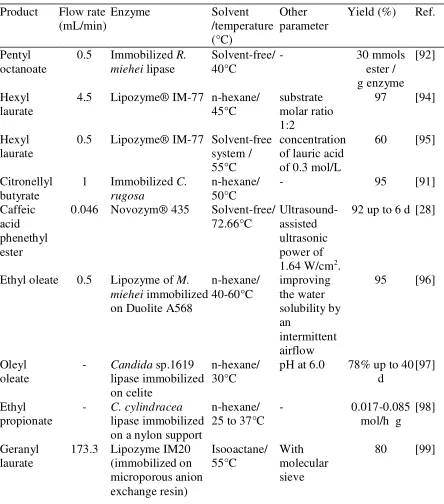
Table 4 shows several esters that been successfully synthesized in PBR. Chen et al [28] showed that high yield of caffeic acid phenethyl ester can be synthesized in a continuous PBR using immobilized Novozyme 435 (from Candida antarctica) at reaction temperature of 73°C, flow rate of 0.046 mL/min, and the lipase in the bioreactor was found to be stable for at least 6 days.
Significant yield of esterification reactions involving glycerol and unsaturated fatty acids with an immobilized Rhizomucor miehei lipase could also be achieved using PBR operated at 65°C [25,85]. In most study using PBR, the reactants appear in liquid or it can be easily liquefied.
Table 4. Enzymatic synthesis of several esters in Packed Bed Reactor.
Product Flow rate (mL/min)
Enzyme Solvent /temperature (°C)
Other parameter
Yield (%) Ref.
Pentyl octanoate
0.5 Immobilized R. miehei lipase
Solvent-free/ 40°C
- 30 mmols
ester / g enzyme
[92]
Hexyl laurate
4.5 Lipozyme® IM-77 n-hexane/ 45°C
substrate molar ratio 1:2
97 [94]
Hexyl
laurate 0.5 Lipozyme® IM-77 Solvent-free system / 55°C
concentration of lauric acid of 0.3 mol/L
60 [95]
Citronellyl butyrate
1 Immobilized C. rugosa
n-hexane/ 50°C
- 95 [91]
Caffeic acid phenethyl ester
0.046 Novozym® 435 Solvent-free/ 72.66°C
Ultrasound-assisted ultrasonic power of 1.64 W/cm2.
92 up to 6 d [28]
Ethyl oleate 0.5 Lipozyme of M. miehei immobilized on Duolite A568
n-hexane/ 40-60°C improving the water solubility by an intermittent airflow
95 [96]
Oleyl oleate -
Candida sp.1619 lipase immobilized on celite
n-hexane/
30°C pH at 6.0 78% up to 40 d [97]
Ethyl propionate
- C. cylindracea lipase immobilized on a nylon support
n-hexane/ 25 to 37°C
- 0.017-0.085 mol/h g
[98]
Geranyl
laurate 173.3 Lipozyme IM20 (immobilized on microporous anion exchange resin)
Isooactane/ 55°C With molecular
sieve
80 [99]
Fluidized Bed Reactor
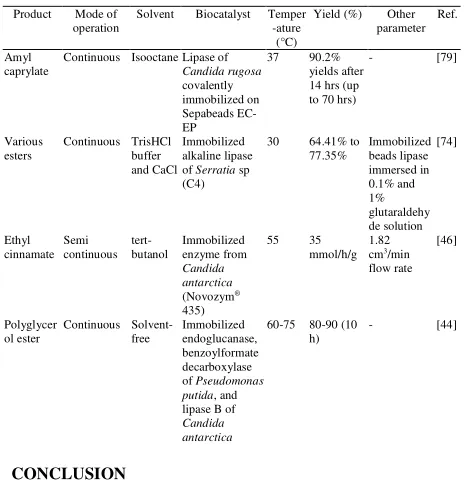
Fluidized bed reactors (FBR) are hybrid of continuous flow stirred tank and packed bed reactors where the immobilized enzyme is loosely packed into a column and the stream of substrate passes from the lower to the upper part of the column at a fixed rate which is sufficiently high to lift and mix the particles of immobilized enzyme within the column [86]. Fluidized bed reactors are used to produce gasoline and other fuels along with many other chemicals. Many industrial produce polymers are made using FBR technology. Various utilities also use FBR’s for water and waste treatment settings. Used in these applications, fluidized bed reactors not only allow for a cleaner and efficient process, it also offer several advantages such as uniform particle mixing due to fluid-like behaviour of solid material, uniform temperature gradient and ability to operate in continuous state [87].
Table 5. Enzymatic synthesis of several esters in fluidized and bubble column reactor
Product Mode of
operation Solvent Biocatalyst Temper-ature (°C)
Yield (%) Other parameter Ref.
Amyl caprylate
Continuous Isooctane Lipase of Candida rugosa covalently immobilized on Sepabeads EC-EP
37 90.2% yields after 14 hrs (up to 70 hrs)
- [79]
Various esters
Continuous TrisHCl buffer and CaCl
Immobilized alkaline lipase of Serratia sp (C4)
30 64.41% to 77.35%
Immobilized beads lipase immersed in 0.1% and 1% glutaraldehy de solution
[74]
Ethyl cinnamate
Semi continuous
tert-butanol
Immobilized enzyme from Candida antarctica (Novozym®
435)
55 35 mmol/h/g
1.82 cm3/min
flow rate [46]
Polyglycer
ol ester Continuous Solvent-free Immobilized endoglucanase, benzoylformate decarboxylase of Pseudomonas putida, and lipase B of Candida antarctica
60-75 80-90 (10
h) - [44]
CONCLUSION
The growing demand of natural consumer product has led to an increased research in Kojic acid production, modification and application. Kojic acid, which has wide application, is currently used as whitening agent in cosmetic cream [5,13]. However, the hydrophilicity of KA has restricted its application in cosmetic formulation and oily food industry. This characteristic of KA could be improved by esterification of KA to its ester. The enzymatic esterification is preferred as it offered several advantages over chemical esterification such as high substrate specificity, high reaction specificity, mild reaction conditions and reduction of waste product formation [89]. Various reaction conditions in Kojic acid ester synthesis such as substrate ratio, amount of enzyme, reaction temperature, reaction time and solvent polarity has been studied in order to gain better understanding of the process. Statistical method such as RSM has gained huge attention over conventional methods by researchers to investigate their operating conditions and interactive relationships due to its advantages of reducing number of experimental runs which is sufficient to provide statistically acceptable result [84,90]. This statistical method has also been successfully used in the optimization of various enzymatic processes.
ACKNOWLEDGEMENT
This project was financially supported by MTDC-CRDF (grant no. 6364704), UPM and MOHE
CONFLICT OF INTEREST
Authors declare that there is no conflict of interest in this article
REFERENCES
1. El-Aasar, SA. Cultural conditions studies on kojic acid production by Aspergillus paraciticus. Int J Agric Biol. 2006;8:468-473. 2. Mohamad R, Mohamed MS, Suhaili N, Salleh MM, Ariff A. Kojic
acid: Applications and development of fermentation process for production. Biotechnol Mol Biol Rev. 2010;5(2):24-37.
3. Aytemir MD, Calis U. Anticonvulsant and neurotoxicity evaluation of some novel kojic acids and allomaltol derivatives. Archiv der Pharmazie. 2010;343(3):173-181.
4. Bransova J, Brtko J, Uher M, Novotny L. Antileukemic activity of 4-pyranone derivatives. Int J Biochem Cell Biol. 1995;27: 701-706.
5. Brtko J, Rondahl L, Fickova M, Hudecova D, Eybl V, Uher M. Kojic acid and its derivatives: history and present state of art. Cent Eur J Pub Health. 2004;12:16-18.
6. Aytemir MD, Özçelik B. A study of cytotoxicity of novel chlorokojic acid derivatives with their antimicrobial and antiviral activities. European J Medicinal Chem. 2010;45(9): 4089-4095. 7. Aytemir MD, Erol DD, Hider RC, Ozalp M. Synthesis and
evaluation of antimicrobial activity of new 3-Hydroxy-6-methyl-4-oxo-4H -pyran-2-carboxamide derivatives. Turk J Chem. 2003;27:757-776.
8. Aytemir MD, Ozçelik B, Karakaya G. Evaluation of bioactivities of chlorokojic acid derivatives against dermatophytes couplet with cytotoxicity. Bioorg Med Chem Lett. 2013;23(12):3646-3649. 9. Emami S, Ghafouri E, Faramarzi MA, Samadi N, Irannejad H,
Foroumadi A. Mannich bases of 7-piperazinylquinolones and kojic acid derivatives: Synthesis, in vitro antibacterial activity and in silico study. Eur J Med Chem. 2013;68C:185-191.
10. Vajragupta O, Boonchoong P, Sumanont Y, Watanabe H, Wongkrajang Y, Kammasud N. Manganese-based complexes of radical scavengers as neuroprotective agents. Bioorg Med Chem. 2003;11(10):2329-2337.
11. Kang SS, Kim HJ, Jin C, Lee YS. Synthesis of tyrosinase inhibitory (4-oxo-4H-pyran-2-yl)acrylic acid ester derivatives. Bioorg Med Chem Lett. 2009;19:188-191.
12. Rho HS, Baek HS, You JW, Kim S, Lee JY, Kim DH, Chang IS. New 5-hydroxy-2-(hydroxymethyl)-4H-pyran-4-one derivatives has both inhibitory and antioxidant properties. Bull Korean Chem Soc. 2007;28(3):471-473.
13. Raku T, Tokiwa Y. Regioselective synthesis of kojic acid esters by Bacillus subtilis protease. Biotechnol Lett. 2003;25:969-974. 14. Lajis AF, Basri M, Mohamad R, Hamid M, Ashari SE, Ishak N,
Zoolkiflie A, Ariff A. Enzymatic synthesis of kojic acid esters and their potential industrial applications. Chem Pap. 2013;67(6):573-585.
15. Al-Edresi S, Baie S. In-vitro and in-vivo evaluation of a photo-protective kojic dipalmitate loaded into nano-creams. Asian J Pharm Sci. 2010;5(6):251-265.
16. Khamaruddin NH, Basri M, Lian GEC, Salleh AB, Raja Abdul Rahma, RAZ, Ariff A, Mohamad R, Awang R. Enzymatic Synthesis and characterization of palm-based kojic acid ester. J Oil Palm Res. 2008;20:461-469.
17. Manosroi A, Wongtrakul P, Manosroi J, Midorikawa U, Hanyu Y, Yuasa M, Sugawara F, Sakai H, Abe M. The entrapment of kojic oleate in bilayer vesicles. Int J Pharm.2005;298(1):13-25. 18. Arcos JA, Bernabe M, Otero C. Quantitative enzymatic
production of 1,6-diacyl fructofuranoses. Enzyme Microbial Technol. 1998;22:27-35.
19. Dholakiya BZ. Super phosphoric acid catalyzed biodiesel from low cost feed stock. Arch Appl Sci Res. 2012;4(1):551-561. 20. Liu X, Gong I, Xin M, Liu J. The synthesis of sucrose ester and
selection of its catalyst. J Mol Cat A: Chem. 1999147:37-40. 21. Cho JC, Rho HS, Baek HS, Ahn SM, Woo BY, Hong YD, Cheon
JW, Heo JM, Shin SS, Park YH, Suh KD. Depigmenting activity of new kojic acid derivative obtained as a side product in the synthesis of cinnamate of kojic acid. Bioorg Med Chem Lett. 2012;22:2004-2007.
22. Adamopoulos L. Understanding the Formation of Sugar Fatty Acid Esters. Master's Thesis, North Carolina State University, North Carolina, United States, 2006.
23. Zirak M, Eftekhari-sis B. Kojic acid in organic synthesis. Turk J Chem. 2015;1:1-58.
24. Kobayashi Y, Kayahara H, Tadasa K, Tanaka H. Synthesis of n-kojic-amino acid and n-n-kojic-amino acid-kojiate and their tyrosinase inhibitory activity. Bioorg Med Chem Lett. 1996;6(12):1303-1308.
26. Gumel AM, Annuar MSM, Heidelberg T, Chisti Y. Lipase mediated synthesis of sugar fatty esters. Process Biochem. 2011;46:2079-2090.
27. Liu KJ, Shaw JF. Lipase-catalyzed synthesis of kojic acid esters in organic solvents. J Am Oil Chem Soc. 1998;75:1507-1511. 28. Chen HC, Kuo CH, Twu YK, Chen JH, Chang CMJ, Liu,YC,
Shieh CJ. A continuous ultrasound-assisted packed-bed bioreactor for the lipase-catalyzed synthesis of caffeic acid phenethyl ester. J Chem Technol Biotechnol. 2011;86(10):1289-1294.
29. Ashari SE, Mohamad R, Ariff A, Basri M, Salleh AB. Optimization of enzymatic synthesis of palm-based kojic acid ester using response surface methodology. J Oleo Sci. 2009;58(10):503-510.
30. Lajis AF, Hamid M, Ariff A. Depigmenting effect of kojic acid esters in hyperpigmented B16F1 melanoma cells. J Biomed Biotechnol. 2012;Article ID 952452, 9 pages.
31. El-Boulifi N, Ashari SE, Serrano M, Aracil J, Martinez M. Solvent-free lipase-catalyzed synthesis of a novel hydroxyl-fatty acid derivatives of kojic acid. Enzyme Microbial Technol. 2014;55:128-132.
32. Schmidt RD, Veger R. Lipases: Interfacial enzymesn with attractive applications. Angew Chem Int Ed. 1998;37:608-1633. 33. Stergiou PY, Foukis A, Filippou M, Koukouritaki M, Parapouli
M, Theodorou LG, Hatziloukas E, Afendra A, Pandey A, Papamichael EM. Advances in lipase-catalyzed esterification reactions. J Biotechnol Adv. 2013;31:1846-1859.
34. Jaeger KE, Dijkstra BW, Reetz M.T. Bacterial biocatalysis: molecular biology, three-dimensional structures, and biotechnological applications of lipases. Ann Rev Microbiol. 1999;53:315-351.
35. Reetz MT. Lipases as practical biocatalysts. Curr Opin Chem Biol. 2002;6:145-150.
36. Villeneuve P, Muderhwa JM, Graile J, Hass MJ. Customizing lipases for biocatalysis: A survey of chemical physical and molecular biological approaches. J Mol Cat B: Enzym. 2000;9:113-148.
37. Ray A. Application of lipase in industry. Asian J Pharm Technol. 2012;2(2):33-37.
38. Hari Krishna S, Divakar S, Prapulla SG, Karanth NG. Enzymatic synthesis of isoamyl acetate using immobilized lipase from
Rhizomucor miehei. J Biotechnol. 2001;87:193-201.
39. Sharma S, Shamsher SK. Organic solvent tolerent lipases and applications. Sci World J Rev. Art. 2014;Article ID 625258, 15 pages.
40. Ozturk B. Immobilization of lipase from Candida rugosa on hydrophobic and hydrophilic supports. Master's Thesis, Izmir Institute of Technology, Turkey, 2001.
41. Kapoor M, Gupta MN. Lipase promiscuity and its biochemical applications. Process Biochem. 2012;47:555-569.
42. Kosugi Y, Tanaka H, Tomizuka N. Continuous hydrolysis of oil by immobilized lipase in a countercurrent reactor. Biotechnol Bioeng.1990;36(6):617-622.
43. Adlercreutz P. Immobilisation and application of lipases in organic media. Chem Society Rev. 2013;42:6406-6436.
44. Datta S, Christena LR, Rajaram YRS. Enzyme immobilization: an overview on techniques and support materials. Biotechnology. 2013;3:1-9.
45. Khan AA, Alzohairy MA. Recent advances and applications of immobilized enzyme technologies: A review. Res J Biol Sci. 2010;5(8):565-575.
46. Carrea G, Riva S. Properties and synthetic applications of enzymes in organic solvents. Angew Chem Int Ed. 2000;39:2226– 2254.
47. Castillo E, Pezzotti F, Navarro A, López-Munguía A. Lipase catalyzed synthesis of xylitol monoesters: Solvent engineering approach. J Biotechnol. 2003;102: 251–259.
48. Watanabe Y, Miyawaki Y, Adachi S, Nakanishi K, Matsuno R. Equilibrium constant for lipase-catalyzed condensation of mannose and lauric acid in water-miscible organic solvents. Enzyme Microbiol Technol.2001;29: 494–498.
49. Zhang X, Kobayashi T, Adachi S, Matsuno R. Lipase-catalyzed synthesis of 6-O-vinylacetyl glucose in acetonitrile. Biotechnol Letters. 2002; 24: 1097–1100.
50. Servat F, Montet D, Pina M, Galzy P, Arnaud A, Ledon H, Marcou L, Graillie J. Synthesis of fatty hydroxamic acid catalyzed by the lipase of Mucor miehei. J Oil Chem Soc. 1990;67(10): 646-649.
51. Tewari YB, Schantz MM, Vanderah DJ. Thermodynamics of the lipase-catalyzed esterification of 1-dodecanoic acid with menthol in organic solvents. J Chem Eng Data. 1999;44: 641–647. 52. Daniel RM, Dines M, Petach H. The denaturation and degradation
of stable enzyme at high temperature. Biochem J.1996;317:1-11. 53. Sharma R, Thakur V, Sharma M, Birkeland NK. Thermophilic
microbes in environmental and industrial biotechnology: Biotechnology of Thermophiles. Springer, London, 2013. 54. Abdul Wahab R, Basri, M, Raja Abdul Rahman R.N.Z, Salleh
AB, Abdul Rahman AB, Chaibakhsh N, Leow TC. Enzymatic production of a solvent-free menthyl butyrate via response surface methodology catalyzed by a novel thermostable lipase from
Geobacillus zalihae. Biotechnol Biotechnol Equip.
2014;28(6):1065-1072.
55. Aracil J, Garcia T, Martinez M. Enzymatic synthesis of an analogue of jojoba oil: Optimization by statistical analysis. Enzyme Microbial Technol.1993;15:607-611.
56. Sheldon R. Catalytic reactions in ionic liquids. Chem Comm. 2001;2399–2407.
57. Xu Y. Process Technology for Immobilized Lipase-Catalyzed Reaction. Phd Thesis, Technical University of Denmark, Kongens Lyngby, Denmark, 2012.
58. Turon F, Caro Y, Villeneuve P, Graille J. Effect of water content and temperature on Carica papaya lipase catalyzed esterification and transesterification reactions. John Libbey Eurotext. 2003;10:400-4004.
59. Bradoo S, Saxena RK, Gupta R. High yields of ascorbyl palmitate by thermostable lipase-mediated esterification. J Am Oil Chem. Soc. 1999;76:1291-1295.
60. Kang IJ, Pfromm PH, Rezac ME. Real time measurement and control of thermodynamic water activities for enzymatic catalysis in hexane. J Biotechnol. 2005;119(2):147-154.
61. Sharma CK, Kanwar SS. Synthesis of methyl cinnamate using immobilized lipase from B. Licheniformis MTCC-10498. Res J Recent Sci.2012;1(3): 68-71.
62. Pan X, Chen B, Wang J, Zhang X, Zhul B, Tan, T. Enzymatic synthesizing of phytosterol oleic esters. Appl Biochem Biotechnol. 2012;168(1): 68–77.
63. Bezerra MA, Santelli RE, Oliveira EP, Villar LS, Escaleira LA. Response surface methodology (RSM) as a tool for optimization in analytical chemistry. Talanta. 2008;77:965-977.
64. Marchitan N, Cojucaru C, Mereut, A, Duca G, Cretescu I, Gonta M. Modelling and optimization of tartaric acid reactive extraction from aqueous solutions: A comparison between response surface methodology and artificial neural network. Sep Purif Technol. 2010;75:273-285.
65. Chen CS, Liu KJ, Lou YH, Shieh CJ. Optimisation of kojic acid monolaurate synthesis with lipase PS from Pseudomonas cepacia.
J Sci Food Agri. 2002;82:601-605.
66. Neta NS, Peres AM, Teixeira JA, Rodrigues LR. Maximization of fructose esters synthesis by response surface methodology. New Biotechnol. 2011;28:349-355.
67. Sun WJ, Zhao HX, Cui FJ, Li YH, Yu SL, Zhou Q, Qian JY, Dong Y. D-isoascorbyl palmitate: lipase-catalyzed synthesis, structural characterization and process optimization using response surface methodology. Chem Cent J. 2013;7:114-126. 68. Keng PS, Basri M, Rahman MBA, Salleh AB, Rahman RNZA,
Ariff A. Optimization of palm-based wax ester production using statistical experimental designs. J Oleo Sci. 2005;54:519-528. 69. Bidin H, Basri, M Radzi SM, Ariff A, Rahman RNZA, Salleh AB.
Optimization of lipase-catalyzed synthesis of palm amino acid surfactant using response surface methodology (RSM). Ind Crops Prod. 2009;30:206-211.
70. Soo EL, Salleh AB, Basri M, Rahman RNZA, Kamaruddin K. Response surface methodological study on lipase-catalyzed synthesis of amino acid surfactants. Process Biochem. 2004;39:1511-1518.
72. Scragg A.H. Bioreactors in biotechnology. London: Ellis Horwood, 1991.
73. Ferreira BS, Fernandes P, Cabral JMS. Design and modelling of immobilized biocatalytic reactors. In Multiphase Bioreactor
Design, ed. J.M.S. Cabral, M. Mota, and J. Tramper, pp. 85-114.
London: Taylor & Francis, 2001.
74. Mat Radzi S, Basri M, Salleh AB, Ariff A, Mohamad R, Abdul Rahman MB, Raja Abdul Rahman RNZ. High performance enzymatic synthesis of oleyl oleate using immobilised lipase from
Candida rugosa. Electron J Biotechnol. 2005;8(3):291-298.
75. Doran MP. Bioprocess Engineering Principles. London: Academic Press, 2003.
76. Kadic A, Palmqvist B, Liden G. Effects of agitation on particle size distribution and enzymatic hydrolysis of pretreated spruce and giant reed. Biotechnol Biofuels. 2014;7:77-86.
77. McDonough RJ. Mixing for the Process Industries. New York: Van Norstrand Reinhold, 1992.
78. Chaibakhsh N, Abdul-Rahman MB, Vahabzadeh F, Abd-Aziz S, Basri M, Salleh AB. Optimization of operational conditions for adipate ester synthesis in a stirred tank reactor. Biotechnol Bioprocess Eng. 2010;15(5):846-853.
79. Chaibakhsh N, Basri M, Abdul Rahman MB, Adnani A, Salleh AB. Lipase-catalyzed synthesis of ergosterol ester. Biocat Agric Biotechnol. 2012;1:51-56.
80. Deng L, Wang XJ, Nie KL, Wang F, Liu JF, Wang P, Tan TW. Synthesis of wax esters by lipase-catalyzed esterification with immobilized lipase from Candida sp. 99-125. Chinese J Chem Eng. 2011;19(6):978-982.
81. Keng PS, Basri M, Ariff AB, Mohd Basyaruddin AR, Rahman RNZ, Salleh AB. Scale-up synthesis of lipase-catalyzed palm esters in stirred-tank reactor. Bioresour Technol. 2008;99(14):6097-6104.
82. Mat Radzi S, Basri M, Salleh AB, Mohamad R, Abdul Rahman MB, Abdul Rahman RNZ. Kinetics of enzymatic synthesis of liquid wax ester from oleic acid and oleyl alcohol. J Oleo Sci. 2010;59(3):127-34.
83. Habulin M, Krmelj V, Knez Z. Synthesis of oleic acid esters catalyzed by immobilized lipase. J Agric Food Chem. 1996;44(1):338–342
84. Bartal N, Serrati G, Szewczyk D, Waterman J. Modelling of a Catalytic Packed Bed Reactor and Gas Chromatograph Using COMSOL Multiphysics. Degree’s Project Report, Worchester Polytechnic Institute, United States, 2009.
85. Arcos JA, Garcia HS, Hill CG. Continuous enzymatic esterification of glycerol with (poly)unsaturated fatty acids in a packed bed reactor. Biotechnol Bioeng. 2000;68(5):563-570. 86. Jakovetic SM, Lukovic ND, Boskovic-Vragolovic NM,
Bezbradica DI, Picazo-Espinosa R, Knezevic-Jugovic ZD. Comparative study of batch and fluidized bed bioreactors for lipase-catalyzed ethyl cinnamate synthesis. Ind Eng Chem Research. 2013;52(47):16689-16697.
87. Sahoo S. Fluidized Bed Reactor: Design and Application for Abatement of Fluoride. Degree’s Thesis, National Institute of Technology, Roukela, India, 2012.
88. Saponjić S, Knežević-Jugović ZD, Bezbradica DI, Zuza MG,
Saied OA, Bosković-Vragolović N, Mijin DZ. Use of Candida rugosa lipase immobilized on sepabeads for the amyl caprylate synthesis: Batch and fluidized bed reactor study. Electron J Biotechnol. 2010;13(6): 1-15.
89. Li C, Sun J, Li T, Liu SQ, Huang D. Chemical and enzymatic synthesis of a library of 2-phenetyl esters and their sensory attributes. Food Chem. 2014;154:205-210.