*Corresponding author: [email protected]
2017 UTHM Publisher. All right reserved. penerbit.uthm.edu.my/ojs/index.php/jst
Effect of Additives on Polypropylene/Kaolin Composite Prepared
via In-situ Process
Dagaci Muhammad Zago
1,3, Suzi Salwah Jikan
1*, Nur Azam Badarulzaman
2, Shehu
Yahaya
1,4and Awwal Hussain Nuhu
1,51Department of Physics and Chemistry, Faculty of Applied Sciences and Technology,
Universiti Tun Hussein Onn Malaysia
2Department of Materials and Design Engineering,Faculty of Mechanical and Manufacturing
Engineering, Universiti Tun Hussein Onn Malaysia
3Department of Chemistry, Ibrahim Badamasi Babangida University, Lapai, Niger State, Nigeria 4Department of Physical Sciences Niger State Polytechnic, Zugeru, Nigeria
5Department of Chemistry Bauchi State University, Gadau, Bauchi State, Nigeria
Received 30 September 2017; accepted 30 November 2017; available online 26 December 2017
Abstract: Polypropylene/Kaolin (PP/K) composites were prepared by in-situ process with additives, in particular ungrafted maleic anhydride (MA) and dicumyl peroxide (DCP) each at varied parts per hundred resin (1 phr, 3 phr, and 5 phr). The two-roll mixer machine was used in compounding of the PP/K composite, then all the samples were moulded through the injection moulding machine. The synthesized samples were investigated with the aim to seek the one with the best property among the composites. These samples were characterized by Fourier transform infra-red (FTIR), Melt flow index (MFI), and Scanning electron microscopy (SEM). The FTIR spectrum reveals new peaks different from the PP bands signifying successful coupling and formation of the expected composite. There were variations in respect of the values of index of fluidity 2.04 to 1.72 g/10min for PP/UK and between 2.04 to 1.98 g/10 min in favour of PP/TK as observed in the MFI result. SEM which studies the morphology of the composite demonstrates indication for delamination and eventually intercalation of the composite. Accordingly, there is promising effect in preparation of composite through this process. Keywords: Additives; Kaolin; In-situ; Composites; Polypropylene
1. Introduction
In the recent times there has been focus on research towards the area of polymer in the production of composite from polymer layered silicates mutually in the academia and at industrial level owing to their compelling potentially improved properties. This is due largely by taking advantage of their alternative low cost, enormous applications at the industrial level with regard to quality reliance properties of the composites for general purposes e.g. in packing and automotive industries, domestic and commercial derive. The improved polymer properties are obtained when layered silicates are proportionately dispersed or distributed and exfoliated uniformly into polymer matrix [1]. In spite some of the polymers are also important thermoplastic in terms of volume of usage and applications e.g. polyvinyl chloride, polypropylene (PP) remains principal in the markets. As a polyolefin, PP is the most
resourceful commodity thermoplastic that possess low density, but high thermal stability and a low cost implication [2]. Furthermore, the ease of modification through various methods to suit wide variety of end-use application is one of its outstanding characteristics [3]. PP is a substantial polymer utilize extensively in several applications [4]. PP as a thermoplastic polyolefin and clay (kaolin) as filler by the reason of their utility in composite preparation contribute extensively to the rapid growth of polymer composite within the class of thermoplastics, while clay has vast acceptance due to its effective role as reinforcing agent [5]. Nevertheless there are challenges of incompatibility due to hydrophilic nature of kaolin, whereas PP
exhibit hydrophobic character. The
20 through the reaction with PP polymer melt in
the presence of organic peroxide, in this case DCP. The peroxide acts as initiator of the reaction through hemolytic scisssion. This chemical reaction creates oxygen-oxygen bonds forming a radical that withdraw hydrogen atoms from the PP [7].
Kaolin (K) which is also referred to as kaolinite possess the chemical formula as Al2[Si2O5](OH)4. It is a dioctahedral 1:1 phyllosilicate formed by an excellent structural arrangement of silicon and aluminium tetrahedral and octahedral sheets respectively. The adjoining layers are bonded by hydrogen and Van der Waal’s forces [8]. Fillers, especially nanofillers like kaolin have achieved patronage in modern science by supporting polymers to improve its mechanical properties due to superb interactions within its structure taking the advantage of large surface area of nanofillers at small quantity in the ranges of 1-3 % or 3-5 wt % [9-10].
It is therefore noteworthy to observe that the preparation of composite through the commercially modified clay introduces new properties into the composite. Subsequently, direct mixing of the modifiers was utilized in this work. Hence, maleic anhydride and dicumyl peroxide were used simultaneously as additives in the preparation of composite using in-situ process. The investigation seeks to examine the effectiveness of the additives in a successful preparation of the composite.
2. Experimental
2.1 Materials
Kaolin was supplied by Kaolin (Malaysia)
Sdn. Bhd. with chemical formula of
Al2[Si205](OH)4 and chemical composition in wt % as SiO2 57.633, Al2O3 37.766, Fe2O3 0.860, MgO 0.596, CaO 0.346, K2O 1.801, TiO2 0.605, P2O5 0.311. Polypropylene (PP) copolymer Titan pro SM-240 resin grade which is in pellet shape with density of 0.894 gcm-3 was used in this research and is supplied by Lotte Chemical Titan (M) Sdn. Bhd. MA (C4H2O3) and DCP (C18H22O2) were purchased from Quality Reagent Chemical (QReC) Asia Sdn Bhd.
2.2 Preparation of Polypropylene/Kaolin (PP/K) Composite
The kaolin used in this study was subjected to oven drying at temperature (40 ºC) for 24 hrs to reduce the moisture. Thereafter it was stored in a sealed plastic container to avoid further absorption of water molecules from the environment. The composites which comprises of PP and kaolin were prepared by melt mixing via in-situ processing of PP, K and additives; MA and DCP. With MA at (1 phr, 3 phr and 5 phr) while DCP was at (0.1 phr, 0.3 phr and 0.5 phr) each in the mixing compartment of a two roll mixer. The temperature was set at 190ºC, whereas the rotor speed was 50 rpm, while the mixing time was at 10 min interval. The composites prepared were then crushed using grinder machine, which were later moulded into dumb-bell shaped of 2 mm thickness by injection moulding machine at 190C and 20 MPa for 10 min, followed by cooling to room temperature at 5 MPa. The dumbbell samples prepared were utilized for the characterizations of the composites.
2.3 Fourier Transform Infrared
Spectroscopy (FTIR)
To observe the reactions involved during the production, the composites were analysed by using FTIR spectroscopy. The spectra were recorded using a Perkin Elmer FTIR Spectrometer UATR spectrum two at a resolution of 4 cm-1 in the range of 4000-400 cm-1.
2.4 Melt Flow Index (MFI)
Melt flow indices were measured using melt flow machine following standard method of ASTM D1238. This study was done on pure PP, the treated PP/K (PP/TK) and untreated PP/K (PP/UK) composites at the condition of 2.16 kg load at 230ºC.
2.5 Scanning Electron Microscopy
(SEM)
21 Prior to the observation, sample surfaces were
coated with a thin gold layer using Fison sputter coating system in order to circumvent electrostatic charging with acceleration voltage of 10 kV.
3. Results and Discussion
3.1 Fourier Transform Infrared
spectroscopy (FTIR)
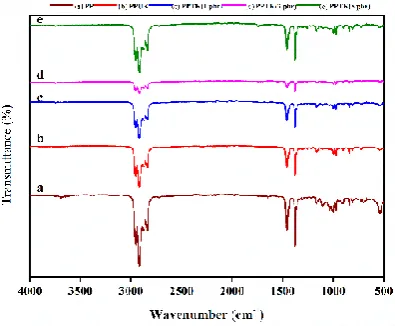
Fig. 1 displays the FTIR spectra of the pristine polypropylene (PP) and that of the PP/K samples with and without additives. The main characteristic bands for the PP are between
2946–2750 cm-1 which correlates to
asymmetric and stretching vibration of CH in the methylene groups. The other strong peaks occurred between 1500-1250 cm-1 bands and are those of deformation vibrational symmetrical and asymmetrical of the same methylene groups. Other smaller peaks amid 1160-715 cm-1 include the wagging and rocking vibrations of (CH, CH2, CH3) groups.
Fig. 1 FTIR spectra of (a) PP (b) PP/UK (c) PP/TK (1 phr) (d) PP/TK (3 phr) (e) PP/TK (5 phr)
It is observed that the peaks are of high intensity with PP100 sample. However, all the peaks at these three locations indicated in the spectra reduced in intensity with the introductions of kaolin and additives in PP matrix. This scenario suggests that weak interactions had occurred between PP and kaolin filler. The intensity of the peaks starts to decrease with the addition of kaolin and is at moderate intensity in Fig. 1(d). As the quantity of the additive increases to 5 phr in Fig. 1(e), the intensity of the peaks begins to rise again. These changes could be attributed to the formation of agglomerations by the high
load of the kaolin filler and the additives. This can be traced to the fact that quantity and size of the fillers play a vital role in the processing of polymer composites [12]. From the aforementioned observations, it can be deduced that processing of polymer composite with these formulation may require further thorough investigation. Nevertheless, there is an element of a successful polymer composite production.
3.2 Melt Flow Index (MFI)
The disparity in MFI values of PP/UK and PP/TK composites are presented in Table 1. There are minimal variations in PP/UK from 2.04 to 1.72 g/10min likewise in PP/TK from 2.04 to 1.98 g/10mim. With these values, it shows slight variation in MFI values from PP which reflect possible agglomeration that may increase the viscosity. These values, nonetheless, indicate that the presence of treated kaolin is responsible for the increase in the index of flow index fluidity.
Table 1. Melt values of PP, PP/UK and PP/K composites
Kaolin (phr) Melt Flow Indices (g/10 min)
PP/UK PP/TK
0 2.04 2.04
1 1.91 1.94
2 1.87 1.98
3 1.72 2.01
3.3 Scanning Electron Microscopy
(SEM)
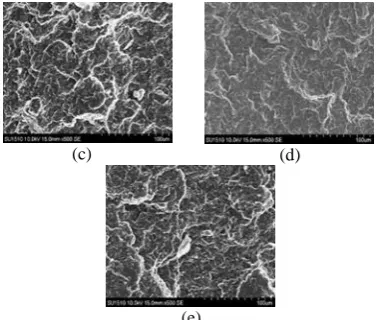
Scanning electron microscopy (SEM) was employed to probe the dispersion of kaolin platelets in PP matrix. Fig. 2 displays the SEM micrographs obtained from this research work. The micrographs indicate that there are variations in the microstructures of the samples. SEM images for PP, PP/UK and PP/TK composites are shown in Fig. 2(a)-(e).
22
(c) (d)
(e)
Fig. 2 Scanning electron microscope images of (a) PP (b) PP/UK (c) PP/TK (1 phr) (d) PP/TK (3 phr) (e) PP/TK (5 phr) at 500 magnification.
Fig. 2(a) represents the image of PP with very large irregular contour shape of PP matrix. In Fig. 2(b) which is the image of PP/UK, there is reduced size in irregularities in the microstructure that gives indication of fillers in the matrix [13]. Though, the introduction of untreated kaolin brings about a little change in shape which is in the form of uneven aggregates distributed along the matrix. These uneven aggregates could be attributed to the fact that immiscibility occur as there are no modifiers as such poor bonding interactions [14]. Fig. 2(c)-(e) correspond to morphological images of the samples treated with MA and DCP at different (phr), with Fig. 2(c), 2(d) and 2(e) each representing 1 phr, 3 phr and 5 phr respectively. Here, there is influence of compatibility between PP and kaolin fillers by the addition or introduction of additives which is evidence in the micrographs of the three corresponding images. However, the interaction is more apparent in Fig. 2(d) as the morphology exhibits significant reduction in the sphere size with the insertion of compatibilizer as indicated in their smaller and uniform structures [15]. It is therefore pertinent attributing this uniformity to the presence of MA and DCP which aids better dispersion of kaolin in PP matrix [16].
4. Conclusion
In this work, series of PP/K composites were prepared based on PP and K with MA & DCP as additives using four different proportions of the additives (0 phr, 1 phr, 3 phr and 5 phr) in a two roll mill machine at temperature of 190°C and a rotor speed of 50 rpm for 10 min.
There were variations in the FTIR and MFI results with possible interfacial interaction of fillers and PP matrix for PP/TK composites. MFI was observed as 2.04 to 1.72 g/10 min for PP/UK and between 2.04 to 1.98 g/10 min in favour of PP/TK. The SEM results suggest that PP/TK composite with 3 phr shows weak interaction between PP and K in comparison with other PP/TK as it reveal size reduction in its particles as indicated by the SEM micrograph.
References
[1] Nguyen, Q.T. and Baird, D.G. (2007). An improved technique for exfoliating and dispersing nanoclay particles into polymer matrices using supercritical carbon dioxide. Polymer (Guildf), Vol. 48. No. 23 pp. 6923–33.
[2] Meziane, O., Bensedira, A., Guessoum
M. and Haddaoui, N. (2016).
Polypropylene modified kaolinite
composites: Effect of chemical
modification on mechanical, thermal and morphological properties, Vol. 8. No. 2 pp. 494-509.
[3] Akil, H. M., Rasyid, M. F. A. and
Sharif, J. (2012). Effect of
compatibilizer on properties of
polypropylene layered silicate
nanocomposite. Procedia Chem, Vol. 4. pp. 65–72.
[4] Awang, M., Ismail, H. and Hazizan, M. A. (2008). Processing and properties of polypropylene-latex modified waste tyre dust blends (PP/WTDML). Polym Test, Vol. 27. No. 1 pp. 93–99.
[5] Lei, S. G., Hoa, S. V. and Ton-That M.T. (2006). Effect of clay types on the
processing and properties of
polypropylene nanocomposites. Compos Sci Technol, Vol. 66. No. 10 pp. 1274– 1279.
[6] Kakroodi, A. R. and Rodrigue, D.
(2014). Impact modification of
polypropylene-based composites using surface-coated waste rubber crumbs. Polym Compos., pp.2280-2289.
23 Frost, R. L. (2012). The thermal
behavior of kaolinite intercalation complexes-A review. Thermochim Acta, Vol. 545. pp. 1–13.
[9] Bhattacharya, M. (2016). Polymer
nanocomposites - A comparison
between carbon nanotubes, graphene, and clay as nanofillers. Materials (Basel), Vol. 9. No. 4 pp. 1–35.
[10] Venegas, C. (2010). Polypropylene / clay nanocomposites. Synthesis and characterization, J. Chil. Chem. Soc., Vol. 55. No. 4 pp. 2–6.
[11] Shah, K. J., Shukla, A. D., Shah, D. O and Imae, T. (2016). Effect of organic modifiers on dispersion of organoclay in polymer nanocomposites to improve mechanical properties. Polym (United Kingdom), Vol. 97. pp. 525–532. [12] Kumar, V. and Singh, A. (2013).
Polypropylene clay nanocomposites. Rev. Chem. Eng., Vol. 29. No. 6 pp. 439-448.
[13] Yang, N., Zhang, Z. C., Ma, N., Liu, H. L., Zhan, X. Q., Li, B., Gao, W., Tsai, F. C., Jiang, T., Chang, C. J., Chiang, T. C. and Shi, D. (2017). Effect of surface modified kaolin on properties of polypropylene grafted maleic anhydride. Results in Physics, Vol. 7. pp. 969-974. [14] Yang, C., Junfang, G., Hui H., Huimin
G. and Lingyan, Z. (2016). Structural change and interfacial interaction in blended rubber composites filled with silica–kaolin hybrid fillers: A Fourier transform infrared spectroscopic study. Spectroscopy Letters, Vol. 49. No. 2, 118-127.
[15] Hajar, R. N., Majid, A., Saeed, K. N., Rahim, M. G. and Majid, M. (2015). Effects of nano-clay particles and oxidized polypropylene polymers on improvement of the practical roperties of wood - polypropylene
composite
. Advanced Composite Materials, Vol. 24. No. 3 pp 239-248.[16] Pang, A.L. and Ismail, H. (2014).
Studies on the Properties of
polypropylene / (waste tire ust) / kenaf
(PP/WTD/KNF) composites with