A Study on Human Fall Detection Systems: Daily Activity
Classification and Sensing Techniques
Yoosuf Nizam
1,*, Mohd Norzali Haji Mohd
1,2, M. Mahadi Abdul Jamil
1Yoosuf Nizam
1,*, Mohd Norzali Haji Mohd
2, M. Mahadi Abdul Jam
1Biomedical Engineering Modeling and Simulation (BIOMEMS) Research Group, 2Embedded Computing Systems (EmbCos),
Faculty of Electrical and Electronic Engineering,
Universiti Tun Hussein Onn Malaysia, 86400 Johor, MALAYSIA.
1.
Introduction
Assistive technology or adaptive technology is an emerging topic since daily living assistance are very often needed for many people in today’s aging populations including disabled, over weight, obese and elderly people. One important aim of assistive technology is to provide better health care to those in need, especially allowing elderly people who live alone to stay independently as long as possible in their own home without changing their life style.
In order to provide better living for them, it is important to have continues human monitoring systems in their home to inform the health care representatives of any emergency attendance. Among such monitoring systems, fall detection systems are in increasing interest since statistics [1, 2] shows that falls are the main reasons of injury related death for seniors aged 79 [3, 4] or above and it is the second common cause of injury related (unintentional) death for all ages [5, 6]. Also fall is the biggest threat among all other incidents to elderly and those people in need [3, 7-16]. For elderly people, fall can have severe consequences, especially if not attended in a short period of time [17]. Accurate independent fall detection systems are very important to help the elderly people to live independently because it has proved that the medical consequences of a fall are highly dependent on the response and rescue time of the medical staff [18], which is only possible with accurate and reliable fall detection mechanism. Such detections are also vital since there may be a case where someone lose consciousness or are unable to call for help.
Therefore highly accurate fall detection can significantly improve the living of lonely elderly people
and enhance the health care services too. There have been plenty of researches conducted in this area to develop systems and algorithms for enhancing the functional ability of the elderly people patients with special needs such as disable [18]. This has led to the improvement in the technologies used to make such systems and thus make it feasible. The confidential level of the devices has also increased which encouraged people to use the product. This in turn lead to the reduction in labor cost in terms of no presence of medical staffs at all times looking after the elderly people.
The recent researches conducted on assistive health monitoring technologies for elderly people can be categorized into five classes [18-20]. These classes distinguish different detection methods used, as wearable device based, wireless based, ambiance based, vision based and floor sensor/electric field sensor based.
This paper presents a short review of the studies on fall detection systems, which could serve as a reference to the researchers in the area for further investigation. Fall types and different fall detection approaches are reviewed, along with the algorithms used to detect fall and fall detection sensors. Finally, some initial results from a depth sensor based approach with Microsoft Kinect v1 sensor is presented, which requires further improvement to develop a reliable fall detection system.
2.
Characteristics of Fall
Falls can be categorized into different types depending on the characteristics of the movements that lead to the fall. It is important to recognize these characteristics of the movement in order to understand the
Abstract: Fall detection for elderly is a major topic as far as assistive technologies are concerned. This is due to the high demand for the products and technologies related to fall detection with the ageing population around the globe. This paper gives a review of previous works on human fall detection devices and a preliminary results from a developing depth sensor based device. The three main approaches used in fall detection devices such as wearable based devices, ambient based devices and vision based devices are identified along with the sensors employed. The frameworks and algorithms applied in each of the approaches and their uniqueness is also illustrated. After studying the performance and the shortcoming of the available systems a future solution using depth sensor is also proposed with preliminary results.
existing algorithms used to detect falls and also to device new algorithms.
Falls can be divided into many types from the characteristics of movements that causes falls. Yu [20] divided the falls into four types. Fall from sleeping (bed), fall from sitting (chair), fall from walking or standing on the floor and fall from standing on support such as ladder, tools [20]. The characteristics of the four types of falls are significantly different from each other even though they do share some crucial features [18]. The last type of fall is not common amongst elderly people since they normally occur among working people. The main challenge that the researchers are facing is some of the characteristics mentioned above do exists in normal daily actions such as crouch.
3.
Classification of Fall Detection
Approaches
Human fall detection system classifies activities of daily life to identify an unintentional fall. Various sensors and techniques are been used to classify daily activities to distinguish human fall. Noury et al. reviewed the algorithms and sensors for automatic early fall detection for elderly people [21]. In 2008 Yu also gave a survey on fall detection for elderly and patients focusing on the approaches and principles of fall detection [20]. Mubashir et al. also wrote a comprehensive survey on recent fall detection techniques [18]. These are the only review papers on principles and methods used in fall detection. Therefore this paper is meant to briefly review the scopes and challenges of the fall detection principles and approaches and then propose a future solution that can be implemented to develop a new system framework that would be widely accepted by the elderly people, patients and care givers.
There are various methods that can be used to detect human fall such as using a camera to sense a fall or using various sensors to detect fall. These sensors use different approaches to identify a fall. In this respect, from the analysis of fall detection methods they can be divided into three main approaches which could be further divided into few other categories depending on the sensors and algorithms used [22]. The three basic approaches are wearable device based, camera based devices and ambience sensor based devices [18, 20, 22, 23] as shown in fig 1.
Fig. 1: Hierarchy of fall detection methods.
As illustrated in fig 1, wearable device based systems can be further divided into two different categories based on the approach used, as inactivity based (motion based) and posture based. Similarly ambient/fusion based devices either use floor sensors or electric field and posture based sensors to detect fall. Three different approaches are used in camera or vision based devices.
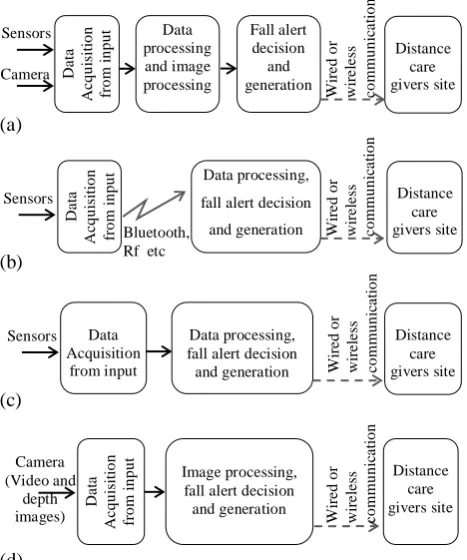
These different approaches and methods of fall detection as mentioned above do share same general framework as illustrated in fig 2a [20]. Some of the fall detection methods just use one sensor indicator with a threshold while others use complicated algorithms and image processing to detect falls. The only distinguishing factor among them is the sensors deployed, the number of sensors used and their detection algorithms. For example, data acquisition for sensing one indicator can be different from a single sensor than to multiple sensors and different cameras working together to collect data [20]. The framework followed in three main types of fall detection systems also differ in architectural design and the communication methods implemented between the inner components. Fig 2b, fig 2c and fig 2d illustrate the general framework for the three main approaches of fall detection as wearable, ambient and camera based approaches respectively. These different approaches of fall detection are briefly discussed in the next section with some review of the previous works in the following sub-sections.
(a)
(b)
(c)
(d)
Fig. 2: Framework for different approaches used in fall detection (a) General framework used in all fall detection and alerting (b) Framework for wearable based
Fall detection Camera / vision based Wearable device based Ambience / fusion based Posture based Inactivity based
Floor Sensor /
Electric field Posture
Body shape change Analysis
Inactivity detection
3D head change Analysis W ire d o r wi re le ss c om m uni ca ti on D a ta A c q u is itio n fro m i n p ut Sensors Camera Data processing and image processing Fall alert decision and generation Distance care givers site D a ta A c q u is itio n fr om i nput Sensors Data processing,
fall alert decision and generation Distance care givers site W ire d o r w ir e le ss c om m uni ca ti on Bluetooth, Rf etc
Data Acquisition
from input
approaches (c) Framework for ambient based approaches (d) Framework for Camera based approaches.
3.1 Wearable Based Technique
Most of the previous academic researches on fall detection were based on wearing devices with embedded sensors to detect posture and motion of the body. Those sensors are either placed on garments or they are in the form of wearable belts. Different types of sensors are used to make such devices and hence there are varieties of methods to detect falls, which are briefly summarized below.
3.1.1 Accelerometer Based Devices
Among the wearable devices, accelerometer is the most extensively used method to realize a fall. It uses the measure of the acceleration of the body to classify falls.
Clifford et al patented a human body fall detection system using accelerometer, a processor and a wireless transmitter [24]. The processor uses accelerometer measurements to determine if the person wearing the device is falling and also a non-movement phase followed by a fall. The generated response is then transmitted remotely to a signal receiver by the wireless transmitter [24].
Doukas et al. developed an accelerometer based wearable device to detect human falls for patients. Along with the accelerometer data, Support Vector Machine (SVM) is used to determine fall. Data is collected wirelessly from an accelerometer which is attached at the foot of the user. [25].
Noury et al developed a device that collects vertical acceleration shock from a piezo electric accelerator, the body orientation from a position tilt switch and the mechanical vibration of the body surface, which are then sent to a computer to detect human fall incident [26, 27].
Mathie et al used a waist mount accelerometer to detect falls. Fall is detected when a negative acceleration is sensed from the change in orientation from upright to a lying position of the waist mount accelerometer [28].
Nyan et al developed a garment based fall detector and daily activity monitor using 3 axis Micro Electric Mechanical System (MEMS) accelerators to collect data. A signal processor using discrete wavelet transformation (DWT), processes the collected data and identifies fall and activity. Sensor is placed in shoulder position of a jacket and all other components such as microcontroller, batteries and Bluetooth transmitter are inside the pocket. Therefore it is subject to wearing difficulties and it also not possible to wear it all the time. [29].
Narayanan et al described a distributed fall management system capable of real time fall detection in an unsupervised living context using a waist mounted tri-axial accelerometer. The wearable unit has to be attached to the waist belt every morning and place back for charging before they go to bed [30].
An elderly fall monitoring method and device that uses accelerators to obtain motion data was patented by Petelenz et al. in [31]. It uses signal feature extraction and
interpretive method for characterizing acceleration and body position. It is remote monitoring approach for detecting serious fall events in nursing home patients or in similar care facilities.
Bianchi et al used barometric pressure sensor, as a surrogate measure of altitude to help in differentiating real fall events from normal daily living activities. The waist based device measures the acceleration and air pressure data which is then analyzed offline [32].
Estudillo-Valderrama et al used a Personal Server for controlling and processing of data acquired from multiple biomedical sensors to detect human fall. They focused on PSE (Personal server) which is an electronic device that can be worn as a watch or a pendent. Future improvements include optimization of communication protocols between PSE and smart accelerometer sensors and a second validation stage of the proposed algorithms with actual elderly people [33].
Tamura et al developed a wearable airbag that incorporates in a fall detection system that uses both acceleration and angular velocity signals to trigger inflation of the airbag. Apart from the wearing difficulties and false alarm can give discomfort to the wearer as the trigger will inflate the air bag [34].
Chen et al created a wireless low power sensor network by using small, non-invasive, low power motes (sensor nodes). The sampling of acceleration is done sequentially on-board device to reduce the burden onto the network. For fall detection the angle of change is produced by the dot product of acceleration vector, from the orientation information [35].
Wang et al developed a system for fall detection that uses an accelerometer which is placed on the head. By using a reference velocity which is calculated using the backward integration of accelerations they are able to distinguish falls from normal daily activities with a predefined threshold [36].
3.1.2 Posture Sensor Based Devices
There are studies conducted on determining human fall using the posture movements. Body orientation as posture is used to detect fall using either posture sensors or multiple accelerometers [37, 39].
Kang et al developed a wrist worn fall detector using two axial accelerometers with a posture sensor. It includes a tele-reporting capability for emergency telemedicine and telecare. Fall detection was part of the device which also includes single-channel electrocardiogram (ECG), noninvasive blood pressure (NIBP), pulse oximetry (SpO2), respiration rate and body
surface temperature measuring unit. Since it is wrist worn, the device’ accuracy in fall detection is subject to the different habits of hand movement of people [37].
Kaluza et al presented a posture based fall detection algorithm using the ideology of reconstruction of an object’s posture. The posture is reconstructed in a 3D plane by locating the wireless tags which were placed on body parts (sewn on clothes) such as hips, ankles knees, wrists elbows and shoulders. Some tags are also placed at specific positions such as bed, chair, sofa, table to identify some postures such as lying on bed or sitting on chair. The fall detection algorithms use acceleration thresholds along with velocity profiles. Acceleration is derived from the movements of the tags. Acceleration and accurate velocity calculation is subject to the tag’s localization precision [39].
Kangas et al used a waist worn tri-axial accelerometer, transceiver and microcontroller to develop a new fall detector prototype based on fall associated impact and end posture [40].
3.1.3 Accelerometer and Gyroscope Based
Devices
Combination of accelerometer and gyroscope data has also proved to determine fall more accurately than any of the sensor alone. Accelerometer can provide kinetic force while gyroscope can help to estimate the current posture [41]. The combination of two sensors can also help to identify any false measurement from anyone sensor. Some studies are presented below.
Nyan et al used 3D accelerometer and 2D gyroscope worn on thigh which is based on Body Area Network (BAN) to prevent from fall related injuries such as inflatable airbag for hip protection before the impact. The system is based on the concept that thigh segments will not exceed a certain threshold angle to side and forward in normal daily activities except for fall, which was validated in an experiment with 21 young healthy volunteers performing normal daily activities and falls [41].
Li et al presented a novel fall detection system using both accelerometer and gyroscopes. By using two tri-axial accelerometer at separate body locations they are able to recognize four kinds of static postures: standing, bending, sitting and lying. Motions between these static postures are considered as dynamic transitions and if the transition before lying posture is not intentional, a fall is detected. Whether motion transitions are intentional or not is determined by the linear acceleration and angular velocity measurements [42].
Bourke et al used a bi-axial gyroscope sensor mounted on the trunk to differentiate fall from normal daily activities. Fall is determined from measurement of pitch and roll angular velocities and a threshold-based algorithm [43].
3.1.4 Discussion on Wearable Based
Approach
In all of the wearable based devices discussed above, a fall is distinguished from normal daily activities using the unique pattern of motion the fall possess. Therefore it is prone to give false alarm by triggering a fall from
motions of daily activities [20-21]. More ever it is often rejected by the elderly because of the difficulty of the wearing devices or garments. Irrespective of this, it do have the advantages of been cheap, easy to setup and operate.
3.2 Vision Based Technique
Vision or camera based devices are increasingly in use due to its multiple advantages over other sensor based devices [44-47]. Some of the reasons are that, cameras can be used to detect multiple events simultaneously and it can avoid the difficulty of wearing devices and garments for fall detection. Most importantly the recorded video from camera can be used for verification after a fall has occurred. Vision based approach do have disadvantages of not preserving the users’ privacy. Selected previous works on camera or vision based devices from different sub-categories are briefly reviewed in this section.
3.2.1 Inactivity
With this approach, a fall is detected based on the inactivity period on the floor. Camera or motion detector tracks the person to obtain motion traces and based on it a fall is determined [48].
Jansen and Deklerck used a stereo camera to acquire depth images (3D images) to identify body area and to find body orientation. The orientation change of the body is used to detect inactivity and if inactivity occurs in certain context a fall is detected [48].
3.2.2 Shape Change
The main perception with this approach is that the shape of a person will change from standing to lying if a fall occurs.
Toreyin et al presented a Hidden Markov Model (HMM) based fall detection where HMM uses video features to differentiate fall from walking. And another HMM based approach uses audio features to differentiate falling sound from talking [49].
Another HMM-based algorithm to detect fall was proposed by Anderson et al [50]. The HMM uses multiple features extracted from silhouette: height of bounding box, magnitude of motion vector, determinant of covariance matrix and ratio of width to height of bounding box of person [50].
Thome and Miguet proposed robust Hierarchical Hidden Markov Model (HHMM) based algorithm to detect fall, where HHMM is used to model the motion. Many improvements are possible including automating the rectification processes using Hough transfer for detecting sets of parallel lines and computing the orthogonal vanishing points. Optimal Placement of additional cameras for further improved recognition can be achieved by using the relationship between image angle and posture [51].
detection. Fall is determined based on the ratio of width to height of the bounding box of body in image [52, 53].
A 3D shape of body extracted from multiple cameras to detect fall was proposed by Cucchira et al. This multi-camera vision system for detecting and tracking people employs warping people’s silhouette technique to exchange visual information between overlapped cameras when camera handover occurs. The system also delivers live video streams to operators/remote users in order to verify the received alarm [54].
3.2.3 3D Head Motion Analysis
The principle used in this approach is that during a human fall, vertical motion is faster than the horizontal motion [55].
Rouger et al developed fall detector using monocular 3D head tracking. They separated fall from walking by computing the vertical and horizontal velocity of head with two threshold values. The method presented is based on Motion History Image (MHI) and changes in human shape. The detection method is based on the fact that the motion is large when a fall occurs. Therefore the system will first detect a large motion and if a motion is detected than the shape of the person in the video sequence will be analyzed. In this stage the concept used is that during a fall the human shape changes and at the end of the fall the person is usually on the floor with few second and with less body movements [55].
3.2.4 Discussion on Vision Based Approach
This is the most reliable technique for fall detection compared to the other approaches [53-55]. If individual different sub-categories are compared, inactivity detection is simple in terms of processing and hence they are less reliable. A shape detection algorithm is more reliable because body shape detection can give more accurate information about fall than head detection. And 3D body shape detection uses more cameras and requires complex computing. The recent trend in fall detection uses depth sensor for human identification and movement recognition. The three techniques discussed in vision based approach namely inactivity detection, shape change and 3D head motion analysis can be applied with a single depth sensor. The section 4 shows some preliminary result of fall detection system based on depth sensor approach.
3.3 Ambient Based Technique
This approach usually uses array of sensors to identify falls through pressure sensing, vibrational data, IR sensor and single far-field microphone [56, 58-61].
3.3.1 Pressure Sensing and Vibration
Alwan et al used array of vibration sensors on the floor and a processor to identify fall by analyzing location data. The methods used is based on the perception that a human fall will always cause a vibration pattern on the floor and implies that the vibration generated from fall is
significantly different from normal daily activities and at the same it is also different from the vibration generated by objects falling on the floor [56].
Scott patented a bed exit detection apparatus by using bladder or other fluid carrying devices in fluid communication with a pressure sensor. This particularly a patient presence detection system that enables the care giver to get alert about both the presence and absence of the patient on patient carrying surface. Especially, whether the patient is sitting upright or is leaning, falling forward or falling sideways [57].
Sixsmith et al used an array of pyroelectric IR sensors on wall for detecting fall. The infrared arrays will locate and track the thermal target in the sensor’s field of view. The array also provides size, location and velocity information. They considered the motion of target and inactivity period to identify fall. Further improvements include improving the fall detection algorithm, creating algorithm to track, locate multiple individuals [58, 59].
A wireless sensor network with array of sensors and event detection and modalities and distributed processing for smart home monitoring application was proposed by Tabar et al [60].
Zhuang et al proposed a system that detects human falls in the home environment, distinguishing them from competing noise, by using audio signal from a single far-field microphone. They model each fall or noise segment using a GMM super vector to distinguish them from background noise and classify the audio segments into falls and other types of noise using SVM built on GMM super vector kernel [61].
3.3.2 Discussion on Ambient Based Approach
This approach also has several disadvantages like wearable devices. Since it is mostly based on pressure sensor which is very prone to measure weight of all objects, thus false alarm rate is very high. Unlike wearable devices, it causes fewer disturbances to the users. Similar to wearable devices it is very cost effective and does not require high installation costs [56, 59].
4.
Results from Depth Sensor
For the experimental setup, Microsoft® Kinect v1 Sensor was used as a depth sensor to generate the necessary depth images. Different activities of daily life such as walking, running, sitting on chair, sitting on floor, lying of floor, fall from chair, fall while standing and fall while trying to sit on a chair have been tested on the experimental setup to obtain results for performance analysis of the system. Algorithms employed used, changes of subject’s height and body velocity for the classification of human fall from other activities of daily life. The results obtained and the methodologies that can be applied after studying the performance of the proposed system is further discussed in the following paragraphs.
non-invasive and are far better in human movement detection using 3D depth maps. This section will introduce some methods of measurements that can be implemented with a depth sensor to classify human fall from other activities of daily life.
One method to identify a fall would be to measure the human height continuously. Human fall can be predicted, if the height drops close to the floor plane either from a height which can be assumed as standing or sitting on a chair. On the other hand lying down on floor will also give a similar drop of human height. Therefore the velocity or acceleration of the body has to be incorporated to accurately distinguish lying down on the floor from a fall. Apart from these measurements, the position of human subject could also provide information in classifying similar activities and also identifying the posture. The pattern of human height changes for different activities is shown in Fig. 3. These heights
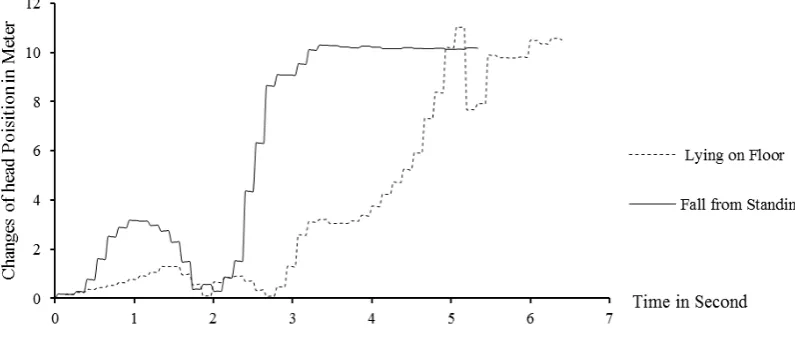
changing pattern can be used together with the velocity and position of joints to classify human fall from other activities of daily life. As seen from fig. 3, the changes of height pattern itself can distinguish some of the activities like sitting on chair and sitting of floor. For those activities where the height change patterns are similar and are difficult to distinguish, the changes of velocity has shown clear gaps as illustrated in fig. 4, which shows the changes of head position for falling and lying on floor from standing. Experimental results also showed that these two movements are most difficult to distinguish since the changes of height pattern are very similar except the time it takes. Even in this stage the system showed good performance in classifying fall from other activities except intentional lying, this is an indication that further improvements on the algorithm can increase the accuracy of the system. Thus further study can lead to development of a better fall detection system using depth sensor.
Fig 3: Result of changes in distance for the activities (a) Standing; (b) bend and stand up; (c) Walking across the sensor; (d) Walking slowly across the sensor; (e) Running; (f) Walking around the sensor; (g) sit down on floor; (h) falling from standing; (i) sit on chair; (j) fall from chair; (k) stand up.
Fig 4: Changes of velocity for a fall from standing and lying on floor from standing.
5.
Summary and Future Works
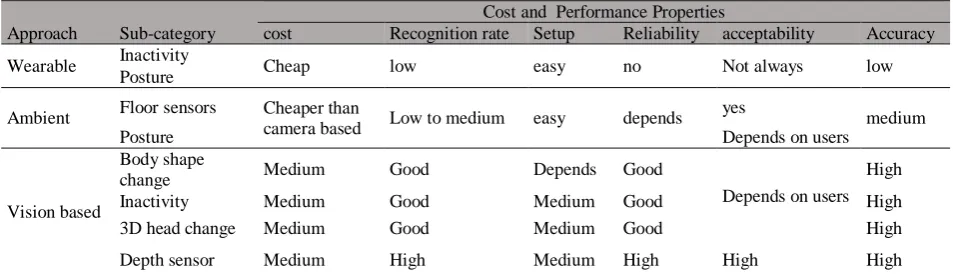
This paper has presented a review of different approaches used in human fall detection for elderly people. The underlining features and methods along with the algorithms for detecting falls are also described. The merits, reliability and pitfalls in the existing approaches are briefly highlighted. Table 1 compares the existing system approaches based on their performance, accuracy, acceptably, reliability, recognition and cost. We have also shown some results generated from preliminary testing conducted on a fall detection system based on depth sensor. The results showed that the depth sensor can classify human fall from other activities of daily life more accurately and is reliable. At the same time it can preserve the privacy of users, since color videos are not captured.
On the other hand wearable sensor based devices sometimes cannot distinguish fall from sitting especially if it is accelerometer based. Also it is very often rejected by the wearer due to the difficulty of wearing such belts or garments and discomforts associated with it. Ambient based devices are also prone to generate false alarms mainly from the pressure sensors which measure the pressure of everything. Apart from these two methods the vision based approach has high reliability and accuracy. It also avoids the disturbance to the wearer that otherwise is caused by the wearing and other mounted devices. Vision based devices can also provide verification of falls after the event has occurred. At the same time it has the disadvantage of not preserving the user’s privacy which could be solved by using depth sensors.
Irrespective of the issues mentioned in the existing methods and devices, a baseline has been established to help developing new techniques which can minimize the
problems and provide a better solution. From this point of view a better fall detection could be developed by incorporating accelerometers or gyroscope with camera based approaches to improve the detection accuracy. Since devices with only accelerometer or gyroscope have shown high false alarm rates, integrating a camera for fall verification could solve the problem to some extent, but it is again subject to privacy and confidentiality issues. Since camera will be used for verification only, the issue of privacy will be less of a concern. New techniques and algorithms can also be developed to do verification within the system rather than transmitting images to caregivers for fall confirmation. Additional works on reducing the complexity of fall detection in vision based systems from low light conditions and of course fall prevention systems can help to reduce fall occurrence. However the best solution as per the preliminary results obtained is the depth sensor based approach. It would be a better than many other approaches in terms of the parameters described in table 1, except for the cost and setup. In terms of the cost, a depth sensor based fall detection system could be similar to a normal color camera based system and it could be cheaper if the color camera based system incorporates multiple cameras. The setup difficulty would be same as a color camera based system or it can depend on how the system is developed. From the review and results obtained it can be concluded that depth sensor can be used to develop an accurate non-invasive fall detection system with least false alarm ratio. At the same time the problem of obstacles around can be minimized by using multiple sensors on different orientations.
Table 1: Comparison of different approaches used in fall detection
References
[1] Griffiths, C., C. Rooney, and A. Brock, Leading causes of death in England and Wales–how should we group causes. Health Statistics Quarterly, 2005. 28(9).
[2] Baker, S.P. and A. Harvey, Fall injuries in the elderly. Clinics in geriatric medicine, 1985. 1(3): p. 501-512.
[3] Stevens, J.A., et al., The costs of fatal and non-fatal falls among older adults. Injury prevention, 2006. 12(5): p. 290-295.
[4] Kannus, P., et al., Prevention of falls and consequent injuries in elderly people. The Lancet, 2005. 366(9500): p. 1885-1893.
Approach Sub-category
Cost and Performance Properties
cost Recognition rate Setup Reliability acceptability Accuracy
Wearable Inactivity Cheap low easy no Not always low
Posture
Ambient Floor sensors Cheaper than
camera based Low to medium easy depends
yes
medium
Posture Depends on users
Vision based
Body shape
change Medium Good Depends Good
Depends on users High
Inactivity Medium Good Medium Good High
3D head change Medium Good Medium Good High
[5] Bourke, A., J. O’brien, and G. Lyons, Evaluation of a threshold-based tri-axial accelerometer fall detection algorithm. Gait & posture, 2007. 26(2): p. 194-199. [6] Kangas, M., et al., Comparison of low-complexity
fall detection algorithms for body attached accelerometers. Gait & posture, 2008. 28(2): p. 285-291.
[7] Gostynski, M., [Prevalence, circumstances and consequences of falls in institutionalized elderly; a pilot study]. Sozial-und Praventivmedizin, 1990. 36(6): p. 341-345.
[8] Gurley, R.J., et al., Persons found in their homes helpless or dead. New England Journal of Medicine, 1996. 334(26): p. 1710-1716.
[9] Lin, L.-J., F.-T. Chiou, and H.H. Cohen, Slip and fall accident prevention: A review of research, practice, and regulations. Journal of safety research, 1996. 26(4): p. 203-212.
[10]Lord, C.J. and D.P. Colvin. Falls in the elderly: Detection and assessment. in Engineering in Medicine and Biology Society, 1991. Vol. 13: 1991., Proceedings of the Annual International Conference of the IEEE. 1991. IEEE.
[11]Lord, S.R., et al., Falls in older people: risk factors and strategies for prevention. 2007: Cambridge University Press.
[12]Sadigh, S., et al., Falls and fall-related injuries among the elderly: a survey of residential-care facilities in a Swedish municipality. Journal of community health, 2004. 29(2): p. 129-140.
[13]Salvà, A., et al., Incidence and consequences of falls among elderly people living in the community. Medicina clinica, 2004. 122(5): p. 172-176.
[14]Teasell, R., et al., The incidence and consequences of falls in stroke patients during inpatient rehabilitation: factors associated with high risk. Archives of physical medicine and rehabilitation, 2002. 83(3): p. 329-333.
[15]Tinetti, M.E. and C.S. Williams, Falls, injuries due to falls, and the risk of admission to a nursing home. New England journal of medicine, 1997. 337(18): p. 1279-1284.
[16]Almeida, O., M. Zhang, and J.-C. Liu. Dynamic fall detection and pace measurement in walking sticks. in High Confidence Medical Devices, Software, and Systems and Medical Device Plug-and-Play Interoperability, 2007. HCMDSS-MDPnP. Joint Workshop on. 2007. IEEE.
[17]Shany, T., et al., Sensors-based wearable systems for monitoring of human movement and falls. Sensors Journal, IEEE, 2012. 12(3): p. 658-670.
[18]Mubashir, M., L. Shao, and L. Seed, A survey on fall detection: Principles and approaches. Neurocomputing, 2013. 100: p. 144-152.
[19]Arshad, A., et al., A study on health monitoring system: recent advancements. IIUM Engineering Journal, 2014. 15(2).
[20]Yu, X. Approaches and principles of fall detection for elderly and patient. in e-health Networking,
Applications and Services, 2008. HealthCom 2008. 10th International Conference on. 2008. IEEE.
[21]Noury, N., et al. Fall detection-principles and methods. in Engineering in Medicine and Biology Society, 2007. EMBS 2007. 29th Annual International Conference of the IEEE. 2007. IEEE. [22]Luo, S. and Q. Hu. A dynamic motion pattern
analysis approach to fall detection. in Biomedical Circuits and Systems, 2004 IEEE International Workshop on. 2004. IEEE.
[23]Kepski, M., B. Kwolek, and I. Austvoll. Fuzzy inference-based reliable fall detection using Kinect and accelerometer. in Artificial Intelligence and Soft Computing. 2012. Springer.
[24]Clifford, M.A., R.L. Borras, and L. Gomez, System and method for human body fall detection. 2007, Google Patents.
[25]Doukas, C., et al., Patient fall detection using support vector machines, in Artificial Intelligence and Innovations 2007: from Theory to Applications. 2007, Springer. p. 147-156.
[26]Noury, N., et al. Monitoring behavior in home using a smart fall sensor and position sensors. in Microtechnologies in Medicine and Biology, 1st Annual International, Conference On. 2000. 2000. IEEE.
[27]Noury, N., et al. A smart sensor based on rules and its evaluation in daily routines. in Engineering in medicine and biology society, 2003. Proceedings of the 25th annual international conference of the IEEE. 2003. IEEE.
[28]Mathie, M.J., et al., Accelerometry: providing an integrated, practical method for long-term, ambulatory monitoring of human movement. Physiological measurement, 2004. 25(2): p. R1. [29]Nyan, M., et al. Garment-based detection of falls and
activities of daily living using 3-axis MEMS accelerometer. in Journal of Physics: Conference Series. 2006. IOP Publishing.
[30]Narayanan, M.R., et al. Falls management: detection and prevention, using a waist-mounted triaxial accelerometer. in Engineering in Medicine and Biology Society, 2007. EMBS 2007. 29th Annual International Conference of the IEEE. 2007. IEEE. [31]Petelenz, T.J., S.C. Peterson, and S.C. Jacobsen,
Elderly fall monitoring method and device. 2002, Google Patents.
[32]Bianchi, F., et al., Barometric pressure and triaxial accelerometry-based falls event detection. Neural Systems and Rehabilitation Engineering, IEEE Transactions on, 2010. 18(6): p. 619-627.
[33]Estudillo-Valderrama, M.Á., et al., Design and implementation of a distributed fall detection system—personal server. Information Technology in Biomedicine, IEEE Transactions on, 2009. 13(6): p. 874-881.
[35]Chen, J., et al. Wearable sensors for reliable fall detection. in Engineering in Medicine and Biology Society, 2005. IEEE-EMBS 2005. 27th Annual International Conference of the. 2006. IEEE.
[36]Wang, C.-C., et al. Development of a fall detecting system for the elderly residents. in Bioinformatics and Biomedical Engineering, 2008. ICBBE 2008. The 2nd International Conference on. 2008. IEEE. [37]Kang, J.M., T. Yoo, and H.C. Kim, A wrist-worn
integrated health monitoring instrument with a tele-reporting device for telemedicine and telecare. Instrumentation and Measurement, IEEE Transactions on, 2006. 55(5): p. 1655-1661.
[38]Ghasemzadeh, H., R. Jafari, and B. Prabhakaran, A body sensor network with electromyogram and inertial sensors: multimodal interpretation of muscular activities. Information Technology in Biomedicine, IEEE Transactions on, 2010. 14(2): p. 198-206.
[39]Kaluža, B. and M. Luštrek, Fall detection and activity recognition methods for the confidence project: a survey. Population, 2010. 2020(2030): p. 2040.
[40]Kangas, M., et al., Sensitivity and specificity of fall detection in people aged 40 years and over. Gait & posture, 2009. 29(4): p. 571-574.
[41]Nyan, M., F.E. Tay, and E. Murugasu, A wearable system for pre-impact fall detection. Journal of biomechanics, 2008. 41(16): p. 3475-3481.
[42]Li, Q., et al. Accurate, fast fall detection using gyroscopes and accelerometer-derived posture information. in Wearable and Implantable Body Sensor Networks, 2009. BSN 2009. Sixth International Workshop on. 2009. IEEE.
[43]Bourke, A.K. and G.M. Lyons, A threshold-based fall-detection algorithm using a bi-axial gyroscope sensor. Medical engineering & physics, 2008. 30(1): p. 84-90.
[44]Mohd, M. N. H., Kashima M., K. Sato, K.,
Watanabe, M. 2015. A Non-invasive Facial Visual-Infrared Stereo Vision Based Measurement as an Alternative for Physiological Measurement. In Lecture Notes in Computer Science (including subseries Lecture Notes in Artificial Intelligence and Lecture Notes in Bioinformatics), 9009: 684-697.
[45]Mohd, M. N. H., Kashima M., K. Sato, K.,
Watanabe, M. 2015. Internal state measurement from facial stereo thermal and visible sensors through SVM classification. ARPN Journal of Engineering and Applied Sciences, 10(18): 8363-8371.
[46]Mohd, M. N. H., KASHIMA, M., SATO, K., & WATANABE, M. Internal Emotion State (Mental Stress) Based on the Information from Thermal and Visible Sensors.
[47]Mohd, M. N., KASHIMA, M., SATO, K., &
WATANABE, M. Mental Stress Recognition based on Non-invasive and Non-contact Measurement from Stereo Thermal and Visible Sensors. International
Journal of Affective Engineering, 2015. 14(1): p. 9-17.
[48]Jansen, B. and R. Deklerck. Context aware inactivity recognition for visual fall detection. in Pervasive Health Conference and Workshops, 2006. 2006. IEEE.
[49]Töreyin, B.U., Y. Dedeoğlu, and A.E. Çetin, HMM based falling person detection using both audio and video, in Computer Vision in Human-Computer Interaction. 2005, Springer. p. 211-220.
[50]Anderson, D., et al. Recognizing falls from
silhouettes. in Engineering in Medicine and Biology Society, 2006. EMBS'06. 28th Annual International Conference of the IEEE. 2006. IEEE.
[51]Thome, N. and S. Miguet. A HHMM-based approach for robust fall detection. in Control, Automation, Robotics and Vision, 2006. ICARCV'06. 9th International Conference on. 2006. IEEE.
[52]Miaou, S.-G., F.-C. Shih, and C.-Y. Huang. A smart vision-based human fall detection system for telehealth applications. in Proc. Third ISATED Int. Conf. on Telehealth. 2007.
[53]Miaou, S.-G., P.-H. Sung, and C.-Y. Huang. A customized human fall detection system using omni-camera images and personal information. in Distributed Diagnosis and Home Healthcare, 2006. D2H2. 1st Transdisciplinary Conference on. 2006. IEEE.
[54]Cucchiara, R., A. Prati, and R. Vezzani, A multi‐ camera vision system for fall detection and alarm generation. Expert Systems, 2007. 24(5): p. 334-345. [55]Rougier, C., et al. Fall detection from human shape
and motion history using video surveillance. in Advanced Information Networking and Applications Workshops, 2007, AINAW'07. 21st International Conference on. 2007. IEEE.
[56]Alwan, M., et al. A smart and passive floor-vibration based fall detector for elderly. in Information and Communication Technologies, 2006. ICTTA'06. 2nd. 2006. IEEE.
[57]Scott, T.E., Bed exit detection apparatus. 2000, Google Patents.
[58]Sixsmith, A. and N. Johnson, A smart sensor to detect the falls of the elderly. Pervasive Computing, IEEE, 2004. 3(2): p. 42-47.
[59]Sixsmith, A., N. Johnson, and R. Whatmore.
Pyroelectric IR sensor arrays for fall detection in the older population. in Journal de Physique IV (Proceedings). 2005. EDP sciences.
[60]Tabar, A.M., A. Keshavarz, and H. Aghajan. Smart home care network using sensor fusion and distributed vision-based reasoning. in Proceedings of the 4th ACM international workshop on Video surveillance and sensor networks. 2006. ACM. [61]Zhuang, X., et al. Acoustic fall detection using