Volume-7 Issue-2
International Journal of Intellectual Advancements
and Research in Engineering Computations
An experimental study on structural behaviour of blended cement concrete
Tamil Selvan J
1Abdul Hameed A
21
P.G.Student (M.E. Structural Engineering), Nandha Engineering College (Autonomous), Erode,
Tamilnadu, India-638052.
2
Assistant Professor, Nandha Engineering College (Autonomous), Erode, Tamilnadu, India-638052.
ABSTRACT
Fly ash or coal ash has been partly used to replace cement in concrete industry for a long period because it contributes beneficial properties to concrete. It improves the workability, durability and chemical resistance of concrete. Despite these benefits, the use of fly ash is limited due to the low early strength of fly ash concrete. To eliminate this problem studies have been conducted on accelerating the pozzolanic properties of fly ash. The pozzolanic property of fly ash can be improved by various types of activations namely, thermal activation, mechanical activation and chemical activation. Thermal activation by heating and mechanical activation by grinding requires costly equipment and energy Compared to these chemical activation is cheap and easy. Many researchers have carried out studies on microstructural development of strength with chemical activation. Calcium oxide and sodium silicate are used in 1:8 ratio for activating fly ash in the project study.The m ain objective of the thesis is to study the strength behavior of beams using chemically activated fly ash at various cement replacement of 40%, 50% and 60% with water binder ratio 0.45.The results are compared with ordinary cement concrete and activated fly ash concrete.
Keywords:
Concrete, Fly Ash, Fine Aggregates, Coarse Aggregates, Activated Fly Ash.INTRODUCTION
Cement concrete is the most widely used construction material in any infrastructure development projects. The production of Portland cement, an essential constituent of concrete, release large amount of CO2 into the atmosphere.CO2 is major contributor to the green house effect and the global warming of the planet, which is a major global environmental issue currently the planet is encountering. The
ash is among the commonly used mineral admixtures as it is available in large quantities in many developing countries. The blending materials like fly ash and rice husk are already used without activation and their physical and chemical properties are studied by many authors. The performance of fly ash concrete can be improved by many means. The methods like chemical activation, mechanical and thermal activation are in practice. The objective of the present investigation is to improve the quality of fly ash by
various replacements with cement like 40%, 50%, and 60%.The results are compared with fly ash concrete and control mix. [1-5]
MATERIALS USED
Cement
A cement is a binder, a substance used for construction that sets, hardens, and adheres to other materials to bind them together. Cement is seldom used on its own, but rather to bind sand and gravel (aggregate) together. Cement mixed with fine aggregate produces mortar for masonry, or with sand and gravel, produces concrete. [6-10]
Fly ash
Fly ash or flue ash, also known as pulverised fuel ash and it is a coal combustion product that is composed of the particulates (fine particles of burned fuel) that are driven out of coal-fired boilers together with the flue gases. Fly ash produced from the burning of younger lignite or sub-bituminous coal, in addition to having pozzolanic properties, also has some self-cementing properties. In the presence of water, Class C fly ash hardens and gets stronger over time. Class C fly ash generally contains more than 20% lime (CaO). Unlike Class F, self-cementing Class C fly ash does not require an activator.
Fine aggregates
Fine aggregates generally consist of natural sand or crushed stone with most particles passing through a 3/8-inch sieve. Coarse aggregates are any particles greater than 0.19 inch, but generally range between 3/8 and 1.5 inches in diameter.
Coarse aggregates
Construction aggregate, or simply "aggregate", is a broad category of coarse to medium grained
particulate material used in construction, including sand, gravel, crushed stone, slag, recycled concrete and geosynthetic aggregates. Aggregates are the most mined materials in the world.
Silica fumes
Silica fume is a by product of producing silicon metal or ferrosilicon alloys. One of the most beneficial uses for silica fume is in concrete. Because of its chemical and physical properties, it is a very reactive pozzolan. Concrete containing silica fume can have very high strength and can be very durable.
MIX DESIGN
Based on the basic test on materials the mix proportion is arrived as per IS 10262:2009
1 : 1.25 : 2.997
with water-cement as 0.50 Mix Proportion Of Ratio
Cement = 425.77 kg/cu.m
Water = 191.6 kg/cu.m
Fine aggregate = 532.38 kg/cu.m Coarse aggregate = 1276.35 kg/cu.m
CASTING AND CURING
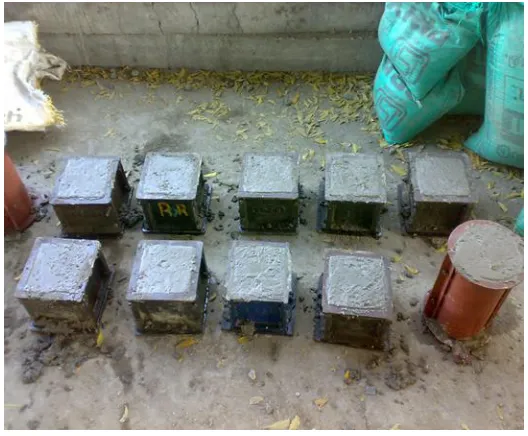
Fig I. Casting of cube specimen
Experimental Testing is comparision of comressive, split tensile strength and flexural tensile strength with conventional concrete.
TEST
RESULTS OF
CONCRETE
SPECIMEN
For conventional concrete test report on phase 1 project. Concrete mix was designed as per IS
10262-2009. M30 grade concrete having mix proportions of cement: River Sand: Coarse aggregate proposal ratio of 1:1.25:2.997 used by weight and the w/c ratio was fixed as 0.40 as per the designed curve.
Table I. Conventional Concrete Compression strength Results for M30 grade of concrete Trail. No
conventional concrete 7 Days N/mm²
28 Days N/mm²
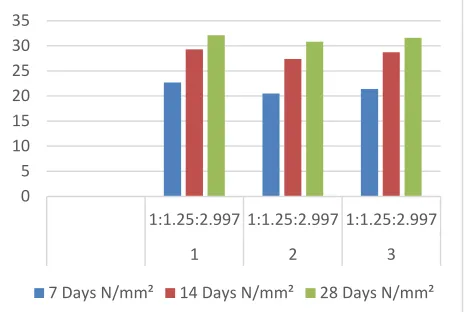
1 1:1.25:2.997 22.7 32.1
2 1:1.25:2.997 20.5 30.8
Fig II. Flow chart for conventional concrete compression strength results for M30 grade of concrete
For compressive strength of concrete by replacement of cement by FA40%+AFA4 0%, FA50%+AFA30%, FA60%+AFA20%.
Table II. Compressive strength results for M30 grade of concrete for partial replacement of cement by fly ash and activated fly ash.
Specimen Mix 7 days N/mm2 14 days N/mm2 28 days N/mm2
Trail 1 FA40% + AFA40% 18.8 25.4 33.7
FA40% + AFA40% 19.3 24.8 32.9
FA40% + AFA40% 18.9 25.2 33.3
Trail 2 FA50% + AFA30% 17.2 23.5 30.5
FA50% + AFA30% 17.3 23.6 31.3
FA50% + AFA30% 16.9 23.8 30.9
Trail 3 FA60% + AFA20% 16.2 20.6 28.9
FA60% + AFA20% 16 21.4 29.3
FA60% + AFA20% 15.9 20.9 29.5
0 5 10 15 20 25 30 35
1:1.25:2.997 1:1.25:2.997 1:1.25:2.997
1 2 3
Fig III. Flow chart for compressive strength Results for M30 grade of concrete for partial replacement of cement by fly ash and activated fly ash.
From the above result the optimum mix ratio for the concrete is FA40% +AFA40%
For split tensile strength of concrete by replacement of cement by FA40%+A FA40%, FA50%+AFA30%, FA60%+AFA20%.
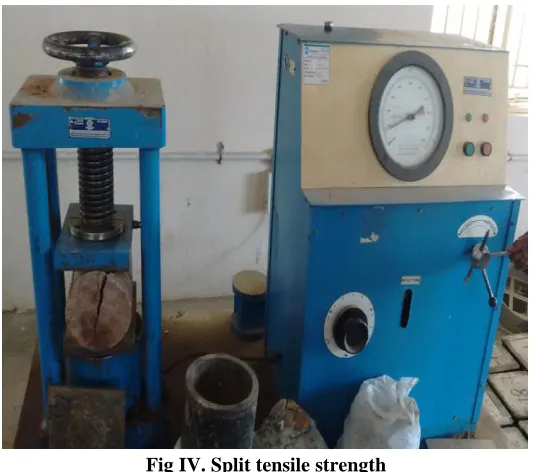
Fig IV. Split tensile strength 0
5 10 15 20 25 30 35 40
Comprssive Test Result
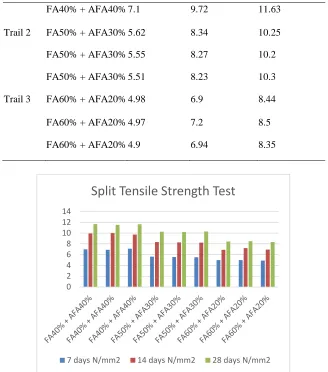
FA40% + AFA40% 7.1 9.72 11.63
Trail 2 FA50% + AFA30% 5.62 8.34 10.25
FA50% + AFA30% 5.55 8.27 10.2
FA50% + AFA30% 5.51 8.23 10.3
Trail 3 FA60% + AFA20% 4.98 6.9 8.44
FA60% + AFA20% 4.97 7.2 8.5
FA60% + AFA20% 4.9 6.94 8.35
Fig V. Flow chart for split tensile strength Results for M30 grade of concrete for partial replacement of cement by fly ash and activated fly ash.
From the above result the optimum mix ratio for the concrete is FA40% +AFA40%
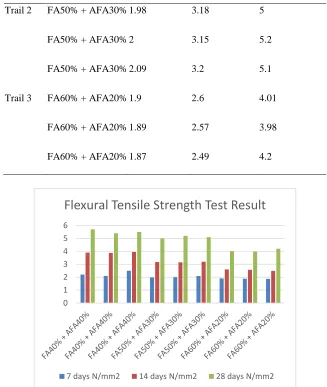
For flexural tensile strength of concrete by replacement of cement by FA40%+AFA40%, FA50%+AFA30%, FA60%+AFA20%.
Table IV. Split tensile strength results for M30 grade of concrete for partial replacement of cement by fly ash and activated fly ash.
Specimen Mix 7 days N/mm2 14 days N/mm2 28 days N/mm2
Trail 1 FA40% + AFA40% 2.2 3.9 5.7
FA40% + AFA40% 2.1 3.87 5.4
FA40% + AFA40% 2.5 3.95 5.5
0 2 4 6 8 10 12 14
Split Tensile Strength Test
Trail 2 FA50% + AFA30% 1.98 3.18 5
FA50% + AFA30% 2 3.15 5.2
FA50% + AFA30% 2.09 3.2 5.1
Trail 3 FA60% + AFA20% 1.9 2.6 4.01
FA60% + AFA20% 1.89 2.57 3.98
FA60% + AFA20% 1.87 2.49 4.2
Fig VI. Flow chart for flexural tensile strength Results for M30 grade of concrete for partial replacement of cement by fly ash and activated fly ash.
From the above result the optimum mix ratio for the concrete is FA40% +AFA40%
RESULTS AND DISCUSSIONS
The main objective of current experimental investigation is to find out the M30 grade design ratio of conventional concrete test report on phase 1 and test results of same M30 grade concrete with
1:1.25:2.997 used by weight and the w/c ratio was fixed as 0.40 as per the designed curve.
CONCLUSIONS
Concrete cubes were cast at using normal conventional mix and partial replacement of cement by fly ash and activated fly ash of our mix design. The water cement ratio for this work was
0 1 2 3 4 5 6
Flexural Tensile Strength Test Result
investigation revealed that 100% of natural sand achieving maximum strength of M30 concrete and in case of partial replacement of cement by fly ash and activated fly ash also achieved the maximum strength of M30 concrete . In that reference to the test results of conventional concrete and partial replacement of cement by fly ash and activated fly
ash both attain its desired strength according to its mix design so by reducing the amount of cement used we can reduce the co2 emission during concreting and make the surrounding eco friendly environment as well as cost efficient by using fly ash as raw material for concreting.
Table V. Comparision test results for M30 grade of concrete for conventional concrete and partial replacement of cement by fly ash and activated fly ash.
Mix Compressive Strength N/mm2
Split Tensile Strength N/mm2
Flexural Tensile Strength N/mm2
Conventional Concrete 32.1 10.2 5.5
Optimum mix ratio FA40% + AFA40%
33.7 10.67 5.7
REFERENCE
[1]. A.Guerrero, S.GonaiI ,A.Macoaa “durability of fly ash –belite Cement mortars in sulfated and chloride medium” Cement and Concrete Research 30, 2007, 1231-1238
[2]. Alhozaimy.A, Soroushian.P, Mizra.F, Effects of curing conditions and age on chloride permeability of fly ash mortar, ACI Materials Journal, 93(1), 1996, 87 –95.
[3]. P.Arjunan, M.R.Silsbee, and D.M.Roy, Chemical activation of low calcium fly ash-identification of suitable activators and their dosages, Cement and Concrete Research 30, 2001, 1231-1238.
[4]. Antiohos.A.Papageorgiou, S.Tsimas, Activation of fly ash cementitious system in the presence of quicklime. ACI Materials Journal, 92(2), 2006, 178-187.
[5]. Baton Rouge “Alkali activated class C fly ash cement” ACI Materials Journal, 1987, Vol.84 (3), pp.286-295. [6]. Bewailing, R. Michel V.M. Malhotra, Performance of high-volume fly ash concrete in large experimental
monoliths, ACI Materials Journal, 91(2), 1994, 178-187.
[7]. Blanco,M.P.Garcia,J.Ayala,G.Mayoral, The effect of mechanically and chemically activated fly ashes on mortar properties, Cement & Concrete Composites 28, 2006, 673–680.
[8]. Caijun Shi “Early Microstructure Development of Activated Lime-Fly Ash Pastes” Cement and Concrete Research, 26(9), 1996, 1351-1359.
[9]. Enchancing Our Environment (Green building Using Environment), ICJ, 45, 270-279.