e-ISSN: 2250-3021, p-ISSN: 2278-8719 Vol. 3, Issue 4 (April. 2013), ||V1 || PP 35-42
Trusted Securtiy Model In Wireless Sensor Network Using Tarf
Selvi.K ,Ms.S.Vidhushavarshini
M.E. Computer Science,. III Year (Part Time), Gnanamani College of Technology Namakkal, India. M.E., Asst. Professor / CSE Gnanamani College of Technology Namakkal, India.
Abstract: The multi-hop routing in wireless sensor networks (WSNs) offers little protection against identity deception through replaying routing information. An adversary can exploit this defect to launch various harmful or even devastating attacks against the routing protocols, including sinkhole attacks, wormhole attacks and Sybil attacks. The situation is further aggravated by mobile and harsh network conditions. Traditional cryptographic techniques or efforts at developing trust-aware routing protocols do not effectively address this severe problem. To secure the WSNs against adversaries misdirecting the multi-hop routing, that has been designed and implemented TARF, a robust trust-aware routing framework for dynamic WSNs. Without tight time synchronization or known geographic information, This project provides trustworthy, time efficient and energy-efficient route. Most importantly, TARF proves effective against those harmful attacks developed out of identity deception; the resilience of TARF is verified through extensive evaluation with both implementation and empirical experiments on large-scale WSNs under various scenarios including mobile and RF-shielding network conditions.
Keywords: Wireless Sensor Networks(WSNs), Trusted Aware Routing Framework (TARF) TinyOS.
I. INTRODUCTION
Wireless sensor networks (WSNs) are ideal candidates for applications to report detected events of interest, such as military surveillance and forest fire monitoring. A WSN comprises battery-powered senor nodes with extremely limited processing capabilities. With a narrow radio communication range, a sensor node wirelessly sends messages to a base station via a multi-hop path. However, the multi-hop routing of WSNs often becomes the target of malicious attacks. An attacker may tamper nodes physically, create traffic collision with seemingly valid transmission, drop or misdirect messages in routes, or jam the communication channel by creating radio interference. Based on identity deception,the adversary in capable of launcing harmful and hard – to-detect attacks against routing , such as selective forwarding ,wormhole attacks,sinkhole attacks and Sybil attacks
A. PROBLEM STATEMENT
As a harmful and easy-to-implement type of attack, a malicious node simply replays all the outgoing routing packets from a valid node to forge the latter node’s identity; the malicious node then uses this forged identity to participate in the network routing, thus disrupting the network traffic. Even if this malicious node cannot directly overhear the valid node’s wireless transmission, it can collude with other malicious nodes to receive those routing packets, which is known as a wormhole attack.
A node in a WSN relies solely on the packets received to know about the sender’s identity, replaying routing packets allows the malicious node to forge the identity of this valid node. After “stealing” that valid identity, this malicious node is able to misdirect the network traffic. It may drop packets received, forward packets to another node not supposed to be in the routing path, or form a transmission loop through which packets are passed among a few malicious nodes infinitely.
Sinkhole attacks can be launched after stealing a valid identity, in which a malicious node may claim itself to be a base station through replaying all the packets from a real base station. Such a fake base station could lure more than half the traffic, creating a “black hole.” This same technique can be employed to conduct another strong form of attack Sybil attack: through replaying the routing information of multiple legitimate nodes, an attacker may present multiple identities to the network. A valid node, if compromised, can also launch all these attacks.
elements lead to strong energy efficiency, self configuration and robustness requirements. In the last few years several clock synchronization protocols for WSN have been proposed based on different approaches, such as the Reference Broadcast Synchronization (RBS) proposed by Elson et al., or hierarchical approaches, or interval{based, or probabilistic approaches for energy efficiency. However, despite their diversity, these proposals share a common viewpoint: they provide an accurate time estimate by means of periodic synchronization performed by each sensor node and based on messages exchanged with its neighbor nodes. Clearly, each clock adjustment is energy consuming since it involves transmitting messages and listening, besides the computational cost.
II. DESIGN CONSIDERATIONS
Before elaborating the detailed design of TARF, it would like to clarify a few design considerations first, including certain assumptions in Section A, some Authentication requirement in Section B and the goals in Section C.
A. ASSUMPTIONS
The target is secure routing for data collection tasks, which are one of the most fundamental functions of WSNs. In a data collection task, a sensor node sends its sampled data to a remote base station with the aid of other intermediate nodes, as shown in Figure 1. An adversary may forge the identity of any legal node through replaying that node’s outgoing routing packets and spoofing the acknowledgement packets, even remotely through a wormhole.
Additionally, to merely simplify the introduction of TARF to assume no data aggregation is involved.
Nonetheless, this approach can still be applied to clusterbased WSNs with static clusters, where data are aggregated by clusters before being relayed. Cluster-based WSNs allows for the great savings of energy and bandwidth through aggregating data from children nodes and performing routing and transmission for children nodes. In a cluster-based WSN, the cluster headers themselves form a sub-network; after certain data reach a cluster header, the aggregated data will be routed to a base station only through such a sub-network consisting of the cluster headers. This framework can then be applied to this sub-network to achieve secure routing for cluster based WSNs. TARF may run on cluster headers only and the cluster headers communicate with their children nodes directly since a static cluster has known relationship between a cluster header and its children nodes, though any link-level security features may be further employed.
Finally, a data packet has at least the following fields: the sender id, the sender sequence number, the next-hop node id (the receiver in this onehop transmission), the source id (the node that initiates the data), and the source’s sequence number. It would cause too much overhead to transmit all the onehop information to the base station. Also, it assumes the routing packet is sequenced.
B. AUTHENTICATION REQUIREMENTS
authentication code provided by TinySec. It is possible that an adversary physically captures a non-base legal node and reveals its key for the symmetric authentication. With that key, the adversary can forge the identity of that non-base legal node and joins the network “legally”.
C. GOALS
TARF mainly guards a WSN against the attacks misdirecting the multi-hop routing, especially those based on identity theft through replaying the routing information. This paper does not address the denial-of-service (DoS) attacks, where an attacker intends to damage the network by exhausting its resource. For instance, it does not address the DoS attack of congesting the network by replaying numerous packets or physically jamming the network. TARF aims to achieve the following desirable properties:
HIGH THROUGHPUT: Throughput is defined as the ratio of the number of all data packets delivered to the base station to the number of all sampled data packets. In our evaluation, throughput at a moment is computed over the period from the beginning time (0) until that particular moment. Note that single-hop re-transmission may happen, and that duplicate packets are considered as one packet as far as throughput is concerned. Through put reflects how efficiently the network is collecting and delivering data. Here the high throughput as one of our most important goals.
ENERGY EFFICIENCY: Data transmission accounts for a major portion of the energy consumption. It evaluates energy efficiency by the average energy cost to successfully deliver a unit-sized data packet from a source node to the base station. For eg.If every node in a WSN consumes approximately the same energy to transmit a unit-sized data packet can use another metric hop-per-delivery to evaluate energy efficiency. Under that assumption, the energy consumption depends on the number of hops, i.e. the number of one-hop transmissions occurring. To evaluate how efficiently energy is used can measure the average hops that each delivery of a data packet takes, abbreviated as hop-per-delivery.
SCALABILITY & ADAPTABILITY: TARF should work well with WSNs of large magnitude under highly dynamic contexts. It will evaluate the scalability and adaptability of TARF through experiments with large-scale WSNs and under mobile and hash network conditions. Here it does not include other aspects such as latency, load balance, or fairness. Low latency, balanced network load, and good fairness requirements can be enforced in specific routing protocols incorporating TARF.
III. MODULES DESCRIPTION A. ROUTING THE NETWORK
In this module, the networks embedded on the physical fiber topology. However, assessing the performance reliability achieved independent logical links can share the same physical link, which can lead to correlated failures. Mainly, it focuses on assessing the reliability of energy level and trusted network.
B. TRANSFER FILE
In this module, Analysis the Shortest Path algorithm independently routes each logical link on a physical path with the minimum number of hops in trusted network basis. Hence, under the algorithm Shortest Path, each light- path greedily takes the most reliable route and transfers the file.
C. SINKHOLE AND WORMHOLE ATTACKS
Prevent the base station from obtaining complete and correct sensing data
Particularly severe for wireless sensor networks some secure or geographic based routing protocols resist to the sinkhole attacks in certain level many current routing protocols in sensor networks are susceptible to the sinkhole attack Set of sensor nodes
Continuously monitor their surroundings forward the sensing data to a sink node, or base station Many-to-one Communication vulnerable to the sinkhole attack, where an intruder attracts surrounding nodes with unfaithful routing information alters the data passing through it or performs selective forwarding
D. ENERGY WATCHER & TRUST MANAGER
A node N’s TrustManager decides the trust level of each neighbor based on the following events: discovery of network loops, and broadcast from the base station about data delivery. For each neighbor b of N, TNb denotes the trust level of b in N’s neighborhood table. At the beginning, each neighbor is given a neutral trust level 0.5. After any of those events occurs, the relevant neighbors’ trust levels are updated. Note that many existing routing protocols have their own mechanisms to detect routing loops and to react accordingly [31], [32], [28]. In that case, when integrating TARF into those protocols with antiloop mechanisms, TrustManager may solely depend on the broadcast from the base station to decide the trust level can adopted such a policy when implementing TARF later. If anti loop mechanisms are both enforced in the TARF component and the routing protocol that integrates TARF, then the resulting hybrid protocol may overly react toward the discovery of loops. Though sophisticated loop-discovery methods exist in the currently developed protocols, they often rely on the comparison of specific routing cost to reject routes likely leading to loops. To minimize the effort to integrate TARF and the existing protocol and to reduce the overhead, when an existing routing protocol does not provide any anti loop mechanism, it adopts the following mechanism to detect routing loops.
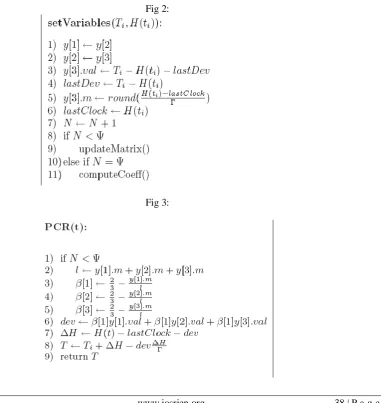
E. A PROBABILISTIC CLOCK READING METHOD This method consists of two procedures:
setVariables (Ti; H( ti )) invoked at each clock synchronization ti, with Ti accurate estimate of ti computed by running a clock synchronization protocol,
PCR(t) that returns an estimate of the current reference time. Figure 2 illustrates setV ariable(), and Figure 3 function PCR(t). The data structures used are the followings: An array y[0..2] of records with two fields: y[j].val
representing the observed value y i-j relative to the time interval [t i-j , t i-j-1] for j = 0, 1, 2, and y[j].m = (t i-j –t i-j-1 / r) representing the times in which the sensor was unable to get its clock synchronized;
An integer matrix M = M(3 x 4) of the coefficients of the linear system.
Fig 2:
F. ANALYSIS ON ENERGYWATCHER AND TRUSTMANAGER
Now that a node N relies on its EnergyWatcher and TrustManager to select an optimal neighbor as its next-hop node, it would like to clarify a few important points on the design of EnergyWatcher and TrustManager. First, the energy cost report is the only information that a node is to passively receive and take as “fact.” It appears that such acceptance of energy cost report could be a pitfall when an attacker or a compromised node forges false report of its energy cost. Note that the main interest of an attacker is to prevent data delivery rather than to trick a data packet into a less efficient route, considering the effort it takes to launch an attack. As far as an attack aiming at preventing data delivery is concerned, TARF well mitigates the effect of this pitfall through the operation of TrustManager. Note that the TrustManager on one node does not take any recommendation from the TrustManager on another node. If an attacker forges false energy report to form a false route, such intention will be defeated by TrustManager: when the TrustManager on one node finds out the many delivery failures from the broadcast messages of the base station, it degrades the trust level of its current next-hop node; when that trust level goes below certain threshold, it causes the node to switch to a more promising next-hop node.
.
Fig. 4. Each node selects a next-hop node based on its neighborhood table, and broadcast its energy cost within its neighborhood. To maintain this neighborhood table, Energy Watcher and TrustManager on the node keep track of related events (on the left) to record the energy cost and the trust level values of its neighbors.
IV. IMPLEMENTATION
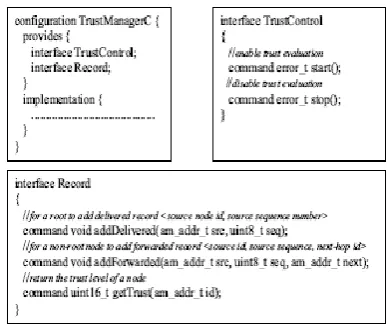
In order to evaluate TARF in a real-world setting, it implemented the TrustManager component on TinyOS 2.x, which can be integrated into the existing routing protocols for WSNs with the least effort. Originally, it had implemented TARF as a self-contained routing protocol on TinyOS 1.x before this second implementation. However, decided to re-design the implementation considering the following factors. First, the first implementation only supports TinyOS 1.x, which was replaced by TinyOS 2.x; the porting procedure from TinyOS 1.x to TinyOS 2.x tends to frustrate the developers. Second, rather than developing a self-contained routing protocol, the second implementation only provides a TrustMan ager component that can be easily incorporated into the existing protocols for routing decisions. The detection of routing loops and the corresponding reaction are excluded from the implementation of TrustManager since many existing protocols, such as Collection Tree Protocol and the link connectivity-based protocol, already provide that feature.
current period also in a record table and compute the trust of its neighbors based on that and the broadcast information.
A root broadcasts two types of delivery failure record: at most three packets of significant undelivered intervals for individual origins and at most two packets of the id’s of the origins without any record in the current period. For each origin, at most three significant undelivered intervals are broadcast. For a non-root node, considering the processing and memory usage overhead, the record table keeps the forwarded message intervals for up to 20 source nodes, with up to 5 non-overlapped intervals for each individual origin. Our later experiments verify that such size limit of the table on a non-root node produces a resilient TARF with moderate overhead. The record table on a node keeps adding entries for new origins until it is full. With our current implementation, a valid trust value is an integer between 0 and 100, and any node is assigned an initial trust value of 50. The weigh parameters are: wupgrade = 0.1, wdegrade = 0.3. The trust table of a non-root node node keeps the trust level for up to 10 neighbors. Considering that an attacker may present multiple fake id’s, the implementation evicts entries with a trust level close to the initial trust of any node. Such eviction policy is to ensure that the trust table remembers those neighbors with high trust and low trust; any other neighbor not in this table is deemed to have the initial trust value of 50.
V. INCORPORATION OF TARF INTO EXISTING PROTOCOLS
the optimal candidate found at Step 1: that candidate has a higher trust level, or the current next-hop neighbor has a too low trust level.
This new implementation integrating TARF requires moderate program storage and memory usage. Here implemented a typical TinyOS data collection application, MultihopOscilloscope, based on this new protocol. The MultihopOscilloscope application, with certain modified sensing parameters for our later evaluation purpose, periodically makes sensing samples and sends out the sensed data to a root via multiple routing hops. Originally, MultihopOscilloscope uses CTP as its routing protocol. Now list the ROM size and RAM size requirement of both implementation of MultihopOscilloscope on non-root Telosb motes in Table 1. The enabling of TARF in MultihopOscilloscope increases the size of ROM by around 1.3KB and the size of memory by around 1.2KB.
VI. RELATED WORK
It is generally hard to protect WSNs from wormhole attacks, sinkhole attacks and Sybil attacks based on identity deception. The countermeasures often requires either tight time synchronization or known geographic information. FBSR, as a feedback-based secure routing protocol for WSNs , uses a statistics-based detection on a base station to discover potentially compromised nodes. But the claim that FBSR is resilient against wormhole and Sybil attacks is never evaluated or examined; the Keyed-OWHC-based authentication used by FBSR also causes considerable overhead. There also exists other work on trust-aware secure routing that is evaluated only through computer simulation, such as.
There are certain existing secure routing solutions for WSNs based on trust and reputation management; however, they rarely address the “identity theft” exploiting the replay of routing information. Two such representative solutions are ATSR and TARP. Neither ATSR nor TARP offers protection against the identity deception through replaying routing information. ATSR is a location-based trust-aware routing solution for largeWSNs. ATSR incorporates a distributed trust model utilizing direct and indirect trust, geographical information as well as authentication to protect the WSNs from packet misforwarding, packet manipulation and acknowledgements spoofing. Another trust-aware routing protocol for WSNs is TARP, which exploits nodes’ past routing behavior and link quality to determine efficient paths.
VII. CONCLUSIONS AND FUTURE WORK
Unlike previous efforts at secure routing for WSNs, TARF effectively protects WSNs from severe attacks through replaying routing information; it requires neither tight time synchronization nor known geographic information. The resilience and scalability of TARF are proved through both extensive simulation and empirical evaluation with large-scale WSNs; the evaluation involves static and mobile settings, hostile network conditions, as well as strong attacks such as wormhole attacks and Sybil attacks.
REFERENCES
[1]. Guoxing Zhan, Weisong Shi, “Design and Implementation of TARF: Trust-Aware Routing Framework for WSNs” IEEE Transactions On Dependable And Secure Computing, vol. 9, no. 2, March/April 2012 [2]. G. Zhan, W. Shi, and J. Deng, “Tarf: A Trust-Aware Routing Framework for Wireless Sensor Networks,”
Proc. Seventh European Conf. Wireless Sensor Networks (EWSN ’10), 2010.
[3]. A. Wood and J. Stankovic, “Denial of Service in Sensor Networks,” Computer, vol. 35, no. 10, pp. 54-62, Oct. 2002.
[4]. I. Krontiris, T. Giannetsos, and T. Dimitriou, “Launching a Sinkhole Attack in Wireless Sensor Networks; The Intruder Side,” Proc. IEEE Int’l Conf. Wireless and Mobile Computing, Networking and Comm. (WIMOB ’08), pp. 526-531, 2008.
[5]. L. Zhang, Q. Wang, and X. Shu, “A Mobile-Agent-Based Middleware for Wireless Sensor Networks Data Fusion,”
[6]. G. Zhan, W. Shi, and J. Deng, “Design, implementation and evaluation of tarf: A trust-aware routing framework for dynamic wsns,” http://mine.cs.wayne.edu/_guoxing/tarf.pdf, Wayne State University, Tech. Rep. MIST-TR-2010-003, Oct. 2010.