Kuldip et al. World Journal of Engineering Research and Technology
PERFORMANCE ANALYSIS OF EDTT AND CONJUNCTIVE RULE
ALGORITHM IN CLOUD COMPUTING ENVIRONMENTS
Kuldip Kaur*1 and Er. Harwinder Kaur2
1
Student. M.Tech CSE Soldier Institute of Engg. & Technology, Near NIT, Jalandhar
(Punjab).
2
Assistant Professor, Department of Computer Sc. & Engg. St. Soldier Institute of Engg. &
Technology, Near NIT, Jalandhar (Punjab).
Article Received on 01/12/2019 Article Revised on 22/12/2019 Article Accepted on 12/01/2020
ABSTRACT
AI is the information revelation process by investigating the huge
volumes of information from different viewpoints and abridging it into
helpful data. Because of the significance of removing information/data
from the enormous information vaults, AI has become a fundamental
segment in different fields of human life. One of the special advantages
- not yet completely acknowledged - of the developing distributed computing pattern is
additionally one of the most disputable parts of the present on-request benefits. The usage of
AI systems through Cloud figuring will enable the clients to recover significant data from for
all intents and purposes coordinated information distribution center that decreases the
expenses of framework and capacity.
INTRODUCTION
Man-made intelligence is the data disclosure process by exploring the tremendous volumes of
data from various perspectives and abbreviating it into supportive information. In view of the
criticalness of expelling data/information from the colossal data vaults, AI has become a
basic fragment in various fields of human life. One of the exceptional favorable
circumstances - not yet totally recognized - of the creating circulated figuring design is
furthermore one of the most debatable pieces of the present on-demand benefits. The
World Journal of Engineering Research and Technology
WJERT
www.wjert.org SJIF Impact Factor: 5.924
*Corresponding Author
Kuldip Kaur
noteworthy information from in every practical sense facilitated data dissemination focus that
diminishes the costs of system and limit.
Cloud Computing is a recently developed technology but its popularity is becoming larger
day by day. You are probably using some of its forms without even realising it. From small
start-ups to global corporations, from government agencies to non-profit organisations, we
are embracing Cloud Computing for all sorts of reasons.
Utilising cloud services has many perks. Whether you are an individual doing online banking
or your organisation is running an application that share photos to millions of mobile users,
Cloud Computing can satisfy all in providing low cost IT resources.
The multi-faceted Cloud Computing
Cloud service providers, such as Amazon Web Services (AWS), offer on-demand cloud
services platform for data storage, applications, and other IT resources via the internet (a.k.a.
the cloud) with a flexible pricing, suitable for even small and medium-sized businesses.
The concept of Cloud Computing is you can access your files anywhere, anytime as long as
you are connected to the internet. Email, mobile banking, online shopping, skyping are just a
few ofthe many applications that Cloud Computing is capable of.
1. Cloud database
Your business is in need of a database but is on a tight budget or lack the adequate expertise
to build one on-site. In such case, cloud database is a better alternative.
Cloud databases give IT personnel a powerful database that just works without the need for a
physical infrastructure. Your cloud service provider will not only support but also take care
of all the maintenance and operation of the database, your sole responsibility is handling your
own data.
2. Test and development
Testing and development testing are crucial steps to ensure your application can run
smoothly, error-free, and usable. In order to successfully test your application, you need a
This is where Cloud Computing comes in to ease your pain of building your own test
environments. There are various ready-made environments, tailored to your specific needs at
your fingertips.
3. Website hosting
Hosting your website on the cloud might be necessary if the current one could not meet up
with the constant growth of your business. If you have built a steady website, you would
know that hosting takes up a large portion of IT resources.
4. Big data analytics
Every data that we encounter today, such as the stack of paperwork, resumes, or digital data like your Facebook messages, is categorised under a big umbrella term called “big data”.
5. File storage and sharing
This is one of the most basic forms of Cloud Computing. Files are stored in the cloud which
makes sharing, retrieving and archiving extremely easy. Google Drive, Dropbox,
Shutterstock are the most popular examples of this service.
6. Backup and disaster recovery
Documents, files and data should be backed up frequently, but not many of us follow through
with the routine. Today, we still manually dispatch data using portable devices and storage
facilities which are bottom line time consuming and not very cost effective.
7. Business applications
There are more than a handful of cloud-based applications that have intuitive interfaces, are
easy to use and tailored for a specific industry.
Machine Learning Techniques
EDTT (Enhanced Decision Tree Technique EDTT): Enhanced Decision Tree Technique, like its name implies, consists of a large number of individual decision trees that operate as
an ensemble. Each individual tree in the random forest spits out a class prediction and the class with the most votes becomes our model‟s prediction. The fundamental concept behind
random forest is a simple but powerful one — the wisdom of crowds. In data science speak,
the reason that the EDTT works so well is: A large number of relatively uncorrelated models
Conjunctive Rule Algorithm: Conjunctive Rule algorithm implements a single conjunctive rule learner that can predict for numeric and nominal class values. Conjunctive rule uses the
relation of logical AND to link stimulus attributes. The rule involves „AND‟ ing the
antecedents together and the consequent (class value) for the classification. In this case, the
consequent is the distribution of the available classes (or mean for a numeric value) in the
dataset. If this rule does not enclose the test instance, then the default class distributions/value
of data that is not enclosed by the rule in the training data is used to predict it. An antecedent
is selected by this learner by calculating the Information Gain of each antecedent and the
generated rule is pruned using Reduced Error Pruning (REP) or simple pre-pruning
depending on the number of antecedents. The weighted mean of the entropies of both the data
covered and not covered by the rule is the Information of one antecedent used for
classification. Single conjunctive rule learner is one of the machine learning algorithms and is
normally known as inductive Learning. The goal of rule induction is generally to induce a set
of rules from data that captures all generalizable knowledge within that data, and at the same
time being as small as possible. Classification in rule-induction classifiers is typically based
on the firing of a rule on a test instance, triggered by matching feature values at the left-hand
side of the rule. Rules can be of various normal forms, and are typically ordered; with ordered
rules, the first rule that fires determines the classification outcome and halts the classification
process. Uncovered test instances are assigned the default class value (or distribution) of the
uncovered training instances. The information gain (nominal class) or variance reduction
(numeric class) of each antecedent is computed, and rules are pruned using reduced-error
pruning.
Dataset Used
Name Class Semester Name of the Institute Reason Cloud Services
JOGINDER PAL BSC 3 St. Soldier Google Drive File storage
SOMNATH BCA 4 CT Inst. Web Hosting Development
RAM PRAKASH B.Tech 5 LKC online money transfers Finance
NAND SINGH MBA 4 St. Soldier ERP Backup
BAL RAJ Pharmacy 6 LKC Facebook whatsapp Big data analyticsÿ
RAMPAT THAKUR B.Tech 2 DAV Office Applications Email Business Applications
RESULT AND DISCUSSION Dataset Used
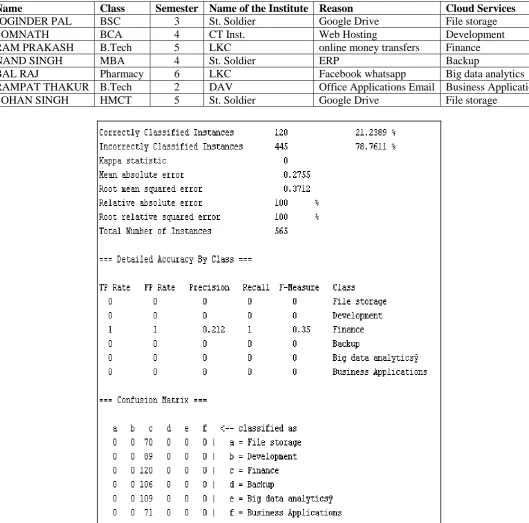
Table 1: Shows the attributes of Cloud dataset with instances.
Name Class Semester Name of the Institute Reason Cloud Services
JOGINDER PAL BSC 3 St. Soldier Google Drive File storage
SOMNATH BCA 4 CT Inst. Web Hosting Development
RAM PRAKASH B.Tech 5 LKC online money transfers Finance
NAND SINGH MBA 4 St. Soldier ERP Backup
BAL RAJ Pharmacy 6 LKC Facebook whatsapp Big data analytics
RAMPAT THAKUR B.Tech 2 DAV Office Applications Email Business Applications
SOHAN SINGH HMCT 5 St. Soldier Google Drive File storage
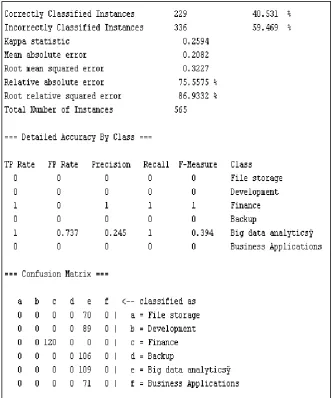
Figure 2: Shows the parameters of EDTT with CCI, ICI, Error Rate and Accuracy on cloud dataset.
CONCLUSION
In this research, using EDTT built a analytical model of cloud environment, using the model
after pruning algorithm the model was optimized by using the model after pruning algorithm
and to evaluate Correctly classified instances, Incorrect classified instances and accuracy
ratio of the classification method, it achieved good the excavation results.
In future course, we will review the various classification algorithms and significance of
Prediction approach in designing of efficient classification algorithms for data mining.
Selection of data and methods for data mining is an important task in this process and needs
REFERENCES
1. Ping Dong, Vice-processor, Junjun Dong, Engineer, Tiansheng Huang, Graduate student, “Application of Data Warehouse Technique in Educational Decision Support System”,
IEEE, 2006.
2. Ning Fang and Jingui Lu, “Work in Progress - A Decision Tree Approach to Predicting
Student Performance in A High-Enrollment, High-Impact, and Core Engineering”, 39th
ASEE/IEEE Frontiers in Education Conference, October 18 - 21, San Antonio, 2009.
3. Pratiyush Guleria, Niveditta Thakur, Manu Sood, “Predicting Student Performance Using Decision Tree Classifiers and Information Gain”, International Conference on Parallel,
Distributed and Grid Computing, IEEE, 2014.
4. Tomas Hasbun, Alexandra Araya and Jorge Villalon,” Extracurricular activities as dropout prediction factors in higher education using decision trees”, IEEE 16th
International Conference on Advanced Learning Technologies, 2016.
5. Hanjun Jin, Tianzhen Wu, “Application of Visual Data Mining in Higher-education Evaluation System”, First International Workshop on Education Technology and
Computer Science, 2009.
6. xiaojian.long, “Application of decision tree in student achievement Evaluation”,
International Conference on Computer Science and Electronics Engineering, 2012.
7. Sajan Mathew and Dr. John T. Abraham, “Application Of Data Mining In Higher
Secondary Directorate Of Kerala”, IEEE, 2016.
8. Ms.Tismy Devasia Ms.Vinushree T P, Mr.Vinayak Hegde, “Prediction of Students
Performance using Educational Data Mining”, International Journal of Innovative
Research in Science, Engineering and Technology, March 2016; 3(3).
9. Fezile Matsebula, “A Big Data Architecture For Learning Analytics In Higher